Introduction
Fungal sinusitis can be divided into four primary categories: (1) acute or fulminant (an invasive type), (2) chronic or indolent (also invasive), (3) fungus ball, and (4) allergic fungal rhinosinusitis. Each subtype has unique clinical, pathological and immunological features. Allergic fungal rhinosinusitis is the most common form of fungal sinusitis. This condition is a non-invasive form of fungal rhinosinusitis, and is seen in 6 to 9 per cent of all rhinosinusitis cases requiring surgery. Allergic fungal rhinosinusitis has been found to be analogous to allergic bronchopulmonary aspergillosis.Reference Schubert1
Millar et al. and Katzenstein et al. first described allergic fungal rhinosinusitis in the early 1980s.Reference Millar, Johnston and Lamb2, Reference Katzenstein, Sale and Greenberger3 Ence et al. suggested that at least 7 per cent of patients requiring surgery for chronic sinusitis had allergic fungal rhinosinusitis.Reference Ence, Gourley and Jorgenson4
Allergic fungal rhinosinusitis has become a subject of increasing interest to otolaryngologists and related specialists. Although certain signs and symptoms may cause the physician to suspect allergic fungal rhinosinusitis, as can radiographic, intra-operative and pathological findings, no standards have been defined for establishing the diagnosis. It is extremely important to recognise allergic fungal rhinosinusitis and to differentiate it from chronic bacterial sinusitis and other forms of fungal sinusitis, because the treatment and prognosis for these conditions vary significantly.Reference Bent and Kuhn5
Up to 10 per cent of patients suffering from chronic rhinosinusitis may have allergic fungal rhinosinusitis, and atopy is very common in these patients. The proposed pathophysiological process involves fungal exposure of the atopic host and consequent development of an (immunoglobulin (Ig) E mediated) inflammatory response, with subsequent tissue oedema, sinus ostia obstruction, sinus stasis, further fungal proliferation, increased antigenic exposure, etc, with the cycle becoming self-perpetuating. Ultimately, the sinuses become filled with the characteristic allergic mucin that is the surgical hallmark of the disease; the development of nasal and/or sinus polyposis may also ensue.Reference Huchton6
In the atopic patient, fungal exposure triggers an immune reaction which leads to the development of allergic fungal rhinosinusitis. In a nonreactive individual, the formation of a fungus ball or ‘sinus mycetoma’ may occur. Allergic fungal rhinosinusitis remains an underdiagnosed condition, due not only to lack of awareness among physicians but also to an inability to demonstrate the presence of fungi in many suspected cases.Reference Ramadan and Quraishi7, Reference McClay, Marple, Kapadia, Biavati, Nussenbaum and Newcomer8
Atopy is characteristic of allergic fungal rhinosinusitis patients: roughly two-thirds report a history of allergic rhinitis, and 90 per cent show an elevated concentration of IgE specific to one or more fungal antigens. In addition, approximately 50 per cent of such patients have asthma.Reference Manning and Holman9
Infections caused by the fungal genera bipolaris, exserohilum and aspergillus show many clinical and pathological similarities, despite the lack of a taxonomic relationship between these genera. All cause disseminated disease in immunocompromised patients, characterised by tissue necrosis and vascular invasion. In addition, all cause central nervous system disease, osteomyelitis and sinusitis and are associated with allergic bronchopulmonary disease. Sinusitis, the most common disease caused by bipolaris and exserohilum species, occurs in otherwise healthy patients with nasal polyposis and allergic rhinitis.Reference Adam, Paquin, Petersen, Saubolle, Rinaldi and Corcoran10
The diagnosis of fungal infections remains a significant problem. The clinical presentation is difficult to interpret, and the findings of non-invasive methods (specifically computed tomography (CT) and X-ray) are non-specific.Reference Richardson and Kokki11 Fungal culture results are available in two to three days at the earliest, and blood and deep tissue sample cultures from infections with focal lesions are frequently negative.Reference Duthie and Denning12, Reference Vincent, Anaissie, Bruining, Demajo, El-Ebiary and Haber13 Direct microscopy and histopathological examinations are rapid, but they do not always allow identification of the infecting agent to the species level.Reference Richardson and Kokki11, Reference Vincent, Anaissie, Bruining, Demajo, El-Ebiary and Haber13 In contrast, the latest generation of monoclonal antibody based, enzyme-linked immunosorbent assays for circulating aspergillus and candida antigens are specific but lack sensitivity.Reference Richardson and Kokki11 Thus, rapid diagnostic methods that are both sensitive and specific are needed. Polymerase chain reaction has been applied to this diagnostic problem in an attempt to meet these requirements.
This study addressed allergic fungal rhinosinusitis patients, and aimed to compare the detection of fungi in sinus aspirate by culture and by polymerase chain reaction assay for universal fungal, aspergillus and bipolaris DNA. The study also aimed to clarify the relationship between the presence of fungi in the nasal sinuses and the type of fungal allergen causing disease. We measured Aspergillus fumigatus specific IgE in sinus aspirate and also calculated the total serum IgE concentration, in an attempt to further clarify this relationship.
Patients and methods
A definite diagnosis of allergic fungal rhinosinusitis requires certain diagnostic criteria to be met.
The most popular and widely accepted such criteria are those proposed in 1994 by Bent and Kuhn.Reference Bent and Kuhn5 These authors described five major criteria for the diagnosis of allergic fungal rhinosinusitis (which have been slightly modified over time), namely: (1) evidence of type I, ‘IgE-mediated’ hypersensitivity, confirmed by history, skin tests or serology; (2) nasal polyposis; (3) characteristic CT findings; (4) allergic mucin without fungal invasion of sinus tissue; and (5) a positive fungal smear.
In 2003, Kuhn and SwainReference Kuhn and Swain14 added several minor criteria to these major criteria, namely: (1) history of asthma; (2) unilateral predominance; (3) radiographic bone erosion; (4) Charcot–Layden crystals; (5) positive fungal culture; and (6) peripheral eosinophilia.
Sixty-eight cases of allergic fungal rhinosinusitis were selected according to both criteria.
In all cases, sinus aspirates were taken and placed on a saline-moistened, nonstick sheet (to avoid mucus absorption). Mucus was then collected in 1.5 ml tubes and transferred directly to the laboratory. There, part of the mucus was used for fungal culture and the rest was frozen at −30°C until used for polymerase chain reaction assay and measurement of A fumigatus specific IgE.
Serum samples were obtained from all patients and frozen for later measurement of total IgE concentration.
All mucus samples were analysed for the presence of characteristic fungal mucin, and Giemsa-stained smears were prepared.
A control group was included, comprising 10 subjects with no history of nasal or paranasal sinus disease, no symptoms of inhalant allergy, and apparently normal mucosa, who had undergone sinus aspiration due to other surgical conditions.
Fungal culture
Sinus aspirates were cultured on Sabouraud dextrose agar, incubated at 25°C for a period ranging from five days to one month, examined regularly and identified systematically.
Bipolaris germ tube test
A drop of distilled water was incubated with a segment of bipolaris fungus, beneath a cover slide on a covered plate to prevent dryness, at room temperature for 8 to 24 hours. A drop of distilled water was sometimes added directly before microscopic examination.
Total serum immunoglobulin E assay
The total serum IgE concentration was measured by enzyme-linked immunosorbent assay (Elitech Diagnostics, France). An enzyme-linked immunosorbent assay reader (Spectra III, Austria) was used for results analysis.
Aspergillus fumigatus specific immunoglobulin E assay
To determine the levels of A fumigatus specific IgE, we used a Ridascreen Spezifisches IgE enzyme-linked immunosorbent assay kit (R-Biopharm AG, Darmstadt, Germany). Fifty microlitres of each of the five standards, the positive and negative controls, and the sinus aspirates were pipetted into wells containing A fumigatus allergen discs (after removal of the buffer from the wells by suction). The plate was incubated at 37°C for 60 minutes. Wells were washed using washing buffer, 50 µl conjugate was added to each well, and the plate was incubated at 37°C for 60 minutes. Washing was repeated. One hundred microlitres of allergy substrate was then added to each well and the plate incubated again at 37°C for 60 minutes. Finally, 50 µl of stop solution was added and absorbance was measured using an enzyme-linked immunosorbent assay reader (Spectra III) at 405/620 nm. A standard curve was constructed and the A fumigatus specific IgE content of the sinus aspirates was calculated.
DNA extraction
A QIAamp DNA mini kit (Qiagen, Valencia, California, USA) was used. Sinus aspirate (usually viscid) was diluted with an equal volume of 0.9 per cent sodium chloride and mixed well by vortexing. Two hundred microlitres of sinus aspirate was placed in a microfuge tube and centrifuged at 7500 rpm for 10 minutes. The supernatant was discarded and 180 µl buffer ATL was added to the pellet. Twenty microlitres of proteinase K was added and mixed by vortex. After incubation at 56°C for 1 hour, 200 µl of AL buffer was added and mixed by pulse-vortexing for 15 seconds, and then incubated at 70°C for 10 minutes. Two hundred microlitres of 100 per cent ethanol was added to the sample and mixed by pulse-vortexing for 15 seconds. The mixture was then applied to the QIAamp spin column and centrifuged at 8000 rpm for 1 minute. Five hundred microlitres of AW1 buffer was added to the QIAamp spin column and centrifuged as before. Five hundred microlitres of AW2 buffer was added to the QIAamp spin column and centrifuged at 14 000 rpm for 3 minutes. Two hundred microlitres of AE buffer was added to the QIAamp spin column and incubated at room temperature for 5 minutes, and then centrifuged at 8000 rpm for 1 minute. The elute was collected in sterile tubes and stored at −20°C until polymerase chain reaction could be performed.
Primers
Three primers were selected.Reference Catten, Murr, Goldstein, Mhatre and Lalwani15 ‘Universal’ fungal primer (internal transcribed spacer) was used to detect any fungal growth in the sinus aspirate samples, as it amplified a highly conserved region of fungal DNA present in most fungi and not shared by human or bacterial DNA. Aspergillus-specific primer was used to detect alkaline protease in both A fumigatus and A flavus. Finally, bipolaris-specific primer was used; this amplified a sequence of the Brn-1 gene found in all bipolaris species. These primer sequences are shown in Table I.
Synthetic oligonucleotide primers used in polymerase chain reaction assays

* 5′ to 3′. ITS = internal transcribed spacer; G = guanine; C = cytosine; A = adenine; T = thymine
Polymerase chain reaction
Polymerase chain reaction was undertaken as described by Catten et al. Reference Catten, Murr, Goldstein, Mhatre and Lalwani15 Two microlitres of DNA, 1 µl of sense primer and 1 µl of antisense primer were added to 46 µl of master mix containing 3 µl MgCl2 solution (1.5 mm), 5 µl 10X polymerase chain reaction buffer (100 mM Tris HCl (pH 8.3) and 500 mM KCl/μl), 1 µl deoxy nucleotide triphosphate (dNTPs) mixture (10 mM/μl) and 0.4 µl Ampli Taq DNA polymerase (5 units/μl), all in 36.6 µl distilled water. A Norwall thermal cycler (Connecticut, USA) was used. The initial denaturing step was performed at 94°C for 3 minutes. Up to 35 polymerase chain reaction cycles were then performed, each consisting of three steps: a denaturing step (15 seconds at 94°C), an annealing step (20 seconds at 55°C) and a primer extension step (30 seconds at 72°C), followed by a final extension step at 72°C for 5 minutes. Aliquots were taken from each tube, mixed with gel loading buffer, run on 1.5 per cent agarose gel in Tris-borate buffer (54 g Tris aminomethane, 27.5 g boric acid and 20 ml 0.5 M ethylene diamine triacetic acid (pH 8.0) per litre, prepared as five-times concentrated stock), and then stained with ethedium bromide (0.5 mg/ml). Photographs were taken under ultraviolet illumination using a digital camera.
Results
Fungal culture
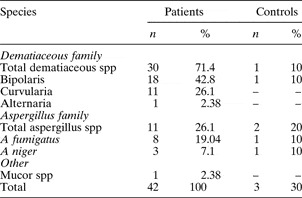
Of the 68 patients with allergic fungal rhinosinusitis, only 42 (61.7 per cent) had positive fungal growth; of the 10 controls, three (30 per cent) had positive growth. Of the 42 allergic fungal rhinosinusitis cases with positive fungal growth, member species of the dematiaceous family were the most commonly isolated (30 cases, 71.4 per cent). Of these genera, bipolaris was the most commonly isolated species type (18 cases), followed by curvularia (11 cases) and alternaria (one case) (Figure 1). Member species of the aspergillus family were isolated from 11 cases (26.1 per cent); A fumigatus was most common (eight cases), followed by A niger (three cases) (Table II).
(a) Macroscopic appearance of bipolaris colonies, which grow rapidly and mature within 7 days. Each colony has a ‘wolly’, olive-green appearance with a raised, greyish periphery and depressed centre; the underside is also olive green to black in colour. (b) Photomicrograph of bipolaris germ tube test after 8 hours, showing germ tubes at one or both ends along the conidial axis. The typical features of bipolaris species are seen, including elongated conidiophore and excess conidia, which are dark and cylindrical with three to five transverse septae. Lactophenol blue stain (×400)

Fungal species cultured in allergic fungal rhinosinusitis patients and controls

– = not detected.
Aspergillus fumigatus specific immunoglobulin E
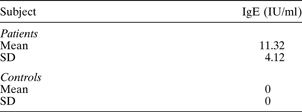
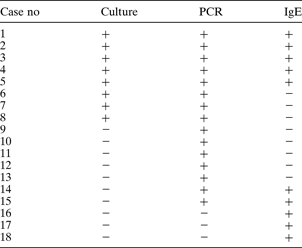
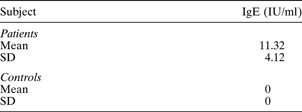
Of the 68 allergic fungal rhinosinusitis patients, 10 were positive for A fumigatus specific IgE (14.7 per cent). The mean A fumigatus specific IgE concentration ± standard deviation (SD) was 11.32 ± 4.12 IU/ml; this was significantly greater than the mean A fumigatus specific IgE concentration of controls, which was 0 IU/ml. Of the 10 patients positive for A fumigatus specific IgE, only seven were positive for A fumigatus DNA on polymerase chain reaction, and only five had a positive fungal culture. Thus, three patients had negative results both for A fumigatus culture and A fumigatus specific polymerase chain reaction, but had positive results for A fumigatus specific IgE assay (Tables III and IV).
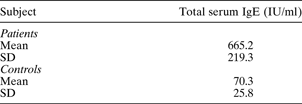
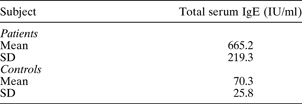
Total serum IgE levels in allergic fungal rhinosinusitis patients and controls
Ig = immunoglobulin; SD = standard deviation
Aspergillus fumigatus specific IgE in patients positive for this IgE* and controls
* n = 10. Ig = immunoglobulin; SD = standard deviation
Polymerase chain reaction
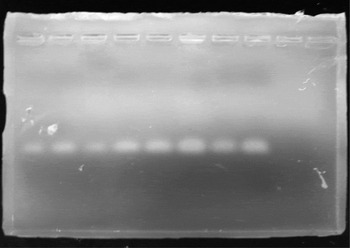
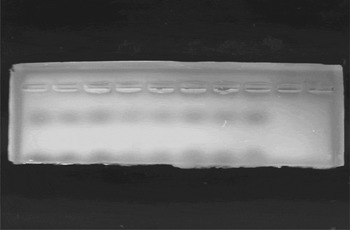
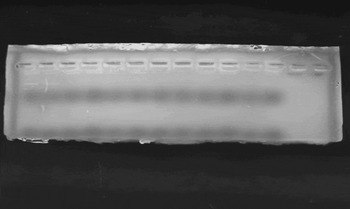
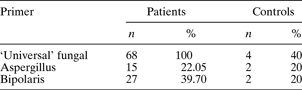
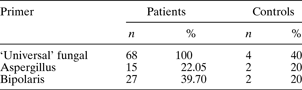
Polymerase chain reaction assay detected universal fungal DNA in all 68 allergic fungal rhinosinusitis patients (100 per cent), and also in four controls (40 per cent). Aspergillus DNA was detected in 15 allergic fungal rhinosinusitis cases (22.05 per cent) and bipolaris DNA in 27 such cases (39.70 per cent) (Tables V and VI, Figures 2 to 4).
Ethedium bromide staining pattern of agarose gel (1.5 per cent) electrophoresis of ‘universal’ fungus DNA. All lanes (one to eight) show 300 bp bands.

Ethedium bromide staining pattern of agarose gel (1.5 per cent) electrophoresis of aspergillus DNA. Lanes one, three, four and six show 747 bp bands.

Ethedium bromide staining pattern of agarose gel (1.5 per cent) electrophoresis of bipolaris DNA. Lanes one, two and eleven show 518 bp bands.

Positive results for polymerase chain reaction assay of fungal DNA using various primers, in allergic fungal rhinosinusitis patients and controls
Results for A fumigatus culture, polymerase chain reaction and specific IgE, for selected patients*
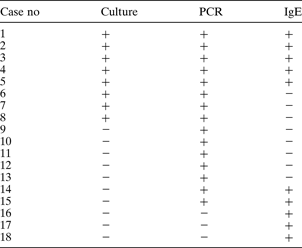
* Eighteen cases positive for at least one investigation type, of 68 cases. No = number; PCR = polymerase chain reaction; Ig = immunoglobulin; += positive; −= negative
Discussion
Allergic fungal rhinosinusitis is believed to represent a hypersensitivity reaction to fungal antigens.Reference Bent and Kuhn5 The pathophysiology of this condition is still not clearly understood. Allergic fungal rhinosinusitis is believed to constitute not a true fungal infection but rather an allergic response to fungal organisms that have colonised the sinus mucosa and secondarily caused a hypersensitivity reaction in the host. Allergic fungal rhinosinusitis patients are usually atopic to multiple aeroallergens.Reference Allphin, Strauss and Abdul-Karim16
Matsuwaki et al. prospectively studied the incidence, pathogenesis and diagnosis of allergic fungal rhinosinusitis in 102 Japanese patients with chronic sinusitis undergoing endoscopic sinus surgery.Reference Matsuwaki, Yanagi, Nakajima and Moriyama17 Four cases (3.9 per cent) were diagnosed with allergic fungal rhinosinusitis based on the criteria of Bent and Kuhn. This incidence is slightly lower than that reported in Europe and the USA. Matsuwaki et al. concluded that IgE antibody mediated type I allergy may be involved in the pathogenesis of allergic fungal rhinosinusitis.
Ponikau et al. found allergic mucin in 97 (96 per cent) of 101 consecutive surgical cases of chronic rhinosinusitis; allergic fungal rhinosinusitis was diagnosed in 94 such cases (93 per cent) based on histological findings and culture results.Reference Ponikau, Sherris, Kern, Homburger, Frigas and Gaffey18 This 93 per cent incidence of allergic fungal rhinosinusitis in patients with chronic rhinosinusitis is considerably higher than figures reported in previous, retrospective reviews.Reference Cody, Neel, Ferreiro and Roberts19, Reference Schubert1
In our patients, the incidence of fungal colonisation of nasal sinuses as determined by positive fungal culture was only 61.7 per cent (42/68 patients), and 30 per cent (three of 10) amongst controls. In these 42 allergic fungal rhinosinusitis cases, member species of the dematiaceous family were the most commonly isolated (30 cases, 71.4 per cent). Within this family, bipolaris species were the most commonly isolated (18 cases), followed by curvularia species (11 cases) and alternaria species (one case). Member species of the aspergillus family were isolated in 11 cases (26.1 per cent). Within this family, A fumigatus was most commonly isolated (eight cases), followed by A niger (three cases).
Because fungi are found nearly everywhere in nature and form airborne spores, it is reasonable to assume that most people have some level of fungal colonisation of their nasal cavities.Reference Catten, Murr, Goldstein, Mhatre and Lalwani15 Ponikau et al. cultured fungi from the nasal samples of all 14 (14 per cent) of their controls with no chronic rhinosinusitis, using an irrigation technique.Reference Ponikau, Sherris, Kern, Homburger, Frigas and Gaffey18 Furthermore, this study demonstrated no difference in fungal spectrum isolated from normal controls versus chronic rhinosinusitis patients, using a sensitive assay. Unfortunately, because 100 per cent of the control group had fungi present, this fact alone was insufficient to implicate fungi as a pathogen in sinusitis. In other words, while the sensitivity of the irrigation assay proved convincingly the ubiquitous nature of fungi, the study failed to show true pathogenesis of the fungi present. We too found that, in our patients, the presence of fungi in the sinuses was not essentially pathogenic.
Our results regarding the incidence and species of fungal growth concur with those of Manning and Holman.Reference Manning and Holman9 In their study, 263 cases of allergic fungal rhinosinusitis were identified, of which 168 yielded positive fungal cultures. Of those 168 positive cultures, 87 per cent were from the dematiaceous genera, including bipolaris, curvularia, exserohilum, alternaria, drechslera, helminthosporium and fusarium species; only 18 per cent were aspergillus species.
Early reports noted primarily aspergillus species in allergic mucin; however, more recently dematiaceous fungi (which include bipolaris, curvularia, alternaria and helminthosporium species) have been identified in most allergic fungal rhinosinusitis cases.Reference Cody, Neel, Ferreiro and Roberts19, Reference Zieske, Kopke and Hamill20, Reference Manning, Scaefer, Close and Vuitch21 This is in agreement with our observation of a high incidence of dematiaceous fungi.
Our results indicated the presence of only a single fungal species per case. In contrast, Braun et al. detected an average of 2.4 different fungal species per patient and 3.1 different species per healthy control.Reference Braun, Stammberger, Buzina, Freudenschuss, Lackner and Beham22
Castelnuovo et al. studied 45 cases (4.3 per cent) out of a total of 1050 patients who had undergone endoscopic surgery for sinus pathology.Reference Castelnuovo, Gera, Di Giulio, Canevari, Benazzo and Emanuelli23 Following the Katzenstein classification, these cases were broken down into non-invasive chronic mycoses or fungus balls (34 cases), allergic mycoses (seven), chronic indolent invasive mycoses (three) and fulminating invasive mycosis (one). The fungal species most often involved was A fumigatus (76.9 per cent). However, these authors isolated fungi from cases of chronic sinusitis rather than allergic fungal rhinosinusitis, which explains the higher incidence of aspergillus species.
Our fungal isolates included a high percentage of bipolaris species. This is in agreement with the findings of Schubert, who diagnosed allergic fungal rhinosinusitis based on surgical histopathology results, with or without a positive surgical sinus fungal culture.Reference Schubert24 In this study, histopathological analysis of extramucosal allergic mucin showed positive staining for scattered fungal hyphae and eosinophilic-lymphocytic sinus mucosal inflammation. Bipolaris spicifera was the most common fungal species cultured.
In Schubert's study, eight patients with culture-positive bipolaris allergic fungal rhinosinusitis were prospectively compared with 10 controls with chronic rhinosinusitis. All eight allergic fungal rhinosinusitis patients had positive skin test reactions to bipolaris antigen. Eight of the 10 controls demonstrated negative results for both skin and serological testing, thus implicating the importance of fungal antigens in the pathophysiology of allergic fungal rhinosinusitis (both in vivo and in vitro).Reference Manning and Holman9
In our study, we measured total serum IgE levels to confirm the diagnosis of allergic fungal rhinosinusitis. The mean total IgE concentration was statistically significantly higher in the allergic fungal rhinosinusitis patients, compared with controls. The value of serum IgE measurement was emphasised by Kuhn and Javer, who stated that the total serum IgE level could be used as a marker to detect disease recurrence.Reference Kuhn and Javer25 In addition, measurement of the total and/or fungus-specific IgE levels can help considerably in differentiating allergic fungal rhinosinusitis from bacterial infection, because levels of neither IgE type appear to rise in response to bacterial infection, even if fungus is cultured. Chang and Fang concluded that fungal identification by culture and by fungus-specific IgE assay can be of assistance, since the latter can be used to follow the patient more accurately.Reference Chang and Fang26
In our study, we measured the concentration of IgE specific for A fumigatus, and found positive results in 10 allergic fungal rhinosinusitis patients (of 68; 14.7 per cent). These patients' mean A fumigatus specific IgE concentration ± SD was 11.32 ± 4.12 IU/ml, compared with a mean of 0 IU/ml in controls, a significant difference. In addition, we found that only seven of these 10 patients were positive for A fumigatus by polymerase chain reaction, and only five had a positive A fumigatus fungal culture. Thus, three patients had negative results for A fumigatus by both culture and polymerase chain reaction but had A fumigatus specific IgE. On the other hand, eight patients positive for A fumigatus by polymerase chain reaction, and three positive by culture, were negative for A fumigatus specific IgE. This indicates that the presence of fungus is not always accompanied by an allergic process.
Our results concur with those of Kuhn and Javer.Reference Kuhn and Javer25 These authors found that fungi were often cultured from the sinuses of control patients without chronic rhinosinusitis. According to these authors, this indicated that the presence of fungus alone may not be important in allergic fungal rhinosinusitis, and may even be a weak criterion for the diagnosis of the disease.
Establishing a causal relationship between fungal culture results and the clinical presentation of allergic fungal rhinosinusitis can be difficult, since many of the fungi isolated are commonly considered to be contaminants. Sometimes, more than one fungal species may be grown. In such patients, clinical correlation is often necessary for accurate interpretation of direct smears and fungal cultures.Reference Tang, Mohan, Sigler, Witterick, Summerbell and Campbell27 On this issue, the results of Tang et al. concur with our own.Reference Tang, Mohan, Sigler, Witterick, Summerbell and Campbell27
Some patients with allergic fungal rhinosinusitis do not have an allergic response to fungi identified in their eosinophilic mucin, but may have elevated levels of IgE specific to other fungi.Reference Collins, Nair and Wormald28 Pant et al. found that only 42 per cent of allergic fungal rhinosinusitis patients were allergic to the fungal species identified in their eosinophilic mucin.Reference Pant, Kette, Smith, Wormald and Macardle29 Ponikau et al. concluded that the mere presence of fungi in the nose and sinuses does not indicate pathogenicity, as fungi were present in the nasal cavities of 100 per cent of healthy controls.Reference Ponikau, Sherris, Kern, Homburger, Frigas and Gaffey18
McCann et al. studied allergic mucin from 17 cases of definitively diagnosed allergic fungal rhinosinusitis, using histological analysis to detect fungal elements.Reference McCann, Cromie, Chandler, Ford and Dolen30 In addition, sera from 18 definitively diagnosed allergic fungal rhinosinusitis patients and six chronic sinusitis patients were tested for IgE specific to A fumigatus and to five recombinant A fumigatus allergens. Ten of the 17 allergic fungal rhinosinusitis cases had hyphae morphologically resembling aspergillus or fusarium species. Seventeen of the 18 allergic fungal rhinosinusitis patients (94 per cent) showed A fumigatus specific IgE, and 12 (67 per cent) were positive to one or more of the recombinant A fumigatus allergens. The allergic fungal rhinosinusitis group had a greater mean A fumigatus specific IgE concentration, compared with the chronic sinusitis group.
Our results are also in accordance with those of Pant et al. Reference Pant, Kette, Smith, Wormald and Macardle29 These authors found that patients with allergic fungal rhinosinusitis, and also those with an allergic fungal rhinosinusitis like condition, had higher concentrations of A fumigatus specific IgE, compared with healthy controls.Reference Pant, Kette, Smith, Wormald and Macardle29
Corradini et al. studied 24 chronic rhinosinusitis patients with a positive result for fungal examination of nasal secretions.Reference Corradini, Del Ninno, Schiavino, Patriarca and Paludetti31 Skin prick tests for seasonal and perennial allergens were positive in five patients (21 per cent), while the same tests for fungi were positive in only four patients (16.6 per cent). Total IgE levels were raised in six patients (25 per cent), but were normal in a further 18 patients. Levels of IgE specific for the tested fungi were within the normal range in all patients, as were eosinophilic cationic protein levels. The nasal provocation test was negative in all patients. The authors concluded that, in patients with allergic fungal rhinosinusitis, the presence of fungi in nasal secretions did not appear to correlate with the patient's allergic status regarding the isolated fungi. Corradini et al. believed it unlikely that IgE played a role in either the aetiology or the pathophysiology of allergic fungal rhinosinusitis. Furthermore, they felt that the diagnostic criteria for allergic fungal sinusitis should probably not include type I hypersensitivity, since no confirmed evidence exists that IgE-mediated type I hypersensitivity is involved in the pathophysiology of allergic fungal rhinosinusitis.
Ponikau et al. found elevated total IgE levels in fewer than 33 per cent of their patients diagnosed as having allergic fungal rhinosinusitis.Reference Ponikau, Sherris, Kern, Homburger, Frigas and Gaffey18 Only 42 per cent of these patients had a detectable type I hypersensitivity on skin testing, and only 30 per cent had an elevated fungis-specific IgE level on radioallergosorbent testing. Local IgE production in the nasal mucosa could explain the fact that 58 per cent of patients showed no evidence of elevated serum levels of fungus-specific IgE.Reference Shatkin, Delsupehe, Thisted and Corey32
There is currently no allergen test available for Bipolaris spicifera.Reference Buzina, Braun, Schimpl and Stammberger33 Courley et al. skin-tested 680 consecutive general allergy patients and found only a 6 per cent incidence of immediate skin reactivity to bipolaris antigen.Reference Courley, Whisman and Martin34
The current methods used to study nasal fungi have several limitations. Firstly, fungal cultures require four to six weeks of evaluation. In a clinical setting, this is often too long to be useful. Secondly, the sensitivity of fungal cultures prepared from swabs is low. Unfortunately, other collection techniques require irrigation and cumbersome transport techniques, making them difficult to perform particularly in an out-patient setting.Reference Ponikau, Sherris, Kern, Homburger, Frigas and Gaffey18 In addition, irrigation techniques cannot differentiate between different areas of the nasal cavity.Reference Catten, Murr, Goldstein, Mhatre and Lalwani15
The use of nasal swabs, particularly those with absorbent tips, results in a low yield of organisms. Cultures are often negative, even when fungal elements are clearly seen on histopathological examination.Reference Schubert1, Reference Cody, Neel, Ferreiro and Roberts19
The viability of fungal elements obtained from fungus balls is poor, and hyphae-rich material obtained during surgery frequently fail to grow in vitro. Furthermore, other limitations may prevent fungus detection and identification, such as the slow growth of many fungi, delayed production, lack of characteristic fruiting bodies or macroconidia, special nutritional requirements, and similarities in macromorphology or micromorphology (or both) at the genus level. Molecular techniques such as dot blot hybridisation and sequence analysis may be useful in determining the fungal species causing fungus balls in the maxillary sinus.Reference Willinger, Obradovic, Selitsch, Beck-Mannagetta, Buzina and Braun35
Polymerase chain reaction is significantly more sensitive than nasal swab culture in detecting the presence of fungi in the nasal mucosa. Demonstration of the presence of a fungal species is insufficient to implicate it as the pathogen in chronic sinusitis.Reference Catten, Murr, Goldstein, Mhatre and Lalwani15
In our study, polymerase chain reaction assay detected fungal DNA in all cases of allergic fungal rhinosinusitis (68 cases; 100 per cent), even though culture methods detected fungi in only 42 cases (61.7 per cent). In addition, polymerase chain reaction detected fungal DNA in four controls (40 per cent); culture methods detected fungi in three controls (30 per cent). Polymerase chain reaction detected aspergillus DNA in 15 of our cases (22.05 per cent) and bipolaris DNA in 27 cases (39.70 per cent). In contrast, culture methods identified aspergillus species in only 11 cases and bipolaris species in 18 cases. These results indicate that the detection of fungal DNA by polymerase chain reaction assay of a nasal aspirate sample was superior to that by fungal culture. Furthermore, these results imply that polymerase chain reaction using specific primers for aspergillus and bipolaris was more sensitive than fungal culture for these species.
Catten et al. reported that polymerase chain reaction assay detected fungal DNA in 42 and 40 per cent of controls and chronic sinusitis patients, respectively, while standard fungal cultures were positive in 7 and 0 per cent, respectively. There was no statistically significant difference in the prevalence of fungi as detected by polymerase chain reaction assay of fungal DNA, comparing controls and chronic sinusitis patients. Of the 18 normal controls positive for fungi as detected using internal transcribed spacer primers, two (4 per cent) were also positive for bipolaris-specific primer and one (2 per cent) was positive for aspergillus-specific primer. There was no evidence of aspergillus or bipolaris DNA in any of the chronic sinusitis patients, using aspergillus- or bipolaris-specific primers.Reference Catten, Murr, Goldstein, Mhatre and Lalwani15 Our results concur with those of Catten et al., although these authors studied chronic sinusitis cases rather than allergic fungal rhinosinusitis cases, explaining their lower fungal DNA detection rate.Reference Catten, Murr, Goldstein, Mhatre and Lalwani15
• Polymerase chain reaction assay is significantly more sensitive than nasal swab cultures in detecting the presence of fungi in nasal aspirate
• Fungal cultures may provide some supportive evidence in the diagnosis and treatment of allergic fungal rhinosinusitis
• Total serum immunoglobulin E levels can be used as useful indicators of allergic fungal rhinosinusitis clinical activity
• The presence of nasal cavity fungus is not always accompanied by an allergic process
Hendolin et al. have reported a procedure based on panfungal polymerase chain reaction and multiplex liquid hybridisation, developed to detect fungi in tissue specimens. The polymerase chain reaction amplified the fungal internal transcribed spacer region (ITS1-5.8S rRNA-ITS2). The procedure was used to examine 12 deep tissue specimens and eight polypous tissue biopsies from the paranasal sinuses. A detection level of 0.1 to 1 pg of purified DNA (two to 20 colony-forming units) was achieved. Of the 20 specimens, the polymerase chain reaction assay was positive for 19 (95 per cent), of which 10 (53 per cent) were hybridisation-positive. In comparison, 12 of the specimens (60 per cent) were positive by direct microscopy, but only seven (35 per cent) showed fungal growth.Reference Hendolin, Paulin, Koukila-Kahkola, Anttila, Malmberg and Richardson36
Our results for fungal DNA are also in agreement with those of Willinger et al. Reference Willinger, Obradovic, Selitsch, Beck-Mannagetta, Buzina and Braun35 These authors obtained fresh surgical specimens from maxillary sinus fungus balls (diagnosed by histopathological analysis). All samples underwent polymerase chain reaction using amplified fungal DNA. Sixteen samples (51.6 per cent) were culture-positive, 25 (80.7 per cent) showed a positive result on hybridisation and 28 (90.3 per cent) were positive by sequencing.
Another study, by Kim et al., also found that polymerase chain reaction based methods were more sensitive than conventional culture methods for fungal detection.Reference Kim, Choi, Cha, Hwang and Chung37
Conclusion
Detection of fungal DNA in nasal aspirate by polymerase chain reaction was superior to fungal cultures as a method of detecting fungal growth. In allergic fungal rhinosinusitis, fungal growth is not always accompanied by an allergic reaction.