INTRODUCTION
Hermit crabs of the family Coenobitidae are represented by 16 species (De Grave et al., Reference De Grave, Pentcheff, Ahyong, Chan, Crandall, Dworschak, Felder, Feldmann, Fransen, Goulding, Lemaitre, Low, Martin, Ng, Schweitzer, Tan, Tshudy and Wetzer2009; McLaughlin et al., Reference McLaughlin, Komai, Lemaitre, Rahayu, Low and Tan2010), including shell-carrying terrestrial hermit crabs (Coenobita spp.) and the monospecific coconut crab Birgus latro. Primarily distributed in the Indo-Pacific, hermit crabs of the genus Coenobita possess an obsolete rostrum, short and semi-chelate fourth pereopods and a soft and spirally twisted pleon (McLaughlin et al., Reference McLaughlin, Rahayu, Komai and Chan2007). Coenobita cavipes Stimpson probably was the only species of this genus reported from India (Ajmal Khan & Natarajan, Reference Ajmal Khan and Natarajan1984). For many years C. violascens has been considered as a synonym of C. cavipes. However, a later report by Nakasone (Reference Nakasone1988) considered C. cavipes (type locality, Japanese island of Okinawa) and C. violascens (type locality, Red Sea) as distinct species, which demands further examination of Indian species of the genus Coenobita. The occurrence of two additional species of hermit crabs, C. brevimanus Dana and C. rugosus H. Milne-Edwards from Thirumullavaram beach, south-west coast of India is reported in this paper.
COENOBITA BREVIMANUS DANA, 1852
Coenobita clypeata: H. Milne-Edwards, Reference Milne-Edwards1837: 239 [not C. clypeatus (Fabricius, 1787)].
Cenobita clypeata var. brevimanus Dana, 1852: 473, pl. 30, figure 4b.
Coenobita clypeata var. brevimanus: Bouvier, 1890: 143.
Coenobita clypeatus: Alcock, 1905: 142, pl. 15, figures 1 & 1a [not Coenobita clypeatus (Fabricius)].
Coenobita hilgendorfi Terao, 1913: 388.
Coenobita clypeata var. Puerto-galera Yap Chiongco, 1938: 213.
Coenobita brevimanus: Rathbun, 1910: 314.
Materials examined
Three specimens, 1 male (total length 55.8 mm), 2 females (total length 45.6–94.0 mm) collected from rock surfaces in the supratidal region of Thirumullavaram beach (08°53′32.8 ″N 076°33′18.5″E), Kollam district, Kerala, India. The reference materials are deposited in the Western Ghats Regional Centre of the Zoological Survey of India at Kozhikode (Calicut), Kerala, India (No. ZSI/WGRC/IR/INV/2324), and in the museum collections of the Department of Aquatic Biology and Fisheries, University of Kerala, India (AR AN1, AR AN 2). The hermits occupied the gastropod shells of Turbo brunneus and Nerita albicilla.
Diagnosis
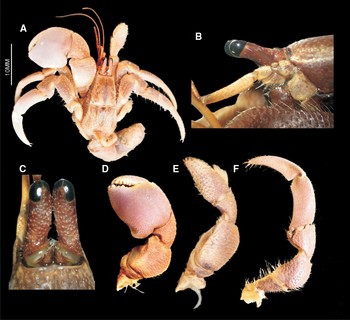
Adults are brownish red, with chelae and ambulatory legs showing violet shades; young specimen light violet in colour (Figure 1A). Eyestalks brown to black. Carapace longer than broader, shield strongly convex and punctuate. Ocular peduncles are sub-cylindrical, extending beyond proximal margins of ultimate antennal peduncular segment (Figure 1B). Ocular acicles serrate (Figure 1C). Antennal acicles not fused to second antennal peduncular segments (Figure 1B). Meri of chelipeds have transverse rumples (Figure 1D); outer surfaces of carpi have irregular tubercles, which develop into spines at inner margin. Left chelae large, with smooth convex outer face (Figure 1D); ‘stridulatory’ ridge absent on outer surface. Outer surface of right chela has numerous tubercles; upper margin of palm with thick brush of long setae (Figure 1E); left chela free of brush of setae on upper margin. Ambulatory legs with punctuate lateral faces; spinulose tubercles cover upper surfaces of carpi, propodi and dactyli; tubercles abundant on dactylus. Propodus and dactylus of second ambulatory leg flattened (Figure 1F). Ventromesial face of left second and third pereopod each with longitudinal ridge of closely-set tubercles. Telson is slightly asymmetrical. Coxa of male separated slightly, flattened and symmetrical; no sexual tube formation.
(A) Coenobita brevimanus Dana—entire; (B) ocular peduncle; (C) ocular acicle; (D) left chela; (E) right chela; (F) third pereopod.

Remarks
Coenobita brevimanus is native to the east coast of Africa and the south-west Pacific Ocean and is reported from East Africa, Philippines, Japan, China and Taiwan (McLaughlin et al., Reference McLaughlin, Rahayu, Komai and Chan2007). The present record of this species from the south-west coast of India shows its extended distribution in the western Indian Ocean, from the east coast of Africa to India.
COENOBITA RUGOSUS H. MILNE-EDWARDS, 1837
Cenobita rugosa H. Milne-Edwards, Reference Milne-Edwards1837: 241.
Caenobita clypeata Owen, 1839: 85, pl. 25, figure 3 [not Coenobita clypeatus (Fabricius, 1787)].
Coenobita rugosus: Ortmann, 1892: 317, pl. 12, figure 22.
Coenobita rugosa: Fize & Serène, 1955: 12, figures 2 & 3A, pl. 1, figures 3, 5 & 7–10.
Coenobita rugosa var. A. granulata: Bouvier, 1890: 146.
Coenobita var. B. compressa Bouvier, 1890: 147 [not Coenobita compressus H. Milne-Edwards, 1837].
Coenobita compressus: De Man, 1902: 742, pl. 24, figure 45 [not Coenobita compressus H. Milne-Edwards, 1837].
Materials examined
Forty-three specimens, 18 males (total length 39.9–114 mm), 25 females (total length 33.9–108.2 mm) collected from rocky intertidal regions of Thirumullavaram beach (08°53′32.8″N 076°33′18.5″E), Kollam district, Kerala, India. The voucher specimens are deposited in the Western Ghats Regional Centre of the Zoological Survey of India at Kozhikode, Kerala, India (No. ZSI/WGRC/IR/INV/2325), and in the museum collections of the Department of Aquatic Biology and Fisheries, University of Kerala, India (AR AN3, AR AN 4). The specimens were collected from the rock surfaces and crevices of the supratidal zone, and were occupying shells of Thias rudolphi, Thias bufo, Babylonia zeylanica, Babylonia spirata, Nerita albicilla, Turbo brunneus, Nerita polita, Euchelus tricarinata and Euchelus asper.
Diagnosis
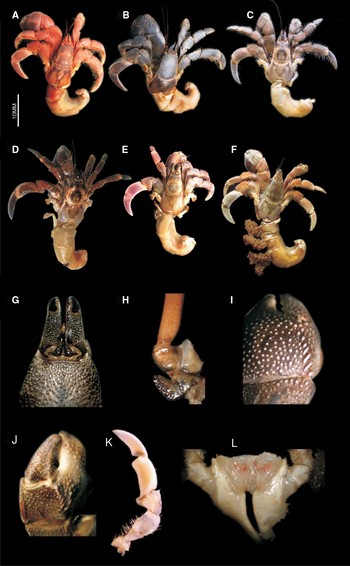
Specimens with various coloration, including reddish-orange, bluish-grey, cream, brown, purple, and a mixture of colours (Figure 2A–F, respectively). There is a dark black patch on the carapace and on the outer face of the left chela of most specimens. The shield is longer than broader, convex and covered with numerous tubercles. Ocular peduncle elongated and slightly compressed laterally, reaching middle of ultimate segment of antennular peduncles. Ocular acicles, narrow and sharply pointed (Figure 2G). Antennal acicles serrate and fused to second peduncular segment (Figure 2H). The brush of setae is present on upper margins of both chelae. Upper outer surface of palm of left chela with pronounced stitch mark or oblique laminar tubercles, usually six or seven in numbers, forming what has been called a stridulatory mechanism (Figure 2I). The middle of the inner surface of the palm of the left chela has a strong longitudinal ridge below brush of setae (Figure 2J). The mesial plane of the merus of the right cheliped is without tuft of setae. Lateral surfaces of propodi and dactyli of left third pereopod flattened and separated from dorsal surface by distinct ridge or crest (Figure 2K); ventromesial surfaces of dactyls of left second and third pereopod with longitudinal ridge of closely-set tubercles. Ambulatory legs covered with long setae. Coxae of male fifth pereopods forming asymmetrically short sexual tubes (Figure 2L).
(A) Coenobita rugosus—reddish orange colour form; (B) C. rugosus—bluish-grey colour form; (C) C. rugosus—cream colour form; (D) C. rugosus—brown colour form; (E) C. rugosus—purple colour form; (F) C. rugosus—mixed colour form; (G) ocular acicle; (H) antennal acicle; (I) left chela with stitch mark; (J) inner surface of left chela; (K) third pereopod; (L) coxae of male fifth pereopods.

Remarks
First described by H. Milne-Edwards in 1837 from the Indian Ocean, this species was reported from east coast of Africa, Philippines, Malaysia, Japan, China, Taiwan, Ryukyu Islands, Polynesia, Australia and Madagascar (Gherardi & McLaughlin, Reference Gherardi and McLaughlin1994; McLaughlin et al., Reference McLaughlin, Rahayu, Komai and Chan2007). Recent investigations by Imafuku & Ikeda (Reference Imafuku and Ikeda1990) found that the oblique laminar tubercles on the palm of left chela in many coenobitids have no role in sound production. The present report from the Indian coastal region shows the extended distribution of Coenobita rugosus and records the continuous distribution of this species from the west coast of Africa to the south-west Pacific Ocean.
ACKNOWLEDGEMENTS
The authors thank the Kerala State Council for Science, Technology and Environment for financial support of the project. We are thankful to Patsy A. Mclaughlin, Shannon Point Marine Center, Western Washington University, USA for her help in confirmation of identification of the specimen and for critically reading the manuscript.