Introduction
Rice is a high-value grain crop grown in the United States; approximately 1 million ha were planted in 2017 (USDA 2019). Louisiana ranked third among the states in rice production, with approximately 162,000 ha planted, which had an estimated value of $312 million in 2017. One of the most important decisions a grower must make to produce a marketable rice crop about a weed management program. During a given year, approximately 9% of total inputs are spent on pesticides, including a chemical weed control program (Salassi et al. Reference Salassi, Deliberto and Hilbun2015).
Weeds interfere with rice production by directly competing with rice for water, nutrients, and sunlight; this competition can result in the direct reduction of total rough rice yield and quality (Smith Reference Smith1968, Reference Smith1983, Reference Smith1984, Reference Smith1988). Indirect impacts of weeds include reduced grain quality and harvesting efficiency, and increased crop lodging, insect and disease pressure, and weed seeds in the soil seedbank.
There are more than 70 different weed species that are prone to infest rice production in the southern United States; of these, barnyardgrass, yellow nutsedge, and rice flatsedge can be some of the most troublesome weeds to control (Smith Reference Smith1968, Reference Smith1974, Reference Smith1988). Smith (Reference Smith1974) reported rough rice yield losses of up to 70% from heavy, season-long barnyardgrass competition. Yellow nutsedge and rice flatsedge can reduce rough rice yields by 59% and 40%, respectively (Keeley Reference Keeley1987).
Since the early 1960s, propanil has been a staple in many rice herbicide programs for its ability to successfully control barnyardgrass. By the early 1990s, greater than 70% of the rice acreage in the United States was receiving one or more applications of propanil or of a propanil-containing herbicide mixture (Crawford and Jordan Reference Crawford and Jordan1995). However, repeated use of propanil effectively selected for resistant biotypes of barnyardgrass.
In 2017, approximately 66% of Louisiana rice acreage used the drill-seeded planting method (Harrell Reference Harrell2017). With more hectares of dry-seeded planting, producers are relying more on PRE, delayed PRE (DPRE), and POST herbicides to suppress weeds until the permanent flood is established (Webster Reference Webster and Saichuk2014).
A residual herbicide is defined as an “herbicide that persists in the soil and injures or kills germinating weed seedlings for a relatively short period of time after application” (Shaner Reference Shaner2014). For producers to suppress weeds before permanent flood establishment, one of the most used tactics is multiple applications of residual herbicides—often referred to as overlaying herbicides. This approach is achieved by applying residual herbicides sequentially to overlay the second application of a residual herbicide before the first herbicide dissipates and weed emergence occurs. This method of proactive weed management helps producers protect rice yields during the most important time relative to weed competition. Smith (Reference Smith1988) reported that most grass species are highly competitive with rice early in the growing season and should be controlled shortly after emergence to protect the rice yield potential.
Overlaying residual herbicides can provide early-season weed management, and this practice also decreases the pressure on POST herbicides to control weeds later in the season. Riar et al. (Reference Riar, Norsworthy, Steckel, Stephenson, Eubank, Bond and Scott2013) suggest that the best management practice to control herbicide-resistant weeds is to start weed free at planting and to follow with sequential applications of residual herbicides that offer multiple modes of action. This practice will ultimately prolong the usefulness of POST grass herbicides, including propanil, quinclorac, cyhalofop, and penoxsulam.
In 2000, clomazone was labeled for use in rice production. Clomazone is a diterpene synthesis–inhibiting (Group 13) herbicide that acts by interfering with chloroplast development and reduces the accumulation of plastid pigments in susceptible weed species (Ferhatoglu and Barrett Reference Ferhatoglu and Barrett2005). Clomazone applied PRE to rice on a coarse-textured soil controlled barnyardgrass 96% to 97%, and barnyardgrass treated with clomazone applied POST, at the one- to two-leaf stage, was controlled 85% (Willingham et al. Reference Willingham, Falkenberg, McCauley and Chandler2008). The first confirmation of clomazone-resistant barnyardgrass occurred in Arkansas in 2008 (Norsworthy et al. Reference Norsworthy, Scott, Bangarwa, Griffith, Wilson and Still2009).
Pendimethalin is a dinitroaniline (Group 3) herbicide that acts by disrupting mitotic cellular division through inhibition of microtubule proteins in susceptible weed species (Vaughn and Lehnen Reference Vaughn and Lehnen1991). Pendimethalin is a soil-applied herbicide that is absorbed by germinating plant roots and coleoptiles, causing highly susceptible weed species either to not emerge or to die soon after emergence. Pendimethalin is active on grass and small-seeded broadleaf weeds infesting rice when applied at different timings (Bond et al. Reference Bond, Walker and Koger2009; Malik et al. Reference Malik, Burgos and Talbert2010; Stauber et al. Reference Stauber, Nastasi, Smith, Baltazar and Talbert1991).
RiceOne® is a prepackaged mixture of pendimethalin plus clomazone in an aqueous capsule suspension formulation (Table 1). Clomazone and pendimethalin have soil residual activity. Clomazone can be applied PRE or POST, and pendimethalin has a DPRE or POST application timing in rice. The objective of this study was to determine whether the prepackaged mixture of clomazone plus pendimethalin should be applied DPRE or POST within a herbicide residual overlay weed management program.
Sources of materials for all products used in the study.

a The formulation for halosulfuron is a water-dispersible granule that contains 75% ai by weight.
b The crop oil concentrate is formulated at 17% nonionic surfactant and 83% unsulfonated oil residue.
Materials and methods
A study was conducted at the Louisiana State University Agricultural Center’s H. Rouse Caffey Rice Research Station near Crowley, LA (30.12°N, 92.22°W) in 2017 and 2018 on a Crowley silt loam of pH 6.4 and 1.4% organic matter. Field preparation consisted of a fall and spring disking followed by two passes in opposite directions with a two-way bed conditioner consisting of rolling baskets and S-tine harrows set at 6-cm depth. A preplant fertilizer consisting of 8-24-24 (N-P2O5-K2O) was applied to the study area at 280 kg ha−1 followed by (fb) an application of 365 kg ha−1 of 46-0-0 fertilizer 24 h before permanent flood establishment. Standard agronomic and pest management practices were used to maximize yield.
The long-grain imidazolinone-resistant rice cultivar ‘CL111’ and long-grain ACCase-resistant rice cultivar ‘PVL01’ were drill seeded at 84 kg ha−1 in 18-cm rows on April 4, 2017, and March 22, 2018, respectively. Plot size was 5.1 × 1.5 m−2. A total of 270 and 150 mm of rainfall was recorded from planting to the establishment of the permanent flood in 2017 and 2018, respectively. An 80-mm flood was then established when the rice achieved the one-tiller growth stage and maintained until 3 weeks before harvest.
The experimental design was a two-factor factorial in a randomized complete block with four replications. Factor A consisted of overlaying residual herbicides of either a prepackaged mixture of clomazone plus pendimethalin applied at 1,020 g ai ha−1 applied DPRE fb POST applications of either clomazone at 335 g ha−1, quinclorac at 420 g ha−1, or saflufenacil at 50 g ha−1, or a PRE application of clomazone at 335 g ha−1, quinclorac at 420 g ha−1, or saflufenacil at 50 g ha−1 fb a POST application of clomazone plus pendimethalin at 1,020 g ha−1 (Table 1). Factor B consisted of POST applications of halosulfuron at 50 g ha−1 or penoxsulam at 40 g ha−1. Preapplications were made immediately after planting, and DPRE applications were applied 7 d after planting and rice seed had begun germination with a 2- to 4-mm exposed radical. A nontreated was added for comparison and removed from analysis due to no control or rice yield.
Herbicide applications were applied with a CO2-pressurized backpack sprayer calibrated to deliver 140 L ha−1 at 190 kPa. The spray boom consisted of five flat-fan 110015 nozzles (Flat Fan AirMix Venturi Nozzle, Greenleaf Technologies, Covington, LA 70434) at 38-cm spacing. A crop oil concentrate at 1% v v−1 was added to all POST treatments.
The research area had a natural population of barnyardgrass, yellow nutsedge, rice flatsedge, and texasweed. The PRE treatments were applied immediately after planting and there were no emerged weeds at application. An activating 40- and 25-mm rainfall was recorded within 3 d of the PRE application in 2017 and 2018, respectively. The DPRE applications were applied 1 wk after planting on barnyardgrass, rice flatsedge, and texasweed, all of which were 1- to 2-cm tall. An activating 20- and 50-mm rainfall was recorded within 3 d of the DPRE applications in 2017 and 2018, respectively. The POST applications were applied to barnyardgrass in the two- to three-leaf stage and 3- to 4-cm tall, with a population density of 40 to 50 plants m−2. Rice flatsedge and yellow nutsedge had three to six leaves, was 5- to 10-cm tall, with populations of 40 to 50 and 20 to 25 plants m−2, respectively. Texasweed had two to three leaves, was 8 to 10 cm tall, with a population density of 10 to 15 plants m−2 at the POST application timing. Rice was 8- to 10-cm in height and was at the two- to three-leaf stage at the POST application timing.
Visual evaluations included crop injury, and barnyardgrass, rice flatsedge, yellow nutsedge, and texasweed control on a scale of 0% to 100%, where 0 = no injury or control and 100 = complete plant death at 14, 28, and 42 days after treatment (DAT). Rice plant height was recorded immediately before harvest by measuring four plants in each plot from the ground to the tip of the extended panicle. The center four rows of each plot were harvested with a Mitsubishi VM3 (Mitsubishi Corp., Tokyo, Japan). Grain moisture was adjusted to 12%.
Data were analyzed as repeated measures and subjected to the mixed procedure in SAS (SAS Institute 2013). Location, years, replication (nested within year), and all interactions including any of these effects were considered random effects. Considering the combination of year as a random effect allows for inferences from treatments over a range of environments (Carmer et al. Reference Carmer, Nyquist and Walker1989; Hager et al. Reference Hager, Was, Bollero and Stroller2003; McKnight et al. Reference McKnight, Webster and Blouin2018). The fixed effects of this model were herbicide treatments and evaluation dates. Normality of treatment effects over all DAT was checked with the SAS UNIVARIATE procedure (SAS 2013). Significant normality problems were not observed. Type III statistics were used to test all possible interactions of these fixed effects. The Tukey honest significant difference test was used to separate means at the 5% probability level (P ≤ 0.05).
Results and discussion
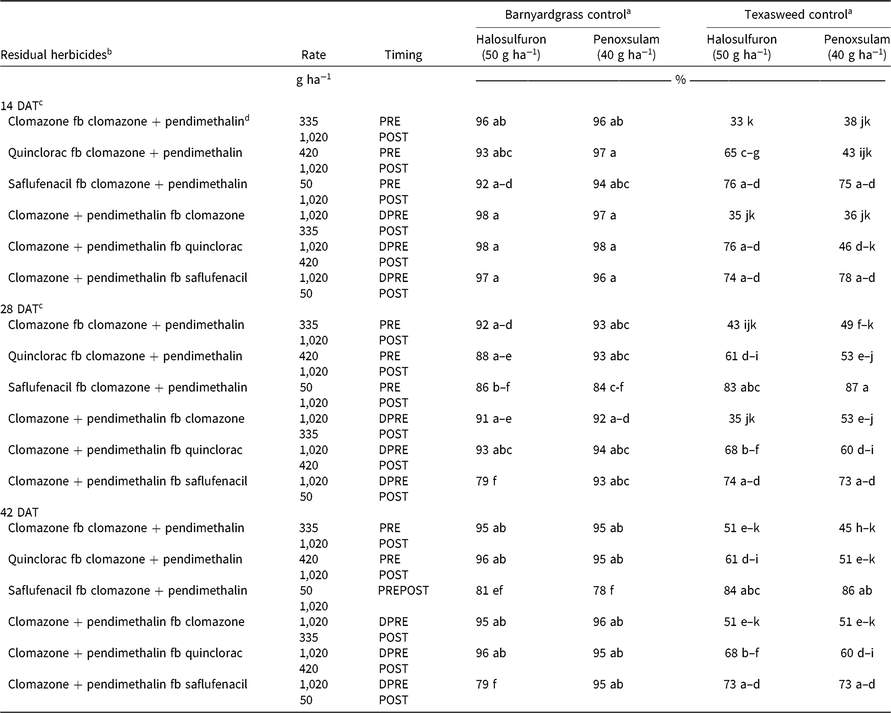
An interaction occurred for the residual herbicide program, by POST herbicides, by evaluation date for the control of barnyardgrass (Table 2). There were no differences in barnyardgrass control at 14 DAT across all treatments, with 92% to 98% control. At 42 DAT, barnyardgrass treated with clomazone plus pendimethalin applied at either timing in combination with clomazone or quinclorac controlled barnyardgrass 95% to 96%. However, barnyardgrass treated with saflufenacil applied PRE, regardless of the POST herbicide program, or saflufenacil applied POST plus halosulfuron resulted in reduced control of this weed: 78% to 81%. This decrease in barnyardgrass control may have been due to applying saflufenacil, which has limited residual activity on grass weeds, as the accompanying residual herbicide (Anonymous 2015).
Barnyardgrass and texasweed control with overlaying residual herbicides coupled with either halosulfuron or penoxsulam applied POST in 2017 and 2018.

a Means within a species followed by the same letter were not statistically different according to Tukey honest significant difference at P = 0.05.
b Respective herbicide residual overlay.
c Evaluation dates for each herbicide residual overlay combination are reported as days after treatment.
d RiceOne® is a prepackaged mixture of clomazone plus pendimethalin marketed by RiceCo LLC, Memphis, TN, www.ricecousa.com.
An interaction occurred for the residual herbicide program, by POST herbicides, by evaluation date for texasweed control (Table 2). At 28 and 42 DAT, texasweed treated with saflufenacil PRE, regardless of POST herbicide program, was controlled 83% and 87%, respectively, and this control was greater than in texasweed treated with clomazone or quinclorac applied PRE (43% to 61%). The results are similar to the effectiveness of saflufenacil control of texasweed compared with clomazone or quinclorac (Webster Reference Webster and Stephenson2017). Texasweed control was 73% to 78% when treated with saflufenacil applied POST, regardless of the addition of halosulfuron or penoxsulam across all rating dates. These data indicate that when applying the prepackaged mixture of clomazone plus pendimethalin mixed with halosulfuron or penoxsulam applied POST, saflufenacil would be a preferred option as a PRE treatment over clomazone or quinclorac when a potential texasweed problem exists. When applying clomazone plus pendimethalin DPRE, producers should consider saflufenacil, rather than clomazone or quinclorac, when overlaying residuals for texasweed control.
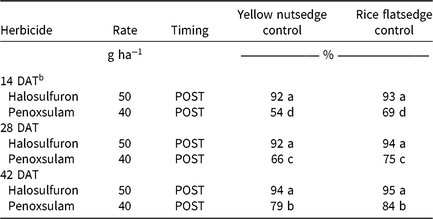
A POST application of halosulfuron or penoxsulam by evaluation dates interaction occurred for yellow nutsedge control; therefore, data were averaged over the residual program (Table 3). Yellow nutsedge treated with halosulfuron was controlled 92%, 92%, and 94% at 14, 28, and 42 DAT, respectively; however, control was reduced when yellow nutsedge was treated penoxsulam, with 54% to 79% control across all rating dates. The results are similar to the observed activity of halosulfuron compared with penoxsulam for yellow nutsedge control (Webster Reference Webster and Stephenson2017).
Yellow nutsedge and rice flatsedge control with POST applications of halosulfuron or penoxsulam averaged over residual herbicide program, 2017 and 2018.a

a Means within a species followed by the same letter were not statistically different according to Tukey honest significant difference at P = 0.05.
b Evaluation dates for each respective herbicide residual overlay combination are in days after treatment.
A POST application of halosulfuron or penoxsulam by evaluation dates interaction occurred for rice flatsedge control; therefore, data were averaged over the residual herbicide program (Table 3). Rice flatsedge treated with halosulfuron was controlled 93%, 94%, and 95% at 14, 28, and 42 DAT, respectively; however, penoxsulam-treated rice flatsedge control decreased to 69% to 84% across all rating dates. Webster (Reference Webster and Stephenson2017) reported similar activity on rice flatsedge with halosulfuron and penoxsulam.
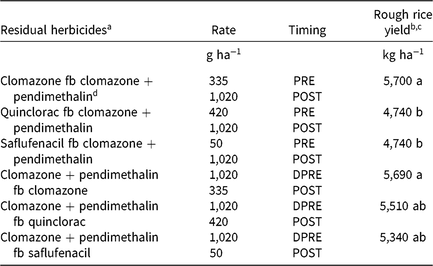
Crop injury was less than 10% across all herbicide treatments and evaluation timings (data not shown). Rice plant height was similar regardless of herbicide program, 104 to 108 cm (data not shown). A main effect of the residual overlay program occurred for rice yield (Table 4). Rough rice yield was 5,690 to 5,700 kg ha−1 (Table 4) when rice was treated in combination with clomazone and clomazone plus pendimethalin, regardless of application timing. These residual combinations controlled barnyardgrass 95% to 96%, which may have contributed to the increase in rough rice yield (Table 2). No difference in rough rice yield was observed when saflufenacil or quinclorac were applied POST after the prepackaged mixture; however, rough rice yield decreased with saflufenacil or quinclorac applied PRE fb the prepackaged mixture, compared with rice treated with the combination of clomazone and the prepackaged mixture, regardless of application timing. To achieve similar results to the residual program of clomazone and clomazone plus pendimethalin, saflufenacil and quinclorac must be applied POST.
Rough rice yield when overlaying residual herbicides in 2017 and 2018, averaged over halosulfuron or penoxsulam applied POST.

a Respective herbicide residual overlay.
b Means within a column followed by the same letter were not statistically different according to Tukey honest significant difference at P = 0.05.
c A nontreated was added for comparison with a rough rice yield of 0 kg ha−1, and yield was removed from analysis.
d RiceOne® is a prepackaged mixture of clomazone plus pendimethalin marketed by RiceCo LLC, Memphis, TN, www.ricecousa.com.
In conclusion, the data from this study suggest that producers should tailor herbicide residual programs to the specific weeds that are present in fields. Overlaying combinations of clomazone or quinclorac with clomazone plus pendimethalin offers the greatest season-long control of barnyardgrass across all evaluations (Table 2). However, texasweed treated with saflufenacil in combination with clomazone plus pendimethalin increased control compared with clomazone applied in combination with clomazone plus pendimethalin. In regard to rough rice yield, these data suggest that a producer should apply clomazone, rather than quinclorac or saflufenacil, PRE in a program with clomazone plus pendimethalin POST due to the activity on barnyardgrass. When applying clomazone plus pendimethalin DPRE, any residual herbicide can be applied POST.
Author ORCIDs
Eric P. Webster http://orcid.org/0000-0003-4809-6876
Acknowledgments
This study was published with the approval of the Director of the Louisiana Agricultural Experiment Station and the Louisiana State University Agricultural Center, Baton Rouge, LA 70803, under manuscript number 2018-306-33410. The authors would like to thank the staff of the Louisiana State University Agricultural Center Rice Research Station. The Louisiana Rice Research Board provided partial funding for this project. No conflicts of interest have been declared.