There is a long tradition of studies assessing the characteristics that differentiate smokers from non-smokers. From this perspective, it is important to identify the personality characteristics of smokers, because these characteristics could be key variables in increased risk for being a smoker and for having difficulties to quit the habit. The majority of studies published to date have focused on models based on a dimensional approach of personality, such as the Big Five Factor Model (e.g., Terracciano, Löckenhoff, Crum, Bienvenu, & Costa, Reference Terracciano, Löckenhoff, Crum, Bienvenu and Costa2008), the Alternative Five Factor Model (e. g., Nieva et al., Reference Nieva, Valero, Bruguera, Andión, Trasovares, Gual and Casas2011), Eysenck’s tripartite taxonomy (e.g., Spielberger & Jacobs, Reference Spielberger and Jacobs1982), Cloninger’s psychobiological model (e.g., Etter, Reference Etter2010), or others (e.g., Kahler et al., Reference Kahler, Daughters, Leventhal, Rogers, Clark, Colby and Buka2009). Classic studies carried out from dimensional models analyzing traits have reported that smokers, compared to non-smokers, obtained higher scores on extraversion, neuroticism and psychoticism (e.g., Spielberg & Jacobs, Reference Spielberger and Jacobs1982). For example, Terracciano and Costa (Reference Terracciano and Costa2004) found that smokers scored significantly higher on impulsivity, one of the neuroticism subscales, as well as in sensation-seeking. In contrast, they scored lower than non-smokers in agreeableness and conscientiousness.
To our knowledge, there are scarcely any studies using Millon’s model on identifying personality patterns involved in cigarette smoking, despite the fact that the assessment instrument derived from this model, the MCMI, is one of the most widely used self-reported questionnaires for studying personality in clinical population (e.g., Ortiz-Tallo, Cardenal, Ferragut, & Cerezo, Reference Ortiz-Tallo, Cardenal, Ferragut and Cerezo2011), especially in addictive disorders (e.g., López & Becoña, Reference López and Becoña2006; Perea, Oña, & Ortiz, Reference Perea, Oña and Ortiz2009).
According to Millon, the personality can be considered as a complex pattern of deep-rooted psychological characteristics, mostly unconscious and difficult to change, that are expressed automatically in almost all areas of the individual’s functioning (Millon, Reference Millon1969; Millon & Davis, Reference Millon and Davis1996). For Millon, normality and abnormality would be understood as two representative points on a continuum, rather than as closed categories. Following the principle of syndromal continuity, then, it is considered that personality disorders emerge from normal personality patterns as the result of complex interactions of biological dispositions, maladaptive learning, and especially, stressful life changes (Millon, Reference Millon2004). Thus, with the final assessment tool derived from this model, a PREV score in the MCMI-III at or above 75 indicates a significant personality trait and a score of 85 or over indicates the presence of a personality disorder.
Although, as we have indicated, the MCMI-III (Millon, Reference Millon1997) is an instrument commonly used in clinical population it has not been widely used in the general population due to difficulties of administration (e.g., duration of the evaluation and the need for specific training of personnel involved in the assessment). Moreover, it is only just beginning to be used in the context of smoking research, given its recent Spanish validation (Cardenal & Sánchez, Reference Cardenal and Sánchez2007).
The profile of smokers assessed in clinical studies is highly specific, since they are those smokers who wish to give up the habit and feel they need help to do so. It has even been postulated that it is common in these types of clinical sample to find Berkson’s bias, whereby the presence of a disorder makes it more likely for a person to seek treatment, thus producing the artefact of an increase in prevalence figures (Pedrero, Puerta, Lagares, & Sáez, Reference Pedrero, Puerta, Lagares and Sáez2003). A study in the general population makes it possible to identify the personality patterns of different groups: 1) non-smokers (a group that includes those who have never smoked and those with more than a year of continuous abstinence, and who cannot be assessed in a clinical context), 2) smokers without nicotine dependence (it is very difficult to find a suitable sample size, since the majority of smokers attending specialized smoking cessation treatment are nicotine dependent), and 3) smokers who are nicotine-dependent (many of these, indeed, do not attend smoking cessation treatment, either because despite wanting to quit, they are highly dependent, which has led them to fail in previous attempts, or because they do not wish to give up smoking, which may be for various reasons, including the presence of certain personality characteristics).
Fernández del Río, Becoña, and López-Durán (Reference Fernández del Río, López and Becoña2010) used the MCMI-II to compare a sample of non-smokers from the general population and a sample of smokers who received a psychological treatment to quit smoking. They found that smokers scored significantly higher than non-smokers on the avoidant, histrionic and passive-aggressive scales (base rate, BR ≥ 75), whilst non-smokers scored higher on the compulsive scale. Therefore, we know that there are different personality patterns among smokers and non-smokers.
In addition, we also need to consider a variable directly related to smoking, that is, nicotine dependence (Zvolensky, Jenkins, Johnson, & Goodwin, Reference Zvolensky, Jenkins, Johnson and Goodwin2011). We know that when people want to stop smoking, smokers with higher nicotine dependence have more difficulty in achieving abstinence (Fiore et al., Reference Fiore, Jaén, Baker, Bailey, Benowitz, Curry and Leitzke2008), and also that nicotine dependence is a variable which can influence the relationship between smoking and personality (Goodwin, Pagura, Spiwak, Lemeshow, & Sareen, Reference Goodwin, Pagura, Spiwak, Lemeshow and Sareen2011). For example, previous studies in clinical population seeking treatment to quit smoking have suggested that smokers with personality disorders (Kalliakou & Joseph, Reference Kalliakou and Joseph2000), tend to exhibit higher rates of cigarette use, which may reflect a greater degree of nicotine addiction (Williams et al., Reference Williams, Wellman, Allan, Taylor, Tonin, Feldon and Rowlins1996). The analysis of traits has yielded significant results. For example, Nieva et al. (Reference Nieva, Valero, Bruguera, Andión, Trasovares, Gual and Casas2011) found that low scores on Sociability (according to the alternative five-factor model of personality, AFFM) predicted high nicotine dependence in males, while no personality traits were found to explain nicotine dependence in women. On the basis of these studies, there emerges a clear need to take into account the presence of nicotine dependence.
Therefore, it is interesting to explore whether there are differences between smokers and non-smokers from the general population as regards personality patterns assessed with an instrument such as the MCMI-III, widely used at the international level, and with which there has been scarcely any research in our country. Moreover, we consider it necessary to analyze personality patterns within the smokers’ sample according to the presence or absence of nicotine dependence, with a view to confirming whether indeed, as found in studies with clinical dependence, it is a key variable in the relation between personality and smoking.
The aim of the present study is to analyze the relation between personality patterns, assessed with the MCMI-III, and tobacco use in general population. On the basis of previous research we hypothesize that: 1) Current smoking would be associated with significantly higher odds of having a PREV ≥ 75 in the avoidant, histrionic, and passive-aggressive personality patterns (Fernández del Río, Becoña et al., Reference Fernández del Río, López and Becoña2010), 2) Non-smoking was associated with significantly higher odds of having a PREV ≥ 75 on the compulsive scale, as concluded by previous studies (Fernández del Río, Becoña et al., Reference Fernández del Río, López and Becoña2010; Zvolensky et al., Reference Zvolensky, Jenkins, Johnson and Goodwin2011), and, 3) Relations between these personality patterns and smoking would be largely accounted for by nicotine dependence, as previous works has suggested (Kalliakou & Joseph, Reference Kalliakou and Joseph2000; Williams et al., Reference Williams, Wellman, Allan, Taylor, Tonin, Feldon and Rowlins1996).
Method
Participants
We used a large sample of adults from 13 cities in Galicia (a region in north-western Spain) stratified by smoker/non-smoker status (about 50% each status), by gender (male, female), and by age (18–35, 36–54, and 55 or over). Smoking status was determined according to whether respondents reported smoking at least one cigarette per day over the previous 30 days (0 = no, 1 = yes). The overall survey response rate was 68.5%. Participants were interviewed face-to-face in their homes between June 2009 and July 2010.
The study was designed to compare a group of adult smokers from the general population of Galicia (a region in Spain) with a group of non-smokers. The objective was to analyze the differences between smokers and non-smokers in personality patterns, so that the groups had to be equivalent (50% smokers versus 50% non-smokers).
The initial sample was made up of 1,096 individuals. Cigarette smoking status was determined by responses to interview questions, asking participants whether they had ever smoked tobacco cigarettes and when they smoked their last cigarette. Eleven participants who were daily smokers in the past year were excluded from the data analysis because they did not meet the “non-smoker” criterion (at least 1 year of abstinence). Four occasional smokers (people who had smoked at least 1 cigarette, but not daily, in the last month) were also excluded from the study. The final sample was made up of 1,081 interviewees (51.4% men, 48.6% women), of whom 48% were smokers (n = 519) and 52% were non-smokers (n = 562). The sample of smokers was over-representative, so as to obtain a sample of about 50% of smokers and 50% of non-smokers. Mean age was 45.16 years (SD = 17.26; range 18 to 91). Regarding educational level, 39.1% had basic education, 42.7% had a medium level, and 18.1% had completed higher education; as far as marital status was concerned, 31.7% had never married, 55.1% were married or living with a partner, and 13.1% were separated/divorced/widowed. All participants gave their informed consent for participation, and the study was authorized by the Bioethics Committee of the Universidad de Santiago de Compostela (Galicia, Spain).
Measures
The interview included a demographic section for the assessment of gender, age, educational level, marital status, and occupation.
Participants responded to questions about past and current smoking behavior (frequency, number of cigarettes smoked per day, age of onset, etc.). Nicotine dependence was assessed through the NDSS-S (Nicotine Dependence Syndrome Scale-Short; Becoña et al., Reference Becoña, Fernández del Río, López, Míguez, Castro, Nogueiras and Vázquez2011), a brief version of the Nicotine Dependence Syndrome Scale (NDSS) by Shiffman, Waters, and Hickcox (Reference Shiffman, Waters and Hickcox2004) (Spanish adaptation by Becoña, López, Fernández del Río, Míguez, & Castro, Reference Fernández del Río, López and Becoña2010; Becoña, Nogueiras, Flórez, Álvarez, & Vázquez, Reference Becoña, López, Fernández del Río, Míguez and Castro2010), which is based on DSM-IV criteria. The NDSS-S is made up of 6 items with Likert-type response format (from 1 “not true” to 5 “completely true”). Total score on the scale ranged from 6 to 30, and the cut-off point for nicotine dependence was 11 or more according to criteria of sensitivity (.87) and specificity (.37) indicated by the authors (see Becoña et al., Reference Becoña, Fernández del Río, López, Míguez, Castro, Nogueiras and Vázquez2011). Reliability (α = .79) of the scale in the Spanish context was good. This measure of nicotine dependence correlates significantly with other indicators, for example, the Fagerström Test for Nicotine Dependence, the carbon monoxide levels in expired air (CO), or the number of cigarettes smoked per day (e.g., Becoña, López et al., Reference Becoña, López, Fernández del Río, Míguez and Castro2010; Okuyemi et al., Reference Okuyemi, Pulvers, Cox, Thomas, Kaur, Mayo and Ahluwalia2007; Shiffman et al., Reference Shiffman, Waters and Hickcox2004). In the present study, on carrying out a bivariate analysis of the data we found that smokers without nicotine dependence, according to the NDSS-S, smoke a significantly smaller mean number of cigarettes per day (M = 10.8, SD = 8.59) than dependent smokers (M = 18.2, SD = 9.08) (t = –9.10; p < .001). Also, the Pearson correlation between number of cigarettes smoked per day and score on the NDSS-S is 0.51 (p < .01). Because of this, and according with previous studies which have revealed a clear relation between score on this scale and other indicators of dependence, such as number of cigarettes smoked per day (e. g., Okuyemi et al., Reference Okuyemi, Pulvers, Cox, Thomas, Kaur, Mayo and Ahluwalia2007), we decided only include the score on the NDSS-S as measure of nicotine dependence.
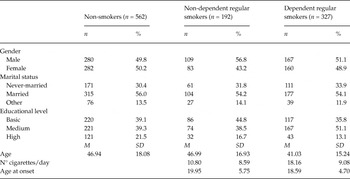
To operationalize smoking status the following categories were created: (a) non-smokers (n = 562), which included never-smokers (participants who reported never having smoked in their lives, n = 416) and ex-smokers (people who had smoked at least 100 cigarettes in their life and had stopped smoking at least in the previous year, n = 146); (b) non-dependent regular smokers: participants who smoked cigarettes every day but were non-nicotine-dependent (NDSS-S < 11; n = 192); and (c) dependent regular smokers: participants who smoked cigarettes every day and were nicotine-dependent (NDSS-S ≥ 11; n = 327). Information on sociodemographic characteristics and smoking behavior in each group is provided in Table 1.
Sociodemographic and smoking behavior characteristics according to smoking status

For the assessment of personality patterns we used the Spanish adaptation (Cardenal & Sánchez, Reference Cardenal and Sánchez2007) of the Millon Clinical Multiaxial Inventory-III (MCMI-III; Millon, Davis, & Millon, Reference Millon, Davis and Millon1997). This is a 175-item self-report questionnaire with true-false response format, providing information, among other aspects, on 14 personality patterns: schizoid, avoidant, depressive, dependent, histrionic, narcissistic, antisocial, aggressive-sadistic, compulsive, negativistic or passive-aggressive, self-destructive, schizotypal, borderline and paranoid, the last three being considered serious personality patterns. According to the MCMI-III, for each pattern a prevalence score (PREV) of 75 or higher indicates the presence of a clinical personality trait, while a PREV score of 85 or higher indicates prominence of that trait (personality disorder). In the present study we took as a cut-off point a score of PREV ≥ 75. The MCMI-III has shown good psychometric properties, with a test-retest reliability of between 0.84 and 0.96 and an internal consistency of over 0.80. Recent studies have indicated that the Spanish validation of the questionnaire has adequate reliability, with most of the scales obtaining alpha coefficients of over 0.75 (Ortiz-Tallo et al., Reference Ortiz-Tallo, Cardenal, Ferragut and Cerezo2011).
Procedure
The study was carried out following a random sampling procedure in participants’ homes according to the following strata: smoking status (smoker vs. non-smoker: 50% vs. 50%), gender (male, female; 50% vs. 50%) and age (18–35, 36–54, 55 or over; 33.3% vs. 33.3% vs. 33.3%). Selection of the streets from which the sample would be recruited in each of the 13 cities was made at random, in accordance with their size. The first inhabited house in each street was selected at random to begin the study. Before interviewing the participants, interviewers had to check that they had been living there for at least six months, inform them of the study’s aim and obtain their informed consent to participate.
All the interviews were carried out face-to-face by psychologists especially trained for that purpose. In all cases participants provided informed consent.
Statistical analysis
The statistics package PASW Statistics 18 was used for the data analysis. In order to compare participants with a PREV ≥ 75 and participants with a PREV < 75 according to smoking status (non-smokers, non-nicotine-dependent smokers, and nicotine-dependent smokers), contingency tables were drawn up and the χ2 statistic with Bonferroni correction was used. This adjustment method for reducing the significance level of comparisons by increasing the Type I error sets the alpha value for the entire set of k comparisons equal to alpha by taking the alpha value for each comparison equal to α/k. In the present study, statistical significance level was set at p < .05 (p < .025 when k = 2, for example in the case of the variable “gender”; or p < .016 when k = 3, for example in the case of the variable “age”, with Bonferroni correction). In those cases in which χ2 was significant, Cramer’s V coefficients were calculated for estimating the effect size. Odds ratios (OR) were calculated between the different personality patterns and the three smoking levels (non-smoker, smoker without nicotine dependence, smoker with nicotine dependence), after adjusting for demographic variables (gender, age, marital status and educational level).
Results
Of the 1,081 participants, 52% were non-smokers (n = 562) and 48% (n = 519) were current daily smokers [30.3% (n = 327) were nicotine-dependent]. As regards personality patterns, 81.4% of the total sample obtained a PREV ≥ 75 in any personality pattern of the MCMI-III (n = 880). The most prevalent personality pattern in the population was compulsive (34.5%, n = 373), followed by the narcissistic (21.5%, n = 232), histrionic (20.3%, n = 219), paranoid (6.2%, n = 67), depressive (3.5%, n = 38), dependent (3.1%, n = 34), negativistic (3.1%, n = 34), antisocial (2.7%, n = 29), schizoid (1.9%, n = 20), avoidant (1.8%, n = 19), aggressive (1.5%, n = 16), borderline (0.3% , n= 3), and schizotypal (0.2%, n = 2) patterns. No participant obtained a PREV ≥75 in the self-destructive scale.
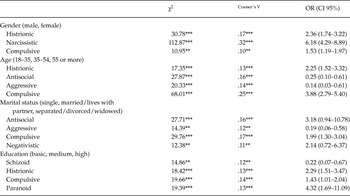
Bivariate analyses (see Table 2) indicated differences by gender in three personality patterns: histrionic, narcissistic and compulsive. All patterns were significantly more prevalent in women than in men, except for narcissistic disorder.
Differences on personality scales of the MCMI-III according to demographic variables

* p < .025 o p < .016 (Bonferroni correction); **p < .01; ***p < .001.
With regard to age, the results indicate that this variable has a significant influence in four personality patterns: histrionic, antisocial, aggressive-sadistic and compulsive. The first three patterns were more prevalent in the youngest group, whilst for the compulsive pattern the prevalence decreased significantly as participants’ age increased.
Significant differences were also found according to participants’ educational level in the cases of the schizoid, paranoid, compulsive and histrionic personality patterns. The first three were more prevalent in participants with basic education, whilst the histrionic pattern was more common in the higher education group.
Finally, regarding marital status, three personality patterns were found to be significantly more prevalent in those who were single: antisocial, aggressive and negativistic. In contrast, the compulsive pattern was found to be more prevalent in participants who were married or living with a partner than in the remaining groups.
Relation between cigarette smoking and personality patterns
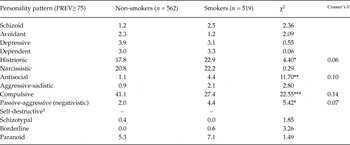
In the group of smokers, 46.5% obtained a PREV ≥ 75 in any personality pattern, and in the group of non-smokers the percentage was 53.5%. Differences between smokers and non-smokers on the 14 personality patterns are shown separately in Table 3.
Differences on personality patterns of the MCMI-III according to smoking status (smokers vs. non-smoker) (%)

* p < .025 (Bonferroni correction); **p < .01; ***p < .001.
1 No participant obtained a PREV ≥ 75 in this personality pattern.
Regarding the relationship between smoking and the different personality patterns, we found that non-nicotine-dependent smokers were at greater risk of presenting a PREV ≥ 75 in the paranoid personality pattern (see Table 4). No significant relationship was found between smoking without nicotine dependence and the rest of the personality patterns.
Significant differences in personality patterns of the MCMI-III (PREV ≥ 75), cigarette smoking and nicotine dependence (ND)

ORa = Adjusted for age, gender, marital status, and educational level; 95% CI, 95% confidence intervals.
* p < .05; **p < .01; ***p < .001.
b The reference category is “Non-smoker”.
Focusing on tobacco use with nicotine dependence, we found a significant relationship with the histrionic and antisocial personality patterns. No significant relationship was found between smoking with nicotine dependence and the rest of the personality patterns (see Table 4).
Finally, for both nicotine-dependent and non-nicotine-dependent smokers we found a significant negative relationship with the compulsive personality pattern. Smokers have a lower risk of presenting a PREV ≥ 75 in this pattern than non-smokers (see Table 4).
Discussion
The aim of the present study was to examine the relationship between smoking and personality patterns in a large sample of adults, both smokers and non-smokers, from the general population. We hypothesized that there would be a significant association between several personality patterns (avoidant, histrionic, passive-aggressive, and compulsive) and smoking status (smoker/non-smoker). Also, it was thought that these relations would be especially stronger when the existence of nicotine dependence was taken into account. The overall results showed that the hypotheses are partially confirmed.
First, smokers had a higher probability of obtaining a PREV ≥ 75 in the histrionic and antisocial personality patterns, especially when nicotine dependence is present. It would seem clear, therefore, that nicotine dependence is strongly and consistently associated with these personality patterns, as occurs in other addictive disorders (e.g., Trull, Jahng, Tomko, Wood, & Sher, Reference Trull, Jahng, Tomko, Wood and Sher2010). Millon and Davis (Reference Millon and Davis1996) characterized these personality patterns by marked impulsivity, dramaticism, excessive emotivity and emotional instability. Impulsivity, a multidimensional construct that includes aspects of reward-seeking (novelty or sensation-seeking) and disinhibition (constraint or unplanned behavior), has emerged as strongly associated with smoking (Flory & Manuck, Reference Flory and Manuck2009).
More specifically, with regard to the histrionic pattern, it has been found that certain characteristics of extraversion (the most common trait in this pattern), such as sensation-seeking, are significantly more common in smokers than in non-smokers (e.g., Terracciano & Costa, Reference Terracciano and Costa2004). The histrionic personality pattern also correlates negatively with the agreeableness trait, which is less prevalent in the smoker population than in non-smokers (Samuel & Widiger, Reference Samuel and Widiger2008). According to Millon and Davis (Reference Millon and Davis1996), this personality pattern is characterized by the need for continuous reinforcement by others, making it more likely that people with this pattern would start smoking during adolescence due to peer pressure (Sussman, Pokhrel, Ashmore, & Brown, Reference Sussman, Pokhrel, Ashmore and Brown2007) and develop nicotine dependence shortly after the first few times of cigarette use, as indicated in recent studies (Collins et al., Reference Collins, Epstein, Parzynski, Zimmerman, Moolchan and Heishman2010).
The same occurs in the case of antisocial personality pattern: there is a relationship between smoking and the presence of this pattern – especially where there is also nicotine dependence. This pattern is one of the most common in addictive behaviors, and for which the results are most conclusive, both for smoking (Zvolensky et al., Reference Zvolensky, Jenkins, Johnson and Goodwin2011) and for other substances (e.g., Preuss et al., Reference Preuss, Johann, Fehr, Koller, Wodarz, Hesselbrock and Soyka2009). Previous studies have reported angry hostility, rebelliousness and low agreeableness, the principal traits of the antisocial pattern according to Millon’s model of personality (Millon, Reference Millon2004), as significantly related to current smoking (Terracciano et al., Reference Terracciano, Löckenhoff, Crum, Bienvenu and Costa2008). Research has also indicated that individuals with an antisocial pattern could seek stimulation through substance use. Their inability to perceive negative consequences of their behavior (e.g., smoking), confrontation with authority and social norms, their low conscientiousness, and their tendency for impulsive actions could support the substance use (Ekleberry, Reference Ekleberry2009).
We should add, in support of the hypothesis initially proposed, that despite the absence of a significant relationship between the passive-aggressive pattern and smoking in our study, this personality pattern included in the Millon’s model shares characteristics with the antisocial pattern (Pedrero-Pérez, López-Durán, & Olivar-Arroyo, Reference Pedrero-Pérez, López-Durán and Olivar-Arroyo2006), which does indeed show a significant relationship with smoking in our study. We found no relationship between the avoidant pattern and smoking, and this was in contradiction to the hypothesis. However, more research is needed for clarifying this relationship found in previous studies, at least in smokers from clinical population in Spain (e. g., Fernández del Río, Becoña et al., Reference Fernández del Río, López and Becoña2010).
As hypothesized, we found a negative association between the compulsive personality pattern and smoking, regardless of whether or not there is nicotine dependence. Previous studies have also found this personality pattern to be common among non-smokers from the general population (Fernández del Río et al., Reference Fernández del Río, López and Becoña2010). It is a personality pattern characterized by high conscientiousness, perfectionism, excessive control, and inflexibility (Millon, Reference Millon2004). These traits could have influenced the onset and maintenance of smoking behavior, either through decreasing the likelihood of experimental cigarette use or increasing the probability of quitting for fear of adverse health effects (Morissette, Tull, Gulliver, Kamholz, & Zimering, Reference Morissette, Tull, Gulliver, Kamholz and Zimering2007). Several studies have found current smokers to score lower on conscientiousness than never-smokers and former smokers (Terracciano et al., Reference Terracciano, Löckenhoff, Crum, Bienvenu and Costa2008). Moreover, research has shown that the compulsive personality pattern is not frequent in other substance users (López & Becoña, Reference López and Becoña2006). However, longitudinal studies are necessary for clarifying the relationship between the compulsive personality pattern and non-smoking.
The data obtained suggest, surprisingly, a direct relationship between cigarette smoking without nicotine dependence and the paranoid personality pattern. This finding may suggest that paranoid individuals are more likely to experiment with cigarettes but are less likely to become nicotine-dependent, perhaps because they need less stimulation than people with other personality patterns, such as antisocial or histrionic (Ekleberry, Reference Ekleberry2009; Samuel & Widiger, Reference Samuel and Widiger2008). The fact of not finding a significant association in nicotine dependent smokers is in contrast to the results of previous studies (Zvolensky et al., Reference Zvolensky, Jenkins, Johnson and Goodwin2011), so that further studies are necessary to clarify the relationship between this personality pattern and smoking according to Millon’s model.
In conclusion, the present study indicates that personality patterns differ between smokers and non-smokers, and that nicotine dependence accounts for the relationship in several cases. Specifically, antisocial emerged as the personality pattern most strongly related to smoking in the case of nicotine-dependent smokers. The only personality pattern that was less frequent in both non-dependent smokers and dependent smokers was the compulsive pattern.
This study has some limitations that must be taken into account on interpreting the results. First of all, given that it is a cross-sectional study, we cannot determine the direction of the relations between smoking, nicotine dependence and personality patterns. Longitudinal studies are necessary to clarify this relationship. Secondly, the personality patterns were assessed with a self-report measure: the MCMI-III. Although this is an assessment instrument widely used in addiction research, scarcely any studies in Spain (e.g., Ortiz-Tallo et al., Reference Ortiz-Tallo, Cardenal, Ferragut and Cerezo2011) have used this version of the questionnaire rather than its predecessor (MCMI-II). Finally, smoking status was also self-reported, with no complementary biological validation (such as carbon monoxide level in expired air), and this could have influenced the quality of the information obtained.
In spite of the limitations, this is the first paper to provide an examination of cigarette smoking and personality patterns according to Millon’s personality model in a large sample of participants, smokers and non-smokers, from the general population. Millon’s personality model is undoubtedly a theoretical model that continues to evolve as complementary perspectives are incorporated, such as the developmental perspective on personality, and has been scarcely applied to research with smokers. We believe, therefore, that studies such as ours, which analyze personality patterns in smokers and non-smokers from the general population, permit us to better identify populations which cannot be reached by clinical studies, which only include people who are actually seeking treatment – with all the limitations that implies (Berkson’s bias, generalization of results only to clinical population, etc.).
Furthermore, the present study has a series of implications for smoking cessation interventions. First of all, it confirms the need to take into account nicotine dependence (e.g., Goodwin et al., Reference Goodwin, Pagura, Spiwak, Lemeshow and Sareen2011; Zvolensky et al., Reference Zvolensky, Jenkins, Johnson and Goodwin2011) in smoking cessation treatments for smokers. It does not seem appropriate to treat smokers as a homogeneous group, since, as we have seen, those who are also nicotine-dependent tend to present personality characteristics that could have influenced both the acquisition of the habit and its maintenance, and which may increase the risk of lapse and relapse after cessation. Bearing this in mind, clinical interventions could significantly increase their efficacy by considering the characteristics typical of each personality pattern in the therapeutic process (Fernández del Río, López, & Becoña, Reference Fernández del Río, Becoña and López-Durán2011) – that is, by implementing treatment guided by personality type. Although the prevalence of smoking has decreased in recent years, it is necessary to explore in more depth the characteristics of individuals who continue smoking and who have problems to quit smoking or attend smoking cessation treatment programs. Previous studies have found that smokers with certain personality patterns (avoidant, self-destructive, negativistic, schizotypal, borderline, dependent, etc.) obtained poorer results at the end of smoking cessation treatment, that is, lower abstinence rates and more relapses (Fernández del Río, López, & Becoña, Reference Fernández del Río, López and Becoña2010; Perea et al., Reference Perea, Oña and Ortiz2009). Thus, we need to consider the possibility that these smokers require more intensive clinical intervention in future, probably because of their higher risk of being nicotine-dependent, with a view to at least trying to increase abstinence rates (Fernández del Río, Becoña, & López-Durán, Reference Fernández del Río, Becoña and López-Durán2011).