INTRODUCTION
The shore, or green, crab, Carcinus maenas (Linnaeus, 1758) (Decapoda: Portunidae), is a common and important component of the marine and estuarine faunas of rocky intertidal to shallow subtidal habitats and occurs naturally throughout Europe, Iceland and parts of the Mediterranean (Crothers, Reference Crothers1967). Carcinus maenas has an omnivorous diet (Ropes, Reference Ropes1968; Lee & Seed, Reference Lee and Seed1992), but is a voracious predator of a wide variety of molluscan, barnacle and worm prey (Seed, Reference Seed1969). It is known to play an important role in regulating community structure but is also a pest of commercial shell fisheries (Dare & Edwards, Reference Dare and Edwards1976; Jensen & Jensen, Reference Jensen and Jensen1985). It has been introduced outside its normal north-eastern Atlantic range into every state of Australia except the Northern Territory (Thresher et al., Reference Thresher, Proctor, Ruiz, Gurney, MacKinnon, Walton, Rodriguez and Bax2003; Poore, Reference Poore2004), South Africa (Griffiths et al., Reference Griffiths, Hockey, van Erkom-Schurink and Le-Roux1992) and the eastern and western coasts of the USA (Ropes, Reference Ropes1968; Cohen et al., Reference Cohen, Carlton and Fountain1995). Carlton & Cohen (Reference Carlton and Cohen2003) have tracked the course of this invasion across the globe. As an aggressive alien it has had an important impact on native species and commercial operations, for example of mussel and oyster culture systems (Ropes, Reference Ropes1968; Jamieson et al., Reference Jamieson, Grosholz, Armstrong and Elner1998; Thresher et al., Reference Thresher, Proctor, Ruiz, Gurney, MacKinnon, Walton, Rodriguez and Bax2003; Hoagland & Jin, Reference Hoagland and Jin2006).
Not surprisingly, given its ecological importance, the feeding biology of adult Carcinus maenas has been well studied. Indeed C. maenas has been the subject of classic predator/prey relationship studies (e.g. Elner & Hughes, Reference Elner and Hughes1978). The adult crab is heterochelous with a master or ‘crusher’ chela (typically the right), and a smaller ‘cutter’ chela (usually the left) (Abby-Kailo & Warner, Reference Abby-Kalio and Warner1989; Lee & Seed, Reference Lee and Seed1992; Smith, Reference Smith2004). During feeding activities, the chelae of Carcinus maenas can be used in a variety of different ways to access prey, from outright crushing to ‘perimeter’ attacks such as edge chipping or peeling and ‘boring’ of the ligament area of bivalves (Elner, Reference Elner1978; Moody & Steneck, Reference Moody and Steneck1993). The latter authors observed that most (75%) attempts at accessing prey involved crushing and that ‘perimeter’ attacks were only utilized once these had failed. Laboratory experiments suggest that C. maenas feeds optimally (Elner & Hughes, Reference Elner and Hughes1978) and that experience increases efficiency (Cunningham & Hughes, Reference Cunningham and Hughes1984; Hughes & O'Brien, Reference Hughes and O'Brien2001).
In contrast, the feeding behaviour of juvenile Carcinus maenas individuals has been neglected. Even reports purporting to investigate ‘juveniles’, for example, Rangeley & Thomas (Reference Rangeley and Thomas1987) and Mascaró & Seed (Reference Mascaró and Seed2001), have used individuals of carapace width >15 mm, and, therefore, at the larger end of the ‘juvenile’ spectrum. There is thus little known about the feeding behaviour of smaller individuals of C. maenas. Notwithstanding, Jensen & Jensen (Reference Jensen and Jensen1985) believe that small C. maenas (carapace width <10 mm) in the Danish Wadden Sea are a major predator of juvenile Cerastoderma edule Linnaeus, 1758 and have a considerable impact on the population dynamics of their prey, preventing the local development of cockle beds.
Field observations by one of us (B.M.) have revealed that small (~20 mm shell length) individuals of the intertidal mussel Mytilus galloprovincialis Lamarck, 1819 on the south-east coast of England were frequently discovered dead and showed an unusual but distinctive marginal damage to the shell valves. Although shore birds, such as oystercatchers, are known to feed on mussels (Norton-Griffiths, Reference Norton-Griffiths1967), the damage they inflict is not similar and, in any case, we have not observed any feeding on the part of the shore studied herein. Having excluded the only other two mussel predators on the shore as the agents of such damage, that is, Nucella lapillus (Linnaeus, 1758) and Ocenebra erinaceus (Lamarck, 1822) (B.M., unpublished data), the coexisting crab Carcinus maenas was examined experimentally. In this paper we describe the behaviour of 22 small individuals (carapace widths <22 mm) of C. maenas, as well as three larger individuals (carapace widths >39 mm) feeding on small M. galloprovincialis (shell lengths ranging from 5–25 mm) in aquaria.
MATERIALS AND METHODS
Feeding experiments
Twenty-two individuals of Carcinus maenas ranging in carapace widths from 5.6 –21.6 mm (juveniles) plus three others with carapace widths ranging from 39.9–42.5 mm (adults) were collected from beneath stones at the western side of the entrance to the River Arun at Littlehampton, West Sussex, United Kingdom. All individuals were inter-moults and showed no appendage damage. No selection was made between males and females because of the difficulty of determining sex accurately at these small sizes and because, as noted by Mascaró & Seed (Reference Mascaró and Seed2001), sexual differences in chelal sizes, which are well defined in adults, are not apparent in juveniles. From 27 September to 29 October 2006, that is, a total of 33 d, each crab was held in individually identified 500 ml pots with high sides (to lessen the chances of escape) containing local, ambient seawater. The carapace width of each crab was measured and recorded. The temperature and salinity of the seawater in the experimental pots (which were located outside and thus experienced natural fluctuations on the shore in terms of temperature) were recorded every morning at ~1000 h. Over the experimental period, the two parameters ranged from 10–26°C and 35–38‰, respectively. The pre-aerated water in the pots was changed twice daily, at the times of re-immersion, in accordance with local semidiurnal tides. Each pot also contained five individuals of similarly locally collected Mytilus galloprovincialis. The five individuals were of ~5.0, 10.0, 15.0, 20.0 and 25.0 (± 2.0) mm shell length and chosen following microscopic examination to determine that none showed any sign of shell damage.
Twice a day at least, usually when the water in the pots was changed, but also at other times, the crabs were inspected to determine if any either were or had been attacking the mussels. Where attacks were observed, special attention was made to their manner. In all cases of successful attacks, the carapace width of the crab and the shell length of the prey were recorded. Each successfully predated Mytilus galloprovincialis was kept in a numbered tube and replaced immediately in the relevant experimental pot with a similar-sized conspecific.
At the end of the 33-day experiment, all the crabs were sacrificed by freezing followed by preservation in 80% alcohol. All the mussels, including those successfully predated and the survivors, were examined under a dissecting microscope to determine if any showed any sign of shell damage and all were re-measured along their greatest shell lengths and again stored in 80% alcohol. From these latter observations, we were able to determine the sizes of Mytilus galloprovincialis individuals attacked unsuccessfully by the experimental Carcinus maenas and the attack method utilized (if any).
Chelal mechanics and mandibular structures
Chelae characteristics of the experimental Carcinus maenas were investigated by collecting data from ten of the experimental individuals (<45 mm carapace width). Morphological features of the chelae were noted and measurements made of the right ‘master’ chela following Warner & Jones (Reference Warner, Chapman, Hawkey and Waring1976), Vermeij (Reference Vermeij1977) and Brown et al. (Reference Brown, Cassuto and Loos1979). These measurements included carapace width, claw height (dorso-ventral dimension), claw thickness (antero-posterior dimension), dactylus length from its tip to the pivot point (a), the distance between the insertion point of the closer apodeme and the pivot point (b) and the maximum opening distance allowed between the tips of the dactylus and fixed finger. ‘Ideal’ mechanical advantage was calculated as the ratio of b:a (Brown et al., Reference Brown, Cassuto and Loos1979). Measurements were made either with Vernier calipers or from electron micrographs.
The mandibles were dissected from four of the preserved, experimental Carcinus maenas that were seen to have fed on individuals of Mytilus galloprovincialis by marginal chipping. These were immersed in 3.5% NaOCl for 10 minutes in order to remove adherent tissues. After washing in distilled water and cleaning in a sonic bath, the mandibles were mounted on stubs for examination by scanning electron microscopy (SEM) using a Jeol 820 at the University of Cambridge.
Damage characteristics
Shells of Mytilus galloprovincialis individuals that had been attacked and successfully eaten by known Carcinus maenas in the experiments were examined using SEM (see above). Additionally, one field-collected shell of M. galloprovincialis (among many and to be reported upon elsewhere) that showed similar signs of damage was also examined in this way for comparison.
RESULTS
Feeding experiments
Fourteen of the 25 experimental Carcinus maenas individuals attacked the provided Mytilus galloprovincialis. A total of 38 attacks was recorded by these 14 individuals and, of these, 17 were successful resulting in the death and consumption of the mussel. Nearly all the feeding events were observed directly (none occurred at night).
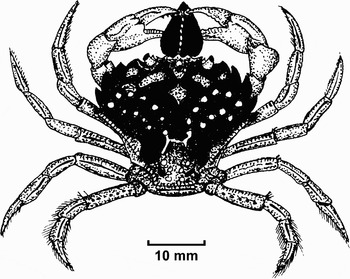
All attacks recorded in the experiment were by the same method of posterior marginal ‘chipping’ or ‘nibbling’. The chelae were only involved with manipulation and final entry. The crab held the mussel vertically with its chelae and with the posterior margin of the shell towards its mouth (Figure 1). The mussel was progressively rotated and nibbled, using the mandibles, around the posterior margin of the shell. Once sufficient space had been created, the finger of a chela was inserted between the valves sometimes resulting in the shell cracking and more angular shards being removed. Once the mussel flesh was contacted, consumption was rapid. In two cases it was possible to time the attacks. The two cases involved mussels of 7.0 and 8.8 mm shell lengths and these were attacked and consumed in ~120 and 30 minutes, respectively, by a single C. maenas individual of 16.6 mm carapace width.
Carcinus maenas. A dorsal view of a juvenile attempting to gain access to a small Mytilus galloprovincialis by mandibular chipping. The mussel is being held with the umbones pointing downwards, with the crab's mandibles chipping around the posterior margins of the shell.

Of the 21 unsuccessful feeding attempts, some were actually observed to end in failure whereas the other failed attacks, although not observed, were inferred by the presence of posterior chipping marks following examination of the mussel shells at the termination of the experiment.
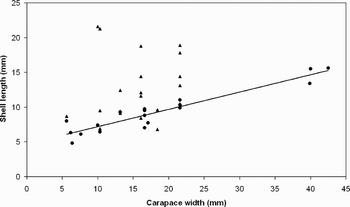
Figure 2 shows a plot of the shell lengths of attacked Mytilus galloprovincialis against the size of Carcinus maenas responsible, differentiating between successful and unsuccessful attacks. For the 17 successful attacks there is a positive correlation (r2 = 0.89; P < 0.01) between the two parameters indicating that larger crabs were able to select and subjugate larger mussels. In contrast, the data for failures are more scattered with no correlation (r2 = 0.02). Interestingly, however, the majority of the ‘unsuccessful’ data points lie above the line defined by the ‘successful’ dataset, indicating that these failed attacks resulted from individuals attacking mussels which were too large. None of the mussels of shell lengths >25 mm was attacked either successfully or unsuccessfully.
The relationship between predator (Carcinus maenas) carapace width (mm) and prey (Mytilus galloprovincialis) shell length (mm) for the 17 successful attacks (⨐). Also shown are the data points (▴) for failed attack events. The regression line (y = 0.249x + 4.607; r2 = 0.89) applies only to the successful attacks. Note that most unsuccessful attacks lie above that line.

Master chela and mandible characteristics
Small individuals of Carcinus maenas are heterochelous, with (in all individuals examined) the right being the ‘master’ chela. Differences between the two chelae in juveniles are, however, less marked than in adult individuals as noted by Mascaró & Seed (Reference Mascaró and Seed2001). In this study, strong positive correlations between crab carapace width and both dactylus length and manus height were identified. Measurements of ‘ideal’ mechanical advantage gave a mean value of 0.27 (N = 10) but no correlation between the measured values and carapace width was obtained.
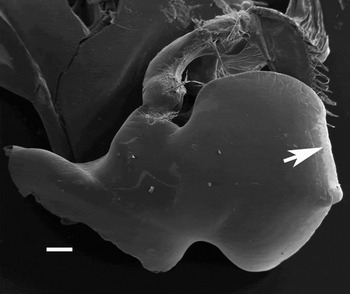
Our observations on the mandibles of Carcinus maenas agree with those of Borradaile (Reference Borradaile1922). The paired structures are strongly calcified with a cutting edge (Figure 3). Some of the individuals examined appeared to have a ‘wear facet’ on the leading edge of each mandible.
Scanning electron micrograph of the right mandible of a Carcinus maenas juvenile (carapace width = 18 mm) that is known to have successfully attacked a Mytilus galloprovincialis individual during this study. Note the ‘wear facet’ on the closing edge (arrowed). Scale bar = 200 µm.

Damage characteristics
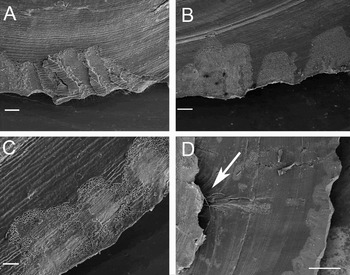
Figure 4A, B, & C show the damage inflicted to the posterior margin of four shell valves of Mytilus galloprovincialis by Carcinus maenas under experimental conditions and using mandibular chipping. The pattern observed is characteristic, each ‘rasping’ stroke of the mandible being evidenced as a trough (~300 µm wide) starting approximately 800 µm inside the valve margins and moving towards them, becoming deeper towards the end of the stroke. When the stroke is terminated, it leaves an arcuate chip. The form of this damage is entirely different from the angular shards left by the chelae of molluscivorous crabs, for example, Thalamita danae Stimpson, 1858 feeding on the mussels Perna viridis (Linnaeus, 1758) and Brachidontes variabilis (Krauss, 1848) in Hong Kong (Seed, Reference Seed and Morton1990, plate 1), although more angular damage was produced once the chela had been inserted. The damage inflicted upon the shells of the experimental M. galloprovincialis (Figure 4A–C) matched closely that observed in damaged dead shells collected from the field and interestingly on repair scars (that is, unsuccessful accessing attempts) identified on older parts of the valves (Figure 4D, arrow) and succeeded by repaired shell material that was successfully chipped subsequently.
(A, B, & C) Scanning electron micrographs of the marginal damage inflicted on the shells of Mytilus galloprovincialis by the experimental Carcinus maenas individuals using mandibular chipping. Also shown (D) is a field collected empty M. galloprovincialis shell showing similar (successful) marginal damage but also (unsuccessful) damage to the shell at an earlier time that was subsequently repaired (arrow). Scale bars: A = 200 µm; B = 100 µm; C = 100 µm; and D = 500 µm.

DISCUSSION
Adult Carcinus maenas are well known for their ability to attack hard-shelled organisms with their chelae using a range of strategies that are related to the size of their prey (Elner, Reference Elner1978). Portunids have narrower more elongate and, thus, weaker claws than those of many other crabs (Seed & Hughes, Reference Seed and Hughes1995). Warner et al. (Reference Warner, Chapman, Hawkey and Waring1982) reported upon a relatively low mechanical advantage for adult C. maenas and this has been related to the absence of a dactylar peg that enhances mechanical advantage in other molluscivorous crabs such as Calappa ocellata (Holthuis, 1958) (Seed & Hughes, Reference Seed and Hughes1995, figure 1A). As a consequence, C. maenas is not as well adapted to durophagous predation as are some other crabs. It is, however, important to note that although the chelae are responsible for processing hard-shelled prey they are also known to have a significant role in competition for mates and intraspecific aggression (Lee & Seed, Reference Lee and Seed1992) and these structures must, hence, be subject to a broad range of selection pressures.
Moody & Steneck (Reference Moody and Steneck1993) refer to Carcinus maenas as quick and dexterous, with a broad repertoire of feeding methods including (in large individuals) shell crushing and (in smaller individuals because of their relatively weak chelae) perimeter cracking. Warner et al. (Reference Warner, Chapman, Hawkey and Waring1982) reported a mean mechanical advantage (MA) of 0.36 for C. maenas individuals with carapace widths ranging from 50–70 mm whereas Daldorfia horrida (Linnaeus, 1758) (Parthenopidae) has a MA of 0.55 (Seed & Hughes, Reference Seed and Hughes1995). Indeed, these authors put C. maenas close to the bottom of a list (their table 1) of 22 molluscivorous crabs in terms of chelal MA. The MA values reported upon for C. maenas by Warner et al. (1992) and Seed & Hughes (Reference Seed and Hughes1995), that is, 0.36 (mean) and 0.32 (males), respectively, are higher than those recorded here for small individuals (0.27) and females (0.28) (Seed & Hughes, Reference Seed and Hughes1995, table 1). Although we have not attempted to measure other important parameters such as sarcomere length, we suggest that the smaller crabs herein reported upon were capable of delivering less force than their larger conspecifics. Furthermore, the maximum gape of the chelae is also narrow, thereby preventing any crushing technique, as practised by larger individuals (Elner, Reference Elner1978). We have shown in this study that smaller juvenile C. maenas employ an additional technique to access their mussel prey, that is, using the mandibles rather than the chelae. We suggest that as the individuals increase in size the mechanical advantage and the gape of the chelae increases also so that in larger individuals of C. maenas they become more efficient as weapons and thus the more familiar method of attacking shelled prey.
In a review of feeding techniques used by decapod crustaceans, Lau (Reference Lau1987) reported that using mandibles to chip the valve edges of molluscan prey was known for a number of taxa. Specifically however, it is clear that this strategy is employed either by non-chelate taxa such as the palinurid red rock lobster Jasus edwardsii (Hutton, 1875) (Randall, Reference Randall1964; Griffiths & Siederer, Reference Griffiths and Seiderer1980; James & Tong, Reference James and Tong1998) or the juveniles of chelate taxa, for example, Homarus americanus Milne-Edwards, 1837 (Elner & Jamieson, Reference Elner and Jamieson1979). It seems, from the results of this study, that small Carcinus maenas are behaving in a similar fashion, that is, as if they were functionally non-chelate in terms of accessing hard-shelled prey.
Vermeij (Reference Vermeij1977) reviewed the evidence for the ability of crustaceans to crush their prey over geological time and suggested that specialization has occurred since the Cretaceous (as evidenced by claw size). We ask if it is possible that, prior to this time, access to hard-shelled prey by mandibular chipping was the principal attack method adopted for weak clawed progenitors but that, in terms of both ontogeny and phylogeny, the more direct method of chelal crushing has been adopted subsequently?