Introduction
Spices are important part of human diet and have also been used for centuries in traditional medicine (Rivlin, Reference RIVLIN2001). In addition to boosting flavour, herbs and spices are known for their preservative (Neilsen and Rios, Reference NEILSEN and RIOS2000), antioxidative (Shobana and Naidu, Reference SHOBANA and NAIDU2000), and antimicrobial (Salie et al., Reference SALIE, EAGLES and LENG1996) roles. Spice herbs have been used therapeutically to improve health and wellbeing of animals, mostly for prophylactic purposes and to improve growth and feed utilisation (Simon, Reference SIMON2005). Garlic is one of the most traditionally used plants as a medicinal herb (Puvača et al., Reference PUVAČA, STANAĆEV, GLAMOČIĆ, LEVIĆ, PERIĆ, STANAĆEV and MILIĆ2013). Garlic preparations and extracts have been shown to exhibit: antiatherosclerotic, antimicrobial, hypolipidemic, antithrombotic, antihypertensive, antidiabetic effects (Mansoub, Reference MANSOUB2011). There are several active components in garlic, the main being allicin (Rahmatnejad and Roshanfekr, Reference RAHMATNEJAD and ROSHANFEKR2009). Allicin has been shown to reduce low density lipoprotein, triglyceride and cholesterol in serum (Alder and Holub, Reference ALDER and HOLUB1997) and tissues (Stanaćev et al., Reference STANAĆEV, GLAMOČIĆ, MILOŠEVIĆ, PERIĆ, PUVAČA, STANAĆEV, MILIĆ and PLAVŠA2012), and it has been used in treatments against cardiovascular diseases (Tanamai et al., Reference TANAMAI, VEERAMANOMAI and INDRAKOSAS2004). Garlic has been found to decrease serum and liver cholesterol levels (Qureshi et al., Reference QURESHI, ABUIRMEILEH, DIN, ELSON and BURGER1983; Crespo and Steve-Garcia, Reference CRESPO and STEVE-GARCIA2003), inhibit bacterial growth (Griffin et al., Reference GRIFFIN, GUO, WINDSOR and BUTTERWITH1992) and reduce oxidative stress (Ide and Lau Reference IDE and LAU2001). Specifically in broilers, feeding garlic as a supplement improved broiler growth and feed conversion ratio (FCR), and decreased mortality rate (Stanaćev et al., Reference STANAĆEV, MILOŠEVIĆ, PLAVŠA, BJEDOV, STANAĆEV, PUVAČA, ARAPOVIĆ and 2010). Heightened broilers performance and carcass traits may also be achieved, and including levels of 1.5, 3 and 4.5% caused a significant reduction in poultry serum, liver and skin cholesterol content (Konjufca et al., 1997; Lin et al., Reference LIN, WANG, LEE, CHIN, LIU, CHIU and KUNG2000; Demir et al., Reference DEMIR, SARICA, OZCAN and SUICMEZ2003; Puvača et al., Reference PUVAČA, KOSTADINOVIĆ, LJUBOJEVIĆ, LUKAČ, LEVIĆ, POPOVIĆ, NOVAKOV, VIDOVIĆ and ĐURAGIĆ2015).
Garlic (Allium sativum L.) and its bioactive compounds
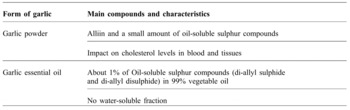
The chemistry of the Allium species is dominated by many sulphur-containing compounds. However, a variety of components, including non-sulphur compounds, work synergistically to provide various health benefits (Amagase et al., Reference AMAGASE, PETESCH, MATSUURA, KASUGA and ITAKURA2001). The major sulphur-containing compounds in intact garlic are γ-L-glutamyl-S-allyl-L-cysteines and S-allyl-L-cysteine sulphoxides (alliin). Both are abundant as sulphur compounds, and alliin is the primary odourless, sulphur-containing amino acid, a precursor of allicin (Stoll and Seebeck, Reference STOLL and SEEBECK1948), methiin, (+)-S-(trans-1-propenyl)-L-cysteine sulphoxide, and cycloalliin (Fujiwara et al., Reference FUJIWARA, YISHIMURA, TSUNO and MURAKAMI1958). These sulphoxides, with the exception of cyloalliin, are converted into thiosulphinates (such as allicin) through enzyme reactions when raw garlic is cut or crushed. Thus, no thiosulphinates are present in intact garlic. Gamma-L-glutamyl-S-allyl-L-cysteine is converted into S-allylcysteine through an enzymatic transformation with g-glutamyltranspeptidase when garlic is extracted in an aqueous solution (Matsuura, Reference MATSUURA1997). S-allylcysteine produced from γ-L-glutamyl-S-allyl-L-cysteine, a sulphur amino acid detected in the blood that has been verified as both biologically active and bioavailable. The disruption of garlic bulbs causes the formation of thiosulphinates such as allicin through the enzymatic reaction of sulphur-substituted cysteine sulphoxides, compartmentalised in the cytoplasma with alliinase in the vacuole, via sulphur-substituted sulphenic acids as a highly reactive intermediate. Allicin readily reacts with amino acids and proteins, creating an -SH group. Allicin binds to protein and fatty acids in the plasma membrane, and are bound before absorption and so cannot circulate in the blood (Freeman and Kodera, Reference FREEMAN and KODERA1995). Typical volatiles that have been identified in crushed garlic and its extract include diallylsulphide, diallyldisulphide, diallyl trisulphide, methylallyl disulphide, methylallyl trisulphide, 2-vinyl-4H-1, 3-dithiin, 3-vinyl-4H-1, 2-dithiin, and (E,Z)-ajoenes. Over 20 sulphides have been identified in steam-distilled garlic oil and oil-soluble extract of garlic, and many of them, especially sulphides having an allyl group, are responsible for the characteristic smell and taste after ingesting garlic. The major sulphides in garlic oil include diallylsulphide (57%), allylmethyl (37%), and dimethyl (6%) monosulphides to hexasulphides, in some cases, together with a small amount of allyl 1-propenyl and methyl 1-propenyl di-, tri-, and tetrasulphides (Lawson et al., Reference LAWSON, WANG and HUGHES1991). Diallyl trisulphide is the most abundant in fresh garlic oil, but commercially available garlic oil products have an increased amount of diallyldisulphide (Jirovetz et al., Reference JIROVETZ, JAGER, KOCH and REMBERG1992). Table 1 shows main components and characteristics of some garlic products.
Components and characteristics of garlic powder and garlic essential oil (Freeman and Kodera, Reference FREEMAN and KODERA1995; Amagase, Reference AMAGASE2006)/

Influence of dietary garlic addition on broiler performance
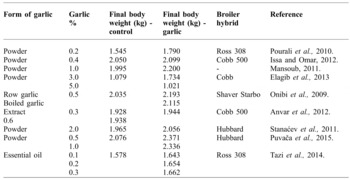
Many researchers over the years have investigated the varying influences of different garlic forms in poultry nutrition on productive performance, meat quality and lipid profile of blood and tissues. Stanaćev et al. (Reference STANAĆEV, GLAMOČIĆ, MILOŠEVIĆ, PUVAČA, STANAĆEV and PLAVŠA2011) examined the effects of garlic and Cu separately and in combination on production parameters and carcass quality in broiler chicks. Treatment groups were given 2% of garlic powder or 2% of garlic powder plus 100 ppm copper and compared against diets supplemented with 100 ppm of copper alone. Addition of garlic powder in the diet led to a significant (P<0.05) increase of body mass of chicken (2.056 kg) compared to the control group (1.965 kg) and better feed utilisation in groups treated with garlic powder. Elagib et al. (Reference ELAGIB, EL-AMIN, ELAMIN and MALIK2013) performed a study to investigate the effects of incorporating garlic powder (in replacement of growth promoters) in broiler feed on growth performance, carcass characteristics and blood profiles. The groups were assigned to three diets containing 0, 3 or 5% garlic powder. Diets containing 3% garlic significantly (P<0.05) increased feed intake (3.051 kg), body weight gain (1.689 kg), body weight (1.734 kg) and achieved the best efficiency of feed utilisation (1.81). Dressing percentage showed no significant difference (P>0.05) between the various treatments. The highest breast weight was attained by feeding 3% of garlic (0.250 kg) and the lowest weight was attained when feeding 5% level (0.155 kg). No significant differences (P>0.05) both bursa and thymus weights between the different treatments were found. Spleen weight decreased significantly (P<0.05) in birds fed diets containing 3% (1.01 g) and 5% (1.23 g) garlic powder compared to the unsupplemented control (1.67 g). Garlic supplementation had no significant effect (P>0.05) on total red blood cells, packed cells volume, total white blood cells or neutrophiles, eosinophiles, monocytes and lymphocytes.
Elagib et al. (Reference ELAGIB, EL-AMIN, ELAMIN and MALIK2013) concluded that the incorporation of garlic at 3% in feed significantly enhanced growth and performance of broiler chicks without any side effects as detected by blood profiling. Fayed et al. (Reference FAYED, RAZEK and OUF2012) assessed the effect of garlic supplementation in broiler dies as a replacement for antibiotics on performance, dressing percentage, weight of heart, gizzard and liver, and meat quality. They found that chickens supplemented with 0.5 kg/t garlic achieved the highest live weight and best FCR. Significant differences between treatments for dressing percentages were recorded, but not for giblet weight Meat cholesterol concentration in thigh and breast muscles decreased significantly (P<0.05) with garlic supplementation, in agreement with the findings of Shahriari et al. (Reference SHAHRIARI, FATEMI TABATABAIE, JAFARI and GHORBANZADEH2009), Stanaćev et al. (Reference STANAĆEV, GLAMOČIĆ, MILOŠEVIĆ, PERIĆ, PUVAČA, STANAĆEV, MILIĆ and PLAVŠA2012) and Puvača et al. (Reference PUVAČA, STANAĆEV, BEUKOVIĆ, LJUBOJEVIĆ, KOSTADINOVIĆ and DŽINIĆ2014). Research by Onibi et al. (Reference ONIBI, ADEBISI, FAJEMISIN and ADETUNJI2009) assessed dietary garlic supplementation on the performance and meat quality of Shaver Starbo broiler chickens. Diets contained supplementary raw or boiled garlic powder at levels of 0.5 and 5 g/kg diet. Weight gain, feed intake and FCR of the birds were not significantly (P>0.05) influenced by dietary treatments, but chickens fed the garlic supplemented diets had marginally higher weight gain in a dose dependent manner compared to the control. Carcass and organ characteristics of the chickens were not significantly affected (P>0.05), but abdominal fat percentages were numerically lower in birds fed supplementary garlic (Onibi et al., Reference ONIBI, ADEBISI, FAJEMISIN and ADETUNJI2009). The same researchers found that oxidation susceptibility of meat, measured as concentration of malondialdehyde, decreased with increasing levels of garlic (P<0.01). Issa and Omar (Reference ISSA and OMAR2012) conducted a study to investigate effects of garlic powder at 0.2 and 0.4% in feed and reported no significant effects on weight gain, feed intake, FCR, carcass cuts or visceral organs. However, feeding garlic decreased (P<0.05) total cholesterol, triglycerides, low density lipoprotein and increased high density lipoprotein levels. Dry matter, crude protein and crude fat digestibility were all improved by feeding garlic powder. Jakubcova et al. (Reference JAKUBCOVA, MAREŠ, ZEMAN, HORKY, JURIKOVA, MLČEK, BALLA, KALHOTKA, MRKVICOVA and SOCHOR2014) focused their studies on chicken weight gain and antioxidant status, using diets supplemented with garlic extract at 10 g and 15 g/kg in feed. Feeding garlic extract did not have any influence on weight gain, but showed an improvement in antioxidative status. Garlic shows another potential important role in increasing the concentration of the C18:3n-3 fatty acid in broilers breast muscle (Ramiah et al., Reference RAMIAH, ZULKIFLI, RAHIM, EBRAHIMI and MENG2014). Table 2 shows the influence of supplementing garlic in feed on performance in broilers.
Comparison of performance of chickens fed with dietary garlic addition.

Conclusions
A number of studies have shown the potential use of various phytogenic additives, herbs, spices or their essential oils into feed rations of broiler chickens, especially as alternatives to antibiotics. More studies on their use are needed, considering the fact that their effect depends on many factors. Efficacy may be influenced by the amount of additive, amount of active substances, digestibility or composition of feed rations. From the review of the current literature, garlic can be successfully used in broiler nutrition to improve productive performance, reduction of cholesterol levels in edible tissues and has potential for meat and carcass quality improvement.
Acknowledgements
This paper forms a part of project III 46012 which was financed by Ministry of Education, Science and Technological development of the Republic of Serbia.