Introduction
Hypertensive disorders of pregnancy (HDP) are pregnancy-specific diseases occurring in around 10% of pregnancies worldwide Reference Say, Chou and Gemmill1 . Gestational hypertension (GH) is defined as systolic blood pressure of ≥140 mmHg or diastolic blood pressure of ≥90 mmHg occurring after 20 weeks’ gestation in a woman who was previously normotensive Reference Tranquilli, Dekker and Magee2 , and preeclampsia (PE) is defined as GH in combination with proteinuria and/or other maternal organ dysfunction or uteroplacental dysfunction evidenced by intrauterine growth restriction Reference Tranquilli, Dekker and Magee2 . Some women with GH will develop PE Reference Chen, Seow and Chen3 . However, it is unclear as to whether this is a progression of the same disease or a different disease with shared characteristics.
Both PE and GH are associated with increased cardiovascular disease (CVD) risk in both mother and offspring later in life Reference Nahum Sacks, Friger and Shoham-Vardi4–Reference Garovic and Hayman8 . CVD is the leading cause of death worldwide 9 . Even though CVD is the leading cause of death, cardiovascular risk has been underestimated in the female population Reference Mosca, Barrett-Connor and Wenger10 . This may be, in part, due to the difference in cardiovascular symptoms and predictive risk factor management between women and men Reference Mikhail11,Reference Zhao, Vaartjes and Graham12 . Risk factors for CVD include obesity, smoking, hypertension and dyslipidaemia which are influenced by genetic and environmental factors Reference Kokubo and Matsumoto13 .
The association between HDP and later cardiovascular risk in both mothers and children has been well established Reference Andraweera and Lassi14,Reference Behrens, Basit and Melbye15 . However, much of this research has focused on conventional CVD risk factors including blood pressure, body mass index (BMI), circulating lipids and glucose, whereas emerging risk factors such as augmentation index (Aix) and microvascular function have not been as well researched. Aix is a surrogate measure of vascular stiffness and has been shown to associate with CVD risk Reference Aminuddin, Chellappan and Maskon16,Reference Janner, Godtfredsen, Ladelund, Vestbo and Prescott17 . Microvascular dysfunction is an early marker of cardiovascular risk as impairment occurs long before the onset of clinical symptoms Reference Abularrage, Sidawy, Aidinian, Singh, Weiswasser and Arora18 . This is ideal for determining cardiovascular risk in children, as clinical risk factors do not become apparent for some years. Indeed, atherosclerotic processes begin in childhood, and non-invasive methods such as retinal photography or laser Doppler flowmetry Reference Sorensen, Houben and Berendschot19 to determine microvascular function have become important in identifying those women and children in need of intervention Reference Bond, Williams and Barker20 . Our aim was to compare the blood pressure profiles of women who experienced PE or GH with women who had uncomplicated pregnancies, as well as their children, 8–10 years after the pregnancy. We also aimed to compare haemodynamic profiles between male and female children exposed to PE or GH in utero.
Methods
Study population
This study included women and their children from the Adelaide Screening for Pregnancy Endpoints (SCOPE) cohort from 2005 to 2008. SCOPE study was a prospective, multicentre cohort study aimed to predict and prevent pregnancy complications Reference Kenny, Black and Poston21 . The original SCOPE study in Adelaide recruited 1164 nulliparous participants from a socioeconomically disadvantaged population in 2005–2008. The New Zealand Socioeconomic Index (NZSEI) was used to measure socioeconomic index (SEI) during pregnancy. Women were contacted using phone numbers provided during the SCOPE study or from hospital records. Two hundred and seventy-three woman–child pairs attended for follow-up in 2016–2018. Two hundred and seventy-three women and their children aged 8–10 years participated in this study.
Clinical data
Body weights of women and children were measured using the TANITA SC-330 bioimpedance scale which measured weight to the nearest 0.1 kg, fat percentage, fat mass, fat free mass and BMI. Heights of women and children were measured with a stadiometer to the nearest 0.1 cm.
Peripheral systolic and diastolic blood pressures were measured by the USCOM BP+ (USCOM, Sydney, Australia) using appropriately sized cuffs while participants were seated. USCOM BP+ uses brachial oscillometric pulse wave analyses to determine central systolic and diastolic blood pressures and peripheral Aix. Suprasystolic pulse pressure (ssPP) is determined by oscillometric analysis of the brachial artery pulse waveform at suprasystolic pressure Reference Saikia, Derrick, Fordham and Brierley22 .
The complete cardiac haemodynamic profile was obtained from the USCOM 1A, including cardiac output and heart rate. The USCOM 1A (USCOM, Sydney, Australia) is a non-invasive continuous-wave Doppler ultrasound device validated for use in children Reference Cattermole, Leung, Mak, Chan, Graham and Rainer23 . Measurements were taken in the supine position after rest.
Microvascular assessment
Peak perfusion, time to max (TM) and recovery time (time to half, TH2) were measured using laser Doppler perfusion monitoring. Skin microvascular perfusion was measured by a laser Doppler perfusion monitor (Periflux System 5000; Perimed, Stockholm, Sweden) and post-occlusive reactive hyperaemia (PORH) assessed microvascular reactivity providing a non-invasive means of assessing global microvascular function. Each participant was seated in an armchair and two probes were affixed to the middle of the right volar forearm at least 5 cm apart. After a 2-min measurement of rest perfusion, forearm blood flow was occluded for 3 min using an appropriately sized sphygmomanometer cuff inflated to 20–30 mmHg above resting systolic blood pressure. On cuff release, the peak perfusion, TM and recovery time (time to half, TH2) were recorded. The averaged response in arbitrary perfusion units (PU) of the two probes was used for analysis.
Statistical analysis
CVD risk factors among women who experienced PE or GH were compared with women who had uncomplicated pregnancies. CVD risk factors among children born to pregnancies complicated with PE or GH were compared with children born to uncomplicated pregnancies. Data were analysed using IBM SPSS Version 26. ANOVA was used to compare anthropometric characteristics between pregnancy complications and data are presented as mean ± standard deviation, n (%) or median (Interquartile Range (IQR)). Kruskal–Wallis test was used as a non-parametric alternative to compare gestational age between pregnancy complications. Linear regressions were used to assess haemodynamic variables and data are presented as mean difference (95% CI) and p value. Non-normal data were log-transformed to approximate normality and results are reported as ratio of geometric means (95% CI). Interactions between pregnancy complications and sex were also included and were incorporated into the final models following evidence from global tests. Maternal data were adjusted for current smoking, age and BMI. Child data were adjusted for maternal smoking during pregnancy, current maternal smoking, age and sex.
Results
Out of the 1164 mother–child pairs from the initial SCOPE study, a total of 273 women and their eldest child born during the SCOPE study consented to this follow-up between 2016 and 2018. In the index pregnancy, 129 had an uncomplicated pregnancy, 20 experienced GH and 38 experienced PE. Other pregnancy complications such as gestational diabetes, preterm birth and small-for-gestational-age were not included in this paper. There was no significant difference between BMI at 15 weeks’ gestation between women who were followed up and lost to follow-up for each of the uncomplicated pregnancy, PE and GH subgroups. SEI during the index pregnancy was also not significantly different between women who were followed up compared to those lost to follow-up in the uncomplicated and PE subgroups. However, the SEI of mothers with GH who were lost to follow-up was significantly lower than for those who were followed up (26.24 ± 8.40 vs 32.84 ± 14.0, NZSEI p = 0.004). BMI, SBP and DBP at 15 weeks’ gestation were not significantly different between mothers in the GH compared to PE groups.
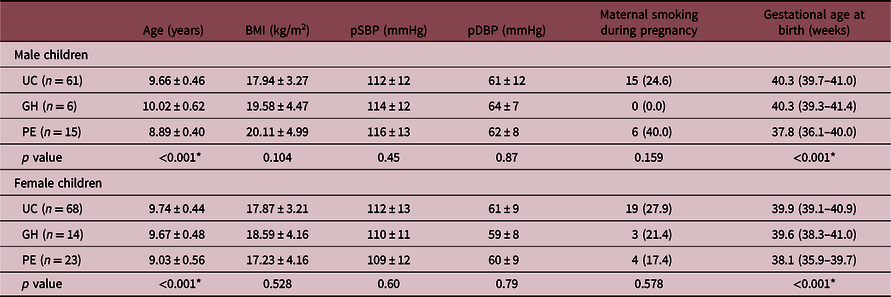
The age range of the women at follow-up was 26–51 years for those who had uncomplicated pregnancies, 31–51 years for women who had GH and 28–45 years for women who developed PE (Table 1). Gravidity and parity were not significantly different between uncomplicated, PE and GH groups. The age range of the children at follow-up was between 8 and 10 years with a statistically significant mean difference in child age between groups (Table 2).
Characteristics of women in the study

Data are mean ± SD or n (%).
* Indicates statistical significance.
Characteristics of male and female children in study

UC, uncomplicated pregnancy; GH, gestational hypertension; PE, preeclampsia.
Data are mean ± SD or n (%) and gestational age is median (IQR).
* Indicates statistical significance.
Women
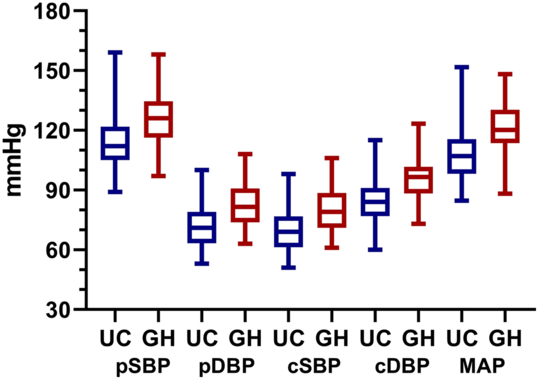
Women who had GH had higher mean peripheral systolic (126 ± 16 vs 114 ± 13 mmHg) and diastolic (80 ± 12 vs 70 ± 10 mmHg) blood pressure, as well as mean central systolic (119 ± 15 vs 107 ± 13 mmHg) and diastolic (82.35 ± 12.00 vs 72.43 ± 10.48 mmHg) blood pressures compared to those who had uncomplicated pregnancies (Fig. 1). Women in the GH group also had increased mean arterial pressure (95.46 ± 12.35 vs 84.85 ± 10.96 mmHg) compared to women who had an uncomplicated pregnancy (Table 3). No other haemodynamic or microvascular differences were seen between women who had GH and those who had an uncomplicated pregnancy. No difference was seen between women who had PE and those who had an uncomplicated pregnancy.
Minimum, 25th, 50th, 75th percentiles and maximum blood pressure of women in GH (red) compared to uncomplicated [UC (blue)] groups. pSBP, peripheral systolic blood pressure; pDBP, peripheral diastolic blood pressure; cSBP, central systolic blood pressure; cDBP, central diastolic blood pressure; MAP, mean arterial pressure.

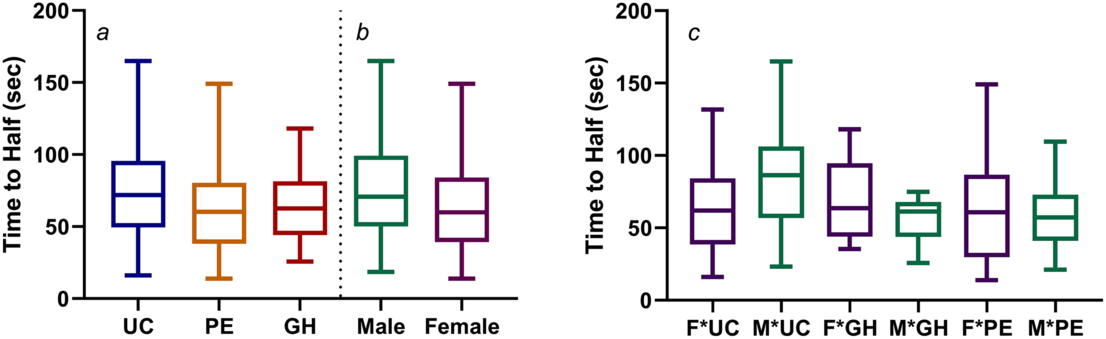
(a) Recovery time (time to half) in children of mothers who had PE (orange) and GH (red) compared to those born to uncomplicated pregnancies [UC (blue)]. (b) Recovery time (time to half) in female (purple) compared to male children (green). (c) Recovery time in females who were born to uncomplicated pregnancies compared to males who were born to uncomplicated pregnancies; females whose mothers had GH compared to males whose mothers had GH and females whose mothers had PE compared to males whose mothers had PE.

Blood pressure in women 8–10 years after pregnancy

Model adjusted for current smoking, age and BMI.
* Indicates statistical significance.
Children
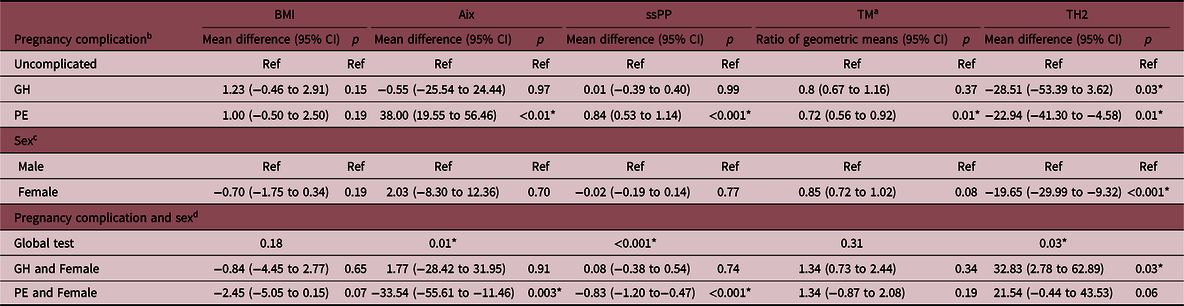
Children born to a pregnancy complicated by GH had decreased recovery time compared to those born to an uncomplicated pregnancy [−29.51 s (−53.39 to 3.62) p = 0.03]. No other differences between children born to a pregnancy complicated with GH and children born to an uncomplicated pregnancy were found. Children exposed to PE in utero had increased Aix [38.00% (19.55–56.46) p < 0.001], ssPP [0.84 mmHg (0.53–1.140) p < 0.001] and increased TM [0.72 s (0.56–0.92) p = 0.01] and TH2 [−22.94s (−41.30 to −4.58) p = 0.01] but no difference in peak perfusion [−4.17 PU (−10.51 to 2.17) p = 0.20] compared to those whose mother had an uncomplicated pregnancy. When assessing interaction by sex, female children whose mothers had PE had decreased Aix [−33.54% (−55.61 to −11.46) p = 0.003] and ssPP [−0.83 mmHg (−1.20 to −0.47) p < 0.001] compared to male children exposed to PE in utero (Table 4). TH2 was increased in females whose mothers had GH compared to males whose mother had GH [32.83 s (2.78–62.89) p = 0.03] (Table 4; Fig. 2). TH2 was also decreased in female compared to male children, irrespective of pregnancy complication [−19.65 s (−29.99 to −9.32) p < 0.001] (Table 4; Fig. 2).
Haemodynamic characteristics of children exposed to hypertensive disorders of pregnancy in utero

* Indicates statistical significance.
a TM was log-transformed for analysis.
b Models adjusted for maternal smoking during pregnancy, current maternal smoking, age and sex.
c Females compared to males, irrespective of pregnancy complications.
d If there was no strong evidence of interaction from global test, above results are from final model without interaction term.
Discussion
This study of women and children 8–10 years after the first pregnancy shows that GH was associated with increased SBP and DBP in women 8–10 years after the first pregnancy, and intrauterine exposure to PE was associated with some increased cardiovascular risk factors in male children at 8–10 years of age. GH and PE have similar manifestations, but it is unclear if these are two different diseases or are a spectrum of the same disease Reference Shen, Smith, Rodger, White, Walker and Wen7 . Many studies have shown an association between HDP and cardiovascular risk in later life in both the mother and the offspring Reference Nahum Sacks, Friger and Shoham-Vardi4,Reference Herrera-Garcia and Contag5,Reference Kvehaugen, Andersen and Staff24,Reference Alsnes, Vatten and Fraser25 . However, increased Aix, ssPP and microvascular dysfunction in children born to mothers who had PE have not been previously shown.
Women who developed GH in their first pregnancy had increased mean arterial pressure, peripheral systolic and diastolic blood pressures and central systolic and diastolic blood pressures 8–10 years after the pregnancy compared to those who had an uncomplicated pregnancy. This difference was not seen between women who had PE and those who had an uncomplicated first pregnancy. This finding is consistent with previous research from Denmark of women who had given birth from 1978 to 2012. Behrens et al. found that in 1,025,118 women over 30 (30–34, 35–39, 40–44, 45–49 and ≥50 years age groups), GH was more strongly associated with subsequent hypertension than either moderate or severe PE Reference Behrens, Basit and Melbye15 . They also found that subsequent hypertension was 2–6 fold higher in women who had GH compared to a normotensive pregnancy. A Norwegian study which followed up 60,027 women also found that risk for hypertension after 10 years was greater in women who had GH or PE compared to those who had no complication, but the study did not directly compare GH to PE Reference Egeland, Skurtveit and Staff26 . That study used diverse adjustment models, which included maternal age, prepregnancy BMI, educational level, physical activity, smoking, alcohol, diet quality, daily energy intake and duration of pre-conception oral contraceptive use.
Our research also found that children born to pregnancies complicated by PE have increased ssPP and Aix at 8–10 years of age. Suprasystolic pressure assessment is used as a non-invasive measure of vascular stiffness Reference Aggoun, Szezepanski and Bonnet27 and is associated with obesity in children Reference Saner, Simonetti, Wuhl, Mullis and Janner28 . Aix is also a measure of vascular stiffness and, when elevated, is associated with cardiovascular risk Reference Janner, Godtfredsen, Ladelund, Vestbo and Prescott17,Reference Nurnberger, Keflioglu-Scheiber, Opazo Saez, Wenzel, Philipp and Schafers29 and mortality Reference Vlachopoulos, Aznaouridis, O’Rourke, Safar, Baou and Stefanadis30 . The increase in both of these variables suggests that the larger vessels may be less compliant in children after intrauterine exposure to PE compared to an uncomplicated pregnancy.
The microvasculature is also less compliant in children born to mothers who had PE compared to those born to an uncomplicated pregnancy. Children in the PE group had increased TM but no increase in peak perfusion, which is suggestive of a delay in the endothelial independent myogenic response and impaired vasodilation post-ischaemia. Interestingly, the endothelial dependent function (TH2) indicated faster recovery. As we did not see a decrease in peak perfusion, which would couple with the increased recovery, this could mean that the endothelial function is compensating for the endothelial independent pathway and beginnings of vascular stiffness in the bigger vessels. Previous studies have shown capillary rarefaction at birth and at 3 months in children after in utero exposure to hypertension Reference Yu, Aye and Lewandowski31 and altered endothelial regulatory microRNA expression in umbilical endothelial cells Reference Yu, Reilly and Lewandowski32 . These early microvascular differences may be responsible for the delay in myogenic and endothelial responses seen in our study, including the decrease in recovery time seen in children born to pregnancies complicated with GH. This decrease in recovery time is the only haemodynamic or microvascular difference seen between children born to pregnancies complicated with GH and those born to uncomplicated pregnancies. If we consider PE and GH to be a spectrum of the same disease, this could be because changes to the endothelium are the first to appear and the children born to a pregnancy complicated with GH are progressing more slowly down the path of microvascular impairment compared to those born to a pregnancy complicated by PE. This could also be explained by considering GH and PE to be two different diseases where the effects of in utero exposure to hypertension alone and the effect of in utero exposure to both hypertension and placental dysfunction on the microvasculature of the child are also different.
Increased CVD risk in children born to pregnancies complicated by PE is commonly attributed to the association between PE and offspring obesity Reference Davis, Lazdam and Lewandowski33,Reference Goffin, Derraik, Groom and Cutfield34 . However, whether this is due to shared genetic or behavioural risk factors rather than fetal exposure to PE is a topic of debate Reference Alsnes, Vatten and Fraser25 . Decreased SEI is associated with both obesity and CVD risk Reference Schultz, Kelli and Lisko35 , and the women in our study had a lower than average SEI. Our study did not observe a difference in BMI between children born to a pregnancy complicated with PE or GH and those born to an uncomplicated pregnancy. We also did not find a difference between all male and all female children in our study nor between male and female children in the uncomplicated, PE or GH exposed groups. We did find that recovery time was decreased in female compared to male children involved in this study.
We found that males and females had different areas of impairment after pregnancies complicated with PE. Males born to a pregnancy complicated with PE had increased vascular stiffness, whereas females had impaired endothelial function. This suggests that the progression of vascular and microvascular impairment in response to PE is different for males and females. Many animal models have been used to assess sexual dimorphism in the microcirculation, but no studies have assessed sexual dimorphism in offspring after PE in women Reference Huxley and Kemp36 .
Compared to the majority of literature, our study assessed CVD risk factors in women and children from SEI disadvantage (Table 1). Cohort studies often inadvertently select for participants of moderate to high SEI as loss due to follow-up has been shown to be associated with socioeconomic disadvantage Reference Baldwin, Hart and Rodriguez37,Reference Howe, Tilling, Galobardes and Lawlor38 . As we selected participants from a disadvantaged population, it is possible that there is an increased association between pregnancy complications and CVD risk factors compared to other populations as SEI is an independent risk factor for CVD risk, morbidity and mortality Reference Schultz, Kelli and Lisko35,Reference Kilpi, Silventoinen, Konttinen and Martikainen39,Reference Podolecka, Dorynska and Nadrowski40 .
A limitation of this study is our limited sample size for the GH group in the interaction analysis between pregnancy complications and sex. Although there is some evidence for USCOM BP+ to assess central haemodynamics in children, these measures may lack accuracy as the validation study had just 11 participants. We also used laser Doppler flowmetry and PORH, and replication with a more sensitive method of determining microvascular function would be beneficial. One of the strengths of this study is the separation of PE and GH, which are often grouped together in the literature. Additionally, interaction analysis between sex, PE and vascular function is novel as sexual dimorphism in response to HDP is an emerging area of interest. In conclusion, in this low SEI cohort, GH is associated with increased diastolic blood pressure in women 8–10 years after the first pregnancy and PE is associated with increased vascular and microvascular stiffness in children at 8–10 years of age with evidence of sexual dimorphism. Our data point to differences in transgenerational effects on offspring vasculature, and potentially cardiovascular risk, between GH and PE that warrant further research with the power to determine differences with respect to offspring sex.
Acknowledgements
We thank the participants of the SCOPE study who generously consented to follow-up. The SCOPE database is provided and maintained by MedSciNet AB (http://medscinet.com).
Financial support
This work was supported by NHMRC Peter Doherty Early Career Fellowship, awarded to PHA (GNT1090778), a Channel 7 Children’s Research Foundation Project Grant awarded to PHA and CTR (GNT 161305) and a University of Adelaide, Lloyd Cox Professorial Research Fellowship awarded to CTR from University of Adelaide. CTR is currently supported by a NHMRC Investigator Grant (GNT1174971) and a Matthew Flinders Fellowship from Flinders University, South Australia.
Conflicts of interest
None.
Ethical standards
The authors assert that all procedures contributing to this work comply with the ethical standards of the NHMRC of Australia and with the Helsinki Declaration of 1975, as revised in 2008, and has been approved by the Women’s and Children’s Health Network Human Research Ethics Committee, South Australia.