Introduction
The tea mosquito bug Helopeltis theivora (Waterhouse) (Heteroptera: Miridae) is an important pest of various plantation and cash crops in India, including black pepper, cashew, cinchona, cocoa, guava and tea. Gurusubramanian and Bora (Reference Gurusubramanian and Bora2007) estimated that 80% of the tea plantation area in India was affected by this pest alone, resulting in production losses of 10–50%.
Continuous use of synthetic insecticides is known to lead to the development of tolerance or resistance in many insects. Dzolkhifli et al. (Reference Dzolkhifli, Khoo, Muhamad and Ho1986), Liew et al. (Reference Liew, Dzolkhifli and Muhamad1992) and Ho (Reference Ho1994) have reported high insecticide tolerance in H. theivora populations attacking cocoa, and variations in the relative toxicity of commonly used insecticides have been observed in H. theivora populations from Jorhat, Assam (Gurusubramanian and Bora, Reference Gurusubramanian and Bora2007), Darjeeling (Bora et al., Reference Bora, Sarmah, Rahaman and Gurusubramanian2007), and the sub-Himalayan Dooars region of India (Roy et al., Reference Roy, Gurusubramanian and Mukhopadhyay2008a).
Over the last two decades, insecticide use for the control of H. theivora has doubled, with a concomitant increase in pest control costs (Barbora and Biswas, Reference Barbora and Biswas1996; Gurusubramanian and Bora, Reference Gurusubramanian and Bora2007). In the Dooars tea plantation in Darjeeling, West Bengal for instance, endosulphan, monocrotophos, deltamethrin and cypermethrin are extensively used, with an average of 7.5 litres of insecticides applied per hectare per year (Roy et al., Reference Roy, Mukhopadhyay and Gurusubramanian2008b).
Resistance to insecticides is associated with changes in biological and physiological characteristics of insects (Bhatia and Pradhan, Reference Bhatia and Pradhan1968, Reference Bhatia and Pradhan1971; Saxena and Bhatia, Reference Saxena and Bhatia1980; Senapati and Satpathi, Reference Senapati and Satpathi1981; Campanhola et al., Reference Campanhola, Mccutchen, Baehrecke and Plapp1991; Yamada et al., Reference Yamada, Tanaka, Fahnoy and Miyata1993). Qualitative and quantitative changes have been recorded in the enzyme profiles of insecticide-exposed H. theivora, including increased production of esterases (Sarker and Mukhopadhyay, Reference Sarker and Mukhopadhyay2003), glutathione S-transferase and acetylcholinesterase (Sarker and Mukhopadhyay, Reference Sarker and Mukhopadhyay2006a,b).
The assessment of changes in biological characteristics accompanying resistance development is important for the design of resistance management programmes (Kumar and Kumar, Reference Kumar and Kumar1997), most of which involve reducing the fitness of resistant genotypes relative to susceptible genotypes, by either preserving susceptible homozygotes or eliminating heterozygotes and resistant homozygotes (Leeper et al., Reference Leeper, Rough, Reynolds and Georghiou1986).
We studied the development of resistance in five successive generations of H. theivora exposed to endosulphan, the most commonly used insecticide against the tea pest. Three study populations were studied: (i) an endosulphan-selected strain from a conventional tea plantation that routinely uses endosulphan (E), (ii) a non-selected strain from the conventional plantation (C) and (iii) a susceptible strain from an organic tea plantation (S). Changes in life cycle traits associated with the development of resistance were also studied.
Materials and methods
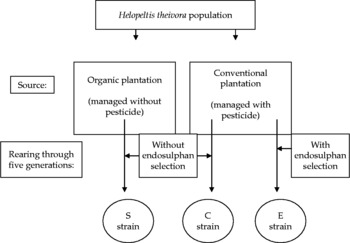
A laboratory culture of H. theivora was initiated with about 600 nymphs collected during the first week of September 2006 from the Dooars tea plantations, where tea bushes are routinely managed with synthetic insecticides. The nymphs were kept in the laboratory at 26 ± 2 °C in a biochemical oxygen demand (BOD) incubator and provided with tea leaves of the Tocklai variant (TV1) clone. Leaves were changed every 24 h until the insects reached the adult stage. After one generation, the stock was divided into two groups, named C and E. Group C was reared without endosulphan treatment through five generations, while group E was subjected to sub-lethal treatments of endosulphan in the laboratory (screening), also through five generations. A third strain, S, was obtained from Makaibari Tea Estate, an organic tea plantation that had never used synthetic pesticides in its history, and was similarly reared through five generations in the laboratory without endosulphan treatment (Fig. 1).
Scheme showing the strains of Helopeltis theivora used to study resistance development to endosulphan

Various biological parameters of F5 generations of the three strains were assessed as described below and compared.
Bioassays and laboratory selection
A technical formulation of endosulphan (Thiodan 35 EC; Aventis Crop Science Ltd, Mumbai, India) was used to prepare a 10% stock solution in distilled water, from which serial dilutions were prepared in distilled water. Toxicity assays were conducted using the standard ‘leaf dipped method’ (FAO, 1980).
Healthy shoots (three leaves and a bud) of TV1 clone were collected from an experimental plot, washed thoroughly with distilled water and air-dried. Fifteen tea shoots for each treatment were dipped for 5 s in the various endosulphan concentrations to ensure complete wetting, their bases were wrapped with wet cotton wool, and then they were kept in glass vials (2 cm diameter × 2 cm length) containing water. The vials were held under a ceiling fan for 15 min to allow drying of the emulsion, then placed in a Petri dish (10 cm diameter) lined with blotting paper. The assembly was covered with a hurricane lamp glass chimney (12.5 cm diameter mouth, 9.0 cm base opening and 18.0 cm height), which was covered at the mouth with muslin cloth, and maintained in a BOD incubator (26 ± 2° C; 12 h light-12 h dark photoperiod, 80% humidity) in a culture room.
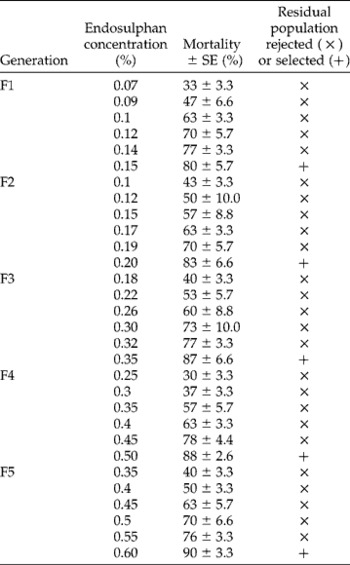
More than five preliminary tests were done to find the appropriate sub-lethal doses of endosulphan to use to obtain strain E (Robertson et al., Reference Robertson, Smith, Savin and Lavigne1984; Robertson and Preisler, Reference Robertson and Preisler1991). Based on the results of these preliminary tests, 30 (15 males and 15 females) insects in successive generations were exposed to six concentrations of endosulphan per generation (Table 1). A set of controls (using leaves treated with water) was maintained for each concentration, and control mortalities were used to calculate corrected mortalities for treatments. The survivors obtained at the highest endosulphan concentrations ( ≥ LC80) were transferred to clean glass vials and reared on fresh TV1 tea leaves. The progeny of the first surviving lot was termed the F1 generation. Endosulphan treatments and selection were continued in a similar way until the F5 generation. Strains C and S were reared for five generations without endosulphan treatment.
Screening of a population of Helopeltis theivora with endosulphan through five generations

Biological studies
Newly emerged adults of the F5 generation of the three strains, E, C and S, were studied separately. Two or three healthy TV1 tea shoots (with three leaves and a bud) were kept with their bases immersed through a cotton plug into water-filled glass vials. The vials were placed on a Petri dish lined with paper towels. The set-up was covered with a glass chimney covered at the mouth with nylon mesh, and maintained in the laboratory at 25 ± 2 °C and 70–80% relative humidity and 16 h light-8 h dark photoperiod.
Three male and three female individuals of each strain were introduced into the glass chimney. Mated females were allowed to oviposit in the shoots, and the egg-laden shoots were removed. By using a strong magnifying glass, micropylar processes (hairs) could be seen projecting out of the plant surface where eggs had been inserted. Fresh tea shoots were supplied until the emergence of nymphs. Water mixed with 0.1% carbendazim was added to prevent fungal growth on the shoots. Five such replications of each strain were studied.
Per cent hatching was recorded cumulatively for up to 28 days (Gope and Handique, Reference Gope and Handique1991). Those eggs that did not hatch after this period were considered non-viable. Freshly emerged first instar nymphs were transferred individually to Petri dishes and supplied daily with tender tea shoots moistened with wet cotton around the petioles until they reached the third instar. Ten third instar nymphs were reared in each of the glass chimneys, with tea shoots replaced daily with fresh ones. Nymphs were carefully removed from old shoots using a camel-hair brush and transferred to fresh ones. This process continued until the emergence of adults. Pre-oviposition period, oviposition period, fecundity, incubation period, hatchability, total nymphal duration, longevity of males and females, and sex ratio were recorded for each culture.
Statistical analysis
The development of resistance through successive generations was determined as a resistance ratio. LC50 values for each generation were computed using mortality data converted to per cent mortality and subjected to probit analysis (Finney, Reference Finney1971). The resistance ratio for a generation was calculated by dividing the LC50 for that generation with the LC50 of the parental (F1) generation. Significant differences in biological parameters of the three strains were assessed using analysis of variance.
Results
Endosulphan selection
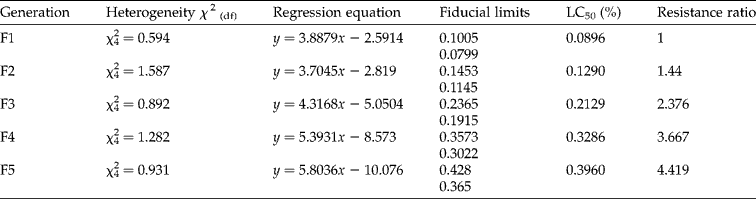
In the F1 generation, minimum survival of H. theivora (20%) was observed at the highest endosulphan concentration used, 0.15% (Table 1). The tolerance of the bug to increasing concentrations of endosulphan increased from the F1 to the F5 generation (Table 1). The LC50 value for the F1 generation of strain E of H. theivora, obtained from a conventional tea plantation, was 0.0896%. This increased progressively with generation, to 0.3960% in the F5 generation (Table 2). The insect's resistance to endosulphan thus increased 4.4-fold within five generations.
Toxicity of endosulphan in different generations of a strain of Helopeltis theivora from a conventional tea plantation
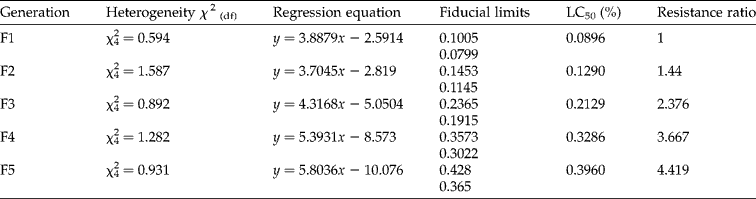
In none of the cases was the data found to be significantly heterogeneous at P = 0.05. df, degrees of freedom; y, probit kill; x, log (concentration × 103); LC50, concentration required for 50% mortality.
Dosage–mortality response data for H. theivora in the successive generations, when subjected to a chi-square test, indicated a good fit of probit responses in all the bioassays, showing that there was no heterogeneity between observed and expected responses (Table 2).
Comparative biology
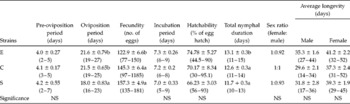
Out of the nine biological traits studied, only two – fecundity and total nymphal duration – were significantly (P = 0.05) affected in the endosulphan-selected H. theivora strain (E). No significant differences were detected in the fecundity of H. theivora strains C (6.75 per female per day) and E (5.68 per female per day) (Table 3).
Biological attributes of F5 generation of an endosulphan-selected strain (E), conventional plantation strain (C) and susceptible organic plantation strain (S) of Helopeltis theivora

Values are means ± SE of ten pairs/individuals. Figures in parentheses represent range.
Means followed by the same letter in a column are not significantly different (P = 0.05) in Tukey's multiple comparison test (HSDa) NS, not significant.
Strain E had a significantly longer nymphal duration than both strains S and C (Table 3). This prolongation resulted in a longer total developmental period of strain E, but it was not significantly different from that of strains C or S.
Discussion
Endosulphan selection
Laboratory-reared H. theivora populations repeatedly exposed to endosulphan developed resistance to the pesticide. It follows that prolonged use of this class of insecticides for the control of the tea mosquito bug may lead to control failures, as the insect develops resistance.
Several workers have observed the development of resistance to chlorinated hydrocarbons in H. theivora (Dzolkhifli et al., Reference Dzolkhifli, Khoo, Muhamad and Ho1986; Liew et al., Reference Liew, Dzolkhifli and Muhamad1992; Ho, Reference Ho1994; Muhamed and Omar, Reference Muhamed and Omar1997; Gurusubramanian and Bora, Reference Gurusubramanian and Bora2007; Bora et al., Reference Bora, Sarmah, Rahaman and Gurusubramanian2007). Their work corroborates our study, which quantifies the generational accrual of resistance to endosulphan in this pest.
Comparative biology
The endosulphan selection pressure resulted in a significant reduction in the fecundity of strain E of H. theivora. This reduction may have resulted from less metabolic energy being available for reproduction, as a major share was allocated towards developing biochemical and physiological defences related to detoxification of the insecticide (Price, Reference Price1974; Ribeiro et al., Reference Ribeiro, Sousa, Nogueira and Soares2001).
It appears that the resistant forms of H. theivora, having passed through a survival bottleneck during screening, developed certain life cycle traits, such as a longer nymphal developmental period, longer oviposition period and lower fecundity, which allowed them to adapt to the reduction in available metabolic energy, and withstand better the stress of repeated pesticide exposures. Similar changes in life cycle traits were reported by Yaqoob and Arora (Reference Yaqoob and Arora2005) and Yaqoob et al. (Reference Yaqoob, Arora and Gupta2006) in endosulphan- and carbaryl-selected populations of Helicoverpa armigera, respectively. Similarly, reduced fecundity in Epilachna sparsa was related to the pest's metabolic resistance to insecticides (Senapati and Satpathi, Reference Senapati and Satpathi1981). Various workers have observed that females of H. armigera (Forrester et al., Reference Forrester, Cahill, Bird and Layland1993; Glenn et al., Reference Glenn, Hoffman and McDonald1994; Xia et al., Reference Xia, Jun, Chang, Ren, Han and Wang2001) and Plutella xylostella (Yamada et al., Reference Yamada, Tanaka, Fahnoy and Miyata1993), which show variable fecundity and oviposition period, had relatively higher tendency to develop resistance to insecticides.
It was evident from our study that high concentrations of endosulphan can induce rapid changes in the life cycle traits of H. theivora, possibly leading to the development of new biotypes. As such, the types and doses of pesticides used in tea plantations should be reviewed periodically to ensure that they are still appropriate for controlling target pests.