‘We keep learning strange names such as vigilante for something traditional but vigilante has been long here. I told you, I did it when I was young.’ (Alhaji Alimi Buraimo Bello, aged 85, Ibadan, January 2003)
Since the 1980s, the phenomenon of vigilantes and vigilantism has been much studied through topics such as the rise of crime and insecurity, the involvement of local groups in political conflicts, and, extending the framework wider still, the possible decline of state law enforcement agencies. Despite the fact that vigilantes and vigilantism have acquired a renewed interest especially in the African literature, Michael L. Fleisher (2000: 209) points out that there is as yet no scholarly consensus on what exactly vigilantism is, especially as regards the nature of its relationship with the state. The word has been used to describe movements that differ in nature and composition as well as geographical location. Africa is no exception: we need only mention movements such as white farmers in the Orange Free State in South Africa in the 1910s and 1920s (Murray Reference Murray1989), anti-thief and anti-witch organizations in Bugisu District in Uganda in the 1960s (Heald Reference Heald1986), movements to counter cattle raiding in Tanzania in the 1980s and 1990s (Abrahams Reference Abrahams1987), state-sponsored groups fighting ANC members in South Africa in the 1980s (Haysom Reference Haysom1986), or political militias with an ethnocentric and strong religious agenda such as the Mungiki in Nairobi (Anderson Reference Anderson2002; Maupeu Reference Maupeu2002) or the O'odua People's Congress (OPC) in south-western Nigerian cities today (Akinyele Reference Akinyele2001, 2007; Adebanwi Reference Adebanwi2005; Guichaoua Reference Guichaoua2007). In each case, vigilante groups interrogate the relationships between the society and law enforcement agents, the issue being to know whether such groups are tolerated or even supported by the police or if they are forbidden because they are considered to be a threat to the state monopoly of legitimate violence.
More recently, some works have focused on the use of community policing within the African continent. This notion is considered to have been popularized in the United States and in the UK from the 1980s onwards and to have been sold more recently to English-speaking Africa and to South Asian societies (Brogden Reference Brogden2004). Community Oriented Police (COP), based on the principle of a better coordination and consultation between the police and the policed, has been portrayed as ‘a success story in the West’ (Brogden Reference Brogden2004: 635), whereas vigilante groups seem in many cases to undermine the legitimacy of the police and to resort to extra-judicial killings. However, ambiguities around the notion of community police have also been enhanced. In Kenya, COP has served to reinforce oppressive structures and could also be seen as decentralizing repression (Ruteere and Pommerolle Reference Ruteere and Pommerolle2003). In many cases, the line between community police and vigilante groups is blurring.
This is especially the case in Nigeria. This article would like to retrace community responses to crime and insecurity using south-western Nigeria, and Ibadan specifically, as a case study. We estimate that the apparent recent rise in Nigeria of vigilante groups, and more generally of what is considered the privatization of state violence, can be understood through an analysis of changing forms of non-state policing. Effectively, ‘vigilante’ in Nigeria is a term initially proposed by the police in the mid-1980s as a substitute for an older practice present since the colonial period and referred to as the ‘hunter guard’ or ‘night guard’ system. Colonial administration in western Nigeria either authorized it or legalized it, giving rise to an enduring continuity of these non-state forms of policing. Hence, instead of looking at vigilante groups as a response to a supposed increase of crime or a supposed decline of the police force, we should consider them – initially at least – as a first attempt at introducing some form of community policing in order to improve the appalling image of the police. As such, vigilantism in south-western Nigeria is not only a response ‘to the Nigerian “politics of plunder” endemic since the beginning of the oil boom‘ (Gore and Pratten Reference Gore and Pratten2003: 212). It is also a new name for an old practice of policing which should be considered in an extended timeframe (from the 1930s onward), a period in which violent crime has been perceived as a potential danger for various communities. This article is based on administrative reports, Nigerian newspapers and oral sources collected among elders in one neighbourhood in central Ibadan. It first considers the history of crime and policing in Nigeria before examining the hunter guard system used in western Nigeria during the colonial period. It then looks at one neighbourhood in Ibadan where the night guard system is locally referred to as sọdẹ sọdẹ. It also analyses the political use of night guards in the 1960s and their official change into the vigilante groups sponsored by some southern states in 1985–7. Finally, the last section proposes to include this issue within the ongoing debate on the privatization of the state in Africa.
VIOLENT CRIME AND STATE POLICING IN SOUTHERN NIGERIA
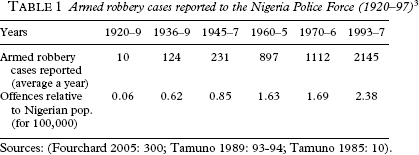
Throughout the twentieth century people's discontents about inequality, corruption and injustice have fuelled alternative solutions to state policing. In this general framework, the most immediate factor leading to the setting up of non-state organizations has been violent crime such as armed robbery and armed burglary. Most researchers consider the Nigerian Civil War (1967–70) and the 1970s as a starting point for the history of violent crime in the country. Central to this argument is the rising number of armed robbery cases, supposedly little known before the war and occurring with epidemic frequency throughout post-civil war Nigeria. This common view was shared by researchers (Fabiyi Reference Bénit, Fabiyi and Owuor2004: 11–12; Pérouse de Montclos 1997: 243; Tamuno 1989: 92–3), top police officers (Jemibewon Reference Jemibewon2001: 79; Inyang 1989: 75) and journalists (Akparanta Reference Akparanta and Albert1994). Most of the studies are based on a very short period in which crime is always perceived as increasing, in contrast to research on the history of crime in Europe or in South Africa, say, where usually a specific period is situated within a more general criminal trend.Footnote 1 The issue of crime in Nigeria is dominated either by conjectural analysis or by a post-conflict explanation that totally underestimates the situation prevalent before the civil war. Armed conflicts do not lead automatically to waves of violent crime and the peculiar consequences of each conflict should be analysed accordingly. In the South African case, for instance, Gary Kynoch (2005: 494–5) has argued convincingly that the current high level of criminality is a ‘deeply entrenched culture of violence produced by decades of repressive racial policing, violent crime and social conflict’. In the Nigerian case, we would also like to state that civil war only changed and made more widespread some earlier criminal practices embedded in the social and political history of the country. Yet it is difficult to assess the rise of crime precisely because of the well-known bias introduced by criminal statistics collected by the police.Footnote 2 Two elements, however, can help us to consider the historical crime landscape in Nigeria. First, violent crime has a long history, especially in south-western Nigeria where historians have emphasized the prevalence of both rural banditry and armed robbery organized by warlords in the nineteenth century (Watson Reference Watson2000; Falola and Oguntomisin 1999). In the 1930s and 1940s, recurrent thefts and burglaries organized by gangs were also becoming a worrying issue for colonial administrators, the Nigerian press and Native Authorities (Fourchard Reference Agbola, Sobanjo, Fourchard and Albert2005; Falola 1995). The number of armed robbery cases reported to the police was already very important before the civil war (Table 1). There has been a general increase in armed robbery cases actually reported to the Nigerian police from the 1930s up to today, and the civil war does not mark an historical rupture.
Second, a trawl through Nigerian newspapers from the 1920s to 2000 seems to reveal a gradual rather than a brutal change in criminal practices. Footnote 4 During the colonial period, armed robbers generally operated by night in a few neighbourhoods which were not covered by the police, the best-known being the outskirts of Lagos, the large pre-colonial parts of Abeokuta or Ibadan, and the under-policed countryside (Fourchard Reference Fourchard, Falola and Salm2005: 299–307; Falola 1995: 10). In the 1960s and 1970s, the areas plagued by violent crime widened: they now included commercial, industrial and residential areas, main streets in the cities and main roads in the countryside. This extension is the result of a major change in criminal practices in the last forty years. Criminal practices became more mobile with the extensive use of the car (from the late 1950s onwards), and the more common use of guns (from the 1960s onwards). Crime also became more radical and violent (with the release of soldiers and the accessibility of firearms after the civil war in the 1970s), targeting the beneficiaries of oil revenues (the middle and upper classes) (Fourchard Reference Fourchard2006b). In Lagos in the 1930s, for instance, the Agege area on the northern outskirts was considered the most dangerous in the region (with 30 armed robberies reported in one year in 1933–4), while by the late 1970s the crime rate was considered to be higher in rich residential areas.Footnote 5
Like violent crime, the state policing system in Nigeria has witnessed more continuity than change. Three features may be summarized briefly here. First, collaboration with the public was problematic from the colonial period onwards, because ‘the prevention and detection of crime in police work was not matched by any move towards policing by consent’ in most African colonies (Anderson and Killingray 1991: 9). Police–public relations deteriorated further: there were increasing allegations of corruption, officially considered very high in Nigeria as early as 1966 (Marenin Reference Marenin1985: 81). The setting up of state vigilante movements from the mid-1980s onwards was thus a response to the popular perception of police corruption (see below) while more recent movements of vigilantism could also be considered as a response to ‘widespread perceptions that the police, the courts, and other institutions of the state were too corrupt to curtail crime’ (Smith Reference Smith2007: 167). Second, the centralization of police services was progressively achieved (the Nigeria Police Force, NPF, was created in 1930). Whenever possible, however, the British administration retained a Native Authority (NA) to act as a police force: this was the case in the south-west of the country, where Native Authority policemen (called Ọlọpa) were responsible for both the maintenance of order and the prevention and detection of crimes throughout the African part of Lagos (Rotimi Reference Rotimi2001). The NPF had been paid, trained, and managed directly by the British since 1906 and operated throughout the Lagos colony and wherever European interests were located, mainly in the residential and commercial areas of major cities. This double policing system enabled the administration to save money and was largely discriminatory: large ‘indigenous’ cities were under the control of a secondary police force that was poorly trained, uneducated and attached to local political interests. Third, the creation of a fingerprint section and of a Criminal Investigation Department (CID) in the 1930s indicates a new interest in dealing with criminal practices, though this was limited because the fight against delinquency and serious crimes was never considered a priority. As in many French or other British colonies, maintaining law and order, anticipating riots and fighting political opposition were growing concerns of the administration in Nigeria, especially after 1945 (Anderson and Killingray 1991: 1–21; Fourchard 2003: 31–2). The inadequate level of security led to the emergence of other forms of policing as soon as feelings of insecurity came to be considered as a direct menace by communities.
THE HUNTER GUARD SYSTEM
Works on the colonial and post-colonial police in Nigeria have largely ignored non-state forms of policing under colonial rule. Private guards used by Native Authorities in the Northern Provinces and in Lagos are mentioned, but not the institution of night guards that became a central feature in western Nigeria from the 1930s to the 1950s. The movement was initially unofficial before being authorized by the colonial administration during the Second World War and then legalized in some parts of the Western Provinces in the 1950s. The Lagos newspapers and the colonial administration have used two expressions – ‘night guard’ and ‘hunter guard’ – indistinguishably, probably because the latter could designate both an organization specifically composed of hunters and an organization in which night guard activities were also assumed by various non-hunter community members.
Hunters from the country were often used as night guards in Yoruba cities in the nineteenth century, before being forbidden by the British administration.Footnote 6 In 1903 the District Officer suppressed them in Ibadan, where they were considered too dangerous, and replaced them with a civil police force (Watson Reference Watson2003: 76–8). Some communities soon reintroduced night guards in areas where criminal activities were significant and the police absent, as in the border area between Dahomey and Nigeria as early as the 1920s, and in Ikeja District (north of Lagos) in the early 1930s. In Mushin, a small locality within the district, migrant leaders banded together, formed seven Village Group Councils, asked for more police protection and, finally, set up night patrols conducted by themselves and hired guards (Barnes Reference Barnes1986: 39–40). In 1940, the Nigerian Daily Times reported that ‘an organization of armed night guards composed of native hunters has been adopted in most of the Yoruba towns for many years’.Footnote 7 Similarly, the Yoruba News asserted that ‘the best measure to protect Ibadan is to entrust the job to hunters as it is done in other towns’, a measure which was taken a few weeks later.Footnote 8 Other articles and administrative reports state that a similar system was operating during the Second World War both in Lagos and in many other smaller towns of the region – notably Osogbo, Ede, Ogbomoso, Ife and Oyo.Footnote 9 Apparently night guards, first introduced informally in many south-western cities in the 1930s, were then authorized after some hesitation by the colonial administration in various cities of the provinces and even in the Lagos colony at the beginning of the war. The context was quite specific: waves of armed burglaries in Lagos, Ibadan and Abeokuta were being headlined in the press, while the NPF and NA policemen were depleted by recruitment for military service.
According to oral and written sources, at least two types of night patrols may have functioned during this period: those organized by an existing local authority and those set up by new associations of residents. In several wards of Ibadan, residents constituted themselves as ‘neighbourhood associations’ or ‘anti-thieves units’, asked some ọlọpa to patrol their area, and adopted a curfew or imposed guidelines for the admission of strangers.Footnote 10 In January 1942, the District Officer eventually authorized the Olubadan, the highest chief in the city, to set up a ‘hunter guard system’.Footnote 11 Requesting the assistance of the chieftaincy was probably a means by which the colonial administration aimed to regain control over a movement with a tendency to elude any form of administrative supervision. The night guard system already in use in Osogbo town served as a pattern for Ibadan District, both for villages and cities. The regulations were fixed by the Olubadan and approved by the District Officer: (1) ‘village heads must provide hunters for their villages and must instruct them to be guards’; (2) ‘It should be made imperative that chiefs …of such quarter should be responsible for providing hunters for their quarter and equip them with gun powder’; (3) ‘At midnight, every one should keep indoors and anybody found roaming about should be arrested by the hunters’.Footnote 12 Quite similarly, in Lagos Chief Asogbon summoned heads of Lagos Island households to his palace in 1941 to organize night patrols supplied with armlets, whistles and torches. Known by Lagosians in 1946 as ‘Asogbon’s Police Force', this ‘unofficial institution’ aimed to put an end to shop break-ins and burglaries.Footnote 13
Initially, this solution was seen as provisional by local administrators, who authorized the people to defend themselves against crime in the specific context of the war. After the war, many comments from the press and the administration were critical of the night guards and their tendency to harass or kill innocent people. But instead of being banned, most of the examples indicate, night guards were either tolerated or even given a legal status. In Lagos colony, the government forbade the wearing of police uniforms but tolerated ‘night watchmen, customarily known as Night Guards’.Footnote 14 In Benin City, a petition circulated in 1953 asked for restriction of movement after 10 p.m. throughout the city, point control (with search powers) of lorries and cars coming into or leaving the town after midnight, and the repatriation of non-native thieves (Falola Reference Falola1995: 18). Even if the Resident did not answer favourably, town-dwellers nonetheless engaged a large number of night guards. Our best documented case is Oyo Province, where the Resident, after some hesitation, decided in 1948 to approve the use of night guards provided the following rules were respected:
1. That a roster of Night Guards is kept.
2. That a head hunter is appointed whose duties are to supervise the arrangements made and be responsible to the local baalẹ (chief) for the conduct of the guards.
3. That each hunter guard is clearly informed that firearms must only be used in self-defence. They must never be used against a suspected person merely because he runs away and does not answer a challenge.
4. If a hunter guard catches a thief or suspect, he should take him to the nearest police station at once and hand him over to the police.
5. That no form of uniform is used by hunter guards.Footnote 15
This was clearly a response to earlier abuses as well as an attempt to organize the system under responsible elders. These recommendations were sent to all districts and villages in Oyo Province already employing guards.Footnote 16 They also became the legal basis on which the use of night guards by a community was authorized. Consequently, a movement to legalize night guards grew rapidly in the province. In Ibadan Division, many petitions seeking authorization were sent to the Olubadan or to the District Officer. In the typical case, after the occurrence of a night burglary and a subsequent meeting of all the village adults, a collective delegation (usually composed of heads of lineages) would be sent to Ibadan. There they would engage a public writer to translate the petition from Yoruba to English. Sometimes these petitions requested guidance as well as authorization: one petition asked for a ‘book of note to guide the hunter’, another for ‘a form of letter to guide the hunters from misbehaviour’ (sic), another ‘to know how to catch the thieves’.Footnote 17 In Ibadan Division alone, 78 authorizations were granted to communities to use night guards between 1948 and 1954.Footnote 18 Authorizations were granted by means of a standard official document from the 1950s onwards, indicating that the delegation of security was already routinized before independence. This example indicates the widespread use of non-state police in different parts of the Western Provinces in the 1950s. A more detailed example of night guard activities in Ibadan sheds light on the internal functioning of these groups.
ṢỌDẸ ṢỌDẸ IN BẸRẸ (IBADAN)
Bẹrẹ is one of the numerous pre-colonial neighbourhoods formed in the nineteenth century, when Ibadan developed as a war camp. Like other wards, it was constituted by the large compounds of extended families and warrior lineages. With the development of the town, the compounds of the core area underwent ‘growth by fission’, and were broken up into a number of separate housing units (Mabogunje Reference Mabogunje1962). According to Mabogunje, half of this core area in the 1960s was occupied by ‘slum dwellings characterized by no identifiable sanitation facilities, housing in mud, physical deterioration and the highest population density area of the town’ (Mabogunje Reference Mabogunje1968: 233). This statement is still valid today: in 1985, 70 per cent of the derelict houses were found in the inner city, at less than 2 km from the centre (Abumere Reference Abumere, Onibokun, Olokesusi and Egunjobi1987: 136). Moreover, this part of the city is distinguished by a total absence of urban management and urban planning. The inhabitants refuse to consider their ward as a slum, however, mainly because it is the land of their grandfathers, the founders of the city (Fourchard Reference Fourchard2003).
In 2003, 20 interviews were conducted in Bẹrẹ.Footnote 19 Most of the people interviewed were men above 60, generally farmers; some were retired civil servants who have been living in the same area for more than 30 years. If most of them had not received any formal education, they generally had a good knowledge of local history, even if accurate dates were most often not remembered. The interviewees all had a good recall of the organization of the night guard system in the neighbourhood.
In the past, the night guard system in Bẹrẹ was called ṣọdẹ ṣọdẹ. In Yoruba, ṣọdẹ is the contracted form of the verb ṣẹ (which means to do) with its object ọdẹ (which means hunter). By extension, the term came to designate both a guard and a hunter.Footnote 20
Hence, ṣọdẹ ṣọdẹ can be translated as ‘to keep watch’. These guards emerged between the 1930s and the 1950s.Footnote 21 A chain of command linked the Olubadan, the heads of powerful lineages associated with him (the Mogaji) and the heads of compounds (baalẹ). ‘The Mogaji were in charge of ṣọdẹ ṣọdẹ; they will call the head of each household then they will tell them about the need to keep watch on the surroundings.’Footnote 22 In each household, the baalẹ would volunteer at least one or two people.Footnote 23 Such obligations could also extend to household members living in the country as farmers for most of the year.
Interestingly, the word most often used by elders to describe this mode of organization is ‘volunteer’, although the system was clearly imposed from above. Elders decided for younger members, who were not paid, because ‘it was for the benefit of the community’; money collected by baalẹ was used only to buy batteries and torches.Footnote 24 The number of people said to have been involved within the neighbourhood varies markedly from one informant to another (4, 8, 10 or even 20 each night). Such different estimates are not necessarily contradictory: the number of guards mentioned probably depended on the period the informant remembered. At the beginning the system may have functioned well, but under the stress of night guard activities some ‘volunteers’ may have found a way of escaping their duties (see below). Those designated as guards on any particular night would gather at a central meeting point where they decided how to patrol the surroundings; usually they were on the streets between 11 p.m. and 5.30 or 6 a.m. Meanwhile, those they were protecting obeyed a self-imposed curfew, a practice apparently accepted by most members of the neighbourhood:
Volunteers go around with a bell saying ‘Kónílé gbélé’ (people should stay in their houses), meaning that the guards are outside and people should stay indoors. …This will also discourage thieves around by the sound of the bell.Footnote 25
The system was based on the capacity of elders to mobilize youth and to engage them in the project of establishing security guarantees. People did not use guns but sticks, canes, whistles and more especially various anti-criminal charms. People had faith in charms because they were believed to be efficient in providing many different forms of protection.
‘Local dane guns used by the thieves had no effect on ṣọdẹ ṣọdẹ because they had charms to control them.’Footnote 26
‘What our fathers did was not to beat thieves but to put some charms in their hand that will lead to their death.’Footnote 27
‘Once the robbers are ambushed, they could be “charmed” and then arrested.’Footnote 28
These anti-criminal charms were supposed to be more efficient than the ones used by robbers. Like the warriors of the nineteenth century, thieves believed in the efficacy of charms to bring success in their operations (Falola Reference Falola1995: 10). Thieves used charms to turn invisible when detected, resist gunshots and machete blows and even to escape from police cells. Burglars operating by night were generally using two kinds of charms: the most common one prevented people from waking during the night; the other one prevented burglars from being arrested. Both these charms were declared illegal by the British. In Ikeja District (northern Lagos) in the 1930s, no fewer than 40 offenders were prosecuted for illegal possession of criminal charms (Fourchard Reference Fourchard, Falola and Salm2005: 305).
In Bẹrẹ, ṣọdẹ ṣọdẹ gave way to a system of paid guards. My informants gave various reasons for the change. The idea that charms were not working any more is held by most elders.
‘Before charms were functioning, they were very efficient … nowadays, people are so deceitful that charms don't work any more.’Footnote 29
‘Old people who had the charms to prevent the invasion of armed robbers are all dead and we don't have people like them again.…Instead of the government supporting traditional practices, they are even suppressing them.’Footnote 30
The development since the 1960s of more violent criminal practices is said to have diminished the power of ancestors' charms: ‘The local dane guns used by the thieves had no effect on the ṣọdẹ ṣọdẹ because they had charms to control it, but with foreign guns it is difficult, it kills.’Footnote 31 Consequently, armed robbers became more of a menace for members of the community and especially for the youth who were in the front line during night patrols. The idea of hiring guards arose in response.
But the new threat from criminal practices was not the only reason for the change. The process of individuation in African cities has accelerated throughout the twentieth century. This was especially true in Ibadan, where contributory factors were the development of cocoa culture and salaried work, massive conversion to Christianity, the weakening of the powers of heads of families and the increasing individualization of housing units. This change is very apparent to elders:
‘Before, people were giving volunteers for ṣọdẹ ṣọdẹ from each household but when it becomes a situation when it is your turn, you give excuse that you are busy. That is when our fathers decided that we should start paying for ọdẹ.…’Footnote 32
‘People used to pretend that they were sick or have to go to farm not to do ṣọdẹ ṣọdẹ; this lack of communitarism made the ṣọdẹ ṣọdẹ not functioning again.’Footnote 33
Actually, ṣọdẹ ṣọdẹ was both time-consuming, exhausting and dangerous, while little compensation was given to the main actors in such a system: the youth and young adults. In this sense, neighbourhood watches are not necessarily a way of reinforcing community identity, but rather indicate that elders were gradually losing control over the younger members of the neighbourhood.
FROM NIGHT GUARDS TO VIGILANTES
Local police as well as night guards became increasingly involved in politics in the late 1950s and 1960s. The Western Region was initially dominated by Obafemi Awolowo's political party, the Action Group (AG), created in 1951: throughout the First Republic (1960–6) the party formed the opposition in the federal legislature. The Northern People's Congress (NPC), formed in the same year, was then the dominant coalition partner in the federal government from 1954 to 1966. By 1962 the AG had split into two rival groups led by Awolowo and Samuel Ladoke Akintola. The latter's group created a coalition with the NPC and founded a new party, the Nigerian National Democratic Party (NNDP) that soon dominated the government of the Western Region.
Local authorities, NA police and customary courts became instruments of local political domination by the Akintola-controlled Western government until the fall of the First Republic in January 1966 (Marenin Reference Marenin1985: 85; Vaughan 2000: 109–12). During this period, thugs were recruited by various political parties – but those in power enjoyed the advantage that their thugs could operate under the cover of the police (Rotimi Reference Rotimi2001: 140). The fact that some thugs went about in uniform – especially in the period between 1964 and 1966 – earned the NA Police the sobriquet of ‘thugs in uniform’ (ibid.). Indeed, local police acquired undisputed notoriety for molesting and victimizing members and agents of political parties opposed to the party in power (Tamuno Reference Murray1989: 87).
Night guards did not escape this process of politicization. In the 1950s and especially during the First Republic, they became an instrument of political domination. The necessity (or otherwise) of night guards became an issue in the context of the general elections of 1959 and 1964 and the regional election of 1965. Before campaigning began in each of these contests the Ibadan City Council (ICC), dominated by the NNDP (and, before 1962, by the AG), passed a by-law concerning the ‘maintenance of order’ by night guardsFootnote 34 and stipulating the necessity of keeping the night guard system intact in Ibadan. In effect, night guards were becoming a useful tool in the hands of the regional premier. For instance, in September 1965, one month before the regional election, the NPF asked the ICC ‘to dispense with the services of its night guards’ in order ‘to give room for police to check on the wave of thuggery and hooliganism in the region’.Footnote 35 The federal government considered that, since the police had intensified efforts to restore peace in the region, the services of the night guards were no longer necessary.Footnote 36 The ICC turned down the police request, a reaction that the new opposition – regrouped into the United Progressive Grand Alliance (UPGA) – considered to be ‘a calculated attempt by the NNDP to arrest as many UGPA supporters as possible’.Footnote 37 The local police force, night guards and political thugs eventually assisted Akintola to win these elections with massive rigging and malpractices. This fuelled a wave of political violence both in the rural areas and in the cities. It was against this background that a faction of the military carried out the first Nigerian coup (15 January 1966).
Because of their involvement in political activities, local police forces in the Western Region were suppressed in 1966 and progressively amalgamated with the NPF (Tamuno Reference Murray1989: 88). Simultaneously, night guards were no longer authorized to perform their role. Even if there is no evidence in the sources, it is highly improbable, however, that night guard patrols were disbanded. A few press articles indicate that night guards were still performing their duties in the mid-1970s.Footnote 38 Moreover, after the civil war feelings of insecurity increased, especially among the population directly or indirectly enriched by oil benefits. Landlord and tenant associations were set up in middle- and upper-class neighbourhoods, and they recruited guards and security company members to implement the restriction of movement into their wards (Fabiyi Reference Brogden2004: 47). If the 1970s did not witness the disappearance of non-state forms of policing in Nigeria, it was only in the mid-1980s that the so called vigilante groups came to public attention. But unlike the 1930–50 night guard movements, which emerged under the auspices of Native Authorities and community elders, vigilante groups of the mid-1980s appeared as a political strategy implemented by the federal government to change the image of the police.
The political context should be kept in mind in this regard. After the coup of 25 August 1985 against General Buhari, General Babangida became President of Nigeria. One year later (October Reference Young1986), the police force was restructured nationwide into seven area commands in place of a command structure based on the states (Hills Reference Hills2000: 42) and Babangida promised additional resources to fight armed robbers. In between these two dates, the Anini gang was arrested in Benin city after a six-month pursuit. The ‘Anini saga’ was extensively covered during several months by newspapers in reports that tended to elevate Anini to ‘the status of a folk hero’ and more generally to ‘the symbol of all the difficulties facing Nigeria’ (Marenin Reference Marenin1987: 261). Of course, such national interest in crime was not new: in 1981, a massive campaign was launched by the government and the press against the menace of the ‘crime wave’ (Barber Reference Barber1983: 437). In 1986, however, the overemphasis by the media on a banal armed robber was perceived by the government as a conscious and concerted attack on the legitimacy of the military regime (Marenin Reference Marenin1987: 278). Moreover, the arrest, trial and execution of former Deputy Superintendent of Police of Bendel State, George Iyamu, a convicted associate of Anini, encouraged a strong belief that other superior police officers like him had escaped detection and similarly rigorous punishment (Tamuno Reference Roberts, Fourchard and Albert2003: 133). More than ever, it was felt, there was a strong need to improve police–public relations in the country. The idea of setting up a Police Community Relations Committee (PCRC) throughout the federation was actually proposed, in 1985, by Inspector General of Police Etim O. Inyang (1984–6). The idea of community policing had resurfaced in the United States and the United Kingdom at the beginning of the 1980s as a new partnership between the police and the community to fight crime and improve the quality of life within neighbourhoods (Chalom Reference Chalom1999). This new way of policing may have influenced Nigerian police officers, who had established relationships with police officers in the USA in the 1960s and the 1970s (Marenin Reference Marenin1986). First proposed in 1985, the PCRC was gradually set up in all divisional police areas to enable the police and the public to interact regularly in the fight against crime (Roberts Reference Roberts, Fourchard and Albert2003: 147; Inyang 1989: 82). Obviously, community policing was seen mainly as one way of improving both the image and the performance of the police. In this framework, vigilante groups came to be popularized by some military governors. In March 1986, Adetunji Olurin and David Mark, governors respectively of Oyo State and Niger State, announced that vigilante groups were to be encouraged ‘to fish out criminals in the community’.Footnote 39 This local development was soon followed by a more general announcement by Inspector General Inyang in August 1986, during the battle then raging between the Anini gang and the police. He officially ‘empowered communities to form vigilante groups in close collaboration with the divisional police officers who will give such groups adequate police protection’. He also made a special appeal to the mass media ‘to stop disseminating sensational stories on crime which, he said, tended to alarm the public and demoralize the police’.Footnote 40
All these declarations by top officials in 1986 testify to a real will to change the policing system in the country. Whereas in 1985 the federal state was still disapproving of the formation of vigilante movements in Nigeria,Footnote 41 one year later it had embraced the opposite idea in order to improve the dreadful image of the police.
Vigilante groups were officially launched in Oyo State in April 1987 by military governor Adetunji Olurin.Footnote 42 Vigilantes as defined in the edict of 1987 were ‘a group of people at the ward or local government level set up to collect information on suspected criminals in its area for use by the police in the detection and prevention of crimes’.Footnote 43 The Governor declared that ‘unlike the previous vigilante groups, the activities of the groups being inaugurated were protected by the law’.Footnote 44 Their main objective was to keep watch over their area, to collect information in respect of persons with criminal tendencies, and to pass such information to the police. Vigilante groups were also authorized to employ the services of paid watchmen.Footnote 45 An incredible number of duties were supposed to be implemented by vigilante groups. Some of them obviously recall the 1950s night guard regulations: ‘monitoring movement of residents within the ward, keeping a register of guards in the wards, responding to distress alarm by neighbours, arresting and handing over of suspects to law enforcement agents, preparing rosters of groups where residents serve as guards, and registering them and all paid guards with the police’.Footnote 46 Vigilante groups were not only assigned to crime control activities but were also supposed to enforce a wider social control: registration of all tenants and landlords, scrutinizing the activities of residents, monitoring the movements of strangers and people with sudden wealth, identification of every house in the ward, and so on.Footnote 47 The creation of vigilante groups led to a multiplication of duties for the community, whereas the role of the police remained largely undefined. Did the introduction of vigilantes change policing practices?
At the local level, the truth is that the elders in Bẹrẹ consider the vigilante system introduced in 1987 as a new name given by the police to refer to older policing practices as well as an apparently stronger involvement of police officers in neighbourhood affairs:
‘When the robbers started to attack us, ọdẹ were then employed and people contributed money at the end of the month to pay them. Police was not involved then. The police established a group called PCRC. It was in 1987 by Colonel Olurin, governor of Oyo State. What the police did was to refer to the system in the past.’Footnote 48
‘Government got involved in the ọdẹ, reason why it became vigilante. Initially, it was a neighbourhood affair.’Footnote 49
‘The neighbourhood organized a meeting ask for volunteers, they were given charms, gun powders, head lamp. Then nobody knows what is called vigilante. It's a new thing in vogue.’Footnote 50
We can thus consider vigilante groups as a legalization and institutionalization of earlier night guard patrols (ṣọdẹ ṣọdẹ or paid ọdẹ), which have existed in the region for more than 50 years, in order to regain control over local communities. Like the night guards of the colonial period, vigilantes of the 1980s were requested to keep watch on the area, to hand over suspects and criminals to law enforcement agents and to give the police information on night guards. However this initiative did not fundamentally change former practices. Most of the directives concerning registration of tenants and identification of houses have not been implemented and many elders in Bẹrẹ consider the system of vigilante activities as not fundamentally different from the pre-existing neighbourhood watches or night guards. In this specific case, vigilante groups initiated by the government are only old actors with new names.
The only new practice which did not exist before the PCRC is the monthly meeting organized with the community leaders at the local police station. Officially police officers use these meetings to ensure that community members hand over thieves to law enforcement agents, while community leaders are supposed to report the state of crime in their neighbourhood. It should be noticed, however, that without this regular meeting the police will not patrol the neighbourhood on a monthly basis.Footnote 51 What actually happens is that, in exchange for the police patrol, each community member contributes 100 Naira monthly, an amount collected by the baalẹ and handed over at the police meeting. In this case, community policing has been a way of institutionalizing corruption practices at the neighbourhood level.
Beyond this local case, the government's initial project of setting up vigilante groups has failed for at least two reasons. First, vigilante groups and the PCRC failed to modify the state policing pattern and the image of the police, even though community policing and improving the public perception of the force are two of the priorities stressed by the Nigeria Police in its current 10-point programme of action.Footnote 52 Obviously, the implementation of community policing objectives was constrained by insufficient human and material resources (Roberts Reference Roberts, Fourchard and Albert2003: 149). The main issue, however, was that the PCRC did not match earlier expectations because the force did not change its former practices fundamentally. Civilian allegations of arbitrary arrests, police brutality, unconstitutional detention in police cells and prisons, corruption and collusion with suspected offenders – among other criticisms – helped to sour relations between the NPF and the public, especially during the Babangida and Abacha regimes (1985–98) (Tamuno Reference Roberts, Fourchard and Albert2003: 135). Such practices have continued since Obasanjo became President in 1999. In April 2005 the former Inspector General of Police, Tafa Balogun (2000–5) was accused of stealing two billion Naira from funds allocated to the Nigeria Police Force.Footnote 53 A Human Rights Watch investigation in March 2005 found that the use of torture and other cruel, inhumane and degrading treatment by the NPF was widespread, and that it was perpetrated by and with the knowledge of senior police officers.Footnote 54
RECONSIDERING THE CHRONOLOGY OF VIGILANTISM AND THE PRIVATIZATION OF THE STATE IN NIGERIA
The historical forms of vigilante organizations may help us to reconsider two important issues in Nigeria: first, the history of the state and its so-called privatization; second, the legacy of such a heritage in contemporary forms of vigilantism in Nigeria.
The increasing number of armed groups and the incapacity of the federal state to control the legitimate means of violence are part of a wider debate on the nature of the state in Africa. What is considered to be the process of ‘privatization’ of state security agencies and the loss of sovereign control by the state over its territory has become a central issue within the last fifteen years, with the rise of private security companies, private armies, warlords and powerful vigilante groups in many African countries: the privatization of crime control is only one element in this debate. For instance, Crawford Young considers that ‘the dramatic erosion of stateness in the 1990s opened space for a multitude of actors: informal traders, smugglers, warlords, arms traffickers, youth militia’ (Young Reference Young2004: 23–5). Achille Mbembe (2005: 95–139) also considers gouvernement privé indirect (private indirect government) as a form of government different from the post-colonial state. The former has appeared as the result of a lack of material goods, deinstitutionalization, and the emergence of new private institutions that administer violence and constraint. I have recently indicated that such a chronology does not square with the history and the nature of the federal state in Nigeria – which remains rich, powerful and neo-patrimonial, and which historically has tolerated or even encouraged the delegation of security functions to different private and community actors (Fourchard Reference Akinyele and Fourchard2007).
The colonial state, we should remember, did not fully exercise its monopoly of legitimate violence. It is well known that under indirect rule practices of coercion were delegated to Native Authorities to collect taxes, to recruit forced labour, to implement sanitary regulations and, more generally, to preserve law and order – including policing the city against criminals (Killingray Reference Barnes1986: 416). Mahmood Mamdani has analysed indirect rule as a ‘decentralized despotism’ in which ‘local custom within a larger colonial project was a way of achieving a hegemonic domination’ (Mamdani Reference Mamdani2002: 286). Thomas Spear reminds us, however, that ‘colonial power was limited by chiefs’ obligation to ensure community well-being to maintain the legitimacy on which colonial authorities depended' (Spear Reference Spear2003: 3). In the Nigerian case, the power of police was also transferred to local communities through the Native Authorities, who were not always able to control them. It was neither imposed by the District Officer nor invented as a new tradition. The process of legalization was, rather, a hesitant negotiation between public actors (colonial administration, Native Authority) and between them and private ones (local communities). Of course, night guards were regarded by the colonial administration as well as Nigerian journalists as ‘customary’ and ‘traditional’ as early as the 1940s. But the law regulating their activity was typically customary in the sense proposed by Thomas Spear: ‘Less invented than transformed, codified, expanded and criminalized under specific historical conditions, customary law was neither traditional nor modern, African nor European, but quintessentially colonial’; (Spear Reference Spear2003: 14). Despite these regulations, the NPF, NA police and Native Authorities did not have the means of controlling night guard activities on a daily routine basis, whereas the night guards were already the main policing agents in many villages and neighbourhoods in south-western Nigeria. Thus, the monopoly of legitimate means of violence and the control over the territory exercised directly by District Officers or indirectly by Native Authorities was not achieved under colonial rule in Nigeria.
The independence of the country did not change this trend: non-state forms of policing show historical continuity from the colonial period to the present. Forms of policing exercised under the leadership of community members (night guards, ṣọdẹ ṣọdẹ, ọdẹ) blended with community policing initiatives to form the first state-controlled vigilante groups in the late 1980s. In the 1990s a new wave of vigilante groups appeared, initially without any police supervision, such as the OPC in the west, the Bakassi Boys in the east, the Egbusu Boys in the Delta and the various shari‘a enforcement groups set up in 1999–2000 in some northern states. All these organizations have their own historical trajectories, which cannot be analysed here. In many cases, however, they can be analysed as examples of the night guard heritage: ward-level organization, extensive resort to anti-criminal charms, extra-judicial killing, and potential use by political leaders. As with ṣọdẹ ṣọdẹ and former hunter guards, the employment of various charms and occult abilities is a central resource for Bakassi Boys (Eastern Nigeria) and OPC members (Gore and Pratten Reference Gore and Pratten2003; Guichaoua 2007). It is difficult to know whether charms are playing a more important role today than before. But in contrast to Cameroon, charms have not been used to resist change within the community (Geschiere Reference Geschiere1995). Instead, in the Nigerian case they have helped communities to adapt to more violent criminal practices.
Vigilantism in Nigeria has often been considered as a social or community reaction to crime, whereas it is also a top-down political response to policing issues. As discussed above, the first official vigilante organizations in Nigeria were created by military governors under the Babangida regime. The demand for a local police ‘closer to the people’ has been strong ever since the suppression of the regional police in 1966–70 (Fourchard Reference Akinyele and Fourchard2007: 17). Because it is forbidden to create state police, civilian governors under the Fourth Republic set up state vigilante organizations not very different from the previous ones (Agbola and Sobanjo Reference Agbola, Sobanjo, Fourchard and Albert2003; Sesay et al. 2003: 19). The Bakassi Boys – the once popular and well-known vigilante groups in eastern cities – were transformed in 2000 into Vigilante State Services by the governors of Abia and Anambra states, before being officially suppressed in 2002 (Meagher Reference Meagher2007). In the south-west, many governors have supported, officially or unofficially, the vigilante activities of the OPC (Akinyele Reference Akinyele and Fourchard2007). Undoubtedly, crime control organizations have been part of an ongoing struggle between the federal government and the newly elected governors since the return of a civilian regime in 1999. More generally, if vigilante organizations were sometimes fought by the state, they were more often tolerated and even promoted by military and civilian governors, mainly because it was a way to offload to the community the heavy price of protecting it. Instead of considering the rise of vigilantism in Nigeria as the manifestation of state erosion, we consider that vigilante practices are part of the historical and ongoing formation of the state (Hibou 1999).
Taking into consideration the historical roots of vigilantism in Nigeria may also help us to reconsider the history of crime in a less normative way as well as to study the legacy of non-state policing practices in contemporary forms of vigilantism. Indeed, most of the studies on vigilante organizations are dominated by conjectural and teleological approaches that perceive crime as an ever-increasing constant. Instead, community responses to insecurity should be analysed in a more extended timeframe in which solutions to crime fluctuated considerably. In many cases, the night guard system was abandoned as soon as the feeling of security began to return, before being recreated when protection once again began to seem necessary. In central Ibadan, night guards were set up in 1941, reinstalled in 1942, set up again in 1948, changed into vigilante groups in 1987, then abandoned later on in Bẹrẹ – before being resuscitated in 1998 after a massive armed robbery. Of course, the alternation of creation and abandonment has nothing specifically ‘African’ about it. Mike Brogden (2004: 635) has pointed out that Neighbourhood Watch Schemes in the majority of cases have a very short life in Western countries. Actually patrolling an area is boring, costly and dangerous, all good reasons why organizations easily falter and disappear. However, most of the studies on vigilantes in Nigeria have focused almost exclusively on the organization itself rather than on the practices developed over time. Instead of considering the rise of vigilantes under the Fourth Republic as a recent phenomenon, as is sometimes done, it is worth considering it as the last wave of a movement which started much earlier. One way of doing this is to look at the recycling of earlier organizations under a new name, a classical but undocumented process in Nigeria.
In the south-west, the OPC presents the case of a militia group that turned into a vigilante group in 1999–2000. Numerous recent studies on this militia have been unable to dissociate what is really new from what is older in the self-defence practices of the organization. At first glance, differences between the OPC and former vigilante groups appear very clearly. The organization is apparently larger and more structured than any previous vigilante group.Footnote 55 More empirical research is needed, however, to understand the relationships between the different operational levels of the organization. First, since 1999 there has been an ongoing struggle between two factions (Adebanwi Reference Adebanwi2005), and which faction controls which city or part of the city remains unclear. Second, to a certain extent the OPC is simply taking over previous crime control practices at neighbourhood level. In some cases, OPC members have been invited by ‘traditional authorities’ to take over security organization at city level, as was the case in Oworo in 2002, and Osogbo in 2003 (Akinyele Reference Akinyele and Fourchard2007: 154). In Lagos, Ibadan and Osogbo, OPC members mainly patrol in low- and medium-income housing areas where police protection is lacking, whereas in richer areas the organization is almost absent (Akinyele Reference Akinyele2007; Fourchard 2006b). Interestingly, security provision at grassroots level is almost identical in neighbourhoods patrolled by non-OPC guards as in those that rely on the OPC: the number of guards patrolling the ward is the same (from 2 to Reference Abumere, Onibokun, Olokesusi and Egunjobi4); guards patrol the area between 11 p.m. and 5 a.m.; and they receive an equivalent salary (5000–8000 Naira), usually paid out of fees collected from the inhabitants of the neighbourhood. It seems that OPC militia groups, in certain cases, took over from earlier self-defence organizations. To what extent this has really changed the way the neighbourhood is policed should be evaluated properly in forthcoming research.
CONCLUSION
Can we explain the development of other contemporary vigilante groups with such a local historical specificity? In other words, are south-western organizations exceptional cases within contemporary vigilantism in Nigeria? Interestingly, the vast literature on the Bakassi Boys has not paid attention to past organizations. According to Ifeanyi Onyeonoru (2003: 380):
insecurity in Onitsha in the late 1970s led to ‘Operation Boys Oye-e’ in which traders went on a rampage, fishing out and burning alive suspected criminals. In related circumstances, in the 1980s and 1990s, members of the Onitsha Market Amalgamated Traders Association (OMATA), arrested, tried and executed suspected criminals.
In the north, and especially in Kano, vigilante groups became official in the mid-1980s and, according to Rasheed Olaniyi (2005: 55), they were offshoots of Yantauri (hunters).Footnote 56 Appropriate empirical work on the historical origins of vigilante organizations is now necessary to confirm and develop such findings.
Elements of continuity with the colonial period may well emerge. The practices of OPC members, like those of former night guards and vigilantes, were familiar to community members because extra-legal practices and the use of charms were features of crime control operations throughout the twentieth century. Thieves caught by neighbourhood watches were sometimes handed over to the Native Authority which repatriated them to the country, a policy which probably functioned until the First Republic. But in most cases the suspect was seriously beaten or killed. Newspapers and police reports continually mentioned cases in which thieves were burnt, forced to drink poison or nailed on the head. This accustomed local communities to regimes that aimed to get rid of ‘undesirable elements’ – which could be criminals, non-observers of curfew practices, passers-by, members of other ethnic groups considered dangerous to the community, or even political opponents during electoral campaigns. Undoubtedly, these forms of policing contributed to the development of a culture of impunity, tolerated because extra-judicial killings were undertaken under the banner of defending the community. Significantly, night guards and militia groups have never been forbidden on human rights grounds.
Finally, one central heritage of such policing practice is the curfew culture that all these organizations have promoted throughout the last seven decades. Curfew practices present in so many south-western Nigerian cities today were known first in villages and under-policed neighbourhoods during the colonial period, before they migrated to the city as a whole when criminal gangs no longer feared to challenge the police and targeted more protected areas. The practice of staying indoors during the night is today a self-imposed constraint everywhere, even if criminal practices have changed and now take place in broad daylight. This has changed the pattern of city life. In most southern cities, a gate system has been set up in order to restrain the circulation of people by night, but most zones are relatively porous by day (Bénit, Fabiyi and Owuor 2007). Curfews have also affected other cultural practices such as familial, social and religious meetings – now rescheduled to daytime and weekends, but that is another story.
ACKNOWLEDGEMENTS
This article was first presented at the African Studies Seminar, St Antony's College, University of Oxford, 23 November 2006. I want to thank Professor David Anderson for suggesting to me a long time ago the idea of studying the historical origins of vigilantism in Nigeria. I also want to thank David Pratten, Vincent Foucher, the two anonymous reviewers of Africa and the audience of the African Studies Seminar for their comments on an earlier version of this article.
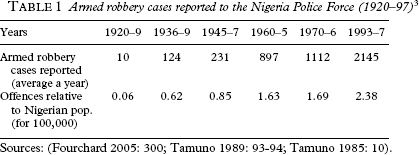
Sources: (Fourchard Reference Fourchard, Falola and Salm2005: 300; Tamuno 1989: 93–94; Tamuno 1985: 10).