Introduction
The flowers of the female hop plant (Humulus lupulus L.) are used mainly in the brewing industry to add bitterness and flavor to beer. They are a rich source of prenylated flavonoids. Xanthohumol (fig. 1) is the main prenylated flavonoid found in hops at a concentration of 0.1–1.0% of the cone dry mass (Stevens et al., Reference Stevens, Taylor and Deinzer1999), and it displays a wide range of biological activities, e.g.: antioxidant, antimicrobial, antiviral, antiplasmodial, antiinflammatory, antiangiogenic and anticancer activity (Stevens & Page, Reference Stevens and Page2004; Chadwick et al., Reference Chadwick, Pauli and Farnsworth2006; Zanoli & Zavatti, Reference Zanoli and Zavatti2008; Bartmańska et al., Reference Bartmańska, Tronina, Popłoński and Huszcza2013). Several recent studies showed that xanthohumol has chemo-preventive properties relevant to the suppression of cancer development at the initiation, promotion and progression phases (Strathmann & Gerhäuser, Reference Strathmann, Gerhäuser, Diederich and Noworyta2012). Xanthohumol is converted into the corresponding isomeric prenylflavanone isoxanthohumol (fig. 1) during the brewing process of beer. Although isoxanthohumol has a significantly better solubility than xanthohumol, its biological properties are not so promising (Bartmańska et al., Reference Bartmańska, Tronina, Popłoński and Huszcza2013).
Chemical structures of xanthohumol (1) and isoxanthohumol (2).

The high concentration and the external accumulation of xanthohumol in lupulin glands significantly facilitate the extraction of this lipophilic compound with chloroform or acetone (Stevens et al., Reference Stevens, Ivancic, Hsu and Deinzer1997). However, the most convenient source of xanthohumol is spent hops – waste product of the large scale hop-processing industry, generated during the extraction of hop cones with supercritical carbon dioxide, which is currently the most accepted solvent for the manufacture of hops extracts for the brewing industry. Carbon dioxide extracts (50°C, 280 bar) contain almost all essential oils present in hops, a high ratio of bitter acids, a small amount of other hops components and moreover, they lack traces of unpleasant solvents (Guo-qing et al., Reference Guo-qing, Hao-ping, Qi-he, Hui, Zhao-yue and Lonseny2005). The resulting spent hops can serve as suitable starting materials to obtain xanthohumol, because the extraction of hops with carbon dioxide under 300 bar causes polyphenols, including prenylflavonoids, to be retained almost quantitatively in the waste material.
Flavonoids play an important role in plant development and physiology, especially during plant interactions with other organisms (Iwashina, Reference Iwashina2003). They have been considered as factors of resistance to insects in several studies. They are involved in the constitutive as well as in the induced resistance phenomena. Some flavonoids act through direct toxicity while others affect insects as feeding deterrents or digestion inhibitors (Harborne & Grayer, Reference Harborne, Grayer and Harborne1993; Simmonds, Reference Simmonds2001, Reference Simmonds2003; War et al., Reference War, Paulraj, Ahmad, Buhroo, Hussain, Ignacimuthu and Sharma2012). Various hops extracts containing mainly hops bitter acids, β-acids and also spent hops extract were tested for their antifeedant activity against insects. These preparations were shown to be deterrent to mites (Jones et al., Reference Jones, Campbell, Hardie, Pickett, Pye and Wadhams2003), moths (Gökçe et al., Reference Gökçe, Stelinski, Whalon and Gut2009), aphids (Powell et al., Reference Powell, Hardie and Pickett1997; Dancewicz et al., Reference Dancewicz, Wiśniewska, Lagiera, Anioł and Gabryś2011) and beetles (Gökçe et al., Reference Gökçe, Isaacs and Whalon2012). Taking into account these data, the authors decided to examine whether the main prenylated flavonoid from hops – xanthohumol, and a supercritical carbon dioxide extract of spent hops – a waste material containing xanthohumol and isoxanthohumol as main flavonoid components, will exhibit deterrent activity against three selected species of insect stored product pests. Such results may have, in the foreseeable future, some applicative value for stored food and feed grain protection.
Materials and methods
Tested compounds and materials
Plant material
Cones (hops) of H. lupulus cv. ‘Magnum’ were collected in 2013 in Lublin region (SE Poland).
Chemical compounds studied in the experiment reported in this article
Xanthohumol (PubChem CID: 639665);
Isoxanthohumol (PubChem CID: 513197)
Xanthohumol (3′-[3,3-dimethylallyl]-2′,4′,4-trihydroxy-6′-methoxychalcone) was isolated according to Stevens et al. (Reference Stevens, Ivancic, Hsu and Deinzer1997) from supercritical carbon dioxide extracted hops, obtained in the Production of Hop Extracts of New Chemical Syntheses Institute, Puławy, Poland. Xanthohumol obtained for this study was identical with the standard (Alexis Biochemicals, Switzerland).
Spent hops
Extraction with supercritical carbon dioxide (SC CO2) was carried out using the high pressure pilot plant comprising two extractors of 40 l each, designed by Natex, Austria. The plant was designed to operate at a maximum pressure of 1000 bar and temperature 100°C, and at a maximum mass flow rate of SC CO2 of 220 kg h−1. The plant has two separators; one for high pressure separations up to 300 bar and the second up to 100 bar, usually 50–60 bar. Commercial carbon dioxide (99% purity, produced by Zakłady Azotowe, Puławy, Poland) was used for the extractions.
Supercritical carbon dioxide extract of spent hops
The spent hops were used as a raw material for extraction of xanthohumol. The following process parameters were used for the extraction: pressure – 850 bar, temperature − 80°C. The two-separator system has been used to collect the extract.
The extract analysis
The extract was dissolved in methanol and analysed by HPLC on Waters 2695 Alliance instrument with a photodiode array detector Waters 2996 (detection at 280 and 370 nm wavelength) using the analytical HPLC column Cosmosil Cholester 5 μm (4.6 × 250 mm) at the flow rate of 1 ml min−1. A linear solvent gradient from 45 to 95% aq MeOH containing 0.05% HCOOH over 39 min was used. Standards of xanthohumol and isoxanthohumol were purchased from Alexis Biochemicals (Switzerland).
Test insects and feeding deterrent activity tests
Insects
The tests of feeding deterrent activity were carried out using three species of stored product pests: Granary Weevil (Sitophilus granarius L.), Confused Flour Beetle (Tribolium confusum Duv.) and Khapra Beetle (Trogoderma granarium Everts). The species had been selected originally by Nawrot et al. (Reference Nawrot, Bloszyk, Harmatha, Novotny and Drozdz1986), for their stored product pest status and are recognized since then as a kind of standard set of model organisms used for screening the deterrent activity of chemical compounds (see Nawrot et al., Reference Nawrot, Dams and Wawrzeńczyk2009). Granary Weevil and Confused Flour Beetle are cosmopolitan, synanthropic species that occur only indoor in a temperate climate. S. granarius L. is feeding on stored grain of wheat, barley, rye, oats, millet and maize, as well as on buckwheat. T. confusum Duv. also feeds on flour, cereal bran and on dried bread. The reason for including T. granarium Everts is its tropical origin, as this fact broadens the possible scope of information about the activity of tested compounds and may render the results of the experiments important also for the regions to which this species is native. Nonetheless, T. granarium Everts is repeatedly reported from storage facilities in Poland as an introduced species. Although it does not complete its development outdoor for its high thermal requirements, it is an important pest of stored grain. (Coleoptera Poloniae. Information System about Beetles of Poland – KFP (Catalogue of Fauna of Poland). Database browser 2011, accessed in July 2014).
The insects were reared in permanent darkness in climatic chambers. S. granarius L. was reared at 26 ± 1°C, T. confusum Duv. – at 30 ± 1°C and T. granarium Everts – at 31 ± 1°C. The relative humidity in all the chambers was maintained at 60 ± 5%. S. granarius L. was reared on wheat grain cv. NATULA, whereas T. confusum Duv. and T. granarium Everts – on commercially available oat flakes of the brand Górskie (Stoisław Mills, Poland), mixed at equal proportion with oat flour (VITACORN, Poznań, Poland). The temperature and humidity during the tests were always identical to those of the rearing conditions and the tests were also carried out in darkness.
Wheat wafer test
Wheat wafer disk bioassay, as described by Nawrot et al. (Reference Nawrot, Bloszyk, Harmatha, Novotny and Drozdz1986, Reference Nawrot, Dams and Wawrzeńczyk2009), was used to test the feeding deterrent activity of the purified xanthohumol and that of spent hops extract. The wheat wafer used in this method is produced of wheat flour and water in the process which does not involve extensive heating and baking as in the majority of bakery products. It also does not contain any additional materials such as fats or monosaccharides and in this sense it may distantly ‘resemble’ the main constituents of wheat grain, yet without a number of features typical for living biological material, to mention only respiration. The authors of the manuscript had made an assumption that the wafer is an inert, homogenous substrate, suitable for testing the biological activity of different target compounds in the most fundamental context, i.e., unaffected by any possible interactions with the treated material, as might be expected in the case of tests carried out on true grain. The compound or the extract was tested as 1.0% ethanol solutions. The wheat wafer disks of 1 cm diameter were dipped in the ethanol solution of the compound, in the extract or in the absolute ethanol (reference) using pincers, and placed on large glass Petri dishes, treatment and reference separately, in order to air-dry. After 30 min of drying, which allowed for the ethanol evaporation, the disks were weighed and placed on polystyrene Petri dishes of 90 mm diameter. After the weighing of the disks in all the treatments have been completed, the test insects, beetles or larvae, depending on the species, were placed on the Petri dishes which were then covered and placed in climate chamber conditions appropriate for the test species of insect used. All the insects necessary for one test had been always collected from their cultures 1–2 h before the beginning of the test and kept until that time in polyethylene tubes of 35 mm diameter and 60 mm height, loosely closed with a polyethylene screw-cap. Therefore transferring them all on the test dishes with wafers took <5 min per one test set, and it was possible that they started feeding at almost the same time. The tests were carried out in 5 replicates. In a single replicate 3 adults of S. granarius L. were used, or 20 adults or 10 larvae of T. confusum Duv., or 10 larvae of T. granarium Everts, following the test description by Nawrot et al. (Reference Nawrot, Dams and Wawrzeńczyk2009).
The originally designed number of different insects and instars used in a single replicate reflects their body mass and voracity, and it makes it possible that the depletion of the wafer mass after the test is detectable and measurable. For instance, the mean body weight of adult Granary Weevil amounts to approximately 3.12 mg (n = 26), whereas that of the Confused Flour Beetle – to 1.68 mg (n = 21). An example consumption of the untreated wafer per one insect, estimated by the authors of the presented study in different tests, oscillates between 1.88 mg ± 0.1853 and 2.04 mg ± 0.3131 (n = 15) for the Granary Weevil and may range from 0.79 mg ± 0.1045 to 1.07 ± 0.1358 (n = 15) for the Confused Flour Beetle.
Unsexed, 7–10-day-old adults or 5–30-day-old larvae were used for each test. After 120 h the insects were quickly removed from the Petri dishes and the remnants of the wheat wafers were weighed again.
The tests were conducted in a three part run simultaneously: reference (two pure wheat wafers treated with solvent), choice test (one pure solvent-treated wafer and one compound solution-treated wafer) and no-choice test (two compound solution-treated wafers). Based on the depletion of the wafers’ weight during the test time three indices of the compound activity were calculated, following the formulae used by Nawrot et al. (Reference Nawrot, Bloszyk, Harmatha, Novotny and Drozdz1986): relative (R), absolute (A) and total (T) deterrency coefficient, where:
 $$R = C - E{\rm} /C + E \times {\rm 1}00\,\,({\rm choice}\,\,{\rm test}),$$
 $$A = CC - EE/CC + EE \times {\rm 1}00\,\,({\rm no} - {\rm choice}\,\,{\rm test}),$$
 $$T = A + R,$$
and C, CC is the consumed amount of the reference disks (C stands for ‘control’, as reference is named in Nawrot et al.,); whereas E, EE is the consumed amount of the disks treated with the tested compound. C and E markings refer to choice test (one wafer of each kind in a single replicate), whereas CC and EE markings refer to reference and to the no-choice test, respectively (two wafers of the same kind in a single Petri dish).
The T coefficient is the only parameter actually taken into account as the measure of a compound activity. T values may range between −200 and +200. T values within the intervals 151–200 and 101–150 indicate very good and good deterrent activity, respectively. Compounds with values of T within the range of 51–100 show medium deterrent activity and those showing T lower than 50 are weak deterrents. The negative value of T coefficient indicates attractancy, whereas R and A values should not be interpreted alone as proving deterrency or attractancy.
In case of ambiguous results another five-replicate test was set, following the original one as soon as possible, and all the resulting data were then analysed collectively. At three such occasions during the whole testing cycle it also appeared judicious to exclude one or two replicates from the analysis, based on their detached position relative to the other data points within the same treatment. Since each time this had been the case at which another five replicates were prepared, the single treatment analysed never had <5 replicates.
Statistical analysis
The total deterrence coefficient (T) was used as the index of the biological activity of the tested materials. Kruskal–Wallis (K–W) analysis of ranks and Kolmogorov–Smirnov (K–S) two-sample test, as available in Statistica 10 package (StatSoft, Inc. 1984–2011), were used to analyse the data.
Results and discussion
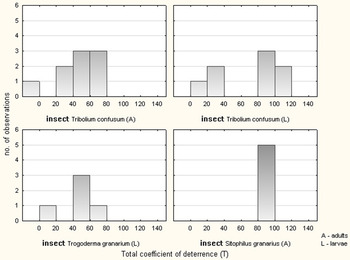
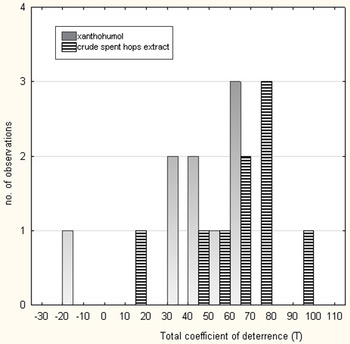
The results of the feeding deterrent activity tests are presented in tables 1 and 2. For convenience, the means and standard deviations (SD) are given. However, as the Levene test of the homogeneity of variances indicated significant differences between the variances of the calculated T values (F = 4.02, P = 0.0195), the data were analysed using K–W analysis of ranks, a non-parametric equivalent to ANOVA. Thus actually the means in the tables represent only the groups of data that were nevertheless analysed using other measures, non-related to the position of sample mean but relevant to the data distribution within a sample. For that reason both tables are accompanied by histograms which better illustrate the nonparametric statistics used (figs 2 and 3). Also, the additional percent values given in the text below but not found in tables 1 and 2 refer to the percentage of the treated wafer mass left in the Petri dishes by the end of the choice test (1st value) and no-choice test (2nd value).
Deterrent activity of xanthohumol in four tested organisms as estimated by the total deterrency coefficient (T).

Deterrent activity of xanthohumol and crude hops extract in adults of Tribolium confusum Duv. as estimated by the total deterrency coefficient (T). The distributions of T value differ significantly between xanthohumol and crude extract, according to Kolmogorov–Smirnov two-sample test, P < 0.05.

Values of feeding deterrent coefficients for xanthohumol in different test insects.

1 Relative (R), absolute (A) and total (T) deterrency coefficients.
2 Number of replicates.
The groups represented by mean values in T column, marked with different small letters, differ significantly; Kruskal–Wallis test; H = 8.787478, P = 0.0323.
Values of feeding deterrent coefficients for xanthohumol and for hops extract; test insect: adults of Tribolium confusum Duv.

1 Relative (R), absolute (A) and total (T) deterrency coefficients.
2 Number of replicates.
Means in T column differ significantly; Kolmogorov–Smirnov two-sample test, P < 0.05.
The data specified in table 1 show that, according to the applied scale of T values, pure xanthohumol has medium deterrent activity against the adults of S. granarius L. and the larvae of T. confusum Duv. (T = 90.4; T = 69.1, respectively, table 1) (98.4, 86.6 and 96.2%, 95.6% of the wafer mass left, respectively). Moreover, the test indicates that in T. confusum Duv. the larvae are still more sensitive to xanthohumol compared to adults, which are only weakly deterred from the treated substrate (T = 43.4, table 1) (78.9%, 62.59%). Conversely, it is the larvae of T. granarium Everts that show only a weak response to the presence of xanthohumol in their food (T = 48.7, table 1) (85.9%, 86.09).
Independently of the calculated deterrency coefficients, the distribution of data points which is, contrary to the mean value, the genuine trait analysed by the K–W analysis of ranks, apparently shows that it is only in S. granarius L. where the response to xanthohumol is consistent (fig. 2). In the two other species the replicate values of T coefficient are more scattered (fig. 2) and this is why no significant differences can be demonstrated between these distributions (table 1).
Nawrot et al. (Reference Nawrot, Bloszyk, Harmatha, Novotny and Drozdz1986) did not use significance tests to analyse their data in 1986, whereas the same author working with another team (Nawrot et al., Reference Nawrot, Dams and Wawrzeńczyk2009) applied one-way ANOVA to compare the mean coefficient values of 21 different compounds and their mixtures across three test insect species. In the first stage of the present study only one compound was tested (xanthohumol), and the response of three test organisms was compared. Hence, the present study is more about three insect species, the response of which to a certain compound was tested, rather than about a number of compounds, the activity of which would be determined in a small number of test organisms. In this simple experimental design the T coefficient and its distribution per se provide an adequate and robust view of the obtained results. The authors consider the use of the significance test as an auxiliary tool in the data analysis.
Taking into account the economic aspect of the use of hops flavonoids for the control of the stored product pests, the authors decided to test, on a species and instar which was responding weakly to pure xanthohumol, the crude preparation obtained by the extraction of spent hops with the supercritical carbon dioxide. The preparation contained 1.23% of xanthohumol and 0.22% of isoxanthohumol and it was tested on the adults of T. confusum Duv. Supercritical carbon dioxide extract of spent hops exhibited stronger deterrent activity against the beetles of T. confusum Duv. (T = 63.0, table 2) (82.4%, 57.3% of the wafer mass left) than pure xanthohumol (T = 43.4, table 2) (78.9%, 62.6%). The difference between the T values for each treatment was statistically significant (K–S two-sample test) (table 2, fig. 3).
In the presented experiment, a stronger deterrent activity of the crude spent hops extract has been demonstrated in one of the test insects, compared to the action of the main flavonoid component of that extract – xanthohumol – when applied as a pure ingredient. For that reason it appears reasonable to test, in the future, the remaining components of the crude extract, in order to pick out the ones responsible for deterrent action stronger than that of xanthohumol. On the other hand, it may be suggested that the crude spent hops extract should be used in stored product protection, in case further research confirms its deterrent activity in actual storage situations. The level of deterrency that would be sufficient for effective grain protection is difficult to assess based on the present results, i.e., the results of the test carried out on material other than the target product, and using ethanol solutions. Hence, the presented study does not aim at its precise determination. Finding out that level requires a study that would quantify the deterrent effect in terms of mass or quality depletion of the product in question, observed in semi-laboratory conditions and later in field situations (i.e., in true storage facility). Such a study would require as well that application methods and some kind of formulation is tested, designed so that the nutritional quality of the stored product is not compromised. In the authors’ view, the level of deterrence demonstrated in the present study, combined with the current knowledge of the positive biological activities, exhibited in humans by both xanthohumol and primary hops extract (Larson et al., Reference Larson, Yu, Rosa, Lee, Olga, Price, Haas and Johnson1996; Stevens & Page, Reference Stevens and Page2004; Biendl, Reference Biendl2007), makes such an endeavour worth trying. The prospective target product for such application would be stored grain, as cereals are the main staple food worldwide.
Conclusions
Xanthohumol and supercritical carbon dioxide extract of spent hops were shown to possess considerable antifeedant activity against two insects studied: S. granarius L. and T. confusum Duv. To the best of the authors’ knowledge, the presented study represents the first report on the antifeedant activity of that main hops prenyl flavonoid against stored product pests.
Potential application of the crude spent hops extract as a feeding deterrent against the stored product pests may be suggested. This, however, should be preceded by properly designed semi-laboratory and field (i.e., in true storage facility) research.
Acknowledgements
The complete method of the wheat wafer disk bioassay and the cultures of the test organisms had been transferred, in December 2012, to the authors of the present article from the laboratory managed by Jan Nawrot at the Department of Entomology of the Plant Protection Institute – National Research Institute in Poznań, Poland, which the authors kindly acknowledge.