

Introduction
The development of practical procedures for artificial insemination (AI) in Russia lead the establishment of dairy AI cooperatives in Europe and the United States (US) between 1933-1938 (Ombelet and Van Robays, Reference OMBELET and VAN ROBAYS2015). After 1953, the dairy industry needed longer-term bull sperm storage, and this resulted in research into sperm cryopreservation (Walters et al., Reference WALTERS, BENSON, WOODS and CRITSER2009). The first important factor in sperm freezing was the discovery of glycerol by Polge et al. (Reference POLGE, SMITH and PARKES1949) cited in Pegg (Reference PEGG2002) and Walters et al. (Reference WALTERS, BENSON, WOODS and CRITSER2009). This was supported by the introduction of a simple method of preserving human sperm by using glycerol, reported by Dr Jerome K Sherman in 1955 (Ombelet and Van Robays, Reference OMBELET and VAN ROBAYS2015). Sherman showed, for the first time, that frozen sperm were able to fertilise an egg after thawing, resulting in normal development. Over time, cryopreservation became an important technique for maintaining genetic diversity and the preservation of genetic resources. Several techniques have been developed to prevent the loss of genetic resources. Among these techniques, poultry semen cryopreservation is considered to be a challenging method to preserve reproductive cells (Blesbois, Reference BLESBOIS2011; Kowalczyk and Łukaszewicz, Reference KOWALCZYK and ŁUKASZEWICZ2015).
In most mammalian species, reasonable fertility rates have been obtained after the insemination of thawed sperm cells. In poultry, however, semen cryopreservation has not been as successful (Blesbois, Reference BLESBOIS2011; Reference BLESBOIS2012; Blesbois and Brillard, Reference BLESBOIS and BRILLARD2007), since fertility, after the freezing/thawing process of poultry sperm, is inconsistent and significantly lower than that seen in mammalian species (Long, Reference LONG2006). This makes frozen poultry semen not reliable enough to be used in artificial insemination programs. In particular, the fertility of frozen tom turkey semen is considerably lower than that of rooster semen. Consequently, the turkey industry is more dependent on insemination with fresh semen.
The aim of this paper was to review the present condition of poultry semen cryopreservation and the possible reasons for its lower fertility.
Poultry semen cryopreservation
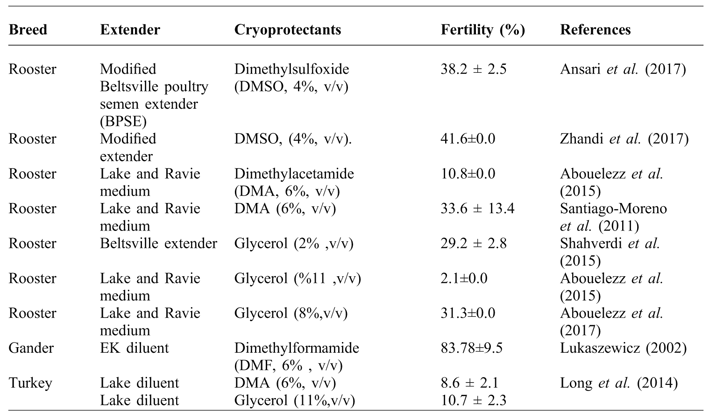
Currently, semen cryopreservation has only been commercially applied in the cattle industry, where semen cryopreservation has been optimised, standardised and automated. However, the extent of success in sperm cryopreservation has not been achieved for other livestock mammalians, such as pigs and sheep (Holt, Reference HOLT2000). In poultry, semen cryopreservation has not been successful, mainly because the poor fertility rates reported with frozen/thawed poultry, whereby sperm counts are extremely low, highly variable, and not sufficiently reliable (Table 1) in commercial production or the preservation of genetic resources (Donoghue and Wishart, Reference DONOGHUE and WISHART2000; Hammerstedt and Graham, Reference HAMMERSTEDT and GRAHAM1992; Wishart, Reference WISHART1985).
Fertility of poultry semen reported after freezing in different extenders containing different cryoprotectants in different concentrations.

Therefore, the freezing of chicken semen is still in the experimental phase and is not yet sufficiently advanced for practical application in the poultry industry (Blesbois et al., Reference BLESBOIS, SEIGNEURIN, GRASSEAU, LIMOUZIN, BESNARD, GOURICHON, COQUERELLE, RAULT and TIXIER-BOICHARD2007; Wishart, Reference WISHART1985). The fertility problem with frozen semen is much more worse in turkeys (Table 1). Overall fertility rates of cryopreserved turkey sperm cells are considerably lower than that of frozen/thawed chicken sperm cells (Kurbatov et al., Reference KURBATOV, NARUBINA, BUBLIAEVA, TSELUTIN, MAVRODINA, TUR and KOSIANENKO1986; Nelson et al., Reference NELSON, GRAHAM and SCHMEHL1980; Schramm and Hubner, Reference SCHRAMM and HUBNER1988; Sexton, Reference SEXTON1981; Wishart, Reference WISHART1989). Therefore, AI in turkey depends on the availability of fresh semen, while it is less often employed in chickens (Blanch et al., Reference BLANCH, TOMÁS, CASARES, GÓMEZ, SANSANO, GIMÉNEZ and MOCÉ2014). Turkeys are heavy birds, and the large white strains of males can weigh over 33 kg compared to hens weighing approximately 9 kg. Therefore, natural mating results in low fertility in this strain, which is the reason for the integration of AI in commercial turkey enterprises (Donoghue and Wishart, Reference DONOGHUE and WISHART2000).
Why is cryopreservation of poultry semen not successful?
The fertility of frozen poultry semen is dramatically lower as compared to that of fresh semen. The reason why freezing/thawing decreases the fertility rate of poultry semen is not completely understood, but might be related to the unique morphological and physiological features of poultry sperm cells (Cecil and Bakst, Reference CECIL and BAKST1993; Cerolini et al., Reference CEROLINI, KELSO, NOBLE, SPEAKE, PIZZI and CAVALCHINI1997).
differences between poultry and mammalian sperm cells
Poultry sperm cells are morphologically different from mammalian sperm cells. The morphology of sperm cells from different poultry species (such as chickens, turkeys, drakes, and ganders) is similar, however. Therefore, the damage to their spermatozoa during freezing/thawing should be the same, although chicken and turkey sperm cells are metabolically different from each other (Lake and Wishart, Reference LAKE and WISHART1984).
The filiform shape of the poultry sperm head is not much wider in diameter than the tail (Thurston and Hess, Reference THURSTON and HESS1987). Therefore, sperm heads have less cytoplasmic volume, and this means they have less ability to move in the cryoprotectants (CPA). Poultry sperm have a relatively long tail (between 90-100 µm; Thurston and Hess (Reference THURSTON and HESS1987)) compared to bull spermatozoa (Salisbury and Vandemark, Reference SALISBURY and VANDEMARK1961). Such long-tailed sperm cells are easily damaged during freezing/thawing. According to previous studies, during the cryopreservation and thawing process, the ultrastructure of poultry sperm cells is damaged, especially the mitochondria, midpiece, and perforatorium (Xia et al., Reference XIA, LALLI, ANSAH and BUCKLAND1988). Electron microscopy has shown that 60% of poultry sperm organelles suffered irreversible damage after cryopreservation (Bakst and Sexton, Reference BAKST and SEXTON1979).
membrane fluidity
The sperm plasma membrane is composed of lipids, cholesterol and proteins. Cholesterol has major effects on sperm by regulating membrane stability, the acyl chains order of phospholipids, and the consequent regulation and control of numerous membrane properties and functions, including membrane thickness, fluidity, and permeability to water and other molecules. It influences phase transitions and maintains a favourable micro-environment for membrane proteins (Crockett, Reference CROCKETT1998; Müller et al., Reference MÜLLER, MÜLLER, PINCEMY, KURZ and LABBE2008).
The resistance of sperm cells to cryopreservation has been verified by the membrane phospholipid content and fluidity (Holt, Reference HOLT2000). Fluidity of poultry sperm is closely related to the cholesterol/phospholipids ratio of the membrane (Holt, Reference HOLT2000) and is an indication of sperm freezability (Blesbois et al., Reference BLESBOIS, GRASSEAU and SEIGNEURIN2005). It has been hypothesised that a high cholesterol content of the sperm plasma membrane is associated with a low freezing tolerance in mammals (Müller et al., Reference MÜLLER, MÜLLER, PINCEMY, KURZ and LABBE2008), while in poultry, the lower freezing tolerance of sperm cells is associated with lower concentrations of cholesterol and a lower fluidity of the plasma membrane (Blesbois et al., Reference BLESBOIS, GRASSEAU and SEIGNEURIN2005).
Membrane fluidity can be determined by the measurement of fluorescence polarisation anisotropy via fluorescent dye. Anisotropy values correspond to membrane rigidity and are inversely related to membrane fluidity (Blesbois et al., Reference BLESBOIS, GRASSEAU and SEIGNEURIN2005). According to previous studies, anisotropy values are highest in guinea fowl (0.205), lowest in chickens (0.155), and intermediate in turkeys (0.180). As a result, membrane fluidity is highest in chickens, intermediate in turkeys, and lowest in guinea fowl (Blesbois et al., Reference BLESBOIS, GRASSEAU and SEIGNEURIN2005).
The effect of cholesterol on membrane fluidity depends on the temperature. At temperatures above phase transition, high cholesterol in the plasma membrane decreases membrane fluidity, making sperm cells more susceptible to cold shock and reducing their ability to survive after freezing/thawing (Blesbois et al., Reference BLESBOIS, GRASSEAU and SEIGNEURIN2005; Buffone et al., Reference BUFFONE, VERSTRAETEN, CALAMERA and DONCEL2009; Darin-Bennett and White, Reference DARIN-BENNETT and WHITE1977; Partyka et al., Reference PARTYKA, BONARSKA-KUJAWA, SPORNIAK, STROJECKI and NIŻAŃSKI2016). At temperatures below phase transition, cholesterol increases membrane fluidity. This bimodal effect of cholesterol is more significant in membranes rich in saturated phospholipids as compared with those containing unsaturated ones (Crockett, Reference CROCKETT1998; Mocé et al., Reference MOCÉ, BLANCH, TOMÁS and GRAHAM2010a). It has been reported that increasing membrane fluidity and permeability may reduce the volume of intra-cellular ice formation at temperatures above the phase transition, which can minimise freezing damage (Partyka et al., Reference PARTYKA, BONARSKA-KUJAWA, SPORNIAK, STROJECKI and NIŻAŃSKI2016). In addition, the removal of cholesterol from the chicken sperm prior to freezing has resulted in the highest fluidity measured at 5°C (Partyka et al., Reference PARTYKA, BONARSKA-KUJAWA, SPORNIAK, STROJECKI and NIŻAŃSKI2016).
polyunsaturated fatty acids in membranes
Cryopreservation causes a dramatic reduction in the fertility of poultry semen because of a high polyunsaturated/saturated fatty acid ratio in the plasma membrane, which makes poultry sperm relatively vulnerable to cold shock (Darin-Bennett and White, Reference DARIN-BENNETT and WHITE1977; Santiago-Moreno et al., Reference SANTIAGO-MORENO, CASTAÑO, TOLEDANO-DÍAZ, COLOMA, LÓPEZ-SEBASTIÁN, PRIETO and CAMPO2012). Polyunsaturated fatty acids in the poultry sperm membrane can easily undergo lipid peroxidation (LPO) when reactive oxygen species (ROS) are present in the freezing medium (Cerolini et al., Reference CEROLINI, ZANIBONI, MALDJIAN and GLIOZZI2006; Shahverdi et al., Reference SHAHVERDI, SHARAFI, GOURABI, YEKTA, ESMAEILI, SHARBATOGHLI, JANZAMIN, HAJNASROLLAHI and MOSTAFAYI2015; Surai et al., Reference SURAI, BLESBOIS, GRASSEAU, CHALAH, BRILLARD, WISHART, CEROLINI and SPARKS1998).
Cryopreservation increases reactive oxidising species (ROS) production in the freezing media and ROS can attack the bis-allylic methylene group of plasma membrane phospholipids, leading to LPO (Agarwal et al., Reference AGARWAL, VIRK, ONG and DU PLESSIS2014; Aitken et al., Reference AITKEN, SMITH, JOBLING, BAKER and DE IULIIS2014; Nguyen et al., Reference NGUYEN, SEIGNEURIN, FROMENT, COMBARNOUS and BLESBOIS2015) and subsequent sperm plasma membrane damage. Membrane damage is an important factor causing sperm death during the freezing/thawing process (Morris et al., Reference MORRIS, ACTON, MURRAY and FONSECA2012). LPO causes sub-structural damage in sperm (Aitken et al., Reference AITKEN, BUCKINGHAM, CARRERAS and IRVINE1996; Long, Reference LONG2006). Increased ROS production reduces the phosphorylation of axoneme proteins, resulting in a decrease in membrane fluidity. Membrane fluidity is an indicator of sperm freezability in poultry species (Blesbois et al., Reference BLESBOIS, GRASSEAU and SEIGNEURIN2005) and is important for sperm-oocyte conjugation (Moghbeli et al., Reference MOGHBELI, KOHRAM, ZARE-SHAHANEH, ZHANDI, SHARAFI, NABI, ZAHEDI and SHARIDEH2016). Consequently, all these factors result in the immobility of sperm cells.
High amounts of ROS in the freezing media damage sperm DNA (Duru et al., Reference DURU, MORSHEDI and OEHNINGER2000; Fanaei et al., Reference FANAEI, KESHTGAR, BAHMANPOUR, GHANNADI and KAZERONI2011; Hu et al., Reference HU, LI, LI, CHEN, HAI-YANG, ZHANG and WANG2006; Khan, Reference KHAN2011). Experimental studies have shown that antioxidants prevent the decrease in sperm motility and DNA fragmentation (Greco et al., Reference GRECO, ROMANO, IACOBELLI, FERRERO, BARONI, MINASI, UBALDI, RIENZI and TESARIK2005; Khan et al., Reference KHAN, RAHMAN, NIKOUSEFAT, JAVDANI, LAUDADIO and TUFARELLI2012b; Kopena et al., Reference KOPENA, MARTÍN, LÓPEZ and HERCZEG2011). Normally, antioxidant systems such as glutathione peroxidase, catalase, superoxide dismutase, vitamin E, and vitamin C are present in poultry semen (Khan et al., Reference KHAN, RAHMAN, JAVED and MUHAMMAD2013) to prevent the damage imposed by ROS, but the activity of such compounds is considerably decreased by cryopreservation (Partyka et al., Reference PARTYKA, ŁUKASZEWICZ and NIŻAŃSKI2012).
commonly used CPA are harmful to poultry sperm
The first important step in successful poultry semen cryopreservation is the choice of the cryoprotectants and its use during the process. Commonly used cryoprotectans are glycerol (GLY) (Abouelezz et al., Reference ABOUELEZZ, SAYED and SANTIAGO-MORENO2017; Shahverdi et al., Reference SHAHVERDI, SHARAFI, GOURABI, YEKTA, ESMAEILI, SHARBATOGHLI, JANZAMIN, HAJNASROLLAHI and MOSTAFAYI2015), dimethylacetamide (DMA) (Abouelezz et al., Reference ABOUELEZZ, CASTAÑO, TOLEDANO-DÍAZ, ESTESO, LÓPEZ-SEBASTIÁN, CAMPO and SANTIAGO-MORENO2015; Santiago-Moreno et al., Reference SANTIAGO-MORENO, CASTAÑO, TOLEDANO-DÍAZ, COLOMA, LÓPEZ-SEBASTIÁN, PRIETO and CAMPO2011), dimethylsulphoxide (DMSO) (Ansari et al., Reference ANSARI, ZHANDI, KOHRAM, ZAGHARI, SADEGHI and SHARAFI2017; Zhandi et al., Reference ZHANDI, ANSARI, ROKNABADI, ZARE SHAHNEH and SHARAFI2017) and dimethylformamide (DMF) (Lukaszewicz, Reference LUKASZEWICZ2002) (Table 1). However, these CPA are toxic (GLY, DMA and DMSO) for poultry sperm. GLY is the least toxic cryoprotectant, but it has contraceptive activity (Blesbois, Reference BLESBOIS2011; Lake, Reference LAKE1986), although the underlying mechanism has not yet been clarified. One possible reason might be the decreased acrosome reaction of sperm. According to a previous study, a major reduction occurred in the ability of sperm cells to undergo the acrosome reaction immediately after the supplementation of CPA. The damage caused by GLY was more dramatic than that caused by DMA. The decrease in acrosome reaction was more pronounced than the decrease in motility and in the membrane integrity of sperm cells. CPA had considerably more harmful effects than cryopreservation, especially when GLY was used in combination with slow-freezing (Mocé et al., Reference MOCÉ, GRASSEAU and BLESBOIS2010b). According to empirical studies, the combined introduction of sperm cells and GLY into the vagina prevents fertilisation if the final concentration of GLY is over 2% (Blesbois, Reference BLESBOIS2011; Lake, Reference LAKE1986). Increasing the GLY concentration to 4% or greater resulted in almost no fertilized eggs (Abouelezz et al., Reference ABOUELEZZ, CASTAÑO, TOLEDANO-DÍAZ, ESTESO, LÓPEZ-SEBASTIÁN, CAMPO and SANTIAGO-MORENO2015) . Therefore, prior to intra-vaginal insemination, GLY has to be removed (Hammerstedt and Graham, Reference HAMMERSTEDT and GRAHAM1992; Polge, Reference POLGE1951; Tajima et al., Reference TAJIMA, GRAHAM and HAWKINS1989).
Preferred methods of GLY removal involve centrifugation through a discontinuous Accudenz column, direct centrifugation and stepwise dilution with a GLY-free medium (Purdy et al., Reference PURDY, SONG, SILVERSIDES and BLACKBURN2009). These methods are time-consuming and decrease the fertility rate of sperm cells due to the osmotic and physical damage associated with the removal of glycerol (Hammerstedt and Graham, Reference HAMMERSTEDT and GRAHAM1992). Because of this, DMA has been proposed as an alternative cryoprotectant due to the its non-contraceptive effects (Bacon et al., Reference BACON, SALTER, MOTTA, CRITTENDEN and OGASAWARA1986; Blesbois et al., Reference BLESBOIS, SEIGNEURIN, GRASSEAU, LIMOUZIN, BESNARD, GOURICHON, COQUERELLE, RAULT and TIXIER-BOICHARD2007; Chalah et al., Reference CHALAH, SEIGNEURIN, BLESBOIS and BRILLARD1999; Woelders et al., Reference WOELDERS, ZUIDBERG and HIEMSTRA2006).
DMA does not need to be removed from the frozen/thawed sperm (Blesbois et al., Reference BLESBOIS, SEIGNEURIN, GRASSEAU, LIMOUZIN, BESNARD, GOURICHON, COQUERELLE, RAULT and TIXIER-BOICHARD2007; Chalah et al., Reference CHALAH, SEIGNEURIN, BLESBOIS and BRILLARD1999; Woelders et al., Reference WOELDERS, ZUIDBERG and HIEMSTRA2006), thereby avoiding sperm damage and resulting in greater fertility. However, in roosters, fertility did not differ between intra-vaginal insemination of sperm cells cryopreserved with GLY or DMA. Only intramagnal insemination of DMA-preserved sperm cells resulted in higher fertility levels than insemination of GLY-preserved sperm cells (Purdy et al., Reference PURDY, SONG, SILVERSIDES and BLACKBURN2009).
In the hen genital tract, egg yolk (EY) has a contraceptive effect (Santiago-Moreno et al., Reference SANTIAGO-MORENO, CASTAÑO, TOLEDANO-DÍAZ, COLOMA, LÓPEZ-SEBASTIÁN, PRIETO and CAMPO2012). Consequently, the fertility rate in chickens is reduced due to the use of EY in extenders and preservatives (Fewlass et al., Reference FEWLASS, SEXTON and SHAFFNER1975; Harris Jr, 1968; Jasper, Reference JASPER1950; Wilcox, Reference WILCOX1960). Experimental studies have shown that the dilution of rooster semen with chicken EY adequately protected rooster sperm from cold shock during cooling, freezing, and thawing, but EY-treated sperm cells could not fertilise any eggs. The biochemical mechanisms behind the contraceptive effect of EY are still not understood (Fuller, Reference FULLER2004; Santiago-Moreno et al., Reference SANTIAGO-MORENO, CASTAÑO, TOLEDANO-DÍAZ, COLOMA, LÓPEZ-SEBASTIÁN, PRIETO and CAMPO2012).
Strategies used for better fertility results
In contrast to the fertility rate of cryopreserved mammalian sperm, the fertility rate of cryopreserved poultry sperm is significantly lower (Long, Reference LONG2006), constraining its commercial use. Therefore, different strategies, such as the use of different kinds of CPAs (Abouelezz et al., Reference ABOUELEZZ, CASTAÑO, TOLEDANO-DÍAZ, ESTESO, LÓPEZ-SEBASTIÁN, CAMPO and SANTIAGO-MORENO2015; Mocé et al., Reference MOCÉ, GRASSEAU and BLESBOIS2010b), the use of different numbers of sperm cells (Zaniboni et al., Reference ZANIBONI, CASSINELLI, MANGIAGALLI, GLIOZZI and CEROLINI2014), manipulation of the cryoprotectant concentration (Abouelezz et al., Reference ABOUELEZZ, CASTAÑO, TOLEDANO-DÍAZ, ESTESO, LÓPEZ-SEBASTIÁN, CAMPO and SANTIAGO-MORENO2015), different cooling rates (Madeddu et al., Reference MADEDDU, MOSCA, SAYED, ZANIBONI, MANGIAGALLI, COLOMBO and CEROLINI2016), packaging systems (pellets, vials, or straws) (Blesbois et al., Reference BLESBOIS, SEIGNEURIN, GRASSEAU, LIMOUZIN, BESNARD, GOURICHON, COQUERELLE, RAULT and TIXIER-BOICHARD2007; Mocé et al., Reference MOCÉ, BLANCH, TOMÁS and GRAHAM2010a; Tselutin et al., Reference TSELUTIN, SEIGNEURIN and BLESBOIS1999) and the addition of antioxidants to poultry semen (Amini et al., Reference AMINI, KOHRAM, SHAHANEH, ZHANDI, SHARIDEH and NABI2015a; Lotfi et al., Reference LOTFI, MEHRI, SHARAFI and MASOUDI2017; Safa et al., Reference SAFA, MOGHADDAM, JOZANI, KIA and JANMOHAMMADI2016) have been used to increase the fertility rate for commercial use.
The most commonly used CPAs are GLY and the DMA (Abouelezz et al., Reference ABOUELEZZ, SAYED and SANTIAGO-MORENO2017). Experimental studies have shown that higher fertility rates could be obtained when the semen was mixed with DMA and frozen in a pellet form by directly plunging it into liquid nitrogen (Abouelezz et al., Reference ABOUELEZZ, SAYED and SANTIAGO-MORENO2017; Tselutin et al., Reference TSELUTIN, SEIGNEURIN and BLESBOIS1999). Alternatively, sperm cells could be mixed with GLY and slow-frozen in straws (Blesbois et al., Reference BLESBOIS, SEIGNEURIN, GRASSEAU, LIMOUZIN, BESNARD, GOURICHON, COQUERELLE, RAULT and TIXIER-BOICHARD2007; Long and Kulkarni, Reference LONG and KULKARNI2004; Seigneurin and Blesbois, Reference SEIGNEURIN and BLESBOIS1995). However, the practical identification of semen samples frozen with DMA in pellets is difficult, as this method is prone to cross contamination (Wishart, Reference WISHART2009). Therefore, the use of straws and slow-freezing is more suitable and is required by Food and Agriculture Organization of the United Nations (FAO) guidelines (FAO, 2011).
As GLY has a contraceptive effect on avian sperm, avian semen must undergo further processing to reduce GLY before use. The mechanical damage associated with GLY removal was more harmful to fertilising capacity than the toxicity of DMA and freezing/thawing (Abouelezz et al., Reference ABOUELEZZ, SAYED and SANTIAGO-MORENO2017). Therefore, freezing the poultry semen both with DMA in pellets or with GLY in straw results in a small portion of thawed live sperm with a lower fertilizing ability compared with that of semen samples immediately after collection (Abouelezz et al., Reference ABOUELEZZ, SAYED and SANTIAGO-MORENO2017).
Poultry sperm cell membranes contain higher quantities of n-6 polyunsaturated fatty acids, including arachidonic (20:4n-6) and docosatetraenoic (22:4n-6) acids, than the membrane of mammalian sperm cells (Amini et al., Reference AMINI, KOHRAM, ZARE-SHAHANEH, ZHANDI, SHARIDEH and NABI2015b). This makes poultry sperm cells extremely vulnerable to LPO by ROS produced by the cellular components of semen during freezing (Nguyen et al., Reference NGUYEN, SEIGNEURIN, FROMENT, COMBARNOUS and BLESBOIS2015). Experimental studies have shown that LPO causes irreversible damage to DNA and decreases sperm mobility and fertility in the freezing/thawing process (Amini et al., Reference AMINI, KOHRAM, SHAHANEH, ZHANDI, SHARIDEH and NABI2015a; Reference AMINI, KOHRAM, ZARE-SHAHANEH, ZHANDI, SHARIDEH and NABI2015b; Safa et al., Reference SAFA, MOGHADDAM, JOZANI, KIA and JANMOHAMMADI2016).
Seminal plasma from numerous animal species, including poultry, normally contains antioxidant properties (Bréque et al., Reference BRÉQUE, SURAI and BRILLARD2003; Cerolini et al., Reference CEROLINI, ZANIBONI, MALDJIAN and GLIOZZI2006; Khan et al., Reference KHAN, LAUDADIO and TUFARELLI2012a; Li et al., Reference LI, LIN, LIU, XIAO and LIU2010; Partyka et al., Reference PARTYKA, ŁUKASZEWICZ and NIŻAŃSKI2012). However, antioxidant activity is dramatically decreased by cryopreservation, resulting in higher levels of LPO (Partyka et al., Reference PARTYKA, ŁUKASZEWICZ and NIŻAŃSKI2012). Therefore, avian sperm cells must be supplemented with additional antioxidants in the media to overcome the effects of lipid oxidation during freezing/thawing. For this reason, numerous substances with antioxidant effects, such as vitamin C (Amini et al., Reference AMINI, KOHRAM, SHAHANEH, ZHANDI, SHARIDEH and NABI2015a), vitamin E (Safa et al., Reference SAFA, MOGHADDAM, JOZANI, KIA and JANMOHAMMADI2016), selenium (Safa et al., Reference SAFA, MOGHADDAM, JOZANI, KIA and JANMOHAMMADI2016), catalase (CAT) (Amini et al., Reference AMINI, KOHRAM, ZARE-SHAHANEH, ZHANDI, SHARIDEH and NABI2015b) and hyaluronic acid (HA) (Lotfi et al., Reference LOTFI, MEHRI, SHARAFI and MASOUDI2017) have been added to semen prior to cryopreservation. Studies have shown that the addition of vitamin E, Se, CAT, and superoxide dismutase to rooster semen reduced oxidation rates and improved post-thaw sperm motility, viability, and membrane stability of the sperm cells (Amini et al., Reference AMINI, KOHRAM, ZARE-SHAHANEH, ZHANDI, SHARIDEH and NABI2015b; Safa et al., Reference SAFA, MOGHADDAM, JOZANI, KIA and JANMOHAMMADI2016). The addition of CAT and vitamin E to rooster semen extender increased post-thaw sperm motility, activity in the mitochondria, and stability of the sperm cell membrane in contrast with the control group, but adding vitamin E and CAT to the extender had no effect on fertility rates (Moghbeli et al., Reference MOGHBELI, KOHRAM, ZARE-SHAHANEH, ZHANDI, SHARAFI, NABI, ZAHEDI and SHARIDEH2016). In another study, rooster semen supplemented with 1 and 2 mM/l carnitine reduced LPO and increased motility, membrane functionality, and viability, while lower motility and viability were observed in frozen-thawed sperm extender containing 8 mM/l carnitine (Fattah et al., Reference FATTAH, SHARAFI, MASOUDI, SHAHVERDI, ESMAEILI and NAJAFI2017).
HA has antioxidant effects both in vitro and in vivo (Campo et al., Reference CAMPO, AVENOSO, CAMPO, D'ASCOLA, FERLAZZO and CALATRONI2004; Halicka et al., Reference HALICKA, MITLITSKI, HEETER, BALAZS and DARZYNKIEWICZ2009). The beneficial effect of HA on sperm function depends on its concentration in the medium. The addition of 1 and 2 mM HA reduced oxidation, resulting in a higher percentage of acrosome integrity and higher fertility rates (Lotfi et al., Reference LOTFI, MEHRI, SHARAFI and MASOUDI2017).
Conclusions
Due to the lower fertility rate, cryopreserved poultry semen can currently not be used in commercial poultry production. Only fresh poultry semen is recommended in artificial insemination, especially in the turkey industry. Every poultry species has its own physiologic aspects of sperm, and significant differences exist between poultry species. However, standard cryopreservation protocols for each poultry species are not presently available. A new effective cryoprotectant for poultry semen still has to be discovered.