Introduction
Prostate cancer is one of the most common malignancies in the male population. The cancer registry in our institute recorded 112 prostate cancer patients in 2011.Reference Chitapanarux and Srisukho1 Radiotherapy is one of the options for the treatment of localised prostate cancer and is the primary treatment in low-, intermediate- and high-risk cases. For high-risk prostate cancer, the combination of radiotherapy and hormonal therapy is standard treatment.Reference Bolla, Gonzalez and Warde2–Reference Jones, Hunt and McGowan5
From previous studies, radiotherapy with a dose of 66–70 Gy in conventional fractionation plus hormonal therapy was standard treatment. When studies into dose escalation (>70 Gy in conventional fractionation) were published in the era of three-dimensional conformal radiation therapy and intensity-modulated radiation therapy (IMRT), the escalated dose is recommended as the standard dose for treatment of prostate cancer.Reference Pollak, Zaagars and Starkschall6–Reference Zietman, Bae and Slater12
In addition, according to the DART01/05GICOR study, there is support for the use of dose escalation radiotherapy plus androgen deprivation treatment. The study included 355 men with localised prostate cancer and reported improvement of 5-year biochemical progression-free survival rate during radiotherapy plus hormonal treatment versus radiotherapy alone (88% vs. 76%) for a high-risk group.Reference Zapatero, Guerrero and Maldonado13 The use of dose escalation treatment with hormonal treatment was then implemented to treat high-risk prostate cancer.
However, the dose escalation treatment took longer total treatment times (at least 8 weeks) causing discomfort to some patients. With the emergence of the concept of low alpha/beta ratio in prostate cancer cells, the hypo-fractionation concept has been utilised to reduce the overall treatment time.Reference Joiner and van der Kogel14
Many phase II and phase III studies have shown promising results concerning moderate hypo-fractionation (>2 Gy). During the period 2001–2002, the first phase II study by Kupelian et al. showed promising results of 70 Gy at 2·5 Gy per fraction in localised prostate cancer treated by IMRT. At a median follow-up time of 30 months, the biochemical relapse-free survival (bRFS) rate was 94% in this schedule. The actuarial grade III late rectal toxicity rate was 2%.Reference Kupelian and Willoughby15–Reference Kupelian, Reddy, Carlson, Altsman and Willoughby17 In addition, the recent phase III publications of this moderate hypo-fractionation regimen versus conventional fractionation showed non-inferiority in terms of biochemical control in a high-risk group.Reference Aluwini, Pos and Schimmel18, Reference Dearnaley, Syndikus and Mossop19
In our institute, the schedule of 70 Gy at 2·5 Gy per fraction was adapted to treat localised prostate cancer at any level of risk in 2012. In this study we report the early results of moderate hypo-fractionation in ‘high-risk’ localised prostate cancer and evaluate the treatment results and toxicity of this regimen after implementation of this fractionation scheme for our population of patients.
Materials and Methods
This study is a retrospective study reporting the results and toxicities of the use of moderate hypo-fractionation (70 Gy at 2·5 Gy per fraction) in high-risk prostate cancer patients who were treated in our institute from 2012 to 2017. Inclusion criteria were non-distant metastatic prostate cancer with an initial PSA >20 ng/mL or Gleason score 8–10 or at least T2c. This retrospective study was approved by the Institutional Review Board of Faculty of Medicine, Chiang Mai University with the code RAD-2560-04709.
From 2012 to 2017, 40 patients with high-risk, localised prostate cancer were treated with the moderate hypo-fractionated regimen. All patients received radical radiotherapy at a dose of 70 Gy at 2·5 Gy per fraction (78 Gy in EQD2 if alpha/beta ratio is 2) to the prostate gland. Pelvic lymph nodes up to the level of common iliac chains were treated to a dose of 50·4 Gy at 1·8 Gy per fraction when the risk of lymph node involvement by Roach’s formula was up to 15%.Reference Roach, Marquez and Yuo20
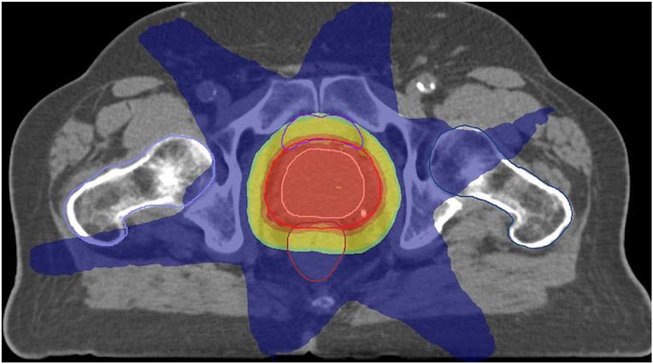
Pelvic CT simulation with 3-mm slice thickness was performed in supine position with straight leg relax. Normal bladder protocol was assigned to all patients (200 mL of water drunk after voiding and then a delay for 20 minutes) to maintain the bladder volume during simulation and irradiation. The targets (clinical target volume; prostate gland ± seminal vesicle) and organs at risk (bladder, rectum, bowels, penile bulb and head of femurs) were contoured. Planning was performed via intensity-modulated arc therapy. Dose parameters to planning target volume (PTV) and organs at risk were recorded in accordance with the International Commission on Radiological Units and Measurements (ICRU) no. 8321 (Figure 1).
Plan of moderate hypo-fractionation (70 Gy at 2·5 Gy per fraction).

Toxicity was evaluated using the toxicity criteria of the Radiation Therapy Oncology Group (RTOG) and European Organization for Research and Treatment of Cancer (EORTC).Reference Cox, Stetz and Pajak22 The American Society of Therapeutic Radiology and Oncology (ASTRO)-Phoenix recommendation (nadir +2) was chosen to evaluate the bRFS (calculated from the date of start of treatment to the date of rise in PSA).Reference Roach, Hanks and Thames23 All descriptive and qualitative analyses were carried out using IBM-SPSS, version 22 (SPSS Inc., Chicago, IL) to analyse clinopathological and treatment data, which are reported as number and percentage.
Results
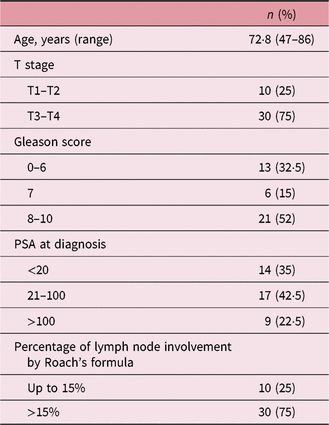
All patients in this analysis were high-risk group with ≥cT2c, a Gleason score ≥8 or a PSA ≥20 ng/mL.Reference Thompson, Thrasher and Aus24 The mean age of this group was 72·8 years. The mean PSA at diagnosis was 86·2 ng/mL (95% CI 49·9–122·4). Thirty-eight patients received long-term hormonal therapy. Fifty-two percent had a Gleason score of 8–10, and 65% had an initial PSA >20 ng/mL. The mean total treatment time was 41 days (95% CI 40–43). The patient characteristics are shown in Table 1.
Patient characteristics

Dose Characteristics
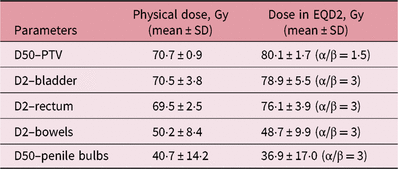
According to ICRU no. 83, the mean doses (in EQD2) to the D50% of PTV, D2% of organs at risk (bladder, rectum and bowels) were 80, 78·3, 76·4, and 50·2 Gy, respectively. The mean dose to the penile bulb was 50 Gy. The details of dose parameters are shown in Table 2.
Dose characteristics

Treatment results
With a mean follow-up time of 34 months (95% CI 29–39), the 2-year bRFS rate was 97·5%.
Toxicity profiles
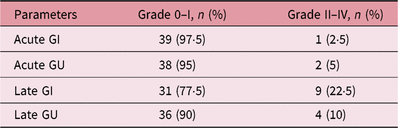
No grade IV toxicity was observed. For acute toxicity, one patient developed grade II+ gastrointestinal (GI) toxicity. For late toxicity, 22·5 and 10% of patients developed grade II–IV genitourinary (GU) and GI toxicity, respectively. The toxicity profiles are shown in Table 3.
Toxicity profiles

Discussion
This study describes the results of the use of a moderate hypo-fractionated regimen in high-risk prostate cancer treatment in our institute. In accordance with the standard treatment of external beam radiotherapy for prostate cancer, the schedules of at least 74 Gy in conventional fractionation were utilised.Reference Pollak, Zaagars and Starkschall6–Reference Zietman, Bae and Slater12 However, conventional fractionation with dose escalation caused a prolongation of treatment time to <8 weeks, leading to patient discomfort. If a shorter regimen is utilised, this will reduce the overall treatment time and is still projected to yield radiobiological benefits.Reference Fowler25
The study by Kupelian et al. reported the results of 70 Gy at 2·5 Gy per fraction in 100 patients with localised prostate cancer. The median follow-up was 66 months (range 3–75); biochemical failure as described by ASTRO-Phoenix recommendations (bRFS) was 88% in all cases. For low, intermediate and high risks, the 5-year bRFS were 97, 93 and 75%, respectively. The actuarial late grade III rectal toxicity rate at 5 years was 3%, and the actuarial late grade III urinary toxicity rate at 5 years was 1%.Reference Kupelian, Thakkar, Khunitia, Reddy, Klein and Mahadevan26
The updated results of this regimen were published in 2007. Seven-hundred and seventy patients with localised prostate cancer treated from 1998 to 2005 with hypo-fractionated intensity-modulated radiotherapy were enrolled onto the study. The median follow-up was 45 months (maximum 86). The overall 5-year ASTRO-Phoenix recommendation of bRFS was 83% in all cases. For patients with low-, intermediate- and high-risk prostate cancers, bRFS were 94, 83 and 72%, respectively. One patient developed grade IV rectal toxicity and one patient developed grade III urinary toxicity.Reference Kupelian, Willoughby, Reddy, Klein and Mahadevan27 The 10-year results of moderate hypo-fractionated intensity-modulated radiotherapy for localised prostate cancer were reported by Abu-Gheida et al. Eight hundred and fifty-four patients were treated between 1998 and 2012. The median follow-up was 11·3 years (maximum 19); the 10-year bRFS rates for low, favourable intermediate, unfavourable intermediate and high-risk groups were 88, 78, 71 and 42%, respectively. For all patients, the 10-year actuarial overall survival (OS) rate was 69% (95% CI 66–73%), and the 10-year prostate cancer-specific mortality (PCSM) rate was 6·8% (95% CI 5·1–8·6%). Moreover, the 10-year PCSM rate for the high-risk disease was 15%. Long-term grade ≥III GU or GI toxicity remained low with 10-year cumulative incidences of 2 and 1%, respectively.Reference Abu-Gheida, Reddy and Kotecha28
This regimen was continued in a randomised controlled study of RTOG 0415 to compare the schedules of 73·8 Gy in 41 fractions versus 70 Gy at 2·5 Gy per fraction for low-risk prostate. One thousand one hundred and fifteen men were enrolled onto the study. The 7-year disease-free survival was 75·6% in the conventional arm and 81·8% in the hypo-fractionated arm. Grade III–IV GU toxicity was 4·5% in the conventional arm versus 6·4% in the hypo-fractionated arm. For grade III–IV GI toxicity, the incidences were 3% in the conventional arm and 4·6% in the hypo-fractionated arm.Reference Lee, Dignam and Amin29
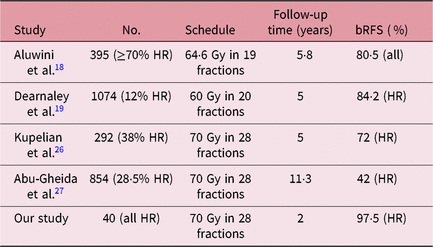
Our study showed comparable results and toxicity profiles to the studies for the same regimen (70 Gy at 2·5 Gy per fraction) reported previously. With this regimen, the patients showed a bRFS of 97·5% in the 24 months of median follow-up, and the overall treatment time was reduced to under 6 weeks. Although the follow-up time of our study was very short, its results are comparable to other randomised studies in moderate hypo-fractionated regimen. As regards toxicity profiles, the rates of at least grade II late GI and GU toxicities in our patients were 10 and 14%, respectively. This result is comparable to other studies. The results are shown in Table 4.
Selected studies of a moderate hypo-fractionated regimen in high-risk, localised prostate cancer

Note: Only in moderate hypo-fractionation arm and high-risk (HR) group. bRFS, biochemical relapse-free survival rate.
There are two main limitations to our study. The follow-up time was too short, but this can be rectified by a further follow-up being carried out to evaluate the long-term results and toxicities. This needs to be at least 5 years hence. Secondly, the number of patients enrolled onto the study was too low in comparison to other studies. This is difficult to resolve as the recorded incidence of prostate cancer in our institute has been very low.Reference Chitapanarux and Srisukho1 This meant that only 50 patients with localised prostate cancer were treated by radical radiotherapy in our radiation oncology unit within the first 5 years of the use of moderate hypo-fractionation.
With many ways to treat prostate cancer (surgery, radiotherapy, hormonal therapy), the number of prostate cancer patients who are suitable for treatment by radical radiotherapy are low. Despite its limitations, the study did demonstrate the effective utilisation of a moderate hypo-fractionation regimen in prostate cancer treated by intensity-modulated radiotherapy in northern Thailand, and our early results are promising in terms of outcomes and organs-at-risk toxicity. This regimen will continue to be adopted in our institute, and long-term evaluation will be performed.
Conclusion
This hypo-fractionated schedule (70 Gy at 2·5 Gy per fraction) in our study is feasible as a treatment for localised, high-risk prostate cancer with promising results and acceptable toxicity. However, due to the short-term nature of the follow-up and the small sample size in this analysis, more patients need to have been treated with this regimen, and a longer follow-up time may be needed to evaluate the results more precisely and recommend its use in different populations.
Acknowledgements
The authors offer many thanks to all staffs of the Division of Radiation Oncology, Faculty of Medicine and Northern Thai Research Group of Radiation Oncology, Faculty of Medicine, Chiang Mai University, Chiang Mai, Thailand, for supporting this study.