INTRODUCTION
Understanding how phenotypic diversity arises through adaptation to environmental conditions has been a central issue in evolutionary studies. Limpets (Patellogastropoda) provide an excellent model system to investigate associations among ecology, morphologies and environments because of their simple conical shell and high variability in their ecology and habitat use. A variety of functional interpretations have been put forward on the differences in limpet shell shape (Branch, Reference Branch1981; Vermeij, Reference Vermeij1993). The association between shell morphology and environmental factors has been theoretically and empirically studied (Denny, Reference Denny2000; Denny & Blanchette, Reference Denny and Blanchette2000), and it has usually been assumed that shell shape in limpets has evolved to minimize hydrodynamic forces while providing a large aperture for adhesion to rock (Branch, Reference Branch1981; Denny, Reference Denny1988; Vermeij, Reference Vermeij1993). However, the flat shape of limpet shells would not have evolved only through adaptation to the risk of dislodgement by hydrodynamic forces in the immediate environment because the shell morphologies of limpets in nature differ from the optimal shell morphology for hydrodynamic force (Denny, Reference Denny2000). For example, shell shape may also have evolved in response to thermal and desiccation stress (Denny, Reference Denny2000) in the intertidal zone, to predation on limpets by crabs (Lowell, Reference Lowell1985, Reference Lowell1986, Reference Lowell1987) and birds (Hahn & Denny, Reference Hahn and Denny1989), and to the foraging and territorial behaviour of the limpet itself (Stimson, Reference Stimson1970). More importantly, a number of studies have documented that differences in the substrates, such as rock and gooseneck barnacle colonies (Glesel, Reference Glesel1969), limestone and volcanic rock (Vermeij, Reference Vermeij1971), strongly affect shell shape of the limpets. Carlton et al. (Reference Carlton, Vermeij, Lindberg, Carlton and Dudley1991) documented that the limpet Lottia alveus living on eelgrass had a laterally compressed shell against the narrow blade of the eelgrass. These observations suggest that differences in the substrate conditions may alter the optimal shape to produce the maximum adhesive force. However, no studies have investigated how substrate conditions affect adhesive force and how they regulate shell morphology in limpets.
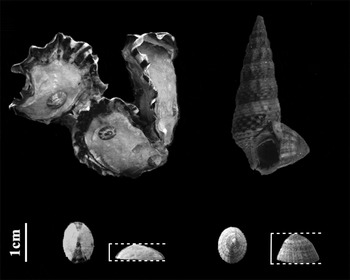
In the present study, the relationships between shell shape and adhesive force were investigated using the intertidal limpets Patelloida pygmaea and Patelloida conulus (Figure 1). Shell morphology of P. pygmaea is flat and normal for a limpet shell, but that of P. conulus is extremely high and domed, unusual for a limpet shell. These species are anatomically and phylogenetically related and have been considered as polymorphisms within a single species until very recently (Sasaki & Okutani, Reference Sasaki and Okutani1994; Okutani, Reference Okutani2000, Reference Okutani2004). These species coexist on intertidal mudflats but show clear differences in habitat preferences. Patelloida pygmaea is found only on oyster shells (Crassostrea gigas) which provide flat and large substrate for limpets. In contrast, P. conulus is found on intertidal gastropod Batillaria cumingi which provide intensely curves and small substrate for limpets. However, P. conulus is also found on the oyster shells when no P. pygmaea is present. Patelloida pygmaea is a specialist regarding its use of oyster shells in principle, and P. conulus is a generalist because it can attach not only to B. cumingi, but also to oyster shells when P. pygmaea is absent (Nakai et al., Reference Nakai, Miura, Maki and Chiba2006).
Patelloida pygmaea on oyster shell (left) and Patelloida conulus on shell of Batillaria cumingi (right). Representative shells of P. pygmaea (left) and P. conulus (right) and dimensions of shell measured are shown.

If these species functionally adapt to ecologically characteristic lifestyles on the B. cumingi and oyster shell, respectively, it is expected that P. pygmaea would have greater ability to adhere to the oyster shell than to the B. cumingi shell, whereas P. conulus would adhere better to the B. cumingi shell rather than the oyster shell when compared to P. pygmaea; furthermore, P. conulus would have similar ability to adhere to both the B. cumingi shell and oyster shell. In addition, morphological differences between these species would reflect the difference in optimal shell shape that can facilitate sufficient adhesive force on the particular substrates. The large aperture relative to shell volume of P. pygmaea would be advantageous for adhering to the flat surface of the oyster shell. In contrast, the small aperture relative to shell volume of P. conulus would be advantageous for adhering to the curved surface of the B. cumingi shell. If these advantages hold true, the adhesive force of P. pygmaea would show a linear increase with volume on the oyster shell, whereas it would show no increase or even decrease with volume on the B. cumingi shell when the volume of P. pygmaea is greater than the particular volume. This idea leads to an expectation that the shell of P. conulus becomes higher with increasing aperture area and explains why P. conulus has a relatively higher shell than P. pygmaea. In the present study, these hypotheses are tested by morphological analyses and by measuring the attachment forces of these species on both the oyster shells and B. cumingi.
MATERIALS AND METHODS
Samples
Samples of P. pygmaea (Dunker, Reference Dunker1860) and P. conulus (Dunker, Reference Dunker1861) used in the present study were collected from the mud flat of Mangokuura Bay, Miyagi, Japan and were located on muddy sand in the central parts of the bay where they were protected from wave action. Samples were collected during daytime low tide from July to September 2007. The individuals collected were kept in plastic tanks (30 × 20 cm, 20 cm high) with saltwater and sands. All tank conditions were maintained by aeration and filtration. The temperature was held constant at 20°C. Shells of C. gigas and B. cumingi were collected from the same mudflat. To remove probability that a dead oyster made water condition bad, shells (approximately 10 × 5 cm in size) were collected from live C. gigas.
Measurement of the attachment force
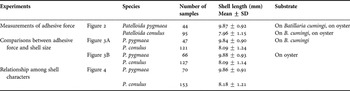
Tenacity of both limpet species on B. cumingi and oyster shells was examined by measuring the maximum force needed to detach individuals from the substrate using modification of the methods in previous studies (Denny, Reference Denny2000; Denny & Blanchette, Reference Denny and Blanchette2000; Ellem et al., Reference Ellem, Furst and Zimmerman2002). A loop of wire (0.28 mm in diameter) was glued to the surface of the live limpet shell using epoxy resin adhesives. The limpets were allowed to adhere to an oyster shell or a B. cumingi shell for more than 24 hours in the laboratory before each measurement procedure, and the top of the shell was gently hit by fingers three times just before the treatment. A wire from the digital force gauge (IMADA DPX-5TR) was connected to the loop on the shell and was gently pulled until the limpet was dislodged from the substrate. The maximum force required to dislodge individual animals from the substrate was measured by the gauge. Force measurements were repeated twice for the same individual on the same substrate, and the larger value was recorded as the maximum adhesive force for the individual on the substrate. After sampling, limpets which were attached to original substrate (oyster shell for P. pygmaea, B. cumingi for P. conulus) were kept in plastic tanks for more than 24 hours. After first measurements, limpets were put on the next substrate (B. cumingi for P. pygmaea, oyster shell for P. conulus) and had more than a 24 hours interval. The same experiment steps were conducted for third and fourth measurements. In total, 72 individuals of P. pygmaea and 152 individuals of P. conulus were used for measurements of adhesive force. The differences in adhesive force between P. pygmaea and P. conulus on the B. cumingi shell and oyster shell were examined statistically using one-way analysis of variance. The probabilities were adjusted by the Bonferroni method, which provides protection against the probability of a false rejection for multiple tests. In addition, the difference in adhesive force for each species between the B. cumingi and oyster shells was also examined. In this analysis, tenacity of each species (P. pygmaea and P. conulus) on the shells of oysters and B. cumingi was assessed using the same individuals, with a total of 44 individuals of P. pygmaea and 95 individuals of P. conulus (Table 1).
Number of the samples used for the experiments to measure adhesive force and that to compare between adhesive force and shell size, and the samples used to examine relationship among shell characters. Measurement data were also shown for each sample.

Morphological analysis
Morphometrical analysis of shell characteristics followed the measurements of attachment force. Shell height was measured from P. pygmaea and P. conulus using a digital micrometer (Figure 1). The image of shell aperture was scanned directly (Scanner: EPSON GT7700U), and aperture area was extracted using a graphics editor (Adobe Photoshop 7.0) and calculated using an image processing program (ImageJ 1.4.3.67). Volume of the limpets was approximated to the volume of a cone and was calculated by shell height and aperture area as volume = aperture area × shell height × 1/3.
The relationship between aperture area and volume was examined for P. pygmaea (70 individuals) and P. conulus (153 individuals) by regression analysis. Heterogeneity of the slope of these two regression lines was tested by analysis of covariance (ANCOVA) (uniformity of slope test). In addition, the relationship between the volume and adhesive force was examined for each species on each substrate by using regression analyses. There were 47 individuals of P. pygmaea and 121 individuals of P. conulus on the B. cumingi shell, along with 66 individuals of P. pygmaea and 127 individuals of P. conulus on the oyster shell used for regression analyses and model selection. To test whether the slope of the regression line changed by increasing aperture area, the model selection was carried out on the basis of relative likelihood of the simple linear regression model and non-linear regression model using Akaike's information criterion scores.
RESULTS
Variations in adhesive force
The maximum adhesive forces observed were 8.9 N (Newton) for P. conulus and 11.1 N for P. pygmaea. Some limpets were dislodged from the substrate by low power not measureable with the gauge used in the present study; therefore, the adhesive forces of these limpets were recorded as zero.
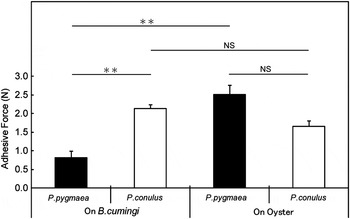
Tenacity of P. conulus was similar on both the oyster and B. cumingi shells (F(1,188) = 4.86, P = 0.11). Tenacity of P. pygmaea, in contrast, was significantly greater on oysters compared to B. cumingi shells (F(1,86) = 21.8, P < 0.001). In addition, tenacity of P. conulus on B. cumingi was significantly greater than that of P. pygmaea (F(1,137) = 40.9, P < 0.001) although on oyster, both limpet species showed similar tenacity forces (F(1,137) = 2.86, P = 0.37) (Figure 2).
Adhesive forces (Newton (N)) of both Patelloida pygmaea and Patelloida conulus on different substrates (Batillaria cumingi and oyster). Mean values, standard errors and result of one-way analysis of variance (ANOVA) are shown together. Comparative pair by one-way ANOVA is illustrated using a black line (—). **P < 0.001.

Relationship between adhesive force and shell morphology
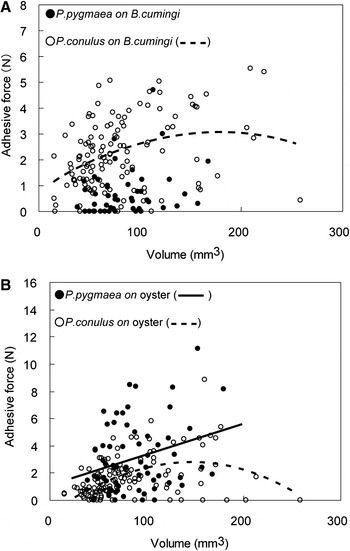
On the B. cumingi shell, a significantly positive correlation was found between adhesive force and volume in P. conulus (R = 0.33, P < 0.001), but not in P. pygmaea (R = 0.25, P = 0.09) (Figure 3A). On the oyster shell, a significant positive correlation was found between adhesive force and volume in both P. conulus (R = 0.36, P < 0.0001) and P. pygmaea (R = 0.29, P < 0.05) (Figure 3B).
Relationship between adhesive force and volume is shown for the Batillaria cumingi (A) and oyster (B). Approximation lines and curves are shown together.

The relationship between adhesive force and volume in P. conulus showed better fitting for non-linear regression than for linear regression with both the B. cumingi and oyster shell (Figure 3A, B). The relationship between adhesive force and volume in P. pygmaea showed better fitting for linear regression than for non-linear regression on the oyster shell (Figure 3B).
Relationships among shell characters
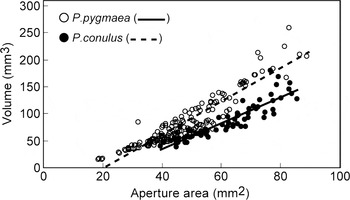
The volumes of P. conulus and P. pygmaea were significantly and positively correlated with aperture area (P. conulus (R = 0.94, P < 0.001), P. pygmaea (R = 0.90, P < 0.001)) (Figure 4). However, the slope of the regression line was significantly greater in P. conulus than in P. pygmaea (ANCOVA, F = 7.69, P < 0.01). Thus, the shell height of P. conulus becomes higher with increased volume, and the difference in shell height between P. conulus and P. pygmaea becomes greater with increasing volume.
Relationship between aperture area and volume is shown for Patelloida conulus and Patelloida pygmaea (P < 0.01, analysis of covariance).

DISCUSSION
The results of the present study support the hypothesis that P. conulus is functionally adapting on the B. cumingi shell, while P. pygmaea is adapting on the oyster shell. The expectation of higher adhesive force for P. pygmaea on the oyster shell rather than on the B. cumingi shell and higher adhesive force of P. conulus on the B. cumingi shell was supported in the present experiments. In addition, there was no significant difference in adhesive forces in P. conulus on the B. cumingi shell and the oyster shell. However, having no difference in adhesive forces between P. pygmaea and P. conulus on the oyster shell is not consistent with our expectation. On a unique substrate, such as the intensely curved and small substrate of B. cumingi shells, P. conulus shows the greater adaptation with higher adhesive force than P. pygmaea. On the other hand, the expectation of the greater adaptation of P. pygmaea on oyster shells compared to P. conulus is not supported by the results of the present experiments. Adhesive ability may not be important for competition between these species on the oyster shell. However, on the B. cumingi shell, the difference in adhesive ability between these species is suggested as a major reason for why only P. conulus lives on the B. cumingi shell.
The ability to adhere to substrate is important for limpets because they clamp to defend against predators and resist hydrodynamic drag (Branch & Cherry, Reference Branch and Cherry1985; Denny, Reference Denny1988; Thompson et al., Reference Thompson, Jenkins and Bussell2000). Thus, differences in structure and topology of substrate would cause adaptive divergence in limpet species. In the present study, artificial substrate was not used because these species would not adhere to the substrate on which no algae or biofilm grew. These limpets escaped from the substrate without algae, suggesting heterogeneity of resource conditions of the substrate and preference for particular resources could also affect adhesive force. Future studies addressing this issue are needed.
It is most likely that the above difference in adhesive ability between the two species is related to the morphological difference between them. The result of the comparison between adhesive force and shell volume in P. pygmaea is consistent with the expectation that adhesive force declines with an increase in shell volume on the B. cumingi shell, but not on the oyster shell. In comparison to the flat and smooth surface of the oyster shell, the curved and rough surface of the B. cumingi shell limits the attachment area available for the limpet. For small limpets, the surfaces of the B. cumingi shell and oyster shell are relatively flat. Therefore, adhesive force can increase with aperture area in small limpets. However, for large limpets, a larger aperture has no advantage for adhering to the curved and rough surface of the B. cumingi shell because large apertures fail to adhere to the curved surface without making spaces. This observation suggests that the aperture area of P. pygmaea cannot increase proportionally with body size. One of the solutions to this problem for P. conulus living on the B. cumingi shell is to produce a high shell that enables the aperture area to be small relative to body size. This expectation is supported by the finding of a steeper slope in the positive correlation between relative shell height and aperture area in P. conulus compared to P. pygmaea. Accordingly, the high and strongly domed shell of P. conulus is most likely a result of adaptation for living on the B. cumingi shell.
Shell morphology of limpets is affected by various factors. For example, Branch (Reference Branch1981) reviewed evidence that the flat shell shape of the limpet may have evolved to reduce the likelihood of desiccation stress. This flat shell shape is also advantageous for predation risk (Vermeij, Reference Vermeij1993). Examples of inter-specific competition between closely related species of limpets have been seen in Patella (Thompson et al., Reference Thompson, Jenkins and Bussell2000; Boaventura et al., Reference Boaventura, Da Fonseca and Hawkins2002, Reference Boaventura, Da Fonseca and Hawkins2003). Active defence of territories has also been observed in several species of limpets (Stimson, Reference Stimson1970; Branch, Reference Branch1975, Reference Branch1976). Stimson (Reference Stimson1970) reported that limpets use the shell as a bulldozer to maintain their own territory. However, the environmental conditions for P. conulus and P. pygmaea are mostly equal except for the substrate that these species adhere to; therefore, it is unlikely that the difference in shell morphology between these species is caused by a difference in predation pressure and wave action. The causes of stressors following vertical distribution (e.g. desiccation and temperature) cannot be rejected. However, these species often coexist at the same place, and therefore, the influence of vertical distribution is not large.
Accordingly, the difference in shell morphology between P. conulus and P. pygmaea is most likely caused by an adaptation to utilize different habitats and to adhere to substrates with different structure and topology. Although the causes of the flat shell of P. pygmaea are still not clear, the extremely high shell of P. conulus is a result of adaptation to adhere to the round shell of B. cumingi. The above findings suggest that differences in substrate can result in diversification of shell morphology in limpets.
ACKNOWLEDGEMENTS
We express our sincere thanks to J. Urabe, M. Kawata, E. Kikuchi and M. Maki for helpful advice and assistance, and to J. Konuma for providing materials. The sampling and experimental work in this study complied with the current laws of Japan.