Introduction
Human-driven disturbances of tropical forests are reorganizing their biodiversity from population to ecosystem level by converting them into human-modified landscapes, particularly through habitat loss, the creation of forest edges and the exploitation of forest resources (Laurance et al. Reference Laurance, Lovejoy, Vasconcelos, Bruna, Didham, Stouffer, Gascon, Bierregaard, Laurance and Sampaio2002, Malhi et al. Reference Malhi, Gardner, Goldsmith, Silman and Zelazowski2014). In this emerging scenario, a winner-loser replacement of native species occurs, leading to local/regional extirpation of several species and the proliferation of others (McKinney & Lockwood Reference McKinney and Lockwood1999, Tabarelli et al. Reference Tabarelli, Peres and Melo2012). Such population-level changes in plant species have been documented to alter the structure of whole plant communities relative to taxonomic, functional and phylogenetic attributes (Ribeiro et al. Reference Ribeiro, Arroyo-Rodríguez, Santos, Tabarelli and Leal2015, Reference Ribeiro, Santos, Arroyo-Rodríguez, Tabarelli, Souza and Leal2016; Rito et al. Reference Rito, Tabarelli and Leal2017b, Santos et al. Reference Santos, Tabarelli, Melo, Camargo, Andrade, Laurance and Laurance2014, Santo-Silva et al. Reference Santo-Silva, Almeida, Melo, Zickel and Tabarelli2013), with potential impacts on biodiversity persistence, patterns of ecosystem functioning and the provision of ecosystem services, such as carbon sequestration and storage (Magnago et al. Reference Magnago, Rocha, Meyer, Martins and Meira-Neto2015, Oliveira et al. Reference Oliveira, Santos and Tabarelli2008).
The proliferation of disturbance-adapted species as a response of tropical biodiversity to human-driven disturbances and their potential multiple cascades has only recently received attention (see Lopes et al. Reference Lopes, Girao, Santos, Peres and Tabarelli2009, Tabarelli et al. Reference Tabarelli, Peres and Melo2012). One potential cascade of effects may involve some palm species and their associated communities of epiphytes. Tropical epiphytes represent a highly diverse plant group, with several species, or ecological groups, that are considered sensitive to human disturbances because they depend on particular microclimatic conditions (e.g. light and humidity) (Zotz & Bader Reference Zotz, Bader, Lüttge, Beyschlag, Büdel and Francis2009) and specific phorophytes or host plants (Aguirre et al. Reference Aguirre, Guevara, García and López2010, Benzing Reference Benzing1990, Mendieta-Leiva & Zotz Reference Mendieta-Leiva and Zotz2015, Sanger & Kirkpatrick Reference Sanger and Kirkpatrick2017), such as the disturbance-sensitive large trees in the Atlantic forest (Siqueira-Filho & Tabarelli Reference Siqueira-Filho and Tabarelli2006). On the other hand, many epiphytes may proliferate if the phorophytes with physical characteristics they depend on are disturbance-adapted species, which might explain in part the reports in the literature of contrasting responses by epiphyte communities across human-disturbed tropical forests (Hietz et al. Reference Hietz, Buchberger and Winkler2006, Nkongmeneck et al. Reference Nkongmeneck, Lowman and Atwood2002, Nöske et al. Reference Nöske, Hilt, Werner, Brehm, Fiedler, Sipman and Gradstein2008, Werner & Gradstein Reference Werner and Gradstein2009).
Several arborescent palm species, such as Astrocaryum acaule, A. mexicanum, Attalea humilis, A. oleifera, A. speciosa, Bactris maraja and Lepidocaryum tenue, are known to increase their densities in disturbed habitats (Aguiar & Tabarelli Reference Aguiar and Tabarelli2010, Campos et al. Reference Campos, Albuquerque, Peroni and Araújo2017, Martínez-Ramos et al. Reference Martínez-Ramos, Ortiz-Rodríguez, Piñero, Dirzo and Sarukhán2016, May et al. Reference May, Anderson, Balick and Frazão1985, Pimentel & Tabarelli Reference Pimentel and Tabarelli2004, Scariot Reference Scariot1999, Souza & Martins Reference Souza and Martins2003). Following human-driven disturbances, the increased recruitment rates in response to increased light availability (Souza & Martins Reference Souza and Martins2003) and changes in dispersal–predation dynamics caused by poaching are two of the mechanisms that lead these palm species to proliferate (Pimentel & Tabarelli Reference Pimentel and Tabarelli2004, Wright et al. Reference Wright, Zeballos, Domínguez, Gallardo, Moreno and Ibáñez2000). Some palm species may play an important role in epiphyte community assembly because they keep senescent leaf sheaths covering the stem, which favour the accumulation of nutrient-rich sediments that allow plant development and may contain a particular seed bank (Bernal & Balslev Reference Bernal and Balslev1996, Corrêa et al. Reference Corrêa, Fischer and Santos2012, Nadkarni & Haber Reference Nadkarni and Haber2009), including not only true epiphytes and hemiepiphytes, but also accidental and facultative epiphytes (Castro et al. Reference Castro, Fabricante and Siqueira-Filho2016, Oliveira et al. Reference Oliveira, Santo and Alvarez2015). In addition, palm stems can represent a safe site for epiphytic species with decreased mortality risk and an increased probability of plant establishment (Benzing Reference Benzing1990, Corrêa et al. Reference Corrêa, Fischer and Santos2012). Therefore, palm species may represent an important phorophyte for epiphyte communities in human-disturbed tropical forests. Despite this, the potential role played by palms as phorophytes has received very little attention, particularly in tropical dry forests, one of the most threatened forest types in the world (Miles et al. Reference Miles, Newton, DeFries, Ravilious, May, Blyth, Kapos and Gordon2006).
The Brazilian Caatinga is the largest and one of the most species-rich seasonally dry tropical forests globally, covering an area of 912 529 km2 of north-eastern Brazil (Silva et al. Reference Silva, Leal and Tabarelli2017). The Caatinga has been experiencing conversion of its natural vegetation into human-modified landscapes since the arrival of the Europeans in the 16th century. Nowadays, the extant vegetation consists of mosaics of croplands, pastures, fallows, and old-growth and regenerating forest stands of varying ages (Silva et al. Reference Silva, Leal and Tabarelli2017). In this human-dominated scenario, some plant species benefit by increasing their relative abundance, not only due to the altered physical environment (Ribeiro et al. Reference Ribeiro, Arroyo-Rodríguez, Santos, Tabarelli and Leal2015, Reference Ribeiro, Santos, Arroyo-Rodríguez, Tabarelli, Souza and Leal2016; Ribeiro-Neto et al. Reference Ribeiro-Neto, Arnan, Tabarelli and Leal2016, Rito et al. Reference Rito, Tabarelli and Leal2017b), but also due to human use and protection (Noblick Reference Noblick2017). This may well be the case for Syagrus coronata (Mart.) Becc. (Arecaceae), a palm tree endemic to the Caatinga that is exploited by local human populations for multiple purposes, such as food, construction and craftwork (Noblick Reference Noblick2017, Rufino et al. Reference Rufino, Costa, Silva and Andrade2008). Although S. coronata supports species-rich epiphyte assemblages in the Caatinga (Oliveira et al. Reference Oliveira, Santo and Alvarez2015), it is unclear whether it plays an important role in species persistence and, therefore, acts as a community-structuring force across Caatinga human-modified landscapes; i.e. a pervasive cascade associated with the proliferation of disturbance-adapted species.
Here, we investigated whether the palm, S. coronata, proliferated in a human-modified landscape of Caatinga dry forest and how this species affected the structure of epiphyte assemblages. First, we documented S. coronata density in old-growth and regenerating stands of Caatinga to evaluate if the palm proliferates in disturbed habitats. Second, we recorded the vascular epiphyte flora supported by S. coronata and by non-palm/control phorophytes across five habitats ranging from crop/pasture to old-growth forest stands. We expected (1) S. coronata to provide microhabitats for several epiphyte species, including not only true epiphytes but also plants from other life forms, as palm leaf sheaths and stipe scars represent a microhabitat with unique characteristics in our landscape; and (2) S. coronata to exhibit distinct cross-habitat epiphyte assemblages, with more disturbed habitats exhibiting epiphyte assemblages with relatively low species richness and reduced numbers of individuals, as well as few biotically dispersed species and individuals, which are at a disadvantage in disturbed sites. Beyond simply documenting the role played by a specific phorophyte in the persistence of epiphyte species, we highlight the cascade of effects connecting human disturbance, proliferation of disturbance-adapted species and community organization at the landscape level.
Methods
Study area
This study was carried out in the Catimbau National Park (8º24′00′′–8º36′35′′S, 37º0′30′′–37º1’40′′W), a 607-km² protected area in north-east Brazil. The regional climate is semiarid, with an average annual temperature of 23°C and precipitation ranging from 550–1100 mm (Rito et al. Reference Rito, Arroyo-Rodríguez, Queiroz, Leal and Tabarelli2017a). Quartzite sandy soils predominate and support low-stature dry forests, with some enclaves of shrubby vegetation over rocky terrain. Fabaceae, Euphorbiaceae, Boraginaceae and Burseraceae are the dominant and most species-rich families (Rito et al. Reference Rito, Arroyo-Rodríguez, Queiroz, Leal and Tabarelli2017a). Since the arrival of European populations in the 16th century, the Caatinga dry forest has been converted into human-modified landscapes via slash-and-burn agriculture and livestock production (Silva et al. Reference Silva, Leal and Tabarelli2017). Such landscapes, including an expressive portion of the Catimbau National Park, can be referred to as vegetation mosaics consisting of old-growth and regeneration forest stands of varying age plus active and abandoned crop/pasture fields (Souza et al. Reference Souza, Sfair, Paula, Barros, Rito and Tabarelli2019).
Syagrus coronata
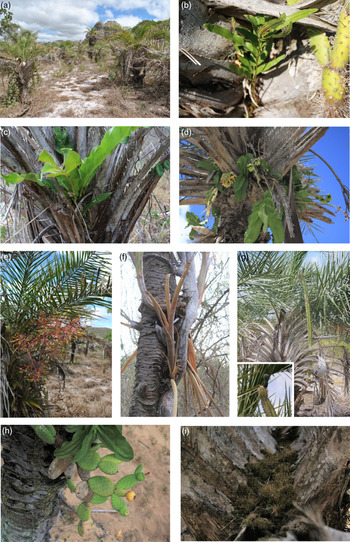
Syagrus coronata is a palm tree, with a single stem that grows to 3–12 m in height and is endemic to the Caatinga region (Noblick Reference Noblick2017) (Figure 1). The leaves, of about 2–3 m in length, grow at regular intervals forming a spiral along the stipe (Drumond Reference Drumond2007, Noblick Reference Noblick2017). When a leaf is shed, a scar remains in the stipe, as well as on a portion of the sheath (up to 30 cm long), which allows the accumulation of nutrients and water in the rainy seasons (Drumond Reference Drumond2007). Flowers are unisexual, with male and female flowers in the same inflorescence, and the fruits are ellipsoid drupes arranged in clusters (Noblick Reference Noblick2017). The peak of flowering and fruiting of S. coronata is from December to March, but this palm flourishes and fruits all year round (Noblick Reference Noblick2017).
Syagrus coronata in the Catimbau National Park, north-east Brazil. Burned area where S. coronata palms proliferate (a), Serpocaulon sp. (b), Anthurium affine (Araceae) (c), Catasetum purum (Orchidaceae) (d), Aechmea leptantha (e), Neoglaziovia variegata (Bromeliaceae) (f), fruiting individuals of Pilosocereus pachycladus (g), Tacinga inamoena (Cactaceae) (h) and mosses covering the palm trunk and leaf sheaths (i).

Because it flourishes and fruits year-round and remains green in the dry season, S. coronata is commonly used by human populations for many purposes (Noblick Reference Noblick2017, Rufino et al. Reference Rufino, Costa, Silva and Andrade2008). Almost all parts of the palm are used: fruits as food for humans and domestic animals, the trunk and leaves for construction and craftwork, the trunk as fuelwood and the watery endosperm for medicinal purposes (Rufino et al. Reference Rufino, Costa, Silva and Andrade2008). Thus, palms are often maintained close to human dwellings and persist even in very disturbed areas. In fact, the formation of dense populations of S. coronata in disturbed areas is very common in the Catimbau National Park, particularly in abandoned croplands and cattle pastures (personal observation), suggesting that this species may benefit from disturbances, as do other tropical palm species (Aguiar & Tabarelli Reference Aguiar and Tabarelli2010, Pimentel & Tabarelli Reference Pimentel and Tabarelli2004, Scariot Reference Scariot1999, Souza & Martins Reference Souza and Martins2003). Previous studies (e.g. Castro et al. Reference Castro, Fabricante and Siqueira-Filho2016, Oliveira et al. Reference Oliveira, Santo and Alvarez2015) have also documented many epiphytes inhabiting S. coronata, including true epiphytes and those taking other life-forms.
Syagrus coronata density
To investigate the response of S. coronata to human disturbance, particularly shifting cultivation, all palms (DSH ≥ 3 cm and ≥ 1 m tall) were sampled across 35 0.1-ha plots (20 × 50 m), distributed in two habitat types: (1) old-growth forest – 20 plots across sites with no signs of agricultural land use, thereby exhibiting aboveground biomass higher than regenerating forest stands in our focal landscape (Souza et al. Reference Souza, Sfair, Paula, Barros, Rito and Tabarelli2019); and (2) stands of regenerating forest – 15 plots in areas previously used for small crops (i.e. shifting cultivation), particularly beans, cassava and corn, which were abandoned from four to 70 years ago (Table S1, Supplementary material). Plots were at least 2 km apart and their spatial location intended to cover most of the precipitation and regeneration gradients (see Rito et al. Reference Rito, Arroyo-Rodríguez, Queiroz, Leal and Tabarelli2017a, Souza et al. Reference Souza, Sfair, Paula, Barros, Rito and Tabarelli2019). The age of regenerating forest stands or time since land abandonment was established through interviews with local residents as already published (Souza et al. Reference Souza, Sfair, Paula, Barros, Rito and Tabarelli2019).
Epiphyte sampling
For the inventory of epiphytes, we selected 680 phorophytes, 340 S. coronata palms and 340 non-palms (hereafter control phorophytes) in a paired sampling design, across 17 sites covering a wide range in terms of land use and vegetation structure. These 17 sites were at least 1 km apart and assigned to five classes of disturbance intensity (from the most to the least disturbed): (1) cropland (one plot) – an agriculturally used field still supporting some individuals of S. coronata; (2) active cattle pastures (two sites) – fenced areas for cattle grazing, dominated by grasses and with low densities of cacti and S. coronata; (3) stands of regenerating forest (eight sites) – second-growth forest stands of 4–20 years after land abandonment; (4) shrubby Caatinga (three sites) – patches of old-growth Caatinga vegetation dominated by shrubs up to 3 m tall; and (5) old-growth forest (three sites) – patches of Caatinga dominated by trees > 6 m tall without evidence of shifting cultivation. In each site, we selected haphazardly 20 S. coronata palms 1.5–6 m tall (4.2 m ± 1.3), at least 10 m apart and counted and registered all epiphyte individuals presented in leaf sheaths and scars. We selected the nearest (≥ 10 m distant) tree to each S. coronata palm as control phorophytes. All control phorophytes present characteristics of adult/old trees in Caatinga, with 4.4 m ± 2.1 tall, similar to the palms sampled in this study (see above). We understand that the best option would be to use another palm species as a control phorophyte, but S. coronata is the only native palm in our landscape. Epiphytes were sampled from August 2014 to May 2015, during the dry and wet seasons. The number of sites and palms sampled reflects their availability in our focal landscape, resulting in an unequal sampling effort. In order to estimate how much habitat S. coronata provides for epiphytes, both scars and leaf sheaths were counted in each sampled palm.
Functional groups of epiphytes
All epiphytes were identified at least to family level and assigned into functional groups based on their relationship with the host (i.e. life form) and according to their dispersal mode. Four life forms were considered: (1) accidental – plants without specific adaptations for canopy life that were growing accidentally on the phorophyte and whose roots did not make contact with the ground (this category included shrubs and cacti); (2) facultative – those that can inhabit both the canopy and the ground; (3) hemiepiphytes – plants which start their life cycle as epiphytes but reach the ground later; (4) true epiphytes or holoepiphytes (hereafter true epiphytes) – epiphytes that spend their entire life without coming into contact with the ground (Benzing Reference Benzing1990). Dispersal modes were defined as: (1) biotically dispersed – those species that produce fresh pulp, aril or other features that attract animals; and (2) abiotically dispersed – including species with structures that promote wind-dispersal such as plumes or winged seeds (anemochoric), weight-dispersed species (barochoric), and those with ballistic discharge of seeds due to explosive dehiscent fruits (van der Pijl Reference van der Pijl1982). Ballistic dispersal is commonly observed in Euphorbiaceae (Griz & Machado Reference Griz and Machado2001, Webster Reference Webster1994), while ballistic and barochoric dispersal are frequent in Fabaceae species (Griz & Machado Reference Griz and Machado2001), the two most speciose families in the Caatinga (Ribeiro et al. Reference Ribeiro, Arroyo-Rodríguez, Santos, Tabarelli and Leal2015, Rito et al. Reference Rito, Arroyo-Rodríguez, Queiroz, Leal and Tabarelli2017a).
Data analysis
First, to examine the proliferation of S. coronata in disturbed habitats, we compared the population densities of old-growth (n = 20) and regenerating forest (n =15) stands using a Wilcoxon test. Due to an extensive range in time since abandonment across regenerating forest stands (i.e. the age of forest stands), we also performed a linear regression to test the relationship between this variable and S. coronata density. Differences in epiphyte richness between S. coronata and control phorophytes were analysed using two methods. At local scale, we compared the epiphyte species richness per phorophyte using Wilcoxon tests. At landscape scale, differences in terms of species richness supported by phorophytes were analysed using species accumulation curves constructed using the Vegan package in R. In both methods, we performed the analysis twice – once considering all epiphyte life forms, and once considering only true epiphytes.
To evaluate the effect of habitat type on the epiphyte assemblages supported by S. coronata, we first examined between-habitat differences in epiphyte species richness and abundance per palm by performing GLMs followed by Tukey’s post hoc comparisons, considering each individual of S. coronata as one sample. As the number of leaf sheaths differed greatly in individuals of S. coronata (11–900 sheaths), we also adopted the number of sheaths as a factor in the GLMs. Second, we evaluated total species richness via individual-based rarefaction curves (Chao et al. Reference Chao, Gotelli, Hsieh, Sander, Ma, Colwell and Ellison2014). We extrapolated rarefaction estimates of species richness and calculated their 95% of confidence intervals using the iNEXT function of the iNEXT package in R. Third, we performed G tests to evaluate between-habitat differences in the proportion of biotically and abiotically dispersed species. Fourth, we documented levels of taxonomic similarity between habitats via non-metric multidimensional scaling (NMDS) based on a Bray–Curtis dissimilarity matrix using the Vegan package in R. Species abundances were sqrt-transformed to avoid any bias resulting from highly abundant species. Given that some palms presented a relatively low number of epiphytes, we performed NMDS treating each site as a sample to avoid any bias from low abundance communities. To infer the contribution of biotically dispersed species to patterns of taxonomic similarity, we performed a GLM using this variable as an exploratory variable for NMDS scores. Finally, an indicator species analysis (Dufrêne & Legendre Reference Dufrêne and Legendre1997) was carried out for the assemblages across the five habitats. All analyses were performed in R (version 3.5.3).
Results
A total of 106 S. coronata individuals were sampled across the 35 0.1-ha plots, with an average of 3.02 ± 5.2 individuals (mean ± SD) per plot (0.1 ha). Palm density was eight times higher in regenerating (6.07 ± 6.7 palms/0.1 ha) compared with old-growth forest stands (0.75 ± 1.5 palms/0.1 ha) (W = 72.5; P < 0.05; Figure 2). No relationship was found between the age of secondary forest stands and S. coronata density (R² = 0.06, P < 0.376).
Density of the palm Syagrus coronata (individuals/0.1 ha) found in old-growth and regenerating forest stands of Caatinga in the Catimbau National Park, north-east Brazil. Boxes indicate 25th and 75th percentiles, while error bars indicate 10th and 90th percentiles. Solid and dashed lines show median and mean, respectively, while black points indicate the outliers.

Across the 680 phorophytes sampled in the five habitat types, a total of 59 species from 31 genera and 26 families were recorded. Bromeliaceae and Cactaceae (12.1% of recorded species, in each family), Euphorbiaceae (8.6%), Orchidaceae and Fabaceae (6.9% each) were the most species-rich families, while Cataseum purum (28.7% of all individuals), Vanilla palmarum (16.8%) and Pilosocereus pachycladus (7%) were the most abundant species. However, only 25% were true epiphytes, 26% were facultative, 24.4% were accidental epiphytes and 4.1% were hemiepiphytes (Table S2, Supplementary material). On average, palms exhibited 101.6 ± 77.2 sheaths and up to 2000 scars on a single individual (207.7 ± 110.7).
Syagrus coronata supported all the epiphyte species recorded at the landscape scale (i.e. 59 species), including true epiphytes and species from other life forms. On the other hand, only four species were recorded on control phorophytes, all true epiphytes from the Bromeliaceae family, with most individuals belonging to the Tillandsia genus. A total of 93.1% of species from all life forms were exclusively recorded on S. coronata, particularly in the palm leaf sheath. In terms of true epiphytes, 69.2% of species were recorded exclusively in S. coronata. At local scale, S. coronata supported, on average, much more epiphyte species than control phorophytes when considering either all life forms (species richness more than 11 times higher; V = 38.338, P < 0.001; Figure 3A) or true epiphytes exclusively (more than 5 times higher; V = 18.884, P < 0.001; Figure 3B). At landscape scale (i.e. collapsing all sampled phorophytes via rarefaction curves), S. coronata exhibited a total number of species almost 15 times greater than control phorophytes. In addition, the species rarefaction curve suggested we did not capture all epiphyte species which inhabit S. coronata, while the rarefaction curves for our control phorophytes appeared to have reached an asymptote (Figure 3C). When considering only true epiphytes, S. coronata hosted four times more species than control phorophytes (Figure 3D).
Average species richness (a and b) and species rarefaction curves of epiphytes (c and d) found on the palm Syagrus coronata (solid lines) and other phorophytes (dashed lines) in areas of Caatinga in the Catimbau National Park, north-east Brazil. In A and C we take into account all types of epiphytes, while in B and D we analysed only true epiphytes. Error bars indicate standard deviation. * P < 0.05.

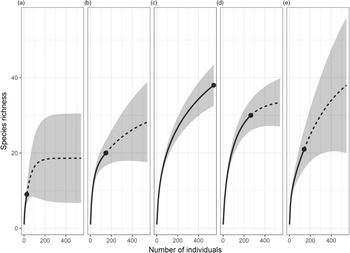
The role played by S. coronata palms supporting epiphytes was dependent on habitat type – epiphyte richness and abundance per palm were higher in habitats that experienced intermediate regimes of disturbance. For example, cattle pastures, regenerating stands and shrubby Caatinga exhibited values higher than croplands and old-growth Caatinga in terms of epiphyte abundance (Figure 4A; F= 7.65, P < 0.0001) and species richness (Figure 4B; F= 9.08, P < 0.0001). However, individual-based rarefaction curves for all habitat types suggested epiphyte richness on S. coronata is probably higher than sampled here (Figure 5). Epiphyte assemblages recorded on S. coronata also differed in terms of prevailing dispersal mode, since those in cattle pastures, regenerating stands and shrubby Caatinga exhibited the lowest relative abundance of biotically dispersed epiphytes (G = 76.77, g.l. = 4, P < 0.0001; Figure 6A). However, epiphyte assemblages supported by S. coronata were similar across habitats in terms of relative richness of biotically dispersed species (G = 6.03, g.l. = 4, P = 0.197; Figure 6B).
Number of individuals (a) and species richness (b) of vascular epiphytes on the palm Syagrus coronata in areas of Caatinga with different levels of disturbance in the Catimbau National Park, north-east Brazil. Boxes indicate 25th and 75th percentiles, while error bars indicate 10th and 90th percentiles. Solid and dashed lines show median and mean, respectively, while black points indicate the outliers. In B, median is equal to 75th percentile for croplands, equal to mean for regenerating forest stands, and equal to the 25th percentile for shrubby and old-growth Caatinga.

Individual-based species accumulation curves for vascular epiphyte species on the palm Syagrus coronata in croplands (a), cattle pastures (b), regenerating stands of Caatinga (c), shrub Caatinga (d) and old-growth forest (e) in the Catimbau National Park, north-east Brazil. Solid lines represent interpolated data, while dashed lines represent extrapolated data.

Percentage of vascular epiphyte individuals (a) and species (b) dispersed abiotically (white) and biotically (grey) found on the palm Syagrus coronata in areas of Caatinga with different levels of disturbance in the Catimbau National Park, north-east Brazil.

Epiphyte assemblages in S. coronata were taxonomically distinct across the focal habitats. The NMDS ordination indicated relatively similar assemblages across sites experiencing the same disturbance level (stress = 0.21; Figure 7), but this pattern was not explained by the percentage of biotically dispersed species (R² = 0.10, P = 0.206). Finally, the indicator species analysis suggested the existence of cross-habitat differences in assemblages by identifying Talinum paniculatum as an indicator of pastures (indicator value = 0.84, P = 0.031) and a Poaceae species as an indicator of cropland assemblages (indicator value = 0.62, P = 0.007).
Non-metric multidimensional scaling (NMDS) of vascular epiphyte assemblages found on the palm Syagrus coronata on the basis of taxonomic similarity in areas of Caatinga with different levels of disturbance in the Catimbau National Park, north-east Brazil. Open triangle, closed triangles, open circles, closed circles and squares indicate croplands, pastures, regenerating patches, shrubby Caatinga and old-growth forest, respectively.

Discussion
Our study suggests that the palm S. coronata benefits from human disturbances and becomes particularly abundant across regenerating forest stands, while also inhabiting pastures and old fields in human-modified landscapes of the Caatinga dry forest. Syagrus coronata populations support abundant and diverse vascular plant assemblages, consisting not only of true epiphytes but also facultative, hemiepiphytes, shrubs and small tree species (here classified as accidental epiphytes). Interestingly, many shrub, tree and cactus species recruit on S. coronata individuals, including some species that manage to conclude the reproductive phase of their life cycles on the palms.
In fact, S. coronata appears to be an exclusive phorophyte plant species in human-modified landscapes of Caatinga dry forest, including true and non-true epiphytes. Differently from control phorophytes, S. coronata can accumulate in the palm sheaths and scars a substrate similar to those found on the ground, which favour the establishment of epiphytes from all life forms across a wide range of habitats from pasture to old-growth forest. Moreover, S. coronata is able to support relatively distinct assemblages, including in pastures, as suggested by the selection of Talinum paniculatum as an indicator species. Finally, S. coronata provides an irreplaceable ecological role across a wide range of habitats from pasture to old-growth forest, as ~70% of true epiphyte species rely exclusively on these palms, including six orchids and bromeliad species.
The higher density of S. coronata in regenerating stands contradicts the idea that this palm is threatened by human exploitation in the Caatinga (Johnson Reference Johnson1996, Rufino et al. Reference Rufino, Costa, Silva and Andrade2008) and suggests that this species is in fact a winner (sensu Tabarelli et al. Reference Tabarelli, Peres and Melo2012) because it proliferates across second-growth stands of the Caatinga dry forest (also see Souza et al. Reference Souza, Sfair, Paula, Barros, Rito and Tabarelli2019). The eight-fold increment in S. coronata population density we documented is much higher than those reported for other palm species in disturbed habitats (e.g. Campos et al. Reference Campos, Albuquerque, Peroni and Araújo2017, Martínez-Ramos et al. Reference Martínez-Ramos, Ortiz-Rodríguez, Piñero, Dirzo and Sarukhán2016). Increments in arboreal palm density across disturbed forest habitats are commonly associated with an increase in light incidence (Souza & Martins Reference Souza and Martins2003) and changes in the rates of seed predation and dispersal (Pimentel & Tabarelli Reference Pimentel and Tabarelli2004, Wright et al. Reference Wright, Zeballos, Domínguez, Gallardo, Moreno and Ibáñez2000). In our focal landscape, exotic goats eat the fruits of S. coronota and regurgitate a substantial number of their seeds throughout the entire landscape (M. Tabarelli, personal observation), which might help this palm species to persist across a variety of habitats due to long-distance seed dispersal events. Local people also collect and eat fruit pulps, discarding the seeds along paths.
In addition to effective seed dispersal by exotic species (e.g. goats and humans), the distribution of S. coronata in ecologically distinct habitats in our focal landscape suggests that it is able to tolerate (1) environmental stress associated with open habitats, such as extreme temperatures, intense luminosity and soil desiccation, and (2) human-imposed defoliation, fire and browsing by livestock such as goats. In fact, S. coronata appears to be a stress-tolerant and aggressive colonizer, as are other light-demanding palm species, e.g. Attalea humilis, A. oleifera, A. speciosa (Aguiar & Tabarelli Reference Aguiar and Tabarelli2010, Campos et al. Reference Campos, Albuquerque, Peroni and Araújo2017, Henderson et al. Reference Henderson, Galeano and Bernal1995, Lorenzi et al. Reference Lorenzi, Souza, Cerqueira, Costa and Ferreira2004, May et al. Reference May, Anderson, Balick and Frazão1985). Moreover, farmers frequently leave some palms when clearing forest for pasture or crops as they are useful. Syagrus coronata has a long list of uses by rural populations, such as providing forage for cattle during the dry season, providing raw materials for construction and craftwork, as well as being used as a food source and for medicinal purposes (Noblick Reference Noblick2017, Rufino et al. Reference Rufino, Costa, Silva and Andrade2008).
Our findings also highlight the value of palms for biodiversity persistence, as S. coronata supports rich epiphyte communities in both natural and human-modified landscapes (Castro et al. Reference Castro, Fabricante and Siqueira-Filho2016, Corrêa et al. Reference Corrêa, Fischer and Santos2012, Oliveira et al. Reference Oliveira, Santo and Alvarez2015). These findings contrast to those documented across oil palm plantations, which exhibit reduced biodiversity value by supporting not only impoverished epiphyte communities (Böhnert et al. Reference Böhnert, Wenzel, Altenhövel, Beeretz, Tjitrosoedirdjo, Meijide, Rembold and Kreft2016, Einzmann & Zotz Reference Einzmann and Zotz2016) but also of arthropods associated with these plants (Fayle et al. Reference Fayle, Turner, Snaddon, Chey, Chung, Eggleton and Foster2010, Turner & Foster Reference Turner and Foster2009). Other studies also have documented a diverse flora supported by some palm species, such as S. coronata in the Caatinga dry forest; e.g. 16 epiphyte species supported by S. coronata in the Catimbau National Park (Castro et al. Reference Castro, Fabricante and Siqueira-Filho2016, Oliveira et al. Reference Oliveira, Santo and Alvarez2015), 17 epiphyte/hemiepiphyte species on Sabal mexicana across disturbed habitats in México (Aguirre et al. Reference Aguirre, Guevara, García and López2010), and seeds from 75 species in the palm sheaths of Attalea phalerata in the Pantanal (Corrêa et al. Reference Corrêa, Fischer and Santos2012). As the only palm species exhibiting long-standing sheaths in our focal landscape (see Reference Rito, Arroyo-Rodríguez, Queiroz, Leal and TabarelliRito et al. 2017a), S. coronota represents an irreplaceable habitat for many true epiphytes such as Orchidaceae species, which are recognized as vulnerable and under threat of extinction (CITES 2019). Beyond true epiphytes, shrub and trees species (e.g. Caesalpinia microphyla, Mimosa ophthalmocentra and Croton species) also recruit on S. coranata palms, but most of these species (except cactus species) are not expected to reproduce successfully (e.g. Croton shrubs); i.e. palms can operate as seed traps rather than a safe recruitment site.
Furthermore, our findings suggest that this palm-mediated ecological service is available across all habitats (from pastures to old-growth forest), with the structure of epiphyte assemblages responding accordingly, in terms of abundance, species richness and functional and taxonomic composition, resulting in more abundant and species-rich assemblages (~33% increment) in regenerating forest stands and areas of shrubby Caatinga. It has previously been proposed that the abundance of epiphyte species is strongly influenced by some of the physical characteristics of their hosts, such as bark peeling (Talley et al. Reference Talley, Setzer and Jackes1996, Zimmerman & Olmsted Reference Zimmerman and Olmsted1992) or the persistence of leaf sheaths, which may facilitate the accumulation of water and nutrients as well as capture seeds and reduce seed mortality (Aguirre et al. Reference Aguirre, Guevara, García and López2010, Bernal & Balslev Reference Bernal and Balslev1996, Corrêa et al. Reference Corrêa, Fischer and Santos2012). In the case of S. coronata, its structure consists of an immense set of leaf sheaths that remain attached to the trunk even after leaf fall (Noblick Reference Noblick2017), which contributes to the accumulation of substrate and water, resulting in a humid substrate near the palm trunk. As we have documented here for six species, stipe scars may also capture seeds and offer support for epiphytes, even though this structure is not expected to retain sediments. Moreover, S. coronata is evergreen (in contrast to the predominance of deciduous plant species in the Caatinga flora) and its dense foliage, organized symmetrically around the stipe, probably provides mesic/relatively shaded microhabitats year-round, as suggested by the abundant moss cover we anecdotally documented in the Catimbau landscape (see Figure 1i). Thus, the refuge provided by S. coronata, in the context of the seasonal water scarcity, frequently prolonged droughts and hot summers of the Caatinga (Sampaio Reference Sampaio1995), probably facilitates the persistence of diverse epiphyte species.
From this perspective, differences in microclimatic conditions, seed rain arriving on palms and palm abundance probably represent the main drivers for cross-habitat differences exhibited by epiphyte assemblages documented here. Syagrus species have been reported to serve as a food source for a myriad of vertebrates, including species from the Psittacidae (Andrade et al. Reference Andrade, Ramos, Souto and Bento-Silva2015), Ramphastidae, Thraupidae and Procyonidae families (Silva et al. Reference Silva, Begnini, Lopes and Castellani2011). In the case of A. phalerata, most seeds recorded on sheaths were believed to reach palms via dispersal by bats as they use palms as feeding roosts (Corrêa et al. Reference Corrêa, Fischer and Santos2012). In fact, A. phalerata is able to support a dense seed bank (~50 seeds per palm stem) as high as 10% of the local vascular flora in the Pantanal, with a substantial proportion of seeds being defecated by bats (Corrêa et al. Reference Corrêa, Fischer and Santos2012). In the Catimbau landscape, crop and pasture fields are likely to be more desiccated habitats, but remaining palms may operate as exclusive perches for birds and roost for bats, both vertebrate groups operating as seed dispersers (see Evelyn & Stiles Reference Evelyn and Stiles2003, Morante-Filho et al. Reference Morante-Filho, Arroyo-Rodríguez, Pessoa, Cazetta and Faria2018). On the other hand, secondary-growth and shrubby Caatinga are more suitable habitats for epiphyte development, with dense palm clusters attracting much more seed dispersers as compared with the other habitats. In synthesis, we propose that dense clusters of S. coronata inhabiting second-growth forest stands represent environmentally suitable habitats for epiphytes, capturing much more seeds per palm.
The conversion of old-growth forest into human-modified landscapes has been proposed to reorganize biodiversity, from population to ecosystem level (Gardner et al. Reference Gardner, Barlow, Chazdon, Ewers, Harvey, Peres and Sodhi2009, Newbold et al. Reference Newbold, Hudson, Hill, Contu, Lysenko, Senior, Börger, Bennett, Choimes, Collen, Day, Palma, Díaz, Echeverria-Londoño, Edgar, Feldman, Garon, Harrison, Alhusseini, Ingram, Itescu, Kattge, Kemp, Kirkpatrick, Kleyer, Correia, Martin, Meiri, Novosolov, Pan, Phillips, Purves, Robinson, Simpson, Tuck, Weiher, White, Ewers, Mace, Scharlemann and Purvis2015). This reorganization imposes a myriad of negative effects, including species extirpation, the collapse of species interactions and the impoverishment of native assemblages, as previously proposed for epiphytes (Nöske et al. Reference Nöske, Hilt, Werner, Brehm, Fiedler, Sipman and Gradstein2008, Werner & Gradstein Reference Werner and Gradstein2009). In the Caatinga dry forest, shifting cultivation and pastures followed by land abandonment creates suitable habitats, particularly second-growth forest stands, for the proliferation and persistence of S. coronata. By being an exclusive phorophyte, the response of S. coronata to disturbance favours the persistence of true epiphytes, while reorganizing epiphyte assemblages at landscape scale. This cascade to community-level from a population-level response to disturbance highlights one of the consequences the proliferation of disturbance-adapted species can pose across human-modified landscapes.
Supplementary material
To view supplementary material for this article, please visit https://doi.org/10.1017/S0266467420000073
Acknowledgements
We thank Conselho Nacional de Desenvolvimento Científico e Tecnológico (CNPq, PELD process 403770/2012-2) and Fundacão de Amparo à Ciência e Tecnologia do Estado de Pernambuco (FACEPE, PRONEX process 0138-2.05/14) for supporting M. Tabarelli in the research programme in Catimbau National Park. We also thank the members of the laboratories LIPA and LEVA for helping during fieldwork. L.J.B. Gonçalves thanks CNPq for providing a scholarship.
Financial support
This study was funded by Conselho Nacional de Desenvolvimento Científico e Tecnológico (CNPq, PELD process 403770/2012-2) and Fundacão de Amparo à Ciência e Tecnologia do Estado de Pernambuco (FACEPE, PRONEX process 0138-2.05/14).