INTRODUCTION
Lucerne (Medicago sativa L.) is a major summer forage crop in most countries with a Mediterranean climate, but is also grown in other areas too. Lucerne forage is essentially used as livestock feed, not only due to its high nitrogen (N) content and acceptability by ruminants but also due to its high mineral, vitamin and fibre contents (Barnes & Sheaffer Reference Barnes, Sheaffer, Barnes, Miller and Nelson1995). Lucerne crops produce a large quantity of forage that is usually stored as hay for periods of scarcity.
Driven by photosynthetic activity, lucerne cumulates total non-structural carbohydrates (TNC) throughout the day. Consequently, TNC concentration is higher in lucerne cut at sunset (PM) than lucerne cut at sunrise (AM). However, in grasses, the differences between times of cutting are dependent on season of cutting (Bélanger et al. Reference Bélanger, Pelletier, Tremblay, Bertrand, Drapeau, Castonguay, Pageu, Schnyder, Isselstein, Taube, Auerswald, Schellberg, Wachendorf, Herrmann, Gierus, Wrage and Hopkins2010) and growth conditions (Pelletier et al. Reference Pelletier, Tremblay, Lafrenière, Bertrand, Bélanger, Castonguay and Rowsell2009; Sauvé et al. Reference Sauvé, Huntington, Whisnant and Burns2010). Ruminants prefer forages cut or grazed at PM to those cut at AM due to their higher TNC concentrations (Fisher et al. Reference Fisher, Mayland and Burns2002). Lucerne is characterized by high N content that is highly degradable in the rumen. Consequently, lucerne diets are associated with high ruminal ammonia concentrations, thus reducing the efficacy of this N. Optimum ratio and synchronization between degradable N and carbohydrates are important factors for achieving optimum microbial growth and increasing the efficacy of degradable N use.
A higher forage quantity of TNC because of a different cutting time could modify the degradation characteristics of lucerne, but no studies have yet been conducted to verify this hypothesis. Differences in TNC between times of cutting may also influence the energetic value of forage. Higher dry matter intake (DMI) of PM gamagrass (Tripsacum dactyloides L.) was reported by Huntington & Burns (Reference Huntington and Burns2007) in steers and by Sauvé et al. (Reference Sauvé, Huntington and Burns2009) in goats. Conversely, Burns et al. (Reference Burns, Mayland and Fisher2005) found no significant organic matter digestibility (OMD) and intake differences between PM and AM hays in sheep using lucerne. According to Wilson & Ford (Reference Wilson and Ford1973), the carbohydrate content in tops varies with development stage and temperature, and Burns et al. (Reference Burns, Mayland and Fisher2005) used lucerne at young stages.
The present authors hypothesized that TNC concentration would be greater in PM than AM hay, meaning that effective degradability, digestibility and intake would be greater for PM than AM hays. The aim of the current study was to determine the effect of cutting lucerne at PM or AM on the degradation characteristics, digestibility coefficients and intake of hays obtained in spring, summer and autumn.
MATERIALS AND METHODS
Experimental forage
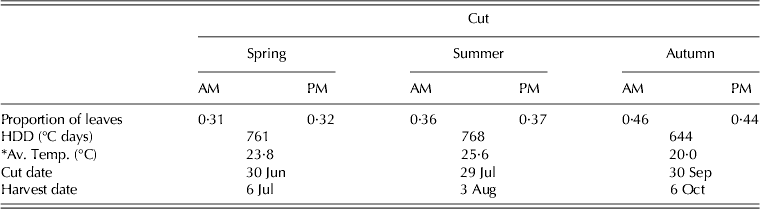
An irrigated and well-established 4 ha lucerne plot (cvar Aragón) in the second year of growth, at La Alfranca farm, Zaragoza, Spain (41°40′N, 0°53′E; 199 m asl) was cut six times a year according to traditional lucerne management in the area (Fanlo et al. Reference Fanlo, Chocarro, Lloveras, Ferran, Serra, Salvia, Muñoz, Andueza, Delgado, Lloveras, Gonzalez-Rodriguez, Vazquez-Yañez, Piñeiro, Santamaria, Olea and Poblaciones2006). The growth periods used were the second (May), fourth (July) and sixth (September) cuts, chosen to represent a wide range of climatic and daylight conditions. For all growth cycles, the plot was cut at mid-bloom (0·50 of plants flowering). Cut dates, climate data and proportions of leaves (proportion of dry weight) are given in Table 1. Proportion of leaves was estimated from a near infrared spectroscopy (NIRS) calibration equation based on 109 samples (standard error of validation=2·7; R 2=0·91) and expressed as a coefficient (Andueza et al. Reference Andueza, Delgado and Muñoz2009).
Hay growth conditions, proportion of leaves and climate conditions of forages cut at sunrise (AM) or at sunset (PM). Accumulated temperature (HDD) was calculated as the sum of positive average daily temperatures from the cutting date
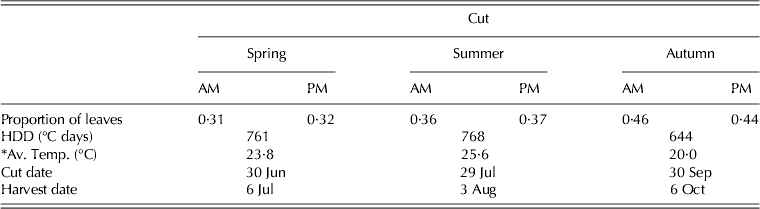
* Av. temp.: average temperature of the growth cycle.
Paired cuts per growth period were taken at AM and at PM, giving six experimental forages. On the date of cutting, half of the plot was cut before 08:00 h using a mower conditioner leaving stubble of 50 mm, and the other half-plot was cut later the same day, after 20:00 h. The forages were sun-dried in natural conditions until reaching a minimum of 800 g dry matter (DM)/kg of fresh forage. Each pair of forages was baled the same day, and two bales (400 kg) per treatment were immediately transported to CITA Research Centre in Zaragoza (Spain) (41°44′N, 0°48′E) and stored for animal utilization.
Animals and experimental procedures
The study was conducted indoors at the CITA farm. All animals were handled by specialist personnel trained in animal care and welfare according to the European Union Directive No. 609/1986 under agreement No. A63 565.
Rumen degradation of DM and N
Ruminal degradation characteristics were determined using three 4-year-old wethers (Fleichchaff×Rasa Aragonesa), averaging 62 kg live weight, fitted with a rumen cannula and adapted for 30 days to a diet composed of 0·70 lucerne hay and 0·30 concentrate (barley plus mineral–vitamin complement). The diet was divided into two equal meals given at 08:00 h and 16:00 h.
Thermally sealed nylon bags of 70×110 mm inside capacity and 46 μm pore size were used. Approximately 3 g (air-dry basis) of forage samples were placed in the bags. Forage samples were formed by thoroughly mixing subsamples from the six periods of digestibility phase. DM and N degradability were determined using the in situ technique (Ørskov & McDonald Reference Ørskov and McDonald1979). Bags containing forages chopped to a length of 20 mm were incubated in the animal's rumen, with two replicates per wether and per incubation time. The bags were left in the rumen for 2, 4, 8, 16, 24 and 48 h before being washed, oven-dried at 60°C and stored at –20°C until analysis. Before analysis, the bags were thawed and washed in a washing machine (3×10 min) with cold water until the rinse water ran clear. Duplicate samples of a common lucerne hay used as a ‘standard’ were incubated for 8 h in the rumen of each sheep to detect any changes in the level of rumen degradation activity during the experiment. DM and N disappearance data obtained for each animal was fitted to the equation proposed by Ørskov & McDonald (Reference Ørskov and McDonald1979). The model is described by

where A is the soluble fraction, B is the insoluble potentially degradable fraction, A+B is the degradable fraction and C is the fractional degradation rate. The values for rumen degradation kinetics were fitted to this equation using the NLIN procedure of the SAS statistical package (SAS 1998). Effective degradability of the DM (EDDM) and N (EDN) in each animal was calculated using the equation:

where ED represents effective degradability and k is the rumen outflow rate. ED was calculated for a k of 0·06/h (Vérité & Peyraud Reference Vérité, Peyraud and Jarrige1989).
Digestibility and voluntary intake
Twelve 4-year-old wether sheep (mean live weight: 45 kg) of Rasa Aragonesa breed were used in a 6×6 Latin square design. The digestibility phase was carried out in metabolism cages for 15 days, during which the first 10 days were devoted to adaptation to the diet and the last 5 days to data collection (daily offering and daily total faeces excretion). The diet offered consisted of forage chopped into 50–70 mm lengths and offered at maintenance level (40 g DM/kg BW0·75) twice a day, at 08:00 h and 16:00 h. After weighing, the faeces of each wether were subsampled (0·20 of each animal's daily output); subsamples from 5 days were then combined to form one sample per animal and per period. Finally, a faeces sample was taken (according to the weight excreted by each wether) from each of the six animals for laboratory analyses.
After determination of digestibility, the voluntary intake of hays was determined using sheep wethers in individual pens over 23 days, during which the first 15 days were devoted to adaptation to the diet and the last 8 days were used to measure the quantities offered and refused by the animals. The animals received hay chopped into 50–70 mm lengths and offered ad libitum, allowing a maximum refusal of 0·10. The forage was offered twice a day, at 08:00 h and 16:00 h.
Forage offered and refusals were sampled daily for analysis, giving one forage sample for both the digestibility phase and intake phase. During the experimental period, animals had free access to water and vitamin–mineral blocks (manufacturer-specified composition: 2 g Mg/kg, 3 g Fe/kg, 0·81 g Zn/kg, 0·05 g I/kg, 0·018 g Co/kg, 0·01 g Se/kg, 985 g NaCl/kg and 9 g moisture/kg).
Before starting the experiment, animals were fed a common lucerne hay (chemical composition: 98 g ash/kg; crude protein (CP), 190 g/kg; neutral detergent fibre (NDF), 410 g/kg; acid detergent fibre (ADF), 235 g/kg and acid detergent lignin (ADL), 52 g/kg) for a 14-day period and then randomly assigned to one of the experimental forages (two animals per experimental forage).
Samples and laboratory analysis
All samples were oven-dried at 60°C for 48 h and ground in a Fritsch pulverisette mill through a 1 mm screen.
Forage samples
Ash and N contents in the dried samples were determined according to AOAC (Reference Helrich1990). CP was calculated by multiplying N values by 6·25. NDF, ADF and ADL content were determined by the method given in Van Soest et al. (1991). NDF and ADF analyses were performed on an Ankom fibre analysis system (Ankom® Tech. Co., Fairport, NY, USA). Soluble carbohydrates (SC) and starch were analysed as described in Buysse & Merckx (Reference Buysse and Merckx1993). TNC concentration was estimated by the sum of SC and starch.
Samples of refusals, faeces and bag residues
Analyses of DM, ash, NDF and ADF were performed on samples of refusals and faeces from the digestibility trial, while analyses of DM and ash were carried out on samples of refusals from the intake trial. Analyses of DM and N were carried out on samples of bag residues.
Calculations
Dry matter digestibility (DMD), OMD, neutral detergent fibre digestibility (NDFD), acid detergent fibre digestibility (ADFD) and digestible organic matter intake (DOMI) were calculated from in vivo results and chemical composition data. DMI and DOMI were expressed in g/kg BW0·75.
Statistical analysis
Data on the chemical composition of the forages and the rumen degradation trial were analysed as repeated measurements, with diurnal cut and growth period as repeated measures. Fixed effects included growth period and diurnal cut. Animal in the rumen degradation trial and replicate in the chemical composition data were included as random effects. Data for digestibility measures, DMI and DOMI were analysed as a Latin square. The statistical model included animal, period, forage and residual error. Fixed effects included period and forage, with animal as the random effect. Orthogonal contrasts were established to compare the differences between AM and PM hay in each growth period. All analyses were performed using the MIXED procedure of the SAS statistical package (SAS 1998) Significance was taken as P<0·05.
RESULTS
Chemical composition
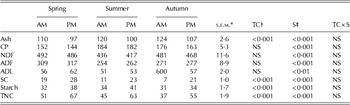
With the exception of SC, the interactions between time of cutting and growth cycle were not significant (Table 2). For SC, the differences between PM and AM cuts were 9, 12 and 14 g/kg for spring, summer and autumn, respectively. The PM cut had lower ash content but higher SC, starch and TNC content than the AM cut (all P<0·001). No significant differences between times of cut (P<0·05) were found for CP, NDF, ADF or ADL contents. Summer growth had higher CP and starch contents and lower NDF and ADL contents than spring and autumn growths (again all P<0·001). SC and TNC contents of the summer growth cycle (17±1·0 and 54±1·9 g/kg DM, respectively) were intermediate between those of the spring growth cycle (24±1·0 and 59±1·9 g/kg DM, respectively) and the autumn growth cycle (14±1·0 and 46±1·9 g/kg DM, respectively).
Mean concentrations of ash (g/kg), CP (g/kg), NDF (g/kg), ADF (g/kg), ADL (g/kg), SC (g/kg), starch (g/kg) and TNC (g/kg) in lucerne hays according to season and time of cutting; sunrise (AM) or sunset (PM) and the significance of cutting time and season

* s.e.m.: standard error of the mean.
† TC: time of cutting.
‡ S: season.
NS: P>0·05.
Ruminal degradation of DM and N
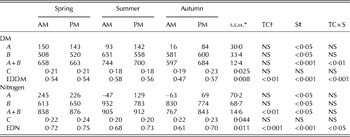
No significant differences between AM and PM were found for the soluble and insoluble potentially degradable fractions of DM (Table 3). A significant interaction (P<0·001) between time of cut and growth cycle was found for EDDM. No significant differences were found between AM and PM for the spring and summer growth cycles; however, for the autumn growth cycle, EDDM was higher (P<0·001) in PM cuts (0·57±0·008) than AM cuts (0·47±0·008).
Mean soluble fraction (a) (g/kg), insoluble potentially degradable fraction (b) (g/kg), degradable fraction (a+b) (g/kg), fractional degradation rate (c) (%/h), EDDM and EDN, calculated for a rumen outflow rate of 0·06/h of lucerne hays according to season and time of cutting; sunrise (AM) or sunset (PM) and the significance of cutting time and season

* s.e.m.: standard error of the mean.
† TC: time of cutting.
‡ S: season.
NS: P>0·05.
Concerning the rumen degradability of N (Table 3), EDN was higher (P<0·001) for PM than for AM hay. However, the significant interaction time of cutting×season (P<0·05) shows that differences between PM and AM hay was higher for the autumn cut (0·097) than for spring and summer cuts (0·024 and 0·043, respectively). No significant differences between AM and PM were found for the A and B fractions of N. PM hay had higher (P<0·01) A+B of N values than AM hay.
Digestibility and intake
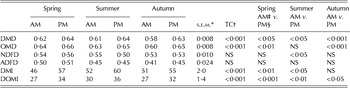
Digestibility and voluntary intake results from the in vivo studies on AM and PM hays are shown in Table 4. DMD and OMD were higher (P<0·05) for PM than AM hay, with the exception of OMD values for the summer growth cycle. No significant differences were found for ADFD between AM and PM. However, NDFD values for the summer growth cycle were higher (P<0·05) for AM (0·55) than PM hay (0·50).
DMD, OMD, NDFD, ADFD, DMI (g MS/kg BW0·75) and DOMI (g MS/kg BW0·75) of lucerne hays according to season and time of cutting and the significance of cutting time and season

* s.e.m.: standard error of the mean.
† TC: time of cutting.
‡ AM: sunrise.
§ PM: sunset.
NS: P>0·05.
PM hay showed higher DMI values (P<0·05) than AM hay in spring and summer growth cycles. No differences between times of cutting were found for DMI of forage cut in the autumn growth cycle.
For all growth periods, mean DOMI values were higher (P<0·05) for PM than AM hays.
DISCUSSION
The phenological stage of forages used in the present study, i.e. 0·50 flowering, was representative of lucerne forage routinely cut in southern Europe.
The carbohydrate contents observed are similar to other reports using the same type of forage (Fisher et al. Reference Fisher, Mayland and Burns2002; Burns et al. Reference Burns, Mayland and Fisher2005). However, SC:starch ratio was different. Fisher et al. (Reference Fisher, Mayland and Burns2002) and Burns et al. (Reference Burns, Mayland and Fisher2005) reported higher SC contents than starch content, whereas higher starch concentrations than SC contents were found in the present study.
Cutting lucerne at PM resulted in higher SC, starch and TNC than cutting at AM. For SC, differences between AM and PM hays were higher in autumn cut (14 g/kg DM) than in summer (9 g/kg DM) or in spring (7 g/kg DM). Climate conditions (day length and temperature; Table 1) explain these differences. Chatterton et al. (Reference Chatterton, Harrison, Bennet and Asay1989) previously found higher SC contents in grasses grown in cool rather than warmer temperatures and Brown et al. (Reference Brown, Blaser and Fontenot1963) reported higher TNC in tall fescue (Festuca arundinacea Schreb.) in autumn than in warmer months. Bélanger et al. (Reference Bélanger, Pelletier, Tremblay, Bertrand, Drapeau, Castonguay, Pageu, Schnyder, Isselstein, Taube, Auerswald, Schellberg, Wachendorf, Herrmann, Gierus, Wrage and Hopkins2010) have emphasized the effect of growing conditions and of plants’ development phase on the TNC at cutting.
In the present study, there were no significant differences between AM and PM hays in terms of CP, partitioning of structural carbohydrates and lignin. This is similar to the results of Burns et al. (Reference Burns, Mayland and Fisher2005), who also found no differences. Fisher et al. (Reference Fisher, Mayland and Burns2002) also reported no significant differences in some hays for NDF, ADF and ADL, but for other lucerne hays used in different experiments, fibre fractions (NDF, ADF and ADL) were lower in the PM-cut than the AM-cut. CP was unaffected by cut time.
The same trend is found when other types of forages are used. Fisher et al. (Reference Fisher, Mayland and Burns1999) reported higher CP, NDF, ADF and ADL contents in tall fescue hays cut at AM than at PM. However, Fisher et al. (Reference Fisher, Burns and Mayland2005), studying with switchgrass (Panicum virgatum L.) hays and Orr et al. (Reference Orr, Rutter, Penning and Rook2001), working with ryegrass (Lolium spp.), found no AM/PM-cut differences for NDF and ADF and for NDF content, respectively. Lower CP content in PM-cut forage has been reported (Fisher et al. Reference Fisher, Burns and Mayland2005), while PM-cut gamagrass hay had decreased NDF and ADF contents Sauvé et al. (Reference Sauvé, Huntington and Burns2009). However, the differences between AM and PM cuts were not considered biologically relevant by Sauvé et al. (Reference Sauvé, Huntington and Burns2009) nor did they find significant differences in CP between hays cut at PM and AM.
In situ ruminal N and DM degradability were higher in PM than AM hay, particularly in autumn. The increase of DM and N degradability in PM hay may be associated with its higher TNC content and more precisely with the SC content. Yañez et al. (Reference Yañez Ruiz, Martin Garcia, Moumen and Molina Alcaide2004) obtained higher DM and CP degradability when olive leaves were supplemented with barley grain and faba beans (Vicia faba L.), concluding that the addition of readily degraded carbohydrates leads to adequate microbial activity, consequently increasing ruminal forage degradation. Argyle & Baldwin (Reference Argyle and Baldwin1989) and Hall & Weimer (Reference Hall and Weimer2007) also found that the increased TNC concentration promoted microbial growth and enhanced fibre digestion.
In the present study, DMD and OMD values were higher in PM than AM hay cut in spring and autumn (Table 4). Similar results have been reported in gamagrass (Sauvé et al. Reference Sauvé, Huntington and Burns2009) and switchgrass (Huntington & Burns Reference Huntington and Burns2007). These patterns can be partially related to the increased TNC contents in PM cuts. In the current study, in autumn, when differences in TNC content between PM and AM were at a peak, the differences in DMD and OMD were 0·05 against 0·02 in spring and summer. Burns et al. (Reference Burns, Mayland and Fisher2005) found no significant DMD differences between PM and AM lucerne hays when tested in sheep, but the DMD of PM hays was higher when tested in goats and steers. Differences between the Burns et al. (Reference Burns, Mayland and Fisher2005) results and those in the current paper may be partially explained by the digestibility method (ad libitum v. maintenance), phenological stage of the lucerne, and the different environmental conditions in the two studies. Burns et al. (Reference Burns, Mayland and Fisher2005) studied lucerne hays cut at late vegetative stage, whereas in the current study lucerne was cut later, at 0·50 flowering. According to Smith (Reference Smith, Butler and Bailey1973), leaf:stem ratio influences the TNC of herbage, and this ratio changes with the advancing maturity.
The current study found no differences in OMD between PM and AM hays in summer, although SC, starch and TNC contents of PM forage were higher than those of AM. However, when ADF:NDF ratio was compared for PM and AM hay, the summer cut showed the greatest differences between PM and AM hays (4·6 g/kg v. 2·4 and 2·8 g/kg for spring and autumn cuts, respectively). The average temperature during the period of growing forage in summer was higher than that of spring and autumn cuts (Table 1). Higher temperatures are associated with a greater lignification of the cellular bundles (Buxton Reference Buxton1996), thereby reducing relationship with digestibility (Wilson & Ford Reference Wilson and Ford1973; Buxton Reference Buxton1996).
OMD of PM lucerne hays were not associated with similar increases in NDFD or ADFD. According to Aldrich et al. (Reference Aldrich, Muller, Varga and Griel1993) and Argyle & Baldwin (Reference Argyle and Baldwin1989), the synchronization of ruminally degradable N and carbohydrates should optimize microbial growth, with the result that fibre digestion would be improved. However, an excess of TNC could depress the cell wall digestion rate (Ørskov Reference Ørskov1992), although TNC differences between AM and PM cuts in the current study do not appear to be high enough to depress fibre digestion.
DMI and DOMI values were higher for PM-cut forage than for AM-cut forage in our study. Results reported previously do not consistently imply increases. For example Burns et al. (Reference Burns, Mayland and Fisher2005) found no significant differences between PM and AM hays fed to sheep. However, Burns et al. (Reference Burns, Fisher and Mayland2007), using hays from lucerne cut at a similar developmental stage (late vegetative stage) but with high TNC values found that DMI increased linearly across 3 h intervals from 07:00 h to 19:00 h. In the current study, using a more mature lucerne characterized by intermediate TNC values between Burns et al. (Reference Burns, Mayland and Fisher2005) and Burns et al. (Reference Burns, Fisher and Mayland2007), sheep ate more of the PM hays than that of the AM hays. Miller et al. (Reference Miller, Moorby, Davies, Jumphreys, Scollan, Macrae and Theodorou2001) working with dairy cows concluded that an increase in water SC of a ryegrass diet led to an increase in the digestible DMI. According to Mertens (Reference Mertens, Fahey, Collins, Mertens and Moser1994), intake is regulated by physical, metabolic and physiological mechanisms. In the current study, the NDF intake was highest in PM than AM hays, and consequently physical fill did not seem to limit DMI between times of cutting. Taking into account the TNC content and digestibility of forages, DMI differences between times of cutting could be explained by the higher energy available in the forages cut at PM.
CONCLUSION
Delaying the lucerne cut from the morning to the evening constitutes a simple management strategy that increases the SC, starch and TNC contents of the forage at no extra production cost. As a consequence of these changes, the digestibility coefficients intake and DOMI of lucerne hays obtained from PM forages are improved. Cutting lucerne hays at PM also improves the effective degradability of DM and nitrogen, particularly in autumn, when differences in TNC and especially SC were greatest.
The authors gratefully acknowledge the technical assistance of Ángeles Legua, Miguel Angel Céspedes and Anabel López in conducting and analysing this experiment. This work was partly funded by the Instituto Nacional de Investigación Agroalimentaria (INIA) (under contract No. RTA 2005-00105-C02-01).