Introduction
The high prevalence and serious clinical consequences of co-morbidity make it one of the main challenges in psychopathology assessment and treatment (Krueger & Markon, Reference Krueger and Markon2006). The co-morbidity involving post-traumatic stress disorder (PTSD) is extensive, with >80% of individuals with PTSD having an additional disorder (Breslau et al. Reference Breslau, Davis, Andreski and Peterson1991; Kessler et al. Reference Kessler, Sonnega, Bromet, Hughes and Nelson1995; Creamer et al. Reference Creamer, Burgess and McFarlane2001). Among these additional disorders, major depressive disorder (MDD) has been found to be one of the most prevalent co-morbid conditions with PTSD (e.g. Bleich et al. Reference Bleich, Koslowsky, Dolev and Lerer1997). For example, Shalev et al. (Reference Shalev, Freedman, Peri, Brandes, Sahar, Orr and Pitman1998) found that 43% of individuals with PTSD had co-morbid MDD 4 months following a traumatic event.
Nevertheless, the specific nature of the PTSD–depression co-morbidity is still poorly understood. Addressing this issue, we sought to examine three possible models of the PTSD–depression association in a sample of adults exposed to a traumatic event: (1) the synchronous change model (i.e. PTSD and depression are time synchronous and change together); (2) the demoralization model (i.e. PTSD symptoms increase the severity of depression); and (3) the depressogenic effect model (i.e. depressive symptoms increase the severity of PTSD symptoms). In the following sections we describe each of the three models and the methods used to examine them in this study.
The synchronous change model
According to this model, post-traumatic stress and depression vary synchronously over time. Synchronous change may occur as a result of a third factor or factors that are causally related to both conditions and contribute to their simultaneous changes. Consistent with this idea, Breslau et al. (Reference Breslau, Davis, Peterson and Schultz2000) analyzed both retrospective and prospective data, and concluded that PTSD and depression do not emanate from distinct factors but rather from overlapping or common factors.
Indeed, many studies have revealed multiple overlapping risk factors for both disorders. These include female sex, family history of major depression, history of childhood trauma, and pre-existing anxiety and depressive disorders (Davidson et al. Reference Davidson, Swartz, Storck, Krishnan and Hammett1985; Helzer et al. Reference Helzer, Robins and McEvoy1987; Breslau et al. Reference Breslau, Davis, Andreski and Peterson1991, Reference Breslau, Davis, Andreski, Peterson and Schultz1997; Kessler & Magee, Reference Kessler and Magee1993; Zaidi & Foy, Reference Zaidi and Foy1994; Kessler et al. Reference Kessler, Sonnega, Bromet, Hughes and Nelson1995; Connor & Davidson, Reference Connor, Davidson, Yehuda and Mcfarlane1997; Bromet et al. Reference Bromet, Sonnega and Kessler1998; Weiss et al. Reference Weiss, Longhurst and Mazure1999), personality characteristics such as neuroticism and low self-esteem (Barnett & Gotlib, Reference Barnett and Gotlib1988; McFarlane, Reference McFarlane1989; Andrew et al. Reference Andrew, Hawton, Fagg and Westbrook1993; Zlotnick et al. Reference Zlotnick, Shea, Pilkonis, Elkin and Ryan1996) and also cognitive factors such as autobiographical memory non-specificity (van Minnen et al. Reference van Minnen, Wessel, Verhaak and Smeenk2005; Bryant et al. Reference Bryant, Sutherland and Guthrie2007; Kleim & Ehlers, Reference Kleim and Ehlers2008) and impaired emotional processing (Litz et al. Reference Litz, Orsillo, Kaloupek and Weathers2000; Pos et al. Reference Pos, Greenberg, Goldman and Korman2003; Miller & Litz, Reference Miller and Litz2004; Lim & Kim, Reference Lim and Kim2005). These common risk factors of PTSD and depression are postulated to play an important part in their synchronous development over time.
Importantly, the synchronous change model does not assume that the subsets of risk factors for PTSD and MDD are identical (for a possible exposition of such a partial vulnerability model, see Mineka et al. Reference Mineka, Watson and Clark1998). Indeed, although some of the risk factors for both conditions are identical (e.g. negative affectivity), other factors might make the conditions distinct and enable causal relationship in addition to synchronous fluctuation to emerge. Thus, models in which PTSD is causally related to the course or onset of depression or, vice versa, in which depression is causally related to the course or onset of PTSD are also considered.
The demoralization model: PTSD symptoms cause depression
In the majority of scientific reports on co-morbidity, anxiety is considered primary to depression, and often constitutes a causal risk factor of subsequent depression (Wittchen et al. Reference Wittchen, Beesdo, Bittner and Goodwin2003). Several studies have found that anxiety symptoms lead to depressive symptoms more consistently than depressive symptoms lead to anxiety symptoms (Bromberger & Matthews, Reference Bromberger and Matthews1996; Cole et al. Reference Cole, Peeke, Martin, Truglio and Seroczynski1998; Wetherell et al. Reference Wetherell, Loebach and Pedersen2001). Anxiety might evolve into subsequent depression by a process of demoralization. Because of the difficulty of controlling and coping with anxiety symptoms, individuals can feel incompetent and helpless following unsuccessful attempts to control anxiety (Mangelli et al. Reference Mangelli, Giovanni, Grandi, Grassi, Ottolini, Porcelli, Rafanelli, Rigatelli and Sonino2005). This explanation is especially compelling in the case of PTSD, which is sometimes referred to as a disorder of non-recovery (e.g. Gilboa-Schechtman & Foa, Reference Gilboa-Schechtman and Foa2001).
One possible pathway for the effect of PTSD on subsequent depression involves inadequate emotional processing and negative cognitions. Foa & Kozak (Reference Foa and Kozak1986) postulated that, in PTSD, normative emotional distress accompanying the traumatic event is exacerbated by lack of adequate emotional processing, which is associated with negative thoughts about the world and the self (Foa et al. Reference Foa, Ehlers, Clark, Tolin and Orsillo1999; Ehring et al. Reference Ehring, Ehlers and Glucksman2006). These negative cognitions may lead to hopelessness and demoralization (e.g. Abramson et al. Reference Abramson, Metalsky and Alloy1989) and are postulated to be at the core of depression (Beck, Reference Beck1964; Clark et al. Reference Clark, Beck and Alford1999). In another possible pathway, prolonged anxiety and avoidance of trauma reminders lead individuals to refrain from experiencing pleasurable life events and to withdraw from interpersonal relationships. Both anhedonia (Loas, Reference Loas1996) and loneliness (e.g. Wei et al. Reference Wei, Russell and Zakalik2005) have been found to cause or exacerbate depression. Thus, PTSD symptoms may cause subsequent depression.
The depressogenic model: symptoms of depression cause PTSD
Once a traumatic event has occurred, it is possible that factors strongly associated with depression drive the development or persistence of post-traumatic distress. For example, negative affect was found to predict both a larger number and a greater severity of PTSD symptoms following stroke (Merriman et al. Reference Merriman, Norman and Barton2007). Conversely, the experience of positive emotions can contribute to resilience in the face of trauma or bereavement (Fredrickson et al. Reference Fredrickson, Tugade, Waugh and Larkin2003; Bonanno, Reference Bonanno2004), which is noteworthy, given that lack of positive affect (i.e. anhedonia) is a unique marker for depression (Loas, Reference Loas1996). In addition, Bryant & Guthrie (Reference Bryant and Guthrie2007) found that negative self-concept strongly associated with the development of depression (e.g. Shahar, Reference Shahar2001) is causally implicated in the etiology of post-traumatic distress. Finally, a prospective longitudinal study of MDD and generalized anxiety disorder (GAD) found that, in many cases, the emergence of MDD precedes that of GAD (Moffitt et al. Reference Moffitt, Harrington, Caspi, Kim-Cohen, Goldberg, Gregory and Poulton2007). These combined studies suggest that depressive symptoms may play a role in causing or exacerbating post-traumatic symptoms.
The present study
In the present study, we examined evidence for these three models using a longitudinal design. Participants were recruited following a traumatic event that led to admission to a medical emergency room. All subjects were interviewed to ensure that the traumatic event fulfilled criterion A of DSM-IV (APA, 2000) and to assess additional exclusion and inclusion criteria (see below). In addition, participants were assessed for symptoms of PTSD and MDD using self-report questionnaires at 2, 4 and 12 weeks post-event. Cross-lagged, latent variable, structural equation modeling (SEM) analysis was conducted to examine the direction of relationships between symptoms of depression and PTSD. Based on the available evidence, we expected to find support for the synchronous change model. As stated earlier, the synchronous change model is not at odds with the demoralization or the depressogenic model: although common factors may influence depression and PTSD independently, PTSD may still affect depression or depression may have a further effect on PTSD. Thus, we examined whether, over and above the synchronous change, the temporal unfolding of post-traumatic and depressive symptoms supports the demoralization or the depressogenic model.
Method
Participants
We recruited individuals who attended the Rabin Medical Center (in Petach-Tikva, Israel) to receive medical treatment following exposure to a traumatic event. Participants were approached either in the emergency room or in one of the hospital wards. To be included in the study, participants had to (a) be aged >18 years, (b) have experienced a trauma that satisfied criterion A of PTSD according to the DSM, and (c) be Hebrew speakers. Participants were excluded from the study if they had (a) mental retardation, (b) active psychotic disorder, (c) an injury resulting from deliberate self-harm, (d) substantial head injuries, or (e) current substance abuse disorder. A total of 202 individuals gave written informed consent to take part in the study.
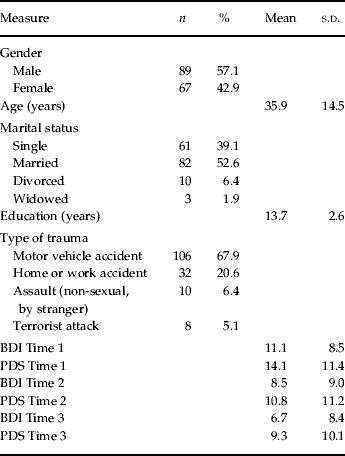
Of the 202 participants initially approached, 156 (77.2%) completed the first assessment at 2 weeks, and these comprised our total sample. Of this total sample, 147 (94.2%) completed the second assessment at 4 weeks and 145 (92.9%) completed the third assessment at 12 weeks. We compared individuals who did not complete the first assessment (n=46) and those who did (n=156) on all measures. Drop-outs did not differ from completers on any demographic or clinical measure, with the exception of years of education [t(193)=3.21, p<0.001] and age [t(199)=2.09, p<0.05]. Differences were such that drop-outs reported slightly fewer years of education (mean 12.3, s.d.=1.7) than completers (mean=13.7, s.d.=2.6) and were younger (mean age=31.0 years, s.d.=11.6) than completers (mean age=35.9 years, s.d.=14.5). No differences were found between drop-outs and completers in any other measure. Demographic, trauma-related and clinical measures for the entire sample are presented in Table 1.
Demographic and clinical measures of the total sample (n=156)

BDI, Beck Depression Inventory; PDS, Posttraumatic Diagnostic Scale; s.d., standard deviation.
Procedure
At the first encounter (Time 0) participants were interviewed and their eligibility for participation in the study was assessed. Interviewers were B.A. and M.A. psychology students who had received training and supervision from the first and last authors of the present paper. Participants who met the criteria for inclusion gave their signed informed consent and completed an initial questionnaire inquiring about gender, age, marital status, years of education and the type of trauma experienced (type of event, injury details of self and others, sense of life danger to self or others, whether they felt helplessness or terror during the event, and whether they had experienced a traumatic event in the past). Preliminary interviews were conducted 2–48 h following the traumatic event (Time 0). These interviews also included Parts 1 and 2 of the Posttraumatic Diagnostic Scale (PDS; Foa et al. Reference Foa, Cashman, Jaycox and Perry1997) and an assessment of criterion A of DSM-IV. At 2 weeks post-trauma (Time 1), 4 weeks post-trauma (Time 2) and 12 weeks post-trauma (Time 3), participants' post-traumatic and depressive symptoms were assessed. For these measurements, participants were contacted and met by research assistants in their homes to fill out self-report versions of the Beck Depression Inventory (BDI; Beck et al. Reference Beck, Ward, Mendelson, Mock and Erbaugh1961) and the PDS. Because the participants were physically injured and our study concerned psychological distress, the research assistants specifically directed the participants to disregard symptoms arising purely from injury.
The three time-points in the present study were chosen to best reflect DSM diagnoses and crucial periods in the aftermath of trauma. Our first measurement (Time 1) was designed to examine the first response following trauma and to temporally approximate the trauma. Our second measurement (Time 2) reflected the DSM specification of 1 month as the transition point between the diagnosis of acute stress disorder (ASD) and acute PTSD (APA, 2000). Our third measurement at 3 months (Time 3) reflected the DSM time-point from which acute PTSD becomes chronic PTSD.
Measures
The BDI (Beck et al. Reference Beck, Ward, Mendelson, Mock and Erbaugh1961) is a 21-item scale assessing severity of depression. The extensively validated Hebrew version of the BDI was used in this study (Rosenbaum & Shichman, Reference Rosenbaum and Shichman1979; Stein et al. Reference Stein, Apter, Ratzoni, Har-Even and Avidan1998). Cronbach's α reliability coefficients in the current study ranged from 0.87 to 0.92.
The PDS (Foa et al. Reference Foa, Cashman, Jaycox and Perry1997) is a 17-item scale that provides total and subscale severity scores and categorical classification of PTSD. Internal consistency ranges from 0.78 to 0.92, and test–retest reliability of the severity scores ranges from 0.77 to 0.85. Cronbach's α reliability coefficients in the current study ranged from 0.91 to 0.93.
SEM analyses
Analysis was conducted in two phases. In Phase 1, we established the measurement model of the study variables by using confirmatory factor analysis (CFA). This model included six latent factors pertaining to depression and PTSD symptoms at Times 1, 2 and 3. At each time-point, depression was assessed by means of the cognitive-affective and physical manifest indicators (Shahar et al. Reference Shahar, Bareket, Rudd and Joiner2006) whereas PTSD symptoms were assessed by means of the avoidance, arousal and re-experiencing manifest indicators as specified by DSM (APA, 2000).
Correlations were specified between these latent factors. Autocorrelations were specified between the error terms of the manifest indicators across time. To ensure measurement invariance over time, loadings of the manifest indicators onto their respective latent factors were constrained to equality across time (Hoyle & Smith, Reference Hoyle and Smith1994).
In Phase 2 we used a cross-lagged, SEM analysis (Hays et al. Reference Hays, Marshall, Wang and Sherbourne1994; see also Shahar & Davidson, Reference Shahar and Davidson2003; Shahar et al. Reference Shahar, Bareket, Rudd and Joiner2006). Specifically, we estimated synchronous, stability and cross-lagged associations between the depression and PTSD latent factors at Times 1–3.
All analyses were conducted using AMOS 7.0 (SPSS Inc., USA) with the maximum likelihood (ML) estimation procedure. Model fit was assessed using the following fit indices: the χ2/df index, the Non-Normed Fit Index [NNFI; Bentler & Bonett (Reference Bentler and Bonett1980), labeled the Tucker–Lewis Index (TLI) in AMOS 7.0], the Comparative Fit Index (CFI; Bentler, Reference Bentler1990), and the Root Mean Square Error of Approximation (RMSEA; Steiger, Reference Steiger1980). Models are said to fit the data well when the χ2/df index is <3, the NNFI and CFI are >0.90 (Bentler, Reference Bentler1990), and the RMSEA is <0.06 (Kline, Reference Kline1998; Hu & Bentler, Reference Hu and Bentler1999).
Missing data were handled using full information ML (FIML) estimates (Anderson, Reference Anderson1957). Compared with other imputation methods, FIML produces the least biased estimates of missing values (Muthen et al. Reference Muthen, Kaplan and Hollis1987). Thus, the SEM analyses in this study were based on the total sample of 156 individuals. Analyses with and without missing data resulted in identical results. Thus, all analyses are reported on the full imputed data set (n=156).
Results
Measurement model results
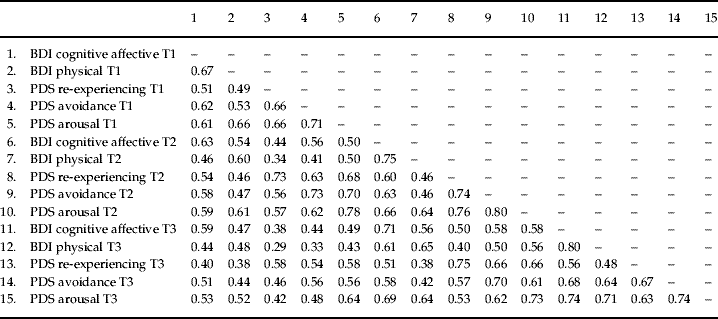
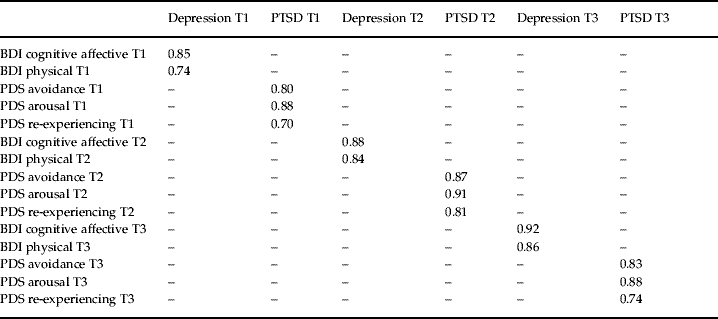
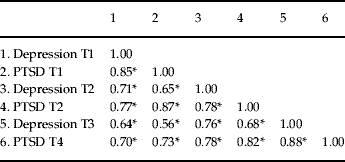
The measurement model evinced an adequate fit to the data (χ2=133.31, df=66, χ2/df=2.02, NNFI=0.94, CFI=0.96, RMSEA=0.08). The loadings of the manifest indicators onto their respective latent variables were all strong and statistically significant, ranging from 0.74 to 0.92. The measurement model of the study variables was therefore established. Table 2 presents the correlations among the disattenuated (free of measurement error) latent variables. All correlations were strong, ranging from 0.56 to 0.88.
Correlations between all manifest variables

BDI, Beck Depression Inventory; PDS, Posttraumatic Diagnostic Scale; T1, first measurement at 1–2 weeks following trauma; T2, second measurement at 4 weeks following trauma; T3, third measurement at 12 weeks following trauma.
All p<0.001.
Structural model results
The cross-lagged SEM analysis evinced an identical model fit (χ2=133.31, df=66, χ2/df=2.02, NNFI=0.94, CFI=0.96, RMSEA=0.08). The following statistically significant associations between the latent factors were found.
For synchronous associations, depression and PTSD correlated strongly at Time 1 (r=0.85, p<0.001, shown in Table 3). At Times 2 and 3, the ‘disturbances’ of these variables, that is the variances in these variables that are not accounted for by incoming arrows, also correlated very strongly (r=0.58, p<0.001; r=0.73, p<0.001, for Times 2 and 3 respectively). For stability effects, Time 1 depression predicted Time 2 depression (β=0.58,p<0.01) but not Time 3 depression (β=0.25, n.s.). Time 2 depression predicted Time 3 depression (β=0.50, p<0.001). Time 1 PTSD predicted Time 2 PTSD (β=0.78, p<0.001) but not Time 3 PTSD (β=0.09, n.s.). Time 2 PTSD predicted Time 3 PTSD (β=0.44, p<0.05). Most importantly, for cross-lagged effects, a single statistically significant effect was found, that between Time 2 depression and Time 3 PTSD (β=0.36, p<0.01).
Loadings of the manifest variables onto their respective latent factors

PTSD, Post-traumatic stress disorder; BDI, Beck Depression Inventory; PDS, Posttraumatic Diagnostic Scale; T1, first measurement at 2 weeks following trauma; T2, second measurement at 4 weeks following trauma; T3, third measurement at 12 weeks following trauma.
All p<0.001.
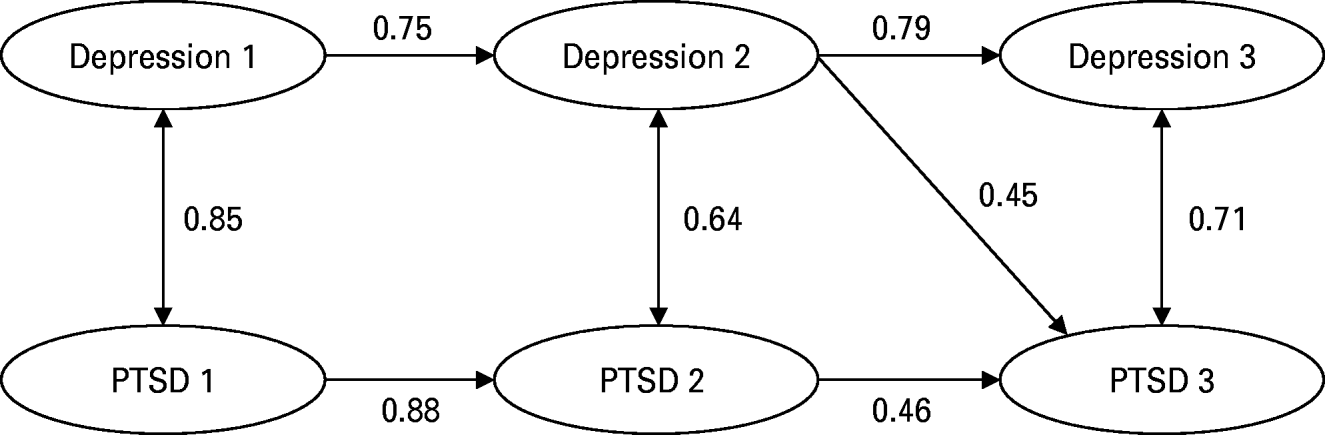
Based on Bentler & Moojaart (Reference Bentler and Moojaart1989), we arrived at the most parsimonious model by omitting non-significant structural paths. This model evinced an adequate fit (χ2=141.00, df=73, χ2/df=1.93, NNFI=0.94, CFI=0.96, RMSEA=0.07). The associations among the latent variables in this model are presented in Fig. 1 (Table 4).
Most parsimonious model obtained by structural equation modeling (SEM) analysis. Numbers are standardized path coefficients (all p<0.001).

Correlations among the latent variables

T1, First measurement at 2 weeks following trauma; T2, second measurement at 4 weeks following trauma; T3, third measurement at 12 weeks following trauma; Depression, latent depression factor; PTSD, latent post-traumatic stress disorder factor.
* p<0.001.
Discussion
Comparing three theoretical models of the nature of the PTSD–depression co-morbidity in a sample of Israeli victims of a single-event trauma, we found evidence for the synchronous change model and for the less examined, depressogenic model. Specifically, depressive and post-traumatic symptoms exhibited significant stability effects and were associated synchronously at each time-point. In addition, depressive symptoms predicted an increase in post-traumatic distress between 4 and 12 weeks following trauma. Our findings suggest that depressive symptoms play an active role in the development of PTSD symptoms.
The results of our study lend support for the synchronous change model, in that the synchronous associations among post-traumatic and depressive symptoms were high at each time-point, including Time 3, where a partial cross-lagged effect of depressive symptoms on post-traumatic symptoms was found. These results are congruent with the tripartite model of depression and anxiety (Clark & Watson, Reference Clark and Watson1991), which includes shared factors in anxiety and depression (e.g. negative affect) that may contribute to synchronous changes over time. In a similar vein, a recent study that examined the structure of post-traumatic distress among motor vehicle accident (MVA) survivors found that a model in which dysphoria was a higher-order factor (that was correlated with both PTSD and MDD) best fit their data (Grant et al. Reference Grant, Beck, Marques, Palyo and Clapp2008). To summarize, our results mirror those of recent studies and support the view of PTSD and depression as changing synchronously and emanating partially from common risk factors.
Despite evidence in support of the demoralization model in anxiety disorders, no support for this model was found in the present study. It is possible that the effects of demoralization emerge later in the course post-trauma, and that our 12-week time-frame was insufficient to detect these effects. The present study focused on the acute PTSD time-frame (up to 3 months) and it is therefore possible that the demoralization model may be more pronounced during the chronic PTSD phase (from 3 months onwards). Alternatively, demoralization effects might be less prevalent than had been thought before, at least in a population consisting mostly of single-trauma victims. Congruent with the present study, a large, 30-year prospective study found that GAD did not precede MDD more often than MDD preceded GAD (Moffitt et al. Reference Moffitt, Harrington, Caspi, Kim-Cohen, Goldberg, Gregory and Poulton2007). Thus, similar to the present study, Moffitt et al. (Reference Moffitt, Harrington, Caspi, Kim-Cohen, Goldberg, Gregory and Poulton2007) did not find clear evidence for the causal effect of anxiety symptoms on subsequent depression.
Our data supported a depressogenic model in which depressive symptoms contribute to subsequent post-traumatic symptoms. The link between depressive and post-traumatic symptoms can be understood in the light of prospective studies focusing on mechanisms of PTSD development. Several researchers have suggested that two basic mechanisms are involved in the development of post-traumatic distress: negative self-concept (Bryant & Guthrie, Reference Bryant and Guthrie2007) and impaired fear extinction (Guthrie & Bryant, Reference Guthrie and Bryant2006). One possible mechanism by which depression may influence PTSD is through the latter: fear extinction. Depressive symptoms such as anhedonia and negative self-evaluation may hinder an individual's motivation and ability to engage in exposure to trauma-related stimuli. Consider, for instance, an MVA victim who experiences intrusions and hyperarousal in the weeks following the accident. Whether these normative experiences eventually dissipate, as happens in the majority of the cases (e.g. Bonanno, Reference Bonanno2004), may depend crucially upon this person's belief in their ability to weather the crisis (self-efficacy). Depression may embed a major impediment of this self-efficacy belief, and lead to cognitive and behavioral avoidance in dealing with trauma-related reminders that are crucial for recovery. Put differently, the experience of depression may derail attempts to exercise the self-regulatory processes needed to engage in distress-provoking activities, thus contributing to the maintenance of both depressive and post-traumatic stress symptoms.
To the extent that depression following trauma contributes to an increase in post-traumatic stress symptoms, assessment and intervention implications are noteworthy. From the point of view of assessment, clinicians may strive to assess depression as close as possible to the time of the trauma. Indications for elevated levels of depressive symptoms can be treated as a risk factor for both major depression and PTSD. From the point of view of treatment, addressing depressive symptoms in therapy seems warranted. Whereas many treatments of PTSD evidence a reduction in depressive symptoms as a result of trauma-focused interventions geared primarily to the reduction of PTSD symptoms (Resick et al. Reference Resick, Nishith, Weaver, Astin and Feuer2002; Foa et al. Reference Foa, Hembree, Cahill, Rauch, Riggs, Feeny and Yadin2005), it is possible that depression-focused interventions may also decrease the severity of post-traumatic symptoms. Recently, several researchers have begun to examine depression-geared interventions for the treatment of PTSD with promising results: an early intervention of behavioral activation was found to reduce PTSD symptoms among individuals with co-morbid PTSD and depression (Wagner et al. Reference Wagner, Zatzick, Ghesquiere and Jurkovich2007) and among veterans with PTSD (Jakupcak et al. Reference Jakupcak, Roberts, Martell, Mulick, Michael, Reed, Balsam, Yoshimoto and McFall2006). Interpersonal psychotherapy was also found to significantly reduce PTSD symptoms (Bleiberg & Markowitz, Reference Bleiberg and Markowitz2005). Taken together with our own findings, the results of these studies suggest that the etiology, in addition to the treatment, of PTSD may depend on depression-related processes.
In contrast to the highly stable effects of depression between 4 and 12 weeks following trauma, post-traumatic symptoms had lower stability effects during that time-period. In other words, depressive symptoms at 4 weeks were more predictive of later (12 week) depressive symptoms compared to post-traumatic symptoms, which were less predictive of later (12 week) post-traumatic symptoms. This finding is consistent with research on resilience and recovery following trauma (Bonanno, Reference Bonanno2004). Ample research indicates that some individuals may be resilient to trauma and therefore experience low levels of post-traumatic stress both immediately following the trauma and months later. Others may recover from trauma, experience moderate or high levels of post-traumatic stress immediately following the trauma, and these levels decline with time. Others may have a delayed onset of PTSD, experience moderate or low levels of post-traumatic stress immediately following trauma, and these levels rise with time. Finally, some individuals may experience chronic PTSD involving high post-traumatic stress both immediately after the trauma and months later. Indeed, a range of recovery trajectories can occur following trauma, and these trajectories are of importance to the development of PTSD (Gilboa-Schechtman & Foa, Reference Gilboa-Schechtman and Foa2001). The present study contributes to this literature as it suggests that depressive symptoms play a role in determining trajectories of recovery following trauma.
The present study had several limitations. First, our focus was on continuous levels of syndromal depression and PTSD rather than on categorical diagnoses. The use of interview-based measures for diagnosis would have enhanced our understanding of the interactions between MDD and PTSD. Related to this is the exclusive reliance on self-report measures, which may have bolstered the association between the two syndromes because of shared method variance. Second, the relatively short time-frame may have limited our ability to find support for the demoralization model. Third, the prospective-longitudinal nature of our design is consistent with both an onset explanation (depression causes subsequent PTSD symptoms) and a course explanation (depression appears earlier in the course of post-traumatic distress, and indicates the emergence of subsequent PTSD symptoms). Fourth, we did not collect data on pre-trauma morbidity (e.g. diagnoses present before the trauma, previous traumatic experiences). These variables may affect the aftermath of trauma and should be considered in future studies. Finally, our sample is slightly smaller than the optimal sample size for SEM (Hoyle, Reference Hoyle1995; n=200). However, use of SEM in samples with n<200 is fairly common (e.g. Shahar et al. Reference Shahar, Blatt, Zuroff, Krupnick and Sotsky2004). Replication of these findings among larger samples will increase confidence in our conclusions.
The present study adds to the literature on the co-morbidity between depression and post-traumatic distress and highlights the complexity of the processes taking place in the aftermath of trauma. Understanding the interaction between depressive and post-traumatic symptoms following trauma can enhance our understanding of the trajectories of (non-) recovery following trauma.
Acknowledgments
This study was based on collaboration between the Emotion, Cognition and Psychopathology Laboratory at the Department of Psychology of Bar-Ilan University and the Stress and Personality Laboratory at the Department of Psychology of Ben-Gurion University of the Negev (Israel). The study was partly funded by a grant from IFT – Israeli Foundation Trustees. Data for this study were collected as part of I. Schnidel-Allon's doctoral dissertation, supervised by E. Gilboa-Schechtman.
Declaration of Interest
None.