Introduction
The 1959–1961 Chinese Famine was the largest in human history, causing up to 30 million deaths.Reference Ashton, Hill, Piazza and Zeitz 1 , Reference Smil 2 Its genesis was the ‘Great Leap Forward’ campaign launched in 1958, which led to rural households being organized into people’s communes and to the disruption of agricultural production. A sudden drop in grain production in 1959–1961 precipitated the famine but a host of interrelated factors increased its severity: drought, grain appropriation by the state, eroded incentives for food production due to collectivization, delayed response to the food shortage and resource diversion as a result of massive industrialization.Reference Chang and Wen 3 – Reference Becker 7 The famine affected all of China, but its severity and duration varied across areas. Rural areas suffered disproportionately.Reference Chen and Zhou 4
Famines provide a ‘natural experiment’ or quasi-experimental setting for research on the long-term effects of nutritional deprivation on human development. While most 20th century famines occurred in developing countries, little attention has been paid to impact on human development in these settings. The best-studied famine is the Dutch ‘hunger winter’ at the end of World War II.Reference Lumey, Stein and Kahn 8 The Dutch famine had a well-defined but brief duration (∼6 months) and, while severe, it occurred in the context of an otherwise well-nourished population. The Chinese famine was of much longer duration and was superimposed on widespread chronic undernutrition. Although estimates of dietary intake in China during the famine are unavailable, national data on food availability per capita suggest a decline in available daily food energy from 2170 kcal in 1958 to 1535 kcal in 1960.Reference Ashton, Hill, Piazza and Zeitz 1 There was large variation across provinces in grain availability and cities were favored; reports of extreme behavior in many rural areas, such as eating tree bark or even cannibalism, imply extremely low intake.Reference Becker 7
Research on the Dutch famine documented that among women exposed during the last third of pregnancy, their offspring weighed 263 g less at birth compared to newborns of unexposed women.Reference Lumey and Stein 9 The offspring of women exposed during pregnancy did not differ from the offspring of unexposed women in adult stature and other linear measures.Reference Stein, Kahn, Rundle, Zybert, van der Pal-de Bruin and Lumey 10 Intergenerational effects of the Dutch famine have been examined as well. The birth weights of newborns of women themselves exposed prenatally did not differ from those of newborns of unexposed controls.Reference Lumey, Stein and Ravelli 11 However, in a within-family analysis, the normal pattern of birth weight among siblings, where the firstborn are smaller than the later born, was not seen in women themselves exposed in the first trimester of pregnancy.Reference Lumey and Stein 9
We are unaware of any previous studies on intergenerational effects of the Chinese famine on birth size. The objective of this paper is to estimate the impact of exposure to the Chinese famine during prenatal and early postnatal life in girls on the birth size of their offspring.
Method
Data
Data are from the China–U.S. Collaborative Project for Neural Tube Defect Prevention conducted by the U.S. Centers for Disease Control and Prevention (CDC) and Beijing Medical University in the early 1990s. The study evaluated the efficacy of periconceptual folic acid supplementation to prevent neural tube defects in 35 counties from three provinces in China (Hebei, Zhejiang and Jiangsu) and was approved by the institutional review boards of the CDC and Beijing Medical University.Reference Berry and Li 12 , Reference Berry, Li and Erickson 13 Women preparing for marriage registered with the pregnancy-monitoring system; birth length and weight were collected by health system personnel within 24 h after birth.
We restricted the study to women born in 1957–1963 (n = 35, 767). Few women born before 1957 were available for study. Those born 1957–1963 would have been the oldest women participating in the folic acid study (mean age 32.3 ± 1.8 years old at delivery). We further excluded 4318 cases with any missing information for the mother (prenatal weight, height, education, occupation and age at delivery) or the baby (sex, birth order, birth length and birth weight). The majority (70%) of missing cases lacked information on birth order of the baby. There were no significant differences in the measured characteristics of mothers and babies with missing data compared to those included in the sample for analyses (n = 31, 449).
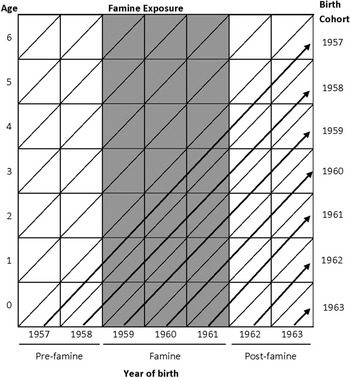
Birth anthropometric data were collected between 1993 and 1996. We divided the maternal birth cohorts into (a) those born before the famine (1957–1958; ‘pre-famine’), (b) those born during the famine (1959–1961; ‘famine’), (c) those born after the famine (1962; ‘post-famine’) and (d) those unexposed to the famine (1963; ‘unexposed’). The unexposed cohort was the reference cohort in our analyses. The 1962 birth cohort was not combined with the 1963 cohort because some of the 1962 births could have been exposed early in pregnancy; also, the famine may have extended into 1962 in some parts of China.Reference Chang and Wen 3 Exposure to the famine was postnatal for the pre-famine cohorts and both prenatal and postnatal for the famine cohorts (Fig. 1). For example, someone born at mid-year in 1957 would have been exposed to the famine from around 1.5–4.5 years of age; all those born in 1960 would have been exposed to the famine in utero as well as during early infancy. We further divided our sample into urban (n = 1507) and rural (n = 29,942) strata according to the residency status of the mother.
Exposure to the Chinese Famine (1959–1961) during prenatal and postnatal life for maternal birth cohorts born between 1957 and 1963. The shaded area corresponds to famine exposure. The arrows trace exposure for those born at mid-year.

Measures
Outcomes
The outcomes of interest were weight, length and body mass index (BMI) at birth of the offspring of mothers born between 1956 and 1963. Health workers were trained to measure birth length to the nearest mm (XX.X cm) and birth weight to the nearest dekagram (X.XX kg). Analysis of the terminal digit indicates that health workers measured birth length most commonly to the nearest centimeter, since 97% of values ended in 0. In addition, 45% of all birth length values were reported exactly as 50 cm. Over 80% of birth weight values ended in 0% and 18% in 5, suggesting that workers most often measured to the nearest 100 g and to a lesser extent, to the nearest 50 g. The most commonly reported birth weight was 3 kg, 8.5% of the total.
Famine severity
We extend the analytic approach of Chen and ZhouReference Chen and Zhou 4 , who used province-level excess mortality in 1960 to generate a measure of famine severity. As we had only three provinces but 35 counties represented, we used a 1% sample of China’s 1990 population census to derive a measure of famine intensity at county level based on the size of the famine cohorts relative to non-famine cohorts (the data are publicly available at https://international.ipums.org/international/). We assumed that the smaller the size of the famine cohorts, due to reduced fertility and/or increased mortality, the greater the severity of the famine.Reference Huang, Li, Wang and Martorell 14 To derive an index of famine severity for each county, we first calculated the mean cohort size of women born during the 3 years immediately before the famine (1956–1958) and the 3 years immediately after the famine (1962–1964), labeled as N nonfam, as well as the mean cohort size of women born during the famine years (1959–1961), labeled as N famine. We then calculated the cohort size shrinkage index (CSSI) as the difference between N nonfam and N famine divided by N nonfam. Among the 35 counties, CSSI ranged from 0.24 to 0.64, with a mean of 0.42 and s.d. of 0.09, indicating that on average the group of adults in 1990 who were born during the 3 years of the famine was 42% smaller compared to those of adults born in the 3 years immediately preceding or following the famine. To gauge the validity of our measurement on famine intensity, we calculated the cohort size shrinkage index at the province level and found that it was correlated strongly (r = 0.87, P < 0.001, n = 28) with the excess mortality rate at province level, a measure of famine intensity used in a previous study.Reference Chen and Zhou 4 We are unable to compute the correlation at county level for these two indices because of the lack of mortality data at county level.
Statistical model
We used a Difference-in-Difference model (DID) that contrasts maternal birth cohort group (pre-famine: 1957–1958, famine: 1959–1961 and post-famine: 1962) to the unexposed (1963) maternal cohort, using dummy variables for each cohort group, leaving the 1963 cohort as the reference. As the famine was less severe in urban compared to rural areas, we expected weaker relationships for the urban stratum.
The ideal design to study maternal famine exposure and offspring birth outcomes would first estimate the difference in the famine area, say in offspring birth weight, between newborn of mothers in the 1959 birth cohort and those born to mothers in the 1963 reference cohort. However, this difference may represent wholly or partly an age effect or time trend unrelated to the famine. To guard against this possibility, we would want to subtract a second difference from the first, specifically the difference in offspring birth weight between the same birth cohorts but in a non-famine or control area. Since the Chinese famine was nationwide, we lack a true non-famine or control area. Thus, we relied on the variation in famine severity across counties to construct the DID model, similar to the approach used by Chen and Zhou.Reference Chen and Zhou 4

Where, Birk is the outcome of interest (birth weight, birth length or BMI at birth) for a baby born to a woman who herself was born in county r and period k (k = 1 refers to birth years 1957–1958, k = 2 refers to birth years 1959–1961, k = 3 refers to birth year 1962), αk is the cohort fixed effect, and CSSI r is the cohort size shrinkage index in county r (an indicator of famine intensity in the county). βk is the coefficient of the interaction between the famine severity index and the cohort group dummy variables (CSSI × cohort) and is a measure of the double difference representing the impact of maternal famine exposure on birth outcomes of the offspring. To estimate the average effect across all 35 counties, we multiplied the interaction coefficient by the mean CSSI across all counties, 0.42, with the product being the overall estimate of intergenerational impact.
We report the average impact (in cm for birth length, in kg for birth weight and kg/m2 for birth BMI) across counties, their 95% CIs and P-values. The basic models included child’s sex as a co-variate. We also explored whether these estimates were robust to the inclusion of maternal height, education and age at delivery in the model. No education was used as the reference and three dummy variables were created to represent elementary, junior high and high school or greater education. We limited the analyses to only data points for the newborn outcomes within ±3 s.d. from the mean to test whether the findings were sensitive to extreme values. CIs were adjusted for clustering by county. All analyses were conducted using SAS version 9.
Results
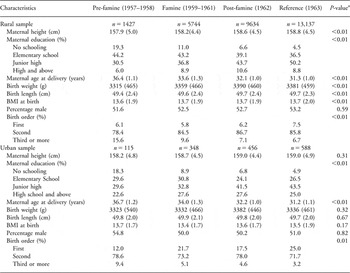
Characteristics of the sample by maternal cohort group and urban/rural residence are given in Table 1. Mothers were around 158 cm tall and offspring weights generally over 3300 g and lengths slightly under 50 cm. Schooling improved over time. Between 50% and 55% of newborns were boys and the majority was second born.
Characteristics (X and s.d. or %) by maternal birth cohort and maternal residency

a P-value generated from the ANOVA test.
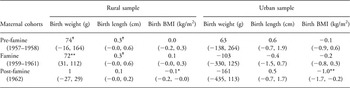
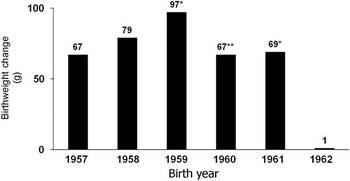
Compared to the offspring of women born in 1963 and unexposed to the famine, in rural areas, birth weight were greater by 74 g in the offspring of women from the pre-famine group and by 72 g in those from the famine group; however, the coefficient was significant at P < 0.05 only for the famine group (Table 2). Intergenerational associations with birth weight for specific maternal birth year cohorts varied between 67 and 97 g for years 1957 to 1961 (pre-famine and famine years) but were significant (P < 0.05) only for 1959, 1960 and 1961 maternal birth cohorts (Fig. 2). There was a tendency (P < 0.10) for birth length to be greater in the offspring of pre-famine and famine maternal birth cohorts by 0.3 cm (Table 2). All intergenerational associations for birth length by specific maternal birth year cohort were positive, but were significant (P < 0.05) only for 1957 and 1959 cohorts (results not shown). BMIs of newborns born to mothers born in 1962 were lower by 0.1 kg/m2 (P < 0.05). After pooling pre-famine and famine cohorts (1957–1961), we found significant associations with all outcomes; birth weight was greater by 69 g (30, 108), birth length by 0.3 cm (−0.0, 0.5) and birth BMI by 0.1 kg/m2 (0.0, 0.2).
Associations between maternal famine exposure in early life and offspring birth size
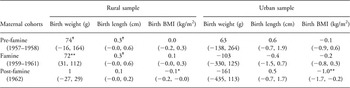
Note: † P < 0.1, *P < 0.05; **P < 0.01; 95% CI in parentheses; coefficients and confidence intervals correspond to the average CSSI (Cohort size shrinkage index) across counties of 0.42.
Intergenerational differences in offspring birth weight in rural areas associated with famine exposure, by maternal birth cohort. From difference-in-difference models, where 1963, the unexposed cohort, is the reference (*P < 0.05, **P < 0.01).

There were no intergenerational associations with famine exposure in urban areas for weight or length at birth. The only significant finding in urban areas was in BMI, which was lower by 1.0 kg/m2 (P < 0.01) in the offspring of mothers born in 1962. There was no significant association after pooling pre-famine and famine cohorts (1957–1961); the coefficients found were as follows: birth weight, −52 g (−225, 121), birth length, −0.1 cm (−1.0, 0.9) and birth BMI, −0.2 (−0.6, 0.2) kg/m2.
The results were not appreciably altered by including maternal height, education or age at delivery in the model (results not shown). The results were not appreciably changed when the sample was restricted to only outcome values within plus/minus 3 s.d. from the mean (results not shown).
Discussion
Contrary to our expectation, we found that the offspring of rural women themselves exposed in utero and early postnatal life to the Chinese Famine were bigger at birth compared to their counterparts who were born after the famine. In contrast, we found that exposure to the famine was not associated with offspring birth size in urban areas.
Famine exposure during fetal life was not associated with adult stature in Holland.Reference Stein, Kahn, Rundle, Zybert, van der Pal-de Bruin and Lumey 10 In China, it is impossible to isolate prenatal from postnatal exposure as in Holland, given the long and imprecise duration of the famine. Exposure to the Chinese famine prenatally and in early childhood was associated with shorter adult stature, as much as 3 cm less for some birth cohorts.Reference Chen and Zhou 4 Lower estimates of reduced adult stature were found in a study using the same sample analyzed here; women’s height was shorter by 1.7 cm (−2.7, −0.6) for the 1958 and by 1.3 cm (−2.2, −0.5) for the 1959 birth cohort, but only in rural areas.Reference Huang, Li, Wang and Martorell 14 The differences in the magnitude of the associations with height between these studies may reflect differences in famine intensity across areas in China.Reference Huang, Li, Wang and Martorell 14
Given the findings that exposure to the famine was associated with shorter adult height, we expected birth outcomes of the offspring of mothers themselves exposed during fetal and/or postnatal life to be smaller than for offspring of unexposed mothers. Instead we find, in rural areas only, that birth weights were larger by 69 g, birth lengths by 0.3 cm and birth BMIs by 0.1 kg/m2 in newborns of mothers born from 1957 to 1961, who therefore were exposed to the famine in early life. These estimates correspond to 0.15, 0.13 and 0.05 of the pooled standard deviation in the total sample for weight, length and BMI at birth, respectively. Although the difference in birth weight was significant only for the 1959–1961 cohort years, which were exposed during prenatal and postnatal life, the estimates were similar in magnitude to those for the 1957 and 1958 cohorts that were exposed only in the postnatal period. The difference in significance across these cohort groups likely reflects differences in sample sizes. Associations with birth outcomes were independent of maternal height, education and maternal age at delivery.
Our findings are consistent with a report from China that assessed relationships between famine exposure and schizophrenia.Reference Song, Wang and Hu 15 The mental health data were carefully collected in a nationally representative sample, rather than from hospital records as in previous smaller studies,Reference St Clair, Xu and Wang 16 , Reference Xu, Sun and Liu 17 and rates of schizophrenia were compared for those born prior, during and after the famine. Famine exposure was associated with higher risk in urban areas but in rural areas, famine was associated with lower risk of schizophrenia. The authors speculate that intense survival selection resulting from the greater severity of the famine in rural compared to urban areas may have ‘weeded out’ the frail.Reference Song, Wang and Hu 15 This difference in famine severity between urban and rural areas might have led therefore, to the expected negative association observed in urban areas, consistent with findings about the Dutch famine,Reference Susser, Hoek and Brown 18 and in the ‘protective’ association found in rural areas.
The lack of associations with adult stature among some cohorts of adults exposed to the Chinese famine in early childhood has been characterized as puzzling given the very high mortality rates that these cohorts experienced during the famine.Reference Gørgens, Meng and Vaithianathan 19 Two forces are postulated to operate during a severe famine; the first is a stunting effect likely due to reduced nutrient intakes and diminished resistance to infection, leading to growth failure and the second is a selection effect favoring survival of those that are hardier, a characteristic possibly related to growth potential, leading to taller survivors.Reference Gørgens, Meng and Vaithianathan 19 , Reference Bozzoli, Deaton and Quintana-Domeque 20 These two forces can cancel each other out and lead to some exposed cohorts not being different from unexposed cohorts, as we have seen in our own research.Reference Huang, Li, Wang and Martorell 14 In settings of very high mortality, as in the Chinese famine in rural areas, models of stunting and selection predict that selection will dominate stunting.Reference Bozzoli, Deaton and Quintana-Domeque 20 In settings of high mortality, one would predict the children of individuals, who survive this intense selection to be larger, which is what we find in rural areas.
The famine may have extended into 1962 in some areas of China, while in others food supplies probably improved over the year. We found a trivial difference in birth BMI in the newborns of the 1962 maternal birth cohort in rural areas (−0.1 kg/m2 or 0.05 s.d. units) and a much larger difference for the newborns of the 1962 cohort in urban areas (−1.0 kg/m2 or 0.50 s.d. units). We have no adequate explanation for why the babies born to urban women themselves exposed in early life at the end of the famine, in 1962, are thinner compared to the newborns of unexposed women.
Our study has several limitations. The famine in China was nationwide and there was no region unaffected, although cites were much less affected. The lack of a control area led us to adapt the approach followed by Chen and ZhouReference Chen and Zhou 4 who used variability in excess mortality across provinces; we generated a DID model that used variability across counties in the extent to which birth year cohort sizes during the famine were affected. We found that our cohort size shrinkage index, when estimated at province level, was highly correlated with province level excess mortality, giving us confidence in our county-level approach. Had mortality data been available at county level, we would have explored the relative merits of using cohort size or mortality indices as indicators of famine severity. The long and imprecise duration of the famine does not allow for a precise specification of exposure nor does it permit one to isolate prenatal from postnatal exposure. We found associations with newborn outcomes in rural but not in urban areas; however, sample sizes were many times smaller in urban compared to rural areas and our null findings in urban areas may reflect low statistical power. Our measures of birth weight and birth length were made by routine health personnel, and there was substantial heaping, particularly for length, in the recorded values. The better relative measurement of weight compared to length may explain greater consistency and tighter CIs of the results for birth weight. Measurement imprecision will drive estimates to the null. Hence, our findings are likely underestimates of possible effects, although exclusion of outliers did not alter the results. A limitation of our study is that we do not have data about the fathers of the newborns. In a study in Guatemala, generational effects on birth outcomes and child growth of a nutrition intervention occurred only in the offspring of better nourished girls but not boys, adding plausibility to the results.Reference Behrman, Calderon, Preston, Hoddinott, Martorell and Stein 21 Furthermore, the sample studied was from the China–U.S. Collaborative project and included only the oldest subjects in this study; the newborns we studied were mostly second-born and this prevented us from assessing parity specific effects. Finally, we do not have information about the birthplace of the women in the study sample and we assumed that the county of current residence was that of birth. This assumption is likely to be valid because the data for this study was collected in the early 1990s, when migration was rare in China.Reference Lin, Wang and Zhao 22 Using the 1990 Chinese Census, we checked the migration status for the women born during 1956–1963 in the sampled provinces (Hebei, Zhejiang and Jiangsu) and found that for all the three provinces <4% of women moved out of the current county of residence during the period 1985–1990; those who moved out were more likely to be educated and have non-agricultural professions. Although famines are normally accompanied by outbreaks of population migration out of famine areas, the Chinese famine of 1959–1961 led only to mild mobility, primarily caused by the restriction imposed by the residence registration (hukou) system.Reference Chen and Zhou 4 The Hukou regulation, initiated in 1951, was formalized and then strictly reinforced in both cities and rural areas by 1958.Reference Chan and Zhang 23 Under the hukou regulation, every citizen was required to register at one permanent residency. Regulation on migration was firmly controlled by a public security system, which monitored and controlled over not only the rural influx to the cities but also all intrarural and intraurban movement.Reference Chan and Zhang 23 Although out-migration was likely low during the famine and up to the 1990s, we do not have the necessary data to estimate its extent and the possible biases that it may have introduced to our results.
The strengths of the study include the analytic strategy. The DID model corrects for secular trends and makes it possible to isolate the famine impact through the generation of an index of severity at county level based on relative cohorts sizes using a 1% sample of the 1990 Chinese census. The fact that education improved across the cohorts illustrates the need to control for secular trends through the analytic design. Another strength is the large sample size for rural areas.
As the mothers included in our study were somewhat older (∼32 years), our findings pertain mostly to second born newborns. Our findings cannot be generalized to all famines since the intensity of selection varies according to famine severity. Indeed, our findings cannot be generalized to all of China since the results are sensitive to the provinces and counties selected for study. Several other provinces in China, such as Anhui, Sichuan and Henan were more severely affected than the provinces we studied, and results may have differed had these areas been included in our study.
Our findings suggest that severe and prolonged famine, resulting in high mortality rates and decreased fertility, may lead to greater newborn size in the offspring of mothers themselves exposed to famine during in utero and the first few years of life.
Acknowledgments
We thank R.J. Berry, MD for his assistance in providing background information about the China–U.S. Collaborative Project for Neural Tube Defect Prevention conducted by the U.S. Centers for Disease Control (CDC) and Beijing University Medical Science Center since the early 1990s. This research was funded by a grant from The Global Health Institute of Emory University. The funder had no role in the conduct of the study. RM conceived the project and with CH designed the study; ZL provided the data; CH developed the analytic model and carried out the analyses; CH wrote the first draft and RM wrote subsequent drafts and incorporated suggestions from all authors; KMN and DW read and commented on preliminary drafts. RM had primary responsibility for final content. All authors read and approved the final manuscript.
Statement of Interest
None of the authors has any conflict of interest to disclose.