I. INTRODUCTION
The economist Allen V. Kneese (1930–2001) made immense contributions to environmental economics in the 1960s and 1970s—a period when this field was still in a nascent stage of development. He has been called a “pioneer in environmental economics” (The Economist 2001; Resources 2001),Footnote 1 “one of the founders of the field of environmental economics” (Resources 2001), the “father of American environmental economics” (Oates Reference Oates1996), and the “father of environmental economics” and a “path breaking environmental economist” (Kolstad Reference Kolstad2010). However, despite his remarkable achievements, Kneese’s works have yet to be given sufficient recognition in the history of economic thought and even in that of environmental economics. There are two reasons for this statement.
First, Kneese’s discussions have had very few opportunities to be referred to as an effective theoretical framework of environmental economics. When environmental pollution is discussed in the framework of modern economic analysis, what we read about is not Kneese but Arthur C. Pigou and his concept of external diseconomies or externalities, which, we are told, has been a core theoretical tool since Pigou first proposed it in Wealth and Welfare (Reference Pigou1912) and The Economics of Welfare (1920). In histories on the subject, we hear about two major traditions, the Pigouvian and the Coasean, and their proposed remedies to external diseconomies: Pigouvian taxes and the Coase Theorem (e.g., Aslanbeigui and Medema Reference Aslanbeigui and Medema1998; Vatn and Bromley Reference Vatn and Bromley1997).Footnote 2
Second, even when Kneese is referenced, commentators have given him unsatisfactory treatment. Much of Kneese’s most important work concerned water quality management; yet whenever his early works in that area are discussed, distinctions between them and the Pigouvian tradition have tended to be ambiguous and thus remain unclear (e.g., Baumol and Oates Reference Baumol and Oates1988; Cropper and Oates Reference Cropper and Oates1992; Fisher and Peterson Reference Fisher and Peterson1976; Kolstad Reference Kolstad2010; Røpke Reference Røpke2004). For example, Anthony Fisher and Frederick Peterson (Reference Fisher and Peterson1976)—which is “a survey article that may be characterized as the first state-of-the-art presentation of environmental economics” (Medema Reference Medema2014a, p. 43)—argued that, in Kneese (Reference Kneese1962, Reference Kneese1964) and Kneese and Blair Bower (Reference Kneese and Bower1968), “Kneese is the first economist after Pigou to treat externalities analytically and, at the same time, express a serious concern for pollution” (Fisher and Peterson Reference Fisher and Peterson1976, p. 12). And in the same discussion, the authors considered Kneese’s “explicit use of the Pigouvian externality framework” to be among Kneese’s major contributions. Moreover, Inge Røpke (Reference Røpke2004), in referring to Fisher and Peterson (Reference Fisher and Peterson1976), remarked about Kneese as follows: “Fisher and Peterson (1976, p. 12) point to Allen Kneese’s revival of Pigou’s concept of externalities in relation to a study of water pollution as the starting point” (p. 300).
Expressions such as “the first economist after Pigou to treat externalities analytically,” the “explicit use of the Pigouvian externality framework,” and “Allen Kneese’s revival of Pigou’s concept of externalities” could lead us to mistakenly believe that Kneese’s works are a mere extension of the Pigouvian tradition. There are two reasons that might be responsible for such misunderstandings. One is that Kneese’s argument was certainly based on an external diseconomies framework as found in the Pigouvian tradition. The other is that Kneese emphasized the use of “effluent charges”—similar to Pigouvian taxes—as a desirable tool for curbing the problem of water pollution.
Thus, there is no doubt that both the Kneesian approach and the Pigouvian tradition adopted an external diseconomies framework and considered the “polluter pays principle” and economic incentives to be important. With these facts in mind, it should not be said that the interpretation that Kneese’s works are an extension of the Pigouvian tradition is completely incorrect. However, it is also true that this interpretation could obscure critical differences between the two. Therefore, this article attempts to clarify the differences by taking a historical approach.
Over time, Kneese’s academic theme had shifted in the 1970s from water quality management to the “material balance approach,” which is probably his most well-known contribution, and to ethical and distributional issues of environmental economics in the 1980s, as depicted in section II. And then, Kneese’s arguments covered in this article, especially about how to treat “non-market value” and the form of organization and institution that implements environmental resources management, was the theoretical cornerstone of his subsequent works in the 1970s and 1980s. Therefore, to understand the entire scope of his contributions, historical studies about him must begin, as this article does, with a discussion about his water quality management research.
This article makes two contributions to our understanding of the history of economics. First of all, it is about Kneese’s position within the history of environmental economics. The historical studies of that field, such as Spencer Banzhaf (Reference Banzhaf2006, Reference Banzhaf2009, Reference Banzhaf2010, Reference Banzhaf2016) and Michael Hanemann (Reference Hanemann and Navrud1992, Reference Hanemann, Rogers, Ramón Llamas and Martinez-Cortina2006), have tended to focus on the evaluation of non-market value and its methodology. Their theoretical frameworks are typically related to price theory, surplus analysis, or cost-benefit analysis. In these studies, for example, John V. Krutilla, another important founder of environmental economics in the 1960s, was often recognized for his approach to estimating the value of the natural environment (e.g., “existence value”). In contrast, Kneese’s main concern was not with that topic. Rather, as explained in sections III and IV, his focus was on how to internalize external diseconomies without evaluating non-market value and on how to form the institutions and organizations that implement internalization policy. It can be said that, for this reason, the earlier historical studies on environmental economics have had little opportunity to refer to Kneese’s works.Footnote 3
Second, examining Kneese’s works could be also worthwhile to historical studies of applied economics, which deal with the interrelationship between economic theory and policy (e.g., Backhouse and Biddle Reference Backhouse and Biddle2000; Backhouse and Cherrier Reference Backhouse and Cherrier2016). This is because Kneese’s water quality management research was not only the application of an externality framework to water pollution but also a unique challenge to extend and revise an externality framework more practically based on his empirical studies, as investigated in sections III and IV. This challenge was motivated both by his doubt about water quality management policy in the United States and by the innovative policy in the Ruhr region of Germany. It is important to understand that Kneese reached the final form of his research by going back and forth between his theoretical and empirical works. Thus, considering these situations, this article can contribute to historical studies in these ways.
To the purpose of this article, comparisons between Kneese and three other important figures in the history of environmental economics—Krutilla, Ronald H. Coase, and Elinor Ostrom—help distinguish Kneese’s contributions, as discussed in section V. By focusing on the relationship between Kneese’s arguments and those of Krutilla’s non-market value (Banzhaf Reference Banzhaf2016; Hanemann Reference Hanemann and Navrud1992, Reference Hanemann, Rogers, Ramón Llamas and Martinez-Cortina2006) and Coase’s “comparative institutional approach” (Medema Reference Medema2011, Reference Medema2014a, Reference Medema2014b), it can be more clearly understood how Kneese’s argument was positioned in the history of environmental economics. And by discussing the relationship between Kneese’s argument and Ostrom’s argument about “self-organizing and self-governing institution” or “Commons,” which has much more presence in both modern environmental and ecological economics, it can be more distinctly revealed how Kneese’s argument has implications for modern environmental and ecological economics.
II. ABOUT KNEESE: A BRIEF BACKGROUND
Kneese was born on a livestock farm in Fredericksburg, Texas, on April 5, 1930. The region there is arid, so as a boy Kneese would work on the farm while “watching every, even slightly, promising cloud in the hopes of a rainstorm or even shade.” As Kneese recalled, “It all started on tractor seats and grain combine platforms in West Central Texas.” His interest in the natural environment and in water resource development had been nurtured in childhood by “[t]he interactions of man and Mother Nature,” which were “a daily drama of great significance to our welfare” (Kneese Reference Kneese2000, p. 58).
However, his interest in these issues did not immediately direct him toward natural resource economics. One of the reasons might be that “at the time there was no such academic field as natural resource economics, not to mention environmental economics,” and there were few opportunities to cultivate his interest academically. A memorial article (Resources 2001) notes that Kneese “went to Southwest Texas State College[Footnote 4] with no idea what he was going to do,” but that he had “a strong interest in nature,” and a “professor who became a mentor turned him toward economics” (p. 26).
After graduating from the college in 1951, he received a master’s degree in art from the University of Colorado in 1953 and a doctorate in economics from Indiana University in 1956. His doctoral thesis was entitled “An Industry Study Approach to the Problem of Exclusive Dealing,” and it did not focus on water resource issues—or any other environmental problems, for that matter.Footnote 5 Thereafter, Kneese was employed as an assistant professor of economics at the University of New Mexico for two years (1957 to 1958), before joining the Federal Reserve Bank of Kansas City as a research associate (1958 to 1960).
It was when Kneese taught at the University of New Mexico that his academic research on water resources began. The person who gave Kneese this chance was Nathaniel Wollman, who was his department chairman and “later one of the nation’s distinguished figures in water resources economics” (Kneese Reference Kneese2000, p. 58). Wollman lent Kneese a copy of Multiple Purpose River Development: Studies in Applied Economic Analysis (Eckstein and Krutilla Reference Eckstein and Krutilla1958). This book introduced him to the work of Krutilla and had a great influence on him (Kneese Reference Kneese2000, p. 58).Footnote 6
At the University of New Mexico, Kneese and Wollman worked on a project funded by Resources for the Future (RFF) that studied “the economics of allocating New Mexico’s share of the Upper Basin entitlement to water from the Colorado River under the terms of the Law of the River” (Kneese Reference Kneese2000, p. 58). Some of this research with Wollman continued while he worked with the Federal Reserve Bank of Kansas City. A few years later, his works bore fruit in the form of his first book, Water Resources (1959).
A major turning point in Kneese’s life occurred in 1960, when Krutilla and Irving Fox—who, at the time, were co-directors of the water quality program at RFF—asked him to join the program. As Kneese put it, this event was “the greatest piece of good luck of my whole professional life” (Kneese Reference Kneese2000, p. 58). In 1961, Kneese joined RFF, where he served as a research economist from 1961 to 1963 before becoming the director of the Water Resources Program and the Quality of the Environment Division. In 1978, he was promoted to the position of Senior Fellow at the Quality of the Environment Division.Footnote 7 In 1990, Kneese and Krutilla were awarded the first Volvo Environment Prize, which The Economist (2001, p. 97) described as “the next best thing in his discipline to a Nobel.”
When he died of cancer on March 14, 2001, at the Woodbine Rehabilitation and Healthcare Center in Alexandria, Virginia, The Economist (2001), The Washington Post (2001), and Resources (2001) published obituaries on Kneese. As can be gathered from the obituaries, his lifetime work can be summarized in three ways.
First, Kneese recognized the importance of economic incentives, which is illustrated by his use of the concept of “effluent charges” (to use his own words) as pollution abatement policy tools and by his proposed design for cost-minimizing paths towards reaching certain standards of environmental quality. He wrestled with this topic through water quality management research in 1960s, and the concepts he developed in this research continued to characterize his subsequent theme.
Second, Kneese focused on material flow in economic systems, especially disposal processes that traditional economics had ignored. This is most tellingly shown by his keen interest in waste disposal processes, in relation to which he made policy recommendations for reducing, reusing, and recycling by-products (Ayers and Kneese Reference Ayres and Kneese1969; Kneese et al. Reference Kneese, Ayres and D’Arge1970; Kneese and Bower Reference Kneese and Bower1979). He called this a “material balance approach.” In a sense, it can be said that this was an expanded and more comprehensive version of his water quality management research. Furthermore, it is also related to the more general dimension of natural resource scarcity and the view of the natural environment itself as a scarce resource, an idea that was just then being discussed in other classic works, such as Harold Barnet and Chandler Morse (Reference Barnett and Morse1963) and Krutilla (Reference Krutilla1967).
Third, Kneese believed that distributional problems are inevitably a very important topic in environmental economics. He first took this up as a main subject in his representative treatise “Faustian Bargain” (Kneese Reference Kneese1973), which discussed economic and environmental effects that arise from atomic power generation and radioactive waste disposal with respect to intra- and intergenerational equity. Throughout the 1980s, he tried to show the distributional implication in environmental economics further based on the framework of political philosophy (e.g., Kneese and Shulze Reference Kneese, Schultze, Kneese and Sweeney1985).Footnote 8
III. THE PROCESS OF FORMING KNEESE’S WATER QUALITY MANAGEMENT RESEARCH
From a “Resource Allocation” to a “Pollution” Problem
To examine the start of Kneese’s work on water quality management, it is essential to refer to his earliest two books, Water Resources (1959) and Water Pollution (1962). Around the time these books were published, many books dealing with the economic analysis of the water resources development project came out, starting with the Green Book (1950), and followed by Otto Eckstein (Reference Eckstein1958), Eckstein and Krutilla (Reference Eckstein and Krutilla1958), and Jack Hirshleifer et al. (Reference Hirshleifer, De Haven and Milliman1960). Much of this early literature aims to evaluate water projects through the formulation of non-market valuation, consumer surplus, and cost-benefit analysis (Banzhaf Reference Banzhaf2009; Hanemann Reference Hanemann and Navrud1992, Reference Hanemann, Rogers, Ramón Llamas and Martinez-Cortina2006; Porter Reference Porter1995). While he was influenced by these studies, Kneese’s early works take a different direction. Initially, his main focus was on water resource allocation problems, and after that, it shifted to water pollution and its management.
In his first book, Kneese empirically examined water resource allocation and water “quantity” problems in the United States, especially in the dry regions “in which potential evapotranspiration exceeds precipitation” (Kneese Reference Kneese1959, p. 1). The area he selected for his case study was the Tenth Federal Reserve District, which includes Colorado, Kansas, Nebraska, New Mexico, Oklahoma, and Wyoming.Footnote 9 Kneese presented data on the shortage of water resources in this area and advocated for an allocation of scarce water resources to fulfill societal purposes, which meant increasing production and employment and supporting economic development in the region. His analysis indicated that non-agricultural sectors (i.e., manufacturing and mining) contributed more to production and employment than the agricultural sector, even as the latter was found to use a larger share of water resources for activities such as irrigation. Therefore, Kneese concluded that it was important to restructure the allocation of water resources in the region. At the same time, he pointed out that “manufacturing and agriculture are not true alternatives” and that “a relatively small shift of water use from agriculture to most manufacturing and mining uses is sufficient to allow the water resources of an area to support a greatly increased employment and product” (Kneese Reference Kneese1959, p. 48).
In its final chapter, Kneese’s book refers to the water “quality” problem. Kneese’s discussion about water quality problems was based on an understanding that a decline in water quality due to severe water pollution would significantly reduce the quantity of water available for use, in effect, and thus influence the allocation of water resources. Moreover, the use of any water resource inevitably results in a certain level of pollution, in many cases. Therefore, Kneese concluded in this chapter that “a complete analysis of available water supplies and of water productivity in various uses would have to regard the extent of pollution involved in specific uses and the costs, if any, of reclaiming the polluted discharge for beneficial uses” (Kneese Reference Kneese1959, p. 50).
Thus, for Kneese, water quality problems were a part of water resource allocation problems. It can be said that this way of looking at the problem led Kneese to analyze water pollution in the framework of external diseconomies and efficient resource allocation in his second book, Water Pollution (1962).
In the 1960s, the environmental and ecological movement gradually began to spread. Contemporaneously, the understanding that natural resources needed to be protected—rather than be exploited solely for economic development, as was the case with the Tennessee Valley Authority of the New Deal—was gaining acceptance. The movement was greatly influenced by Silent Spring (1962), a hugely influential book by Rachel L. Carson that uncovered environmental problems such as soil pollution caused by pesticides. It is not unreasonable to claim that the shift of his main academic focus from water resource allocation to water pollution might actually reflect the change in broader general interest from the exploitation of resources to environmental protection.Footnote 10
In Water Pollution (1962), which was Kneese’s first theoretical work, he analyzed the pollution of rivers from the viewpoint of external diseconomies and provided readers with a basic knowledge of engineering and hydrology, along with an economic framework to consider water pollution.
To highlight the economics of water pollution, Kneese proposed the concept of the “basin-wide firm,” which is one of his unique ideas and one of the core concepts in his book. Kneese defined a “basin-wide firm” as “a single firm [that] carries out all water-related activities within a heavily populated and extensively industrialized basin that empties into the ocean.” Further, Kneese assumed that “the firm conducts all water using industrial enterprises, all water and sewage utilities (no privately-owned septic tanks, water softener, etc.), and all water transportation and related facilities,” that “the firm operates all hydroelectric facilities, owns all land and structures in the flood plain, and is the sole provider of flow regulation,” and that “the firm operates in markets which are either competitive or in which public authority set prices equal to necessary marginal costs at a level which clears the market” (Kneese Reference Kneese1962, pp. 21–22). These statements mean that the basin-wide firm is an unrealistic and hypothetical firm that implements all water-related projects and provides all water-related services not at monopolistic prices but at competitive prices.
The most important point here is that the basin-wide firm could internalize all water-related activities and their effects, including water pollution. This firm could manage the entire basin, from its source to its mouth, and thus necessarily it could incorporate the external costs of water pollution into its private or internal costs. As such, any divergence between social and private marginal costs could be eliminated and external diseconomies could be internalized. For example, if the firm pollutes the river upstream, the victim of the downstream pollution would be the firm itself. Moreover, in managing the whole basin in an integrated manner, this firm would also be able to raise efficiency by equalizing the marginal costs of all the alternatives. This is similar to the course of action that normal firms take when maximizing their profits. In fact, this logic implies a single-ownership solution to externalities.
This idea certainly seems to be an ideal case, but, as Kneese emphasized that “[i]t is not implied that such a firm should or could exist in the U.S. economy” (Kneese Reference Kneese1962, p. 22), this firm is no more than a thought experiment. He insisted that public policy needs to manage the basin in a manner that would be pursued by this hypothetical firm. Kneese’s aim was to make us recognize that “pollution causes technological links between various activities” and to “illustrate some of the direction that appropriate public policy might take” (Kneese Reference Kneese1962, p. 28). However, an inquiry into the design of such public policy was not discussed in concrete terms in his book. Further, “effluent charges” is referenced only a few times and as a trivial issue.
In the concluding part of his book, Kneese emphasized that the purpose of his book was to clarify only economic (and engineering) reasons for water pollution and solutions to it, on the one hand. On the other hand, Kneese clearly explained that economic reasoning is necessary but not sufficient to approach water pollution problems. These problems are too complex to be solved by only economic reasoning. In other words, non-economic reasoning is also needed. Then, Kneese especially focused on the “institutional and administrative problem” as an interesting and important area of non-economic reasoning. However, Kneese wrote his book “without specifically confronting the range of relevant problems of an institutional and administrative character,” because he thought that “these could more fruitfully be approached once economic and technical aspects are better understood” (Kneese Reference Kneese1962, p. 107), and he deferred institutional and administrative analysis of the water pollution problem to a later work.
As described below, Kneese was going to advance and deepen the study of the institutional and administrative character of the water pollution problem as a next step. His later works, such as Kneese (Reference Kneese1964) and Kneese and Bower (Reference Kneese and Bower1968), faced this issue directly, and his discussions in these writings can help us see the differences between the Kneesian approach and the Pigouvian tradition.
Differences among Kneese (Reference Kneese1962), Kneese (Reference Kneese1964), and Kneese and Bower (Reference Kneese and Bower1968)
After Water Pollution (1962), Kneese’s work on water quality management gradually progressed toward its final form, Water Quality Management (1968). This book was written with Blair T. Bower, his student and a researcher at RFF during that time.
In 1964, Kneese published The Economics of Regional Water Quality Management, which updated the water pollution analysis he had proposed in 1962. This book contained a more sophisticated theoretical framework. Although both Kneese (Reference Kneese1962) and Kneese (Reference Kneese1964) share an external diseconomies framework (which considers water pollution) and attention to the interrelations between engineering and economic aspects, there are three main differences between them. First, in Kneese (Reference Kneese1964), effluent charges are proposed as a solution for internalizing external diseconomies, and this does not appear in Kneese (Reference Kneese1962).
Second, water resources management associations in the Ruhr basin of North Rhine–Westphalia, Germany, which he calls “Genossenschaften,” are introduced as desirable in a case study in Kneese (Reference Kneese1964).Footnote 11 This case study is published in Kneese’s article “Water Quality Management by Regional Authority in the Ruhr Area with Special Emphasis on the Role of Cost Assessment” (1963). This qualitatively empirical article was later revised and incorporated as one chapter of Kneese (Reference Kneese1964) and Kneese and Bower (Reference Kneese and Bower1968). The concept of the Genossenschaften greatly characterized much of his work.
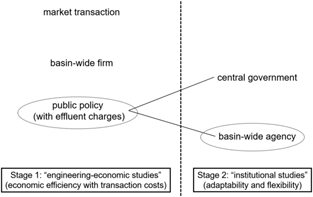
Third, the “comparative institutional approach” is incorporated into his argument in Kneese (Reference Kneese1964) to determine the best institutional solution for water quality management. In Kneese (Reference Kneese1962), a basin-wide firm was not compared with other alternative solutions. At first, Kneese (Reference Kneese1964) expanded upon this argument—market solution, basin-wide firm, and public policy—and then compared these alternatives. In a next step, in the context of public policy, the central government and associations like Genossenschaften were compared.
Kneese and Bower (Reference Kneese and Bower1968) is a revision and an extension of Kneese (Reference Kneese1964)—as they explained in the preface to the book—and the basic theoretical framework and the structure of the argument remain unchanged. However, it should be recognized that there is a crucial difference between Kneese (Reference Kneese1964) and Kneese and Bower (Reference Kneese and Bower1968): in the latter of these works, the analysis of water quality management is divided into “Engineering–Economic Studies” and “Institutional Studies.” The former category is inherited from Kneese (Reference Kneese1964), while the latter is a newly added argument in Kneese and Bower (Reference Kneese and Bower1968). Furthermore, in fact, the chapter in the work that discussed institutional studies in Kneese and Bower (Reference Kneese and Bower1968) was an almost identical reproduction of Kneese’s earlier pamphlet, Approaches to Regional Water Quality Management (1967), which included fieldwork not only in Germany but also in England, France, and the United States.Footnote 12
Thus, in Kneese (Reference Kneese1964), the effluent charges argument, the case study of Genossenschaften, and the comparative institutional approach were added to the framework earlier proposed in Kneese (Reference Kneese1962). Furthermore, in Kneese and Bower (Reference Kneese and Bower1968), “Institutional Studies” shaped in Kneese (Reference Kneese1967) were additions to Kneese’s (Reference Kneese1964) framework.
IV. THE FINAL FORM OF KNEESE’S WATER QUALITY MANAGEMENT RESEARCH
In this part, the final outcomes of Kneese’s study on water quality management would be summarized and discussed, with reference to Kneese (Reference Kneese1964). His previous work (Kneese Reference Kneese1962, Reference Kneese1963, Reference Kneese1964, Reference Kneese1967) was compiled in Managing Water Quality (Kneese and Bower Reference Kneese and Bower1968). The main questions posed by this study were the following:
(1) How do we determine the quality of the water we want to maintain in our watercourses, both surface and underground?
(2) What is the “best” system of management measures for achieving the specified pattern of water quality?
(3) What are the best institutional or organizational arrangements for managing water quality? (Kneese Reference Kneese1964, p. 4; Kneese and Bower Reference Kneese and Bower1968, pp. 4–8).
In short, the questions listed above refer to (1) policy goals, (2) policy tools, and (3) policy agents, which implement policy tools and achieve policy goals. These issues are further divided into “Engineering–Economic Studies” and “Institutional Studies.” Before tackling these “studies,” to understand Kneese’s thought sufficiently, it is necessary to discuss briefly the features of the Genossenschaften, which greatly influenced his framework.
Kneese employed empirical case studies to analyze water quality management. While he also referred to the English river authority that manages the Thames River, the French Basin Agency, and the Delaware River Basin Commission in the United States, he regarded the Genossenschaften in the Ruhr basin as representing the most ideal case (Kneese Reference Kneese1967; Kneese and Bower Reference Kneese and Bower1968). The Economist (2001) remarks that it was in “the Ruhr valley [that] he found the environmentalist’s Holy Grail and wrote a book about it” (p. 97).
As indicated in Franz-Josef Brüggemeier (Reference Brüggemeier1994), the Ruhr region, as well as London, Manchester, and Pittsburgh, was one of the most concentrated and highly developed industrial areas worldwide, especially in coal mining. As early as the late nineteenth century and until around the 1960s, this region’s natural environment was severely polluted.Footnote 13 Although it had highly developed industries and a high population density, it is believed that the Genossenschaften succeeded in planning and implementing the “Integrated Water Resources Management” policy at an early period and in rehabilitating the area around the river to a certain degree. The Genossenschaften consisted of eightFootnote 14 small associations, each of which had autonomy in its organizational matters and adopted a representative decision-making system. The Emschergenossenschaft, the first of those eight organizations, was established in 1899; Ruhrverband, the second one, in 1913. The Genossenschaften was founded for the purpose of water supply and waste water disposal, and all eight organizations have had an almost identical function. One important feature shared by all eight organizations is their cooperative character, which is “a self-governing, but state-controlled public body”Footnote 15 (Bode et al. Reference Bode, Evers and Albrecht2003, p. 81). This means that the water resources in the Ruhr basin are not managed as private or state property but as common property resources.Footnote 16 In other words, the stakeholders of the water resources in this basin—which mainly consist of firms and municipalities—are members of this organization. These stakeholders collectively manage the basin, share the benefits, and allocate the costs on the basis of each member’s level of water use and waste water discharge,Footnote 17 through a “contribution” system that Kneese called “effluent charges.” Further, this organization has a representative system through which members’ opinions are reflected in the decision-making process.Footnote 18
In particular, Kneese focused on two features of these associations. First, they construct an “Integrated Water Resource Management” system that covers a basin-wide area in its entirety and incorporates all activities related to water resource management, as the hypothetical basin-wide firm would do. Second, effluent charges are used as the main tool to manage policy at minimal total cost.
These features of the Genossenschaften play an important role in the Kneesian framework. Based on these points, “Engineering–Economic Studies” and “Institutional Studies” will be reviewed in turn.
“Engineering–Economic Studies”
In “Engineering–Economic Studies,” water resource management is discussed from the perspective of optimality, which is both an engineering and an economic criterion. The argument centers on two points. One is the choice of institutional form that is desirable for internalizing external diseconomies. Kneese compared three alternatives—market transactions, the basin-wide firm, and public policy—from the perspective of economic efficiency with transaction costs. As Steven Medema (Reference Medema2014a, Reference Medema2014b) suggested, the process of this comparison was significantly influenced by Coase’s argument. The other point is that Kneese recommended that effluent charges be adopted as a public policy tool.
In terms of the choice among these three alternatives, Kneese first referred to the possibility of establishing a market transaction system that deals with pollution rights for water resources. Although Kneese admitted the possibility of a market transaction of such rights in order to internalize external diseconomies under certain situations, he concluded that it is unrealistic to organize such a market transaction. The reason is because “[t]he damaging effects of waste discharges may be widespread and diffuse, and the linkages between dischargers and damaged parties so technically complex … that establishing a market which would systematically take account of external costs would be a very complex and expensive procedure” (Kneese Reference Kneese1964, p. 46; Kneese and Bower Reference Kneese and Bower1968, p. 84). It means that the difficulty of this kind of transaction is caused by hydrological features and that transaction costs would be exceedingly high. Therefore, Kneese argued that market transactions cannot be applied as solutions.Footnote 19
Second, Kneese referred to a hypothetical basin-wide firm as a solution that could internalize external diseconomies. Kneese (Reference Kneese1962) defined a “basin-wide firm” as a monopolistic firm that conducts all projects relevant to water supply and waste water in a certain basin and at the same time sets the prices of all products equal to marginal costs similar to a competitive market. Therefore, the firm cannot help but have an incentive to take account of the negative external effect of upstream economic activities on downstream areas. This is a type of “single ownership solution” that was suggested by Coase (Reference Coase1937) and H. Scott Gordon (Reference Gordon1954). In theory, this option has the potential to resolve the flaws seen in the market transactions by eliminating the factors that increase transaction costs.
However, this hypothetical firm bears an inevitable contradiction and is not an appropriate solution from the viewpoint of economic efficiency. The reason is the dead-weight loss and economic inefficiency caused by the monopolistic feature and market power that this hypothetical firm would have by definition.
Instead of this inevitably flawed hypothetical firm, Kneese proposed the concept of the “basin-wide agency,” rather than “firm,” which he considered to be the most desirable form of institution for internalizing external diseconomies. The basic idea behind the basin-wide agency is taken from the water management association in the Ruhr region. Therefore, this basin-wide agency takes the form of cooperative or associate organizations, like the Genossenschaften, which aim to conduct all projects relevant to water supply and waste water treatment in the basin and set the prices of its products equal to marginal costs. In this way, this organization functions like basin-wide firms. The difference between a “basin-wide firm” and a “basin-wide agency” is that the former attempts to maximize its profit, while the latter attempts to maximize social welfare in the basin area.
What policy should be pursued by a basin-wide agency to achieve this goal? The answer is “effluent charges,” which is the second feature of the Genossenschaften. Effluent charges was a concept distinct from Pigouvian taxes. In the case of Pigouvian taxes, the optimal tax rate is determined at the point where marginal costs are equal to the marginal benefits of pollution abatement. At this point, an optimal pollution level is achieved and resource allocation is Pareto-efficient. However, achieving this optimal pollution level requires precise information about the cost-and-benefit curves of pollution abatement. The benefits are determined based on the general public’s willingness to pay, and it is extremely difficult to obtain this information. For this reason, Kneese abandoned the goal of achieving the first-best optimal pollution level. He instead wrote that “it appears that some form of watercourse standards will be the mechanism used to establish water quality levels,” and, according to him, this “some form of watercourse standards” means, for example, “an upper limit on the concentration of a given waste, say, a material toxic to fish in the stream” (Kneese Reference Kneese1964, p. 142; Kneese and Bower Reference Kneese and Bower1968, p. 131).
Kneese further insisted that effluent charges may be used to achieve these watercourse standards at minimal costs. This is because an effluent charge “tends to induce the least costly combination of measures for waste reduction at each outfall, and the least-cost distribution of waste reduction among outfalls, thereby minimizing the real resources cost of attaining a stream water quality standard” (Kneese and Bower Reference Kneese and Bower1968, p. 141). Thus, the main role of a basin-wide agency is to set ecologically and hydrologically desirable water quality standards as a policy goal, which, in turn, is achieved at the lowest costs by employing effluent charges.
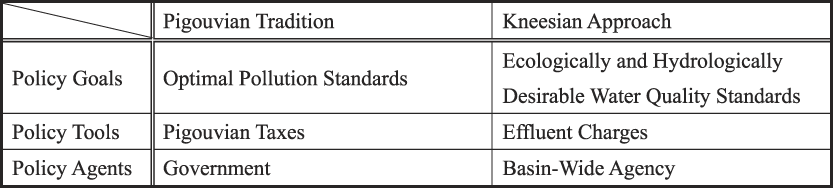
In summary, Kneese’s answers to the three main issues of water quality management that he put forward were as follows:
(1) policy goal: ecologically and hydrologically desirable water quality standardsFootnote 20
(2) policy tool: effluent charges
(3) policy agents: basin-wide agency
“Institutional Studies”
In the previous subsection, it was observed that a basin-wide agency must have the ability to achieve ecologically and hydrologically desirable water quality standards at minimal costs through effluent charges. However, according to Kneese, the use of engineering–economic studies cannot ensure optimal water quality management in itself. Kneese is worth quoting at length on this point.
Studies of the economic–engineering aspects of water quality management have demonstrated that a regional system can achieve major economies that cannot be realized by the conventional approach to water quality control. But little is known about how to devise legal and institutional arrangements that will permit efficient and politically responsible implementation of water quality management programs. Compared with engineering and even economic studies, institutional studies of water quality management are in their infancy. For this reason, we have concentrated up to this point on questions of economics and technology largely within an economic efficiency framework. Not until the preceding chapter [“Engineering–Economic Studies”] did we take a tentative step toward recognizing that economic and technological analysis can only find its ultimate meaning in a political and institutional context. Political and institutional forces cannot by themselves produce efficiency, but they can prevent it. Moreover, certain institutional arrangements may channel political forces in a way that is conductive to efficiency. In this part [“Institutional Studies”] we take a long but uncertain stride into the realm of institutional arrangements for implementing water quality management programs. (Kneese and Bower Reference Kneese and Bower1968, p. 255)
Kneese here implies that the validity of optimality or efficiency as shown in “Engineering–Economic Studies” depends on the form of institution and organization within which policy is implemented. In other words, whether economic efficiency—that is, economic reasoning, which had been explored since Water Pollution (1962)—can be achieved depends on whether the institutional and organizational form of the policy agent that implements the water quality management program is appropriately designed.
Kneese suggested that a basin-wide agency is a desirable form of public policy. However, the “public policy” to which Kneese referred does not necessarily implicate the government. Kneese thought that in water quality management, desirable policy goals and tools depend on intrinsic conditions, which are different in each basin area, and that “appropriate standards vary with the costs of reducing waste discharge, with demand for water use, and with stream-flow condition, as would effluent charges or payments.” Further, Kneese believed that it is extremely difficult for government to adopt desirable policy goals and tools “because each governmental jurisdiction—local, state, or federal—tends towards uniformity within its jurisdiction” (Kneese Reference Kneese1964, pp. 199–200).
That is to say, the government cannot demonstrate the validity of optimality or efficiency postulated in “Engineering–Economic Studies,” because of a mismatch between its uniformity characteristic and the inherent nature of each region and the variability of the basin environment. In fact, Kneese criticized US government policy on water quality management for the same reason.Footnote 21 However, a basin-wide agency can overcome this weakness, because, as Kneese argued, it has the ability to manage the basin continuously as a whole system and to adapt to changing situations and constraints over time, such as technology, information, and the basin environment itself. Kneese called this ability “adaptability” (Kneese Reference Kneese1964, p. 204) and “flexibility” (Kneese and Bower Reference Kneese and Bower1968, p. 301).Footnote 22
To demonstrate the validity of optimality or efficiency by public policy, the basin-wide agency should have adaptability/flexibility in formulating and implementing policy. In other words, adaptability/flexibility is a necessary condition for realizing optimality derived from engineering–economic studies. To realize economic reasoning (i.e., economic efficiency), non-economic reasoning (i.e., adaptability/flexibility) is inevitably needed as its premise. That is because optimal policy goals and tools must reflect the changing circumstances and the environment of the basin. Without this function, the organization cannot set desirable policy goals and adopt policy tools, and it will fail to form an optimal system, as in the US government case that Kneese criticized. To satisfy these conditions, Kneese emphasized that a basin-wide agency should also have a representative decision-making system, like the Genossenschaften. This is because choices and decisions about policy alternatives influence and change the costs and benefits allocated to the stakeholders of water quality management in the basin.
Thus, Kneese, on the basis of both economic and non-economic reasoning, proposed that a basin-wide agency is the most desirable institution or organization for managing water quality. Economic reasoning called for economic efficiency, including transaction costs, as discussed in “Engineering–Economic Studies.” Non-economic reasoning, as “Institutional Studies” indicates, called for adaptability/flexibility in the decision-making process with regards to policy goals and tools, as well as a representative system that can reflect members’ willingness or social preference.
V. IMPLICATIONS
Kneese began his study on environmental economics by addressing the problem of water resource allocation and later shifted his interest to water quality management with respect to external diseconomies. Impressed by the pioneering endeavors of Germany’s Genossenschaften, Kneese finally arrived at a unique analytical framework that comprises a two-stage approach based on “Engineering–Economic Studies” and “Institutional Studies.” This argument can be called the “Kneesian approach.” It is now clear that the Kneesian approach differs from the Pigouvian tradition. These differences are summarized in the following three points.
First, “effluent charges” is not synonymous with “Pigouvian taxes.” For Kneese, effluent charges are policy tools used not to achieve a “first-best” Pareto-optimal pollution level (as is the case with Pigouvian taxes) but to achieve ecologically and hydrologically desirable water quality standards at minimal cost through the “marginal equivalent” mechanism. The implementation of Pigouvian taxes requires correct information about the marginal benefits of pollution abatement and the marginal cost of pollution damage. Certainly, effluent charges can overcome this problem. Determining the desirable effluent charges, however, requires a trial-and-error process. Later, this “second-best” approach with cost minimization was formulated as “the pricing and standards approach” in William Baumol and Wallace Oates (Reference Baumol and Oates1971).
Moreover, it is important to note that Kneese’s direction is also different from Krutilla’s, which attempted to uncover a way to evaluate the “non-market value” of the natural environment. In contrast, Kneese attempted to uncover the “second-best” efficient solution and the least-cost path without evaluating it. At least at this time, Kneese chose the argument that did not require evaluation rather than following Krutilla’s direction.Footnote 23
Second, Kneese suggested that the point at issue was the form of institution or organization that would internalize external diseconomies. This argument about policy agents—in other words, “who should internalize external diseconomies”—is the point that has hardly been considered in the context of modern environmental economics. In the case of the Pigouvian tradition, it is premised that the central government internalizes external diseconomies through Pigouvian taxes, but the form of institution and organization is not considered an issue. The Kneesian argument about the form of institution and organization can be understood with a two-stage approach— “Engineering–Economic Studies” and “Institutional Studies” (Figure 1).
Kneesian Two-Stage Approach

In the context of “Engineering–Economic Studies,” Kneese compared three alternative institutions from the viewpoint of economic efficiency with transaction costs incurred in the course of internalizing external diseconomies. This part of Kneese’s argument is very similar to the “comparative institutional approach” proposed by Coase. In “The Nature of the Firm” (1937), Coase argued that a firm would be established when resource allocation is implemented with transaction costs that are lower than those seen in the market system—in effect, he compared the market system with the firm from the perspective of economic efficiency with transaction costs. Coase discussed this, in part, in “The Problem of Social Cost” (1960). In this article, as in Coase (Reference Coase1937), alternative methods for rearranging legal rights—market transactions, firms, government regulation, and doing “nothing about the problem at all”—are compared from the perspective of economic efficiency with transaction costs. Coase’s (Reference Coase1937; Reference Coase1960) comparative institutional approach can be observed in nearly similar arguments put forward by Kneese. Indeed, Kneese cited Coase (Reference Coase1960) in his argument when discussing the market solution (Kneese Reference Kneese1964, p. 44; Kneese and Bower Reference Kneese and Bower1968, p. 82), and Coase (Reference Coase1937) when discussing the basin-wide firm (Kneese Reference Kneese1964, p. 48; Kneese and Bower Reference Kneese and Bower1968, p. 89). Thus, it is clear that he was aware of Coase’s argument. Moreover, the comparative institutional approach was not used in Kneese (Reference Kneese1962). It appears for the first time in Kneese (Reference Kneese1964). The same is true of his references to Coase. Therefore, although Kneese did not openly state that he had been impressed by Coase’s approach, when recalling that the comparative institutional approach was Coase’s original and unique argument, it is natural to conclude that Kneese followed and applied Coase’s theorizing to his argument about the form of institution and organization needed for water quality management.
In the latter stage of the two-stage approach, and this is the third point, Kneese further deepened his argument regarding the forms of institutions and organizations from the viewpoint of non-economic reasoning. For Kneese, “public policy” can include two alternatives—the central government, and the basin-wide agency modeled after the Genossenschaften, such as the Emschergenossenschaft and the Ruhrverband in the Ruhr region. As described previously, he preferred a basin-wide agency to the central government, because the former has adaptability/flexibility in its decision making and in the implementation of water resource policy. Therefore, Kneese believed that a basin-wide agency is the best form of institution for implementing water quality management. As is reflected in his argument that “economic and technological analysis can only find its ultimate meaning in a political and institutional context” (Kneese and Bower Reference Kneese and Bower1968, p. 255), he insisted that whether optimality or efficiency as discussed in “Engineering–Economic Studies” can be attained depends on the institutional and organizational forms in play. That is, according to Kneese, the institutional or organizational form is a substructure of the argument on optimality or efficiency based on engineering and economic reasoning. This means that the Kneesian two-stage approach implies that the issue of the policy agent’s form could be of more importance than that of tools when considering environmental policy.
Thus, when discussing the form of policy agents, not only is there a need to investigate economic efficiency with transaction costs but also a need to consider adaptability/flexibility when achieving optimality in its true sense. By the two-stage approach, Kneese tried to expand and revise the range of discussion about internalization of external diseconomies from economic reasoning towards non-economic reasoning and to formulate the relationship and the demarcation between both kinds of reasoning. With regards to addressing his future challenges, Kneese placed greater importance on “Institutional Studies” than on “Engineering–Economic Studies.” For Kneese, this argument is about avoiding not only market failure but also government failure, with regards to the external diseconomies of the water quality problem.
Furthermore, it should not be overlooked that a basin-wide agency shares things in common with Ostrom’s argument. In Governing Commons (1990), Ostrom re-evaluated “Commons,” which is not the state solution or the market solution to environmental resources management and which had been criticized as the “Tragedy of Commons” in Gordon (Reference Gordon1954) and Garrett Hardin (Reference Hardin1968). Ostrom (Reference Ostrom1990), as well as Daniel Bromley (Reference Bromley1991, 2006), demonstrated that, in fact, Gordon (Reference Gordon1954) and Hardin (Reference Hardin1968) had presented not the Tragedy of Commons but the Tragedy of Open Access (= no rule). At the same time, Ostrom (Reference Ostrom1990) focused on and emphasized the significant role of the self-organizing and self-governing institution as Commons. Within such contexts, it is extremely important to note that Kneese virtually pointed out the effectiveness and the potentiality of Commons, or a self-organizing and self-governing institution, for environmental resource management, just like Ostrom, by suggesting a basin-wide agency at around the same time that the concept of the “Tragedy of Commons” was being proposed by Hardin (Reference Hardin1968). That is, the basin-wide agency and its model, Genossenschaften in the Ruhr region, represent almost the same framework as Commons, or the self-organizing and self-governing institution.
There is, however, a crucial difference between Kneese and Ostrom: the theoretical framework. While Kneese used external diseconomies and a welfare economics framework, Ostrom employed game theory. It is natural to conjecture that this is one of the reasons why Ostrom (Reference Ostrom1990) did not refer to Kneese’s work. In fact, Ostrom did not refer to Alfred Marshall or Pigou even once.
In any case, when considering the difference between the Kneesian approach and the Pigouvian tradition, it is important to note that Kneese and Ostrom shared positive visions about Commons as a desirable way to manage environmental resources.
VI. CONCLUSION
This article aimed to specify the difference between the Kneesian approach and the Pigouvian tradition and to clarify the inherent position of Kneese’s early work—research on water quality management—within the history of environmental economics. In earlier studies, Kneese’s argument was considered a mere “extended version” of the Pigouvian tradition; this is because Kneese adopted the external diseconomy framework, which focuses on economic efficiency (much like the Pigouvian tradition) and emphasizes the advantage of “effluent charges.” The distinguishing features are related to the three points raised by Kneese—policy goals, policy tools, and policy agents (the form of the institution and organization that decides and implements policy goals and tools) (Figure 2). The Pigouvian tradition argues that the central government uses Pigouvian taxes as a policy tool to internalize external diseconomies to maximize welfare as a policy goal. In contrast, Kneese argued that it is desirable for a basin-wide agency to employ effluent charges to achieve the policy goal of ecologically and hydrologically desirable environmental standards at minimal costs. These arguments were proposed as alternatives to water resource policies being implemented by the US government at that time and they focused on ad hoc ecologically and hydrologically undesirable environmental standards and inefficient direct regulation.
Differences between Kneesian Approach and the Pigouvian Tradition

In the process of distinguishing between the Kneesian approach and the Pigouvian tradition, Krutilla’s, Coase’s, and Ostrom’s arguments helped us to understand Kneese’s approach. First, Kneese and Krutilla both wrestled with the non-market value of the natural environment and resources, but their approaches are distinct. Kneese had pursued the internalization of external diseconomies without the evaluation of non-market value. Second, Kneese was inspired by Coase’s comparative institutional approach and used it for his argument. And third, Kneese’s basin-wide agency shares features with Ostrom’s Commons, or self-organizing and self-governing institution. These viewpoints also help us to understand Kneese’s position within the history of environmental economics.
Furthermore, Kneese’s argument about the form of policy agents, which is the point that modern environmental economics has not focused on sufficiently, has implications for environmental policy. In other words, how should policy agents be designed? In this argument, Kneese tried to formulate the relationship and demarcation between economic and non-economic reasoning in environmental economic policy, and emphasized the importance of the type of institutional and organizational form as a substructure of the policy framework. This layout had gradually been clarified in the process of his alternating theoretical and empirical work. Kneese inspected and revised the Pigouvian theoretical framework in his empirical studies pragmatically.
Kneese later claimed that his “efforts were directed toward extending and adapting these concepts [external diseconomy theory] in directions more appropriate than the received doctrine for the explanation of environmental problems and for their analysis” (Kneese Reference Kneese, Steppacher, Zogg-Walz and Hermann1977, p. 93). Thus, it should be concluded that these “efforts” reflect the difference between the Kneesian approach and the Pigouvian tradition. The essence of the Kneesian approach would continue in his subsequent research themes.