1. Introduction
Tropical, carbonate platform deposits dominate the Upper Cambrian–Middle Ordovician Beekmantown Group (Clarke & Schuchert, Reference Clarke and Schuchert1899) on the east margin of the Laurentia palaeocontinent. The Ordovician part of the group was a standard for the Laurentian Lower Ordovician (or ‘Canadian Series’), until more prolific shelf faunas were found in the Great Basin, and the Ibexian Series was proposed for the Laurentian terminal Cambrian and Lower Ordovician (e.g. Ross et al. Reference Ross, Hintze, Ethington, Miller, Taylor, Repetski, Sprinkle and Guensburg1997).
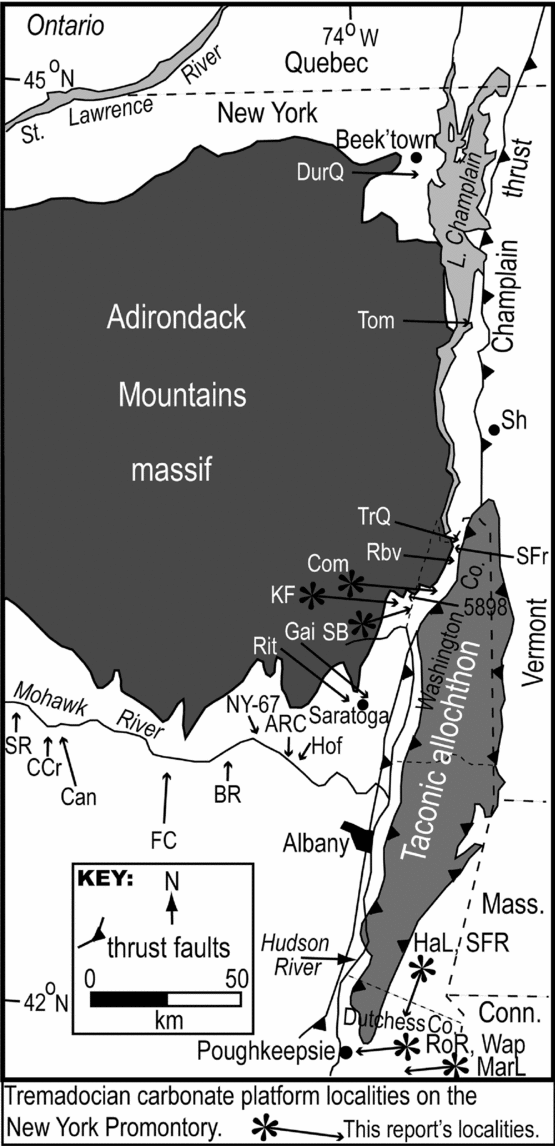
The Beekmantown Group comprises a cratonic–parautochthonous succession in a N–S belt along the New York Promontory from southern Ontario and Quebec through eastern New York and westernmost New England (Fig. 1). This region along the east Laurentia palaeocontinent was a passive margin beginning in the late Early Cambrian until the Late Ordovician Taconic orogeny (Landing, Reference Landing and Landing2007). Its long-term quiescent tectonic setting means that its Lower Ordovician stratigraphy should provide a basis for determining the timing and relative intensity of eustatic rises and falls (Landing, Reference Landing, McLelland and Karabinos2002). Many reports exist on Cambrian–Ordovician eustasy, but very different interpretations are reached on the possible periodicity and strength of eustatic change. Ross & Ross's (Reference Ross, Ross, Cooper, Droser and Finney1995) and Nielsen's (Reference Nielsen, Webby, Paris, Droser and Percival2004) Ordovician eustatic curves show little evidence for periodicity but propose great differences in the height of successive rises and falls. However, Haq & Schutter's (Reference Haq and Schutter2008, fig. 1) Ordovician eustatic history shows little difference in the extent of successive land- and basinward shoreline movements, and postulates much higher sea-levels than at present.
General locality map for Tremadocian carbonate platform units of the eastern Laurentian craton and the western parautochthonous Appalachian slices. Localities discussed herein are marked by arrows with large asterisks, and include the parautochthonous Halcyon Lake (HaL), Martin Lane (MarL) and Strever Farm Road (SFR) sections in Dutchess County, and the cratonic Comstock (Com) and Smith Basin (SB) successions in Washington County. Arrows without asterisks show Tribes Hill localities detailed in earlier publications (Landing, Reference Landing and Landing1988a, Reference Landing and Landingb, Reference Landing, McLelland and Karabinos2002, Reference Landing and Landing2007; Westrop, Knox & Landing, Reference Westrop, Knox and Landing1993; Landing, Westrop & Knox, Reference Landing, Westrop and Knox1996; Landing, Westrop & Van Aller Hernick, Reference Landing, Westrop and Van Aller Hernick2003; Landing & Westrop, Reference Landing and Westrop2006; Landing et al. Reference Landing, Franzi, Hagadorn, Westrop, Kröger, Dawson and Landing2007, Reference Landing, Westrop, Kröger and English2010; Landing, Reference Landing and Landing2007, in press; Kröger & Landing, Reference Kröger and Landing2007). Abbreviations: 5898 – NYSM locality 5898, cephalopod locality 1.5 north of Rte 149 in Wolf Hollow Member of Tribes Hill Formation (Kröger & Landing, Reference Kröger and Landing2007) that Fisher (Reference Fisher1984) mapped as part of the Upper Cambrian Little Falls Formation; ARC – Amsterdam Road cut; Beek'town – Beekmantown village; BR – Borden Road; Can – Canajoharie quarry; CCr – Canajoharie Creek; Com – Comstock section; Conn. – Connecticut; DurQ – Durand Road quarry; FC – Flat Creek; Gai – Gailor quarry; HaL – road-cut on Rte 82 east of Halcyon Lake; Hof – Hoffmans road-cut; KF – Kane Falls; MarL – Martin Lane; Mass. – Massachusetts; NY-67 – quarry north of NY Rte 67; Rbv – Rathbunville Road; Rit – Ritchie Limestone section; RoR – Rochdale Road; SB – Smith Basin section; SFr – Steves Farm section; SFR – Strever Farm Road; Sh – Shoreham village; Tom – Tompkins Point; TrQ – Tristates quarry; Wap – road-cut on Rochdale Road just west of Wappinger Creek.

A study of the faunas, relative age and palaeoenvironments of the Lower Ordovician Tribes Hill Formation (Ulrich & Cushing, Reference Ulrich and Cushing1910) and Rochdale Formation (Knopf, Reference Knopf1927) was undertaken to relate their litho- and biofacies in eastern New York and adjacent Vermont to the intensity of Tremadocian eustatic changes. Considerable work has been done on the biotas and deposition of the Tribes Hill Formation on the craton (Cleland, Reference Cleland1900, Reference Cleland1903; Fisher, Reference Fisher1954, Reference Fisher1980, Reference Fisher1984; Flower, Reference Flower1964, 1968a; Braun & Friedman, Reference Braun and Friedman1969; Fisher & Mazzullo, Reference Fisher and Mazzullo1976; Mazzullo, Reference Mazzullo1978; Landing, Westrop & Knox, Reference Landing, Westrop and Knox1996; Landing, Reference Landing1998, Reference Landing and Landing2007; Landing, Westrop & Van Aller Hernick, Reference Landing, Westrop and Van Aller Hernick2003; Kröger & Landing, Reference Kröger and Landing2007). This report provides the first descriptions of Tribes Hill sections and microfaunas from a more distal platform setting in the parautochthonous (thrust) sequences of the Appalachians (Fig. 1, localities HaL and MarL).
Early work on the overlying Rochdale Formation in New York emphasized its cephalopods and rare trilobites from southern localities in Dutchess County (Dwight, Reference Dwight1879, Reference Dwight1880, Reference Dwight1881, Reference Dwight1884; Ulrich et al. Reference Ulrich, Foerste, Miller and Unklesbay1944) and further north in Washington County (Flower, Reference Flower1964, Reference Flower1968). More recent study has been done on conodonts from the basal Rochdale and at an isolated outcrop of the unit in Washington County, eastern New York (Fig. 1, locality KF) (Landing, Westrop & Van Aller Hernick, Reference Landing, Westrop and Van Aller Hernick2003, referred to as ‘Fort Ann Formation’; see Appendix 1). This preliminary work and a restudy of cephalopods in Washington and Dutchess Counties (Kröger & Landing, Reference Kröger and Landing2008) showed the Rochdale to be early late Tremadocian (a generalized Stairsian age in Laurentia), but have not dealt with the regional stratigraphy and eustatic significance of the Rochdale.
2. Geological setting
The geological setting of the Beekmantown Group on the east Laurentian platform has been extensively reviewed in its cratonic and parautochthonous, western Appalachian settings (e.g. Landing, Reference Landing and Landing2007; Kröger & Landing, Reference Kröger and Landing2008; Landing et al. Reference Landing, Westrop, Kröger and English2010) (Fig. 1). The group has a repeated depositional motif in which each Ordovician formation is a relatively thin depositional sequence (20–40 m thick on the craton) with a basal unconformity, often a deeply eroded type 1 unconformity with reworked clasts of the underlying formation. The lower transgressive facies tract is frequently a quartz arenite; and the upper highstand facies is always a limestone, which has often undergone hydrothermal dolomitization (Landing, Westrop & Knox, Reference Landing, Westrop and Knox1996; Landing, Westrop & Van Aller Hernick, Reference Landing, Westrop and Van Aller Hernick2003; Landing & Westrop, Reference Landing and Westrop2006; Landing, Reference Landing and Landing2007, in press). Cephalopods and molluscs are most abundant and diverse in a thrombolitic interval that is regularly present in the middle of the highstand carbonates of the Tribes Hill, Rochdale and Fort Cassin formations (Kröger & Landing, Reference Kröger and Landing2010) (Fig. 2). Abundant trilobites only appear in higher energy grain- and packstones at the transition from transgressive facies to the highstand carbonates (Westrop, Knox & Landing, Reference Westrop, Knox and Landing1993; Landing, Westrop & Knox, Reference Landing, Westrop and Knox1996; Brett & Westrop, Reference Brett and Westrop1996; Kröger & Landing, Reference Kröger and Landing2007, Reference Kröger and Landing2008, Reference Kröger and Landing2009, Reference Kröger and Landing2010). The association of trilobites with echinoderm debris in the transgressive–highstand facies transition is consistent with a less restricted marine, somewhat more offshore setting (e.g. Westrop, Tremblay & Landing, Reference Westrop, Tremblay and Landing1995).
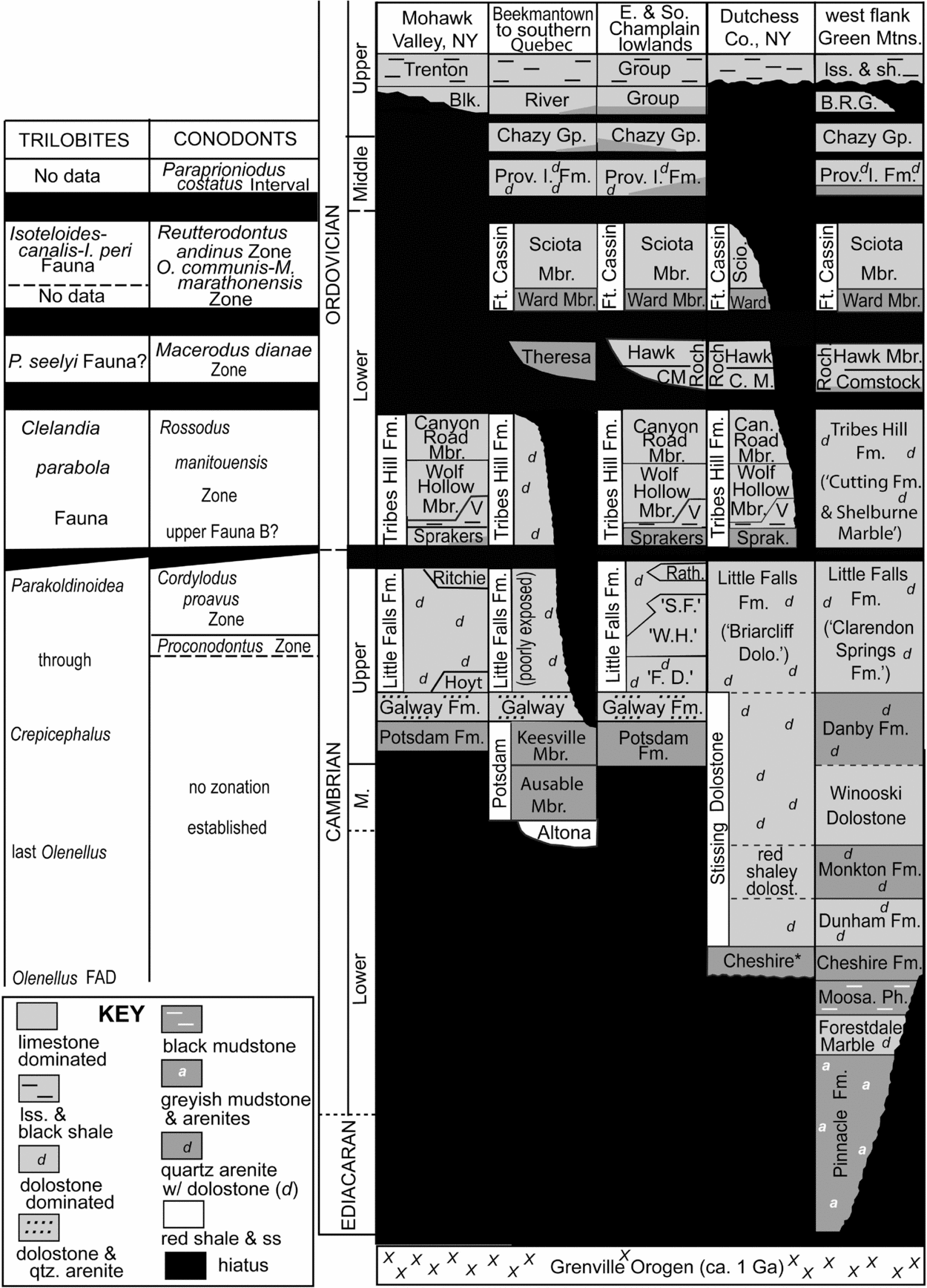
Platform stratigraphy on the NE Laurentian craton (three left columns) and in parautochthonous succession of Appalachian New York and Vermont (two right columns). Modified from Landing (Reference Landing and Landing2007, fig. 2). Abbreviations: In faunal columns on far left: I. – Isoteloides; M. – Macerodus; O. – Oepikodus; P. – Paraplethopeltus. In stratigraphic columns: B.R.G. – Black River Group; Blk – Black; Can. – Canyon; CM – Comstock Member; d – dolomitic, Dolo. – dolostone; ‘F. D.’ – Finch Dolostone; Fm. – Formation; Ft. – Fort; Gp. – Group; lss. – limestones; Mbr. – Member; Moosa. Ph. – Moosamaloo Phyllite; Prov. I. – Providence Island; Rath. – Rathbunville School Limestone; Roch. – Rochdale; ‘S.F.’ – ‘Steves Farm Limestone’; sh. – shale; V – Van Wie Member; ‘W. H.’ – ‘Warner Hill Limestone’. (The designations ‘Lower’, ‘Middle’ and ‘Upper’ Cambrian in this figure and in the text are informal subsystem-level divisions that correspond, respectively, to the Terreneuvian Series + Series 2, Series 3 and Furongian Series (Fig. 1) (see Landing, Reference Landing and Landing2007). As these adjectives are the major divisions of a system/period, they must be capitalized (North American Commission on Stratigraphic Nomenclature, 1983).) *Traditionally called Poughquag Quartzite in Dutchess County.

The Tribes Hill and Rochdale formations differ considerably in outcrop area along the New York Promontory (Landing & Westrop, Reference Landing and Westrop2006). The Tribes Hill, the most areally extensive Beekmantown Group formation, crops out along the Mohawk valley and along the east margin of the New York Promontory from southern Quebec to Dutchess County, New York (e.g. Fig. 2).
However, the Rochdale is the least areally extensive of any Beekmantown formation (Landing & Westrop, Reference Landing and Westrop2006), and it (or a synonymous unit under a different name) is not recorded in the autochthonous successions on the east side of Lake Champlain in Vermont (Welby, Reference Welby1961). The Rochdale is restricted to eastern Beekmantown Group outcrops, where it extends about 200 km N–S from the flat lying to gently E-dipping sections on the east Laurentian craton in Washington County into the parautochthonous, frequently strongly folded, faulted and slaty successions in the frontal Appalachian Mountains in Dutchess County, New York (Fig. 1). It extends at least 45 km further north in the Appalachian frontal thrusts to Shoreham, Vermont (the actual type area of the Beekmantown Group), where it comprises the lower ‘Benson Formation’ of Cady (Reference Cady1945) (abandoned by Landing amp; Westrop, Reference Landing and Westrop2006; Appendix 1). Kröger & Landing (Reference Kröger and Landing2008) recognized two informal divisions of the Rochdale, a ‘lower member’ and an upper ‘thrombolitic member’. These are formalized herein as the Comstock and Hawk members, respectively (Appendix 1).
The Rochdale is absent at an unconformity between the Tribes Hill and Fort Cassin formations west of Lake Champlain at Beekmantown village (Landing & Westrop, Reference Landing and Westrop2006; Fig. 1). Whitfield's (Reference Whitfield1889) Stairsian trilobites reported 2.8 km north of Beekmantown seem to indicate presence of the Rochdale. However, the diverse (bassleroceratid, endoceratid, protocyloceratid and tarphyceratid) cephalopods that Whitfield (Reference Whitfield1889; also Ulrich et al. Reference Ulrich, Foerste, Miller and Unklesbay1944, p. 18) recorded are clearly of Fort Cassin Formation aspect (Kröger & Landing, Reference Kröger and Landing2009). Landing & Westrop (Reference Landing and Westrop2006) restudied Whitfield's (Reference Whitfield1889) locality, and illustrated younger Fort Cassin Formation trilobites and Oepikodus communis–Fahraeusodus marathonensis Zone conodonts (i.e. Tulean–Blackhillsian Stages). Thus, Whitfield's (Reference Whitfield1889) Stairsian trilobites could not have been collected at this Fort Cassin Formation locality.
The carbonate-rich Rochdale is replaced by dolomitic quartz arenites and sandy dolostones of the coeval Theresa Formation to the north near Plattsburgh, New York, and in the Ottawa aulacogen of NE New York and adjacent Quebec and Ontario, (Salad Hersi, Lavoie & Nowlan, Reference Salad Hersi, Lavoie and Nowlan2003; Landing, Reference Landing and Landing2007, in press; Landing et al. Reference Landing, Franzi, Hagadorn, Westrop, Kröger, Dawson and Landing2007) (Fig. 2).
3. Northern Dutchess County, New York, localities
Knopf's (Reference Knopf1927, Reference Knopf1962) maps provide detailed information on the parautochthonous Beekmantown Group in the Appalachian Mountain frontal thrusts in northern Dutchess County. The ‘Halcyon Lake Formation’ (Knopf, Reference Knopf1962) and overlying ‘Rochdale Limestone’ (Knopf, Reference Knopf1927) were proposed in this area for Lower Ordovician carbonate-dominated units that had ‘lower’ and ‘middle Canadian’ molluscs, respectively.
3.a. Halcyon Lake
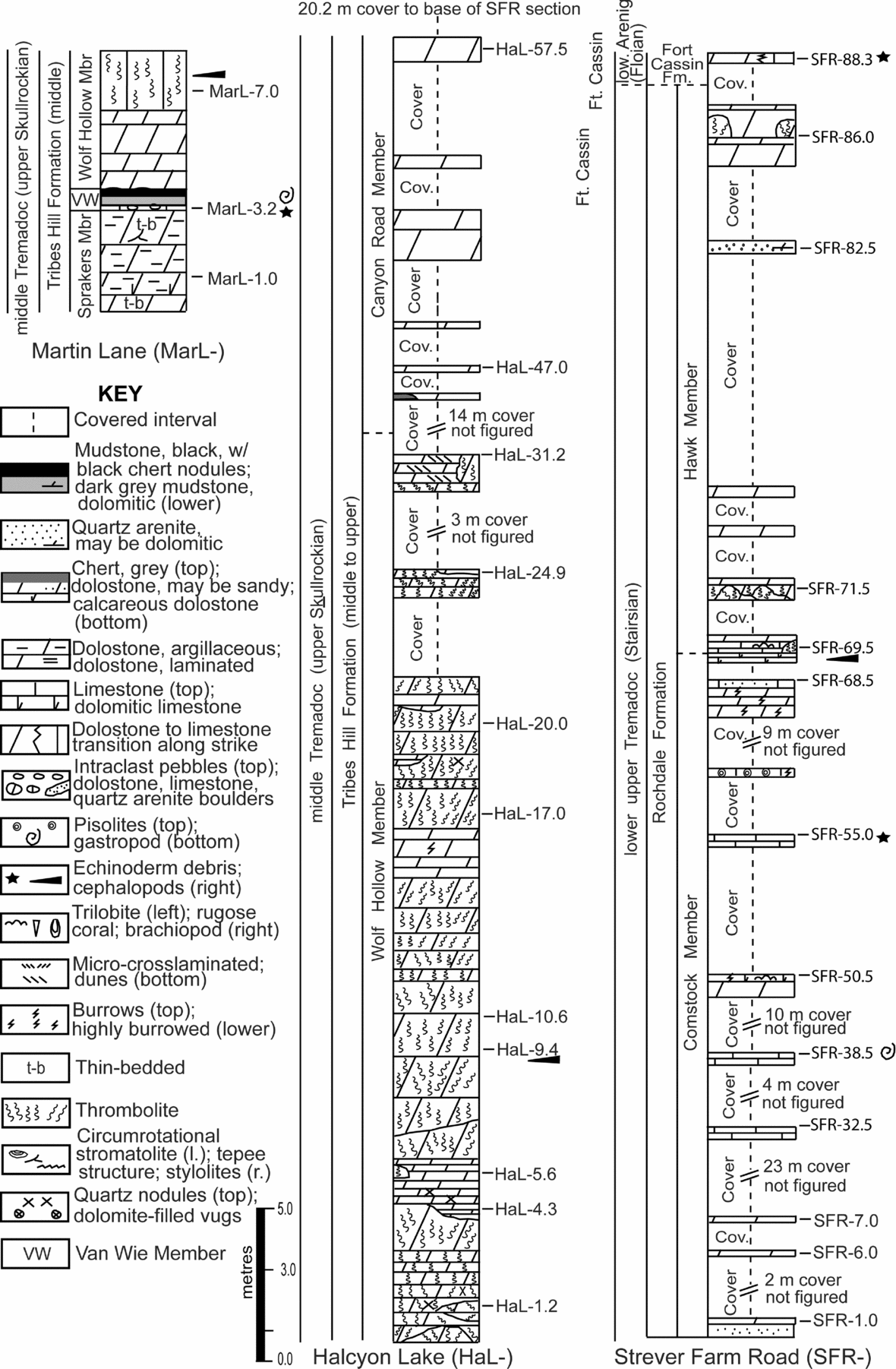
A S-dipping road-cut on the east side of Rte 82 is Knopf's (Reference Knopf1962) ‘Halcyon Lake Formation’ type section. The lower thrombolite-dominated and upper, relatively featureless dolostones (Figs 1, 3, section HaL) are lithologically comparable to the Wolf Hollow and Canyon Road members, respectively, of the Tribes Hill Formation (Fig. 2), an impression strengthened by specimens of the ellesmeroceroid cephalopod Ectenolites Ulrich & Foerste, Reference Ulrich and Foerste1935, in the cut (compare Kröger & Landing, Reference Kröger and Landing2007). This section was sampled for conodonts to determine an upper Tribes Hill Formation age.
Parautochthonous carbonate platform successions in the Tremadocian Tribes Hill and Rochdale formations, Dutchess County, SE New York.

3.b. Strever Farm Road
The location and cephalopods of the Strever Farm Road (SFR) section are detailed in Kröger & Landing (Reference Kröger and Landing2008, pp. 494, 495). The Rochdale Formation is separated by a 22.2 m thick covered interval from the top of the Halcyon Lake section (Fig. 3). The base of the Rochdale is a fine-grained, white quartz arenite bed (Knopf, Reference Knopf1962). The top of the SFR section is a prominent limestone-capped ledge about 3.3 km south of Pine Plains village and 50 m north of Bethel Crossing Road. This ledge is likely one of Dwight's (Reference Dwight1901) undescribed Fort Cassin Formation localities from Dutchess County as it has Isoteloides pygidia (Kröger & Landing, Reference Kröger and Landing2008). A collection in the NYSM Paleontology Collection made by W. D. Dwight from ‘2 mi. S. of Pine Plains’ (i.e. 3.3 km) has Isoteloides peri Fortey in a brownish grey echinoderm grainstone identical to that of sample SFR-88.3. These data indicate that the Halcyon Lake–SFR succession embraces much of the middle Beekmantown Group as it extends from the middle Tribes Hill Formation into the lower Fort Cassin Formation (Figs 2, 3).
4. Southern Dutchess County localities
Gordon's (Reference Gordon1911) map is the last original published study of the parautochthonous Cambrian–Ordovician of southern Dutchess County. With suburban development of this area, most outcrops assigned by Gordon (Reference Gordon1911) to an undivided ‘Beekmantown’ or ‘Rochdale-Calciferous’ are now inaccessible.
4.a. Martin Lane railroad cut
An exception to the loss of Gordon's outcrops is a railroad cut 1.6 km SE of Hopewell Junction village (Gordon, Reference Gordon1911, pls 13–15, fig. 24). This fault-duplicated, gently N-dipping section is 75 m south of the end of Martin Lane (Figs 1, 3; section MarL), and is best exposed on the north side of the cut. Three successive lithofacies are present: a lower argillaceous dolostone with tepee structures that record evaporitic conditions; middle, thin, unburrowed, pyritic, black mudstone; and an upper thrombolitic limestone with an ellesmeroceroid cephalopod. These units resemble the Sprakers, Van Wie and Wolf Hollow members, respectively, of the Tribes Hill Formation on the craton in the Mohawk River valley and Washington County (Landing, Westrop & Knox, Reference Landing, Westrop and Knox1996; Landing, Westrop, & Van Aller Hernick, Reference Landing, Westrop and Van Aller Hernick2003).
4.b. Rochdale village localities
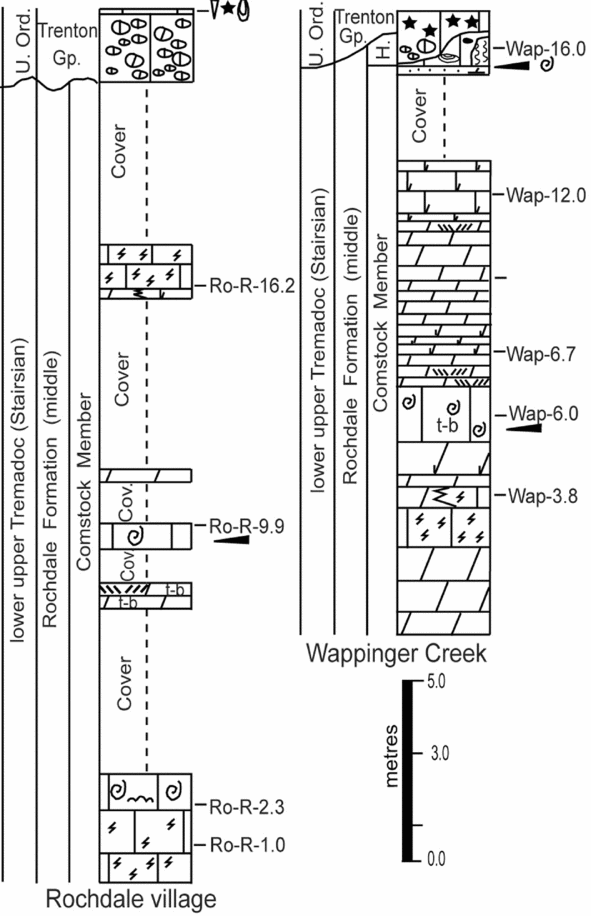
As discussed by Kröger & Landing (Reference Kröger and Landing2008), the exact location of Dwight's (Reference Dwight1884) collecting localities in the Rochdale Formation in Rochdale village near Poughkeepsie, New York, cannot be determined (Fig. 1). Kröger & Landing (Reference Kröger and Landing2008, pp. 495–6) described two localities on Rochdale Road: a road-cut just west of Wappinger Creek (section Wap, Fig. 4) and a low road-cut in the middle of Rochdale village (section RoR, Fig. 4). Locality Wap probably corresponds to Dwight's (Reference Dwight1884) cephalopod- and trilobite-bearing locality D.
Parautochthonous carbonate platform successions in the Tremadocian Rochdale Formation, Rochdale village, Dutchess County, New York. See Figure 3 for key to symbols. Abbreviations: H. – Hawk Member; U. Ord. – Upper Ordovician.

5. Northern Washington County, New York, localities
5.a. Smith Basin
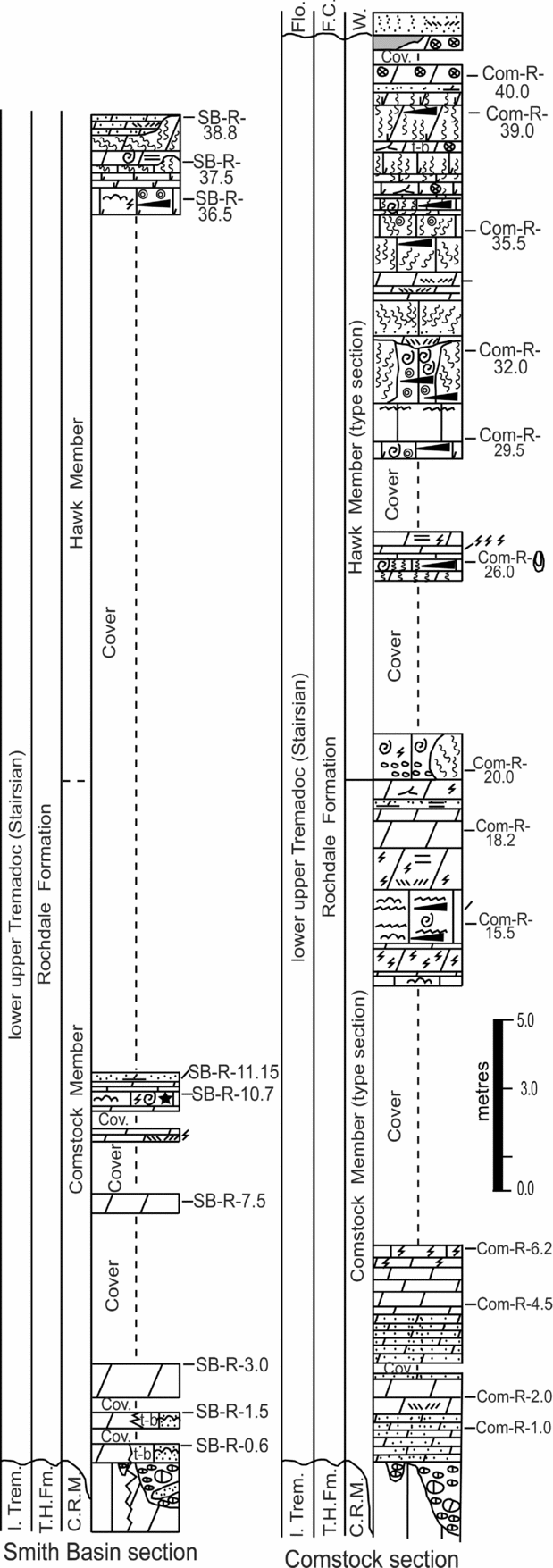
The classic Upper Cambrian–Lower Ordovician pasture section at Smith Basin (Flower, Reference Flower1964; Rodgers & Fisher, Reference Rodgers, Fisher and Bird1969) is now heavily overgrown (Fig. 1, locality SB), and an alternative Rochdale section 500 m south along Rte 149 was documented by Kröger & Landing (Reference Kröger and Landing2008). It includes the lower Comstock Member and several metres of the upper Hawk Member (Fig. 5, section SB). Cephalopods occur at the top of the section (Kröger & Landing, Reference Kröger and Landing2008), but R. H. Flower's specimens (NYSM locality 5897) probably came from now-covered exposures of the lower Hawk Member.
Autochthonous (cratonic) carbonate platform successions in the Tremadocian Rochdale Formation, northern Washington County, New York. See Figure 3 for key to symbols. Abbreviations: C.R.M. – Canyon Road Member; F. C. – Fort Cassin Formation; Flo. – Floian Stage; l. Trem. – lower Tremadocian; T.H. Fm. – Tribes Hill Formation; W. – Ward Member.

5.b. Comstock
The Comstock section (Com) just east of Comstock village and 12.3 km NNE along strike from Smith Basin has the best exposures through the Rochdale Formation in road-cuts along US Rte 22 (Kröger & Landing, Reference Kröger and Landing2008; their section Com-R). This section includes the underlying Upper Cambrian Little Falls and lower Tremadocian Tribes Hill formations (Landing, Westrop & Van Aller Hernick, Reference Landing, Westrop and Van Aller Hernick2003) (Figs 1, 5). A deeply eroded unconformity between the Tribes Hill and Rochdale formations is present in a cliff just north of Rte 22. The type sections for the Comstock and overlying Hawk members of the Rochdale Formation (new; see Appendix 1) are in this sequence, with the lowest, thrombolite-bearing beds of the Hawk Member just opposite the T-intersection of US Rte 22 (E–W-running) and Hawk Road (N–S). The base of the overlying Fort Cassin Formation is marked by dark grey quartz arenite of the Ward Member at the east end of the road-cut (Fig. 5).
5.c. Kane Falls
A third Rochdale section is at Kane Falls on Halfway Creek, just NW of Fort Ann village, New York (Fig. 1, locality KF). This succession was termed a ‘reference section’ for the upper Little Falls and lower Tribes Hill formations (Fisher & Mazzullo, Reference Fisher and Mazzullo1976). However, the thrombolite-rich, 23 m thick Kane Falls section was later assigned to the much younger ‘Fort Ann Formation’ (Landing, Westrop & Van Aller Hernick, Reference Landing, Westrop and Van Aller Hernick2003, fig. 3). As ‘Fort Ann Formation’ is a junior synonym of the Rochdale Formation (Landing & Westrop, Reference Landing and Westrop2006; Appendix 1), the Kane Falls locality is a third Washington County section with a good exposure of the upper member (Hawk Member, new) of the Rochdale.
5.d. Starbuck Road
The Starbuck Road locality, 5 km SW and along strike from the Comstock section, yielded a sparse Rochdale cephalopod and trilobite fauna (Flower, 1969, NYSM locality 5916). This spot locality is now heavily vegetated and was not relocated (Kröger & Landing, Reference Kröger and Landing2008).
6. Depositional environments, faunas and correlation
6.a. Tribes Hill Formation depositional succession
Knopf (Reference Knopf1962, p. 32) noted that the lowest strata of her ‘Halcyon Lake Formation’ on Hill 679 just northeast of section HaL (Fig. 3) were ‘light gray, laminated, and cross-bedded sandy dolomites’ and sandstones that weather to ‘a peculiar, fibrous, woody-looking coat’ that is comparable to ‘equivalent strata in the Champlain Valley of New York’. These now covered strata on Hill 679 are identical in their description to the current cross-bedded, fine-grained, arenaceous, lowest part (Sprakers Member) of the Tribes Hill Formation. The Sprakers Member unconformably overlies the uppermost Cambrian on the craton in Washington County and the eastern Mohawk River valley of New York and in western Vermont (Landing, Westrop & Knox, Reference Landing, Westrop and Knox1996; Landing Westrop & Van Aller Hernick, Reference Landing, Westrop and Van Aller Hernick2003; also see ‘Winchell Creek Member’ (abandoned) of Mazzullo, Reference Mazzullo1978).
The deepest facies of the Tribes Hill Formation are the overlying medium to dark grey mudstones and nodular carbonates of the thin Van Wie Member above the Sprakers Member (Landing, Westrop & Knox, Reference Landing, Westrop and Knox1996). The Van Wie is dark grey, burrowed and yields abundant trilobites (Bellefontia biofacies) and a diverse conodont fauna on the craton in the Mohawk River valley and Washington County (Landing, Westrop & Van Aller Hernick, Reference Landing, Westrop and Van Aller Hernick2003). However, the black, pyritiferous, laminated (unburrowed) Van Wie at Martin Lane lacks any macrofossils, and is best interpreted as an anoxic or strongly dysoxic deposit (Figs 2, 3).
Although the thinnest member of the Tribes Hill Formation (up to 2 m thick), the distinctive medium grey–black mudstone of the Van Wie Member is now recognized across eastern New York at all localities where the middle Tribes Hill is exposed. Strata just above the Van Wie yield the most diverse conodont faunas (e.g. Table 1), and represent part of the deepest facies of the deepening–shoaling succession of the Tribes Hill Formation on the craton (Westrop, Knox & Landing, Reference Westrop, Knox and Landing1993; Landing, Westrop & Knox, Reference Landing, Westrop and Knox1996; Landing, Westrop & Van Aller Hernick, Reference Landing, Westrop and Van Aller Hernick2003). The Van Wie is overlain by the thrombolite-bearing, mollusc- and cephalopod-rich Wolf Hollow Member (Kröger & Landing, Reference Kröger and Landing2007), and then by the relatively monotonous, sparsely fossiliferous, restricted-marine carbonates of the Canyon Road Member on the eastern New York and western Vermont craton (Landing, Westrop & Van Aller Hernick, Reference Landing, Westrop and Van Aller Hernick2003; Fig. 2).
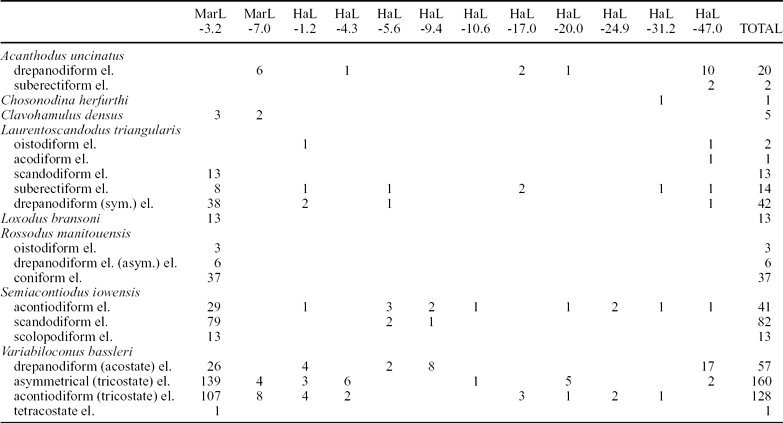
Upper lower Tremadocian (upper Skullrockian) conodonts from productive samples in the Van Wie (MarL-3.2), Wolf Hollow (MarL-7.0, HaL-1.2–31.2) and Canyon Road (HaL-47.0) members of the Tribes Hill Formation, Dutchess County, New York

Acid-disaggregated samples had a 6.0 kg mass. Abbreviations: asym. – asymmetrical; el. – element; sym. – symmetrical.
This report now shows that a complete succession of the Sprakers–Canyon Road members, as known on the craton, is present in the Appalachian frontal thrusts of Dutchess County in Knopf's (Reference Knopf1927) ‘Halcyon Lake Formation’. This succession is recognizable from exposures on Hill 679 (Knopf, Reference Knopf1962), the MarL railroad cut and the Rte 82 cut east of Halcyon Lake (Fig. 3). Thus, the best formation-level name for this interval is the senior synonym of Ulrich and Cushing's (Reference Ulrich and Cushing1910) Tribes Hill Formation (Landing & Westrop, Reference Landing and Westrop2006).
Only relatively trivial differences exist between the cratonic and Appalachian successions of the Tribes Hill Formation. One difference is that the Dutchess County succession, which was deposited closer to the cooling margin of the New York Promontory (Landing, Reference Landing and Landing2007), has thicker sections of the individual members of the Tribes Hill, with the Wolf Hollow and Canyon Road members at least 57 m thick, while they reach only about 20 m in the eastern Mohawk River valley (Landing, Westrop & Knox, Reference Landing, Westrop and Knox1996, fig. 2). A second difference is that the Wolf Hollow Member is completely composed of stacked thrombolites at the Halcyon Road road-cut, rather than consisting of thrombolites that alternate vertically and laterally with current- and wave-deposited carbonate as on the craton.
The regional extent of the thrombolites of the Wolf Hollow Member is remarkable; they extend from the northern to the southern Lake Champlain lowlands in New York (Landing, Westrop & Van Aller Hernick, Reference Landing, Westrop and Van Aller Hernick2003; Landing & Westrop, Reference Landing and Westrop2006) and east to Shoreham, Vermont (E. Landing, unpub. data). The Wolf Hollow thrombolites occur through the eastern and central Mohawk River valley (Landing, Westrop & Knox, Reference Landing, Westrop and Knox1996) and into the westerly thrusted, northern Dutchess County region (this report).
This approximately 12000+ km2 area of thrombolitic build-ups suggests a uniform, shallow-marine environment during the later Rossodus manitouensis Chron along the New York Promontory. The abundance of thrombolites at the Halcyon Lake road-cut suggests that further work may show that the outer carbonate platform along the New York Promontory was shallow and rimmed by thrombolite build-ups during Tribes Hill Formation deposition.
6.b. Tribes Hill Formation conodonts and correlation
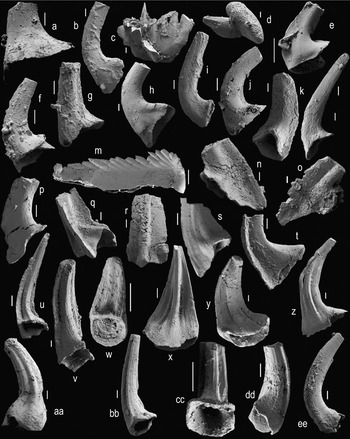
As on the craton of the Mohawk River valley and Washington County, New York, and western Vermont (Landing, Westrop & Van Aller Hernick, Reference Landing, Westrop and Van Aller Hernick2003), the Tribes Hill Formation of the parautochthonous Appalachians has one Laurentian faunal province conodont assemblage, which spans low-diversity faunas tentatively referred to the upper conodont Fauna B interval and extends into the Rossodus manitouensis Zone (Figs 2, 6; Table 1). Typical R. manitouensis Zone taxa (Chosonodina herfurthi Müller, Reference Müller1964; Clavohamulus densus Furnish, Reference Furnish1938; Loxodus bransoni Furnish, Reference Furnish1938; R. manitouensis Repetski & Ethington, Reference Repetski and Ethington1983; Semiacontiodus iowensis (Furnish, Reference Furnish1938); Variabiloconus bassleri (Furnish, Reference Furnish1938)) occur through the Tribes Hill of Dutchess County (Table 1).
Euconodonts from the Tribes Hill Formation (upper lower Tremadocian, upper Skullrockian, Rossodus manitouensis Zone), Dutchess County, New York; hypotypes. Scale bars = 0.05 mm. (a, b) Acanthodus uncinatus Furnish, Reference Furnish1938, emend. Landing, Westrop & Van Aller Hernick (Reference Landing, Westrop and Van Aller Hernick2003). (a) NYSM 17800, suberectiform with anterolateral flare of basal margin (ulrichodiniform plan), HaL-47.0; (b) NYSM 17801, drepanodiform, MarL-7.0. (c) Chosonodina herfurthi Müller, Reference Müller1964, NYSM 17802, HaL-31.2. (d) Clavohamulus densus Furnish, Reference Furnish1938, NYSM 17803, MarL-3.2. (e–l, p) Laurentoscandodus triangularis (Furnish, Reference Furnish1938). (e) NYSM 17804, oistodiform, HaL-47.0; (f) NYSM 17805, acodiform with rounded, inner lateral costa on base, HaL-47.0; (g) NYSM 17806, corroded suberectiform shows longitudinal microstriae, HaL-1.2; (h) NYSM 17807, subsymmetrical, large-based drepanodiform, MarL-3.2; (i) NYSM 17808, symmetrical, small-based drepanodiform, MarL-3.2; (j) NYSM 17809, large-based, symmetrical drepanodiform, HaL-47.0; (k) NYSM 17810, long-based scandodiform, MarL-3.2; (l) NYSM 17811, short-based scandodiform, MarL-3.2; (p) NYSM 17812, large-based scandodiform, MarL-3.2. (m) Loxodus bransoni Furnish, Reference Furnish1938, NYSM 17813, MarL-3.2. (n, o, q–t) Rossodus manitouensis Repetski & Ethington, Reference Repetski and Ethington1983, MarL-3.2. (n) NYSM 17814, oistodiform; (o) NYSM 17815, oistodiform; (q) NYSM 17816, coniform (acontiodiform), posterolateral view; (r) NYSM 17817, coniform (acontiodiform), anterior view; (s) NYSM 17818, coniform (scandodiform), inner-lateral view; (t) NYSM 17819, coniform (asymmetrical drepanodiform with inner-lateral deflected anterior keel). (u, v, bb–ee) Variabiloconus bassleri (Furnish, Reference Furnish1938), MarL-3.2. (u) NYSM 17820, posterolateral view acontiodiform with bifid posterior costa; (v) NYSM 17821, asymmetrical tricostate with posterolateral costa; (bb) NYSM 17822, posterolateral view tetracostate element; (cc) NYSM 17823, acontiodiform; (dd) NYSM 17824, bicostate scandodiform; (ee) NYSM 17825, acostate element with circular cross-section. (w–aa) Semiacontiodus iowensis (Furnish, Reference Furnish1938) emend. Landing, Westrop & Van Aller Hernick (Reference Landing, Westrop and Van Aller Hernick2003), MarL-3.2. (w) NYSM 17826, acontiodiform with low posterior costa; (x) NYSM 17827 acontiodiform with strong posterior costa; (y) NYSM 17828, scandodiform; (z) NYSM 17829, symmetrical, laterally flattened, costate (scolopodiform) element with one costa tectonically detached; (aa) NYSM 17830, asymmetrical, laterally flattened, costate (paltodiform) element.

The more ‘marginal’ successions of the Tribes Hill Formation in Dutchess County have lower conodont diversity (8 species) than the higher diversity (14 species) of cratonic Tribes Hill assemblages in the Mohawk River valley. Half of the conodont species recorded in Dutchess County occur in a sample (MarL-3.2; Table 1) taken right above the deepest facies, the Van Wie Member. The low diversity (3–4 species) and low number of conodont elements from other samples, despite a relatively large sample size (6.0 kg), suggest that diversity was suppressed by more highly restricted marine conditions in the more outer platform Appalachian succession of the Tribes Hill Formation.
Rossodus manitouensis Zone conodonts, provincial trilobites of the Clelandia parabola Fauna (Westrop, Knox & Landing, Reference Westrop, Knox and Landing1993) and ellesmeroceroid cephalopods (Kröger & Landing, Reference Kröger and Landing2007) provide an upper Skullrockian correlation of the Tribes Hill Formation with other Laurentian successions (e.g. Furnish, Reference Furnish1938; Bryant & Smith, Reference Bryant and Smith1990; Ji & Barnes, Reference Ji and Barnes1994; Ross et al. Reference Ross, Hintze, Ethington, Miller, Taylor, Repetski, Sprinkle and Guensburg1997). The recovery of R. manitouensis Zone conodonts in the Paltodus deltifer deltifer Subzone on the Baltic palaeocontinent and in Mexican West Gondwana allows a trans-Iapetus correlation with cool-water, upper lower Tremadocian successions (Löfgren, Repetski & Ethington, Reference Löfgren, Repetski and Ethington1999; Landing, Westrop & Keppie, Reference Landing, Westrop and Van Aller Hernick2007).
6.c. Rochdale Formation depositional succession
Lithologically, the Rochdale Formation is essentially a repetition of the underlying Tribes Hill and overlying Fort Cassin formations (Fig. 2). The Rochdale is a carbonate-dominated, unconformity-bound depositional sequence with subaerially eroded upper and lower contacts, just as the Tribes Hill and Fort Cassin formations, on the craton in the Lake Champlain lowlands of eastern New York and Vermont (Landing & Westrop, Reference Landing and Westrop2006; Kröger & Landing, Reference Kröger and Landing2008, Reference Kröger and Landing2009; Fig. 5). The contacts of the Rochdale are not exposed to the south in Dutchess County. However, the quartz arenite that defines the base of the Rochdale at the SFR section (Knopf, 1961; Fig. 3) is similar to the mineralogically mature, transgressive facies tract sandstones elsewhere in the Beekmantown Group. Similarly, the Rochdale–Fort Cassin Formation contact is also covered at section SFR, but the abrupt appearance of Fort Cassin (Floian Stage) conodonts at the top of the section (discussed in Section 6.g) is consistent with an unconformity between the two formations.
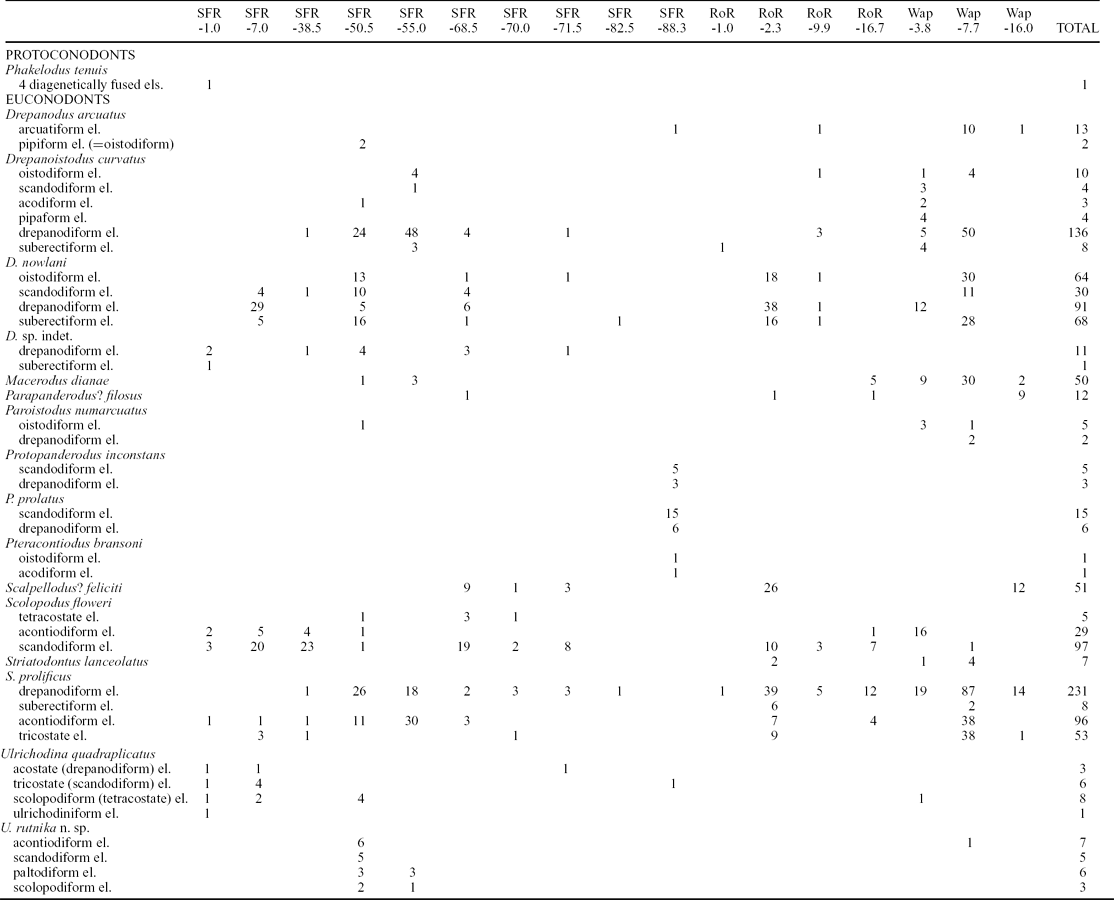
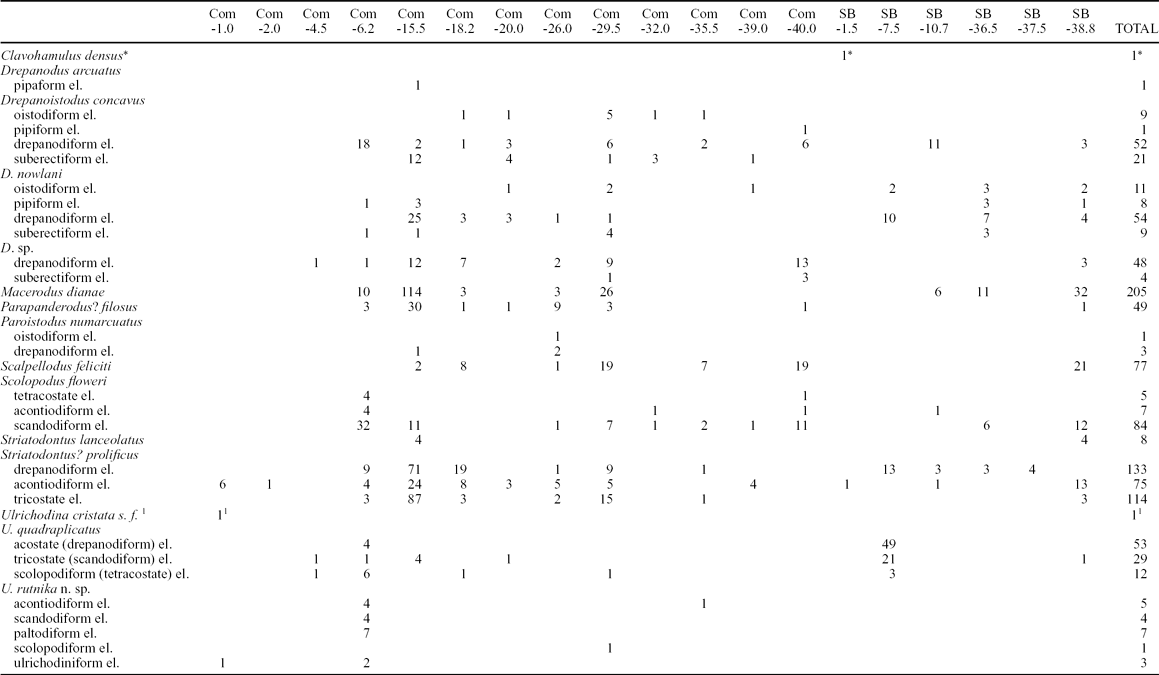
The Rochdale also resembles the Tribes Hill and Fort Cassin formations in that it has relatively low diversity conodonts (about 12 species; Tables 2, 3) and cephalopods that do not change significantly through the formation (e.g. Kröger & Landing, Reference Kröger and Landing2010). Finally, a similar vertical lithofacies succession is present in the Rochdale on the craton and in the parautochthonous Appalachians.
Upper Tremadocian (middle–upper Stairsian) conodonts from productive samples in the Rochdale Formation, Dutchess County, New York

Sample SFR-88.3 is lower Floian (lower Arenig/lower Tulean) Fort Cassin Formation.
Acid-disaggregated samples had a 6.0 kg mass. Abbreviations: el. – element; els. – elements.
Sample series R0-R (Fig. 4) abbreviated to ‘RoR’ to save space in table.
Rochdale Formation conodonts (upper Tremadocian, middle Stairsian) from productive samples from Washington County, New York

Most acid-disaggregated samples had a 6.0 kg mass. Abbreviations: asym. – asymmetrical; el. – element; s. f. – sensu formo; sym. – symmetrical. *Reworked element from Tribes Hill Formation; 11 – specimen illustrated as Ulrichodina cristata Harris & Harris, Reference Harris and Harris1965, s. f. in Landing, Westrop & Van Aller Hernick (2003, p. 96, fig. 11.28).
Kröger & Landing (Reference Kröger and Landing2008) noted that lower, relatively silty carbonates of the Rochdale Formation are overlain by a thrombolite-rich, carbonate high-stand facies that locally shoals upward into evaporitic carbonate (Fig. 5, Comstock section). These two parts of the Rochdale, respectively the Comstock and Hawk members (Appendix 1), extend from the craton (Washington County) into the parautochthonous Appalachians (Dutchess County) (Figs 3–5).
The top of the Hawk Member is a subaerially eroded unconformity with the overlying Fort Cassin Formation in Washington County, New York. The lowest Fort Cassin (or Ward Member of Fisher, Reference Fisher1984) is often a conglomerate with pebbles to boulders of the Rochdale overlain by current cross-bedded quartz arenite (Landing & Westrop, Reference Landing and Westrop2006; Kröger & Landing, Reference Kröger and Landing2009). Rochdale–Fort Cassin contacts that show this type 1 sequence boundary are not exposed to the south in Dutchess County. However, Weaver (Reference Weaver1957) described dolomitic sandstone of the lower Fort Cassin Formation (his ‘Copake Formation’) in Copake village, Columbia County, about 22 km NE of section SFR. This sandstone is comparable to the Ward Member, and conodonts from overlying, carbonate-rich samples from the ‘Copake’ are characteristic of the Fort Cassin Formation (E. Landing, unpub. data).
The abrupt change in conodont faunas at the top of the SFR section (Table 2; Fig. 7), with the disappearance of all conodonts known from the Rochdale Formation (Table 2, sample SFR-88.3; Fig. 9) and appearance of the characteristic Fort Cassin Formation trilobite Isoteloides (discussed by Kröger & Landing, Reference Kröger and Landing2008), shows that the Rochdale–Fort Cassin unconformity lies in the covered interval just below the top of the SFR section. The lower and upper brackets of the Rochdale Formation at section SFR show that the Rochdale is about twice as thick in the frontal thrusts of the Appalachians as on the craton.
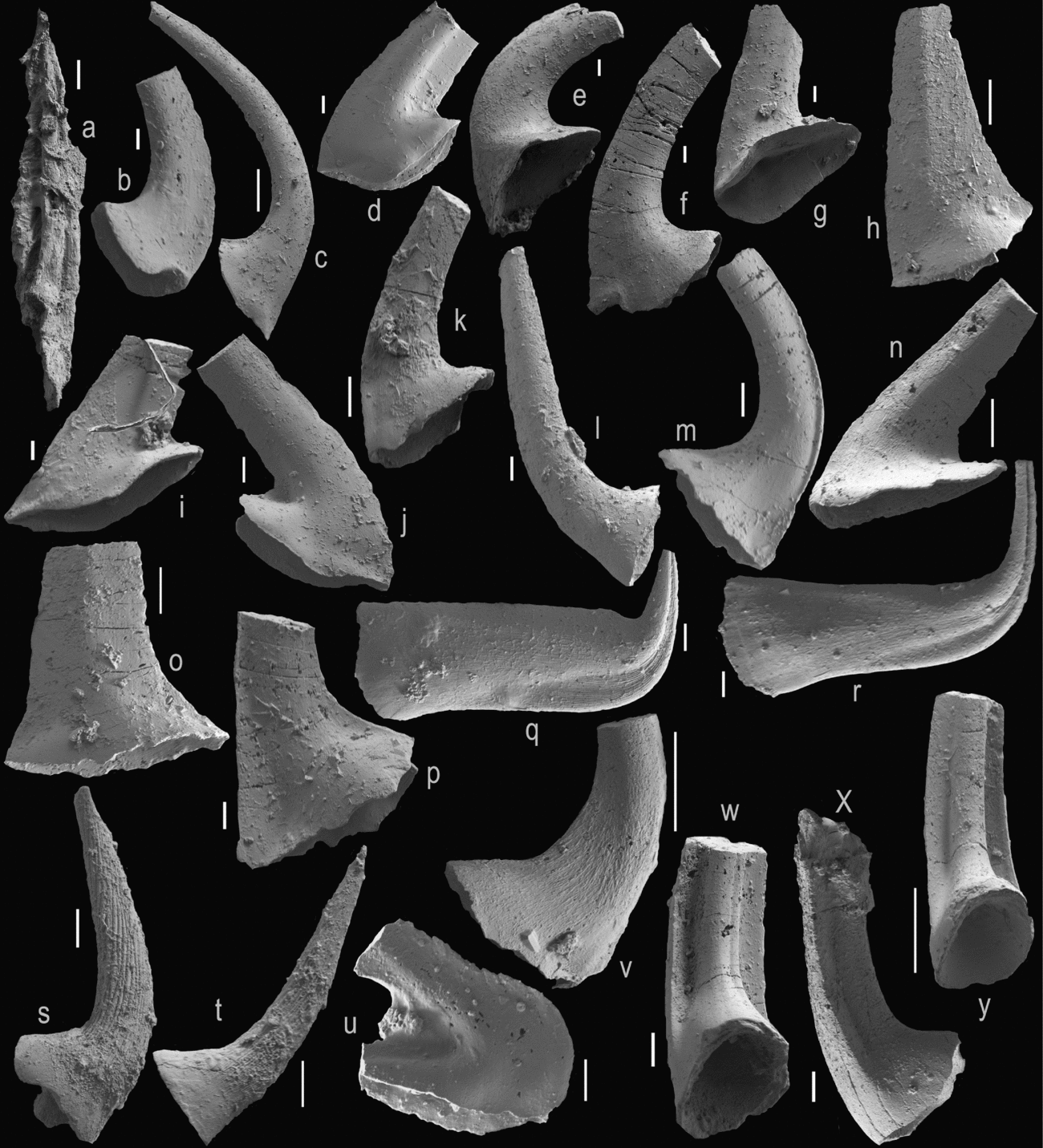
Protoconodont (a) and euconodonts (b–y) from the Rochdale Formation, hypotypes. Scale bars = 0.05 mm. (a) Phakelodus tenuis (Müller, Reference Müller1959), NYSM 17844, posterior view of four diagenetically fused elements, SFR-1.0. (b, c) Drepanodus arcuatus Pander, Reference Pander1856; (b) NYSM 17845, oistodiform, RoR-9.9; (c) NYSM 17846, drepanodiform (arcuatiform), Wap-7.7. (d–h) Drepanoistodus concavus (Branson & Mehl, Reference Branson and Mehl1933) from Wap-3.8. (d) NYSM 17847, oistodiform; (e) NYSM 17848, acodiform; (f) NYSM 17849, drepanodiform (‘pipiform’); (g) NYSM 17850, scandodiform; (h) NYSM 17851, suberectiform. (i–p) Drepanoistodus nowlani Ji & Barnes, Reference Ji and Barnes1994. (i) NYSM 17852, oistodiform, Wap-7.7; (j) NYSM 17853, oistodiform, Wap-7.7; (k) NYSM 17854, short-based, reclined drepanodiform with gentle inner-lateral deflection of lower anterior margin, Wap-3.8; (l) NYSM 17855, long-based, proclined drepanodiform, Wap-3.8; (m) NYSM 17856, subsymmetrical, long-based, recurved drepanodiform with inner-lateral deflection anterior keel, Wap-3.8; (n) NYSM 17857, scandodiform (i.e. oistodiform variant with sharply inward-deflected base), Wap-7.7; (o) NYSM 17858, symmetrical suberectiform, Wap-7.7; (p) NYSM 17859, subsymmetrical suberectiform with inward-deflected basal-anterior margin, Wap-7.7. (q, r) Macerodus dianae Fåhraeus & Nowlan, Reference Fåhraeus and Nowlan1978, Wap-7.7, NYSM 17860 and NYSM 17861, respectively. (s, t) Parapanderodus? filosus (Ethington & Clark, Reference Ethington and Clark1964). (s) NYSM 17862, reclined drepanodiform with circular cross-section, Wap-16.0; (t) NYSM 17863, proclined drepanodiform with circular cross-section, Wap-16. (u, v) Paroistodus numarcuatus (Lindström, Reference Lindström1955), Wap-7.7. (u) NYSM 17864, oistodiform; (v) NYSM 17865, drepanodiform. (w–y) Scalpellodus? feliciti (Ji & Barnes, Reference Ji and Barnes1994) emend. Landing, Westrop & Van Aller Hernick, 2003, RoR-2.3. (w) NYSM 17866, posterior view; (x) NYSM 17867, lateral view; (y) NYSM 17868, posterior view.

6.d. Rochdale Formation conodonts and correlation
Conodonts readily allow correlation of the Rochdale Formation into other Laurentian successions. The fauna includes such taxa as Drepanoistodus concavus (Branson & Mehl, Reference Branson and Mehl1933); D. nowlani Ji & Barnes, Reference Ji and Barnes1994; Macerodus dianae Fåhraeus & Nowlan, Reference Fåhraeus and Nowlan1978; Scolopodus floweri Repetski, Reference Repetski1982; Striatodontus lanceolatus Ji & Barnes, Reference Ji and Barnes1994; and S. prolificus Ji & Barnes, Reference Ji and Barnes1994 (Tables 2, 3; Figs 7, 8).
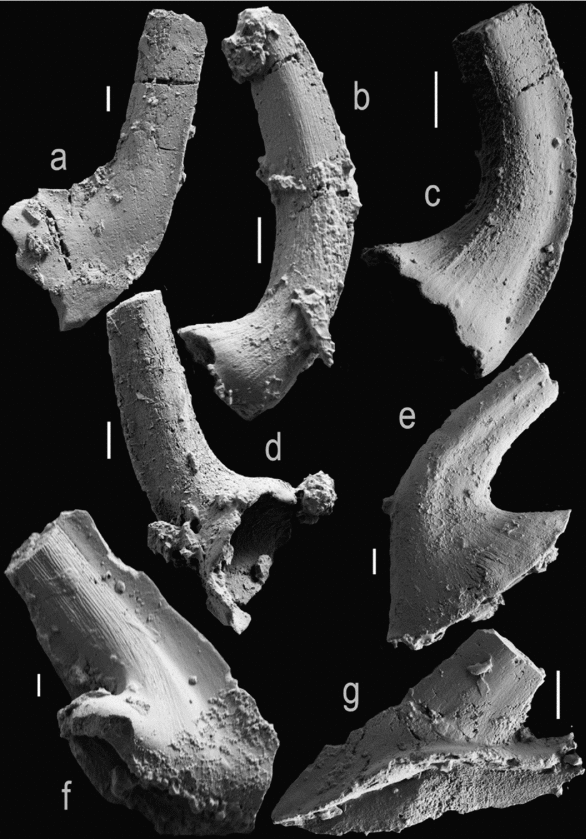
Euconodonts from the Rochdale Formation, hypotypes unless otherwise indicated. Scale bars = 0.05 mm, except = 0.025 mm in tiny fragment of Figure 8t. (a–f) Scolopodus floweri Repetski, Reference Repetski1982. (a) NYSM 17869, symmetrical tetracostate element (scolopodiform) with antero- and posterolateral costae, SFR-68.5; (b) NYSM 17870, posterior view symmetrical acontiodiform, RoR-16.7; (c) NYSM 17871, outer-lateral view scandodiform with rounded base–cusp transition, RoR-2.3; (d) NYSM 17872, inner-lateral view scandodiform with rounded base–cusp transition, RoR-2.3; (e) NYSM 17873, inner-lateral view scandodiform with angular base–cusp transition, RoR-2.3; (f) NYSM 17874, as Figure 8e, but with costae on inner-lateral surface, SFR-7.0. (g, h) Striatodontus lanceolatus Ji & Barnes, Reference Ji and Barnes1994, Wap-7.7. NYSM 17875 and NYSM 17876. (i–p) Striatodontus prolificus Ji & Barnes, Reference Ji and Barnes1994, from RoR-2.3 unless otherwise indicated. (i) NYSM 17877, posterior view suberectiform; (j) NYSM 17878, lateral view suberectiform; (k) NYSM 17879, postero-lateral view drepanodiform; (l) NYSM 17880, lateral view drepanodiform; (m) NYSM 17881, postero-lateral view acontiodiform; (n) NYSM 17882, posterior view acontiodiform with lateral costae; (o) NYSM 17883, asymmetrical tricostate element with lateral, posterior, and postero-lateral costae, Wap-7.7; (p) NYSM 17884, asymmetrical tricostate element with characteristic microstriae of species, Wap-7.7. (q–t) Ulrichodina quadraplicatus (Branson & Mehl, Reference Branson and Mehl1933). (q) NYSM 17885, acostate element with circular cross-section, SFR-1.0; (r) NYSM 17886, posterior view tricostate element (asymmetrical element with only one lateral sulcus), Wap-3.8; (s) NYSM 17887, tetracostate element, lateral view, SFR-1.0; (t) NYSM 17888, base of ulrichodiniform, Wap-1.0. (u–cc) Ulrichodina rutnika Landing n. sp., paratypes from SFR-50.5 unless otherwise indicated. (u) NYSM 17889, posterolateral view acontiodiform with bifid posterior costa; (v) NYSM 17890, lateral view acontiodiform with bifid posterior costa; (w) NYSM 17891, anterolateral view of broken acontiodiform with anterior costae; (x) 17896, posterior view acontiodiform, Com-15.5; (y) holotype NYSM 17892, posterior view scandodiform; (z) NYSM 17897, ulrichodiniform, Com-15.5; (aa) NYSM 17893, posterior view multicostate scandodiform; (bb) NYSM 17894, lateral view paltodiform with large medial costa (this view) and posterolateral costa (obverse side); (cc) NYSM 17895, scolopodiform with four costae on each side and anterior and posterior keels.

These taxa occur with Macerodus dianae in western Newfoundland (Ji & Barnes, Reference Ji and Barnes1994) and in the M. dianae Zone (Ross et al. Reference Ross, Hintze, Ethington, Miller, Taylor, Repetski, Sprinkle and Guensburg1997, p. 25, pl. 1) of the Great Basin of the western United States. Macerodus dianae appears in somewhat higher diversity faunas 5–6 m above the base of the Rochdale Formation (Tables 2, 3). However, the presence of Striatodontus prolificus, a characteristic M. dianae Zone form (i.e. Ji & Barnes, Reference Ji and Barnes1994), in the low abundance and low diversity conodont faunas of the basal Rochdale (Tables 2, 3) suggests that the lowest Rochdale is best assigned to the M. dianae Zone.
Macerodus dianae Zone conodonts persist through the Rochdale Formation. Forms with a lowest occurrence in the terminal Stairsian–lower Tulean Acodus deltatus–Oneotodus costatus Zone (Ross et al. Reference Ross, Hintze, Ethington, Miller, Taylor, Repetski, Sprinkle and Guensburg1997) do not occur in the upper Rochdale Formation. For this reason, all of the Rochdale is assigned to the M. dianae Zone.
By comparison with the composite Ibexian Series reference section in the Ibex area, west-central Utah (Ross et al. Reference Ross, Hintze, Ethington, Miller, Taylor, Repetski, Sprinkle and Guensburg1997), the Rochdale Formation is middle–late (but not latest) Stairsian in age. This correlation refines the generalized Stairsian correlation that resulted from study of the Rochdale cephalopods (Kröger & Landing, Reference Kröger and Landing2008).
Almost all of the Rochdale conodonts have been described from the middle Boat Harbour Formation in western Newfoundland (see Ji & Barnes, Reference Ji and Barnes1994). This faunal similarity reflects not only comparable depositional environments between two widely separated regions on the east Laurentian platform, but also reflects similarities in depositional sequence history of the Rochdale and middle Boat Harbour Formation.
Rossodus manitouensis Zone conodonts are abruptly replaced by Macerodus dianae Zone conodonts at the Tribes Hill–Rochdale sequence boundary. A comparable, complete conodont replacement takes place at the ‘breccia bed’ (Knight & James, Reference Knight and James1987) in the lower Boat Harbour Formation (Ji & Barnes, Reference Ji and Barnes1994). The ‘breccia bed’ has been thought to represent a minor offlap–onlap couplet (Knight & James, Reference Knight and James1987; Ji & Barnes, Reference Ji and Barnes1994). However, the complete turn-over in conodont taxa and this turn-over's association with an apparently lengthy hiatus bracketed by the late R. manitouensis Chron at least through the middle Stairsian indicate the importance and duration of the sea-level changes at the bases of the middle Boat Harbour and Rochdale formations.
At the top of the middle Boat Harbour Formation, a ‘major’ offlap–onlap couplet has been invoked to explain the ‘pebble bed’ (Stouge, Reference Stouge1982; Knight & James, Reference Knight and James1987; Ji & Barnes, Reference Ji and Barnes1994). The pebble bed marks the abrupt replacement of Macerodus dianae Zone conodonts by younger conodonts of the upper Boat Harbour Formation (i.e. the terminal Stairsian–lower Tulean Acodus deltatus–Oneotodus costatus Zone assemblage of Ross et al. Reference Ross, Hintze, Ethington, Miller, Taylor, Repetski, Sprinkle and Guensburg1997).
A more dramatic replacement of the Macerodus dianae Zone assemblage occurs at the Rochdale–Fort Cassin Formation sequence boundary along the New York Promontory. As discussed in Section 6.g., the younger fauna of the Fort Cassin was recovered at the top of the Strever Farm Road section (Fig. 9), where it indicates correlation with the Oepikodus communis–Fahraeusodus marathonensis Zone of Landing & Westrop (Reference Landing and Westrop2006).
Euconodonts from the Fort Cassin Formation (sample SFR-88.3, hypotypes). Scale bars = 0.05 mm. (a, b) Protopanderosus inconstans (Branson & Mehl, Reference Branson and Mehl1933). (a) NYSM 17831, scandodiform that lacks antero- and posterolateral costae; (b) NYSM 17832, symmetrical, laterally compressed drepanodiform. (c–e) Protopanderodus prolatus Ji & Barnes, Reference Ji and Barnes1994. (c, d), NYSM 17833 and NYSM 17834, scandodiforms that lack antero- and posterolateral costae; (e) NYSM 17835, symmetrical drepanodiform with oval cross-section and lateral costae. (f, g) Pteracontiodus bransoni (Ethington & Clark, Reference Ethington and Clark1981). (f) NYSM 17836, anteriorly broken acodiform (Sd); (g) NYSM 17837, large-based oistodiform (M).

Provincial conodonts and trilobites (discussed in the following Sections) mean that a finely resolved correlation of the Rochdale Formation and coeval Laurentian units into other Early Palaeozoic palaeocontinents is not possible. As noted above, conodonts allow correlation of the Tribes Hill Formation with the late early Tremadocian Paltodus deltifer deltifer Subzone of Baltica and West Gondwana (Löfgren, Repetski & Ethington, Reference Löfgren, Repetski and Ethington1999; Landing, Westrop & Keppie, Reference Landing, Franzi, Hagadorn, Westrop, Kröger, Dawson and Landing2007). However, correlation of the Rochdale Formation into Baltica is more problematical.
Only a few conodonts known from Baltica (Drepanodus arcuatus Pander, Reference Pander1856 and Paroistodus numarcuatus (Lindström, Reference Lindström1955); Fig. 7) occur in the Macerodus dianae Zone of the Rochdale Formation. However, these species also have their lowest occurrences in the Paltodus deltifer deltifer Subzone of Gondwanan Mexico (Landing, Westrop & Keppie, Reference Landing, Westrop and Keppie2007) and Baltica (e.g. van Wamel, Reference Van Wamel1974), with P. numarcuatus persisting to the end of the Tremadocian (van Wamel, Reference Van Wamel1974). As the P. deltifer deltifer Subzone is regarded as late early Tremadocian, as would be the Tribes Hill Formation, the correlation of the overlying Rochdale Formation can only be regarded as late Tremadocian.
6.e. Rochdale trilobites, earlier reports
Only four earlier publications have reported Rochdale Formation trilobites from eastern New York and, apparently, Vermont. This sparse record reflects the low abundance of trilobite remains in the mollusc-dominated Rochdale macrofaunas (Kröger & Landing, Reference Kröger and Landing2008, Reference Kröger and Landing2010; see Flower's, Reference Flower1968 ‘Fort Ann Formation’ report). In addition, Rochdale deposition seems to have been associated with relatively low-energy conditions. Thus, the higher energy, locally trilobite-rich grainstones present in the transgressive–highstand facies transitions and between the highstand thrombolites in the Tribes Hill and Fort Cassin formations were not found in the Rochdale (compare Westrop, Knox & Landing, Reference Westrop, Knox and Landing1993; Brett & Westrop, Reference Brett and Westrop1996; Landing, Westrop & Knox, Reference Landing, Westrop and Knox1996; Landing, Westrop & Van Aller Hernick, Reference Landing, Westrop and Van Aller Hernick2003; Landing & Westrop, Reference Landing and Westrop2006).
Rochdale trilobites, which are also found primarily in the transgressive–highstand facies transition (i.e. Comstock–Hawk Member boundary interval), often cannot be cracked out as identifiable specimens from the frequently stylolitic, neomorphic, dolomitic and locally slaty wacke- to packstones. Landing, Westrop & Van Aller Hernick (Reference Landing, Westrop and Van Aller Hernick2003) noted unidentifiable trilobite sclerites in packstone lenses between thrombolites of the Hawk Member in eastern Washington County (Fig. 1, locality KF).
A second, more important, report of Rochdale Formation trilobites was Dwight's (Reference Dwight1884) description of two trilobite species from his locality D, which was near (or is) section Wap of this study (Figs 1, 4). Dwight's (Reference Dwight1884) specimens from eastern Rochdale village, Dutchess County, probably came from the Comstock–Hawk Member transition interval.
A third report of Rochdale trilobites was Flower's (Reference Flower1968) poorly preserved hystricurid specimen. Flower's (Reference Flower1968) specimen also came from the Comstock–Hawk Member transition interval, as it was recovered near the ‘power station’ at the Comstock section in Washington County (i.e. the transformer station on the north side of Rte 22; Kröger & Landing, Reference Kröger and Landing2008).
A fourth report of Rochdale trilobites was Whitfield's (Reference Whitfield, Seeley and Brainerd1886, Reference Brezinski, Repetski, Taylor, Santucci and McClelland1889), who described Stairsian trilobites from a section just north of Beekmantown village in the NE Lake Champlain lowlands, Clinton County, New York (Fig. 1). This occurrence was cited in later reports, and was a basis for proposing the middle Beekmantown ‘Spellman Formation’ of northeastern New York (e.g. Fisher, Reference Fisher1968, Reference Fisher1977; designation abandoned Landing & Westrop, Reference Landing and Westrop2006). Re-investigation of the cephalopods and illustration of new trilobite and conodont collections from Whitfield's (Reference Whitfield1889) locality conclusively demonstrate that the locality is in the younger Fort Cassin Formation, and suggest that Whitfield's trilobites (received from H. B. Seeley) likely came from a section in Vermont, as the Rochdale does not occur near Beekmantown (Landing & Westrop, Reference Landing and Westrop2006; Kröger & Westrop, Reference Kröger and Landing2009).
6.f. Rochdale trilobites, re-evaluated
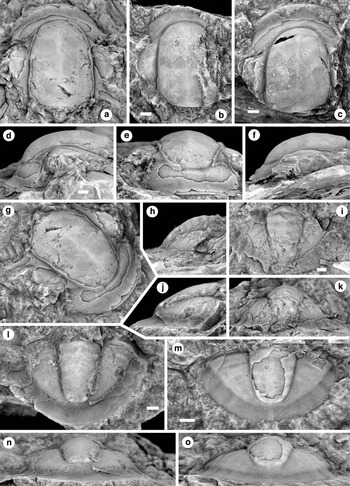
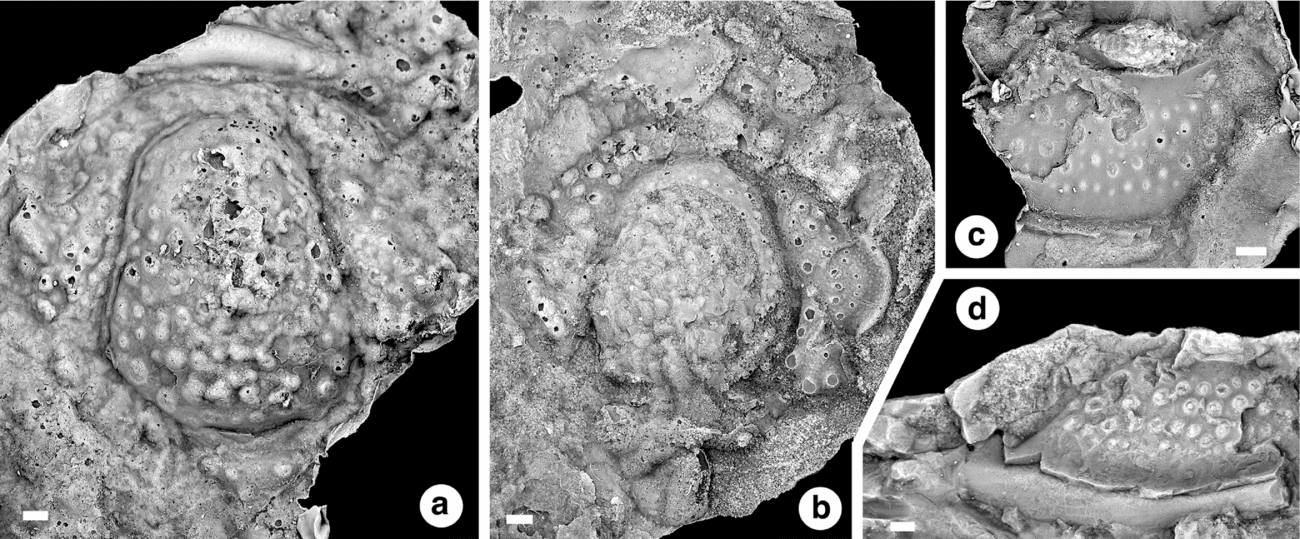
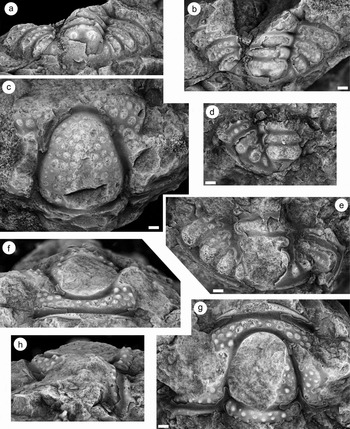
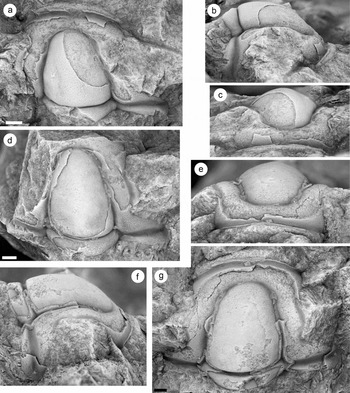
Our work expands the trilobite fauna of the Rochdale Formation to include Randaynia taurifrons (Dwight, Reference Dwight1884), Hystricurus crotalifrons (Dwight, Reference Dwight1884) and specimens tentatively referred to H. crotalifrons, an undescribed hystricurid and Leiostegium. Unfortunately, these trilobites add little to the biostratigraphic conclusions based on conodonts.
The most similar trilobite assemblage occurs in the Lower Member of the Boat Harbour Formation of western Newfoundland (Boyce, Reference Boyce1989), which also has Randaynia, strongly tuberculate species of Hystricurus similar to H. crotalifrons and Leiostegium. As the Rochdale, the Lower Member of the Boat Harbour has conodonts of the Macerodus dianae Zone, and is a coeval depositional sequence on the eastern Laurentian platform (discussed in Section 6.d).
6.g. Fort Cassin conodonts
An abrupt change at the top of the SFR section (Table 2) features the disappearance of Macerodus dianae Zone conodonts and appearance of a younger fauna (Fig. 9). Pteracontiodus bransoni (Ethington & Clark, Reference Ethington and Clark1981) and Protopanderosus inconstans (Branson & Mehl, Reference Branson and Mehl1933) have lowest occurrences in the Acodus deltatus–Oneotodus costatus Zone (terminal Stairsian–lower Tulean) in west Newfoundland, Texas, and the Great Basin (Ethington & Clark, Reference Ethington and Clark1981; Repetski, Reference Repetski1982; Ross et al. Reference Ross, Hintze, Ethington, Miller, Taylor, Repetski, Sprinkle and Guensburg1997). However, Protopanderodus prolatus Ji & Barnes, Reference Ji and Barnes1994 (Fig. 9c–e) from the top of section SFR is known from the lower Floian/Tulean (i.e. Oepikodus communis–Fahraeusodus marathonensis Zone of Landing & Westrop, Reference Landing and Westrop2006) of western Newfoundland (Ji & Barnes, Reference Ji and Barnes1994; Fig. 9). An association of P. prolatus and the trilobite Isoteloides peri (discussed in Section 6.c) shows that the Rochdale–Fort Cassin unconformity is in the covered interval just below the top of the SFR section.
7. Eustatic history
7.a. Late early Tremadocian eustatic rise across a ‘zero slope’ platform
The Tribes Hill Formation was deposited during a strong late early Tremadocian sea-level rise that submerged much of Laurentia (Landing, Reference Landing and Landing1988a, Reference Landing1998, Reference Landing, McLelland and Karabinos2002, Reference Landing and Landing2007, in press; Landing, Westrop & Knox, Reference Landing, Westrop and Knox1996; Landing, Westrop & Van Aller Hernick, Reference Landing, Westrop and Van Aller Hernick2003; Landing & Westrop, Reference Landing and Westrop2006; Landing, Westrop & Keppie, Reference Landing, Westrop and Keppie2007; Landing et al. Reference Landing, Westrop, Kröger and English2010). This sea-level rise is recorded by the deepening–shoaling facies shown by the vertical succession of the Tribes Hill members (Landing, Westrop & Knox, Reference Landing, Westrop and Knox1996), as well as by a trans-Laurentian platform unconformity between the Upper Cambrian and overlying units such as the Tribes Hill with upper Fauna B or Rossodus manitouensis Zone conodonts.
This trans-Laurentian unconformity overlain by upper Skullrockian Stage strata is known in southern Idaho, northern Utah, central Colorado, southern New Mexico, southern Missouri, the upper Mississippi River valley, west Newfoundland, southern Devon Island in the Canadian Arctic Archipelago and North Greenland, and is so widespread that it is best regarded as eustatic (Landing, Reference Landing and Landing1988a). This eustatic rise led to dolostone and quartz arenite deposition of the lower Prairie du Chien Group (i.e. Oneonta Dolostone–Shakopee Formation) in the upper Mississippi River valley of central Laurentia. The Oneota Dolostone is approximately coeval with the Tribes Hill Formation based on sparse conodont faunas (Furnish, Reference Furnish1938; Clark & Babcock, Reference Clark, Babcock and Clark1971). The upper Fauna B or Rossodus manitouensis Zone conodonts in the upper Van Oser Sandstone under the Oneota Dolostone in Wisconsin (Miller & Melby, Reference Miller, Melby and Clark1971, Parsons & Clark, Reference Parsons and Clark1999) suggest that such Lower Ordovician sandstones are transgressive systems tract facies that overlie cryptic unconformities with lithologically similar Upper Cambrian sandstone. The latter interpretation is based on the presence of Acanthodus uncinatus and a number of form species referable to multielement Semiacontiodus iowensis and Variabiloconus bassleri that are well known in both the Tribes Hill Formation and the Van Oser (see Landing, Westrop & Knox, Reference Landing, Westrop and Knox1996).
This strong late Skullrockian sea-level rise was later recorded across Laurentia by Ross & Ross (Reference Ross, Ross, Cooper, Droser and Finney1995). It is detailed further south in the central Appalachians as the Stonehenge transgression (Taylor, Repetski & Orndorff, Reference Taylor, Repetski, Orndorff, Webby and Laurie1992), as well as on such palaeocontinents as the Mexican margin of West Gondwana (Landing, Westrop & Keppie, Reference Landing, Westrop and Keppie2007). Neilsen (Reference Nielsen, Webby, Paris, Droser and Percival2004) termed this eustatic rise the ‘early to middle Tremadocian Highstand Interval’ in Baltica, where it followed terminal Cambrian–earliest Ordovician offlap of the Acerocare Regressive Event (Nielsen, Reference Nielsen, Webby, Paris, Droser and Percival2004).
Late early Tremadocian onlap took place across the New York Promontory on an apparent peneplain with negligible depositional slope. This conclusion is based on the very uniform, vertical facies succession in the Tribes Hill Formation that allows for the recognition of four successive members of the formation across the craton in New York and western Vermont (Landing, Westrop & Knox, Reference Landing, Westrop and Knox1996; Landing, Westrop & Van Aller Hernick, Reference Landing, Westrop and Van Aller Hernick2003). These members also occur in the parautochthonous, thrusted platform in the western Appalachians of Dutchess County, New York (this study).
An interesting feature of the Tribes Hill Formation member succession is the presence of the thin, mudstone-dominated Van Wie Member across at least 12000 km2 of eastern New York, western Vermont and southern Quebec (i.e. the Van Wie Member always underlies the extensive thrombolitic facies of the Wolf Hollow Member; discussed in Section 6.a). The Van Wie is a horizon in the middle of the formation that marks the change from eustatic deepening to maximum flooding (Landing, Westrop & Knox, Reference Landing, Westrop and Knox1996; Landing, Reference Landing1998).
The Van Wie Member cannot be accommodated by a Waltherian interpretation of the Tribes Hill Formation, in which the successive members of the Tribes Hill would be temporal equivalents deposited during an Early Ordovician onlap–offlap cycle. The Van Wie maintains a relatively constant thickness and depositional facies for hundreds of kilometres across and along depositional strike. In the Mohawk River valley and Washington County, the Van Wie even has three event beds (c. 10 cm thick pebble-trilobite hash storm-generated beds) located at its base, middle and top (Landing, Westrop & Knox, Reference Landing, Westrop and Knox1996; Landing, Westrop & Van Aller Hernick, Reference Landing, Westrop and Van Aller Hernick2003).
Indeed, the Van Wie, and by extension the under- and overlying members, are de facto chronostratigraphic units that record geographically widespread environments on the shallow east Laurentian shelf. Because depositional slope was so low and water depths relatively shallow, the carbonate units could not be deposited as regional clinoform intervals which would allow the members to be laterally and temporally equivalent to a Waltherian model of the formation. Obviously, transgression and submergence took place with a rise in eustatic level and with changes in rate of eustatic rise.
These extrinsic factors led to successively different vertical facies associations (i.e. ‘members’) during Tribes Hill deposition. However, tectonic quiescence, uniform tropical climate, negligible depositional slope and the regionally extensive effects of changes in rate of eustatic rise and carbonate production led to development of geographically widespread facies associations (i.e. members) that have time significance.
7.b. Tribes Hill Formation and continental slope dysoxia/anoxia
Most of the Tribes Hill Formation members are characteristic, Early Palaeozoic carbonate-dominated facies deposited in oxic, shallow-marine settings. However, the thin Van Wie Member in Dutchess County brackets what was likely a relatively brief interval of dysoxic/anoxic (d/a) platform deposition that led to the accumulation of black, sparsely burrowed to unburrowed, pyritic mudstone on the easternmost platform. Not only is the deposition of shallow d/a mud on the open shelf of particular interest/problematical, but the Van Wie shows that areas of the east Laurentian shelf had low oxygen bottom waters during part of the Rossodus manitouensis Chron.
It is significant that Rossodus manitouensis Zone conodonts and graptolites occur in black mudstones with thin lime mudstone beds in continental slope facies at the leading edge of the Taconian allochthons along the St Lawrence River in southern Quebec (Landing, Barnes & Stevens, Reference Landing, Barnes and Stevens1986). Subsequently, these R. manitouensis Zone intervals were recognized to form a distinct, macroscale black mudstone alternation in dominantly green-grey mudstones of the Taconian allochthons from east New York to west Newfoundland (Landing, Reference Landing and Landing1988b; Landing, Benus & Whitney, Reference Landing, Benus and Whitney1992). All of these black mudstones seem to represent a single interval of low oxygen conditions on the east Laurentian continental slope designated the ‘Schaghticoke dysoxic/anoxic’ (d/a) interval (Landing, Reference Landing, McLelland and Karabinos2002, Reference Landing and Landing2007, in press).
The interpretation of the Schaghticoke d/a interval is that strengthening and thickening of a mid-water dysoxic water mass took place on the east Laurentian slope with a climate maximum. As earlier discussed by Landing, Benus & Whitney (Reference Landing, Benus and Whitney1992; also Landing Reference Landing, McLelland and Karabinos2002, Reference Landing and Landing2007, in press), this climate maximum resulted from increased insolation as epicontinental seas covered Early Palaeozoic continents with the powerful early Tremadocian eustatic rise, and reduced the latitudinal temperature gradient. Consequently, storms were more infrequent, and deep ocean water mixing fell with a decrease in cold, dense polar water that oxygenated deep marine settings at eustatic low times.
Decreased deep water mixing led to intensification and thickening of the mid-water dysoxic mass and increased black mud deposition on the Laurentian slope. In addition, increased amounts of carbonate were swept off a more extensive carbonate platform with the eustatic rise (Landing, Benus & Whitney, Reference Landing, Benus and Whitney1992; Landing, Reference Landing and Landing2007). It seems that the eustatic rise was so great by the late early Tremadocian that oxygen-depleted slope water spread onto the platform and led to deposition of the Van Wie Member, as has been suggested to explain the extensive epicontinental Jurassic and Cretaceous black shales (e.g. Jenkyns, Reference Jenkyns1980, Reference Jenkyns1988).
7.c. Rochdale Formation and late Tremadocian eustatic rise
The Rochdale Formation records a later Tremadocian (late Stairsian) sea-level rise that did not lead to transgression that extended significantly west of the roughly N–S line of the Hudson River–Lake Champlain lowlands (Landing & Westrop, Reference Landing and Westrop2006). The Rochdale (or an equivalent unit under a different name) seemingly does not occur on the west Vermont craton on the east side of Lake Champlain (Welby, Reference Welby1961). The westernmost known outcrop of the Rochdale Formation is at locality KF in Figure 1.
The Rochdale Formation forms a narrow belt (c. 1200 km2) in cratonic and parautochthonous Appalachian sections at least from Shoreham, Vermont, to Dutchess County. It is coeval with the Theresa Formation (sandy dolostone and dolomitic sandstone) in the New York–Quebec border region (Fig. 2). However, the Theresa's relationship to late Tremadocian sea-level change is problematical, and deposition of the Theresa on an unconformity with the Upper Cambrian Potsdam Formation may reflect reactivation of the Ottawa-Bonnechere aulacogen (Fig. 1), rather than the effects of eustatic change (Landing, Reference Landing and Landing2007).
Barnes (Reference Barnes and Bruton1984) proposed that the unconformity-bound, middle Boat Harbour Formation in western Newfoundland (discussed in Section 6.d) reflected modestly higher sea-levels than the basal and upper parts of the formation. The middle Boat Harbour and Rochdale formations are coeval, and the geographic separation of these east Laurentian areas suggests that a sea-level rise in the Macerodus dianae Chron is eustatic. A coeval sea-level rise and high is Brezinski, Repetski & Taylor's (Reference Brezinski, Repetski, Taylor, Santucci and McClelland1999) ‘cycle 2’ in the central Appalachians of the Pennsylvania Re-entrant, which, as the Rochdale, was interpreted to be significantly weaker than that of the preceding late Skullrockian.
Ross & Ross (Reference Ross, Ross, Cooper, Droser and Finney1995) proposed a Laurentian sea-level rise in the Stairsian (early late Tremadocian) that was as dramatic as that of the late Skullrockian (late early Tremadocian). This purported Stairsian rise has been incorporated into eustatic models (e.g. Neilsen, Reference Nielsen, Webby, Paris, Droser and Percival2004). Unfortunately, Ross & Ross (Reference Ross, Ross, Cooper, Droser and Finney1995) mistakenly thought the ‘Ogdensburg Formation’ (= Fort Cassin Formation) of the New York–Quebec border region was Stairsian, rather than Tulean–Blackhillsian (early Floian) (e.g. Kröger & Landing, Reference Kröger and Landing2009). Thus, they based their strong ‘Stairsian’ sea-level rise on this miscorrelation.
As argued above, the middle–late Stairsian sea-level rise on the east Laurentian margin from west Newfoundland to the Pennsylvania Re-entrant was likely eustatic. However, its recognition on other Early Palaeozoic continents is difficult as a highly resolved intercontinental correlation of the Rochdale and coeval Laurentian units is not currently possible.
Neilsen (Reference Nielsen, Webby, Paris, Droser and Percival2004) showed that the late Tremadocian of Baltica featured a number of sea-level rises and falls. The relatively weak, early late Tremadocian Kiaerograptus Drowning Event is a likely correlative of the sea-level rise represented by the Rochdale Formation, as the sea-level rises recorded in the latest Tremadocian (Hunnebergian Stage in Baltica) would appear to be younger (i.e. correlative with the terminal Stairsian–lower Tulean Acodus deltatus–Oneotodus costatus Zone assemblage of Ross et al. Reference Ross, Hintze, Ethington, Miller, Taylor, Repetski, Sprinkle and Guensburg1997). As the sea-level rise associated with the Rochdale Formation and coeval east Laurentian units is recognizable along much of east Laurentia, it is designated the ‘Rochdale transgression’, a new name that replaces Brezynski, Repetski & Taylor's (1992) ‘cycle 2’.
The Rochdale Formation and Rochdale transgression correlate with a thin black mudstone and ‘ribbon limestone’ interval on the east Laurentian continental slope. This dysoxic/anoxic mudstone interval is known from localities with late Tremadocian graptolites along the leading margin of the Taconian allochthons along the St Lawrence River (Landing, Barnes & Stevens, Reference Landing, Barnes and Stevens1986; Landing, Benus & Whitney, Reference Landing, Benus and Whitney1992; Landing Reference Landing and Landing2007), and is known as the Rte 299 dysoxic/anoxic interval (Landing, in press). As with the eustatic high represented by the Tribes Hill Formation, increased insolation associated with increased areal extent of epicontinental seas during the Rochdale Highstand led to a climate maximum with reduced latitudinal temperature gradient and reduced storminess. The resultant reduced marine circulation again led to more widespread deposition of organic-rich mudstones on the continental slope. However, the sea-level (likely eustatic) rise of the Rochdale Highstand was not as great as the preceding Tremadoc Stonehenge transgression, and a coeval, organic-rich, siliciclastic mudstone facies is unknown on the platform.
8. Conclusions
Examination of the Beekmantown Group in east Laurentia shows that nearly complete changes take place in conodont, cephalopod and trilobite faunas across the interformational unconformities at the Little Falls–Tribes Hill, Tribes Hill–Rochdale and Rochdale–Fort Cassin contacts (Landing, Westrop & Knox, Reference Landing, Westrop and Knox1996; Landing, Westrop & Van Aller Hernick, Reference Landing, Westrop and Van Aller Hernick2003; Landing & Westrop, Reference Landing and Westrop2006; Landing, Reference Landing and Landing2007, in press; Kröger & Landing, Reference Kröger and Landing2007, Reference Kröger and Landing2008, Reference Kröger and Landing2009, Reference Landing, Westrop, Kröger and English2010; Landing & Kröger, Reference Landing and Kröger2009; Landing et al. Reference Landing, Westrop, Kröger and English2010). Although vertical successions through the tropical carbonate platform lithofacies of the successive Beekmantown Group formations are nearly identical, the lower level taxa of older formations do not re-appear in younger formations. In addition, the complexity of marine communities dramatically increases through the successive Beekmantown formations (Kröger & Landing, Reference Kröger and Landing2010).
A correspondence between the physical, interformational discontinuities and the nearly complete faunal breaks between formations may mean that significantly more time is represented by the unconformities than by the rocks of the successive formations. The incompleteness of the Beekmantown Group is not surprising as it reflects deposition on a slowly subsiding passive margin and consequently was strongly influenced by eustatic changes from the terminal Cambrian through the Middle Ordovician.
A significant feature of each Beekmantown formation is that its major lithofacies associations (i.e. members) are regionally extensive, and can be regarded as chronostratigraphic units that provide a resolution of geological time that is more highly resolved than that provided by macrofaunas and conodonts, which change little through each formation. Even very thin units such as the Van Wie Member's mudstone facies extend over thousands of square kilometres.
The exceptional areal extent of member-level divisions of Beekmantown formations reflects development of a type of carbonate platform which is unknown in the Pleistocene and Holocene: a passive-margin platform with essentially zero depositional slope. Rapid and strong eustatic changes in the Pleistocene and Holocene with glaciation and deglaciation led to strong erosion of platforms at eustatic lows. Rapid eustatic rise led to deposition of Quaternary carbonates essentially as clinoform units that show coeval, laterally transitional lithofacies associations.
By comparison, detailed study of sequence boundary unconformities, biostratigraphy and vertical lithofacies succession within formations shows that the Beekmantown Group formations are not laterally gradational units interpretable by a Waltherian model (fide Bernstein, Reference Bernstein1992; Hayman & Kidd, Reference Hayman, Kidd, McLelland and Karabinos2002). Indeed, the Beekmantown Group of east Laurentia provides a useful demonstration of ‘layer cake’ stratigraphy, in which lithofacies associations are regionally extensive and provide much greater resolution for regional time correlation than the associated macro- and microfossils.
9. Systematic palaeontology
E. Landing is responsible for conodont systematics and J. Adrain and S. R. Westrop for trilobite systematics. Most conodont taxa have been well discussed (e.g. Ji & Barnes, Reference Ji and Barnes1994; emendations in Landing, Westrop & Knox, Reference Landing, Westrop and Knox1996 and Landing & Westrop, Reference Landing and Westrop2006) or are represented by a limited number of specimens, and are not discussed below. Illustrated specimens are reposited in the New York State Museum (NYSM) Paleontology Collection.
Class CONODONTA Eichenberg, Reference Eichenberg1930
Order CONODONTOPHORIDA Eichenberg, Reference Eichenberg1930
Genus Drepanoistodus Lindström, Reference Lindström, Sweet and Bergström1971, emend. Ji & Barnes (Reference Ji and Barnes1994)
Type species. Oistodus forceps Lindström, Reference Lindström1955 from the Lower Ordovician of southeastern Sweden.
Discussion. Drepanoistodus is represented in the Rochdale Formation by D. concavus (Branson & Mehl, Reference Branson and Mehl1933) and D. nowlani Ji & Barnes, Reference Ji and Barnes1994 (Fig. 7). Ji & Barnes's (Reference Ji and Barnes1994) distinctions between elements of these two species are generally useful. However, a number of the generally similar drepanodiform and suberectiform elements of these species cannot be distinguished in some of the samples, and are reported as Drepanoistodus sp. (Tables 2, 3).
A wider morphologic variation is present in the drepanodiforms and suberectiforms of Drepanoistodus nowlani than noted by Ji & Barnes (Reference Ji and Barnes1994). In particular, these elements in D. nowlani include subsymmetrical variants. These variants include drepanodiforms with an inner-lateral deflection of the anterior keel, and suberectiforms with an inner-lateral deflection of the anterior-basal margin (Fig. 7m, o).
Genus Ulrichodina Furnish, Reference Furnish1938, emend. Landing, Westrop & Van Aller Hernick, Reference Landing, Westrop and Van Aller Hernick2003
1980 Eucharodus Kennedy.
1980 Glyptoconus Kennedy.
1994 Colaptoconus Kennedy (see Landing, Westrop & Van Aller Hernick, Reference Landing, Westrop and Van Aller Hernick2003, pp. 95–6).
Type species. Acontiodus abnormalis Branson & Mehl, Reference Branson and Mehl1933 (= Ulrichodina prima Furnish, Reference Furnish1938; see Lindström, Reference Lindström1964, p. 176; Kennedy, Reference Kennedy1980; and Ethington & Clark, Reference Ethington and Clark1981, p. 112) from the Lower Ordovician Jefferson City Formation of central Missouri.
Ulrichodina rutnika Landing sp. nov. Figures 8u–cc
2003 Ulrichodina cristata Harris & Harris; Landing, Westrop & Van Aller Hernick, p. 96, fig. 11.28.
Holotype. NYSM 17892 from sample SFR-50.5, upper Tremadocian (middle–upper Stairsian) Macerodus dianae Zone, upper Comstock Member, Rochdale Formation, Martin Lane railroad cut, Dutchess County, New York (Fig. 8y)
Paratypes. NYSM 17889–17891, 17893 and 17894 from SFR-50.5; NYSM 17895 from Wap-7.7.
Diagnosis. Ulrichodina species with apparatus that is a symmetry transition series (acontiodiform–scandodiform–paltodiform–scolopodiform–ulrichodiniform) of proclined (ulrichodiniform) and gently reclined–recurved, microstriated elements with relatively small bases, at least three major costae and additional smaller, secondary costae; scolopodiform laterally compressed with diamond-shaped cross-section; acontiodiforms variable, range from forms with broadly convex posterior surface to elements with a strong, bifid posterior costa.
Etymology. rutnika sp. nov. (L.), named for Erik Rutnik, for his genial help with the NYSM computer system, as well as for sharing E. Landing's sense of humour.
Description. Elements hyaline, generally reclined–erect–gently recurved (Fig. 8v, cc), ulrichodiniforms proclined (Fig. 8z); relatively deep basal cavity, triangular in lateral view, terminates in point near anterior surface in zone of maximum element curvature. Elements covered with longitudinal microstriae (c. 2.5 μm wide) that originate above smooth basal margin (Fig. 8v, x). Acontiodiforms variable, include forms with concave to flat posterior surface (Fig. 8x) and forms with strong, commonly bifid, posterior costa that rises above concave posterolateral sulcae; lateral keels rounded; anterior face ranges from broadly rounded curve to multicostate (Fig. 8w). Scandodiforms are asymmetrical variants of acontiodiforms with lateral deflection of base (Fig. 8y, aa); scandodiform posterolateral costa strongly differentiated to subdued; secondary, small costae may be present on postero- and anterolateral surfaces. Paltodiforms reclined, laterally compressed with sharply rounded anterior and posterior keels, have asymmetrical to subsymmetrical arrangement of major costae on each lateral surface; each major lateral costa has concave posterior surface (Fig. 8bb). Scolopodiforms gently reclined to recurved, weakly laterally compressed, with sharply rounded anterior and posterior keels, up to four lateral costae on each side; costa on middle of lateral face most strongly developed, and with anterior and posterior keels give a diamond-shaped cross-section to scolopodiforms; lateral costae have concave posterior surfaces (Fig. 8cc). Ulrichinodiniforms have anterior and posterior keels, broadly rounded anterolateral costae, and ulrichodinid downward deflection of anterior margin; anterolateral costae have straight to concave aboral outline; anterior keel may extend to aboral margin or terminate above aboral margin (compare Landing, Westrop & Van Aller Hernick, Reference Landing, Westrop and Van Aller Hernick2003, fig. 11.28 and Fig. 8z).
Discussion. The distinctive elements of Ulrichodina rutnika n. sp. are among the smallest conodont elements of the Rochdale Formation. Whether small element size is characteristic of the species is uncertain because relatively few elements were recovered.
Most elements of the new species resemble those of the younger, stratigraphically long-ranging species Ulrichodina multiplicata (Ji & Barnes, Reference Ji and Barnes1994). Ji & Barnes (Reference Ji and Barnes1994) illustrated an ulrichodiniform as part of their Glyptoconus multiplicatus, and this element makes their species referable to Ulrichodina (i.e. Landing, Westrop & Van Aller Hernick, Reference Landing, Westrop and Van Aller Hernick2003).
The acontiodiform–scandodiform elements of the two Ulrichodina species are similar, but the U. rutnika sp. nov. acontiodiforms do not always have a bifid posterior carina, and may have costae on their anterior face. The drepanodiform/scolopodiform elements of U. multiplicata are tetracostate with a posterior sulcus and subcircular cross-section. The homologous elements in U. rutnika sp. nov. are weakly laterally compressed and have a laterally compressed, diamond-like cross-section with as many as four costae on each lateral face (Fig. 8cc). The ulrichodiniform of U. rutnika sp. nov. has an anterior keel, while Ji & Barnes's (Reference Ji and Barnes1994) description and illustration of this element in U. multiplicata indicate a triangular cross-section and no anterior keel. An isolated ulrichodiniform of U. rutnika sp. nov. was compared with the younger (early Middle Ordovician) U. cristata sensu formo by Landing, Westrop & Van Aller Hernick (Reference Landing, Westrop and Van Aller Hernick2003), which was described by Harris & Harris (Reference Harris and Harris1965) as having an anterior keel that did not reach the aboral margin.
Occurrence. Presently known from 40 elements from the Rochdale Formation (Macerodus dianae Zone) in Washington and Dutchess Counties, eastern New York (Tables 2, 3). The species is known from rare elements from the Comstock Member, with one element recovered from the Hawk Member (sample Com-29.5).
Class TRILOBITA Walch, Reference Walch1771
Family bathyuridae Walcott, Reference Walcott1886
Genus Randaynia Boyce, Reference Boyce1989
Type species. Randaynia saundersi Boyce, Reference Boyce1989 from the Lower Member of the Boat Harbour Formation, Old Ferrolle Island, Brig Bay, western Newfoundland, Canada; by original designation.
Other species. Bathyurus taurifrons Dwight, Reference Dwight1884 from the Rochdale Formation, Rochdale, Dutchess County, New York State, USA; Bathyurellus affinis Poulsen, Reference Poulsen1937, Cape Weber Formation, Ella Island, east-central Greenland; R. langdoni Boyce, Reference Boyce1989, Barbace Cove Member, Boat Harbour Formation, Boat Harbour, western Newfoundland, Canada; R. leatherburyi Loch, Reference Loch2007, Kindblade Formation, Kindblade Ranch, Wichita Mountains, Kiowa County, Oklahoma, USA; R. sp. 1 of Loch (Reference Loch2007, p. 71), Kindblade Formation, Chapman Ranch, Interstate 35 Section, Carter County, Oklahoma, USA.
Discussion. In proposing the genus, Boyce (Reference Boyce1989, p. 62) did not assign it to a family, but primarily made comparisons with the lower Ibexian (Skullrockian) asaphids Bellefontia Ulrich in Walcott (Reference Walcott1924) and Parabellefontia Hintze, Reference Hintze1953. He also compared it with the ‘undetermined genus and species No. 2’ of Ross (Reference Ross1958, pl. 84, figs 1, 2, 13–15) of probable late Ibexian age. Ross's (Reference Ross1958) pygidial association is questionable: the pygidia could belong to the co-occurring species of Benthamaspis, to which no pygidia were assigned. The cranidia and librigenae appear to represent a styginid, possibly Promargo Holloway, Reference Holloway2007. Neither of these comparisons seems relevant to Randaynia. We agree with Loch (Reference Loch2007) that Randaynia is a bathyurid.
Randaynia taurifrons (Dwight, Reference Dwight1884) Figure 10
1884 Bathyurus taurifrons Dwight, p. 252, pl. 7, figs 1, 1a, 2, 2a, 2b, 3.
1890 Bathyurus taurifrons Dwight; Vogdes, p. 99.
1893 Bathyurus taurifrons Dwight; Vogdes, p. 283.
1911 Bathyurus taurifrons Dwight; Gordon, pp. 60–1.
1915 Bathyurus? taurifrons Dwight; Bassler, p. 107.
1989 Randaynia taurifrons (Dwight); Boyce, p. 62.
Randaynia taurifrons (Dwight, Reference Dwight1884), from the Rochdale Formation, Rochdale, New York. All specimens are hypotypes and testiferous. Scale bars = 1 mm. (a, d, e, g) cranidium, lectotype, NYSM 9634, original of Dwight (Reference Dwight1884, pl. 7, figs 1, 1a), dorsal, left lateral, anterior and oblique views; (b) cranidium, NYSM 17838, dorsal view; (c, f) cranidium, NYSM 17839, dorsal and left lateral views; (h, i, k) pygidium, NYSM 17840, right lateral, dorsal and posterior views; (j, l, n) pygidium, syntype, NYSM 9636, original of Dwight (Reference Dwight1884, pl. 7, fig. 3), right lateral, dorsal and posterior views; (m, o) pygidium, syntype, NYSM 9635, original of Dwight (Reference Dwight1884, pl. 7, figs 2, 2a, 2b), dorsal and posterior views.

Material. Lectotype (selected herein), cranidium, NYSM 9634 (Fig. 10a, d, e, g); syntypes NYSM 9635, 9636; assigned specimens NYSM 17838, 17839; all from the Rochdale Formation, probably from Dwight's (Reference Dwight1884) Locality D, Rochdale village, New York.
Diagnosis. Randaynia species with cranidium with narrow, elongate glabella; deep and incised axial and preglabellar furrows; narrow palpebral lobes; large pygidium with semicircular outline, strongly effaced, lacks median axial keel, with broad border of similar breadth medially and laterally.
Description. Cranidium with dorsal sculpture, as far as can be determined, entirely smooth; glabella long, glabella and LO account for 85% of sagittal cranidial length; maximum glabellar width across L1 73% of sagittal length; axial furrows very gently anteriorly convergent, bowed slightly outward around L1, inward lie opposite rear half of palpebral lobe so that glabella is slightly narrowed, and lie slightly outward anterior to midlength of palpebral lobe, confluent with preglabellar furrow just behind adaxial end of eye ridge; axial and preglabellar furrows similarly narrow and incised and moderately deep; SO completely effaced, LO and glabella confluent across entire width; glabella with faint median keel along most of its length, also possibly extended onto LO (Fig. 10b); glabellar furrows not incised, but visible on internal moulds as fairly large, posteromedially curved muscle attachment areas; glabella with moderate sagittal convexity rearward of anterior edge of palpebral lobe, sloped sharply downward anteriorly, anterior part of glabella and frontal region steeply sloped; anterior margin of anterior border strongly and evenly anteriorly curved; anterior border furrow broad and shallow; anterior border forms moderate elevated rim around margin, not sloped as steeply as preglabellar field but still sloped at about 30° relative to plane of palpebral lobes; anterior branches of facial suture sharply anteriorly divergent and nearly straight opposite frontal area; frontal area and preglabellar field with faint caecal sculpture; preglabellar field about one-and-a-half times sagittal length of anterior border; interocular fixigena narrow, flat; palpebral lobes nearly abut glabella; palpebral lobes long, narrow; faint palpebral furrow runs adaxial to lateral margin of lobe visible on internal mould (Fig. 10a, g, right-hand side); posterior projection preserved only on lectotype (Fig. 10a, g), apparently short (exsag.), turned strongly posteriorly, extends laterally only a short distance past lateral edge of palpebral lobe.
Librigena, rostral plate, hypostome and thorax unknown.
Pygidium with dorsal sculpture of fine anastomosing raised lines in small specimen (Fig. 10m), sculpture indeterminate in larger specimens; large pygidium with sagittal length about 60% maximum width; axis with sagittal length 77% that of pygidium and maximum anterior width about 30% that of pygidium; axial ring number difficult to determine owing to effacement and poor preservation, but apparently six in number plus a transverse terminal piece with a pair of widely spaced low tubercles; axial furrows narrow, quite deep, converge posteriorly and meet to completely define axis, crossed medially by very faint postaxial ridge immediately behind axis; pygidium convex and vaulted, axis with moderate independent inflation; ring furrows largely effaced; pleural and interpleural furrows more obvious on small specimen, effaced and difficult to count on large specimen; broader, flattened to slightly dorsally concave border, crossed faintly by pleural and interpleural furrows; posterior margin of pygidium evenly arcuate in large specimen, broader and less curved in small specimen.
Discussion. The sample size is tiny and includes two reasonably well-preserved pygidia of different sizes (Fig. 10j, l, n versus Fig. 10m, o) which have obviously different morphology. The differences are tentatively interpreted as ontogenetic; both specimens are effaced, with similar general dimensions and with a subdued tubercle pair on the terminal piece. However, they could easily represent different species. No species of Randaynia is very well known, and ontogenetic development of the pygidium remains to be documented on the basis of abundant specimens. The smaller pygidium (Fig. 10m) is wider relative to its length; its axis is wider relative to its length; its pleural and interpleural furrows are better impressed, even across the border. The border is narrower, and in addition to the faint post-axial ridge immediately behind the axis, it has a faint bicomposite ridge that medially transects the border. The internal mould of the axis of the smaller specimen also reveals a faint axial keel that interrupts the ring furrows, which compares with a similar though more strongly expressed feature present in R. saundersi Boyce (Reference Boyce1989, pl. 37, fig. 2) and R. langdoni Boyce (Reference Boyce1989, pl. 38, fig. 8). The larger pygidium appears to have lost this median keel.
Randaynia taurifrons is most similar to the type species R. saundersi and to R. sp. 1 of Loch (Reference Loch2007). It differs from R. saundersi in its much narrower glabella and overall narrower cranidium and in its more strongly impressed axial and preglabellar furrows. Comparably sized pygidia are very similar, but the pleural regions of R. taurifrons specimens are narrower and the axis of the largest specimen lacks any sign of a median keel. A specimen figured by Boyce (Reference Boyce1989, pl. 37, fig. 1) lacks expression of a keel, but it is a latex cast of an external mould. All of the internal moulds he figured show a keel, which seems definitely absent from the large, mostly exfoliated specimen of R. taurifrons (Fig. 10l). Randaynia sp. 1 of Loch (Reference Loch2007) is known mostly from pygidia that are similar to those of R. taurifrons with the exception of a more strongly posteriorly tapered axis with the terminal tubercles crowded closer together, and a border that is noticeably broader laterally than posteromedially.
Other species currently assigned to the genus are much less similar to R. taurifrons. Randaynia affinis (Poulsen) has a much large, more broadly expanded frontal area and a pygidium with a reduced, low axis and a very broad, concave border. Randaynia langdoni Boyce has a cranidium that is much shorter (sag.) relative to its width, with a shorter anterior border, much larger palpebral lobes with a dorsally obvious palpebral furrow, much shallower preglabellar and anterior axial furrows, and a clearly expressed versus entirely effaced SO. The pygidium is less effaced (at least in relative expression on the internal mould) and has a narrower border. Randaynia leatherburyi Loch has the axial and preglabellar furrows nearly effaced but has the least effaced tail of any species of Randaynia, as it has fairly well-impressed pleural and particularly deep axial ring furrows that contrast strongly with the nearly effaced large pygidium of R. taurifrons (Fig. 10l).
Family hystricuridae Hupé, Reference Hupé and Piveteau1953
Genus Hystricurus Raymond, Reference Raymond1913
Type species. Bathyurus conicus Billings, Reference Billings1859 from the Fort Cassin Formation (locally termed ‘Ogdensburg Member, Beauharnois Formation’, designations abandoned by Westrop & Landing, 2006), Montreal area, Quebec, Canada; by original designation.
Other species. See Adrain et al. (Reference Adrain, Lee, Westrop, Chatterton and Landing2003, p. 562).
Discussion. Hystricurus has long been used as a meaningless taxon of convenience for virtually any tuberculate Lower Ordovician aulacopleuroidean trilobite. Adrain et al. (Reference Adrain, Lee, Westrop, Chatterton and Landing2003) restricted the genus to a small clade with highly distinctive morphology, including a waisted (spindle-like) glabella and pygidia with a tall vertical ‘wall’ that underlies the pleural and axial regions, pleural spines and a pair of terminal axial spines (see Adrain et al. Reference Adrain, Lee, Westrop, Chatterton and Landing2003, fig. 4). With the restudy of the type material of Bathyurus? crotalifrons Dwight, it is clear that the species is a member, albeit an extremely poorly known one, of this clade.
Hystricurus crotalifrons (Dwight, Reference Dwight1884) Figures 11, 12a, b, Figures 12c–h?
1884 Bathyurus? crotalifrons Dwight, p. 253, pl. 7, figs 4, 4a, 5, 6.
1890 Bathyurus? crotalifrons Dwight; Vogdes, p. 98.
1893 Bathyurus? crotalifrons Dwight; Vogdes, p. 281.
1911 Bathyurus crotalifrons Dwight; Gordon, p. 61.
1913 Hystricurus crotalifrons (Dwight); Raymond, p. 61.
1915 Hystricurus crotalifrons (Dwight); Bassler, p. 657.
1999 Hystricurus crotalifrons; Lee & Chatterton, p. 365.
Hystricurus crotalifrons (Dwight, Reference Dwight1884), from the Rochdale Formation, Rochdale, New York. (a–c) are latex casts from external moulds; (d) is partially testiferous. Scale bars = 1 mm. (a) cranidium, lectotype, NYSM 17841, original of Dwight (Reference Dwight1884, pl. 7, fig. 6), dorsal view; (b) cranidium, syntype, NYSM 17842, original of Dwight (Reference Dwight1884, pl. 7, figs 4, 4a), dorsal view; (c) right librigena, syntype, NYSM 9766, original of Dwight (Reference Dwight1884, pl. 7, fig. 5), external view; (d) right librigena, NYSM 17843, external view.

Material. Lectotype (selected herein), cranidium NYSM 17841 (Fig. 11a), syntypes NYSM 17842 and NYSM 9766, and assigned specimen NYSM 17843, all from the Rochdale Formation, probably from Dwight's (Reference Dwight1884) Locality D, Rochdale village, New York.
Discussion. This species is so poorly known that diagnosis and description are barely possible. In addition to cranidia and librigena, one pygidium (Fig. 12a, b) in the NYSM collection has an old, handwritten label that identifies it as ‘probably Bathyurus crotalifrons, Calciferous Limestone, Rochdale, New York. Collected by Dwight (by blasting) subsequent to the publication of the species’. Poorly preserved sclerites of a strongly tuberculate Hystricurus (Fig. 12c–h) occur in R. H. Flower's collections (NYSM locs. 5897, 5916) from the Rochdale in Washington County, but assignment to H. crotalifrons is questionable at best given the poor quality of Dwight's types.
Lower Ordovician trilobites from the Rochdale Formation, eastern New York, hypotypes. Scale bars = 1 mm. (a, b) Hystricurus crotalifrons (Dwight, Reference Dwight1884), probably Hawk Member, Rochdale, Dutchess County, New York. Pygidium, NYSM 12886, posterior and dorsal views; according to NYSM label, this sclerite was collected by W. D. Dwight from the topotype locality after publication of the species’ name in 1884. (c–h) Hystricurus crotalifrons? (Dwight, Reference Dwight1884), Hawk Member, Smith Basin (NYSM loc. 5897), Washington County. (c) Cranidium, dorsal view, NYSM 12887. (d) Pygidium, dorsal view, NYSM 12888. (e) Pygidium, dorsal view, NYSM 12889. (f–h) Hystricurus cf. H. crotalifrons? (Dwight, Reference Dwight1884), Starbuck Road (NYSM loc. 5916), Washington County. Cranidium, anterior, dorsal and lateral views, NYSM 13188.

A stratigraphic succession of well-preserved silicified species of Hystricurus from Utah and Idaho is presently under study by J. M. Adrain and S. R. Westrop. The closest comparison for H. crotalifrons is an undescribed species from the lower Stairsian of Utah (‘Zone D’ of Ross, Reference Ross1951 and Hintze, Reference Hintze1953). Further discussion of the species is deferred until this forthcoming work, when an adequate basis for comparison will be available.
‘Hystricurus’ sp. nov. Figure 13
Discussion. A handful of variably deformed cranidia from the upper Comstock Member at Comstock (collection Com-R-15) may represent a new hystricurid genus in which the tuberculate sculpture is weak or absent. Well-preserved silicified sclerites of related species occur in the Ibexian of the Great Basin, and systematic treatment of the genus must await their description.
Lower Ordovician trilobites from the Comstock Member, Rochdale Formation, Comstock, Washington County, New York (collection Com-R-15), hypotype specimens. Scale bars = 1 mm. (a–g) ‘Hystricurus’ sp. nov. (a–c) Cranidium, dorsal, lateral and anterior views, NYSM 13189. (d) Cranidium, dorsal view, NYSM 13189. (e–g) Cranidium, anterior, lateral and dorsal views, NYSM 13190.
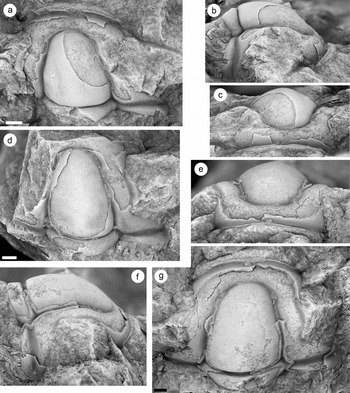
Family leiostegiidae Bradley, Reference Bradley1925
Genus Leiostegium Raymond, Reference Raymond1913
Type species. Bathyurus quadratus Billings, Reference Billings1860 from the Beekmantown Group, Quebec (by original designation, see also Billings, Reference Billings1865).
Leiostegium spp. Figure 14
Discussion. Two sclerites are illustrated to demonstrate the presence of Leiostegium in the Rochdale Formation. The cranidia and pygidia are not associated and occur at different localities, so we cannot be sure that our material represents one species. The cranidium (Fig. 14d–f) is from Rochdale, Dutchess County. An old, handwritten label attached to this specimen indicates that it was collected by W. B. Dwight in 1897 (who identified it as Bathyurus sp.) from the ‘stratum containing Triplesia gregana and Bathyurus crotalifrons’. The pygidium (Fig. 4a–c) was collected by R. H. Flower from the Hawk Member of the Rochdale at Smith Basin (NYSM loc. 5897), Washington County.
Lower Ordovician trilobites from the Rochdale Formation, New York, hypotype specimens. Scale bars = 1 mm. (a–f) Leiostegium spp. (a–c) Pygidium, lateral, dorsal and posterior views, NYSM 13191, Hawk Member, Smith Basin (NYSM loc. 5897), Washington County. (d–f) Cranidium, anterior, dorsal and lateral views, NYSM 13192, from Rochdale, Dutchess County.

Acknowledgements
EL acknowledges field and laboratory support from the NYSM. Scanning microscopy was done in the Wadsworth Laboratories of the New York State Health Department via S. Bowser. F. Mannolini (NYSM) is gratefully acknowledged for picking the conodont elements. Grants from the National Science Foundation, including DEB 0716065 to JMA and EAR 9973065 and EAR 0308685 to JMA and SRW supported work on the trilobites.
Appendix 1. Stratigraphic nomenclature
Rochdale Formation
The Rochdale Formation (Knopf, Reference Knopf1927) is redefined herein as a carbonate-dominated, unconformity-bound unit that ranges from c. 40 m on the craton to 80+ m in parautochthonous (Appalachian) successions. The appearance of thrombolite build-ups in the upper part of the formation allows it to be divided into two members. Most carbonate beds of the Rochdale are secondarily dolomitized, and such primary structures as burrows and ghosts of body fossils are common. A Rochdale type section was never designated, but the road-cut just east of Wappinger Creek along Rochdale Road in Rochdale village, southern Dutchess County, shows parts of both members of the formation. As it likely approximates Dwight's (Reference Dwight1884) fossil locality ‘D’, this section is designated the type section (Fig. 4, locality Wap).
The Rochdale is a depositional sequence along the New York Promontory with eroded contacts with the underlying lowest Ordovician (upper lower Tremadocian, upper Skullrockian) Tribes Hill Formation (Landing, Westrop & Van Aller Hernick, Reference Landing, Westrop and Van Aller Hernick2003; Fig. 5, this report) and overlying upper Lower Ordovician (Floian) Fort Cassin Formation. The Rochdale–Fort Cassin unconformity is exposed at chest level in a road-cut just opposite (east of) the intersection of Sciota Road and Ward Lane in northern Washington County (see Fisher, Reference Fisher1984) and Kröger & Landing, Reference Kröger and Landing2009 for precise locality). This sequence boundary has a subaerial erosion surface on the Rochdale with pebble–small boulder-size clasts of Rochdale succeeded by siliceous to dolomitic quartz arenites of the Ward Member of the lowest Fort Cassin.
The Rochdale is a deepening–shoaling succession with an interval of higher energy carbonates with the most unrestricted marine faunas (trilobites and echinoderm debris) appearing below the thrombolite build-ups. Shoaling into a restricted marine facies is shown by dolostones with tepee structures and dolomite-filled vugs that locally appear below the unconformity with the Fort Cassin Formation (Fig. 5, locality Com). The Rochdale extends at least 245 km roughly N–S in the parautochthonous Appalachians from southern Vermont (Shoreham area) to southern Dutchess County, New York. It also occurs in the autochthonous (cratonic) successions of Washington County, east-central New York.
‘Rochdale Formation’ (Knopf, Reference Knopf1927) is the senior synonym of the lower ‘Benson Formation’ (intervals 1 and 2 of Cady, Reference Cady1945) in central Vermont and ‘Fort Ann Formation’ (Wheeler, Reference Wheeler1941; also Flower, Reference Flower1968; Fisher, Reference Fisher1984) in Washington County, New York (see Landing & Westrop, Reference Landing and Westrop2006; Landing, Reference Landing and Landing2007; Kröger & Landing, Reference Kröger and Landing2008). Landing & Westrop (Reference Landing and Westrop2006, p. 967) noted the ‘Fort Ann Formation’ never had a type section specified, and is actually named for a village located on Upper Ordovician synorogenic flysch (see Fisher, Reference Fisher1984, pl. 1). Both the Rochdale Formation and its junior synonym ‘Fort Ann Formation’ over- and underlie the Tribes Hill and Fort Cassin formations, respectively, and consist of a lower member characterized by restricted-marine carbonates with basslerocerids and an upper member with thrombolites and the earliest appearance of a number of cephalopod groups (e.g. endocerids, tarphyceratids) (Figs 3–5).
The Tribes Hill (Sprakers Member) and Fort Cassin Formation (Ward Member) have prominent quartz-rich, lower members. However, a basal quartz arenite is local and thin in the Rochdale (Fig. 3; section SFR), although quartz sand and silt beds may be prominent in the lower Hawk Member.
Comstock and Hawk members (new)
The lowest thrombolite build-ups divide the Rochdale Formation into lower and upper members. The type sections of the lower Comstock Member and the upper Hawk Member are in the E-dipping Rochdale Formation succession on the north side of US Rte 22 (Fig. 5, locality Com).
The Comstock Member is named for Comstock village, located 1 km west of the unconformable contact between the Tribes Hill Formation and the Rochdale Formation immediately north of US Rte 22. The type section of the Comstock Member is the19.6 m thick interval of lower Rochdale in section Com on the north side of Rte 22 (Fig. 5). The lowest Comstock Member may have a local basal conglomerate (deposited in 2.1 m deep erosional cut-outs on the Tribes Hill Formation at the type section) or a quartzose sandstone (Fig. 3, locality SFR; Fig. 5, locality Com). Higher Comstock Member strata include lower silty carbonates and higher lime mudstones to fossil (mollusc-dominated) wacke- and rare packstones. Most carbonates of the Comstock Member are dolomitized.
The base of the Hawke Member (type section 19.6–41.25 m in section Com, Fig. 5) is defined by the lowest thrombolite build-ups. These thrombolites have a mollusc-dominated fauna (gastropods and cephalopods, see Kröger & Landing, Reference Kröger and Landing2008, Reference Kröger and Landing2010), and may include rare quartz arenites. Evaporitic features (tepee structures and dolomite-filled vugs) may occur in the relatively monotonous dolostones of the uppermost Hawk Member (Fig. 3, locality SFR; Fig. 5, locality Com). The member is named for Hawk Road (N–S-trending, unpaved in 2010), which has a T-intersection with Rte 22 opposite the Comstock–Hawk contact in the Comstock section.
Reconnaissance of the Rochdale Formation beyond the area of this report emphasizes the regional extent of the Comstock and Hawk Members. Cady's (Reference Cady1945) ‘Bascom Formation’ (abandoned, Landing & Westrop, Reference Landing and Westrop2006), which consists of Brainerd and Seeley's (Reference Brainerd and Seeley1890) units 1–4 of their Division D of the ‘Calciferous Formation’, was inspected by EL in the 2009 field season at East Shoreham, Vermont. The reconnaissance showed that unit 2 is thrombolite-rich in its lower part. The conclusions are that the ‘Benson Formation’ is, in part, a junior synonym of the Rochdale Formation (= Units 1 and 2 of Division D), while Units 3 and 4 of Division D and Cady's (Reference Cady1945) upper Benson Formation are lithologically and faunally comparable to the Fort Cassin Formation, conclusions also reached by Wheeler (Reference Wheeler1941) and Cady (Reference Cady1945, p. 544–547).
The Hawk Member and its thrombolite build-ups extend over at least 2500 km2. They extend at least 245 km N–S from the Shoreham, Vermont, area through the cratonic and parautochthonous areas of this report. At a minimum, they extend for 10 km normal to depositional strike (i.e. the approximate E–W distance from Hawk Member outcrops at Kane Falls (Landing, Westrop & Van Aller Hernick, Reference Landing, Westrop and Van Aller Hernick2003, fig. 5) to the Hawke Member at the Smith Basin and Comstock sections (Fig. 1; KF, SB, Com).
‘Comstock’ and ‘Hawk’ are available for use as lithostratigraphic names. Neither word is in use for Lower Palaeozoic lithostratigraphic units in North America (e.g. Wilmarth, Reference Wilmarth1938, and subsequent lithostratigraphic directories).