This study explores the question of the extent to which early bilingual speakers in stable bilingual communities become fully bilingual in their two community languages. This study responds to evidence that the timing of acquisition of a bilingual's two languages is related to amount of exposure to each language. Growing evidence indicates that children with greater exposure to each language have the early advantage in the acquisition of that language, but that, at the same time, differences across groups tend to become neutralized as children grow older and all groups amass a level of input needed to acquire the structures in question (Oller and Eilers, Reference Oller and Eilers2002a; Gathercole, Reference Gathercole2007c; Gathercole and Hoff, Reference Gathercole, Hoff, Hoff and Shatz2007). What is not known, however, is the extent to which this pattern applies to all structures in the language – i.e., whether bilingual children gain a full command of all aspects of both of their languages by adulthood. If, indeed, there are limits to acquisition beyond a certain critical period for language development (e.g., Johnson and Newport, Reference Johnson and Newport1989), this begs the question of whether there might be elements of the language that are timed “off the map” in certain cases.
The answer to this question may depend, at least in part, on the context of bilingualism (De Houwer, Reference De Houwer, Fletcher and MacWhinney1995; Romaine, Reference Romaine1995; Vihman, Reference Vihman1998; Deuchar and Quay, Reference Deuchar and Quay2000) and on the timing of acquisition (Johnson and Newport, Reference Johnson and Newport1989; Hyltenstam, Reference Hyltenstam2006). There is growing evidence that in bilingual communities in which one language is very dominant over the other, acquisition of the dominant language may be quite unproblematic across sub-groups, while acquisition of the minority language can be hampered under conditions of reduced input (Schlyter and Håkansson, Reference Schlyter and Håkansson1994; Allen, Reference Allen2006; Meisel, Reference Meisel2006; Treffers-Daller, Özsoy and van Hout, Reference Treffers-Daller, Özsoy and van Hout2007). There has also been some suggestion that there may be “suppression” of the L1 in bilinguals/L2 learners in some immigrant contexts (Oller, Jarmulowicz, Gibson and Hoff, Reference Oller, Jarmulowicz, Gibson and Hoff2007). Such research suggests that at least in some contexts a bilingual child may not come to a full mastery of both languages.
Wales provides a good natural laboratory in which to examine ultimate attainment in bilinguals. In Wales, children are exposed to both English and Welsh from an early age. Children may hear one or both languages at home, but they also start school at least by age 4. Welsh is often the primary medium of education, or is used alongside English. We will provide data below suggesting that children's and adults’ knowledge of Welsh is directly tied with the level of input they have or have had in Welsh, but, at the same time, that all speakers appear to develop equivalent, mature command of English, regardless of exposure in the home and at school. These data have implications for theories of language development in bilinguals as well as monolinguals: these include implications for acquisition in a stable versus immigrant bilingual community, for views of optimal conditions for bilingual first-language development, for critical periods of acquisition, and for the importance of continual exposure for long-term maintenance of the language.
BACKGROUND
A wide variety of research is making it increasingly clear that growing up with two languages affects the timing of development in each of those languages. Since bilinguals’ time and experience in context with each of their languages is by definition more limited than that of their monolingual peers, because a bilingual's experience is divided between two languages, it appears to take them longer to gain the “critical mass” of input data to acquire structures and to be able to draw out the relevant generalizations governing their use (see Gathercole, Reference Gathercole2007c). This is perhaps most apparent in the case of the development of vocabulary and of morpho-syntactic structures.
In the realm of vocabulary, bilingual children score slightly below the norms for their monolingual peers in each of their languages (Umbel, Pearson, Fernández and Oller, Reference Umbel, Pearson, Fernández and Oller1992; Pearson, Fernández and Oller, Reference Pearson, Fernández and Oller1993, Reference Pearson, Fernández and Oller1995; Pearson and Fernández, Reference Pearson and Fernández1994; Oller and Pearson, Reference Oller and Pearson2002; Hoff and Elledge, Reference Hoff and Elledge2005; Hoff and McKay, Reference Hoff and McKay2005; Cohen, Reference Cohen2006). If one examines which words they know in each of their languages, they typically know fewer than their monolingual peers. (However, they may have the same number of concepts labeled when the two languages are considered together, see Pearson et al., Reference Pearson, Fernández and Oller1993, Reference Pearson, Fernández and Oller1995; Pearson and Fernández, Reference Pearson and Fernández1994.) This is not surprising, given the distributed characteristic/complementarity of bilinguals’ language experience (Grosjean, Reference Grosjean1998; Cobo-Lewis, Pearson, Eilers and Umbel, Reference Cobo-Lewis, Pearson, Eilers and Umbel2002b; Oller, Reference Oller2005; Oller et al., Reference Oller, Jarmulowicz, Gibson and Hoff2007).
The same appears to be largely true in the realm of morpho-syntactic development. In a number of studies, bilingual children's abilities have been shown to develop in the same order as they do in monolinguals (following a language-specific pattern of complexity, or what Håkansson, Salameh and Nettelbladt (Reference Håkansson, Salameh and Nettelbladt2003) call an “implicational order”), but the timing of these developments are later than in monolinguals. Such findings have been reported, e.g., in Rieckborn (Reference Rieckborn2005, Reference Rieckborn and Lleó2006) for the acquisition of tense/aspect in French/German-speaking bilinguals, and in Kupisch (Reference Kupisch, van Kampen and Baauw2004) for determiners in bilingual children speaking French, German, and Italian. This timing difference can be attributed to (generally) less exposure on an average daily basis to each of the bilingual's two languages.
The case of Miami
One bilingual community in which the effects of exposure have been studied in depth and under tightly controlled conditions is that of Miami. A recent large-scale investigation (Oller and Eilers, Reference Oller and Eilers2002c) examined the acquisition of a wide range of linguistic aspects of English and Spanish in bilinguals and monolinguals in Grades Kindergarten (age 5), 2 (age 7), and 5 (age 10). The bilingual children came from homes in which only Spanish was spoken (OSH) or both Spanish and English were spoken (ESH). They also attended two types of schools, English Immersion or Two-way (i.e., two-language medium) schools; and they came from two SES levels, high and low (see Oller and Eilers, Reference Oller and Eilers2002b, for more detail). The structures examined included receptive and productive vocabulary in both languages and development of several morpho-syntactic structures in the two languages (Gathercole, Reference Gathercole2002a, Reference Gathercoleb, Reference Gathercolec).
For vocabulary, among the tests administered were the PPVT for English (Dunn and Dunn, Reference Dunn and Dunn1981) and a normed variant of the PPVT for Spanish, the Test de Vocabulario en Imágenes Peabody (TVIP, Dunn, Padilla, Lugo and Dunn, Reference Dunn, Padilla, Lugo and Dunn1986; see also Cobo-Lewis, Pearson, Eilers and Umbel, Reference Cobo-Lewis, Pearson, Eilers and Umbel2002a, Reference Cobo-Lewis, Pearson, Eilers and Umbelb; Cobo-Lewis, Eilers, Pearson and Umbel, Reference Cobo-Lewis, Eilers, Pearson and Umbel2002). Both bilingual Spanish–English speakers and monolingual English speakers were administered the PPVT, and the bilinguals were also administered the TVIP.
Cobo-Lewis et al. (Reference Cobo-Lewis, Pearson, Eilers and Umbel2002b) report that on the English PPVT, the monolingual English children had an overall 14.9 point advantage on standard scores over the bilinguals. However, the bilingual sub-groups differed: Bilinguals in English Immersion schools had a 4.3 point advantage over bilinguals in Two-way schools, with a greater difference at Kindergarten and Grade 2 than at Grade 5. Children from ESH homes had a 10.3 point advantage over bilinguals from OSH homes; and Low SES bilinguals were better than High SES bilinguals. Differences were more pronounced in Kindergarten and Grade 2 than in Grade 5. Cobo-Lewis et al. (Reference Cobo-Lewis, Pearson, Eilers and Umbel2002b) note that the narrowing of the gap between groups with age reflects increased exposure to English among the bilinguals.
Results on the Spanish TVIP showed similar effects based on differential input. First, the scores for the bilinguals were well below the means for the monolingual norming sample: Even the Kindergarten children from OSH homes showed performance nearly two standard deviations below the mean. Furthermore, while the overall standard scores did not show a substantial change across the three grades, children from OSH homes outperformed their ESH peers, especially those from Low SES homes, and in Two-way schools. In fact, the difference between English Immersion and Two-way children widened with age: in Kindergarten, there was a 0.5-point difference, but in Grades 2 and 5, there was an average difference of 8.8 and 7.8 points, respectively, with Two-way children outperforming English Immersion children.
These results, like the English vocabulary results, appear related to the relative levels of input the different groups of children were receiving in Spanish: Children in OSH homes heard more Spanish at home than children in ESH homes; and children from OSH homes from Low SES families were likely to hear more Spanish than their High SES counterparts because their parents, according to self-report, had low proficiency in English. Finally, children in Two-way schools heard more Spanish than children in English Immersion schools.
In the same larger study, three types of morpho-syntactic constructions were examined for a subset of the participants: the English mass/count distinction (Gathercole, Reference Gathercole2002a), the Spanish grammatical gender system (Gathercole, Reference Gathercole2002b), and that-trace structures in both languages (Gathercole, Reference Gathercole2002c; Gathercole and Montes, Reference Gathercole, Montes, Pérez-Leroux and Glass1997). For each of these, monolingual English-speaking and bilingual Spanish–English-speaking children in Grades 2 and 5 in Miami, plus monolingual Spanish-speaking children in Grades 2 and 5 in Lima, Peru, were asked to judge sentences they heard involving these structures and to correct them if they judged them unacceptable.
In the case of every structure, the monolinguals performed significantly better than any group of bilinguals; and the bilingual sub-groups often differed from each other, with the group experiencing the greatest input in the given language showing an early advantage with the structure in question. For English, English-Immersion bilinguals did better than Two-way bilinguals, those from ESH homes better than those from OSH homes, and higher SES children better than lower; for Spanish, it was the reverse. The significant differences across sub-groups were especially apparent at the younger ages, so by Grade 5, differences across groups had narrowed. The best interpretation of this appears to be that as children in each group gain sufficient exposure to the construct in question,Footnote 1 they are able to draw out the necessary generalizations, so early differences across groups appear to diminish with experience (see Gathercole, Reference Gathercole2007c; Gathercole and Hoff, Reference Gathercole, Hoff, Hoff and Shatz2007).
The question of ultimate achievement
The difference in the pace of acquisition across groups raises an important question regarding the ultimate level bilinguals reach in the acquisition of the vocabulary and morpho-syntax of each of their languages. While the data we have observed above suggest eventual leveling across groups as the children in all groups gain adequate experience with the language, it is not clear whether (or under what conditions) children across groups gain complete parity in their abilities with all of the structures for both languages. While it is likely that with simpler constructs, all groups gain full mastery of the structures, it is not clear whether this is true for more complex structures that take longer (even for monolinguals) to acquire (see Gathercole, Reference Gathercole2007c; Gathercole and Hoff, Reference Gathercole, Hoff, Hoff and Shatz2007; Thomas and Gathercole, Reference Thomas and Gathercole2007a). It is also likely that it will depend on the domain of language involved (e.g., vocabulary vs. syntax vs. phonology; Meier and Newport, Reference Meier and Newport1990; Eubank and Gregg, Reference Eubank and Gregg1999; Weber-Fox and Neville, Reference Weber-Fox and Neville1999).
It has long been debated whether there is a critical period for language development – whether first or second (Elman, Bates, Johnson, Karmiloff-Smith, Parisi and Plunkett, Reference Elman, Bates, Johnson, Karmiloff-Smith, Parisi and Plunkett1996; Bialystok and Hakuta, Reference Bialystok and Hakuta1999; Birdsong, Reference Birdsong1999) – and whether there is an age beyond which a full native-like command of a language can no longer be achieved (Johnson and Newport, Reference Johnson and Newport1989; Newport, Reference Newport, Carey and Gelman1991; Mayberry, Reference Mayberry, Goodman and Nusbaum1994; Bongaerts, Reference Bongaerts1999; Flege, Reference Flege1999; Moyer, Reference Moyer1999; Weber-Fox and Neville, Reference Weber-Fox and Neville1999; Hyltenstam, Reference Hyltenstam2006). Several studies have suggested that when children begin a language any time up until around age 6, they achieve native-like abilities. Beyond this age, there may be at least a decline in certain areas of the grammar, which may never develop fully. In addition, recent neuro-imaging studies suggest, in fact, that age of acquisition in bilinguals can affect neurological structures, and may do so differently for syntax versus semantics (Hernández, Martinez and Kohnert, Reference Hernández, Martinez and Kohnert2000; Hernández and Li, Reference Hernández and Li2007).
Alongside that research are studies indicating that it is common for bilingual speakers to be dominant in one language (Schlyter, Reference Schlyter, Hyltenstam and Viberg1993, Reference Schlyter2001), and suggesting that the language which is dominant in an individual may even vary with time over the developmental trajectory of the two languages (Lanza, Reference Lanza1997; Döpke, Reference Döpke2000). This may depend in part on the dominance relation between the languages in the community: Acquisition of a minority language may especially be hampered under certain conditions (Schlyter and Håkansson, Reference Schlyter and Håkansson1994; Allen, Reference Allen2006; Cohen, Reference Cohen2006; Meisel, Reference Meisel2006) and for certain aspects of the linguistic system.
The case of Wales
To explore the question of ultimate attainment, we focus here on the acquisition of Welsh and English in Wales. The case of Welsh is highly relevant. In Wales, both Welsh and English are used, with 20.8% of the population throughout Wales speaking Welsh. The use of Welsh is strongest in North West Wales, where 69.0% of the population of Gwynedd county, the stronghold of the Welsh language, speak Welsh (http://www.statistics.gov.uk/census2001; Deuchar, Reference Deuchar2005; Thomas and Gathercole, Reference Thomas and Gathercole2005; Gathercole, Reference Gathercole2007c). Children's home languages can be grouped in general into three major types: homes in which only Welsh is spoken, homes in which both Welsh and English are spoken, and homes in which only English is spoken. Children also attend schools in which most or all subjects are taught through the medium of Welsh or through Welsh and English, or in which Welsh is at least taught as a second language (Lewis, Reference Lewis2003). Since children in the UK begin school at age 4, all children are exposed to both languages at least by this age, if not before.
The input in both languages and the take-up of both languages are strong. A recent study (Gathercole, Reference Gathercole2007b) reveals that although the patterns of language use in the home are varied and complex, most children are acquiring both languages by school age. We found, first, that the patterns of parental use of the two languages in the home depended largely on the parents’ own home languages when they themselves were children (Gathercole, Reference Gathercole2007a; Gathercole and Thomas, Reference Gathercole and Thomas2007b). For example, parents in families in which both parents themselves had grown up in only-Welsh-speaking homes used only (96.3%) or mostly (2.8%) Welsh in speaking to their children. Parents in families in which both parents themselves had grown up in homes in which only English was spoken were reported to use only (38.8%) or mostly (37.7%) English to their children (Gathercole and Thomas, Reference Gathercole and Thomas2007b). The patterns of usage for families in which the parents themselves had grown up in two-language homes or in which one parent had grown up in a Welsh-only home and the other an English-only home similarly showed variations consistent with the patterns they themselves had experienced as children (see Gathercole and Thomas, Reference Gathercole and Thomas2007b). These patterns of language choice in parental speech seem to be established early and remain fairly consistent as the child gets older (Gathercole, Reference Gathercole2007a).
These input differences affect the early language use by children. That same study revealed that the language(s) spoken by children under the age of 4½ are in line with the languages spoken to them in the home. Thus, for example, at the extreme ends, most of the children in homes in which both parents themselves grew up in only-Welsh-speaking homes are reported to speak only Welsh (66.7%) or only Welsh but learning English (7.1%); those in homes in which both parents themselves grew up in English-only homes are reported to speak only English (48.6%) or only English but learning Welsh (up to 20.0 %) (Gathercole, Reference Gathercole2007a; Gathercole and Thomas,Reference Gathercole and Thomas2007b).
By the time children reach age 4½, however, the dominant pattern is for all children to be speaking both languages; for example, most children from homes in which both parents grew up in Welsh-only homes or in English-only homes speak both Welsh and English (63.1%, 72.9%, respectively). Children in families with more mixed parental language backgrounds show 90.3% speaking both Welsh and English (Gathercole and Thomas, Reference Gathercole and Thomas2007b).
The Welsh context is, thus, an optimal one for examining the long-range acquisition of two languages in a stable bilingual community. Below we report data from a series of studies revealing a striking asymmetry between attainment (and maintenance) of Welsh and English.
STUDIES
Studies 1–4. CHILDREN
WELSH LANGUAGE
Data on Welsh come from several projects examining children's use of Welsh. These include work on the acquisition of vocabulary, the acquisition of grammatical gender in Welsh, and the identification of sentential subjects in two-noun sentences.
Study 1. Welsh vocabulary
The work on vocabulary acquisition comes from research aimed at developing a receptive vocabulary test for Welsh-language children (Gathercole and Thomas, Reference Gathercole and Thomas2007c; Gathercole, Thomas and Hughes, Reference Gathercole, Thomas and Hughes2008).
Method
Stimuli
For that test, we chose 240 native Welsh words, 30 words from each of eight frequency counts, from the Cronfa Eletroneg o Gymraeg (Ellis, O'Dochartaigh, Hicks, Morgan and Laporte, Reference Ellis, O'Dochartaigh, Hicks, Morgan and Laporte2001; see also Jones, Reference Jones2001). The frequency counts ranged from under 25 occurrences per million, through to over 600 occurrences per million. The choice of words strictly followed criteria designed to tap into children's knowledge of Welsh, not their other language, English, including choice of words from native Welsh vocabulary (not borrowings from English) and avoidance of Welsh–English cognates.
For each of these words, we put together a set of four pictorial stimuli, arranged in a 2 × 2 frame on a page. One picture was a “match” for the word, the other three were distracters. Four distinct sequences of the 240 words were produced, with the words of different levels of frequency systematically interspersed throughout. A computerized PowerPoint format of the test allowed for administration of the test to groups of children in a classroom.
Participants
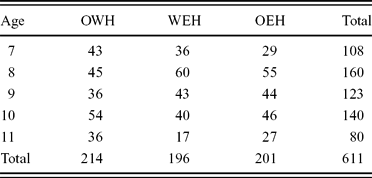
The participants were 611 children (317 females and 294 males) between the ages of 7 and 11. An additional seven children began the test but did not complete it. Children came from North (N = 321), Mid (N = 211), and South Wales (N = 79). Participants were distributed by age as shown in Table 1. The child's assignment to a Home Language group (OWH = only Welsh at home; WEH = Welsh and English at home; OEH = only English at home) was carried out according to a strict set of criteria: in short, if both parents (or a single parent) spoke mostly or only Welsh to the child, OWH; if both parents (or a single parent) spoke mostly or only English to the child, OEH; all other cases were considered WEH.
Study 1. Welsh receptive vocabulary: participants by Age× Home Language.
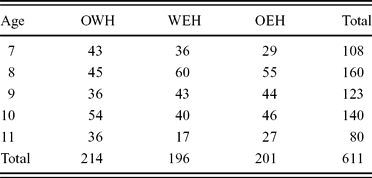
OWH = only Welsh at home; WEH = Welsh and English at home; OEH = only English at home
Procedure
All children were tested in their classrooms in groups. Each child was given an answer booklet that contained copies of the stimuli. On the first page of the booklet, there was a questionnaire that children were asked to fill in with information on age, birth date, and language background, including information on which language(s) their mother, father, and siblings spoke to them. The researchers circulated in the classroom to check that children understood and to help children fill out the form.Footnote 2
The computerized stimuli were shown at the front of the class. Children were instructed to look first at the stimulus shown on the screen and then to circle the picture on their answer booklet that was the best choice for the word they had heard. All vocabulary stimuli were provided orally. At no time did children see any version of the vocabulary items in written form.
Two practice sets of stimuli (afal “apple”, aderyn “bird”) were given first. The researcher instructed the child, e.g., to “wneud cylch o amgylch y llun sy'n mynd ORAU efo'r gair afal, afal” [put a circle around the picture that goes BEST with the word afal “apple”], repeating the word. For these practice items, the researcher gave corrective feedback if needed. After the practice items, the researcher continued to the target items in a similar fashion. Each target word was repeated on each trial. No feedback was given for the target items.
Results
Analyses of variance were conducted in which Age (7–11), Home Language, and Frequency were entered as variables. Because in many cases Welsh may be heard in school only, the child's year level in school may make a difference on performance (e.g., 8-year-olds in Year 3 will have been hearing Welsh one year less than 8-year-olds in Year 4), we also entered Lower/Higher Year for each child, according to whether s/he was at the lower or higher year for that age group, as an additional variable. Results revealed significant main effects of Age (F(4, 582) = 25.8, p < .001), Home Language (F(2, 582) = 16.2, p < .001), and Frequency (F(7, 582) = 3.8, p < .023). Children's performance differed across all ages (Tukey's HSD ps < .001), except for 7- versus 8-year-olds, and except for ages 9 versus 10, which were nearly significant (Tukey's HSD p < .059). Children from OWH homes performed significantly differently overall from the other Home Language groups, Tukey's HSD ps < .001 (WEH vs. OEH: p = .16, n.s.). And children performed significantly differently at every Frequency level, all paired ts: p < .001.
In addition, there were several significant interactions, first of Home Language × Higher/Lower Year, F(2, 582) = 3.8, p < .023. This revealed better performance overall at each age by children who were in the higher school year for their age (mean = 23.0 correct per Frequency group, out of 30) than by children in the lower school year (mean = 22.7 correct).
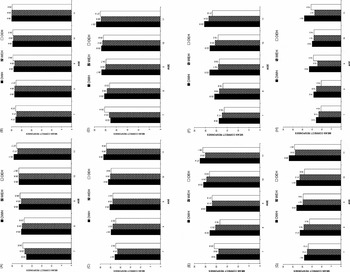
There were also interactions of Frequency × Age, F(28, 582) = 5.7, p < .001, Frequency × Home Language, F(14, 582) = 11.8, p < .001, and Frequency × Age × Home Language, F(56, 582) = 1.6, p < .005. Performance by Age and Home Language is shown for each Frequency level in Figure 1.
Study 1. Welsh vocabulary, performance by Age × Home Language (HL) at each level of frequency.
Figure 1A. FREQUENCY 1 (600+ per million)
Age: 7, 8 < 9, 10 < 11, ps ≤ .022; HL: OWH > WEH, OEH, ps ≤ .002
Figure 1B. FREQUENCY 2 (200–600 per million)
Age: 7 < 9, 10, 11; 8 < 10, 11; 9 < 11, ps ≤ .016; HL: OWH > WEH, OEH, ps ≤ .021 Age × HL: @ 7: OWH > WEH, p = .077; @ 8: WEH > OEH, p = .063; @ 10, OWH > OEH, p < .045
Figure 1C. FREQUENCY 3 (150–199 per million)
Age: 7 < 9, 10, 11; 8 < 10, 11, ps ≤ .021; HL: OWH > WEH, OEH, p < .001
Figure 1D. FREQUENCY 4 (100–149 per million)
Age: 7, 8 < 9, 10 < 11, ps ≤ .006; HL: OWH > WEH, OEH, p < .001
Figure 1E. FREQUENCY 5 (75–99 per million)
Age: 7, 8 < 9 < 10 < 11, ps ≤ .004; HL: OWH > WEH, OEH, ps < .001
Figure 1F. FREQUENCY 6 (50–74 per million)
Age: 7, 8 < 9, 10 < 11, ps ≤ .004; HL: OWH > WEH > OEH, ps ≤ .007
Figure 1G. FREQUENCY 7 (25–49 per million)
Age: 7, 8 < 9, 10 < 11, ps ≤ .021; HL: OWH > WEH > OEH, ps < .005
Figure 1H. FREQUENCY 8 (1–24 per million)
Age: 7, 8, 9 < 10, 11; 8 < 9, ps ≤ .022; HL: OWH > WEH, OEH, ps ≤ .001 Age × HL: @ 7, 9, 11: OWH > WEH, OEH, ps ≤ .013; @ 8: OWH, WEH > OEH, ps ≤ .003; @ 10, n.s.

Follow-up analyses reveal that at each Frequency level, Age and Home Language are still significant (Age: allFs ≥ 14.2, all ps < .001; Home Language: all Fs ≥ 2.1, all ps ≤ .03). But at Frequency levels 2 and 8, there is also an interaction of Age × Home Language (at level 2, OWH > OEH at age 10, p < .04; at level 8, OWH > WEH, OEH at ages 7, 8, 9, and 11, ps ≤ .013, and WEH > OEH at age 8, p < .003).
It can be seen, first, that there is continual progression upward in vocabulary knowledge across the ages, within each Home Language (HL) group and within each Frequency level. It can also be observed that at every Frequency level, the OWH children significantly outperform their WEH and OEH peers. At the higher frequencies, Frequencies 1–5 (75 or more occurrences per million), the WEH and OEH children perform in a similar fashion. At the lower frequencies, from Frequency 6 down (under 75 occurrences per million), there appears to be a split between the WEH and OEH children, with the WEH children outperforming the OEH children in most cases. This difference in HL results across the Frequencies suggest that for the less frequent words, the OEH children may have not had enough exposure to the language – either to have encountered the words frequently enough to have gained some understanding of their meanings or to have encountered them at all – or at least have had less exposure than their WEH peers, who in turn have had less exposure than their OWH peers. For the more frequent words, in contrast, the OEH children appear to have had enough exposure to perform as well as their WEH peers, but both groups are still behind their OWH peers.
These results are entirely consistent with findings in prior research on other languages indicating that the amount of input a child receives in a language is related to his or her vocabulary level in that language.
Study 2. Grammatical gender: comprehension of long-distance anaphora
Another set of studies have examined the acquisition of grammatical gender in Welsh. Grammatical gender in Welsh is encoded through mutations, morpho-phonological processes that affect word-initial consonants (Ball and Müller, Reference Ball and Müller1992; Thorne, Reference Thorne1993; Thomas, Reference Thomas1996). While an extensive description of the system is beyond the scope of this paper (see Gathercole, Thomas and Laporte, Reference Gathercole, Thomas and Laporte2001; Gathercole, Reference Gathercole2007c; Thomas and Gathercole, Reference Thomas and Gathercole2007a), it entails both local marking of gender (in nouns and adjectives modifying them) and distant marking, to encode anaphoric reference to the gender of antecedents with the possessive adjective form ei “3rd person singular possessive” and with anaphoric pronouns. The system is complex, opaque, and unreliable (MacWhinney, Reference MacWhinney1987a, Reference MacWhinney and MacWhinneyb; McDonald, Reference McDonald, MacWhinney and Bates1989) and, thus, entails protracted development across the school years and beyond. We will focus here on just one particular aspect of the system, gender marking in anaphoric structures, with ei and with anaphoric pronouns.
When the antecedent of possessive ei is feminine, it triggers Aspirate Mutation (AM) on the modified possessed noun; when the antecedent is masculine, it triggers Soft Mutation (SM) on the possessed noun. Aspirate Mutation involves the fricativization of initial voiceless stops (/p/, /t/, /k/ to /f/, /θ/, /x/) and insertion of /h/ before initial vowels; Soft Mutation involves voicing of initial voiceless stops (/p/, /t/, /k/ to /b/, /d/, /g/), fricativization of /b/, /d/, /m/ to /v/, /ð/, /v/, and deletion of /g/. Thus, given a word like coes /kɔes/ “leg”, and feminine possessors like dynes “woman”, cath “cat”, and pont “bridge”, if one wishes to refer to these possessors, coes will undergo Aspirate Mutation, as in (1).
(1) Feminine antecedent [→ Aspirate Mutation]


If the antecedent is a masculine possessor like dyn “man”, ci “dog”, or bwrdd “table”, coes will undergo Soft Mutation, as in (2).
(1) Masculine antecedent [→ Soft Mutation]
We have conducted tests of children's comprehension and of children's production of such structures, but will report here on the comprehension study. (The findings are similar, however, for production.)
Method
Stimuli and procedure
In one test (Gathercole and Thomas, Reference Gathercole and Thomas2005), we gave children sets of pairs of sentences, heard in conjunction with sets of picture cards. In the first sentence in each pair, children heard two nouns, clearly marked for their gender. Examples are given in (3) and (4). Children were shown a picture illustrating referents for both of the nouns mentioned in that first sentence.
The second sentence in each pair contained the possessive form ei or an anaphoric pronoun – o “3rd person singular masculine” or hi “3rd person singular feminine”. Ei occurred with either Aspirate Mutation (indicating that the antecedent was feminine) or with Soft Mutation (indicating that the antecedent was masculine), as in (5). An example of a sentence with an anaphoric pronoun is shown in (6). With the second sentence, children saw two pictures, one corresponding to the interpretation of the sentence with a masculine antecedent, the other to the interpretation with a feminine antecedent, and they were asked to choose which picture the sentence went with.
For both the anaphoric possessive form ei and the anaphoric pronouns there were six pairs of sentences with human nouns, six with nouns for animals, and six with nouns for inanimate objects, for a total of 18 sentences with ei and 18 with pronouns (see Gathercole and Thomas, Reference Gathercole and Thomas2005, for more detail).
Participants
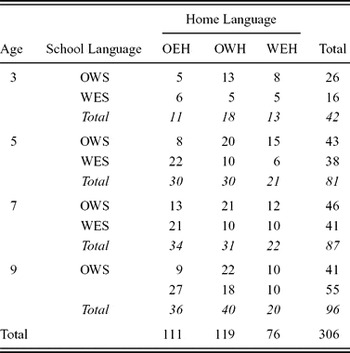
Participants in this experiment were 306 children aged 3, 5, 7, and 9. All the children for this study were from Gwynedd in North West Wales, the stronghold of the Welsh language. Children came from one of three types of homes: homes in which Welsh was spoken over 80% of the time since the child's birth (OWH, N = 118),Footnote 3 homes in which both Welsh and English were spoken 40%–60% of the time since the child's birth (WEH, N = 77), or homes in which English was spoken over 80% of the time since the child's birth (OEH, N = 115).Footnote 4 (Children whose home language profiles did not fit these criteria were not included in the study.) They also attended two types of schools: either only Welsh was used as a medium of education (OWS) or both Welsh and English were used as a medium of education (WES). Their distribution was as shown in Table 2.
Study 2. Comprehension of gender, long-distance anaphora: participants.
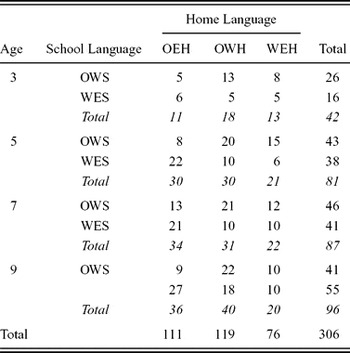
OEH = only English at home; OWH = only Welsh at home; WEH = Welsh and English at home; OWS = only Welsh at school; WES = Welsh and English at school
Results
Full analyses were conducted in which Age, Home Language, Linguistic Item (ei vs. pronouns), Gender (masculine, feminine antecedent), and Animacy (human, animal, inanimate antecedent) were entered as variables (see Gathercole, Thomas and Laporte, in preparation, for complete results). Among the major results of the study were significant differences in performance according to Home Language, of interest here. There was a main effect of Home Language (F(2, 300) = 51.215, p < .001), as well as significant interactions of Gender × Home Language, F(2, 300) = 3.411, p < .05; Linguistic Item (ei vs. pronouns) × Gender × Home Language, F(2, 300) = 5.350, p < .01; Animacy × Home Language, F(4, 600) = 14.355, p < .001; Gender × Animacy × Home Language, F(4, 400) = 3.104, p < .02; and Linguistic Item × Animacy × Home Language, F(4, 600) = 2.471, p < .05.
All Home Language groups performed significantly differently (Tukey's HSD ps < .05). The Animacy × Home Language effect revealed that this was particularly true in relation to human antecedents, and the Linguistic Item × Gender × Home Language effect that it was especially true in relation to feminine uses of ei. In the OWH group, performance on the possessive ei in relation to humans was good by age 5 and improved at ages 7 and 9 (5: 76.2%, 7: 85.6%, 9: 92.5%); in the WEH group, it was good by age 7 (7: 78.9%, 9: 84.2%); in the OEH group performance on ei for humans remained poor (43.2%–61.0%).
In relation to animals, the best performance on ei was among the OWH group at age 9, 62.2%. The OWH group was particularly good on ei in relation to feminine animal antecedents (72.3%, cf. ei with masculine animal antecedents at 46.4% in this group and with feminine animal antecedents at 58.7% and 49.7% in the WEH and OEH groups, respectively).
On inanimates, performance on ei was uniformly poor.
(For the purposes of comparison, adult Welsh speakers from OWH- and WEH-origin home language backgrounds were also tested. Their performance on ei with feminine antecedents was: human antecedents: 100%, animal antecedents: 87%, inanimate antecedents: 73%. It can thus be seen that the adult use of this structure is strong, and that none of the children had yet reached adult target levels of performance.)
On the whole, School Language was not significant (with a marginal main effect, F(1, 300) = 4.49, p = .0512). However, there was an interaction of School Language × Animacy, F(2, 600) = 14.240, p < .001. School Language primarily affected performance on items related to human antecedents: OWS: 81.3%, WES: 70.3%.
These results on the comprehension of gender in long-distance anaphora are consistent with those above on Welsh vocabulary. There was earlier and superior comprehension in OWH children, intermediate performance by WEH children, and lower performance by OEH children. Home Language was the most influential; however, School Language also affected abilities to some extent.
Study 3. Word order and the identification of sentential subjects
Welsh has two dominant word order patterns in declarative sentences: VSO and Aux SVO, as is shown in (7) and (8).
Method
Stimuli and procedure
Using a Competition Model type task (MacWhinney, Bates and Kliegl, Reference MacWhinney, Bates and Kliegl1984), we gave children sentences involving a verb and two nouns in three orders (VNN, NVN, NNV) while they were watching cartoon representations on a video screen. (Note that VNN and NVN are legitimate sequences, with VSO and SVO interpretation, for Welsh; NNV is not.) For each sentence, participants saw three cartoons simultaneously, one each showing N1 acting on N2, N2 acting on N1, and N1 and N2 acting on a third party. They were asked simply to point to the cartoon that they thought went with the sentence they heard. Children heard 96 semantically reversible sentences that involved action verbs. These were balanced for word order, for use of masculine vs. feminine nouns, and for the occurrence of nouns for animals and inanimates (with four orders for N1 and N2: animal–animal, animal–inanimate, inanimate–animal, and inanimate–inanimate). Typical sentences were as in (9). (The sentences were also controlled for additional linguistic characteristics, but these will be ignored here; see Gathercole, Laporte and Thomas, Reference Gathercole, Laporte and Thomas2005; Gathercole et al., in preparation, for further information.)
(9) Sample sentences
Participants
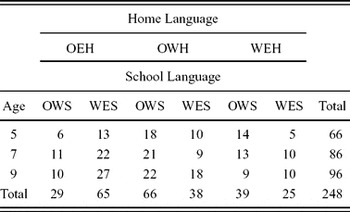
The participants again came from Gwynedd county and from three home types: OWH, WEH, and OEH. Two-hundred and forty-eight children completed the task at ages 5, 7, and 9. Their distribution was as in Table 3. Forty-six adults with OWH or WEH backgrounds were also tested, as a basis for comparison.
Study 3. Word order and identification of sentential subjects: participants. Child participants who completed sentence interpretation task.

OEH = only English at home; OWH = only Welsh at home; WEH = Welsh and English at home; OWS = only Welsh at school; WES = Welsh and English at school
Results
Responses were scored on the basis of whether a participant chose the cartoon depicting the referent of N1 as the subject of a given sentence. Full analyses included Age, Home Language, School Language (only Welsh, Welsh and English), Word Order (VNN, NVN, NNV), Gender of the nouns, and Animacy of the Nouns as variables (see Gathercole et al., Reference Gathercole, Laporte and Thomas2005; Gathercole et al., in preparation). We will discuss here only the results concerning reliance on word order in the interpretation of these sentences, and only in relation to Home Language and School Language effects, but these are representative of the overall results.
First, as a basis for comparison, the adults’ responses reveal considerable reliance on word order in interpreting sentences. Their responses differed significantly by word order (F(2, 44) = 59.66, p < .001): adults interpreted N1 as the subject of the sentence most often with VNN sentences (.918 proportion of the time), next most with NVN (.854), and least often with NNV (.472), all pair-wise comparison ps < .001.
The children's responses revealed a similar attention to word order, but the reliance on word order differed across sub-groups. There were between-subjects main effects of Age (F(2, 230) = 36.39, p < .001), Home Language (F(2, 230) = 15.14, p < .001), and School Language (F(1, 230) = 11.02, p < .001). Children were more likely to choose N1 as the subject of the sentence as they got older (mean proportions: 5: .529, 7: .627, 9: .678), with all three age groups significantly different from one another, all pair-wise ps < .002. Children from OEH homes were less likely overall than children from OWH and WEH homes to choose N1 as subject, ps < .001 (OEH: .56, OWH: .65, WEH: .63). And children from OWS schools treated N1 as subject significantly more often than children from WES schools, .64 vs. .59 choice of N1, respectively.
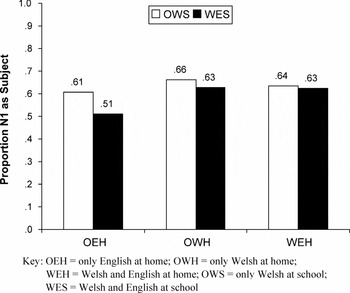
These main effects were attenuated by interaction effects, however. First, there was a two-way interaction of Home Language × School Language, F(2, 230) = 3.28, p < .04. Performance is shown in Figure 2. While performance of children from OWH and WEH homes was in general not affected if they attended OWS or WES schools, that of children from OEH homes was, F(1, 83) = 17.19, p < .001. Children from OEH homes who attended OWS schools were more likely to interpret N1 as subject (.608) than those who attended WES schools (.512).
Study 3. Word order and identification of sentential subjects: Home Language × School Language.

There was also an interaction of Word Order × Home Language, F(4, 460) = 7.04, p < .001. All Home Language groups performed at chance levels on NNV forms (.46–.50), whereas on VNN sentences, OWH children chose N1 as subject more often than OEH children, p < .003, and on NVN sentences, WEH children interpreted N1 as subject significantly more often than both OWH and OEH children, p < .049 and p < .023, respectively. Furthermore, children from OWH homes treated N1 as subject equally often with VNN and NVN sentences (.72 for both); children from OEH homes treated N1 as subject significantly more often with NVN sentences than VNN (NVN: .625, VNN: .572), p < .001; children from WEH homes treated N1 as subject near-significantly more often with NVN (.731) than with VNN (.702) sentences, p = .074.
Word Order also interacted with Gender, Home Language, and Animacy. Included was a significant interaction of Gender × Word Order × Home Language: F(4, 460) = 2.97, p < .019. This interaction was due to the fact that, whereas OWH children were not affected by noun gender in their responses by Word Order type (F(2, 91) = .59, p = .56, n.s.), OEH and WEH children were (OEH: Gender × Word Order: F(2, 82) = 5.20, p < .008, WEH: F(2, 54) = 8.94, p < .001). OEH children showed a near-significant effect of noun gender with NVN sentences, F(1, 24) = 4.12, p < .054 (Masculine: .67, Feminine: .58), and WEH children with VNN sentences, F(1, 30) = 3.04, p < .092 (Masculine: .74, Feminine: .68). In both cases, children gave more N1 responses to sentences with masculine nouns than to sentences with feminine nouns. (Our interpretation of this result is that either WEH and OEH children were negatively affected by the fact that feminine nouns undergo Soft Mutation when occurring with the definite article, which makes the basic forms of feminine nouns opaque, or that children were interpreting some of the feminine nouns as being marked for definiteness; see Gathercole et al., in preparation.)
These results, like the others for Welsh, reveal differences across groups in the acquisition of a major syntactic element in the language, the use of word order cues to the identification of sentential subjects. Both Home Language and School Language play roles in development, but School Language appears influential only in the case of children from OEH homes. Children from OWH homes are most likely to interpret VNN sequences as V–Subject–Object than either of the other groups, and are most like their adult counterparts in this regard. In addition, children from OWH homes are not influenced by extraneous factors such as the gender of the nouns in N1 position, suggesting either a robust knowledge that word order overrides other considerations or a firmer familiarity with the forms of the nouns (especially feminines) that were used in the study. Children from WEH homes were more likely than the others to treat N1 in NVN structures as the subject, although this was also high in the OWH children (as high as their choice of N1 as subject in VNN sequences), and OEH children also performed better on NVN than on VNN structures, though not as high as WEH children. This effect among WEH children was likely due to some interaction with their knowledge of word order in English and to the strength of word order as a cue to subjecthood in English. Children from OEH homes were least successful in treating N1 as subject of the sentence in either VNN or NVN structures.
All of these studies together provide a picture showing that level of exposure to Welsh gives the child the early advantage in learning the structure in question. Thus, children who come from OWH homes typically outperform, at an early age, their WEH peers, who in turn outperform their OEH peers. Similarly, children from OWS schools typically outperform their WES peers. The effect of School Language is particularly influential in the case of OEH and, in some cases, WEH children, suggesting that children who come from OWH homes usually attain a sufficient exposure to the language outside of school to attain the critical mass of input they need to acquire a given structure.
At the same time, as in the case of Miami, there seems to be leveling of abilities as children get older. In the case of every bilingual sub-group, acquisition with each of the structures examined appears to improve with age. And we often see eventual parity across the groups at the older ages. For example, in the case of vocabulary, with the more frequent words, OEH children seem to have reached the level of their WEH peers, even though they have not yet done so on the less frequent words; in the case of the understanding of VNN sentences, all but the OEH children at WES schools appear to become quite competent in the interpretation of VNN sentences by age 9: OWH (both OWS and WES): .82; WEH (OWS): .79; WEH (WES): .82; OEH (OWS): .73; cf. OEH (WES): .64.
These results from Wales showing differences in children's abilities across groups learning Welsh reveal effects parallel to those observed in Miami. Children's timing of development in each language appears related to the level of exposure they have to that language, where the level of exposure can be seen as a composite including home language and school language (as well as exposure related to SES levels). Such effects are applicable to both vocabulary and grammatical development, and to distinct types of grammatical structures.
What is the pattern of development in the acquisition of English in Wales? Evidence on the acquisition of English can provide information complementary to the Welsh data we have reported, and evidence on adults’ abilities in Welsh and English can help to illuminate the question of ultimate attainment.
ENGLISH COMPARED TO WELSH
To examine speakers’ facility with English, we present below information from several studies in which we have tested (the same) children and adults in both Welsh and English. These studies involve vocabulary development and the knowledge of idioms. While the examination of English morpho-syntax in the same population awaits further research, it is worth noting that grammatical development appears contingent on vocabulary development, in that structures are built on or are intimately linked with the lexicon (Bates and Goodman, Reference Bates and Goodman1997, Reference Bates, Goodman and MacWhinney1999). The parallel effects reported above for vocabulary and morpho-syntax for Welsh suggest that the findings for English vocabulary and idioms will provide some initial clues concerning morpho-syntactic development in English as well.
Study 4. Bilingual children's receptive command of Welsh and English vocabulary
In several studies (including Studies 2 and 3) mentioned above, we included as a background measure tests of children's receptive English vocabulary and receptive Welsh vocabulary. These together provide some information on (the same) children's abilities in the two languages within the North Wales context.
Method
Stimuli
The receptive vocabulary tests were based on the British Picture Vocabulary Scales (Dunn, Dunn and Whetton, Reference Dunn, Dunn and Whetton1982) and on an adaptation/translation of the BPVS for Welsh (Spencer, Reference Spencer2000).Footnote 5 The BPVS and its adaptation for Welsh exist in both long and short forms. The long form has 150 items and the short form 32 items. While the BPVS has been normed on British-English-speaking children, the Welsh translation of the test has not been normed on Welsh-speaking children. For this reason, we recorded raw scores on the two tests, for the purposes of better comparison across children and across tests. A child received a total raw score out of 32, for the short version of either test, or a total raw score out of 150, for the long version of either test.
Participants
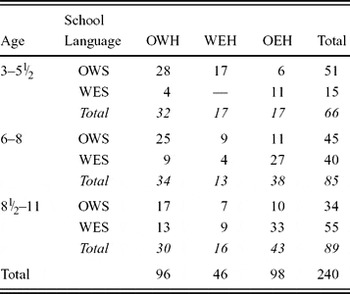
A total of 240 children were administered both the English and the Welsh tests. Children were from three major age groups: 3–5½ years (“4” – mean 4;10, range: 3;0–5;9), 6–8 years (“7” – mean 7;3, range 6;0–8;5), and 8½–11 years (“9” – mean 9;10, range 8;6–11;6). They came from Gwynedd, in North West Wales, and from three home language groups, using criteria as in Studies 2 and 3 above: OWH, WEH, OEH. Children were attending schools with two distinct school language profiles: OWS or WES. The distribution of subjects across groups was as shown in Table 4.
Study 4. Bilingual children's command of Welsh and English vocabulary: participants.

OWH = only Welsh at home; WEH = Welsh and English at home; OEH = only English at home
To avoid children carrying over from their performance on one test to performance on the other, half of the children received the Welsh test in short form and English in long form, half received the Welsh in long form and the English in short form.
Procedure
All children were given the Welsh and English tests on separate days.
Results
Because the short versions of the tests have fewer items than the long versions, we turned raw scores into proportions correct out of the total number of items. Because these scores were proportional, they were transformed using the Arcsin transformation for the purposes of the statistical measures.
Welsh
Scores were entered into an ANOVA as the dependent variable alongside Age Group (4, 7, 9), Home Language (OWH, WEH, OEH), School Language (OWS, WES), and Version of the Test (short, long) as independent variables. Analysis revealed significant main effects of Age Group, F(2, 206) = 72.47, p < .001, and Home Language, F(2, 206) = 10.78, p < .001, and interactions of Age Group × Version, F(2, 206) = 4.72, p < .01, and of Age Group × Version × Home Language, F(4, 206) = 3.326, p < .012. (Because the distribution of participants at age 4 was quite skewed, a re-analysis including only the 7- and 9-year-olds was conducted, and this confirmed the findings based on all participants: Age Group, F(1, 150) = 38.15, p <.001, Home Language, F(2, 150) = 7.12, p < .001, Age Group × Version, F(1, 150) = 3.78, p = .054, Age Group × Version × Home Language, F(2, 150) = 5.04, p < .008.)
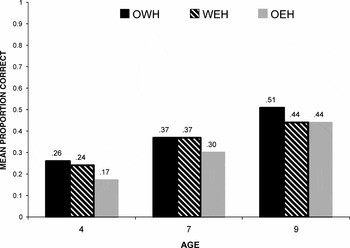
All Age Groups performed significantly differently: Tukey's HSD ps < .001, with means of .22 at age 4, .35 at age 7, and .46 at age 9. The significant effect of Home Language was due to a significant difference between the OWH and OEH children, Tukey's HSD p < .001. OWH children had an overall mean of.38, and OEH children .30. (WEH children were in between these, at a mean of .37.) (Exploratory follow-up tests confirmed that the Home Language differences held at each of the three ages: age 4: F(2, 56) = 6.540, p < .003 [OWH (.26), WEH (.24) > OEH (.17), ps < .001]; age 7: F(2, 73) = 4.419, p < .015 [OWH (.37), WEH (.37) > OEH (.30), ps < .03]; age 9: F(2, 77) = 4.071, p < .002 [OWH (.51) > OEH (.44), p < .004; (WEH: .44)]. See Figure 3.)
Study 4. Performance on Welsh vocabulary (adaptation of BPVS; Spencer, Reference Spencer2006), by Age × Home Language.

The interaction of Age Group × Version was due to better performance at age 4 on the short version (.25 correct) of the Welsh test than on the long version (.19 correct), F(1, 64) = 23.321, p < .001. And the interaction of Age Group × Version × Home Language is due to the fact that, while the younger ages showed significant effects for Home Language for both the short and long versions of the test, by age 9, all Home Language groups performed equivalently on the short version of the test, but not on the long version (age 4: short: F(2, 28) = 6.39, p < .005; long: F(2, 32) = 4.09, p < .03; age 7: short: F(2, 35) = 6.12, p < .005; long: F(2, 44) = 3.81, p < .03; age 9: short: F(2, 45) = .136, p = .87, n.s.; long: F(2, 38) = 13.27, p < .001). These results concerning Version of the test suggest that the shorter version may have been easier than the long version, and that the long version of the test may have been more discriminating at the later age than the short version. It may be that the longer version taps into more complex vocabulary, so older children with more experience can do better on it than younger children, while the shorter version may tap into a more basic level of vocabulary, so it is discriminating at the younger ages, but not the oldest ages, when all Home Language groups seem to have acquired the relevant vocabulary. (The longer version, thus, may be more like the less frequent words in our Study 1, and the shorter version more like our more frequent words.)
The results on this test for Welsh receptive vocabulary, then, show robust effects of Home Language. At all ages, children from OWH homes significantly outperform children from OEH homes, with children from WEH homes somewhere between them. They also reveal no School Language effect at any age.
English
Similar analyses were conducted for English. Scores were entered into an ANOVA as the dependent variable alongside Age Group (4, 7, 9), Home Language (OWH, WEH, OEH), School Language (OWS, WES), and Version of the Test (short, long) as independent variables. Analysis revealed significant main effects of Age Group, F(2, 206) = 97.6, p < .001, Home Language, F(2, 206) = 4.6, p < .011, and School Language, F(1, 206) = 10.37, p < .001. Follow-up statistics revealed that all Age Groups performed significantly differently, Tukey's HSD ps < .001, with 4-year-olds at .24, 7-year-olds at .46, and 9-year-olds at .58 mean correct responses. All three Home Language groups were significantly different, Tukey's HSD ps ≤ .02, with WEH showing .48, OEH .44, and OWH .40 mean correct responses.
There were no significant interactions, but there was a near-significant interaction of Age Group × Version of the Test, F(2, 206) = 2.81, p = .063. As was the case for the Welsh test, it appears that the short test was easier than the longer test, as there was a tendency for the younger two groups of children to do better on the short test (age 4: short: .27, long: .22; age 7: short: .48, long: .43), but the oldest children did better on the long test (age 9: short: .56, long: .60).
As in the case of the Welsh analyses, because the distribution of the participants at age four was quite skewed, a second re-analysis was conducted for just the two older groups. Under this analysis, Age Group and School Language were still significant: Age Group: F(1, 150) = 35.17, p < .001; School Language: F(1, 150) = 10.95, p < .001, but Home Language was not: F(2, 150) = .95, p = .387, n.s. Age Group × Version was now significant: F(1, 150) = 4.14, p < .04.
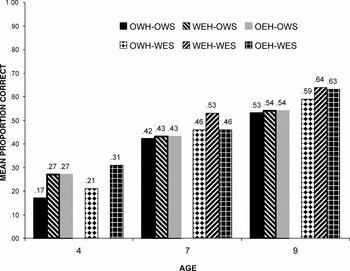
Because of the difference in the results of the two sets of analyses, separate analyses were conducted for the individual Age Groups. Individual Age Group analyses confirmed that for 4-year-olds the effect of Home Language retained significance (F(2, 56) = 8.131, p < .001) (with OEH, .29, and WEH, .27 > OWH, .19), but School Language did not (WES .26, OWS .24); for 7-year-olds neither Home Language nor School Language (SL) reached significance (HL: OEH .45, WEH .48, OWH .44; SL: WES .48, OWS .43); and for 9-year-olds Home Language was not significant (OEH .58, WEH .59, OWH .56), but School Language was (F(1,77) = 12.685, p < .001) (WES .62, OWS .54). See Figure 4.
Study 4. Performance on English BPVS, by Home Language × School Language × Age.

Version was not significant at any age, although it reached near-significance at age 9, F(1,77) = 2.89, p = .093.
These analyses indicate that in general both Home Language and School Language play a role in the acquisition of English vocabulary, but the follow-up analyses suggest that Home Language plays the most important role at the youngest age, age 4 (with children receiving some English at home (either OEH or WEH) outperforming those with no English at home (OWH)); that there is a neutralization of differences across Home Language groups at the intermediate age, age 7; and that at the latest age, age 9, School Language appears to play a larger role (with children receiving some English at school (WES) outperforming those with no English at school (OWS)). The results thus show that, even though Home Language may initially affect a child's English vocabulary, by age 7, children no longer show differences by Home Language. By age 9, School Language seems to play a role – with those children who are hearing English in school on a daily basis (in WES schools) outperforming those who are not being instructed at all in English (OWS).
Studies 5 and 6. ADULTS
We also have data from Welsh–English bilingual adults concerning abilities in the two languages. These data consist of measures of vocabulary abilities and of knowledge of idioms. These are taken from a study of language transmission in bilingual families in Wales (Gathercole, Reference Gathercole2007b) .
Study 5. Adult Welsh and English vocabulary
In the larger study, 302 parents across Wales were interviewed regarding their use of Welsh and English in the home, for the purposes of determining the factors that contribute to that usage. The participants for the vocabulary measures were recruited from the interviewees in the larger study. When time allowed and the interviewee was willing, we administered a Welsh and an English vocabulary test after the interview.
Method
Participants
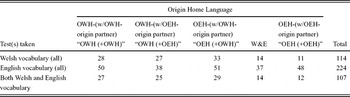
In total, 114 parents (70 mothers, 44 fathers) participated in the Welsh test, 224 (139 mothers, 85 fathers) in the English test, with 107 interviewees (65 mothers, 42 fathers) participating in both the Welsh and English vocabulary tests (Gathercole and Thomas, Reference Gathercole and Thomas2007a). The parents for the larger study were carefully classified into categories according to the languages that were spoken to them as children in their birth homes (their “origin home language”) (only Welsh, Welsh and English, only English). For the purposes of the present analyses, we have reclassified the interviewees who took part in the vocabulary tests according to their origin home languages plus the origin home language(s) of their partner. They fell into five groups: OWH-origin with OWH-origin partner (or with no partner) (“OWH (+OWH)”), OWH-origin with OEH-origin partner (“OWH (+OEH)”), OEH-origin with OWH-origin partner (“OEH (+OWH)”), Welsh-and-English-origin (“W&E”), and OEH-origin with OEH-origin partner (or with no partner) (“OEH (+OEH)”). The number of participants in each category is shown in Table 5.
Study 5. Adult Welsh and English vocabulary: participants.

OWH = only Welsh at home; OEH = only English at home
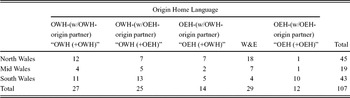
As the adults tested were located across Wales, and as the presence of Welsh and English differs across communities (Welsh is stronger in the North and Mid Wales than in South Wales), the distribution of the participants by group into North, Mid, and South Wales is shown in Table 6. It can be seen that the majority of the OEH (+OEH) adults (10 out of 12) (and 15 out of 26 of all the OEH-origin participants) came from South Wales, while the majority of the adults with OWH and W&E origin backgrounds came from the North (37 out of 81) and Mid Wales (especially from Ceredigion county and Machynlleth, where the percentage of Welsh speakers is approximately 52%–54% (http://www.statistics.gov.uk/census2001)) (16 out of 81). Any possible results showing parity across groups on English abilities – i.e., across Welsh-origin and English-origin participants – cannot be attributed, then, to, for example, the Welsh-origin participants being located in especially strong English areas, or in areas stronger in English than where the English-origin participants were located.
Study 5. Adult Welsh and English vocabulary: participants completing Welsh and English tests, by geographical area.

OWH = only Welsh at home; OEH = only English at home
Stimuli and procedure
Welsh
For the Welsh task, we adapted the receptive vocabulary test described and discussed above in relation to Study 1. For the purposes of this study, we adapted this test to use with adults by administering only the least frequent 108 words from the 240-word test, in order from more frequent to less frequent. Respondents were given a raw score out of 240.
English
For English, we used the long version of the BPVS (Dunn et al., Reference Dunn, Dunn and Whetton1982). The BPVS is designed for children and is standardised to age 18. For our purposes, we adapted the test for use with the adults we interviewed. We began at the vocabulary point appropriate for age 17 and progressed from there according to the procedures used in the normal administration of the test. We entered participants’ raw scores out of 150.
Results
ANOVAs were conducted separately for the Welsh and the English tests. Origin Home Language of participants was entered as an independent variable. In the case of both Welsh and English, ANOVAs were conducted, first, with the scores for all participants, and, second, with the scores for only those participants who took both the Welsh and the English tests. Results were comparable in the two cases, so only the latter results will be reported (where the two sets of results differed, that will be noted).
Welsh
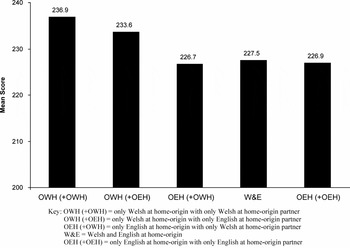
The Welsh scores for the five groups of participants are shown in Figure 5. Analysis of variance revealed a significant effect of Origin Home Language, F(4, 102) =6.99, p < .001. Tukey's HSD reveals that there were significant differences between the OWH (+OWH) group and the OEH (+OWH), W&E, and OEH (+OEH) groups (ps ≤ .007). There was also a near-significant difference between the OWH (+OEH) group and the W&E group, p = .061. (When all 114 Welsh test takers are included in the analysis, the difference between these two groups is significant: p < .03.)
Study 5. Adult Welsh and English vocabulary: performance on Welsh vocabulary by participant group.

Thus, the adults who came from OWH-origin homes and who have OWH-origin partners scored significantly higher than those who came from OEH-origin homes and those who came from two-language Welsh-and-English-origin homes. This latter group also showed a near-significant difference in performance relative to the OWH-origin participants with OEH partners. These results not only reveal that the level of Welsh vocabulary in adulthood corresponds to the level of exposure in the home in childhood (OWH > W&E, OEH), but they also suggest that the level of retention of Welsh vocabulary is influenced by continued exposure (as judged by the origin home language of the partner) in adulthood: The OWH (+OWH) group were significantly different from the OEH-origin groups and the W&E-origin group, but the OWH (+OEH) group was not (with the possible exception of better performance than the W&E-origin group).
English
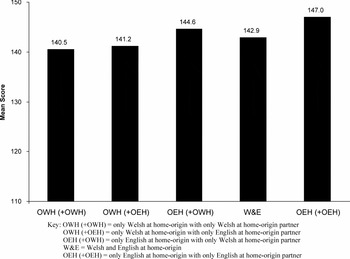
The English scores for the 5 groups of participants are shown in Figure 6. Analysis of variance revealed a near-significant effect of Origin Home Language (F(4, 102) =2.39, p = .056), with the OEH (+OEH) group showing a near-significantly better performance than the OWH (+OWH) group, Tukey's HSD p = .058. (These results reach significance when all 224 participants are included in the analysis, F(4,219) = 3.9, p < .004; Tukey's HSD for the two groups: p < .002.) No other differences were significant.
Study 5. Adult Welsh and English vocabulary: English vocabulary by participant group.

Thus, the English data show that the level of English vocabulary was similar across groups, with the possible exception of the two groups at the extreme ends of level of exposure when both origin home language and current partner are considered together: OEH (+OEH) vs. OWH (+OWH).
The difference in the results on the Welsh and English vocabulary tests, like the results on the vocabulary measures for children, suggests that Welsh vocabulary in adulthood is highly contingent on level of exposure to the language in childhood (and perhaps continued exposure in adulthood), while English vocabulary in adulthood reaches similar levels across groups, regardless of type of exposure in the home in childhood.
Study 6. Adult Welsh and English idioms
The idiom data come from the same larger project involving interviews and tests of 302 parents (Gathercole, Reference Gathercole2007b). Of these interviewed parents, those who were willing were tested for performance on an idiom task in each language (Williams, Deuchar, Thomas and Gathercole, Reference Williams, Deuchar, Thomas and Gathercole2007), following Treffers-Daller (Reference Treffers-Daller1994).
Method
Participants
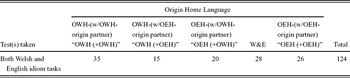
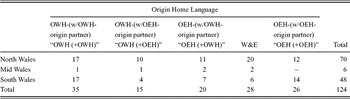
The parents who participated in the idiom tasks for both languages were a subset of 124 (83 mothers, 41 fathers) from the larger study. (Four more adults took part in only the English task, but these have not been included in the analyses reported below.) The 124 participants were distributed by Origin Home Language, as in the case of the Vocabulary data, as in Table 7. The distribution of the participants geographically is shown in Table 8.
Study 6. Adult Welsh and English idioms: participants.

OWH = only Welsh at home; OEH = only English at home
Study 6. Adult Welsh and English idioms: participants, by geographical location.

OWH = only Welsh at home; OEH = only English at home
Materials
The idiom tasks were made up from 10 common idioms in each language. For each idiomatic expression, an alternative structure was designed to resemble the real idiom and to constitute a plausible foil for the idiom. Ten such pairs for each language were drawn up. Samples of the pairs of sentences in English and Welsh are as follows:
(10) English
a. I will get it done, by hook or by crook.
b. *I will get it done, by crook or by hook.
(11) Welsh
danlliFootnote 6 spanking “Jack has bought brand new trainers.” The order in which the correct and alternative forms occurred across the 10 items in each test was balanced.
Procedure
The real and alternative forms were read in sequence to participants, who were asked to judge which of the two choices they deemed more common or used more often in the relevant language.
Results
As the two tests were designed in identical fashion and participants took part in both tasks, the data from both languages were considered in a single analysis of variance in which Origin Home Language and Language of the task were treated as variables. Results show main effects of Language of the task, F(1, 119) = 99.1, p < .001, and Origin Home Language, F(4, 119) = 5.6, p < .001, as well as an interaction of Language of the task × Origin Home Language, F(1, 119) = 9.72, p < .001.
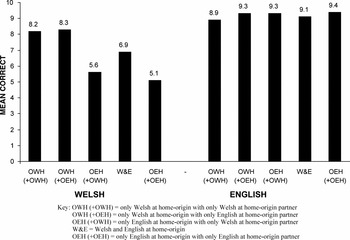
Performance on the two Language tasks by Origin Home Language is shown in Figure 7. Follow-up statistics examining each language separately reveal that for Welsh, Origin Home Language was significant, F(4, 119) = 9.62, p < .001, but for English, it was not, F(4, 119) = .78, p = .54, n.s. Tukey's HSD reveals that on the Welsh task, the OWH-origin participants (regardless of their partner's origin home language) outperformed OEH-origin participants (regardless of partner's origin home language), ps ≤ .007. In addition, the Welsh&English origin participants outperformed the OEH (+OEH) participants, p < .05.
Study 6. Adult Welsh and English Idioms: performance by language and participant group.

These results show, thus, that all groups performed equivalently on the English idioms, but on the Welsh idioms, performance was consistent with level of exposure to Welsh in the origin home language. Those participants who came from OWH homes outperformed those who came from OEH homes, and those who came from Welsh-and-English-origin homes performed between these two extremes. The latter group only exceeded the OEH-origin participants if the OEH participants had OEH-origin partners.
GENERAL DISCUSSION
The results of these six studies together reveal some striking asymmetries in the development and command of Welsh versus English in the bilingual population of Wales. On the one hand, the development of Welsh is highly linked to measurable patterns of input, at all stages:
• OWH and OWS children show earlier acquisition of the vocabulary or constructs in question.
• OWH and OWS children show higher performance on most structures than their bilingual peers from other home- or school-language backgrounds. At the earliest stages or with less frequent forms (e.g., low frequency vocabulary), OWH children show better performance than both WEH and OEH peers; at later stages and with more frequent forms, their performance and that of their WEH peers is comparable, and both outstrip their OEH peers.
• WEH children show intermediate performance, sometimes matching their OWH peers, sometimes their OEH peers.
• OWH-origin adults show better performance than their peers, including W&E-origin peers, on both vocabulary and idioms in Welsh.
• And, interestingly, even in adulthood, OWH-origin adults who have OWH-origin partners show the highest levels of performance on Welsh, indicating that exposure in adulthood may also play a role in the maintenance of Welsh through the lifetime, at least with regard to lexical and idiomatic forms.
In contrast to these findings for Welsh, the development of English seems to be linked to measurable patterns of input at the beginning stages of development, but differences across groups disappear by the mid-school years. At that point, it appears that abilities in English may be affected by school language, but by the time speakers reach adulthood, there appear to be no or few long-term measurable differences in abilities in English. This effect is all the more remarkable because the parity across groups held even when the adult participants with OEH-origin backgrounds were located in the areas of Wales where English is the strongest and the majority of the OWH- and W&E-origin participants were located in the areas of Wales where Welsh is strongest.
These findings have implications for theories of bilingualism and theories of language development in general. For bilingualism, first, these results suggest that children growing up in a stable bilingual community in which there is a dominant language alongside a minority language may all acquire the dominant language to equivalent levels regardless of home language patterns, but may only fully acquire the minority language under certain conditions. What makes the dominant language dominant may be relevant, however. In the context of Wales, English is dominant for a number of reasons: First, virtually everyone knows English, while only some know Welsh; second, English is the language of the larger society, the United Kingdom, of which Wales forms a part; third, until the late 1900s (the 1970s), English was the language of power, and Welsh was suppressed and in decline, even though it was the indigenous language; and, fourth, English is largely still the language of opportunity, especially if one wishes to engage in higher education or employment beyond the Welsh-speaking community. These factors may all contribute to the dominance of English. One further possible factor may be language choice by children when speaking with their peers. Eilers, Oller and Cobo-Lewis (Reference Eilers, Oller and Cobo-Lewis2002) noted that even Hispanic children in Miami, while respecting the language choice (Spanish or English) prescribed in class, chose to use English overwhelmingly outside of the class when speaking with friends (65% or more of the time). However, in the case of the more stable bilingual community of Wales, this dominance of English among child peers is less apparent. In our study of language transmission practices in Wales (Gathercole, Reference Gathercole2007b), we included interviews of children aged 4½–7 years. Among the questions we asked children was the language(s) they spoke with their friends. While 100% of children from OEH homes reported speaking “only” or “mostly” English with friends, 72.8% of children from OWH homes reported speaking “only” or “mostly” Welsh with friends (and 18.2% “both Welsh and English”). (Children from mixed home-language backgrounds were between these two extremes: Depending on home-language profiles, 40% to 57% said “only” or “mostly” English, 21% to 40% said “only” or “mostly” Welsh, 14% to 21% said “both Welsh and English”. See Thomas, Reference Thomas2007, for further information.)
These results also suggest that the distinction that is made between a “stronger”/dominant and “weaker”/ minority language is not subtle enough; for example, “weaker” in a stable bilingual community is different from “weaker” in an immigrant community, and this may have important consequences for patterns of language development. For example, the weaker language in an immigrant community or an indigenous minority language that is spoken by a much smaller subset of the population might be even more susceptible to imperfect learning than we have observed here for Welsh. This is because if a language is spoken by a much smaller percentage of the overall population, children's exposure is likely to be even more sporadic and scattered than in a case like that of Welsh.
Finally, the results we have reported here have implications for prescriptivist recipes for the optimal context for bilingual first-language development. Some argue in favor of a “one-parent–one-language” rule as a (the optimal?) way of bringing up bilingual children. However, such recipes need to be sensitive to the context in which the bilingual child is learning language. In Wales, for example, the above research suggests that the “optimal” learning pattern might be, if the parents speak Welsh, to expose children to only Welsh at home.
The findings above also have implications for theories of language learning in general. First, they raise questions about critical period effects in language development, both with regard to the dominant language and the minority language. For the former, if – as our data suggest – all children in Wales learn English equally well, regardless of early exposure, then age of acquisition may be less critical for final attainment in bilingual contexts in which the majority language is highly dominant. For the latter, the minority language, the data suggest that Welsh acquisition and abilities are highly dependent on continued exposure to the language. This may apply even in adulthood, as the superior performance of OWH-origin adults who have OWH-origin partners suggests.
The data also raise questions about whether language acquisition hinges on, or is guaranteed by, acquiring input up to some critical mass. While it may be that a critical mass is needed to draw out generalizations or to “consolidate” the rules, patterns, constructions of the language, this may not be enough. If that were all that were needed, then we might expect less differentiation of Home Language groups, especially at later ages, and especially between OWH and WEH groups, than we have observed. Instead, the data here suggest that there is a need for continual exposure through the lifespan to a language for maintenance in the individual.
In conclusion, the studies presented here provide concrete evidence on the relationship of the dominant to the minority language in a stable bilingual context. The data suggest that, for the minority language, the timing of acquisition and the ultimate abilities are related directly to input levels in that language. Those with higher levels of input will have stronger abilities; and those adults with continued access and exposure to the language will have stronger abilities than their same-origin-language-background peers. For the majority language, in contrast, while the timing of development in the early stages also appears directly related to input levels, the long-term acquisition and abilities appear to be universal.