Introduction
Neuropsychological assessment is an important tool for understanding cognitive changes following neurological insult. However, cognitive performance can be impacted by a variety of both neurological and non-neurological factors including fatigue, mood or anxiety disorders, motivation, or effort. One non-neurological factor that can impact cognitive test performance is a preexisting expectation of poor performance that can occur under conditions of stereotype threat. Stereotype threat can occur when an individual faces a task that is believed to be poorly performed by members of that individuals’ social group, such as their particular ethnicity, gender, or socioeconomic group. Many studies have found that individuals of stigmatized groups perform poorly in situations in which the stereotype is salient, yet display no deficits in performance when the stereotype is not salient (Aronson et al., Reference Aronson, Lustina, Good, Keough, Steele and Brown1999; Spencer, Steele, & Quinn, Reference Spencer, Steele and Quinn1999). Common examples of stereotype threat include poorer performance on cognitive tasks by African Americans who are made to believe the task is a measure of intelligence (e.g., Katz, Roberts, & Robinson, Reference Katz, Roberts and Robinson1965; McKay, Doverspike, Bowen-Hilton, & Martin, Reference McKay, Doverspike, Bowen-Hilton and Martin2002; Steele & Aronson, Reference Steele and Aronson1995; etc.), and poorer performance by women on math tests when their gender is emphasized (e.g., Keller & Dauenheimer, Reference Keller and Dauenheimer2003; Schmader, Reference Schmader2002; etc.). A recent meta-analysis of stereotype threat effects on cognitive test performance found an overall mean effect size of .26 (Nguyen & Ryan, Reference Nguyen and Ryan2008), which can represent a clinically meaningful effect.
Expectations of poor cognitive performance can also occur in individuals following neurological insults such as a concussion injury (e.g., Kit, Tuokko, & Mateer, Reference Kit, Tuokko and Mateer2008; Ozen & Fernandes, Reference Ozen and Fernandes2011; Suhr & Gunstad, Reference Suhr and Gunstad2002, Reference Suhr and Gunstad2005). Suhr and Gunstad (Reference Suhr and Gunstad2002) proposed the use of the term “diagnosis threat” (p. 450) to refer to the negative impact on cognitive performance obtained by calling attention to one's history of concussion and its potential effects on cognition. To examine this phenomenon, the authors examined undergraduates with a history of concussion who were exposed to test instructions that either called attention to their concussion and its impact on cognition, or were given neutral test instructions. They found that those exposed to the diagnosis threat instructions performed significantly worse on intelligence and memory tests (Suhr & Gunstad, Reference Suhr and Gunstad2002). Replicating these findings, they also found that diagnosis threat was also associated with decrements in attention/working memory, processing speed, and memory (Suhr & Gunstad, Reference Suhr and Gunstad2005).
While these findings were revealing, Kit and colleagues (Kit et al., Reference Kit, Tuokko and Mateer2008) noted one important limitation in their review of stereotype threat in neurological populations—the lack of control samples for comparison. In turn, Ozen and Fernandes (Reference Ozen and Fernandes2011) also examined diagnosis threat in individuals with a history of concussion while including a non-concussed control group for comparison. In addition to cognitive task performance, these authors were interested in symptom self-reports and included several self-report measures of memory and attention functioning in daily life. Unlike the previously described findings, Ozen and Fernandes failed to find a significant effect of instructions on cognitive task performance. However, they did find that individuals with a concussion self-reported greater difficulties with attention and memory failures in their daily life when exposed to diagnosis threat instructions. The authors concluded that diagnosis threat may have a greater impact on one's subjective experience of everyday attention and memory.
One possible factor that may partially explain the inconsistencies in the above findings is a difference in the strength of the diagnosis threat cues, as even subtle manipulations of task instructions are believed to differentially impact test performance (Kit et al., Reference Kit, Tuokko and Mateer2008). Specifically, Suhr and Gunstad (Reference Suhr and Gunstad2002, Reference Suhr and Gunstad2005) used explicit diagnosis threat instructions that included a list of common cognitive domains that are often impaired following concussions. In contrast, Ozen and Fernandes (Reference Ozen and Fernandes2011) implemented threat cues that were comparatively more subtle by using a broader statement regarding the possible types of impairment individuals can experience following a concussion. Given that the strength of the threat cue has been proposed as a moderator of the stereotype effect (Nguyen and Ryan, Reference Nguyen and Ryan2008), it is possible that differing findings on diagnosis threat are in part related to this factor.
Another stereotype threat moderator that has been overlooked by studies of diagnosis threat includes the issue of group identification (Schmader, Reference Schmader2002). While stereotype theory (Steele, Reference Steele1997) asserts that the extent of performance decrement is moderated by domain identification (e.g., math abilities have to be an important component of a female's self-identity to elicit a stereotype threat effect), Schmader (Reference Schmader2002) argues that the same holds true for the degree of identification with the stereotyped group (e.g., extent to which one identifies with one's gender). In a study examining the degree of gender identification and its impact on stereotype threat, Schmader (Reference Schmader2002) found that women with higher levels of gender identification performed more poorly than men when their gender was linked to performance. In contrast, women with lower levels of gender identification performed equally to men regardless of the condition. Taking into consideration these findings, together with previous work, Schmader (Reference Schmader2002) concluded that the critical factor impacting performance is the interaction between situational factors (i.e., threat cues) and features of self-identity (i.e., group and domain identification).
Importantly, the factor of group identification (i.e., the extent to which one identifies as “concussed”) has not been examined in previous diagnosis threat studies, which Kit and colleagues acknowledge is a worthwhile construct to examine in this population (Kit et al., Reference Kit, Tuokko and Mateer2008). Neither the Suhr and Gunstad (Reference Suhr and Gunstad2002, Reference Suhr and Gunstad2005) nor the Ozen and Fernandes (Reference Ozen and Fernandes2011) studies assessed for group identification in their concussed participants. This may contribute to the differing findings between these studies. For example, it is possible that when diagnosis threat cues are comparatively more subtle, such as those used in the Ozen and Fernandes study, the factor of domain identification becomes more relevant. In other words, it is possible that the explicit threat cues used in the Suhr and Gunstad studies were powerful enough to impact performance regardless of the degree of group identification, while the comparatively more moderate threat cues used in the Ozen and Fernandes study were only powerful enough to impact those with higher group identification. Given that none of the studies assessed for group identification, it is impossible to determine what impact it has on the effect of diagnosis threat.
Given the limitations noted above, there seems to be a great deal about diagnosis threat that remains poorly understood. This includes how one's self-perceptions (e.g., group identification) impact cognitive performance, as well as understanding just how significant of an impact diagnosis threat has on cognitive performance, especially in relation to other forms of stereotype threat. More thoroughly understanding these factors is critical, especially in settings such as Veterans Affairs (VA) and Department of Defense (DoD) where diagnosis threat cues are more likely to arise. That is, in such settings, individuals are pre-screened for a potential concussion before being referred on for more thorough neuropsychological evaluation. Thus, the findings of a “positive screen” and subsequent referral may serve as a diagnosis threat cue and adversely impact subsequent neuropsychological performance. Thus, the present study aimed to extend the findings of Suhr and Gunstad (Reference Suhr and Gunstad2002, Reference Suhr and Gunstad2005) and examine the impact of moderately explicit diagnosis threat instructions (i.e., similar to those occurring in settings which screen for concussion) on cognitive performance and symptom reporting while taking into account the extent of group identification. This study also aimed to examine how the effect of diagnosis threat compares to the effect of stereotype threat, more specifically gender stereotype threat. Given that diagnosis threat and stereotype threat can be conceived as specific instances of the same or a similar effect (Suhr & Gunstad, Reference Suhr and Gunstad2002), it is hypothesized that the diagnosis threat and gender stereotype threat conditions will yield comparable effect sizes. In addition to using non-concussed individuals as a control sample, a neutral condition for individuals with a concussion was also included to evaluate whether task performance and symptom reporting were related to experimental manipulation or neurological history.
Method
Participants
Recruitment of undergraduate students took place through an online pre-screen questionnaire at a large southeastern university. Participants who endorsed a history of concussion defined as a blow to the head involving a brief alteration in consciousness (AOC), or loss of consciousness (LOC) for less than 30 min, on the prescreen measure were eligible to take part in the study and were randomly assigned to one of three experimental conditions (Kay et al., Reference Kay, Harrington, Adams, Anderson, Berrol, Cicerone and Malec1993). Exclusion criteria included: a history of traumatic brain injury (TBI) involving LOC greater than 30 min; any other neurological history (e.g., stroke, attention-deficit hyperactivity disorder, learning disability, etc.); a prior history of treatment for substance abuse; history of psychiatric hospitalization; and history of any psychiatric conditions other than depression or anxiety. To reduce heterogeneity of injury characteristics, only participants indicating time since injury between 3 and 60 months were retained for final analyses. Participants were eligible for the control condition if they denied a history of concussion as defined above. Other exclusionary criteria for the control participants were the same as those of the experimental groups. A total of 265 undergraduate students volunteered to participate. Of these, a total of 107 participants were excluded based on the above exclusion criteria, resulting in 100 individuals with a history of concussion and 58 neurologically healthy controls being included in the final analyses. Course credit was offered in exchange for participation. The protocol was approved by the University Institutional Review Board and all subjects provided written informed content.
Measures
Experimental task
The experimental task assessed verbal working memory through 17 mental arithmetic items adapted from the Wechsler Adult Intelligence Scale – Fourth Edition (WAIS-IV) Arithmetic subtest (Wechsler, Reference Wechsler2008). The arithmetic problems were prerecorded using a male voice and administered through computer speakers. A beep indicated the beginning of each problem and was followed by the prerecorded question. After each question, a 30-s interval was allotted during which the participants answered the problem, after which a beep alerted the participants to the next problem. Participants were instructed not to work out problems on the answer sheet. The experimental task was approximately 15 min in duration and the total score was calculated as the raw number correct out of a possible raw total score of 17.
Self-report questionnaires
Participants were asked to complete six separate questionnaires following completion of the arithmetic task to collect demographic, injury, identity, and symptom information (forms available from corresponding author upon request). In total, the questionnaires required approximately 15 min to complete.
Demographics
A demographics questionnaire was used to assess age, gender, years of schooling, and any psychological, psychiatric, neurological, or other medical conditions.
Pre-screen checklist
The pre-screen check included the same exclusionary criteria as the initial pre-screen questionnaire. Participants also indicated if they had experienced (1) a “concussion or head injury,” (2) being “knocked out,” or (3) a “blow to the head that resulted in feeling ‘dazed’ or ‘confused’ immediately afterwards.” Questions regarding loss of consciousness and post-traumatic amnesia were also included.
Concussion history
A concussion history questionnaire identified whether the participant had experienced a concussion or head injury. Those who indicated they had a head injury indicated the cause of injury, number of head injuries, time since last head injury, time since most severe head injury, alterations or loss of consciousness, and symptoms attributed to the head injury.
Self-identity measures
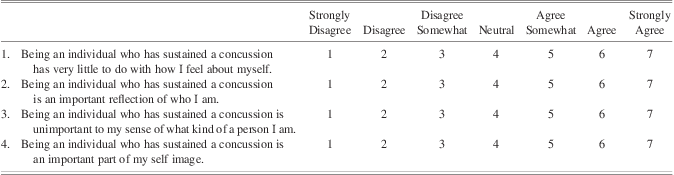
Two measures of identity were used in the current study. A gender identity questionnaire adopted from Schmader (Reference Schmader2002) was used to measure the degree of gender identity (see Appendix 1). This in turn was then adapted to measure identification with having had a concussion (see Appendix 2). These questionnaires consisted of four questions that were answered on a 7-point Likert-type scale, with 1 indicating “strongly disagree” and 7 indicating “strongly agree.” To calculate the degree of gender and concussion identification, items 1 and 3 were reverse scored and a sum total was calculated for all four items. Therefore, higher sum totals were indicative of greater identification on each of the identity measures. The concussion group received both the concussion and gender identification measures. The healthy control group received only the gender identification measure.
Symptom measure
The Neurobehavioral Symptom Inventory (Cicerone & Kalmar, Reference Cicerone and Kalmar1995) was administered to assess the presence of concussion symptoms. The directions instructed the participants to rate the experience of 22 symptoms on a 4-point Likert-type scale (0 = none; 4 = very severe). Symptom severity was calculated using the total sum of all 22 items. The concussion group was instructed to rate how much each symptom disturbs her/him since the injury, while the control group was instructed to rate how much each symptom disturbs her/him.
Procedure
The study was entitled “The Impact of Self-Beliefs on Cognitive Performance” and was posted on the undergraduate participant pool portal where students signed up for participation in the study. The experiment occurred in a classroom environment and was administered in a group setting. Informed consent was obtained and concussed participants were randomly assigned to one of three possible instruction set manipulations: (1) a Diagnosis Threat (DT), (2) a Gender Stereotype (GS) threat, and (3) a Neutral task. Each condition was provided with differing instructions (see Appendix 3 for instructions). The instructional manipulations were administered first to induce the priming effect at the outset for each group. Thus, participants first read one set of the above instructions and then completed the arithmetic task. Following completion of the arithmetic task, participants completed a series of self-report questionnaires and were then debriefed. The total session lasted approximately 30 min.
Results
Demographics
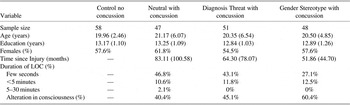
See Table 1 for demographic means and standard deviations. The four groups did not significantly differ in age, F(3,200) = .49, p > .05, or education, F(3,201) = 1.63, p > .05. Sex distribution was not different among groups, χ2(3) = .74, p > .05. All participants in the Diagnosis Threat (DT), Gender Stereotype (GS), and Neutral (N) groups reported a history of at least one concussion. The groups were not significantly different in time since injury, F(2,71) = 1.64, p > .05. Furthermore, there was no significant difference in duration of LOC between groups, χ2(4) = .56, p > .05. Overall, groups were comparable in demographic variables, and all concussion groups were comparable in injury characteristics.
Demographic variables by Group

LOC = loss of consciousness.
Impact of Concussion History
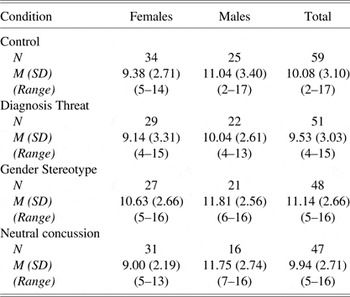
We examined the overall impact of a positive history of concussion on cognitive performance and symptom reporting in comparison to those with a negative history of concussion (i.e., controls). See Table 2 for detailed task performance by group and gender.
Arithmetic task performance by Group and Gender

N = sample size; M = mean; SD = standard deviation.
Cognitive performance
A Gender × Group (positive vs. negative concussion history) factorial analysis of variance (ANOVA) was conducted on arithmetic task performance. A main effect of Gender was observed, F(1,201) = 13.25, p < .01, d = .57, such that males performed significantly better (N = 84; M = 11.11; SD = 2.92) than females (N = 121; M = 9.50; SD = 2.77). Neither the main effect of Group, F(1,201) = 0.09, p > .05, nor the interaction effect, F(1,201) = 0.01, p > .05, were significant, indicating that a history of concussion did not impact cognitive performance.
Symptom reporting
A Gender × Group (positive vs. negative concussion history) factorial ANOVA was conducted on symptom reporting. A main effect of Gender revealed that females had significantly higher symptom reporting (N = 113; M = 16.09; SD = 11.32) than males (N = 82; M = 9.23; SD = 9.86), F(1,191) = 15.59, p < .01, d = −.64. Results also revealed a significant main effect of Group, F(1,191) = 6.25, p < .05, d = .36, such that controls had significantly higher symptom reporting (N = 57; M = 16.00; SD = 11.85) than those with a positive history of concussion (N = 138; M = 12.05; SD = 10.80).
Examination of Diagnosis Threat
We examined the impact of the diagnosis threat instructions on cognitive performance and symptom reporting in comparison to neutral task instructions.
Cognitive performance
A Gender × Condition (Diagnosis Threat vs. Neutral) factorial ANOVA revealed a significant main effect of Gender, F(1,94) = 10.17, p < .01, d = .62, indicating that males performed significantly better (N = 38; M = 10.76; SD = 2.76) than females (N = 60; M = 9.07; SD = 2.77). Neither the main effect of Condition, F(1,94) = 1.87, p > .05, nor the interaction effect, F(1,94) = 2.58, p > .05, were significant. Planned comparisons also failed to reveal a significant difference between groups on arithmetic performance, t(96) = −.70, p > .05.
Given our hypothesis that the degree of concussion identity would impact cognitive performance, we conducted a Gender × Condition (Diagnosis Threat vs. Neutral) factorial analysis of covariance (ANCOVA) with Identification (with being concussed) as a covariate. The degree of identification with being concussed was found to be significant, F(1,91) = 4.97, p < .05. After controlling for the effect of identifying with being concussed, we again found a significant main effect of Gender, F(1,91) = 12.51, p < .01, d = .65 (Males: N = 38; M = 10.76; SD = 2.76; Females: N = 58; M = 8.98; SD = 2.76). We also found a significant interaction effect, F(1,91) = 4.31, p < .05, indicating that males experienced a greater performance decrement as a result of diagnosis threat instructions, d = −.66 (Diagnosis Threat: N = 22; M = 10.04; SD = 2.61; Neutral: N = 16; M = 11.75; SD = 2.74) than female participants, d = .12 (Diagnosis Threat: N = 29; M = 9.14; SD = 3.31; Neutral: N = 29; M = 8.82; SD = 2.12).
Symptom reporting
A Gender × Condition (Diagnosis Threat vs. Neutral) factorial ANOVA revealed a significant main effect of Gender, F(1,89) = 11.26, p < .01, d = .70, with females demonstrating greater symptom reporting (N = 56; M = 15.80; SD = 11.20) than males (N = 37; M = 8.19; SD = 10.52). The main effect of Condition, F(1,89) = 0.85, p > .05, and the interaction effect, F(1,89) = 0.40, p > .05, were not significant. Planned comparisons also failed to reveal a significant group difference on symptom reporting, t(91) = .56, p > .05.
A factorial ANCOVA using Identification (with concussion) as a covariate failed to reveal a significant effect of identification with being concussed, F(1,87) = 2.98, p > .05. This analysis continued to reveal a significant main effect of Gender, F(1,87) = 11.47, p < .01, d = −.68 (Males: N = 37; M = 8.19; SD = 10.52; Females: N = 55; M = 15.38; SD = 10.85), while the main effect of Condition, F(1,87) = 1.86, p > .05, and the interaction, F(1,87) = 0.50, p > .05, remained non-significant.
Examination of Gender Stereotype Threat
We examined the impact of the gender stereotype threat instructions on female participants’ cognitive performance and symptom reporting in comparison to the Neutral condition.
Cognitive performance
An Independent Samples t test revealed a significant difference between females’ arithmetic performance, such that those in the Gender Stereotype condition (N = 27; M = 10.63; SD = 2.66) performed significantly better than those in the Neutral condition (N = 31; M = 9.00; SD = 2.19), t(56) = 2.56, p < .05, d = .69. Thus, while we hypothesized that females would perform more poorly when exposed to a gender stereotype threat, they actually had better performance.
Given that we also hypothesized that the degree to which females identified with their gender would impact task performance, we conducted an ANCOVA using gender identification as a covariate. Gender identification was not significantly related to females’ arithmetic performance, F(1,55) = 0.97, p > .05, and the difference in performance between the Gender Stereotype and Neutral conditions remained significant, F(1,55) =6.34, p < .05, d = .75 (Gender Stereotype: N = 26; M = 10.62; SD = 2.71; Neutral: N = 29; M = 8.83; SD = 2.12).
Symptom reporting
An Independent Samples t test on females’ symptom reporting between the Gender Stereotype (N = 25; M = 13.48; SD = 9.32) and Neutral (N = 28; M = 15.46; SD = 11.42) conditions was not significant, t(51) = −.69, p > .05. Furthermore, an ANCOVA using gender identification as a covariate indicated that gender identification was not significantly related to females’ symptom reporting, F(1,50) = 0.03, p > .05, and symptom reporting did not differ between conditions, F(1,50) = 0.41, p > .05 (Gender Stereotype: N = 24; M = 13.37; SD = 9.51; Neutral: N = 27; M = 14.59; SD = 10.65).
Discussion
The aim of the current study was to examine the impact of moderately explicit diagnosis threat instructions on cognitive task performance and symptom reporting following concussion, while taking group identification into account. We also aimed to gain a better understanding of how diagnosis threat compares to gender stereotype threat, as the two are believed to derive from theoretically similar constructs (Suhr & Gunstad, Reference Suhr and Gunstad2002).
To provide a more coherent context within which to discuss our diagnosis threat findings, it is important to start with a discussion of our findings on gender and gender stereotype threat. First, males tended to outperform females on the arithmetic test. However, contrary to our predictions, gender stereotype threat cues improved female task performance rather than decreasing it, resulting in the phenomenon known as stereotype reactance effect (Nguyen & Ryan, Reference Nguyen and Ryan2008). The stereotype reactance effect postulates that gender stereotype threat operates by working on a subconscious level, thus being susceptible to more subtle threat cues. According to Nguyen and Ryan (Reference Nguyen and Ryan2008), when faced with more explicit threat cues, individuals may consciously react against the stereotype, resulting in a stereotype reactance effect. However, while our threat cues were moderate in nature (i.e., it was not explicitly stated that males perform better than females), they still produced a stereotype reactance effect. It is possible that due to the pervasive nature of the gender stereotype regarding mathematical abilities, explicitly stating the stereotype is not necessary to produce a conscious reaction against it, at least in this cohort of college students.
Given the presence of this underlying gender stereotype reactance effect on female task performance, it should not be surprising that we failed to find a diagnosis threat effect in female participants. However, we did find that the use of moderately explicit diagnosis threat cues negatively impacted cognitive performance in male participants. Interestingly, this effect was only observed when the impact of group identification (i.e., identifying with being concussed) was taken into consideration. This may explain why our findings differ from those of Ozen and Fernandes (Reference Ozen and Fernandes2011), despite both studies using moderate threat cues. When analyzing our data without taking group identification into account, we too failed to find an effect of diagnosis threat. Thus, the lack of findings on cognitive performance in the Ozen and Fernandes study may be related to the fact that their study did not assess for the degree to which group identification impacts one's self-perception and, in turn, their susceptibility to diagnosis threat. The fact that the effect of diagnosis threat is linked to individuals’ perceptions of themselves and their injury is not surprising given the relationship between symptoms and perceptions of illness or misattribution of symptoms (e.g., Mittenberg, DiGiulio, Perrin, & Bass, Reference Mittenberg, DiGiulio, Perrin and Bass1992).
When examining the strength of our diagnosis threat effect, we find that the effect size we obtained is generally consistent with those found by Suhr and Gunstad (Reference Suhr and Gunstad2002, Reference Suhr and Gunstad2005). We found a moderate effect of diagnosis threat in males (d = −.66) using a modified arithmetic subtest, which was equivalent to that which was obtained by Suhr and Gunstad (Reference Suhr and Gunstad2005) using a similar standardized measure of mental arithmetic. In general, the effect sizes obtained by Suhr and Gunstad across both studies ranged from small (d = −.29) to large (d = −.92) across various cognitive measures, with the highest effect sizes obtained on measures of working memory and visuospatial abilities. Thus, the current findings and those of Suhr and Gunstad indicate that the impact of diagnosis threat on cognitive performance is quite robust, especially when the degree of concussion identification is taken into account.
While one aim of the current study was to understand how the effect of diagnosis threat compares to that of gender stereotype threat, this was not possible due to the stereotype reactance effect that was elicited. However, the effect size for gender stereotype threat obtained by Nguyen and Ryan (Reference Nguyen and Ryan2008) as part of a meta-analysis on the topic was generally small, d = −.36. Thus, it appears that the effect of diagnosis threat may have a greater impact on performance than that of gender stereotype threat. One possibility for the varying effect may be the different instructional sets used across studies. Perhaps another consideration is that diagnosis threat relates to the perceived effect of a neurological injury, which may elicit greater anxiety or challenges to perceived self-efficacy, thus resulting in greater disruption of cognitive performance. It is unlikely to be related to an actual discrepancy in performance due to neurological injury, as our findings failed to reveal a difference in cognitive performance as a function of concussion history. The latter finding is not surprising and is generally consistent with previous research demonstrating no persistent cognitive effects of concussion injuries (e.g., Belanger, Curtiss, Demery, Lebowitz, & Vanderploeg, Reference Belanger, Curtiss, Demery, Lebowitz and Vanderploeg2005; Binder, Rohling, & Larrabee, Reference Binder, Rohling and Larrabee1997).
Interestingly, while diagnosis threat cues elicited a decrement in cognitive performance in males in the current study, no effect on symptom reporting was observed. In fact, we found that individuals without a history of concussion (i.e., neurologically healthy controls) had higher rates of symptom reporting than those with a positive history of concussion. While surprising, post-concussive symptoms are not specific to concussion injuries (e.g., Chan, Reference Chan2001; Garden & Sullivan, Reference Garden and Sullivan2010; Iverson & Lange, Reference Iverson and Lange2003) and are likely attributable to other factors not assessed in the current study.
There are several limitations to the current study. First, the degree of explicitness of our threat instructions countered the effect of gender stereotype threat, resulting in a stereotype reactance effect. It appears that the degree of explicitness required to elicit a threat effect differs depending on whether one is attempting to elicit a stereotype or a diagnosis threat effect, with the former requiring a subtle approach, at least in this cohort of college students, and the latter being susceptible to more explicit cues. Furthermore, the presence of an underlying gender stereotype reactance effect limited our ability to examine diagnosis threat in female participants. Thus, it remains unclear if females are as susceptible as males to diagnosis threat when gender stereotype threat is not a factor. Another limitation includes the fact that that this study was conducted on a college sample. The use of a college sample may limit generalizability of these findings to a typical clinical sample, as these participants were high functioning individuals. However, given that treatment-seeking populations may be primed to being more susceptible to diagnosis threat cues by the very fact that they are seeking treatment, it is possible that the impact on cognitive task performance is even more powerful within in a clinical population.
Finally, one potential limitation is the fact that this study relied on self-reports of concussion injuries without independent verification of the injury. One could argue that the reliance on self-reports is too subjective and prevents us from being able to objectively ascertain cognitive differences related to neurological injury. However, the phenomenon of diagnosis threat, and all forms of stereotype threat for that matter, is by definition a product of subjective perceptions regarding one's cognitive (or academic/intellectual) ability. Thus, the goal of understanding the impact of these non-neurological factors on cognitive performance is to tease apart the impact of subjective influences from objective neurological (or inherent) factors. The problem of trying to tease these factors apart mirrors what we have in large systems of care such as VA and DoD. As previously mentioned, these systems rely on the process of concussion/TBI screening, which in turn relies on self-reports. Following a “positive screen” individuals may be referred for subsequent neuropsychological evaluations. Thus, such TBI screening procedures potentially set the stage for just this type of non-neurological diagnostic threat effect in individuals who have yet to be definitively diagnosed. This, in turn, can have a clinically significant impact on later neuropsychological performance, thus impacting diagnosis, treatment, and disability benefits.
These findings are important for several reasons. They show that the impact of diagnosis threat on cognitive performance appears to be powerful enough to have important clinical ramifications, especially in those individuals whose self-perceptions are tied to their concussion history. Furthermore, this is the first study that helps evaluate the comparative effect sizes of gender stereotype threat versus concussion diagnosis threat in the same sample with the same instrument that is likely equally sensitive to gender (math) and concussion (working memory) threat effects. However, more research is needed to better understand the construct of diagnosis threat within a treatment-seeking sample, which may already be primed for a diagnosis threat effect. Furthermore, the fact that our female participants seemed to be experiencing an underlying gender stereotype effect, even without threat cues, highlights the degree of susceptibility to disruptions in cognitive performance related to non-neurological factors. While not examined in the current study, it is possible that minorities may be just as susceptible as our female participants to such subtle stereotype threat effects. Additional questions also remain regarding the possible underlying mechanism(s) that may create a diagnosis threat effect. As Kit and colleagues (2008) point out, the same factors may underlie all forms of stereotype threat, such as lowered expectations, reduced working memory due to anxiety, effort withdrawal due to frustration, impaired sense of cognitive self-efficacy, etc. It will be important for future studies to examine the underlying constructs responsible for reduced cognitive performance in stereotype threat situations, as well as gaining an understanding of potential ways in which to ameliorate the impact of this effect.
Acknowledgments
This research received no specific grant from any funding agency, commercial or not-for-profit sectors. No financial relationships exist that could be interpreted as a conflict of interest affecting this manuscript. The research was supported by the Department of Veterans Affairs and Veterans Health Administration (VHA). Further support was provided by the Tampa VA Medical Center. The views expressed in this article are those of the authors and do not necessarily represent the views of the Department of Veterans Affairs. We gratefully acknowledge the contributions of London Butterfield and Samantha Oliveira for their support in data collection. Unless otherwise indicated, the information in this manuscript and the manuscript itself is new and original, is not currently under review by any other publication, and has never been published either electronically or in print.
APPENDIX 1: GENDER IDENTITY QUESTIONNAIRE (ADAPTED FROM SCHMADER, Reference Schmader2002).
Modified CSE
Instructions: We are all members of different social groups or social categories. Some of such social groups or categories pertain to gender, race, religion, nationality, ethnicity, and socioeconomic class. We would like you to consider your membership in the category of gender and respond to the following statements on the basis of how you feel about your gender group and your membership in it. There are no right or wrong answers to any of these statements; we are interested in your honest reactions and opinions. Please read each statement carefully, and respond by using the following scale from 1 to 7:

APPENDIX 2: CONCUSSION IDENTITY QUESTIONNAIRE (ADAPTED FROM SCHMADER, Reference Schmader2002).
Modified CSE
Instructions: We are all members of different categories. Some of these categories pertain to prior medical history or diagnostic groups. We would like you to consider your membership in the category of someone who has sustained a concussion in the past and respond to the following statements on the basis of how you feel about your membership in this category. There are no right or wrong answers to any of these statements; we are interested in your honest reactions and opinions. Please read each statement carefully, and respond by using the following scale from 1 to 7:
APPENDIX 3: ARITHMETIC TASK INSTRUCTIONS BY GROUP
A. Diagnosis Threat condition instructions:
You have been invited to participate in this study because your responses on a pre-screening questionnaire completed at the beginning of the term indicated that you have a history of receiving a blow to the head that resulted in a loss of consciousness and/or feelings of being dazed, confused and/or disoriented. Any of these are indicative of having had a concussion. Studies suggest that individuals can experience problems with concentration and memory after a concussion. The aim of this study is to examine the extent to which concussion impacts concentration and memory abilities. This will be assessed by a series of mental arithmetic problems. You will hear each problem one at a time followed by a 30 second interval to answer each question. A beep will indicate the beginning of the next question. You will not be allowed to work out the mental arithmetic problems on scratch paper. Please write your answers on the next page entitled Mental Arithmetic Response Sheet. Do not make any stray marks on your response sheet, and you may only use a pen. Please give your best effort on this task. The remainder of the session will consist of completing several questionnaires in the sealed portion of your packet. Please do not break the seal until the first task is completed.
B. Gender Stereotype condition instructions:
You will be completing an arithmetic test to examine gender differences in math performance. You will hear each problem one at a time followed by a 30 second interval to answer each question. A beep will indicate the beginning of the next question. You will not be allowed to work out the arithmetic problems on scratch paper. Please write your answers on the next page entitled Arithmetic Response Sheet. Do not make any stray marks on your response sheet and, you may only use a pen. Please give your best effort on this task. The remainder of the session will consist of completing several questionnaires in the sealed portion of your packet. Please do not break the seal until the first task is completed.
C. Neutral (concussed) and Control (non-concussed) condition instructions:
The first part of this experiment consists of a problem solving task. You will hear each problem one at a time followed by a 30 second interval to answer each question. A beep will indicate the beginning of the next question. You will not be allowed to work out the problems on scratch paper. Please write your answers on the next page entitled Problem Solving Response Sheet. Do not make any stray marks on your response sheet, and you may only use a pen. Please give your best effort on this task. The remainder of the session will consist of completing several questionnaires in the sealed portion of your packet. Please do not break the seal until the first task is completed.