On August 29, 2005, Hurricane Katrina made landfall along the Gulf Coast of the United States as a category 3 storm (winds 111–130 mph), resulting in widespread flooding of areas in and around New Orleans. Disaster response traditionally focuses on preventing injury and infectious disease.Reference Noji1 However, among populations with a large burden of chronic disease, management of chronic disease and related conditions is essential to prevent severe exacerbations or complications.Reference Mokdad, Mensah and Posner2, Reference Ford, Mokdad and Link3 After Hurricane Katrina, a limited-needs assessment conducted in evacuation centers demonstrated that the majority of non–injury-related health care visits were for medication refills, oral health problems, or chronic disease conditions.4 Another survey reported that 41% of evacuees had a history of at least 1 chronic disease.5 There are almost no published data on the burden of chronic conditions at emergency treatment facilities.
In response to Hurricane Katrina, the Centers for Disease Control and Prevention (CDC) and the Louisiana Department of Health and Hospitals implemented active surveillance to monitor for injuries and illnesses at functioning emergency treatment facilities (eg, hospitals, disaster medical assistance teams, military aid stations) in and around New Orleans.Reference Lopez, Bergeron and Ratard6, Reference Williams, Guarisco and Guillot7 The objectives of the present analysis were to determine the prevalence of visits for chronic disease and related conditions (CDRCs) from September 8 to October 22, 2005, at emergency treatment facilities serving the area, and to characterize the distribution of specific CDRCs by age and sex.
METHODS
On September 8, 2005, the Louisiana Department of Health and Hospitals and the CDC established an active surveillance system for injury and illness that captured information from visits to functioning emergency treatment facilities (eg, hospitals, disaster medical assistance teams, military aid stations) providing acute care in 6 parishes (Jefferson, Orleans, Plaquemines, St Bernard, St Charles, and St Tammany) in and around New Orleans.Reference Lopez, Bergeron and Ratard6, Reference Williams, Guarisco and Guillot7 Data were collected prospectively as facilities opened and joined the surveillance system. Retrospective data were collected from hospital facilities when available. This report focuses on data collected from the 8 hospital and 21 nonhospital facilities participating in the surveillance system from September 8 to October 22, 2005.
Health care providers were instructed to complete a standardized 1-page case-report form for every patient visit to an emergency treatment facility. The form was developed by the CDC for use in clinical, posthurricane settings. Data were collected on patient demographics and reason for visit (ie, injury, illness, both illness and injury, medication refill, or routine care or follow-up). Data also were collected on symptoms, mechanism of injury, primary clinical impressions (for illness), preexisting conditions, and disposition (ie, hospitalized, discharged, left without treatment, left against medical advice, transferred, expired, unknown) among visits for injury and illness. For the purpose of this analysis, patients with both illness and injury (n = 299) were combined with those who had only illness (n = 15,069) into 1 illness category. When data collection by health care providers was not practical, epidemiologists were assigned to abstract the medical record.
To characterize CDRCs, health care providers were instructed to select 1 primary clinical impression for the most severe complaint or condition from a checklist that included the following categories: cardiovascular disease; cerebrovascular diseases; hyperglycemia, hypoglycemia, or diabetes mellitus; renal failure; and chronic lower respiratory disease. The list included 13 other conditions that we considered non-CDRC (eg, dehydration, heat-related illness, infectious diseases, mental health–related conditions) and an “other” category with space to record a clinical impression. To capture CDRC data in the write-in fields, the following 7 additional categories were created: dental; obstetric/gynecological (women only); chronic gastrointestinal; chronic pain; hematology/oncology; arthritis; and other chronic conditions. A medical epidemiologist (E.C.W.) categorized subjects as having a CDRC if they had a clinical impression consistent with symptoms, acute events, or complications of a chronic condition. In cases in which more than 1 clinical impression was noted, a person was categorized as having a CDRC if 1 clinical impression was consistent with a CDRC.
Of the 26,230 visits recorded from September 8 to October 22, 2005, a total of 2200 (8.4%) were excluded because of missing data regarding reason for visit (n = 358, 1.4%), reason for visit was immunization (n = 3), or if the reason for visit was known, data was missing on primary clinical impression (n = 1510, 5.8%) or mechanism of injury (n = 329, 1.3%). An additional 2357 (9.0%) visits were excluded because of missing data about age or sex. A total of 21,673 visits were included in the analysis.
We describe the proportion of visits to emergency treatment facilities by reason for visit and the distribution of CDRCs by age group and sex. The distributions of CDRCs among men and women were reported separately to account for an additional primary clinical impression (obstetric/gynecological) among women. Disposition data were collected for 17,354 of the 18,875 visits for injury or illness. In a subanalysis, we describe the proportion of visits in which the disposition was hospitalization. All of the data analyses were performed using SAS software, version 9.0 (SAS Institute, Cary, NC).
RESULTS
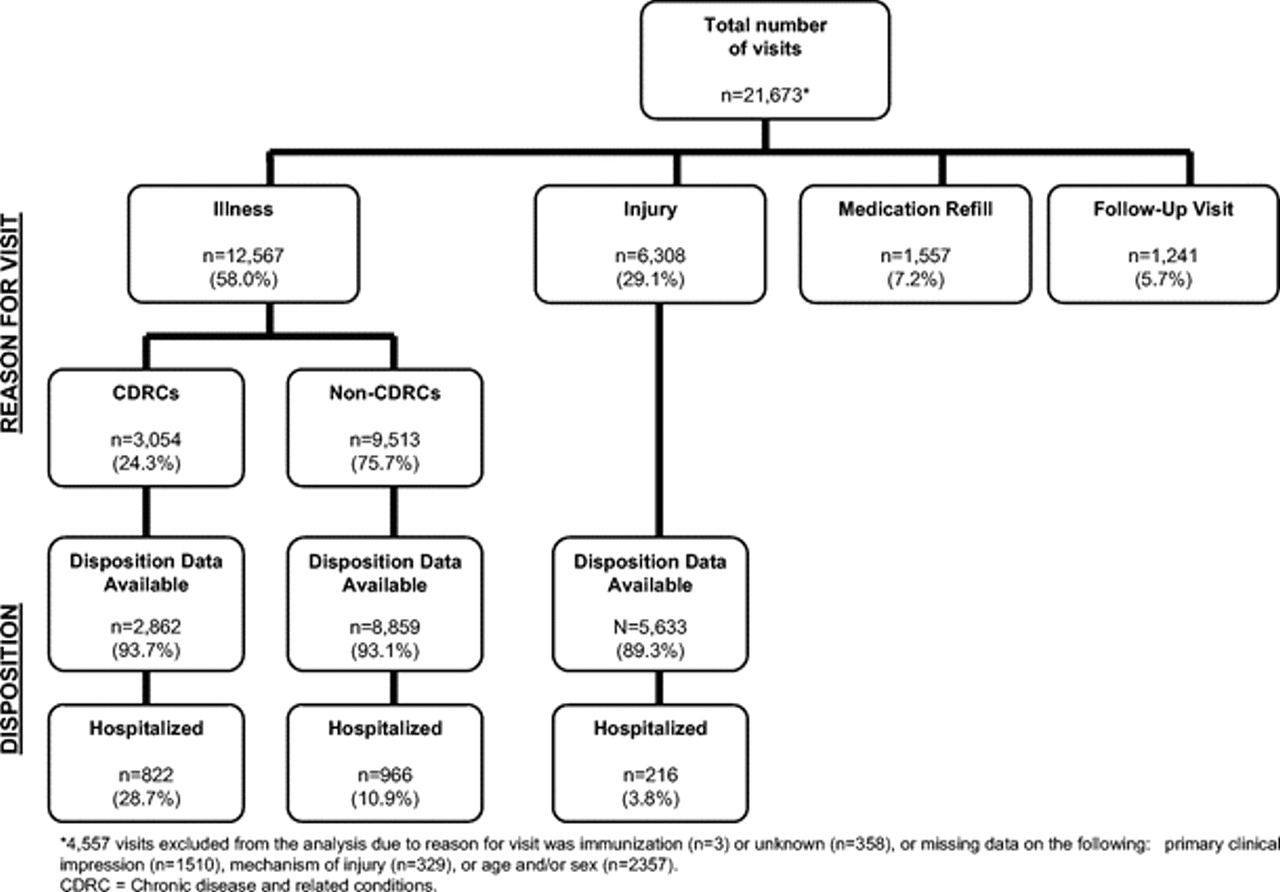
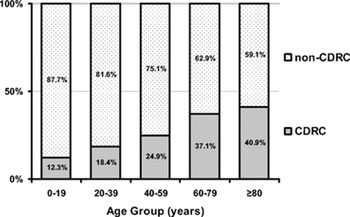
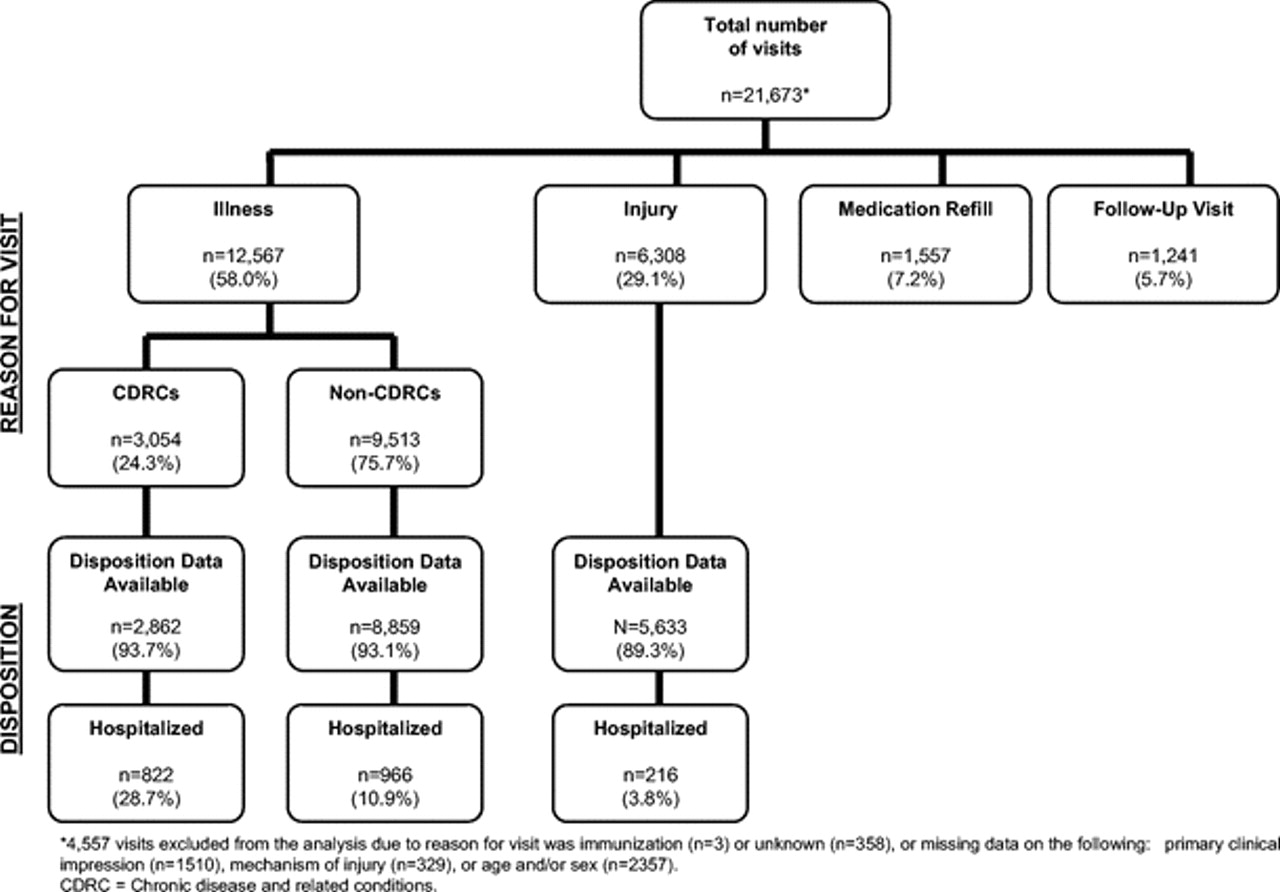
Of the 21,673 visits, 58.0% presented for illness, 29.1% for injuries, 7.2% for medication refills, and 5.7% for routine or follow-up care (Fig. 1). Among visits for illness (n = 12,567), 75.7% were for non-CDRC illnesses (eg, dehydration, heat-related illness, infectious disease, mental health) and 24.3% were for CDRCs. The proportion of visits for illness due to CDRCs increased with age, from 12.3% among patients ages 0 to 19 years to 40.9% among those ages 80 years or older (Fig. 2).
Distribution of visits to emergency treatment facilities, by reason for visit and disposition, in New Orleans area September 8–October 22, 2005
Among visits for illness, the proportion with primary clinical impressions related to chronic disease or related conditions (CDRCs) or non-CDRCs by age group

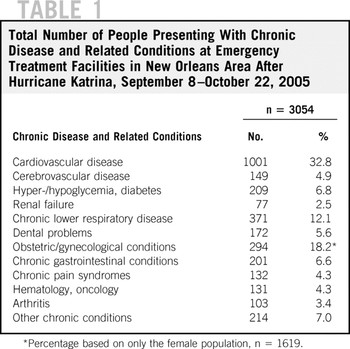
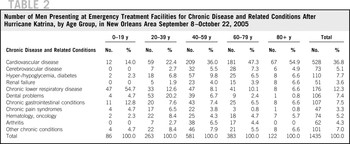
Among the 3054 patients presenting with a CDRC, the most common CDRCs were cardiovascular disease (32.8%), obstetric/gynecological conditions (18.2%), and chronic lower respiratory disease (12.1%; Table 1). Among the 1435 men presenting with a CDRC, the most common CDRCs were cardiovascular disease (36.8%); chronic lower respiratory disease (12.3%); and hypoglycemia, hyperglycemia, or diabetes mellitus (7.7%; Table 2). The proportion of men presenting with cardiovascular disease increased with age from 14.0% among those ages 0 to 19 years to 54.9% among those ages 80 years or older. Chronic lower respiratory disease was the most common CDRC among men ages 0 to 19 years (54.7%) and the second-most common CDRC among men in all age groups 40 years or older (8.8%). Dental problems were the most common CDRC among men ages 20 to 39 years (20.2%).
Total Number of People Presenting With Chronic Disease and Related Conditions at Emergency Treatment Facilities in New Orleans Area After Hurricane Katrina, September 8–October 22, 2005

Number of Men Presenting at Emergency Treatment Facilities for Chronic Disease and Related Conditions After Hurricane Katrina, by Age Group, in New Orleans Area September 8–October 22, 2005

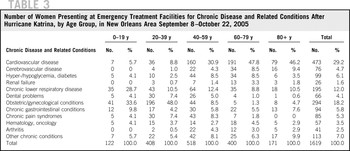
Among the 1619 women presenting with a CDRC, the most common CDRCs were cardiovascular disease (29.2%), obstetric/gynecological conditions (18.2%), and chronic lower respiratory disease (12.0%; Table 3). The proportion presenting for cardiovascular disease increased with age from 5.7% among women ages 0 to 19 years to 46.2% among women ages 80 years or older. Obstetric/gynecological conditions were the most common CDRCs among women ages 0 to 19 years (33.6%) and 20 to 39 years (48.0%). Chronic lower respiratory conditions were the second-most common CDRC among women in all age groups (12.0%), affecting the greatest proportion among women ages 0 to 19 years (28.7%). Overall, hyperglycemia, hypoglycemia, or diabetes mellitus was the fourth-most common CDRC category among women (6.1%).
Number of Women Presenting at Emergency Treatment Facilities for Chronic Disease and Related Conditions After Hurricane Katrina, by Age Group, in New Orleans Area September 8–October 22, 2005

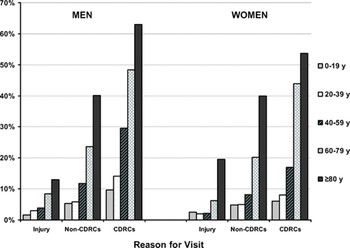
Among the 17,354 visits for which data on disposition were available (Fig. 1), hospitalization was the disposition for 28.7% of people presenting with CDRCs compared with 10.9% with non-CDRC illness and 3.8% with injuries. Although the proportion of visits for which the disposition was hospitalization varied by sex and increased with age across all reasons for visit (Fig. 3), within each age group hospitalization was more common for visits for CDRCs than for visits for either non-CDRCs or injuries.
Proportion of visits for which disposition was hospitalization by sex, age, and reason for visit

DISCUSSION
Hurricane Katrina created substantive public health and medical challenges, especially in southern Louisiana, where the subsequent flooding of New Orleans imposed catastrophic public health conditions. Several large hospitals were rendered inoperable. Nearly all of the smaller treatment facilities and pharmacies were shut down, leaving people with chronic medical conditions without access to their usual sources of medical care and medications.8 In this article, we have described the relevance of CDRCs in medical response.
After Hurricane Katrina, CDRCs accounted for a significant proportion of visits to emergency treatment facilities in and around New Orleans for illness, particularly among people ages 60 years or older. The burden was magnified by the high rate of hospitalization among those presenting with CDRCs. Cardiovascular disease, chronic lower respiratory disease, obstetric/gynecological conditions, and hyperglycemia, hypoglycemia, or diabetes were the most common CDRCs. Although not as common, cerebrovascular disease and renal failure often require immediate interventions with medication or dialysis to prevent further morbidity or mortality.
Disaster preparations usually focus on preventing injury and infectious disease. Disaster preparedness also includes planning for the needs of people who are vulnerable to the stresses and disruptions caused by the disaster. This includes people with either recognized or unrecognized chronic medical conditions. Preparations for controlling chronic diseases and adverse pregnancy outcomes following a disaster can be guided to some degree by the predisaster disease burden, by an awareness of the immediate CDRC needs for specialty care and medications, and by the capacity of the health care delivery system in the area.Reference Ford, Mokdad and Link3 Whether previously diagnosed or not, chronic illnesses can be exacerbated by disaster conditions (eg, lack of food or water, extreme heat or cold, physical and mental stress).Reference Kirizuka, Nishizaki and Kohriyama9–Reference Trichopoulos, Katsouyanni, Zavitsanos, Tzonou and Dalla-Vorgia12 Therefore, active surveillance of CDRCs following a disaster can help tailor disaster response efforts. For example, data could be used to direct essential resources—such as health care providers, medications, or equipment—to potential shortage areas.13 Without appropriate care following a disaster, patients with chronic stable conditions, such as cardiovascular disease, diabetes, or dialysis-dependent renal failure, may experience severe exacerbations or complications such as heart attack, diabetic ketoacidosis, or even death.
To improve surveillance for chronic disease following a disaster, a questionnaire that limits the potential for misclassification is needed. Since Hurricane Katrina, surveillance questionnaires have been updated to distinguish between exacerbations of chronic illness and presentation for stable chronic conditions, as well as presentation for pregnancy complications versus gynecological conditions not related to pregnancy.13 Ideally, the questionnaire would be added to the forms already used by disaster medical assistance teams, and could be integrated into the medical record with ease.
The findings in this article are subject to several limitations. First, the surveillance system was not specifically designed to detect CDRCs. Substantial ambiguity occurred in the symptoms and diagnoses reported, resulting in probable misclassification; however, an effort was made to classify CDRCs conservatively. Second, our estimates of CDRCs may be low because we did not include mental health disorders, medication refills, or follow-up care visits. Mental health was not included as a chronic condition because the category description did not differentiate chronic mental health conditions from acute disorders related to the disaster. Similarly, the underlying medical condition of those requiring medication refills or follow-up care was not ascertained; therefore, the proportion of visits for CDRCs remains unknown. Third, owing to the mass evacuation of the New Orleans area, the loss of health care infrastructure, and the lack of baseline data, determining the absolute burden of CDRCs on the health care system was not possible and generalizability to future disasters is limited. Fourth, prospective data collection began on September 8. Thus, there is little information on the distribution of visits in the first week after the hurricane. Finally, the proportion of obstetric/gynecological visits resulting from complications of pregnancy is not known; however, write-in data suggest that at least 25% of visits were pregnancy related.
Despite these limitations, this report contains important information about medical needs following a disaster. Because of the substantial burden of CDRCs, these findings highlight the importance of emergency response plans and improved active surveillance to address chronic diseases, especially among older adults, and to protect the health of pregnant women. Rapid initiation of surveillance following a disaster is crucial to accurately characterize the burden of disease and direct the appropriate essential resource needs to emergency treatment facilities in the area. The findings underscore a need for including chronic disease care and prevention of complications in predisaster planning and postdisaster surveillance.
Authors' Disclosure
The findings in this report are based, in part, on contributions by the many men and women who provided emergency treatment services throughout the greater New Orleans area during the disaster response, the Greater New Orleans Public Health Response Team, and the National Center for Chronic Disease Prevention and Health Promotion, CDC. The findings and conclusions in this report are those of the authors and do not necessarily represent the views of the CDC.