Introduction
Much research on bilingualism has focused on whether and how the two languages of the bilingual individual are linked in the bilingual mind. This question has been addressed by various studies on different aspects of language use and processing – for instance, on whether bilinguals have one integrated lexicon or two separate ones for their two languages (e.g., Kroll & Stewart, Reference Kroll and Stewart1994). In the last fifteen years, there has also been an increased interest in whether syntactic representations are shared across a bilingual's two languages.
Different accounts support opposing or complementary views. These accounts posit that mental representations of syntactic structures are entirely separate (De Bot, Reference Bot1992; Hartsuiker, Pickering & Veltkamp, Reference Hartsuiker, Pickering and Veltkamp2004; Ullman, Reference Ullman2001), that they are separate yet connected when there are similarities between languages (De Bot, Reference Bot1992; Kantola & van Gompel, Reference Kantola and van Gompel2011; Ullman, Reference Ullman2001), or that certain representations are entirely shared (Hartsuiker et al., Reference Hartsuiker, Pickering and Veltkamp2004; Kantola & van Gompel, Reference Kantola and van Gompel2011). The consensus seems to be that representations of similar structures are shared, whereas structures that differ between languages are represented separately (Hartsuiker et al., Reference Hartsuiker, Pickering and Veltkamp2004; see van Gompel & Arai, Reference van Gompel and Arai2018 for a review). The question that follows from the shared-syntax view then is: how similar do structures need to be to be captured by a single representation in the bilingual's mind?
Previous studies have mostly focused on word-order differences as a factor that determines whether representations are shared (e.g., Hartsuiker et al., Reference Hartsuiker, Pickering and Veltkamp2004). On the other hand, featural information (Pickering & Branigan, Reference Pickering and Branigan1998), such as tense or aspect, and internal constituent structure, such as the realization of the verb as a single word or as auxiliary and lexical verb (Pickering & Branigan, Reference Pickering and Branigan1998), are often assumed to have no effect on whether representations are shared (e.g., Loebell & Bock, Reference Loebell and Bock2003). This assumption is based on studies from the monolingual literature, where the factors mentioned above have no repercussions for argument structure (Pickering & Branigan, Reference Pickering and Branigan1998). However, this assumption has not been explicitly tested in bilingual research or in languages with inflectional features that potentially have structural repercussions. The current study aims to address the effect of voice morphology on bilingual syntactic representations. Specifically, it investigates differences in the verb-internal constituent structure of passive constructions by using the structural priming paradigm to probe the representation of passive and active structures in Greek–English bilinguals.
Structural priming and the argument for shared representations
The experimental paradigm that has been extensively used to probe the question of shared representations is structural priming. Structural priming refers to speakers’ tendency to produce a syntactic structure similar to one that has recently been used in discourse (Branigan & Pickering, Reference Branigan and Pickering2017). Such priming has been observed in spoken as well as written discourse, within and across production and comprehension, and, importantly, in experimental as well as in corpus-based studies (see Branigan & Pickering, Reference Branigan and Pickering2017; Gries & Kootstra, Reference Gries and Kootstra2017 for a review). To start with an early example of monolingual structural priming, Bock (Reference Bock1986) used a task in which participants had to either repeat sentences or describe pictures. Participants were more likely to describe a picture using an active sentence after repeating an active, and they were more likely to describe a picture with a passive sentence after repeating a passive. The same was true for sentences featuring a double-object (DO) or a prepositional-object (PO) construction. This priming effect has been attributed either to it being an implicit learning effect (e.g., Bock & Griffin, Reference Bock and Griffin2000) or to that a particular structure is repeated because it has already been activated in the mind (Branigan & Pickering, Reference Branigan and Pickering2017; Pickering & Branigan, Reference Pickering and Branigan1998). Activation of the same syntactic structure is the account mostly adopted in bilingual priming studies and the shared-syntax account.
The shared-syntax account, as proposed by Hartsuiker et al. (Reference Hartsuiker, Pickering and Veltkamp2004), is an extension of Pickering and Branigan's (Reference Pickering and Branigan1998) account of syntactic-information representation aiming to describe bilingual syntactic representation. Pickering and Branigan's (Reference Pickering and Branigan1998) model starts from the same basis as contemporary lexical-production models (e.g., Levelt, Roelofs & Meyer, Reference Levelt, Roelofs and Meyer1999) in claiming that the lexical entry of each word contains syntactic information about the word. Specifically, the lemma stratum of lexical entries encodes category, featural and combinatorial information according to Pickering and Branigan (Reference Pickering and Branigan1998). Category information specifies the syntactic category of a word, such as noun or verb. Featural information refers to characteristics of a word denoted by specific word-forms, such as person, number, tense or, in the case of Greek, voice in the form of active and non-active morphology (Alexiadou & Anagnostopoulou, Reference Alexiadou, Anagnostopoulou, Alexiadou, Anagnostopoulou and Everaert2004). Finally, combinatorial information specifies the syntactic structures in which each lexical entry can be used.
These levels of information are visualised as nodes, which are abstract forms of representation: the lemma of each lexical entry is connected to those nodes that specify its category, featural and combinatorial properties. This means that a transitive English verb, such as push, would be connected to a combinatorial node denoting the active construction and to one denoting the passive construction, since it can be used in both. In turn, the nodes of active constructions and passive constructions are linked to all verbs that can be used in these constructions.
According to this account, structural priming arises because the combinatorial node representing a particular syntactic structure is activated to a greater extent than an alternative node, due to the former structure's previous use in discourse. In the context of bilingualism, Loebell and Bock (Reference Loebell and Bock2003) were among the first to show that structural priming also occurs cross-linguistically. In a task following the Bock (Reference Bock1986) study, they found that repetition of DO sentences primed the use of DO sentences, whereas POs primed the production of POs, even when prime and target were in different languages (in this case, German and English). Hartsuiker et al.'s (Reference Hartsuiker, Pickering and Veltkamp2004) shared-syntax account was formulated based on findings from Spanish–English bilinguals who were primed to produce active or passive transitive sentences in both languages.
Drawing on Pickering and Branigan's (Reference Pickering and Branigan1998) model of syntactic representation, the shared-syntax account predicts that lexical entries from different languages are connected to the same combinatorial nodes in fluent bilinguals when the structures, in which each lexical entry can occur, are identical across languages (Hartsuiker & Pickering, Reference Hartsuiker and Pickering2008; Hartsuiker et al., Reference Hartsuiker, Pickering and Veltkamp2004). For instance, the lexical entries for the English verb hit and the Spanish verb golpear (hit) would be linked to the same combinatorial nodes for active and passive (Hartsuiker et al., Reference Hartsuiker, Pickering and Veltkamp2004). This means that combinatorial nodes are unspecified for language (Hartsuiker et al., Reference Hartsuiker, Pickering and Veltkamp2004), and lexical entries from either language of a bilingual can be linked to the same node – as long as this represents the exact syntactic structure in both languages. If the passive, for instance, differs in the two languages, it is assumed that the lexical entries of each language are linked to separate passive-construction nodes.
Another important prediction of the shared-syntax account is that the same magnitude of priming can be expected within- and between-languages (Kantola & van Gompel, Reference Kantola and van Gompel2011), at least when different verbs are used in prime and target (Hartsuiker & Pickering, Reference Hartsuiker and Pickering2008). Indeed, there is evidence that cross-linguistic priming is of the same magnitude as within-language priming in bilinguals (Kantola & van Gompel, Reference Kantola and van Gompel2011) and multilinguals (Hartsuiker, Beerts, Loncke, Desmet & Bernolet, Reference Hartsuiker, Beerts, Loncke, Desmet and Bernolet2016). The same magnitude of priming is expected because the language-independent nature of combinatorial nodes entails the same level of activation for a particular structure irrespective of the language used (Hartsuiker & Pickering, Reference Hartsuiker and Pickering2008; Kantola & van Gompel, Reference Kantola and van Gompel2011). The distinction for different verbs is made because it has been observed that when the same lexical item is used in prime and target, the priming effect is greater than when different lexical items are used in the same language (Cacoullos, Reference Cacoullos, Adli, García and Kaufmann2015; Schoonbaert, Hartsuiker & Pickering, Reference Schoonbaert, Hartsuiker and Pickering2007), or when translation equivalent verbs are used in cross-linguistic priming (Schoonbaert et al., Reference Schoonbaert, Hartsuiker and Pickering2007).
Despite the above predictions, experimental (Cai, Pickering, Yan & Branigan, Reference Cai, Pickering, Yan and Branigan2011) and corpus-based studies (Cacoullos & Travis, Reference Cacoullos and Travis2018; Travis, Cacoullos & Kidd, Reference Travis, Cacoullos and Kidd2017) have also reported greater within- than between-language priming, and longer-lasting within- than between-language priming (Travis et al., Reference Travis, Cacoullos and Kidd2017). Cai et al. (Reference Cai, Pickering, Yan and Branigan2011) attributed this discrepancy to the presence of a language node to which all lexical entries are connected and which provides additional activation to all the words in a given language, thus leading to stronger within-language priming; in cross-linguistic priming, the priming effect is caused only by the activated combinatorial nodes, without any additional boost from the language node, since different languages are used in prime and target (Cai et al., Reference Cai, Pickering, Yan and Branigan2011). On the other hand, Cacoullos and Travis (Reference Cacoullos and Travis2018) and Travis et al. (Reference Travis, Cacoullos and Kidd2017) do not support the notion that syntactic structures are shared between languages in bilinguals; rather, they postulate that differences in strength of priming can be explained by the strength of associations between constructions, and between individual components of different constructions (Cacoullos, Reference Cacoullos, Adli, García and Kaufmann2015), and it is these associations that give rise to priming.
It is also important to note that cross-linguistic priming has not always been observed (Bernolet, Hartsuiker & Pickering, Reference Bernolet, Hartsuiker and Pickering2007; Loebell & Bock, Reference Loebell and Bock2003), thus leaving open the question of how similar two structures need to be to be stored as a single representation. Researchers have mostly addressed word order as a factor of necessary similarity (Bernolet et al., Reference Bernolet, Hartsuiker and Pickering2007; Hartsuiker et al., Reference Hartsuiker, Pickering and Veltkamp2004; Loebell & Bock, Reference Loebell and Bock2003). Our study aims to contribute to this discussion by examining the potential effect of featural information on passive structures in Greek–English bilinguals. In Greek, the passive verb is realised as a single word, and it is linked to the feature for non-active morphology, which is polysemous, i.e., may give rise to reflexive and other readings if allowed by the verb, in addition to being structurally marked for passive at the combinatorial level (Spathas, Alexiadou & Schäfer, Reference Spathas, Alexiadou and Schäfer2015). In English, the passive is only connected to phrase structure (auxiliary BE with the past participle form of the lexical verb), which does not give rise to other readings of the verb. Before examining the implications of such differences in passive structure representation, we will briefly consider previous findings on cross-linguistic syntactic priming of passives.
Passive constructions and word-order effects
Previous studies on cross-linguistic syntactic priming of passives have mostly focused on the implications of word order similarity for structural priming and the status of bilingual syntactic representations. Specifically, the lack of cross-linguistic priming of passives in German–English bilinguals in the Loebell and Bock (Reference Loebell and Bock2003) study led to the claim that the structures need to have the same word order in order to be represented as a single structure/combinatorial node (Hartsuiker et al., Reference Hartsuiker, Pickering and Veltkamp2004). Passive sentences in German and English differ in this respect: English passives are formed with the Verb Phrase (VP) following the subject Noun Phrase (NP), whereas German passives allow the placement of the main verb at the end of the sentence, after the Prepositional Phrase (PP) denoting the agent (Loebell & Bock, Reference Loebell and Bock2003). This could explain why passives have been primed cross-linguistically in other language combinations: L2-English passives have been primed by L1-Polish (Fleischer, Pickering & McLean, Reference Fleischer, Pickering and McLean2012) and L1-Spanish (Hartsuiker et al., Reference Hartsuiker, Pickering and Veltkamp2004) passives, presumably because the structures share identical word order in these languages.
Bernolet, Hartsuiker and Pickering (Reference Bernolet, Hartsuiker and Pickering2009) have also suggested that information structure is primed in addition to constituent structure. This was to explain why priming occurred from L1-Chinese (Chen, Jia, Wang, Dunlap & Shin, Reference Chen, Jia, Wang, Dunlap and Shin2013) and L1-Dutch (Bernolet et al., Reference Bernolet, Hartsuiker and Pickering2009) to L2-English passives even when the word order differed. Nevertheless, word order seems to remain a structurally necessary condition for priming. For example, no priming was observed for Relative-Clause structures with differing word orders between L1-Dutch and L2-English (Bernolet et al., Reference Bernolet, Hartsuiker and Pickering2007), but there was priming of the same structure from L1-Dutch to L2-German (where word order is identical).
While previous passive priming studies largely concerned word-order differences, the present study aims to provide insight into another aspect of syntactic representation – that is, the effect of featural information on the activation of a particular structure. The activation of the non-active morphology feature for Greek passives and the one-word realisation of the Greek passive verb are the ways in which these structures differ from those examined in previous studies. At the same time, Greek and English passives exhibit the same clause-level and verb-argument structure as well as word order. Therefore, any effects on priming should be solely due to morpho-syntactic differences, and not a result of word order. Relevant morpho-syntactic considerations have been addressed in other structures, as will be discussed in the following section.
Other similarity conditions for syntactic priming
In cross-linguistic studies, priming of genitive NP constructions with differing genitive-internal constituent structure has been observed from L1-Dutch to L2-English (Bernolet, Hartsuiker & Pickering, Reference Bernolet, Hartsuiker and Pickering2012, Reference Bernolet, Hartsuiker and Pickering2013). It should be noted, though, that only Bernolet et al. (Reference Bernolet, Hartsuiker and Pickering2013) included a condition in which prime and target contained head nouns that were neither cognates nor translation equivalents, meaning this is the only condition where structural priming could not have been facilitated by a phonological (Bernolet et al., Reference Bernolet, Hartsuiker and Pickering2012) or lexical boost (Pickering & Branigan, Reference Pickering and Branigan1998). The difference in the structures used is that the Dutch genitive contained a form of the possessive pronoun after the possessor instead of the possessive morpheme (-'s) used in English, as exhibited in the examples (1a-b) from Bernolet et al. (Reference Bernolet, Hartsuiker and Pickering2013, p. 290). Therefore, Bernolet et al. (Reference Bernolet, Hartsuiker and Pickering2013) provide some evidence that internal constituent structure does not need to be identical, at least in genitive constructions. We propose to extend these findings by explicitly testing differences in the internal constituent structure of verbs in passive constructions.
(1)
a. “De non haar ei is geel.” (“The nun her-POSSESSIVE PRONOUN egg is yellow.”)
b. “The nun's egg is yellow.”
Verb-internal constituent structure and the potential effects of featural information on argument structure were investigated in Pickering and Branigan (Reference Pickering and Branigan1998). Although this was a priming study with monolingual participants, it is presented here because bilinguals are expected to exhibit the same priming patterns as monolinguals if the different-language structures are represented together. Pickering and Branigan (Reference Pickering and Branigan1998) used a series of experiments to show that varying features of the verb between prime and target would not affect syntactic priming, and thus that featural and combinatorial nodes are only connected to the verb lemma but not to each other. Their experiments varied the features of tense (Experiment 3), aspect (Experiment 4), and number (Experiment 5), so that different forms of the same verb (e.g., “showed” vs. “shows” in Experiment 3) were used to prime PO and DO sentences where the target verb either matched the prime at the featural level or not. Syntactic priming of POs and DOs was observed in both conditions: when the target verb matched the prime verb in tense, aspect, and number, as well as when these features did not match between prime and target. This was also the case in Experiment 4, where the different features (perfective and imperfective aspect) resulted in a different verb-internal structure (e.g., “showed” vs. “was showing”).
Their findings suggest that priming occurs even if prime and target differ in terms of features and verb-internal constituent structure. However, two points should be noted in relation to this conclusion. Firstly, prime and target contained the same verb in the three experiments described above, suggesting that syntactic priming might have been reinforced by a lexical boost attributed to the repetition of the verb (Branigan, Pickering & Cleland, Reference Branigan, Pickering and Cleland2000; Pickering & Branigan, Reference Pickering and Branigan1998). Secondly, this study investigated features that do not affect the argument structure of the clause, i.e., either the perfective or the imperfective aspect can be used within a PO or DO structure. In the present study, we investigated Greek passive constructions. These contain an additional verbal feature, that of non-active morphology (Alexiadou & Anagnostopoulou, Reference Alexiadou, Anagnostopoulou, Alexiadou, Anagnostopoulou and Everaert2004; Tsimpli, Reference Tsimpli, Unsworth, Parodi, Sorace and Young-Scholten2006). This inflectional feature is linked to the verb-internal structure and could also affect argument structure. Additionally, although Greek passive constructions presuppose a NP-VP-PP clause structure, the non-active morphology on the verb also evokes reflexive and/or anti-causative readings of a verb (Tsimpli, Reference Tsimpli, Unsworth, Parodi, Sorace and Young-Scholten2006). In the present study, we investigated whether differences in the morphosyntax of the VP modulate syntactic priming across languages, or not, if the structures are otherwise identical, as suggested by Pickering and Branigan (Reference Pickering and Branigan1998).
Transitive structures in Greek and English
The questions of featural and verb-internal structure similarity can be further investigated through Greek and English passives, which differ in these respects. Active structures will also be addressed so that passives can be compared with a structure that is identical across the two languages. As shown in (2a-b), Greek and English actives have the same constituent structure. The Greek active differs in that it is morphologically marked on the verb and the syntactic roles of subject and object are also denoted by case marking in addition to their position in the sentence. However, we can assume that these characteristics should not prevent cross-linguistic priming of actives, since they do not result in verb-internal differences between the Greek and the English active.
On the other hand, the Greek passive (2c) follows the same clause-level structure as English (2d) – that is, a subject-NP followed by the verb, which is in turn followed by a PP containing the entity that performs the action (the agent). However, the two structures are not identical. In Greek passives, the verb is morphologically marked for non-active morphology, and it is realised as a single word. Moreover, the non-active morphology is polysemous, as it is also connected to transitivity alternations other than the passive – namely, reflexives and some anti-causatives (Alexiadou & Anagnostopoulou, Reference Alexiadou, Anagnostopoulou, Alexiadou, Anagnostopoulou and Everaert2004; Tsimpli, Reference Tsimpli, Unsworth, Parodi, Sorace and Young-Scholten2006; Warburton, Reference Warburton1975). The interpretation or activation of a passive, reflexive, or anti-causative is constrained by certain conditions, including the animacy of the syntactic subject, the semantic features of the predicate, and the lexical preferences of the speaker (Tsimpli, Reference Tsimpli, Unsworth, Parodi, Sorace and Young-Scholten2006, p. 23). Finally, the apo-agent (by-agent) phrase is marked in Greek passives, and it also involves other interpretations not restricted to the passive (Tsimpli, Reference Tsimpli, Unsworth, Parodi, Sorace and Young-Scholten2006). In contrast, the English passive is realised by a form of the verb “to be” and the past participle of the main verb, where the morphology of the past participle does not give rise to interpretations other than the passive, and the by-agent phrase that follows is almost ubiquitous in passives.
These differences raise the possibility that the Greek non-active morphology, which is underspecified for passives, reflexives or anti-causatives (Spathas et al., Reference Spathas, Alexiadou and Schäfer2015; Tsimpli, Reference Tsimpli, Unsworth, Parodi, Sorace and Young-Scholten2006), may have a direct effect on the combinatorial node connected to the passive. It should be noted that Greek passives and reflexives always exhibit non-active morphology, whereas anti-causatives may exhibit active or non-active morphology (Alexiadou & Anagnostopoulou, Reference Alexiadou, Anagnostopoulou, Alexiadou, Anagnostopoulou and Everaert2004). Most of the critical verbs used in the present study do not have an anti-causative use, although they allow for both passive and reflexive readings depending on context. Non-active morphology could thus impede or limit the activation of the passive node, since structures other than the passive are also possible with the same morphology. A further possibility of these differences is that English verbs might be connected to an additional combinatorial node specifying two verb-internal constituents for passive constructions (the verb to be and the past participle of the main verb); Greek verb lemmas would not include this additional syntactic specification, since the passive voice is realised through morphological marking on the Greek verb.
(2)
a. O athlitis klotsaei ton klefti. (“The athlete kicks-ACTIVE the thief.”)
b. The athlete kicks the thief.
c. O kleftis klotsiete apo ton athliti. (“The thief kicks-PASSIVE by the athlete.”)
d. The thief is kicked by the athlete.
Another factor that might affect priming of transitive structures is that the Greek passive is less preferred and more restricted in use than the active (Fotiadou & Tsimpli, Reference Fotiadou and Tsimpli2010). It has been observed that less preferred structures exhibit a greater priming effect than more preferred structures both in within-language (e.g., Bock, Reference Bock1986) and between-language priming studies (e.g., Bernolet et al., Reference Bernolet, Hartsuiker and Pickering2007). Coined the inverse-preference effect (Ferreira & Bock, Reference Ferreira and Bock2006), this observation is often connected to priming accounts that regard syntactic priming as the result of a learning effect. This is because less known structures (i.e., less common or less preferred ones, like the passive in many languages) are assumed to exhibit greater learning effects than better-known structures (Ferreira & Bock, Reference Ferreira and Bock2006). This account argues that the language-specific frequency of a particular structure may modulate the tendency to produce it and by extension, the way this tendency might affect results in a priming experiment. For these reasons, language-specific frequency of passives was also taken into account in the formulation of the research questions and predictions.
The present study
This study investigated the degree to which syntactic structures need to be identical to be stored as a single representation in the bilingual mind. To achieve this, we carried out two experiments to test whether a clause-level structure with different verb-internal structure and potential featural effects can be primed from the L1 to the L2. For this reason, we used Greek and English actives, which are identical, and passives, which differ in their verb-internal constituent structure and passivisation restrictions, to test whether priming would occur only for the identical or for both structures.
Experiment 1 investigated structural priming of actives and passives in L1-Greek. We chose to conduct a within-L1 experiment because priming of transitive structures (actives and passives) has not, to our knowledge, been investigated in Greek before. The only other study examining priming of Greek structures was by Salamoura and Williams (Reference Salamoura and Williams2007), who addressed only cross-linguistic priming (from L1-Greek to L2-English) and examined different structures to those in the present study. Therefore, we did not know the extent to which the theoretical passivisation restrictions in Greek have a certain psychological reality. We wanted to explore whether passive constructions can be primed in Greek at all, and if so, how this priming relates to the potential subsequent cross-linguistic priming that might be observed.
The experiment also included a baseline condition where participants were primed with two conjoined noun phrases (involving the same entities as the critical transitive-alternation primes) and no verb (2e). The main experimental conditions (active and passive) were compared against these baseline primes, in accordance with previous studies on transitive structures (e.g., Fleischer et al., Reference Fleischer, Pickering and McLean2012). The reason why intransitive structures were not chosen as the baseline prime is that intransitive verbs still exhibit active morphology in Greek (e.g., “O athlitis kolimbaei” – “The athlete swims-ACTIVE”), hence they would not constitute a neutral baseline condition.
(2)
e. O athlitis kai o kleftis. (“The athlete and the thief”.)
Experiment 2 investigated structural priming of actives and passives from L1-Greek to L2-English in relation to the baseline condition (2e). The aim of this cross-linguistic experiment was to probe the question of shared bilingual representations when the verb-internal structure differs (passive condition). Comparing the magnitude of priming between the two experiments will also inform the prediction of the shared-syntax account that a structure should receive the same amount of activation irrespective of the language used (Hartsuiker & Pickering, Reference Hartsuiker and Pickering2008; Kantola & van Gompel, Reference Kantola and van Gompel2011).
Moreover, the L1-to-L2 direction was chosen to maximise the likelihood of observing priming effects and thus drawing conclusions on the nature of syntactic representations. Although most studies have reported equally strong cross-linguistic priming in both language directions (e.g., Kantola & van Gompel, Reference Kantola and van Gompel2011), some evidence from bilingual children suggests no L2-L1 priming (Vasilyeva et al., Reference Vasilyeva, Waterfall, Gámez, Gómez, Bowers and Shimpi2010). This being the first experiment to investigate transitive structures in Greek–English bilinguals, it was decided that the L1-to-L2 direction would be used to gain more robust results that can later be extended to the reverse language direction.
Regarding the active, we predict that syntactic priming will be observed in both experiments, since it is identical across the two languages and thus in accordance with the shared-syntax account.
The predictions about the passive are more complex and can be summarised as follows for both experiments:
1. If within- (Experiment 1) and between-language (Experiment 2) priming occurs for passives, it would indicate that these structures are fully shared despite the fact that the verb-internal constituent structure differs between the two languages and that non-active morphology does not necessarily activate only the passive in Greek. Two further predictions follow from this:
a) If within-Greek passive priming (Experiment 1) is stronger than cross-linguistic passive priming (Experiment 2), then the language used in the primes (Greek) provides additional activation to all the words in that language, following the predictions of Cai et al. (Reference Cai, Pickering, Yan and Branigan2011).
b) Alternatively, if passive priming is stronger cross-linguistically (Experiment 2) than in Greek only (Experiment 1), we could assume that the polysemy of non-active morphology in Greek interferes with the activation of the target argument structure. This would be an indication that combinatorial nodes are not independent of, but are in fact connected to, the featural information of a verb. This would especially be the case if other non-active structures, such as reflexives and anti-causatives, are significantly used after passive primes.
Additionally, there is a possibility that weaker within-Greek passive priming could be due to the passive being a low-frequency structure in Greek, which also requires certain conditions to be met to be activated and used.
2. If passive priming occurs in Greek (Experiment 1), but not cross-linguistically (Experiment 2), it would indicate that passive representations are not shared due to differences in the verb-internal constituent structure.
3. If neither within-language (Experiment 1) nor cross-linguistic priming (Experiment 2) occurs for the passive, it would suggest that the low frequency and additional requirements of the passive in Greek impede priming and representations are not shared, or are not even fully developed within-language, for a low-frequency, condition-constrained structure.
Experiment 1: within-language priming in L1 Greek
Method
Participants
Twenty-five native speakers of Greek (12 females and 13 males, age range 22–30 years, mean = 25.32) were recruited through personal contacts, Facebook, and the University of Edinburgh email lists and paid £8 for their participation. All participants spoke English as a second language. Two of them were excluded from the statistical analyses for being early bilinguals of Greek and another language (German or Italian). Participants’ performance on the Lexical Test for Advanced Learners of English (LexTALE), a brief standardized vocabulary test that has been shown to correlate with overall proficiency in English (Lemhöfer & Broersma, Reference Lemhöfer and Broersma2012), showed their mean English proficiency was 76.52% (SD = 11.68%). According to information obtained through a modified version of the Language Experience and Proficiency (LEAP) Questionnaire (adapted from Marian, Blumenfeld & Kaushanskaya, Reference Marian, Blumenfeld and Kaushanskaya2007), they had all lived in an English-speaking environment for less than a year (mean = 8.74 months, SD = 3.14 months). We did not expect their knowledge of English to affect their performance in this experiment and we postulated that their L2 was deactivated during the experimental session, since they were required to speak only in Greek, thus being in a monolingual language mode (Grosjean, Reference Grosjean1998).
Materials
Two sets of 72 pictures were used. One set consisted of the pictures used as primes, the other of the pictures used as targets. The critical pictures were 24 in each set, thus constituting one-third of the materials, while the remaining 48 pictures in each set were fillers.
The critical pictures in the target set depicted a transitive action involving two entities: an entity performing the action (the agent), and an entity undergoing the action (the patient) – for example, a trainer pushing a swimmer. Both entities were always animate to satisfy the meaning requirements of the verbs used (which mostly called for animate agents and patients) and the attempt to eliminate the possibility of animacy patterns being primed in addition to syntactic structure (Bock, Loebell & Morey, Reference Bock, Loebell and Morey1992). Half the pictures depicted people and the other half animals, representing distinct entities that would be easy for the participants to name. Moreover, half of the critical pictures showed the agent on the right, half on the left. There were three pictures for each of the following 8 transitive verbs: kinigao (“chase”), klotsao (“kick”), taizo (“feed”), filao (“kiss”), sprohno (“push”), htipao (“hit”), tsimpao (“pinch”), agkaliazo (“hug”). The verbs were chosen with the aim of sounding as natural in a Greek passive construction as possible to counteract the fact that the passive is not a preferred structure in this language. The first six verbs had also been used in a study investigating processing of passive (among other) constructions in Greek-speaking children (Terzi, Marinis, Kotsopoulou & Francis, Reference Terzi, Marinis, Kotsopoulou and Francis2014).
The filler pictures depicted an intransitive action performed by one (e.g., a soldier running) or two entities (e.g., an angel and a witch flying), or simply two entities next to each other (e.g., a parrot and a squirrel). The last option was included to justify the use of two entities in a conjoined NP as a baseline condition in the critical primes (see also Bernolet et al., Reference Bernolet, Hartsuiker and Pickering2009). In order to avoid this condition standing out, one third of the targets and one third of the primes (including the critical primes) contained two entities simply standing next to each other. Finally, all pictures included the verb denoting the pictured action or the conjunction “kai” (and). The verbs and conjunctions were written in Greek at the bottom of the picture.
In the prime set, every picture was accompanied by an oral description narrated by a female voice. Therefore, each trial consisted of a prime picture accompanied by a pre-recorded sentence, followed by a target picture which the participants had to describe. Out of the 24 critical primes, there were eight for each experimental condition: active (e.g., 2a), passive (e.g., 2c), and NP conjunction (e.g., 2e) which served as the baseline condition. The eight verbs used in the targets were also used in the prime sentences, though never in the same experimental trial so as to avoid a possible lexical boost between prime and target (Pickering & Branigan, Reference Pickering and Branigan1998). For the same reason, primes and targets also involved different entities. A full list of the critical prime-target pairs can be found in Appendix S1.
Moreover, the three experimental conditions (active, passive, and conjoined NP primes) led to the creation of three lists of materials. The lists were counterbalanced so that every sentence that constituted a critical prime appeared in all three conditions across the lists, but only once in each list and by extension to each participant. All filler trials remained the same across lists. Finally, the order of critical trials was pseudorandomised, so that they were always separated by two fillers.
Procedure
Each session took place in a quiet room equipped with a computer, keyboard and headphones. Participants were given instructions in Greek. They were told they would be required to repeat some sentences and describe some pictures so that we could explore how they process and produce sentences in Greek. They were instructed to repeat the pre-recorded description that accompanied half of the pictures. This step was included to ensure that participants were paying enough attention to the prime sentences. They were also requested to describe the rest of the pictures aloud, and their responses were recorded. The first two trials consisted of fillers and were used as practice trials before the main part of the experiment. All experimental items were presented on a computer screen and the participants used arrow keys to move on to the next picture. After the experiment, participants completed a modified version of the LEAP Questionnaire and the LexTALE. Each session was about half an hour long.
Scoring
Target responses were transcribed and scored as “active”, “passive”, or “other”. They were scored as “active” if they contained the agent in the subject-NP followed by the main verb in the active, and the patient as the direct object. They were scored as “passive” if they contained the patient in the subject-NP, the main verb in the passive, and the agent in a PP beginning with “apo” (by) following the main verb. Every other response was scored as “other”, including sentences where the target verb was not used as the main verb and sentences containing conjoined NPs as the subject. Additionally, the first sentence was scored if participants gave two responses (unless there were restarts during the response), and the response was scored as “other” if participants asked a question between prime and target or repeated the prime twice. Finally, “other” responses were further classified into “reflexive” if the subject was a conjoined NP and the verb had non-active morphology, “active with conjoined-NP subject” when the verb had active morphology but the subject still consisted of two entities and there was no object, and “other” responses included everything else. The further specification was necessary to capture potential effects of non-active morphology on target responses.
Results
Out of the 552 responses, 423 were scored as “active” (76.6%), 74 as “passive” (13.4%), 18 as “reflexive” (3.3%), 4 as “active with conjoined-NP subject” (0.7%), and 33 as “other” (6%). Proportions of the different target responses can be found in Figure 1. Table 1, depicting the frequencies of observing each response after each prime, shows that passives increased after passive primes in relation to the other prime conditions, whereas actives comprised the majority of responses across conditions. Although the overall percentage of “reflexives” is noteworthy, their distribution shows they were not significantly primed by passive sentences. All instances of “other” responses were omitted from the analysis, so that the outcome variable was binomial, denoting active or passive responses.
The proportion of Target responses per Prime Condition (Experiment 1).

The frequency of Target responses per Prime Condition (out of 552 responses).

Inferential analyses were carried out using generalised mixed effects models. The models were built and run using the lme4 package in R (version 3.5.1). Mixed effects models were used because they can account for variability in the results attributed to individual participants and items (Baayen, Reference Baayen2008). The models were generalised, containing a logistic function, because the outcome variable was binomial (Dixon, Reference Dixon2008; Jaeger, Reference Jaeger2008). Specifically, active responses were coded as 0 and passive responses as 1. In this way, the models reported the probability (in log-odds) of observing a passive response (Jaeger, Reference Jaeger2008), since this is the structure of interest in relation to our predictions. We also tried to keep the random-effects structure maximal, as proposed by Barr, Levy, Scheepers and Tily (Reference Barr, Levy, Scheepers and Tily2013), by starting with a model that included all fixed effects and only random intercepts by participant and by item, and then adding random slopes for prime condition by participant in subsequent models. However, random slopes were only included in the final model if they provided an improvement over the model with the simpler random structure and if they did not cause convergence problems.
To test the question of whether passive structures can be primed within L1-Greek, a generalised mixed effects model was constructed, containing “target structure” as the outcome variable and “prime condition” as the predictor. The final model also included random intercepts by participant and by item, but no random slopes. Results are reported in Table 2, where the intercept represents the probability in log-odds for a passive response in the baseline condition (conjoined NP). The random-effects variance and 95% Confidence Intervals can be found in Table S1. The model shows that there were significantly more passive descriptions after passive primes (7.44% primed passive responses out of all responses included in the inferential analysis) than after baseline primes (3.82%). There was no significant difference in the number of passive responses between the active (3.62%) and baseline prime condition (3.82%), meaning that active responses were not primed in the active condition compared to the baseline. Releveling the predictor, so that the intercept represented the active condition, revealed that the number of passive responses increased significantly (β = 0.98, z = 2.92, p = .00349) in the passive prime condition (7.44%) relative to the active (3.62%), which also means that active responses were significantly more in the active than in the passive condition.
Generalised mixed effects model showing the probability (in log-odds) of producing a passive sentence as predicted by Prime Condition. The intercept represents the log-odds of passive responses in the Baseline Condition.

Final Model: m1 <- glmer (target ~ relevel (prime, “NP”) + (1|ID) + (1|item), family = binomial)
Discussion
Experiment 1 showed that participants produced significantly more passive target sentences after repeating a passive prime than after any of the other prime conditions. This means, for instance, that they were more likely to produce, O kolimvitis sprohnete apo ton proponiti (“The swimmer pushes-PASSIVE by the trainer”) after listening to, I prigipisa filiete apo ton ipoti (“The princess kisses-PASSIVE by the knight”), than after any other priming condition. Therefore, it seems that passive structures can be primed within L1-Greek. This observation is in accordance with monolingual studies on passive priming (e.g., Bock, Reference Bock1986). It should be noted that a number of reflexive responses was also produced (3.3% of all responses included in the descriptive analysis), which could be attributed to the non-active morphology of passive primes resulting in a small degree of feature-node activation. However, the distribution of reflexives, and especially the fact that only four of them were produced after passive primes, indicates that the main priming effect observed in the experiment was purely syntactic, resulting from the activation of combinatorial nodes.
Another important observation is that passives did not significantly differ between the active and the baseline condition despite a numerical trend for less passive responses in the active condition. This also means that the proportion of active sentences did not significantly increase in the active prime condition relative to the baseline. By extension, no priming effect was obtained for the active construction, although there were significantly more active responses in the active condition relative to the passive. The lack of an active priming effect is most likely due to the fact that they were the preferred structure across conditions (as shown in Table 1). As a result, their proportion could not increase in the active condition relative to the baseline. These findings capture the fact that the active structure is more preferred than the passive and follow previous claims about the inverse-preference effect (Ferreira & Bock, Reference Ferreira and Bock2006). According to this account, the less preferred structure (in this case, the passive) is primed to a greater extent than the more preferred one (in this case, the active).
Returning to our predictions, Experiment 1 confirmed that passive priming can be obtained within L1-Greek. This means that, if passive constructions are represented as one in Greek–English bilinguals despite differences in the verb-internal structure, cross-linguistic priming from L1-Greek to L2-English should also occur. Experiment 2 was designed to test whether such a priming effect would be observed, and if so, whether it would be of the same magnitude as the within-language priming effect.
Experiment 2: cross-linguistic priming between L1-Greek primes and L2-English targets
Method
Participants
Twenty-five Greek–English bilingual speakers (17 females and 8 males, age range 23–42 years, mean 29.67) were recruited through personal contacts, Facebook, and the University of Edinburgh email lists and paid £8 for their participation. The participants were different to those recruited for Experiment 1. All participants were native speakers of Greek whose second language was English, except for one native speaker of both Greek and English, who was excluded from the analyses for diverging from our target population of late learners of English. Participants’ performance on the LexTALE had a group mean of 81.15% (SD = 7.88%). Additionally, the participants had lived in an English-speaking environment for a minimum of 1.5 years (mean = 3 years and 7 months, SD = 2 years).
Materials
The materials in the cross-linguistic experiment were identical to those used in Experiment 1. The primes were still presented in Greek. The only difference was that the verb or conjunction (“and”) beneath the target pictures was written in English, as the participants were expected to describe them in English. For this reason, English translations of the verbs employed in Experiment 1 were used.
Procedure
The procedure for Experiment 2 was similar to that of Experiment 1. The difference was that the participants were told to repeat the prime sentences in Greek but describe the target pictures in English, and to use English synonyms if they did not know or recall the name of any entity they had to refer to during the experiment. If they could not find a name to describe the entity in English, they could use the Greek word for that particular entity. Finally, participants also completed the same version of the LEAP Questionnaire as the one used in the previous experiment, as well as the LexTALE. Each session was about half an hour long.
Scoring
Target responses were transcribed and scored as “active”, “passive”, or “other”. They were scored as “active” if they contained the agent in the subject-NP, the main verb in the active, and the patient as the direct object. They were scored as “passive” if they contained the patient in the subject-NP followed by a form of “be” or “get” and the past participle of the main verb, and the agent in a PP beginning with by after the main verb. Every other response was scored as “other”, including passives without the agent, sentences where the target verb was not used as the main verb, and sentences containing conjoined NPs as the subject. Moreover, the first sentence was scored if participants gave two responses (unless there were restarts during the response), and the response was scored as “other” if participants translated the prime in English (instead of repeating it in Greek). Further classification of “other” responses was also made in this experiment to show possible effects of non-active morphology. Responses were coded as “reflexive” if the subject contained two entities (either conjoined or as a single noun in the plural) and the plural verb was followed by the phrase “each other”. They were scored as “active with conjoined-NP subject” if the verb was active but the subject contained two entities (either conjoined or as a single noun in the plural), and there was no object. Finally, they were classified as “truncated passive” if they could be classified as passives except for the fact that there was no by-phrase denoting the agent.
Results
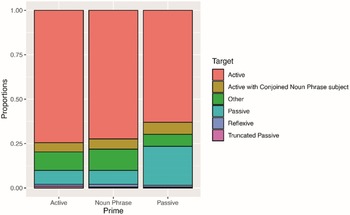
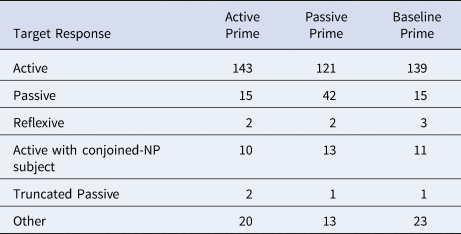
Out of the 576 responses, 403 were scored as “active” (70%), 72 as “passive” (12.5%), 7 as “reflexive” (1.2%), 34 as “active with conjoined-NP subject” (5.9%), 4 as “truncated passive” (0.7%) and 56 as “other” (9.7%). Proportions of the different target responses are shown in Figure 2. The proportions are similar to those observed in Experiment 1, with the notable difference that “active with conjoined-NP subject” responses were significantly increased in this experiment. Still, their distribution does not point to any significant trends. Table 3 depicts the frequency of observing each response after each prime. It shows that passives increased after passive primes and actives comprised the majority of responses across conditions.
The proportion of Target responses per Prime Condition (Experiment 2).

The frequency of Target responses per Prime Condition (out of 576 target responses).

As before, all instances of “other” responses were omitted from the analysis, so that the outcome variable was binomial, denoting active or passive responses. Analyses were carried out using generalised mixed effects models and following the same procedure in operationalising variables, building and choosing models as the one described in Experiment 1.
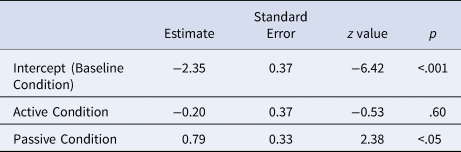
To test the main question of whether passive structures can be primed from L1-Greek to L2-English, a generalised mixed effects model was constructed, containing “target structure” as the outcome variable and “prime condition” as the predictor. The final model also included random intercepts by participant and by item, but no random slopes. Table 4 shows that passives were more likely to be observed after a passive prime (8.84%) than after a baseline prime (3.16%). The probability (in log-odd units) of a passive response did not differ between the active (3.16%) and the baseline (3.16%) prime condition. The random-effects variance and 95% Confidence Intervals can be found in Table S2. Releveling the predictor revealed that the probability of a passive response increased significantly after passive relative to active primes (β = 1.72, z = 4.12, p < .001).
Generalised mixed effects model showing the probability (in log-odds) of producing a passive sentence as predicted by Prime Condition. The intercept represents the log-odds of passive responses in the Baseline Condition.

Final Model: m2 <- glmer (target ~ relevel (prime, “NP”) + (1|ID) + (1|item), family = binomial)
Combined analysis of experiments 1 and 2
Since priming was observed both within- and between-languages, we also addressed the question of whether there is a difference in the strength of priming effects. To test whether passive priming was greater within the L1 or from the L1 to the L2 (or if the effect had the same magnitude in both experiments), a generalised mixed effects model was used. As in the previous analyses, the outcome was “target structure”, and three early-bilingual participants were excluded from the analysis (due to their diverging from our target population of Greek–English bilinguals). Critically, the predictor variables in this analysis were “prime condition” and “experiment” – the latter being a new, binomial variable indicating the experiment from which each response was obtained. Models were built incrementally, first including the two predictors as fixed effects without interaction and then also adding their interaction. The latter model was not an improvement over the first one (x2 (2) = 3.53, p = .17), meaning the interaction was not significant and there was no difference in the strength of passive priming between experiments. The final modelFootnote 1 showed significant passive priming in the passive condition relative to the baseline (β = 1.24, z = 4.71, p < .001), as observed in the previous analyses, but no significant difference in the overall proportion of passive responses between the two experiments (β = -.23, z = -.46, p = .65).
Discussion
Experiment 2 showed that participants produced significantly more English passive sentences after Greek passive primes than after Greek active or baseline primes, indicating that passive structures can be primed cross-linguistically from L1-Greek to L2-English. For example, participants were more likely to produce The swimmer is pushed by the trainer after listening to I prigipisa filiete apo ton ipoti (“The princess kisses-PASSIVE by the knight”), than after O ipotis filaei tin prigipisa (“The knight kisses-ACTIVE the princess”) or after O ipotis kai i prigipisa (“The knight and the princess”). Another notable observation was of the percentage of active structures with subjects in the plural and no object (5.9% of all responses included in the descriptive analysis) – as such, structures could be attributed a reflexive reading and thus reveal activation of the featural node of voice morphology due to the non-active morphology in Greek passive primes. However, these responses exhibited no significant trend across prime conditions, meaning that there was no featural effect in the syntactic priming of passive constructions.
As in Experiment 1, English actives were not primed significantly in relation to the baseline, but this can be attributed to active responses constituting the preferred structure across conditions (as shown in Table 3), most likely because they are the preferred transitive structure in English too (e.g., Bock & Griffin, Reference Bock and Griffin2000). Overall, the results support our first hypothesis, according to which the occurrence of passive priming within- and between-languages indicates that these structures are represented as a single structure in Greek–English bilinguals. This suggests that differences in the verb-internal structure do not prevent passive constructions from being shared.
Furthermore, we examined whether priming would be as strong within- as between-languages if the same combinatorial node is activated in both cases (e.g., Kantola & van Gompel, Reference Kantola and van Gompel2011). For this reason, additional analysis was conducted on both experiments. Results showed no significant difference in the magnitude of passive priming between the experiments. This means that priming of passive structures was equivalent within-Greek and from L1-Greek to L2-English, which provides additional support for the shared-syntax account. Lastly, there was no evidence of a featural effect (of voice morphology) on syntactic priming, at least not in the present study, where neither the primes nor the fillers activated any of the other structures linked to non-active morphology.
General discussion
In this study, we examined the degree of similarity needed for structures from different languages to be stored as a single representation in bilinguals. Specifically, we investigated how voice morphology and differences in the verb-internal structure of Greek and English passive constructions might affect priming. The two languages differ in the realisation of the passive verb due to the morphological specification of non-active morphology in L1-Greek verbs. Two structural priming experiments were used to address this question: one within-Greek experiment, which showed that passive sentences were primed in L1-Greek, and one cross-linguistic experiment, which showed that passive sentences were primed from L1-Greek to L2-English. Lastly, a combined analysis of the two experiments revealed that passive priming did not significantly differ between the two.
The results support our first prediction, which is based on the shared-syntax account (Hartsuiker et al., Reference Hartsuiker, Pickering and Veltkamp2004) and suggests that syntactic representations of passive constructions are shared in Greek–English bilinguals. This means that differences in verb-internal constituent structure did not prevent cross-linguistic priming, and that featural information and passivisation restrictions of Greek passives did not prevent either within- or between-language priming. Despite the passive priming observed, our prediction concerning active priming was not confirmed: active sentences did not receive significant priming in relation to the baseline condition of conjoined-NP primes. This finding is most likely related to the active being the preferred transitive structure, but also links our results to an inverse-preference effect. Implications of our findings are discussed in more detail below.
Shared syntax and structure similarity
Our finding of a cross-linguistic priming effect for passives, which was also of the same magnitude as within-L1 passive priming, supports the predictions of the shared-syntax account (Hartsuiker et al., Reference Hartsuiker, Pickering and Veltkamp2004). As described in the beginning of the article, the shared-syntax account posits that, in bilinguals’ minds, lexical entries from different languages are connected to the same combinatorial node when the structures, in which each lexical entry can occur, are identical across languages (Hartsuiker & Pickering, Reference Hartsuiker and Pickering2008; Hartsuiker et al., Reference Hartsuiker, Pickering and Veltkamp2004). The combinatorial nodes are abstract syntactic representations connected to the lemma level – that is, the part of a lexical entry that contains information about the kinds of structures in which each lexical entry can be used (Pickering & Branigan, Reference Pickering and Branigan1998). Finally, the shared-syntax account further posits that the combinatorial nodes are language-independent, since they represent abstract syntactic structures irrespective of the language in which they can be used (Hartsuiker et al., Reference Hartsuiker, Pickering and Veltkamp2004). Therefore, this account also predicts the equal magnitude of priming within and across languages (Hartsuiker et al., Reference Hartsuiker, Beerts, Loncke, Desmet and Bernolet2016; Kantola & van Gompel, Reference Kantola and van Gompel2011) that was also observed in the present study.
Our results therefore indicate that Greek and English transitive verbs are linked to the same combinatorial node that represents NP-VP-PP passive constructions and is language-independent. This is despite differences in the verb-internal structure, which consists of the main verb in Greek (morphologically marked as non-active) but contains the verb “to be” and the past participle of the main verb in English. For example, the Greek verb sprohno (“push”) and the English verb push can both be used in a passive construction. Given that priming was observed from L1-Greek to L2-English, it seems that the two verbs are connected to the same passive node, as both can be used in a passive structure of the form NP-VP-PP. It can also be inferred that this passive node signifies a passive construction in general or that the passive verb should be followed by a PP denoting the agent. There seems to be no syntactic node specifying the realisation of the passive verb as one or two words. Such specification would differ in the language combination we examined and might have prevented or decreased the cross-linguistic priming effect.
We can also infer that featural nodes do not affect the activation of combinatorial nodes – at least, not to a significant degree. The polysemous nature of Greek non-active morphology, which is connected to reflexives and anti-causatives in addition to the passive, did not prevent the syntactic priming of passive Greek and English constructions. Our results are in accordance with findings from monolingual priming (Pickering & Branigan, Reference Pickering and Branigan1998), in which syntactic priming of POs and DOs occurred despite differences in featural-node verbal information such as tense, aspect, and number.
Further to the topic of non-active morphology, it is possible that our experimental stimuli favoured the activation of the passive to a greater degree than that of reflexives. The stimuli in our critical targets clearly depicted one entity performing an action and the other receiving the action, so that we could observe participants’ choices between active and passive. Additionally, the critical verbs were chosen from a category of verbs for which a passive reading is more likely (Terzi et al., Reference Terzi, Marinis, Kotsopoulou and Francis2014), to counteract the markedness of passive structures in Greek. Therefore, the small proportion of reflexive structures produced (3.3% of all critical responses in the L1-Greek experiment, 1.2% in the L1-Greek-L2-English experiment) might be enough to show a small degree of featural information activation, if we assume that the reflexives produced were activated by the non-active morphology of the passive primes. However, the distribution of reflexive responses showed no immediate priming effect from the passive primes, which further supports our conclusion that featural nodes do not interfere with the activation of combinatorial nodes. That said, further research would need to specify the conditions for such morphological priming and the possibility of cumulative rather than immediate effects in its occurrence.
The occurrence of passive priming despite differences in the verb-internal constituent structure is also in agreement with previous priming studies. Pickering and Branigan found no effect of verb-internal constituent structure in the L1-English priming of POs and DOs (1998). Internal constituent structure also did not prevent the cross-linguistic priming of genitive structures from L1-Dutch to L2-English (Bernolet et al., Reference Bernolet, Hartsuiker and Pickering2013). The differences between genitives in Bernolet et al. (Reference Bernolet, Hartsuiker and Pickering2013) and passives in the current study can be considered equivalent, as both involve the morphological marking of a structure in one language and the inclusion of one fewer word within the critical structure than in the other language. It should be noted that priming occurred from the morphologically marked structure to the structurally complex one in the present study, while the reverse occurred in Bernolet et al. (Reference Bernolet, Hartsuiker and Pickering2013). Our study therefore extends the findings from NP genitives to the VP in passive constructions.
Lastly, our finding of equal priming within and across languages is in accordance with the shared-syntax account (Hartsuiker & Pickering, Reference Hartsuiker and Pickering2008) and previous related studies (e.g., Kantola & van Gompel, Reference Kantola and van Gompel2011), but at the same time diverges from findings of weaker cross-linguistic priming (Cacoullos & Travis, Reference Cacoullos and Travis2018; Cai et al., Reference Cai, Pickering, Yan and Branigan2011; Travis et al., Reference Travis, Cacoullos and Kidd2017). The latter studies are not directly comparable to the current one, given differences in the structures investigated, the target population, and experimental versus spontaneous-speech data. However, an explanation worth exploring in future studies is that structure-preference might be playing a role, such that priming may be modulated by the probability of each target lexical item appearing in one of the two structures tested (Cacoullos & Travis, Reference Cacoullos and Travis2018; Travis et al., Reference Travis, Cacoullos and Kidd2017). Evidence of this has also been reported in a monolingual corpus-based study conducted by Gries (Reference Gries2005) on the verbs used in Pickering and Branigan's (Reference Pickering and Branigan1998) study. Although the overall priming effect was not determined by this distinction, it was clear in individual lexical items that a verb often occurring in one of the two alternative constructions (POs and DOs) tended to be produced in its “preferred” construction, thus “resisting” priming (Gries, Reference Gries2005).
Active priming and preference effects
Another noteworthy finding is the lack of a significant priming effect for active structures. Specifically, actives did not significantly increase in the active prime condition when compared to the baseline (although the difference was significant when compared to the passive condition). However, the lack of a priming effect does not disprove our hypothesis that Greek and English active structures are shared. After all, their word order is identical, and the passive priming observed suggests that the morphological marking of syntactic roles in Greek does not affect cross-linguistic priming. The lack of an active priming effect was most likely due to the active being the preferred response across conditions. This means that participants could not be primed to produce actives to a greater extent than they were already using them.
On the other hand, passive responses were much fewer in the active and baseline conditions but increased significantly after participants had repeated a passive prime. This is in accordance with previous research (e.g., Bernolet et al., Reference Bernolet, Hartsuiker and Pickering2007; Bock, Reference Bock1986) suggesting that less preferred structures, in this case the passive, are primed to a greater extent than more preferred ones, in this case the active, in what is termed the inverse-preference effect (Ferreira & Bock, Reference Ferreira and Bock2006). Moreover, it is noteworthy that the passive priming effect in both experiments was smaller in relation to previous studies investigating the passive in other language combinations (e.g., Fleischer et al., Reference Fleischer, Pickering and McLean2012; Hartsuiker et al., Reference Hartsuiker, Pickering and Veltkamp2004). This discrepancy may be another reflection of the markedly lower preference for passive constructions in L1-Greek, or of the fact that non-active morphology also gives rise to other readings. The latter might be suggested by the production of some reflexive target responses in both experiments. Of course, differences in the sample population and materials among the various studies could offer an alternative explanation for the smaller priming effects observed in the present study.
Limitations and future research
One factor that might have affected the results is that some participants (in both experiments) mentioned having noticed the use of the passive in the Greek primes. This may be a result of the passive being a very infrequent, even marked, structure in Greek, or the instructions stating that we were interested in how people process and produce sentences. This could have led to a greater use of the passive than would otherwise be observed, although the small proportion of passives overall (approximately 13% of responses in each experiment) suggests such an effect might not have been great (cf. Bernolet, Collina & Hartsuiker, Reference Bernolet, Collina and Hartsuiker2016 for an explicit-memory priming task).
Further research would need to confirm whether results were affected by explicit memory of the prime – for example, by using the confederate-scripted dialogue paradigm. This is used to prevent participants from paying attention to the sentence structure, with the priming occurring in the pretext of a picture-matching game between participants and a confederate (Branigan et al., Reference Branigan, Pickering and Cleland2000). An additional measure would be to include fillers between prime and target, as it has been claimed that explicit memory of the prime structure at least partly affects priming whenever the target immediately follows the prime (Bernolet et al., Reference Bernolet, Collina and Hartsuiker2016).
Returning to the predictions of the shared-syntax account, our study provides evidence for shared passive representations by eliciting priming within-L1 and from L1-Greek to L2-English. Future research would also need to examine within-L2 and L2-L1 priming to confirm that passive representations are shared in Greek–English bilinguals (Schoonbaert et al., Reference Schoonbaert, Hartsuiker and Pickering2007). Furthermore, one of our anonymous reviewers pointed out that the syntactic priming observed in the current study could also be attributed to a transfer effect. Even though we postulate that transfer effects should be insignificant given our participants’ high proficiency in L2-English, future studies should also address this possibility – for instance, by adding proficiency as a predictor variable and accuracy or errors as an outcome variable to the experimental design.
Conclusion
To summarise, priming of passive sentences was observed in two structural priming experiments that involved priming in L1-Greek and from L1-Greek to L2-English. Additionally, the priming effect did not differ within- and between-languages. These findings agree with the predictions of the shared-syntax account, which posits that cross-linguistic priming is observed when structural representations from the two languages of a bilingual are shared. This suggests that the same structural representation is activated when a Greek or an English passive sentence is produced, despite differences at the featural level and in the passive realisation of Greek and English verbs. Therefore, our findings indicate that passive structures can be shared across languages despite differences in the morphosyntax of the VP, thus extending our understanding of the degree to which different-language structures need to be identical to be represented as a single structure.
Supplementary Materials
For supplementary material accompanying this paper, visit https://doi.org/10.1017/S136672892200027X
Table S1: Random-effects variance, fixed-effects estimates, and 95% Confidence Intervals for Experiment 1.
Table S2: Random-effects variance, fixed-effects estimates, and 95% Confidence Intervals for Experiment 2.
Appendix S1: A list of the critical prime-target pairs used in the experiments, including all three prime conditions and a description of each target picture.
Acknowledgements
This research was supported by the School of Philosophy, Psychology and Language Sciences as part of the first author's MSc. Sotiria Kotzochampou would also like to acknowledge support from the Drever Trust MSc Postgraduate Scholarship in undertaking the degree programme.