Gratitude pertains to “a generalized tendency to recognize and respond with grateful emotion to the roles of other people’s benevolence in the positive experiences and outcomes that one obtains” (McCullough, Emmons, & Tsang, Reference McCullough, Emmons and Tsang2002, p. 112). To assess individual differences in gratitude, McCullough et al. (Reference McCullough, Emmons and Tsang2002) developed the Gratitude Questionnaire-Six Item Form (GQ-6), a six-item self-report measure of gratitude. The authors found that GQ-6 yielded excellent psychometric properties across university and adult samples. Other studies have found that the scores from GQ-6 were valid and reliable in a sample American middle to high school students (Froh et al., Reference Froh, Fan, Emmons, Bono, Huebner and Watkins2011b) and adult samples (Kashdan, Mishra, Breen, & Froh, Reference Kashdan, Mishra, Breen and Froh2009).
Previous research indicates that gratitude is associated with a wide range of positive psychological outcomes (see Renshaw & Steeves, Reference Renshaw and Steeves2016 for a review). Gratitude is linked to higher positive affect (McCullough et al., Reference McCullough, Emmons and Tsang2002) and life satisfaction (Datu, Reference Datu2014; Datu & Mateo, Reference Datu and Mateo2015; Froh, Emmons, Card, Bono, & Wilson, 2011; McCullough et al., Reference McCullough, Emmons and Tsang2002; Wood, Joseph, & Maltby, Reference Wood, Joseph and Maltby2008; 2009). Conversely, gratitude is associated with lower depression (Froh et al., 2011a; Froh et al., Reference Froh, Fan, Emmons, Bono, Huebner and Watkins2011b; McCullough et al., Reference McCullough, Emmons and Tsang2002), negative affect (Emmons & McCullough, Reference Emmons and McCullough2003; Froh, Sefick, & Emmons, Reference Froh, Sefick and Emmons2008) and stress (McCullough et al., Reference McCullough, Emmons and Tsang2002; Wood, Maltby, Gillett, Linley, & Joseph, Reference Wood, Joseph and Maltby2008). To explore the beneficial value of gratitude in the educational context, Froh et al. (Reference Froh, Emmons, Card, Bono and Wilson2011a) assessed the association of gratitude with academic outcomes and found that grateful students are likely to get higher grades and achieve greater well-being. These findings point to the importance of giving attention to non-academic skills such as gratitude to improve students’ well-being which may also contribute to their academic performance.
The broaden-and-build theory (Fredrickson, Reference Fredrickson2001) is one of the potential frameworks that can explain why gratitude may be associated with optimal psychological outcomes. The model argues that positive emotional states (i.e., feeling grateful) are valuable because they enable broadening of thought-action repertoires that are essential in acquiring durable physical, social, and psychological resources. As feeling grateful involves the appreciation of relevant things, people, or events, it is likely that this affective state may foster a positive mindset that can catalyze durable resources (i.e., resilience and physical health). In the current study, we operationalized gratitude as a positive affective state that may build important educational resources like academic achievement and motivation.
Despite the bulk of evidence regarding the theoretical value of the gratitude construct, limited research has been done to evaluate the psychometric properties of GQ-6. Limited research was also conducted that assessed the linkage of gratitude to academic outcomes especially in non-Western and collectivist settings (i.e., Philippines). Previous studies primarily focused on GQ-6’s factor structure and its association with well-being outcomes (i.e., mainland Chinese, Taiwanese, and Filipino samples; Chen, Chen, Kee, & Tsai, Reference Chen, Chen, Kee and Tsai2009; Chen & Kee, Reference Chen and Kee2008; Datu, Reference Datu2014; Datu & Mateo, Reference Datu and Mateo2015; Zeng, Ling, Huebner, He, & Lei, Reference Zeng, Ling, Huebner, He and Lei2017).
Of these studies, only the studies of Chen et al. (Reference Chen, Chen, Kee and Tsai2009) and Zeng et al. (Reference Zeng, Ling, Huebner, He and Lei2017) have examined the validity and reliability of the GQ-6 among Taiwanese undergraduate students and Chinese middle school students respectively. Contrary to what has been found in the existing literature, Chen et al. (Reference Chen, Chen, Kee and Tsai2009) shows that the 5-item version of the gratitude questionnaire (GQ-5) yielded more superior psychometric properties (CFI = .99; SRMR = .02; RMSEA = .07) than the original 6-item version of the scale. In particular, item no. 6 (“Long amounts of time can go by before I feel grateful to something or someone”) was removed because the scores from the 6-item scale yielded poor fit indices (e.g., Comparative Fit Index or CFI = .94; Standardized Root Mean Squared Residual or SRMR = .07; Root Mean Square Error of Approximation or RMSEA = .12). Furthermore, Zeng et al. (Reference Zeng, Ling, Huebner, He and Lei2017) have offered an additional evidence about the psychometric validity, reliability, and gender invariance of GQ-5 in a sample of Chinese middle school students. The authors have also shown that gratitude was associated with higher extent of hope and students’ life satisfaction.
Similarly, Langer, Ulloa, Aguilar-Parra, Araya-Véliz, and Brito (Reference Langer, Ulloa, Aguilar-Parra, Araya-Véliz and Brito2016) have examined the psychometric properties of the GQ-6 and GQ-5. Specifically, in a sample of Chilean adult and adolescents, they have found that the scores from the GQ-5 had better fit than the GQ-6. They have also demonstrated that gratitude is linked to lower levels of depression and higher levels of subjective happiness.
Furthermore, as previous studies concentrated on exploring the association of gratitude with school adjustment and well-being outcomes, Renshaw and Steeves (Reference Renshaw and Steeves2016) point out that “there is little evidence to suggest that gratitude in youth has practically meaningful associations with performance-based or informant-rated variables that educators and school psychologists tend to value” (p. 300). Although Froh et al. (Reference Froh, Fan, Emmons, Bono, Huebner and Watkins2011b) have assessed the relationship between gratitude and academic outcomes in the Western context, the study did not explicitly examine the factorial validity of the gratitude questionnaire. Clearly, more research is needed to assess the linkage of gratitude to relevant educational outcomes.
Therefore, the primary objective of the study was to assess the psychometric properties and gender invariance of GQ-6 through a construct validation approach (Martin, Reference Martin2007) among Filipino secondary school students. This validation technique involves examining the within-network validity (through confirmatory factor analyses and reliability analyses) and between-network validity (exploring the correlation of gratitude with academic motivation and achievement) of the GQ-6. Unlike previous validation studies that focused on examining how gratitude was related to well-being indices to provide evidence about the scale’s criterion related validity (Chen et al., Reference Chen, Chen, Kee and Tsai2009; Langer et al., Reference Langer, Ulloa, Aguilar-Parra, Araya-Véliz and Brito2016), our study assessed the association of gratitude with amotivation, controlled, and autonomous motivation. Amotivation refers to lack or absence of motivation to engage in academic task (Deci & Ryan, Reference Deci and Ryan2000). Controlled motivation pertains to one’s drive to perform academic activities due to extrinsic reasons such as getting external incentives, avoiding punishment, or feeling guilt for not doing a specific task (Shahar, Henrich, Blatt, Ryan, & Little, Reference Shahar, Henrich, Blatt, Ryan and Little2003). Autonomous motivation refers to a drive to accomplish academic tasks for the sake of having personal fulfillment (Shahar et al., Reference Shahar, Henrich, Blatt, Ryan and Little2003).
We hypothesized that gratitude would be positively associated with autonomous motivation, controlled motivation, and academic achievement because the broaden-and-build theory (Fredrickson, Reference Fredrickson2001) argues that positive affective states like feeling grateful may not only broaden mindsets but will also promote approach-related behaviors and durable resources. Alternatively, gratitude would be negatively linked to amotivation.
Methods
Participants
There were 383 Filipino high school students from a public secondary school who participated in the research. The average of the participants was 14.23 (SD = 1.92). There were 172 boys and 211 girls. The sample was composed of 107 grade 7, 81 grade 8, 116 grade 9, and 79 grade 10 students.
Procedures
The third author sought approval from the school administrators (i.e., principal and subject area coordinator) to collect data from the secondary school. After getting the approval from the school, parents were given passive consent forms and each student-participant was given an active consent form. Then, the questionnaire on gratitude and academic motivation were administered.
Measures
Gratitude
The GQ-6 (McCullough et al., Reference McCullough, Emmons and Tsang2002) was used to assess gratitude. The items were marked on a 7-point likert scale (1 = Strongly disagree; 7 = Strongly agree). Here is a sample item in the scale: “I feel thankful for what I have received in life.”
Academic motivation
The 22-item Academic Motivation Scale (Caleon et al., Reference Caleon, Wui, Tan, Chiam, Soon and King2015) was utilized to measure amotivation, controlled, and autonomous motivation. Items were rated on a 7-point likert scale (1 = Very untrue of me; 7 = Very true of me). Here are sample items in the scale: “Honestly I don’t know, I really feel that I am wasting my time in school” (amotivation); “Because I feel happy and satisfied when learning new things” (autonomous); and “Because when I succeed in school, I feel important” (controlled). The Cronbach’s alpha reliability coefficients of the subscales were: amotivation (α .86), controlled motivation (α .85), and autonomous motivation (α .92).
The English versions of the questionnaires were used in the study.
Academic achievement
The participants’ actual grade point average on all the subjects (English, Math, Science, Filipino, Social Sciences, etc.) in third grading period of the school year was collected from the objective school record of their respective class advisers. The grade point average ranged from 0–100 with higher ratings indicating better academic achievement.
Data analyses
We calculated the descriptive statistical values, reliability coefficients, along with the skewness and kurtoses of all the items in GQ-6 using the 23rd version of Statistical Package for the Social Sciences (SPSS). Next, we conducted confirmatory factor analyses (CFA) via the 23rd version of Analysis of Moment Structures (AMOS) to assess the applicability of the hypothesized and alternative measurement models in the present sample. Consistent to what have been carried out in previous validation studies (Datu, Reference Datu2015; King, Ganotice, & Watkins, Reference King, Ganotice and Watkins2012), we randomly divided our sample into exploratory (n = 192) and cross-validation (n = 191) samples. Then, the model with better fit indices has been tested in the total sample (n = 383). Model 1, which involved a single-factor model with six item indicators (representing the original GQ-6 items), was tested in the exploratory sample. Consistent with the findings of Chen et al. (Reference Chen, Chen, Kee and Tsai2009), an alternative model of gratitude was tested in the cross-validation sample (Model 2) which involved a single-factor model with five item indicators. Based on the results of CFA for exploratory and cross-validation samples, the measurement model with better fit was tested to the total sample. To evaluate the fit of the proposed measurement models, we relied on the criteria of Byrne (Reference Byrne2001) which recommended the following cut-off values: a) goodness of fit index (GFI), comparative fit index (CFI), Tucker Lewis index (TLI) were lower than .90; and b) Root mean square error of approximation (RMSEA) was higher than .08. We also tested whether gratitude would have the same meaning across gender through multi-group CFA. In particular, we assessed the following degree of invariance were achieved: a) configural invariance (equal number of factors and pattern-indicator loading); b) metric invariance (equal factor loading); c) scalar invariance (equal factor variance and covariance); and d) residual variance invariance (equal error variance and covariance). Consistent with one of the recommended criteria of Chen (Reference Chen2007), we concluded that invariance was met if the change in RMSEA is lower than .01. To examine between-network construct validity, we performed regression analyses using SPSS to assess the extent to which gratitude may be associated with academic achievement and motivation after controlling for the potential effects of age and gender.
Results
A review of the item descriptive statistics showed that the skewness and kurtosis values did not exceed 2 and 7, indications that there were no severe violations of normality (Finney & DiStefano, Reference Finney, DiStefano, Hancock and Mueller2006). Even the Mahalanobis distance values indicate absence of multivariate outliers. Hence, we performed confirmatory factor analyses (CFA) through maximum likelihood estimation approach since the preliminary analyses suggest that the dataset appears to be normally distributed.
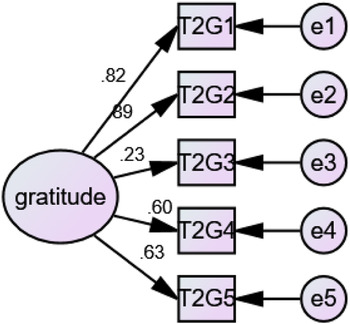
To assess the within-network validity of the GQ-6, we conducted separate CFA across our randomly divided exploratory (n = 192), cross-validation (n = 191), and total (n = 383) samples (See Table 1). Results of CFA in the 6-item version of the GQ-6 (Model 1) in the exploratory sample showed low fit: χ2 = 52.49, df = 9, p < .001, CFI = .89, GFI = .92, TLI = .81, and RMSEA = .16 (.12 – .20). The alternative model (Model 2) after removing item 6 (“Long amounts of time can go by before I feel grateful to something or someone.”) yielded better fit than the hypothesized model: χ2 = 14.28, df = 5, p < .001, CFI = .97, GFI = .97, TLI = .93, and RMSEA = .08 (.04 – .16). Hence, we adopted the alternative model and tested it to our total sample. The results of CFA for the total sample (Model 3; See Figure 1) showed a good fit: χ2 = 20.70, df = 5, p < .001, CFI = .98, GFI = .98, TLI = .95, and RMSEA = .08 (.05 – .13). The fit indices of the abovementioned models are shown in Table 1. All the items significantly loaded at p < .001.
Confirmatory factor analyses of the GQ6

Final measurement model of gratitude.

Multi-group CFA was conducted to examine gender invariance of Model 2 in the current sample. The results demonstrated the scores from the 5-item version of the gratitude questionnaire exhibited configural, metric, scalar, and residual variance invariance as the differences in RMSEA (∆RMSEA) were less than .01 (See Table 2).
Invariance of the gratitude across gender

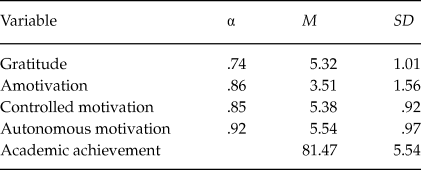
The scale had also a moderate Cronbach’s reliability coefficient (α = .74). Results of descriptive statistical and reliability analyses are shown in Table 3.
Descriptive statistics and reliability coefficients of the scales

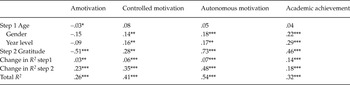
In terms of between-network construct validity, the results of hierarchical regression analyses showed that gratitude was associated with higher degree of autonomous motivation β = .73, p < .001, controlled motivation β = .28, p < .001, and academic achievement β = .43, p < .001 even after controlling for age, gender, and year level (See Table 4). Conversely, gratitude was linked to lower levels of amotivation β = –.51, p < .001 after controlling for the aforementioned demographic variables. These findings indicate that gratitude accounted for 7.84% to 53.29% of the variance in academic achievement and motivation. Conversion of the coefficients of determination values to Cohen’s d showed that the effect sizes between gratitude and academic outcomes ranged from d = .58 to d = 2.14. The magnitude of effect sizes may be interpreted as medium to large effects with reference to the criteria of Cohen (Reference Cohen1988).
Gratitude as a predictor of academic motivation and achievement

* *p < .01, *** p < .001.
Discussion
The main objective of our study was to assess the psychometric validity and gender invariance of the Gratitude Questionnaire-Six Item Form (GQ-6) in Filipino high school students through a construct validation approach. Results of the study corroborated with our theoretical expectations and existing literature on gratitude measurement.
Consistent with the existing line of evidence on the validity of gratitude questionnaires in collectivist societies (Chen et al., Reference Chen, Chen, Kee and Tsai2009; Langer et al., Reference Langer, Ulloa, Aguilar-Parra, Araya-Véliz and Brito2016; Zeng et al., Reference Zeng, Ling, Huebner, He and Lei2017), results of within-network construct validity indicated that compared to the original 6-item version of the gratitude questionnaire, the 5-item version of the scale appears to be more applicable to secondary school students especially in the Philippine setting. Our study also demonstrated that the scores from GQ-5 were reliable and invariant across gender which corroborated the results in previous investigations (Langer et al., Reference Langer, Ulloa, Aguilar-Parra, Araya-Véliz and Brito2016; Zeng et al., Reference Zeng, Ling, Huebner, He and Lei2017). This indicates that gratitude may hold similar meaning for boys and girls in a collectivist context.
Similar to what has been found in the Western context (Froh et al., Reference Froh, Emmons, Card, Bono and Wilson2011a), our research showed that gratitude was associated with higher academic achievement. However, our study addressed the methodological gap in the investigation study of gratitude through using school records as a measure of academic performance. Furthermore, our study demonstrated that gratitude may be linked to autonomous motivation. To the best of our knowledge, this was the first study that utilized academic motivation and achievement about the criterion-related validity of GQ-5.
The positive association of gratitude with adaptive motivational orientations (e.g., autonomous motivation) and achievement corroborated the existing literature on the beneficial impact of gratitude in the school context (Datu, Reference Datu2014; Datu & Mateo, Reference Datu and Mateo2015; Froh et al., Reference Froh, Emmons, Card, Bono and Wilson2011a; Froh et al., Reference Froh, Fan, Emmons, Bono, Huebner and Watkins2011b; Langer et al., Reference Langer, Ulloa, Aguilar-Parra, Araya-Véliz and Brito2016; McCullough et al., Reference McCullough, Emmons and Tsang2002; Renshaw & Steeves, Reference Renshaw and Steeves2016; Wood et al., Reference Wood, Maltby, Gillett, Linley and Joseph2008; Reference Wood, Joseph and Maltby2009; Zeng et al., Reference Zeng, Ling, Huebner, He and Lei2017). These results also supported the broaden-and-build theory (Fredrickson, Reference Fredrickson2001) which proposes that positive affective conditions (i.e., feeling of gratefulness) are valuable because these emotions can broaden mindsets and build essential resources that individuals can use in dealing with a wide range of real-life challenges.
Gratitude was also linked to higher controlled motivation. It is possible that gratitude may be associated with inclinations to study for external rewards and avoidance of guilt (controlled motivational orientation) because previous literature suggests that the extrinsic forms of motivation have advantageous impact in interdependent cultures (King & McInerney, Reference King and McInerney2014). Hence, it is likely that the extrinsic motivational orientation afforded by having greater gratitude may not always stunt positive academic functioning especially for students who are accustomed to cultures that reward socially-oriented academic motivation.
Our study has some limitations. The correlational nature of the study precludes us from forwarding causal conclusions between gratitude and educational outcomes. Future research can address this through adopting longitudinal and experimental designs to assess the linkage of gratitude to academic functioning. Furthermore, the between-network construct validation only concentrated on the association of gratitude with academic achievement and motivation. Hence, future studies are recommended to assess the link of gratitude to other under-explored educational outcomes like academic adjustment, academic resilience, and academic engagement to offer extensive insights about nomological network of gratitude in secondary student samples. As the study recruited Filipino secondary school students, the results may have limited generalizability for high school students in other collectivist societies. This can be addressed in future investigations through recruiting participants from other non-Western contexts (i.e., Japan, Vietnam, and South Korea). Investigating the measurement invariance of the GQ-5 in individualist and collectivist societies is an essential direction to provide evidence about the cross-cultural generalizability of this measure across cultures. Longitudinal validation of the GQ-5 is also needed to assess whether gratitude holds the same meaning over time in secondary school students.
Nonetheless, our study offers theoretical and practical implications. In terms of theory, our study contributed to the existing gratitude literature through demonstrating that the scores from GQ-5 was valid, reliable, and invariant across gender among high school students in the Philippine setting. We also offered new insights regarding the criterion-related validity of the GQ-5 as we concentrated on assessing how gratitude was related to academic achievement and motivation while previous validation studies (Chen et al., Reference Chen, Chen, Kee and Tsai2009; Langer et al., Reference Langer, Ulloa, Aguilar-Parra, Araya-Véliz and Brito2016; Zeng et al., Reference Zeng, Ling, Huebner, He and Lei2017) have explored the link of gratitude to well-being indices. Regarding practice, psychologists, counselors, and other allied health professional are recommended to use the 5-item version of the gratitude questionnaire when assessing the grateful dispositions of secondary school students in non-Western settings. The findings of between-network construct validation indicate that gratitude may be linked to higher academic achievement and motivation. This implies that aside from focusing on improving students’ cognitive abilities, schools should also give attention in enhancing students’ feeling of gratitude to develop their socio-emotional skills, increase their psychological well-being, and improve their academic performance. Psychologists and counselors are recommended to explore the possibility of cultivating non-cognitive traits (i.e., gratitude, grit, hope, and courage) when designing psychological programs for secondary school students.