Carrot is a poor competitor with weeds because of its slow emergence and early-season growth. In the process of establishing a critical weed-free period in carrot, Swanton et al. (Reference Swanton, O’Sullivan and Robinson2010) reported 92% to 100% yield loss in when weeds were left uncontrolled compared to a weed-free crop. Poor competitiveness was exacerbated by early carrot planting. When the carrot crop was seeded in April, the critical weed-free period was through the 12-leaf carrot growth stage, or 930 growing degree days. Soares et al. (Reference Soares, Freitas, Negreiros, Freire, Aroucha, Grangeiro, Lopes and Dombroski2010) established a critical weed-free period of 36 d after emergence and reported that root total soluble solids and vitamin C content weren’t influenced by weed interference, however it should be noted that this work involved a single carrot variety. Williams and Boydston (Reference Williams and Boydston2006) also investigated the critical weed-free period in carrot, but with volunteer potato as the subject weed, a situation unique to the local crop rotation. They observed that a volunteer potato density as low as 0.06 plants m−2 reduced carrot yield by 5%.
In addition to the poor competitiveness of carrot, the reliance on repeated linuron applications for the majority of carrot weed control in US production has selected for resistant weeds. Linuron resistance was documented as early as 1984 and has now been confirmed in eight weed species. Over half of the cases of linuron-resistant weeds were first documented in carrot production, including Powell amaranth (Amaranthus powellii S. Wats.), redroot pigweed (Amaranthus retroflexus L.), common ragweed (Ambrosia artemisiifolia L.), common purslane (Portulaca oleracea L.), and common groundsel (Senecio vulgaris L.) (Heap Reference Heap2016). Moreover, linuron use is restricted on coarse-textured, low organic matter soils where groundwater depth is shallow. Carrot production on such soils is desirable given that the coarse texture allows uniform root development.
Selection of crop varieties that tolerate or suppress weeds can be used as a management tactic with no additional energy input. Studies involving crops other than carrot have investigated the relationship between plant structure and competitiveness with weeds among crop varieties, and in most cases the investigators report differences in the ability to suppress weeds or maintain yield in the presence of weeds (Begna et al. Reference Begna, Hamilton, Dwyer, Stewart, Cloutier, Assemat, Foroutan-pour and Smith2001, Bussan et al. Reference Bussan, Burnside, Orf, Ristau and Puettmann1997, Callaway Reference Callaway1992, Didon Reference Didon2002, Traore et al. Reference Traore, Lindquist, Mason, Martin and Mortensen2002, Lindquist and Mortensen Reference Lindquist and Mortensen1998). In carrot, work in this area is limited to a single study reported by William and Warren (Reference William and Warren1975), in which the authors compared the ability of the varieties ‘Kuroda’ and ‘Nantes’ to tolerate high populations of purple nutsedge (Cyperus rotundus L.). Yield loss attributed to purple nutsedge was less for Kuroda (39%) than it was for Nantes (50%), although Nantes carrot yield was greater in both weedy and weed-free conditions. Kuroda has more top growth than Nantes, but this research suggested that it may come at the cost of root yield.
Trade-offs associated with enhanced crop interference with weeds, or the ability to suppress weeds through crop growth and morphology, should be considered relative to the overall production system. Jordan (Reference Jordan1993) proposed two important considerations in such efforts: whether crop interference can be a viable substitute for other weed management strategies, and whether enhanced crop interference comes at the cost of crop yield, particularly when resources such as light and water are limited.
Crop competitive ability has not been a focus of vegetable plant breeding efforts until fairly recently, and in some crops competitive ability of new varieties has decreased through time. Vandeleur and Gill (Reference Vandeleur and Gill2004) reported that older wheat varieties competed better with weedy oat than modern varieties, despite the fact that yield in weed-free conditions had improved through variety development. Variety yield potential evaluations in breeding studies are often conducted in weed-free conditions, but may not reflect competitive ability. The research presented here is unique in that prominent carrot breeders were engaged in selecting new as well as traditional varieties, such as ‘Bolero’, for the project that varied in canopy development rate and structure while maintaining the desired marketable root characteristics. With that in mind, the objectives of this study were to investigate stand establishment and canopy development rate, the ability to maintain yield in the presence of weeds, and the ability to suppress weeds, compared to traditional industry standards, among carrot varieties selected by plant breeders.
Materials and Methods
Studies were conducted at the University of Wisconsin Hancock Agricultural Research Station in Hancock, Wisconsin, in 2014 and 2015. Soil type was Plainfield loamy sand (sandy, mixed, mesic, Typic Udipsamment) with 0.8% organic matter and a pH of 6.5. Studies were arranged in a randomized split-block design with four replications. The main plot factor was carrot variety and the split-block factor was weed competition. Half of each block was hand-weeded for the first 21 d after seeding (DAS) and then allowed to become weedy (hereafter referred to as weedy), and the other half of each block was hand-weeded for the entire growing season (referred to as weed-free). Carrot was seeded on May 21, 2014, and May 14, 2015, and harvested on September 5, 2014, and September 9, 2015. Individual variety plots measured 1.8 m wide and 3.7 m long, with three carrot rows per plot seeded in the long direction of the plot, and with 45 cm between rows. Carrot was seeded by hand at a rate of 70 viable seeds per meter of row into seeding furrows created by a commercial custom-built carrot seeder. Each meter of row was seeded individually to ensure a consistent seeding rate among plot rows.
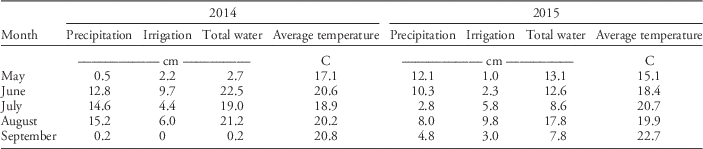
All production practices other than weed management, including fertilizer and irrigation, followed typical commercial practices (Colquhoun et al. Reference Colquhoun, Gevens, Groves, Heider, Jensen, Nice and Ruark2016). Nitrogen fertilizer was applied alongside the carrot rows, equally split among three applications totaling 114 and 129 kg ha−1 in 2014 and 2015, respectively. Precipitation was supplemented with overhead irrigation applied through a linear traveling system at rates indicated by the evapotranspiration replacement method (Table 1). No insect or disease pests were observed through weekly scouting in either year, and therefore no additional management inputs were necessary.
Climatic variables and irrigation for the study site at Hancock Agricultural Research Station in Hancock, WI, in 2014 and 2015. Data only include time period after planting and before harvest for May and September, respectively.

Carrot plant density was quantified four times each growing season by counting the number of emerged carrot plants in one meter of the center row in each weed-free plot. Carrot canopy development was also quantified four times each year by visually estimating ground cover in the weed-free area, with 100% indicating full canopy ground cover. Weed species composition and biomass were quantified in a 0.5-m−1 quadrat in each weedy plot 68 and 72 DAS in 2014 and 2015, respectively. Weed biomass was dried for three days at approximately 60 C and weighed. Weed biomass was pooled across species for analysis and presentation. Carrot root number and total yield were quantified by hand-harvesting the center row of the weedy and weed-free plots at crop maturity. The ratio of weedy to weed-free yield, multiplied by 100, was used to express the ability of carrot varieties to maintain yield in the presence of weeds, also known as weed tolerance or relative yield. Data were subjected to ANOVA to determine if there was a year by variety interaction using PROC GLM in SAS (SAS Institute Inc, Cary, NC 27513). An interaction was observed, thus data were analyzed and presented by crop and year. Means were separated using Fisher’s LSD at P=0.05. Additionally, Pearson correlation coefficients were determined for carrot plant density and canopy development relative to weed biomass.
Results and Discussion
Carrot Emergence
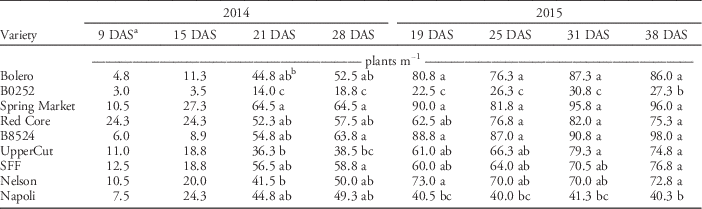
In 2014, carrot stand density 9 and 15 DAS was similar among varieties. By 21 DAS, ‘Spring Market’ carrot plant density was greater than that of ‘B0252’, ‘UpperCut’, or ‘Nelson’ varieties. B0252 had fewer emerged carrot plants than any other variety. At 28 DAS, B0252 carrot variety had fewer plants than all varieties except UpperCut. Plant density was similar among all other varieties at the last quantification timing (Table 2). Some of the same trends were observed in 2015, although the carrot plants in general emerged much faster and established greater plant densities. At every carrot density measurement, B0252 plant density was less than all varieties except ‘Napoli’. The plant densities of all other carrot varieties were comparable to each other (Table 2).
Carrot stand density for nine varieties grown in Hancock, WI, in 2014 and 2015.

a Abbreviation: DAS, days after seeding.
b Means followed by the same letter do not differ according to Fisher’s protected LSD (P=0.05). No significant differences within a column were observed where no letters are included.
Carrot Canopy Development
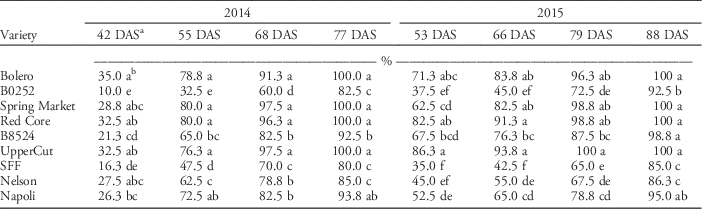
Weed-free carrot plant canopy development 42 DAS in 2014 ranged from 10% (B0252) to 35% (Bolero) ground cover. Canopy development was least where varieties B0252, ‘B8524’, or ‘SFF’ were seeded. At 55 and 68 DAS, canopy development in B0252 was less than that of any other variety. By 68 DAS, canopy development was greater (>90%) with Bolero, Spring Market, ‘Red Core’, and UpperCut compared to other varieties. The same held true 77 DAS, except that Napoli achieved similar canopy development. At this late date, B0252, SFF, and Nelson varieties had developed canopies that only covered 80% to 85% of the ground (Table 3). In 2015, carrot canopy development 53 and 79 DAS was lowest and comparable to B0252 where SFF, Nelson, and Napoli were grown. While SFF, Nelson, and Napoli plant densities were similar to those of varieties with the greatest densities, canopy ground coverage was comparable to the lowest variety. SFF and Nelson varieties still had the least canopy development at 88 DAS. By 79 DAS, UpperCut had reached full ground coverage. Despite poor stand establishment, B0252 carrot canopy covered 93% of the ground by 88 DAS (Table 3).
Carrot canopy development for nine varieties grown in Hancock, WI, in 2014 and 2015.

a Abbreviation: DAS, days after seeding.
b Means followed by the same letter do not differ according to Fisher’s protected LSD (P=0.05).
Weed Suppression
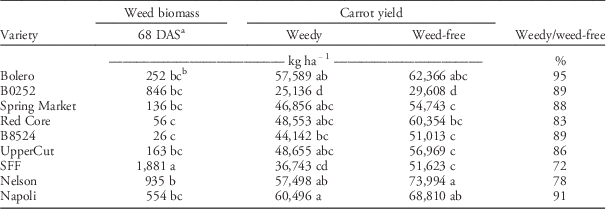
In both years, the weed population was dominated by common lambsquarters (Chenopodium album L.) and redroot pigweed (data not shown). In 2014, weed biomass was variable and ranged from 26 to 1,881 kg ha−1. Weed biomass was greatest where SFF was grown. Additionally, weed biomass was greater where Nelson carrot was grown compared to Red Core or B8524. Weed biomass was much greater in 2015 than in 2014, ranging from 1,243 to 5,603 kg ha−1. Weed biomass was greatest where B0252 was grown, which was comparable to where Nelson carrot was grown.
The relationship between carrot plant density or canopy development and the ability to suppress weed biomass accumulation was also investigated. In 2014, carrot plant density was poorly correlated with weed biomass (r=−0.09 to −0.18 across plant density quantification timings), but crop canopy development was moderately negatively correlated with weed biomass (r=−0.36 to −0.51 across canopy evaluation timings) (data not shown). In 2015, both carrot plant density (r=1−0.35 to −0.40) and carrot canopy development (r=−0.23 to −0.35) were moderately negatively correlated with weed biomass (data not shown).
Carrot Yield and Ability to Tolerate Weed Competition
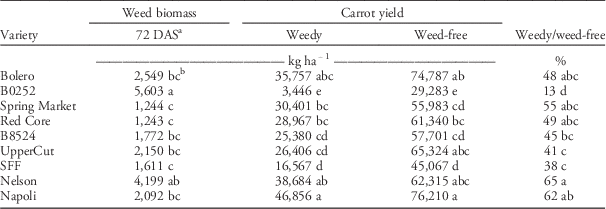
In 2014, weedy and weed-free carrot yield were lowest where B0252 were grown, likely a result of poor plant establishment and survival and poor canopy development. In the weed-free carrot plants, yield was greater in Nelson carrot compared to all other varieties except Bolero and Napoli. No differences in the ability to tolerate weeds, expressed as the weedy yield as a percentage of the weed-free yield, were observed among carrot varieties (Table 4). Again in 2015, B0252 yield was lower than that of any other carrot variety. Napoli yield in the presence of weeds was greater than that of all varieties except Nelson and Bolero, despite the fact that Napoli plant density was less than half that of the most densely established variety. The ability to tolerate weeds was particularly poor for B0252, where yield in the presence of weeds was only 13% of that in the weed-free carrot seeding. The ability of UpperCut and SFF varieties to maintain yield in the presence of weeds was also less than that of the most tolerant varieties (Table 5).
Weed biomass and carrot yield for nine varieties grown in Hancock, WI, in 2014. The ability to tolerate weed competition is expressed as the weedy carrot yield as a percentage of the weed-free carrot yield [(Weedy/weed-free)*100], under the column heading “weedy/weed-free”.

a Abbreviation: DAS, days after seeding.
b Means followed by the same letter do not differ according to Fisher’s protected LSD (P=0.05). No significant differences within a column were observed where no letters are included.
Weed biomass and carrot yield for nine varieties grown in Hancock, WI in 2015. The ability to tolerate weed competition is expressed as the weedy carrot yield as a percentage of the weed-free carrot yield [(Weedy/weed-free)*100].

a Abbreviation: DAS, days after seeding.
b Means followed by the same letter do not differ according to Fisher’s protected LSD (P=0.05).
In years and locations with low to moderate weed pressure, such as in the 2014 study, differences among carrot varieties in weed competitiveness or tolerance may be less apparent and therefore less relevant. Maximum carrot yield loss to weed competition among varieties was 28%. Yield loss in the presence of weeds was 15% or less with six of the nine carrot varieties (Table 4). However, when weed pressure was intense in the 2015 study, both carrot plant density and carrot canopy development were inversely related to weed biomass. Carrot yield loss in the presence of weeds ranged from 38% to 87% (Table 5). The differences between study years in the relationship between carrot growth and weed biomass, as well as the ability to tolerate weeds, may be due to field location and the inherent weed seedbank, planting date, or both. Carrot was seeded 7 d earlier in 2015 compared to 2014. While nothing noteworthy stands out in the weather data between years (Table 1), Swanton et al. (Reference Swanton, O’Sullivan and Robinson2010) documented a rapid shift in carrot competitiveness with weeds in the early spring, while carrot seeded in late April had over twice the critical weed-free period of those planted in mid-May.
Rapid and consistent carrot emergence is a strongly desired variety characteristic for organic growers in particular, who rely heavily on early-season mechanical cultivation (J Navazio, personal communication). Selectivity in cultivation, or the ability to mechanically remove weeds from the crop, requires the crop to have an establishment advantage over the target weeds. In this study, despite correcting seeding populations for differences in germination among carrot varieties, carrot stand establishment varied greatly. For example, B0252 stand density never exceeded one third that of the seeded population during the measurement period in either study year. Spring Market and B8524 stand densities in 2015 were more than 30 plants m−1 greater than in 2014 (Table 2). This inconsistency among varieties and between years would hinder early-season weed management strategies, whether they be mechanical cultivation or timely herbicide applications. Given the importance of early-season weed control and the critical weed-free period, as demonstrated by Swanton et al. (Reference Swanton, O’Sullivan and Robinson2010), it might be warranted to direct future research efforts towards a better understanding of carrot stand establishment factors and their relation to weed control. This research indicated that plant breeding is a valuable tool to select for and maintain desirable growth traits without compromising carrot root quality. Subsequent efforts now underway have been directed towards adding rapid and consistent germination and emergence to the list of desirable growth traits.
Acknowledgments
Authors acknowledge Rob Kane and Phil Simon, United States Department of Agriculture-Agricultural Research Service (USDA-ARS), for providing the carrot seed used in this study, and the USDA-Organic Agriculture Research and Extension Initiative grant program for partial support of the work (National Institute of Food and Agriculture [NIFA] number 60-3655-2-348).