I. INTRODUCTION
Mullite represents a family of aluminosilicates having the general formula Al2(Al4 + 2x Si2−2x )O10−x . The most prominent and technologically important members of this solid-solution series are mullites with x = 0.4 resulting in the composition Al4SiO8 or 2Al2O3·SiO2 (“2/1-mullite”) and mullites with x = 0.25 resulting in the composition Al6Si2O13 or 3Al2O3·2SiO2 (“3/2 mullite”). 2/1-mullites typically form in fusion–quench processes and are considered long-term stable only at high temperatures (>1800 °C). 3/2 mullites form in solid-state reactions and are considered long-term stable below 1800 °C. Due to an outstanding combination of low thermal expansion and thermal conductivity, high creep resistance, and good strength and fracture toughness, 3/2 mullites are frequently used as structural ceramic materials for high-temperature applications. Many studies on structure–property relationships and applications of mullites are available, for example, see Refs. Reference Schneider, Fischer and Schreuer1–Reference Komarneni, Schneider, Okada, Schneider and Komarneni3.
Due to its favorable high-temperature properties, mullites are also attractive materials for continuous fibers which are used as ceramic textiles or reinforcement of ceramic matrix composites. Alternatively to continuous fibers, mullite-based short fibers are usually used as felts or blankets. Short fiber-based components exhibit high gas permeability as well as high inner surface area; consequently, they are also attractive as effective filters or catalyst carriers in hot and corrosive atmospheres such as exhaust gases. Due to their high chemical stability and low thermal conductivity, such blankets are well suited for low-weight thermal insulation materials for industrial applications. Reference Carter4 Currently, similar short-fiber materials are gaining attraction also as aerospace materials. The use of short fibers as structural materials, however, requires additional mechanical stabilization with the help of inorganic fillers or “rigidizers” frequently consisting of liquid siliceous sols or dispersions which are infiltrated in to the fiber network, dried, and thermally solidified. Reference Zhang, Ye, Hou, Li and Wang5–Reference Ohtsuki, Nakahara and Sugiyama15
In recent years, special polycrystalline 3/2 mullite short fibers for long-term high-temperature applications in corrosive environments have been developed. These mullite fibers are chemically pure (72 wt% Al2O3 and 28 wt% SiO2), have low shot content, and a narrow fiber diameter distribution in the range between 5 and 7 μm. Reference Schneider, Merwin and Sebald16 Currently, such mullite fibers are distributed by Mitsubishi Chemical Corporation (formerly Mitsubishi Plastics Inc.) under the trade name “MATFEC® MLS-2.” In contrast to other silica-rich, aluminosilicate short fibers MATFEC® MLS-2 exhibit good creep resistance and low shrinkage. MAFTEC MLS-2 fiber felts are typically needled to produce blankets exhibiting favorable tensile strengths. These blankets can easily be shaped, for example, into insulating panels for furnace linings. A further important application for MAFTEC fibers is the durable support of automotive catalytic converters or diesel particulate filters. Reference Kakikura, Sasaki, Noguchi and Itagaki17 For this purpose, needled MAFTEC MLS-2 fiber mats are additionally stabilized by organic binders. These so-called organic bound mats (OBMs) are then wrapped around the catalyst or filter monoliths before mounting them on their metal casings.
A special feature of MAFTEC OBMs is the fact that MLS-2 fibers are still semicrystalline, consisting of nanoscale transition Al2O3 and amorphous SiO2. This nanoscale microstructure is favorable in terms of fiber strength and is considered a key to the good shaping capability and long-term durability of MAFTEC OBM support mats. Moreover, diphasic alumosilicates are well known in the field of mullite ceramics processing technology. To overcome the low sintering activity of crystalline mullite powders, noncrystalline or semicrystalline “chemical” mullite precursors with much better sintering behavior are being developed for many years. Many variants of mullite precursors, having different homogeneity levels and related crystallization temperatures, have been reported in the literature. Reference Schneider, Merwin and Sebald16 Two basic types of mullite precursors are commonly discerned: single-phase mullite precursors show chemical homogeneity up to the atomic level and crystallize directly to mullites at temperatures as low as approximately 950 °C. Diphasic mullite precursors consist of nanoscale transition alumina phases (e.g., spinel-type γ-Al2O3) coexisting with noncrystalline, silica-rich phases. Due to the chemical reaction of both phases, a metastable, Al2O3-rich mullite (approximately 2/1-composition) forms at temperatures above 1200 °C. At higher temperatures, metastable primary 2/1-mullite gradually transforms into stable 3/2 mullite. Following this basic classification, semicrystalline MLS-2 fibers can be designated as fibrous, diphasic mullite precursors in the “3/2” mullite overall stoichiometry. The crystallization behavior of diphasic precursors gave rise to the assumption that noncrystalline SiO2 may coexist in semicrystalline MLS-2 fibers in a wide temperature range and hence may offer densification and sintering by viscous flow. In this work we demonstrate the uniaxial hot pressing of MAFTEC OBMs without conventional sintering aids such as siliceous rigidizers. The resulting highly porous and fully crystalline mullite fiber compacts promise superior high-temperature strength and creep resistance. A similar manufacturing approach was previously introduced in the authors’ laboratory, where stacked woven mullite-based, Nextel® 720 type fiber fabrics were used to fabricate “matrix-free” composites by uniaxial hot pressing. Reference Steinhauser, Braue, Göring, Kanka and Schneider18 In the present work, we explore a processing window by taking advantage of the semicrystalline, diphasic fiber microstructure of MAFTEC MLS-2 OBMs.
II. EXPERIMENTAL PROCEDURE
MAFTEC MLS-2 OBMs with a chemical composition of 72 wt% Al2O3 and 28 wt% SiO2 were kindly provided by Mitsubishi Plastics Europe (now Mitsubishi Chemical Europe GmbH, Düsseldorf, Germany). Detailed information on properties and applications of MAFTEC-type fiber products is available on the company’s website. 19 All experiments were performed with circular disks (h = 8 mm) which were punched out of as-received MAFTEC OBMs with a hole-puncher. Dilatometry experiments were performed on single disks (d = 25 mm) in a vertically arranged and inductively heated test system (ZMART.PRO, Zwick-Roell, Ulm, Germany). Large specimens were fabricated by stacking six disks (d = 70 mm) and subsequent uniaxial hot pressing in an MoSi2-heated chamber furnace (Thermal Technology, Bayreuth, Germany) using two cylindrically sintered silicon carbide dies (SiSiC, EkaSiC, ESK, now 3M Technical Ceramics, Kempten, Germany) having a diameter of 7 cm. Further heat treatments were performed in a SiC-heated chamber furnace (HTC 03/15, Nabertherm, Lilienthal, Germany). Phase evolution was studied by differential scanning calorimetry (DSC) in an STA 449 F3 Jupiter (Netzsch, Selb, Germany) and by X-ray powder diffraction (XRD) (Siemens D5000, CuKa radiation, secondary graphite monochromator, EVA/Topas 4.2 software package, Bruker AXS, Karlsruhe, Germany). Microstructural analyses were performed in a DSM Ultra 55 scanning electron microscope (Carl Zeiss NTS, Wetzlar, Germany). The mechanical characterization of the hot-pressed specimen was performed in the ZMART.PRO universal test system.
III. RESULTS AND DISCUSSION
A. Phase evolution and deformation behavior of MAFTEC MLS-2 OBM
In general, polycrystalline mullite fibers and mats are prone to fiber breakage upon mechanical load. Indeed, chopped fibers can be simply produced from fully crystalline mullite fiber mats by uniaxial pressing at room temperature. Fiber cleavage occurs at fiber contact points where mechanical stresses are concentrating. The fibers of MAFTEC OBMs, however, consist of noncrystalline SiO2 and nanoscale transitional Al2O3, therefore are considered to offer a priori higher mechanical strength. Moreover, their semicrystalline microstructure with amorphous SiO2 is supposed to provide plastic deformation at high temperatures, avoiding extensive fiber damage during uniaxial hot pressing. It was therefore anticipated that hot pressing of MAFTEC OBMs can be performed prior to mullite crystallization. Consequently, detailed knowledge on the phase evolution of MLS-2 fibers is considered a key to a successful and optimized manufacturing process.
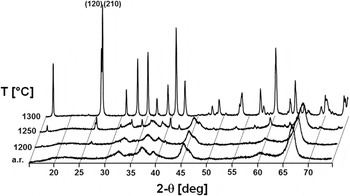
The fundamental crystallization behavior of MLS-2 fibers was elucidated by XRD analysis before and after annealing for 1 h at 1200, 1250, and 1300 °C, respectively (Fig. 1). As-received fibers exhibit the typical broad XRD peaks of transitional Al2O3 and the characteristic “amorphous hump” between 18 and 25° 2-theta is caused by noncrystalline SiO2. At 1200 °C fibers remain mostly semicrystalline, but the appearance of the (120 + 210) reflection pair at about 26° 2-theta indicates the presence of some mullites. At 1250°, the same XRD reflection indicates the progressing mullite formation; however, the major part of the fibers evidently remains semicrystalline. The XRD profile changes drastically at 1300° where extensive mullite formation has occurred, and broad XRD peaks from transitional Al2O3 have mostly disappeared. From these results it was concluded that the upper temperature limit of a possible hot-pressing window lies between 1250 and 1300 °C.
XRD analysis of the crystallization behavior of MAFTEC MLS-2 fibers. As-received material shows broad reflections characteristic for nanoscaled transitional Al2O3. Phase evolution was monitored upon annealing for 1 h, respectively. At 1200 °C traces of mullite are indicated by the 120/210 mullite reflections at about 26° 2-θ. Between 1250 and 1300 °C mullite becomes the dominant phase.

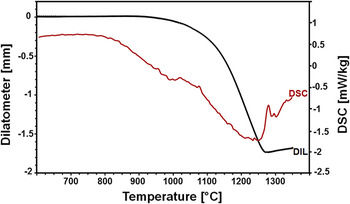
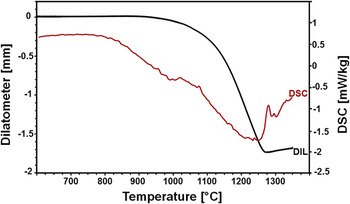
In the following step a simulation of the hot pressing was performed. We used a single OMB disk (d = 25 mm) which was placed in a uniaxial test system between two Al2O3 dies. A constant load was applied and adjusted to a pressure of 2 MPa. Subsequently, the preloaded OBM disk was heated with a constant heating rate of 10 K/min to 1400 °C while the concurrent deformation was recorded. The dilatometer curve plotted in Fig. 2 reveals that the onset temperature of the OBM compaction is at about 900 °C, which is obviously correlated to the softening of noncrystalline SiO2-rich phase. The deformation rate increases with temperature and reaches the maximum at about 1190–1210 °C. Above 1250 °C, compaction is slowing down and freezes abruptly at approximately 1270 °C followed simply by linear thermal expansion. The only plausible reason for the sudden freezing at 1270 °C is the crystallization of mullite and the related consumption of the low-viscous silica phase. Since XRD results indicate that mullite formation occurs in a relatively narrow temperature range, the crystallization behavior of pulverized MLS-fibers was also studied in detail by DSC and compared directly to dilatometry (Fig. 2). The onset temperature of the exothermic mullite crystallization is around 1260 °C, the peak temperature at around 1280°, and the crystallization appears to be mostly completed at 1290 °C. Evidently, the DSC results confirm the assumption that the onset of mullite formation is linked to the sudden stop of densification beyond 1270 °C, emphasizing that hot pressing of OBM fiber mats is viable only if sufficient amorphous SiO2 is available. Note the relative high noise of the DSC signal which is explained by the use of pulverized MLS-2 fibers, i.e., the still mostly fibrous particle morphology is disadvantageous for the packing density of the DSC sample and the resulting thermal flux.
Combined dilatometric and DSC analysis of the compaction and crystallization behavior of MAFTEC MLS-2 OBM mats. The deformation onset temperature is about 900 °C whereas compaction abruptly stops at about 1275 °C. A simultaneous exothermic DSC peak at approximately 1280 °C is related to mullite crystallization.
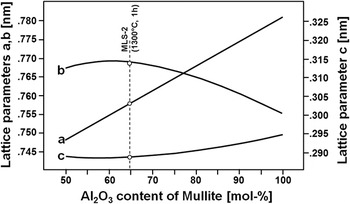
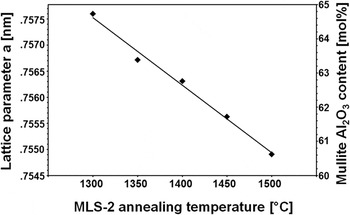
The chemical composition and diphasic nature of MLS-2 fibers suggest that early-formed mullite may still not be the thermodynamically stable 3/2 mullite containing 71.8 wt% Al2O3 and 28.2 wt% SiO2. Given the fact that Al2O3-rich mullites of about 2/1-composition are typically observed as the primary crystallization product in diphasic precursors, a similar behavior is expected for MLS-2 fibers as well. A sensitive measure for the Al2O3 content of mullites is provided by the lattice parameters, which are easily accessed by the analytical XRD profile fitting. Reference Ban and Okada20 Figure 3 displays the well-known literature data for the correlation between lattice parameters and Al2O3 content of mullites. Reference Fischer, Schneider, Schneider and Komarneni2 Open circles represent calculated mullite lattice constants of MLS-2 fibers annealed for 1 h at 1300 °C. Similar to previous studies, we observe an Al2O3-rich primary mullite containing 64.8 mol% Al2O3 being in good agreement with the frequently observed formation of primary 2/1-mullite (66.6 mol% Al2O3). On the other hand, this immediately raises the question about SiO2 being not structurally bonded in mullite. Taking into account the bulk chemical composition of MLS-2 fibers and the calculated mullite composition, approximately 5 wt% free SiO2 should be present after annealing at 1300 °C. Evidently full crystallization of MLS-2 fibers requires annealing at temperatures far beyond their core crystallization range (1260–1290 °C). This observation motivated a further series of 1 h annealing experiments performed between 1300 and 1500 °C. The thermal evolution of the mullites’ “a” lattice constants and the estimated Al2O3 contents are presented in Fig. 4. Although there is significant Al2O3 depletion above 1300 °C, annealing at 1500 °C is required to approximate the 3/2 mullite stoichiometry and also denotes complete consumption of free SiO2. Note that the bulk Al2O3 content of MLS-2 fibers (72 wt%) is slightly richer in Al2O3 than in 3/2 mullite (71.8 wt%); consequently, the lowest possible Al2O3 content of the present mullite is 60.25 mol%, i.e., the mullite composition will remain above the “theoretical” value of 60 mol% even if free SiO2 is completely consumed.
Correlation between lattice parameters and Al2O3 contents of mullites as taken from literature (e.g., Ref. Reference Fischer, Schneider, Schneider and Komarneni2). The lattice parameter refinement of MLS-2 fibers annealed at 1300 °C reveals that the respective mullite has an Al2O3 content of almost 65 mol%. Note the almost perfect linear correlation of a.

Evolution of the “a” lattice parameter of mullites as detected in MLS-2 fibers. At 1300 °C mullites show nearly 2/1-stoiciometry (2Al2O3·SiO2); annealing at 1500 °C is required to approach stable 3/2 mullite (3Al2O3·2SiO2).

B. Processing and characterization of hot-pressed MAFTEC MLS-2 OBMs
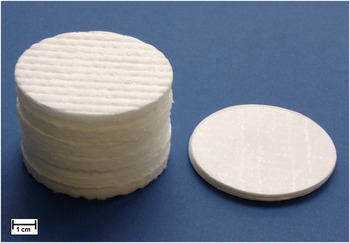
Large OMB compacts were manufactured by means of uniaxial hot pressing in a MoSi2-heated chamber furnace. Taking into account the substantial densification observed in dilatometry, for each run, 6 OMB disks were used to obtain sufficient sample dimensions. Punched OMB disks (d = 70 mm) were aligned and stacked carefully and then positioned between highly dense EkaSiC SiSiC dies (d = 70 mm). Such SiSiC dies exhibit high thermal conductivity (130 W/mK at room temperature [RT], data published by manufacturer); therefore, fast temperature equilibration can be expected resulting in minimal radial thermal gradients in OBM disks especially during heating. Moreover, SiSiC has a thermal expansion coefficient of 4–5 ppm/K which is close to the coefficient of thermal expansion (CTE) of mullite, i.e., undesired radial stresses between dies and OBM disks are minimized during hot pressing as well as cooling. On the basis of the dilatometry results, an appropriate temperature–pressure profile was selected: First, the OMB disk stack is heated to 1075 °C with a rate of 10 K/min. Then follows a fifteen-minute dwell at 1075 °C which provides temperature equilibration across the sample volume. During the final five minutes of the dwell, a pressure of 2.5 MPa is slowly applied. Subsequently, the temperature is raised with 5 K/min to 1275 °C. After a second fifteen-minute dwell at 1275 °C, the hydraulic pressure and furnace heating are switched off simultaneously and then samples are cooled down freely. Although SiSiC underwent some thermal oxidation, the hot-pressed disks were detaching easily from the dies. Figure 5 shows the OMB stack (h ≈ 48 mm) and the hot-pressed OBM compact (h ≈ 6 mm). The total compaction ratio of approximately 7:1 or 87–88% can also be calculated from the as-received OBM density (0.16–0.17 g/cm3; data published by manufacturer) and the density of the OBM compact (1.34–1.36 g/cm3). Taking into account the theoretical density of mullite, (3.1–3.2 g/cm3) the total porosity of the OBM compact is about 57 vol%, while the fiber volume content equals the density and is about 43 vol%.
Stack of six MAFTEC MLS-2 OBM disks before and after uniaxial hot-pressing using process parameters given in Fig. 6. The total compaction ratio is about 7:1.

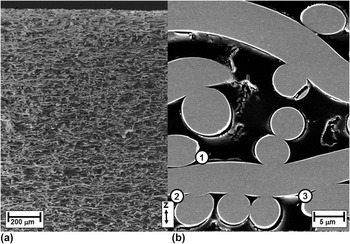
Like conventional short-fiber felts or blankets, OBMs show a random fiber alignment in the base plane (xy-direction) and a preferred fiber alignment perpendicular to the vertical z-direction, respectively. It is expected that compaction along the z-direction will augment this preferred fiber orientation. A representative cross section of a hot-pressed OBM compact is given in Fig. 6(a). The SEM image clearly shows that there is no obvious laminar mesostructure visible along the z-direction which could be associated with the OBM stack, i.e., the fiber volume content appears similar all across the hot-pressed body. Key factors for the integrity and stability of OBM compacts are the structural health and bonding of fibers, respectively. Mechanical strength will evidently suffer from the widespread fiber breakage and/or insufficient bonding between fibers, both inhibiting load transfer. However, fibers appear mostly undamaged, i.e., the hot-pressing process evidently did not produce small and dusty fiber debris. The higher-magnification SEM picture showing a polished cross section [Fig. 6(b)] is crucial for understanding the essential microstructural effects evolving during the hot pressing of OBM. Basically three scenarios are observed at fiber intersections (see respective marks): (i) fibers remain fully separated; (ii) fibers well bonded without apparent interface but exhibit some cracking close to the sintering neck; and (iii) fibers are strongly bonded without apparent interface. Evidently, the absence of distinct fiber/fiber interfaces in (ii) and (iii) is associated with the initially diphasic MLS-2 fiber microstructure allowing fiber re-arrangement and viscous-phase sintering during hot-pressing. Crack-free fiber contact areas are considered dominant microstructural features of hot-pressed OBMs: they provide load transfer between fibers and thus are the reason for obtaining a ceramic body consisting of a rigid fiber network. Nonetheless, some cracking at fiber contacts may occur in later stages of the process when amorphous SiO2 is mostly consumed and crystalline mullite becomes dominant, i.e., fiber deformability decreases while uniaxial pressure is still applied. It is anticipated that free standing or only partially bonded fiber contact areas are not contributing substantially to the structural integrity of OBM compacts. At this point, it is unclear if an optimized temperature–pressure profile could effectively reduce fiber damaging or increase fiber bonding.
(a) Cross section of as-hot-pressed MAFTEC MLS-2 OBM revealing a predominant fiber alignment perpendicular to the compaction direction z. There is no apparent laminar mesostructure due to use of stacked mats. (b) High-magnification of polished cross section. Three basic scenarios are observed: (1) fibers remain separated; (2) fibers are bonded but exhibit cracks close to bonded areas; and (3) fibers are well bonded without defects.

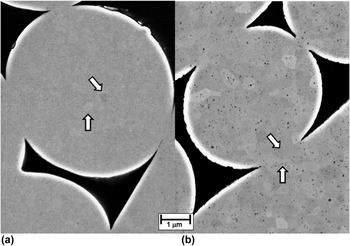
A first evaluation of the fracture behavior and mechanical properties of the hot-pressed OBM was performed by means of standard 3-point bending tests at room temperature and at 1300 °C, respectively. OBMs were tested in the as-hot-pressed state and after subsequent annealing (1500 °C, 1 h). Preliminary experiments at RT revealed a linear-elastic deformation, brittle fracture behavior, and no influence of the orientation of bending bars, i.e., an apparent strength difference between the xy-plane or the zx/zy-plane subjected to tensile loads was not observed. Accordingly, no apparent delamination effects were observed irrespective of the orientation of bending bars, emphasizing the “quasi monolithic” nature of hot-pressed OBM stacks. The two OBM variants were tested in the xy-orientation at 20 °C (RT) and at 1300 °C, the average bending strengths (solid bars) and elastic moduli (hatched bars) are compiled in Fig. 7, respectively. As-hot-pressed OBMs keep about 95% of their 27 MPa RT fracture strength at 1300 °C, but the elastic modulus decreases considerably by almost 35%. The RT fracture strength of postannealed OBMs is 10% higher (29.7 MPa) but is retained to only about 85% at 1300 °C. On the other hand, postannealed OBMs exhibit almost the same modulus at RT, but the elastic modulus decreases by about 15% only. For an interpretation of the observed mechanical behavior, bending tests were corroborated by high-resolution SEM analyses of MLS-2 fibers visualizing microstructural effects associated with postannealing. The observation that as-hot-pressed OBMs almost retain their RT 3-point bending strengths at 1300 °C can certainly be explained by the preservation of the nanoscaled microstructure, i.e., very sluggish growth of mullite grains. A high-magnification SEM image reveals that only few large grains appear in the apparently pore-free microstructure of as-hot-pressed MLS-2 fibers [Fig. 8(a)]. Since no significant reaction of amorphous SiO2 and primary “2/1”-mullite is expected at the bending-test temperature of 1300 °C (see previous section), the presence of about 5 wt% residual amorphous SiO2 is presumably the reason for the decreasing effective elastic modulus. Moreover, coexisting amorphous SiO2 may also help to retain the fracture strength by stress relaxation or redistribution. On the other hand, there is no obvious rationale for the observed mechanical properties of 1500 °C preannealed OBM. Since no substantial shrinkage was observed upon postannealing, there is no plausibility for an increased fiber volume content contributing to the higher fracture strength. Postannealing of 1275 °C hot-pressed OBM at 1500 °C triggers the reaction of amorphous SiO2 and the primary mullite to “3/2” mullite. Figure 8(b) shows the related effects: now the MLS-2 fiber microstructure is dominated by prismatic and isometric mullite crystals exhibiting grain sizes of about 0.2–0.5 μm. Dark spots randomly distributed across the fiber sections represent pores obviously formed by coalescence of nanoscale pores. At first glance, mullite grain growth and pore coalescence seem to be in conflict with the observed increase of RT strength. However, two further microstructural features may be in effect: (i) additional bonding of formerly separated fibers. This would require much material transport and/or deformation, which seems highly unlikely for fibers mostly consisting of crystalline mullite. (ii) Growing fiber contact areas and “healing” of cracks due to sintering. The high-resolution SEM image clearly shows mullite crystals in fiber contact areas where they “bridge” fibers. Although we cannot provide statistically supported evidence at this point, crack healing seems at least plausible (see arrows). Such microstructural effects may contribute to the observed slight improvement of RT fracture strength of annealed OBM compacts. The relative higher strength loss at 1300 °C accompanied by a less decreasing elastic modulus is obviously due to the consumption of residual amorphous SiO2 and primary Al2O3-rich “2/1”-mullite to form fully crystalline, quasistoichiometric “3/2” mullite.
Results of 3-point bending tests performed at room temperature and 1300 °C. Solid bars refer to strengths and hatched bars to elastic moduli, respectively. While as-hot-pressed MAFTEC OBMs mostly retain strength at 1300°, modulus is decreasing significantly. Loss of HT-strength and -modulus is observed for postannealed samples. Note beneficial effect of annealing at 1500 °C for RT strength.

High-magnification SEM analyses of polished MAFTEC MLS-2 OBM cross sections: (a) in the as-hot-pressed state only few primary mullites grow larger than nanoscale and (b) postannealing at 1500 °C triggers formation of a homogeneous “mosaic”-type microstructure. Prismatic mullites are also bridging fibers and crack healing is plausible. Dark spots designate pore coalescence.

C. General aspects of processing
The present manufacturing process for mullite fiber compacts offers advantages as well as disadvantages with respect to standard processing methods employing conventional short-fiber felts or blankets. Fiber compacts are typically obtained by infiltration of short-fiber products with liquid binders or particle dispersions which are subsequently shaped, dried, and eventually heat-treated to obtain a rigid structure. The infiltrated liquids typically contain SiO2-rich constituents such as SiO2-sols, silicate solutions (“water-glass”), or also classical ceramic binders like Al–(meta)phosphate. The first important feature of the process reported in this work is the fiber volume content of compacts. Although the fiber volume content is evidently not substantially changed in conventionally rigidized materials, the uniaxial compaction of MAFTEC OBMs by hot pressing results in a fiber volume content increased by a factor of seven. Considering fibers as a major load-bearing constituent of any fiber compacts, it is straightforward to rationalize the favorable strength of hot-pressed MAFTEC OBMs. The final fiber content is strongly dependant on the fiber “packing density” of used “green” MAFTEC fiber products. Although there are no fundamental constraints, the availability of starting products, e.g., mats with different needling will presumably remain limited.
A major feature of conventionally processed fiber compacts is the presence of excess of glassy/amorphous binder phases which will inevitably deteriorate the high-temperature stability of fiber compacts; mullites can be chemically attacked by low-viscous siliceous melts. Mullite grain boundaries, in particular at fiber contacts, can be wetted. Hence, deterioration of mechanical strength as well as possible creep deformation is expected even at relatively low application temperatures. In contrast to this, the present manufacturing process does not require any kind of additional binders to yield rigid glass-free OBM fiber compacts which are able to preserve a major part of their mechanical stability at high temperatures and consequently can be applied as high-temperature structural materials such as stable insulation panels or any high-temperature structures exposed or penetrated by fluids such as gas filters. The porous and fibrous architecture of OBM fiber compacts is also considered ideally suited for vapor- or liquid-phase infiltration with functional materials such as catalysts. In general, it may be stated that OBM fiber compacts could fill the application gap between low-strength, rigidized fiber felts and high-performance ceramic matrix composites reinforced by continuous fibers.
A fundamental drawback of the present manufacturing process is the limited component shape variability. Conventional processing allows rigidization of large, complex-shaped components “in situ” (e.g., in furnace linings). Uniaxial hot pressing is limited to quasiflat plates where dimensions are limited by existing hot-pressing facilities and tools. The availability of strong, creep-resistant SiSiC dies with a low CTE mismatch to mullite is considered a key issue for successful upscaling: homogenous pressure application as well as minimized thermal gradients and radial stresses between dies and plates become increasingly important for large-scale fiber compacts. An additional processing option would be the use of “plain” OBMs along with OBMs filled by “matrix” components not substantially affecting high-temperature properties. In a similar approach, “fiber-laminate” composites were manufactured by alternating stacks consisting of matrix-infiltrated and noninfiltrated fiber fabrics and subsequent hot pressing. Reference Radsick, Saruhan and Schneider21 The present manufacturing process does offer the same flexibility, i.e., there are quasi-unlimited possibilities to process filled and unfilled OMBs into a single compact. A promising approach would be the use of diphasic mullite precursor powders allowing coprocessing due to their compatible crystallization behavior. By this, conductivity or permeability of fiber compacts could be directed toward specific demands.
IV. SUMMARY
Highly porous mullite fiber compacts were successfully manufactured by uniaxial hot pressing of stacked MAFTEC organic bound mats (OBMs) between SiSiC dies. The process takes advantage of as-received diphasic MAFTEC MLS-2 fibers consisting of amorphous SiO2 and transitional Al2O3, opening a suitable processing window where consolidation proceeds before final crystallization of fiber constituents to mullites. Since the compaction process does not require any additional binders or sintering aids, MAFTEC OBM fiber compacts exhibit favorable mechanical properties which are largely retained at high temperatures; therefore, such compacts are considered well suited as high-temperature structural materials.
ACKNOWLEDGMENT
The authors thank L. Lichtblau, Mitsubishi Plastics Europe, Düsseldorf (Germany) for kindly providing MAFTEC starting materials.