INTRODUCTION
The phonological pattern of velar fronting, in which velar consonants are realized with coronal place, is well attested in the speech of both typically developing children and children with phonological delay/disorder (e.g. Bernhardt & Stemberger, Reference Bernhardt and Stemberger1998). Many child speech processes have counterparts in adult phonological typology: for instance, final obstruent devoicing can be observed in fully developed languages like Dutch and German as well as in phonological development. However, velar fronting belongs to the subset of phonological processes that seem to be unique to child speakers (e.g. Buckley, Reference Buckley2003). Comparison with adult grammars is particularly problematic for the pattern of positional velar fronting(PVF), where fronting applies only in the onset of an initial or stressed syllable (Bills & Golston, Reference Bills, Golston, Carmichael, Huang and Samiian2002; Chiat, Reference Chiat1983; Dinnsen, Reference Dinnsen, Dinnsen and Gierut2008; Inkelas & Rose, Reference Inkelas, Rose, Beachley, Brown and Conlin2003; Reference Inkelas and Rose2007; Morrisette, Dinnsen & Gierut, Reference Morrisette, Dinnsen and Gierut2003; Stoel-Gammon, Reference Stoel-Gammon, Bernhardt, Gilbert and Ingram1996). PVF is illustrated in (1) with examples from case study subject ‘Ben’, who will be introduced below. All examples in (1) were drawn from a single recording session when Ben was aged 4 ; 3·5.
(1) Positional velar fronting
a. Word-initial velars are fronted.
[dƐn] ‘can’
[daƱt] ‘card’
[doi] ‘going’
[dos] ‘ghost’
b. Word-final velars are not fronted.
[wƱk] ‘look’
[dak] ‘cake’
[jak] ‘like’
[dak] ‘dog’
c. Word-medial velars preceding a stressed vowel are fronted.
[oˈdei] ‘okay’
[biˈdʌs] ‘because’
[əˈdƐn] ‘again’
[waˈtun] ‘raccoon’
d. Word-medial velars preceding an unstressed vowel are not fronted.
[ˈstƱko] ‘sticker’
[ˈbakat] ‘bucket’
[ˈdaki] ‘doggie’
[ˈjakiŋ] ‘licking’
PVF thus neutralizes a place contrast in prosodically strong contexts while preserving a distinction in weak contexts. Other examples of neutralization in strong position have been described in the developmental phonology literature, including positional stopping of fricatives or affricates (Dinnsen & Farris-Trimble, Reference Dinnsen, Farris-Trimble, Dinnsen and Gierut2008a) and positional lateral gliding (Inkelas & Rose, Reference Inkelas and Rose2007). As previous work has pointed out, these patterns pose a striking contrast with positional neutralization in fully developed phonologies. Studies of adult typology reveal a robust preference to preserve contrast in prosodically strong positions while neutralizing in weak contexts (Beckman, Reference Beckman1997). This contrast presents a challenge for efforts to generate a formal model of positional neutralization in child grammar.
Modeling positional velar fronting
While several existing models can capture the basic facts of PVF, few have tackled the issue of explaining why child and adult grammars differ in this way. For instance, drawing on data from 67 typically developing children aged 1 ; 3–2 ; 8, Stoel-Gammon (Reference Stoel-Gammon, Bernhardt, Gilbert and Ingram1996) describes velar fronting as the consequence of an implicational universal in phonological development: the presence of velar place in initial position implies its presence in final position. While this account is consistent with observed patterns of PVF, it does not address the origin of the “affinity between velar place and coda position” proposed to characterize child phonology (p. 213).Footnote 1 As Inkelas and Rose (Reference Inkelas, Rose, Beachley, Brown and Conlin2003) point out, data from fully developed phonologies suggest a preference for coronal or placeless consonants, not velars, in coda position. It thus remains to be explained why children and adults differ in this respect, and how the child pattern is eliminated in the course of normal maturation.
Morrisette et al. (Reference Morrisette, Dinnsen and Gierut2003) and Dinnsen (Reference Dinnsen, Dinnsen and Gierut2008) model PVF in the constraint-based framework of Optimality Theory (OT; Prince & Smolensky, Reference Prince and Smolensky2004). These authors propose a constraint *#k (‘Avoid word-initial dorsals’). PVF arises when *#k is ranked above Ident[place], the faithfulness constraint that penalizes changes in place of articulation, which in turn outranks the general constraint *k. This OT analysis can capture the observed properties of PVF, but the constraint *#k has problematic implications for adult typology. While positional markedness constraints are used to model adult phenomena, previous accounts have been explicit in stating that these constraints must not make reference to subsegmental features such as [dorsal] (de Lacy, Reference de Lacy, Matushansky, Costa, Martin-Gonzalez, Nathan and Szczegielniak2001). If such constraints were possible, cross-linguistic typology should reveal adult grammars that neutralize place contrasts only in strong position. In fact, such grammars are unattested. Acknowledging this problem, Dinnsen (Reference Dinnsen, Dinnsen and Gierut2008) suggests that an alternative account may be necessary; he proposes a phonetically motivated analysis hinging on perceptual differences between children and adults (Dinnsen & Farris-Trimble, Reference Dinnsen, Farris-Trimble, Dinnsen and Gierut2008a). The following section will endorse the notion that incorporation of phonetic pressures allows for a more satisfactory account of PVF. However, it will be argued that articulatory rather than perceptual factors provide the best explanation for neutralization in strong position.
Phonetics in child phonology
One possible analysis of child-specific speech patterns holds that children and adults are alike in their grammatical competence, and all differences arise as the consequence of children's performance limitations, such as immature articulatory control (Hale & Reiss, Reference Hale and Reiss1998). However, this approach disregards the systematic nature of child speech processes. Children's phonologies conform in many respects to principles well established in adult typology; when they diverge, they do so in predictable ways, not random breakdowns. This article expressly rejects the notion that PVF must be treated as a phenomenon external to the phonological grammar.
At the same time, there is no question that children and adults experience the physical act of producing and perceiving speech in different ways. These differences can be acknowledged without ignoring the systematic character of child patterns by integrating phonetic and phonological considerations into a single analysis. Many patterns in adult phonology can be interpreted in terms of phonetic pressures such as minimization of articulatory effort or avoidance of perceptual confusion. A phonetically based approach to phonology (e.g. Hayes, Kirchner & Steriade, Reference Hayes, Kirchner and Steriade2004) posits that these perceptual and articulatory factors can drive speech patterns from within the grammar. In this model, if child and adult speakers experience different phonetic pressures, we can also expect some degree of divergence between child and adult phonologies. Moreover, the child's physical experience of producing and perceiving speech will change over the course of anatomical and neural maturation. Assuming a mechanism by which speakers can periodically update the grammar to reflect current phonetic pressures, a phonetically based approach can explain why child-specific phenomena disappear during maturation. For previous accounts proposing that children construct constraints from their own experience of articulatory, motor planning, or perceptual pressures, see Hayes (Reference Hayes, Darnell, Moravcsik, Noonan, Newmeyer and Wheatly1999) and Pater (Reference Pater, Mikkelson and Potts2002).Footnote 2
A phonetically based account of velar fronting
The hypothesis that PVF can be explained by child-specific phonetic factors originates with Inkelas and Rose (Reference Inkelas, Rose, Beachley, Brown and Conlin2003; Reference Inkelas and Rose2007), who suggest that fronting arises as the consequence of prosodically conditioned articulatory strengthening in some child speakers. Data for their study were gathered in diary fashion from one English-speaking child who exhibited PVF from ages 1 ; 0–2 ; 2. Drawing on articulatory evidence from adult speakers, Inkelas and Rose note that linguopalatal contact is both more forceful and more anterior for word- or foot-initial velars than for non-initial velars. Because children show heightened attention and faithfulness to stressed syllables (Kehoe & Stoel-Gammon, Reference Kehoe and Stoel-Gammon1997), they are likely to perceive and attempt to replicate this prosodic enhancement. However, anatomical and motor-control differences between child and adult speakers can influence the child's realization of prosodically enhanced velars. The child's tongue is larger and occupies a more anterior position in the oral cavity than that of the adult, and speech-motor control is less refined (Crelin, Reference Crelin1987; Fletcher, Reference Fletcher1992). A child's efforts to replicate a subtle articulatory enhancement may thus cause the area of linguopalatal contact to extend into the coronal region, yielding fronting. If segmental accuracy is highly valued by a child's grammar, onset strengthening may be abandoned until a later time when it can be achieved without fronting. If the grammar favors faithfulness to prosodic organization, though, enhancement in strong contexts may become an established pattern at the expense of segmental faithfulness.
This article offers new support for Inkelas and Rose's contention that velar fronting is a phonological process rooted in child-specific articulatory factors. However, the present account is distinct in two respects. First, while Inkelas and Rose state that children's motor-control limitations play a role in PVF, they do not go into detail on the nature of the speech-motor differences involved. This article argues that PVF can be linked to a specific, well-documented motor-control limitation in children, namely a lack of differentiated control of tongue and jaw articulators. Second, although Inkelas and Rose state explicitly that the articulatory pressures they describe interact with the child's grammar to yield a phonological pattern of fronting, they do not propose a specific constraint to implement their proposal. This may explain why their model has sometimes been mistaken for an extra-grammatical account (e.g. Dinnsen, Green, Morrisette & Gierut, Reference Dinnsen, Green, Morrisette and Gierut2011). This article argues that articulatory factors can form the basis for a fully formal, constraint-based model of velar fronting. The second half of the article presents longitudinal data from one child whose PVF was also sensitive to several segmental conditioning effects. It will be argued that the phonetically sensitive constraint proposed here can successfully capture this subject's output across all conditioning contexts and developmental stages.
THE SPEECH-MOTOR BASIS FOR POSITIONAL VELAR FRONTING
The core of the present proposal is the claim that PVF can be modeled as the consequence of a child-specific motor limitation affecting the capacity for jaw-independent tongue control. In early stages of motor development, children show a limited ability to move one of two biomechanically coupled structures without the other. Thus, the coupled tongue and jaw (collectively termed the ‘tongue–jaw complex’) are generally activated simultaneously. Furthermore, these two articulators challenge children's motor-control capacity to differing degrees. The bilaterally hinged mandible poses a manageable motor-control task even for a young child (Green, Moore & Reilly, Reference Green, Moore and Reilly2002). A very different problem is presented by the tongue, which is a muscular hydrostat: lacking internal skeletal support, it achieves rigidity through muscular contraction around an incompressible core. Controlling a hydrostat requires simultaneously stiffening the tongue for skeletal support, shaping it, and directing its movement. The large number of parameters involved makes lingual control particularly challenging (Kent, Reference Kent, Ferguson, Menn and Stoel-Gammon1992). For this reason, the tongue is thought to play a relatively passive role in early articulation, borrowing its movement from the active jaw articulator (e.g. Green et al., Reference Green, Moore and Reilly2002; MacNeilage & Davis, Reference MacNeilage, Davis and Jeannerod1990). Children's jaw-dominated productions of stop consonants are also described as ‘ballistic’, since the tongue and jaw are launched rapidly at a target and do not change course until they contact another articulator (Kent, Reference Kent, Ferguson, Menn and Stoel-Gammon1992). Ballistic gestures are less precise than the later-emerging ‘controlled’ gestures, in which the force and direction of articulator movement is adjusted mid-trajectory. Acoustic evidence suggests that a preference for ballistic gestures persists into the preschool years, even after acquisition of a sizable segmental inventory (Edwards, Fourakis, Beckman & Fox, Reference Edwards, Fourakis, Beckman and Fox1999). Edwards et al. found that four-year-old speakers' stops featured steeper F2 transitions than adults', indicating a more rapid, ballistic movement of the articulators. They also report that across all subjects, the steepest-sloped transitions were produced by children with velar fronting. Edwards et al. suggest that young speakers favor ballistic gestures due to a decreased capacity for independent tongue and jaw control, and they further propose that the tendency to move the tongue–jaw complex as a single unit is especially pronounced in children with velar fronting. However, they do not address the question of why diminished tongue–jaw differentiation should cause velars to be realized with coronal place, not vice versa. Since adult speakers produce both velar and alveolar stops with discrete lingual gestures, both places of articulation might be expected to be equally problematic. The next section takes up the task of explaining how diminished tongue–jaw dissociation could give rise to velar fronting.
Fronted place as undifferentiated lingual gesture
To explain how a preference for ballistic articulatory movements could yield velar fronting, here it is proposed that at least some children with velar fronting produce all lingual stops with undifferentiated lingual gestures, i.e. with midsagittal contact extending from alveolar into palatal/velar regions (Gibbon, Reference Gibbon1999). Research using electropalatography to visualize tongue–palate contact suggests that undifferentiated place is widespread in child speech errors. In the electropalatographic studies reviewed by Gibbon (Reference Gibbon1999), 12/17 children with articulatory–phonological disorder produced some undifferentiated gestures, and a majority of these showed undifferentiated contact in most consonants.Footnote 3 It is generally agreed that undifferentiated gestures reflect abnormal motor control of the tongue, manifested through diminished control of functionally independent lingual regions (Goozée, Murdoch, Ozanne, Cheng, Hill & Gibbon, Reference Goozée, Murdoch, Ozanne, Cheng, Hill and Gibbon2007) and/or a lack of tongue–jaw dissociation (Howard, Reference Howard, Aulanko and Korpijaakko-Huuhka1994). This article adopts the latter hypothesis, which will make it possible to explain the connection between velar fronting and diminished tongue–jaw dissociation that was noted by Edwards et al. (Reference Edwards, Fourakis, Beckman and Fox1999).
This account hinges on evidence that stops produced with undifferentiated contact can be perceived to have either coronal or velar place. The perceived place of an undifferentiated gesture is influenced by changes in linguopalatal contact during closure, termed articulatory drift (Gibbon & Wood, Reference Gibbon and Wood2002). Closure might be initiated in the velar region, span the entire palate, and then be released in the coronal region; the reverse is also possible. Gibbon and Wood found significant drift in 72% of lingual consonants produced by children known to use undifferentiated gestures. Depending on the direction of drift, undifferentiated gestures could yield either velar fronting or coronal backing. In prevocalic contexts, the region that is last to be released should have the greatest influence on perceived place of articulation, since it will have the most audible burst and formant transitions (Kochetov & So, Reference Kochetov and So2007). Gibbon and Wood found that coronal-to-velar and velar-to-coronal drift were equally common but, crucially, four of five subjects showed a reliable preference for a forward or backward direction of drift. Children who favor backward drift can be expected to exhibit a pattern of coronal backing, while a preference for forward drift will yield velar fronting. Because it can accommodate both fronting and backing, this account meets one major criticism that has been raised against articulatory models of PVF (Morrisette et al., Reference Morrisette, Dinnsen and Gierut2003). Analyses throughout the rest of this article will focus on children who habitually release the coronal region of an undifferentiated gesture last, i.e. children with velar fronting. A comparable analysis of backing could be pursued for children who favor backward drift.
Note that in this model, children with velar fronting are thought to use an undifferentiated pattern of contact for both coronal and velar targets, although coronal targets will be perceived as accurate if the coronal release is the last, most audible gesture. Covert contrast between coronal and velar stops in equivalent contexts is therefore not predicted by this analysis.
The role of gestural magnitude
Having seen that a lack of differentiated tongue–jaw control can yield undifferentiated gestures, causing coronal–velar neutralization, the next step is to establish why neutralization is more common in prosodically strong contexts. An intuitively plausible possibility is that more forceful gestures are more likely to induce ballistic movements of the tongue–jaw complex. This insight can be formalized if articulatory force is expressed in terms of target height, such that a more forceful gesture corresponds with a higher articulatory target. Kinematic studies suggest that the target for a lingual consonant can actually be located above the fixed obstacle of the palate (Fuchs, Perrier & Mooshammer, Reference Fuchs, Perrier, Mooshammer, Dalsgaard, Lindberg, Benner and Tan2001). The specific properties of motor control of a muscular hydrostat, which imposes simultaneous requirements for skeletal support, shaping and movement, entail that the motor task becomes more complex with increasing target height. When the tongue remains close to the mandible, some skeletal and shaping needs are met passively through contact with the lower teeth. With separation from the mandible, these requirements must be filled solely by the lingual musculature, multiplying the complexity of the motor task. This difference in motor-control complexity creates an implicational relationship: a child who can execute a discrete lingual gesture for a high articulatory target will also be able to do so for a low articulatory target. The reverse does not hold, since the ability to produce independent lingual gestures in a low-force context does not guarantee success in the more demanding context of a larger gesture. Instrumental studies of lingual and labial plosives have documented larger articulator movements in prosodically strong contexts, such as onsets of stressed syllables (e.g. Browman & Goldstein, Reference Browman, Goldstein, Bell-Berti and Raphael1995; Fougeron & Keating, Reference Fougeron and Keating1997). PVF can thus be understood to reflect the more demanding nature of motor control in prosodically strong contexts, which heightens the preference for a jaw-dominated, undifferentiated gesture.
The claim that motor control is more challenging in prosodically strong contexts might appear to conflict with findings that motor trajectories in weak syllables are more variable than their strong-syllable counterparts (e.g. Goffman, Gerken & Lucchesi, Reference Goffman, Gerken and Lucchesi2007). However, Goffman et al. explicitly state that segmental accuracy and stability of the movement trajectory are distinct, dissociable properties. Gestures in strong position may be more consistently executed because children favor the well-practiced jaw-dominated gesture in this context, while greater motor variability in weak syllables could indicate that child speakers are using the low-force context to try out jaw-independent gestures.
Phonological expression of speech-motor limitations
While the preceding sections argued that child-specific speech-motor limitations can be understood as the driving force behind velar fronting, describing PVF in purely phonetic terms would disregard the fundamentally systematic character of the process. A major goal of this article is to demonstrate that proposing an articulatory basis for velar fronting does not constitute “removing [the phenomenon] from the domain of linguistic theories”, as has been suggested of Inkelas and Rose's account (Dinnsen et al., Reference Dinnsen, Green, Morrisette and Gierut2011: 247). Here it is proposed that child speakers evaluate potential outputs against a phonetically sensitive constraint Move-As-Unit, stated in (2), which penalizes any tongue movement not supported by a simultaneous jaw gesture.
Move-As-Unit assigns real-valued violations that increase in proportion to the magnitude of jaw-independent tongue movement. Above, it was argued that motor control is particularly difficult when the target requires vertical separation of tongue and jaw. Horizontal movements of the tongue are also avoided in jaw-dominated articulation (MacNeilage & Davis, Reference MacNeilage, Davis and Jeannerod1990). However, horizontal movements require fewer motor-planning parameters when the lower teeth provide shaping and support; they should be penalized less heavily than vertical movements. The data currently available do not allow for a precise formulation of the relative contributions of vertical and horizontal movement to motor control complexity. As a first-pass approximation, Move-As-Unit will be divided into two sub-constraints, Move-As-Unit[Vertical] and Move-As-Unit[Horizontal]. To capture the greater difficulty of vertical movement, it is proposed that Move-As-Unit[Vertical] and Move-As-Unit[Horizontal] stand in a fixed relationship such that the weight of the former always exceeds that of the latter. The higher-weighted constraint Move-As-Unit[Vertical] will be sufficient to account for most phenomena discussed in the present study. Therefore, Move-As-Unit[Horizontal] will be included only in the tableau that depends crucially on differences in horizontal distance traveled, namely the comparison of back and non-back vowel contexts. For all other comparisons of candidates, only Move-As-Unit[Vertical] will be used; it will be referred to simply as Move-As-Unit in those contexts.
- (2)
a. Move-As-Unit[Vertical]: A movement of the tongue relative to the jaw is penalized in proportion to the vertical distance traveled by the tongue.
b. Move-As-Unit[Horizontal]: A movement of the tongue relative to the jaw is penalized in proportion to the horizontal distance traveled by the tongue.
As a constraint that assigns scalar-valued penalties in proportion to the magnitude of articulator displacement, Move-As-Unit is closely related to constraints proposed to limit the expenditure of articulatory effort in adult grammars, such as Flemming's (Reference Flemming2001) Minimize.ffort. Move-As-Unit is unique only in that it targets a type of articulator movement that is difficult for child but not adult speakers. As tongue and jaw control become increasingly well differentiated over the course of neuromuscular maturation, simultaneous movements of the tongue–jaw complex cease to be motorically easier than independent gestures. At this point, Move-As-Unit ceases to represent a phonetically grounded constraint and should be eliminated from the grammar; see Hayes (Reference Hayes, Darnell, Moravcsik, Noonan, Newmeyer and Wheatly1999) for a framework in which this modification of the constraint set could take place.
The framework of Harmonic Grammar (HG; Legendre, Miyata & Smolensky, Reference Legendre, Miyata, Smolensky, Ziolkowski, Noske and Deaton1990) provides an effective means of incorporating phonetic detail into phonological calculation (Flemming, Reference Flemming2001). Like Optimality Theory, HG evaluates candidate forms against a system of violable constraints. Unlike OT, where constraints are ranked in a strict dominance relationship, HG constraints carry numerical weights. A constraint assigns each candidate a violation score; negative values identify this score as a penalty. The overall harmony of a candidate (H in the tableaux below) is the sum of its weighted violations. The candidate with the highest harmony, or least negative sum of weighted violations, is selected for production. For previous uses of HG in developmental phonology, see, e.g., Pater (Reference Pater2009) and Jesney and Tessier (Reference Jesney and Tessier2011).
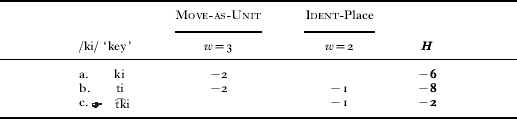
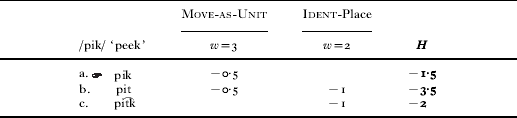
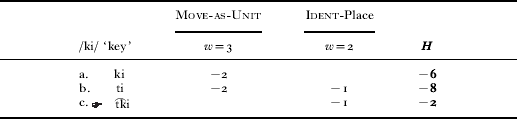
Tables 1 and 2 show how PVF can be modeled with Move-As-Unit in the Harmonic Grammar framework. Arbitrary constraint weights and violation magnitudes are adopted for illustrative purposes; specific values will be worked out in the case study analysis to follow. In Table 1, the velar target is in a prosodically strong position. Candidate (a) features faithful velar place, candidate (b) features fronting to true coronal place, and candidate (c) features an undifferentiated gesture, henceforth represented with conjoined place ([ ] or [
 ]). A discrete lingual gesture in a strong context, whether coronal or velar, incurs a relatively large Move.as-Unit violation, represented provisionally with magnitude −2. By contrast, the undifferentiated gesture does not violate Move.as-Unit, since it is the product of a ballistic movement of the tongue–jaw complex. The faithfulness constraint Ident-Place is violated by (b) and also (c), since an undifferentiated gesture released in the coronal region is perceived as coronal. Because it does not violate Move.as-Unit, however, candidate (c) is selected as most harmonic.Footnote 4
Velar fronting in a prosodically strong context
Faithful velar place in a prosodically weak context
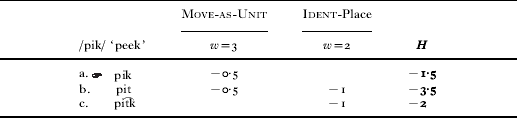
The situation is different for a final velar. Because the articulatory target is lower in a prosodically weak context, the magnitude of the Move-As-Unit violation incurred by discrete lingual gestures is smaller (here, −0·5). In this case, faithful candidate (a) is more harmonic than either unfaithful candidate.
The phonetically sensitive constraint Move-As-Unit can thus generate a descriptively adequate model of PVF. Unlike formal models without phonetic grounding, this analysis also proposes an explanation for the absence of PVF from adult grammars. This analysis makes additional predictions that can be tested against child speech data. Specifically, the effects of a constraint limiting jaw-independent tongue movements should be manifested in other ways, such as a conditioning effect of vowel context on consonant place (MacNeilage & Davis, Reference MacNeilage, Davis and Jeannerod1990). The second half of this article presents new case study data from one child whose velar fronting was conditioned by both prosodic and segmental factors. It will be demonstrated that Move-As-Unit can capture all of the conditioning factors observed in this child's output.
METHODS
Case study subject
New PVF data were collected in a longitudinal study of one child, ‘Ben’, from age 3 ; 9 to 4 ; 4. While Ben demonstrated age-appropriate cognitive and receptive–expressive language abilities, his speech sound development was severely delayed. Since this article aims to draw inferences about PVF as a general phenomenon, it would be ideal to collect evidence from one or more children with typical phonological development. However, there is general consensus that speech patterns are qualitatively similar across children with phonological disorder and younger typically developing children (Beckman, Munson & Edwards, Reference Beckman, Munson, Edwards, Cole and Hualde2007). Since their development resembles a slower version of typical development, children with phonological delay usefully extend the window of opportunity to observe developmental phonological patterns. For previous research using case studies of children with phonological disorder to draw broader grammatical inferences, see, e.g., Chiat (Reference Chiat1989) and Barlow and Dinnsen (Reference Barlow and Dinnsen1998). Nevertheless, there are limitations to the inferences that can be drawn from any single case study, and the validity of the present analysis must ultimately be tested against data from a broader sample of children.
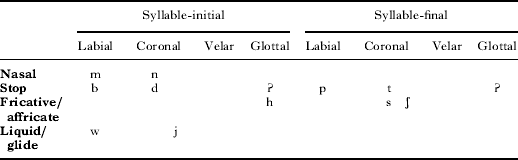
At the start of the study, Ben exhibited a highly limited consonant inventory. Table 3 reports all consonants that Ben produced at least twice in an initial sample of fifty spontaneous utterances, divided across initial and final position. Velars, supraglottic fricatives, and voiceless stops were absent from initial position, while voiced stops and nasals were absent from syllable-final position. Voiceless stops and fricatives were attested in syllable-final position, but stops frequently underwent deletion or debuccalization to glottal stop (e.g. [dʌʔ], ‘duck’). Syllable-final /k/ was not observed in Ben's spontaneous output until the second session, although this may represent an accidental gap. Ben also began the study with a limited range of syllable shapes, with most utterances composed of V and CV syllables; CVC syllables were intermittently attested.
Ben's consonant inventory by position, age 3 ; 9·27
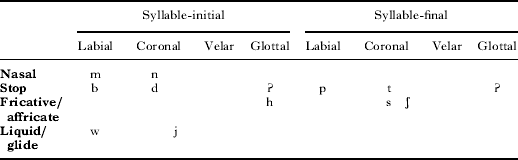
Ben's output reflected the application of numerous phonological patterns, several sensitive to position in the syllable. Along with PVF, he exhibited a pattern of fricative gliding in strong position: syllable-initial fricatives were replaced with glides (e.g. [jo] ‘sew’), while fricative manner was preserved in syllable-final contexts (e.g. [mas] ‘mouse’).Footnote 5 Other patterns included cluster reduction, liquid gliding, syllable-initial voicing and syllable-final devoicing of obstruents, and coda stop deletion or debuccalization to [ʔ]. Based on the presence of characteristics including atypical prosody, inconsistent errors and vowel errors, Ben was assigned a provisional diagnosis of Childhood Apraxia of Speech, suggesting a deficit in his capacity to control the articulators to form and sequence speech sounds (Davis, Jakielski & Marquardt, Reference Davis, Jakielski and Marquardt1998). However, it is notoriously difficult to distinguish between Childhood Apraxia of Speech and generalized phonological delay/disorder. For present purposes, it will be assumed that Ben's difficulties with speech-motor control made him comparable to a typical child in an earlier stage of motor skill development. Again, this equivalence must be validated empirically by comparison with younger children, and data collection to meet this goal has been initiated.
Data collection
Data collection took place during Ben's hour-long speech therapy sessions, which occurred on a roughly biweekly basis. Ben's primary therapy used a minimal pair contrast approach, with other therapy activities using structured imitation tasks to stimulate more faithful production. Articulatory cues, such as hand gestures representing place of articulation, were incorporated throughout Ben's therapy. In the first four weeks, the primary therapy goal was to establish oral place in coda stops. When Ben met a criterion of 80% inclusion of coda place in a structured elicitation task, preservation of fricative manner in syllable-initial position was adopted as the primary therapy target. Eighty percent preservation of initial fricative manner in a structured task was achieved after ten sessions. Velar place in prosodically strong contexts was then targeted and remained the primary therapy goal for the remaining six sessions of the study. Therapy specifically targeted velars in strong position because Ben had already mastered velar place in weak contexts. Target words used in therapy were balanced to represent voiced and voiceless velars in a range of vowel contexts.
One concern raised by data collection in a therapy setting is that it yields a heterogeneous speech sample, including imitative and spontaneous utterances produced in structured and unstructured contexts. Children may produce speech sound targets more accurately in imitation or drills than in spontaneous speech. However, this article takes the position that a child's imitation of an adult model is still an output of his own phonology and can thus offer insight into the grammar. If a particular form is incompatible with the child's grammar, no amount of modeling can guarantee the desired target (i.e. the child is not stimulable for that sound; e.g. Miccio, Elbert & Forrest, Reference Miccio, Elbert and Forrest1999). For six of the seven months documented, Ben was not stimulable for velar targets in strong contexts. Cases where the child does show enhanced accuracy in an imitative context can also be captured within the phonology. The adult's model heightens the child's attention to a phonological category, which may temporarily boost the weight of the corresponding faithfulness constraint. This is akin to grammatically encoding greater preservation of contrast in careful relative to casual speech by scaling faithfulness constraint rankings differently across speech registers (Boersma & Hayes, Reference Boersma and Hayes2001). Thus, while imitative versus spontaneous status does represent a source of variation in Ben's productions, looking at both categories affords a more comprehensive picture of the range of constraint weightings available at a given point in his grammatical development.
During therapy sessions, Ben's interactions with his mother and the clinician were recorded with a Sony ICD-SX57 portable mp3 recorder. Recordings generated with this device were suitable for phonetic transcription but generally not of adequate quality for acoustic analyses. From these recordings, the author transcribed all of Ben's identifiable utterances using impressionistic narrow transcription. Salient phonetic details including vowel length, nasalization, and consonant release properties were marked with diacritics. Utterances were glossed as completely as possible, and items for which a definitive gloss could not be established were excluded from analysis. The glossed transcript was used to identify all words whose adult target form contained a velar obstruent in any position, yielding 2,407 targets in total.
Velar production patterns in the case study corpus
Ben's attempted velar productions were classified as faithful or unfaithful relative to the adult target. Across the study duration, approximately 41% of velar targets were identified as fully faithful. The largest error category was fronting to coronal place, which was observed for 34% of targets. Less common errors included debuccalization to glottal stop (6%) and deletion or other substitutions (5%). One more error category deserves mention, accounting for roughly 9% of velar targets over the course of the study. This pattern featured glottal stop epenthesis adjacent to a velar target. In word-medial position, glottal epenthesis could occur either before or after the velar, as shown in (3)–(4). Postglottalized production was also attested in word-initial position.
(3) Preglottalization in word-medial contexts
[mʌʔki] ‘monkey’
[bƱʔko] ‘pickle’
[haʔki] ‘hockey’
[jʌʔkiŋ] ‘licking’
(4) Postglottalization in word-medial and initial contexts
[dƱkʔƐn] ‘chicken’
[dakʔo] ‘tiger’
[kʔamo] ‘camel’
[kʔʌt] ‘cut’
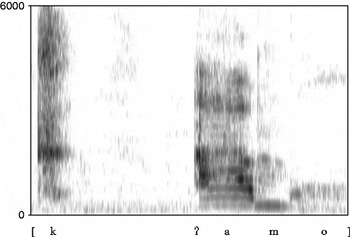
In adult speech, glottal epenthesis adjacent to a consonant can be perceptually subtle. Ben's postglottalized consonants were unusually salient due to the presence of a distinct pause between the velar release and the glottalized onset of the vowel. Preglottalized forms were perceptually less conspicuous. To verify the classification of forms as preglottalized, postglottalized or non-glottalized, 10% of all velar targets in word-medial position were recategorized by a graduate student trained in phonetic transcription. Inter-rater agreement was 84%, an acceptable level for the speech of an unintelligible child. Postglottalized forms in initial position were not reviewed for inter-rater reliability due to their perceptually unambiguous nature. The spectrogram in Figure 1 illustrates postglottalized production of a word-initial voiceless velar ([kʔamo] ‘camel’). As Figure 1 shows, Ben's postglottalized productions were characterized by isolated release of the oral constriction, followed by a distinct pause and then the glottalized onset of the following vowel.
Spectrogram of ‘camel’ with postglottalized initial velar stop.

Glottal stop epenthesis adjacent to a consonant is not a typical developmental phonological error, and postglottalization of initial stops in particular gave Ben's speech an idiosyncratic quality. It is likely that Ben's unusual output reflects the influence of his participation in therapy activities targeting velar place. However, Ben's first use of postglottalization in initial position occurred before any therapy targeting velars, when he was trying to repair a communication breakdown caused by his velar fronting. As noted above, a heightened level of attention to place distinctions – which could arise in therapy or a naturalistic context where the child is highly motivated to convey a contrast – could increase the weight of Ident-Place. Below it will be argued that the grammar selects glottal epenthesis as the most harmonic repair in certain contexts when Ident-Place is high-weighted.
Developmental stages in the case study corpus
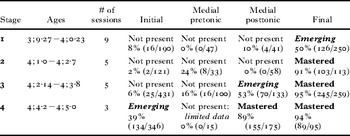
Over the study interval, Ben's accuracy for velar targets across all positions increased from 2% in session 2 to 77% in session 20. To capture this progression, Ben's acquisition of velars was divided into descriptive stages (Ingram, Reference Ingram1989). A new stage was identified whenever velar production accuracy within any prosodic context crossed a threshold between predetermined levels of accuracy. The levels adopted were ‘mastered’ (>80% accuracy), ‘emerging’ (25–80% accuracy) and ‘not present’ (<25% accuracy). Table 4 shows the four stages identified by applying these criteria over Ben's data. For more detailed data about velar targets across contexts and stages, see Appendix A.
Summary of stages in Ben's acquisition of velar place: not present = < 25% correct; emerging = 25–80% correct; mastered = > 80% correct

Although stages were identified using a descriptive criterion, transitions between stages are proposed to reflect a deeper causative factor, namely a change in the weight of one or more constraints. For example, the transition between Stages 1 and 2 was identified when word-final velar targets surpassed 80% accuracy. Most of Ben's errors affecting final velars featured debuccalization to [ʔ] rather than fronting. Debuccalization is modeled with a constraint militating against coda place contrasts, Coda-Cond (Goldsmith, Reference Goldsmith1990). During Stage 1, minimal pair contrast therapy was used to increase Ben's awareness of oral place in coda stops. When debuccalization was suppressed, it was presumed that therapy had caused the weight of Coda-Cond to decrease. Other changes in constraint weight marking the transition from one stage to another will be proposed below.
Coding for conditioning factors
Because there was considerable variability in Ben's production of velar targets, quantitative analysis was undertaken to explore the role of several conditioning factors in shaping his output. Since Ben's patterns of velar production changed over time, targets were coded for the developmental stage in which they were produced. Targets were also coded for prosodic context. Strong contexts included word-initial position and word-medial position before a vowel bearing primary or secondary stress (henceforth, medial pretonic position). Weak contexts were word-final position and word-medial position before a stressless vowel (medial posttonic position). For the quantitative analysis, no distinction was made between stressed and unstressed syllables in initial position due to the small number of initial unstressed velars (14/1,088), although these contexts will be distinguished in the formal analysis below. It was hypothesized that velar production accuracy would be greater in prosodically weak contexts, where the articulatory target is lower.
Vowel context was included as a potential conditioning factor based on evidence that children realize velar place more accurately in the environment preceding a back vowel (Nicolaidis, Edwards, Beckman & Tserdanelis, Reference Nicolaidis, Edwards, Beckman, Tserdanelis, Catsimali, Anagnostopoulou, Kalokerinos and Kappa2003). MacNeilage and Davis (Reference MacNeilage, Davis and Jeannerod1990) propose that syllables composed of a velar stop plus a back vowel are favored in babbling and early speech because they do not require differentiated control of tongue and jaw. Therefore, the present model predicts increased accuracy in the context of a back vowel. Vowel context was coded based on the transcribed backness of the following vowel unless the velar target was word-final, in which case the backness of the preceding vowel was used. A coarse-grained back/non-back coding was used because distortion in Ben's vowels made finer distinctions unreliable. The back-central vowel /ʌ/ was coded as back, while /ə/ and /a/ were coded as non-back.
The proposal that children's difficulty executing jaw-independent tongue gestures is greater in the context of a more forceful articulatory gesture suggests another potential conditioning factor: the voicing of the velar stop. Numerous studies, recently summarized by Hamann and Fuchs (Reference Hamann, Fuchs, Żygis and Fuchs2008), have found that voiceless consonants are formed with higher tongue and jaw position than voiced consonants. Greater gestural force may be a response to elevated intraoral pressure in voiceless stops, which lack the impedance introduced by the vibrating vocal folds (McGlone & Shipp, Reference McGlone and Shipp1972). From this evidence, it was predicted that voiced velars would be realized with greater accuracy than voiceless velars. However, recall that Ben's phonology included patterns of syllable-initial voicing and syllable-final devoicing, which remained robust throughout the study. This close correlation between voicing and position in the syllable tends to confound efforts to evaluate the influence of voicing on velar production accuracy. However, an independent influence of voicing on velar production could still be detected if Ben produced a reliable but sub-perceptible distinction (covert contrast) between voiced and voiceless targets within a given position. Recordings of Ben's outputs were of insufficient quality for reliable measurement of bursts or voice onset times. However, covert voicing contrasts are well attested in developmental phonology and may even represent a universal stage in voicing acquisition (Macken & Barton, Reference Macken and Barton1980). Voicing of the adult target form was thus included as a factor in the quantitative analysis to determine whether voicing could influence velar production accuracy in spite of Ben's apparent neutralization of voicing categories within a position in the syllable.
Analysis
The coded data were fitted to a four-predictor logistic model testing the hypothesis that velar production accuracy was influenced by the factors identified above (Developmental Stage, Prosodic Context, Voicing, Vowel Context). The dependent variable was accuracy in velar production. For the regression, only productions coded as having fully faithful velar place were assigned a score of 1. All other response categories (fronting, glottal epenthesis, debuccalization, and other) received a score of 0; see below for discussion of the decision to code forms with glottal epenthesis as incorrect.
The significance of the contribution of each factor was initially estimated in a model including all main terms and first-order interactions. Partial significance of each factor was determined using the chi-square statistic. In this model, all four main terms were significant (Stage, Prosodic Context, Voicing, p < 0·0001; Vowel Context, p < 0·001). Significant interactions were Stage × Prosodic Context (p = 0·002), Stage × Voicing (p < 0·0001), and Prosodic Context × Voicing (p < 0·0001). The model was re-fitted to exclude non-significant interaction terms. In the revised model, all main terms continued to reach significance. Each main effect will be discussed in detail below. A significant Stage × Prosodic Context interaction reflected differences in the relative accuracies of velars in strong and weak contexts over the course of Ben's development. Significant interactions of Stage × Voicing and Prosodic Context × Voicing appeared to reflect a divergence in the behavior of voiced and voiceless velars in initial position that arose in the fourth and final developmental stage. An R 2 value of 0·56 was calculated for the re-fitted model, suggesting that the model has adequate predictive strength. A model summary is provided in Appendix B.
RESULTS
Prosodic context
As anticipated, prosodic context was a significant predictor of velar production accuracy, and Fisher's exact test confirmed that velar targets were realized with significantly greater accuracy in weak relative to strong contexts (p < 0·0001). Across the duration of the study, velars in weak contexts were realized with 70% accuracy (792/1,124), versus only 16% accuracy in strong contexts (201/1,283). Examples illustrating the contrasting behavior of velars in strong and weak contexts in Ben's output were presented previously in (1). Note that in (1), strong position is subdivided into initial and medial pretonic contexts and weak position into final and medial posttonic contexts. Cumulative accuracies for these subcategories were as follows: initial position, 16% (177/1,088); medial pretonic position, 12% (24/195); medial posttonic position, 56% (229/407); and final position, 79% (563/717). The difference in accuracy between final and medial posttonic position, two prosodically weak contexts, will be addressed in the phonological analysis below.
Vowel context
The regression analysis identified vowel context as a significant predictor of velar production accuracy. As predicted, accuracy was greater for velars preceding a back vowel (461/891, 52%) relative to a non-back vowel (532/1,516, 35%). Fisher's exact test confirmed that this difference was significant (p < 0·0001). The examples in (5), drawn from a single session in Stage 4, illustrate the conditioning influence of vowel context.
(5) Contrasting behavior of velars in back and non-back vowel contexts, age 4 ; 4·2
a. Velars before a non-back vowel are more likely to be fronted.
[din] ‘green’
[sti] ‘ski’
[dæn] ‘can’
[dƐʔ] ‘get’
b. Velars before a back vowel are more likely to be faithful.
[goənaʔs] ‘coconuts’
[got] ‘good’
[gʌmdaps] ‘gumdrops’
[gʌnə] ‘gonna’
Voicing
Voiced versus voiceless status of a velar target was also a significant predictor of accuracy. As predicted, voiced targets were more accurate than voiceless targets (427/826, 52%, versus 566/1,581, 36%). Fisher's exact test confirmed that the difference was significant (p < 0·0001). The voiced–voiceless contrast was manifested partly through differences in the incidence of fronting. For instance, voiceless velar targets in initial position were significantly more likely to undergo fronting than voiced initial velar targets (496/702, 71%, versus 242/386, 63%; Fisher's exact p = 0·01). However, the role of target voicing in conditioning Ben's production of velars was most apparent in connection with the above-described pattern of glottal epenthesis. In Stage 4, Ben showed a systematic contrast between voiced and voiceless velars in initial position, where the former were fully faithful and the latter postglottalized. This contrast is illustrated in (6) with examples from a single session in Stage 4.
(6) Contrasting behavior of voiced and voiceless velars in initial position, age 4 ; 5·0
a. Voiced velar targets are realized faithfully.
[goƱ] ‘go’
[gus] ‘goose’
[gai] ‘guy’
[gin] ‘green’
b. Voiceless velar targets are postglottalized.
[kʔiŋ] ‘king’
[kʔam] ‘come’
[kʔændo] ‘candle’
[kʔɔf] ‘cough’
At first glance, it seems that postglottalization could simply represent Ben's general strategy for realizing voicelessness in initial position. However, initial coronal targets in the same recording session did not undergo postglottalization, as shown in (7). This suggests that postglottalization was specifically linked to velar place.
(7) Postglottalization does not affect initial voiceless coronals, age 4 ; 5·0
[dakiŋ] ‘talking’
[dƱki] ‘turkey’
[dusju] ‘tissue’
[diziŋ] ‘teasing’
Second, it might be objected that the glottal epenthesis category should be scored as accurate, since velar place was in fact realized in these forms. Glottal epenthesis was treated as an error category because these forms are not only perceptually anomalous, but also violate input–output faithfulness by including a glottal stop not present in the target. In the formal analysis to follow, glottal epenthesis will be unified with fronting as a possible output of the grammar in response to the conflicting pressures of Move-As-Unit and faithfulness. This analysis hinges on the observation that glottal stop epenthesis has the potential to reduce the Move-As-Unit violation incurred by a prevocalic stop. The introduction of glottal constriction in the vicinity of the consonant valves air pressure below the level of the oral constriction. This limits the buildup of intraoral pressure behind the consonant closure, making it possible to maintain a seal with less forceful articulatory contact. Preglottalized stops belong to the class of ‘non-explosive’ consonants, defined by the lack of build-up of air pressure within the oral cavity (Clements & Osu, Reference Clements, Osu, Gussenhoven and Warner2002). The postglottalized manner of production represents a slightly different means of limiting intraoral pressure. In Ben's postglottalized stops, the oral constriction was released with a small amount of aspiration, followed by a silent pause and then the glottalized onset of the vowel. With considerable separation between the stop release and the vowel, Ben's postglottalized stops were more akin to isolated or word-final consonants. In the analysis to follow, stops with glottal epenthesis will receive the same Move-As-Unit violation as final and isolated velar stops.
FORMAL ANALYSIS
Constraints
Quantitative analysis revealed complex forces shaping Ben's patterns of velar production. All of the conditioning effects were consistent with the hypothesis that faithful velar production is more likely in contexts that allow smaller, less forceful articulatory gestures. This section will argue that the phonetically sensitive constraint Move-As-Unit can capture the full range of factors influencing Ben's pattern of velar fronting.
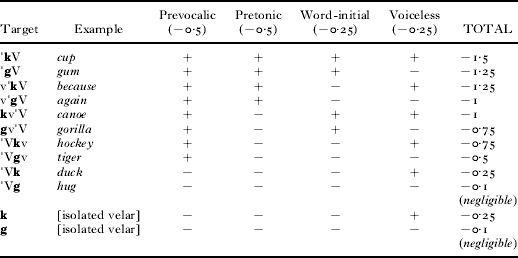
In Harmonic Grammar, it is necessary to specify both the weight of a constraint and the magnitude of the violation incurred by a given candidate. Table 5 reports the Move-As-Unit violation scores that will be used in the tableaux to follow. Although the absolute magnitudes of violation adopted below are ultimately arbitrary, the relative magnitudes were determined systematically by itemizing prosodic and laryngeal contributors to gestural force. Table 5 shows that candidates incur a base violation of magnitude −0·5 for occurring in prevocalic position, with an additional penalty of −0·5 if the vowel is stressed. Word-initial position expands the violation by an additional −0·25. The smaller increment in this context reflects the equivocal nature of the evidence for a stress-independent influence of initial position on articulatory force (Keating, Reference Keating, Elenius and Branderud1995). The contribution of voicing to gestural force is also less firmly established than the role of prosodic context, and so voiceless targets incur a penalty of −0·25 above that assigned to voiced targets. Finally, Table 5 indicates that isolated velar stops should incur a Move-As-Unit violation that is small, since little force is required, but non-zero, since linguopalatal contact specific to the velar region does require jaw-independent tongue control. For the reasons stated above, Ben's pre- and postglottalized productions will be represented with the same violation assigned to an isolated velar stop with the same voicing.
Calculating the magnitude of Move-As-Unit[Vertical] violations by gestural force

In addition to Move-As-Unit, the following constraints will be used to model Ben's grammar in the tableaux that follow. Constraints (8–10) are familiar faithfulness constraints. The final constraint, Voiced-Obstruent → __[+son], is a positional markedness constraint stating that a voiced obstruent occurs only before a sonorant segment. This constraint, which has reflexes in adult typology (e.g. Steriade, Reference Steriade and Gordon1999), drives Ben's pattern of positional voicing; below it will also be seen to influence the availability of voiced velars as a substitute for more forceful voiceless velar targets.
(8) Ident-Place: Segments have the same place of articulation in input and output.
(9) Ident-Voice: Segments have the same value for [+/ − voice] in input and output.
(10) Dep-[ʔ]: A glottal stop in the output has a corresponding glottal stop in the input.
(11) Voiced-Obstruent → __[+son]: Penalize a voiced obstruent that does not occur in the context preceding a [+sonorant] segment.
Tableaux
This section will demonstrate that the Move.as-Unit can capture the behavior of velars in Ben's output across all prosodic and segmental contexts and developmental stages. For brevity, tableaux will be generated for a limited subset of these combinations. Recall that transitions between stages were posited to reflect changes in constraint weights in Ben's grammar. To model the beginning of the recorded interval, the markedness constraints Move-As-Unit and Voiced-Obstruent → __[+son] are assigned a higher weight than the faithfulness constraints. This is in accordance with the general principle that markedness outweighs faithfulness in the initial state of the grammar (Jesney & Tessier, Reference Jesney and Tessier2011).
Ben's utterances to be analyzed below contain a number of phonological substitutions unrelated to velar fronting; these are not taken into account in the comparison of candidates. In addition, candidates involving debuccalization to glottal stop will not be depicted, even though this process did affect velar targets in Ben's output. Driven by Coda-Cond, debuccalization applied equally across all places of articulation and is thus orthogonal to Ben's specific difficulty with velar place. In the tableaux that follow, all examples will be drawn from Ben's Stage 2 or later, after debuccalization was mostly suppressed.
Prosodic context
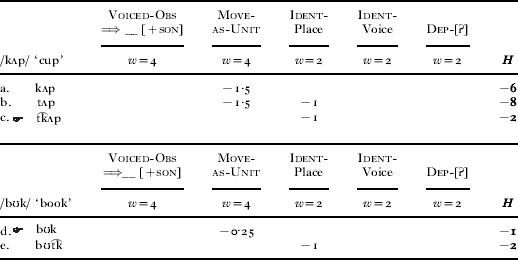
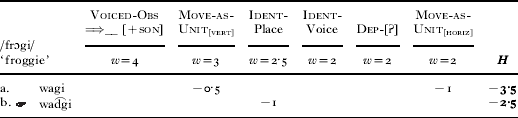
Table 6 illustrates the contrasting behavior of velar targets in word-initial and word-final contexts in Ben's Stage 2. For the target word ‘cup’, faithful candidate (a) incurs a Move-As-Unit violation of magnitude −1·5, as calculated in Table 5 for a voiceless initial pretonic velar. Candidate (b), featuring fronting to true coronal place, incurs the same Move-As-Unit violation because it too requires a discrete lingual gesture. Since candidate (b) also violates Ident-Place, it is harmonically bounded by the faithful candidate and can never be selected as the winner. Candidates with substitution of true coronal place are thus omitted from subsequent tableaux. Candidate (c) features an undifferentiated lingual gesture, which incurs no Move.as-Unit violation. This candidate does violate Ident-Place, but the lower weight of faithfulness relative to markedness in this stage means that (c) emerges as most harmonic, yielding an undifferentiated gesture perceived as coronal in word-initial position. By contrast, the final velar target in ‘book’ incurs a much smaller violation of Move.as-Unit (see Table 5). Since the weighted Move.as-Unit violation incurred by faithful candidate (d) is less than the weighted Ident-Place violation incurred by undifferentiated candidate (e), candidate (d) is selected.
Stage 2: initial velars are fronted, but final velars are faithful

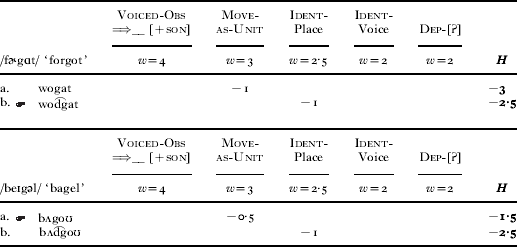
Table 7 depicts the contrasting behavior of velar targets in strong and weak contexts word-medially. In Stage 3, faithful velar place was emerging in medial posttonic position, but fronting remained robust in medial pretonic contexts. The transition between Stages 2 and 3 can be modeled with adjustments to constraint weights. Ben's therapy in Stage 2 targeted preservation of fricative manner in initial position. Because fricatives are controlled gestures, these therapy activities provided Ben with opportunities to practice jaw-independent tongue movements. As motor practice made these movements less difficult, the weight of Move-As-Unit could be expected to decrease, here represented as a decrement from 4 to 3. Place contrasts were not targeted explicitly in Ben's therapy during Stage 2, but some increase in the weight of Ident-Place could be expected as a natural part of phonological development. It has been argued that, in order for phonological learning to converge on an appropriately restrictive adult grammar, the weight of faithfulness constraints must increase more gradually than the weight of markedness constraints decreases (Jesney & Tessier, Reference Jesney and Tessier2011). Accordingly, Table 7 depicts Ident-Place as having increased by an increment of 0·5.
Stage 3: medial pretonic velars are fronted, but medial posttonic velars are faithful

In Table 7, the weighted Move-As-Unit violation incurred by the medial pretonic velar in ‘forgot’ makes faithful candidate (a) less harmonic than undifferentiated candidate (b), and fronting applies in this context. By contrast, the Move-As-Unit violation incurred by a faithful velar in medial posttonic position in ‘bagel’ is less than the weighted Ident-Place violation incurred by undifferentiated candidate (b). Table 7 thus captures the observation that fronting affected velars in strong but not weak word-medial contexts in Stage 3.
Vowel context
Table 8 depicts a different outcome when a voiced velar in medial posttonic position occurs in a non-back vowel context. In the target ‘doggie’, the tongue must move from its backed position for /g/ to an anterior position for /i/. This means that, in addition to the Move-As-Unit[Vertical] violation calculated in Table 5, this candidate violates the lower-weighted constraint Move-As-Unit[Horizontal]. In the absence of specific articulatory data, here the transition from a velar to a non-back vowel is penalized schematically with a violation of magnitude 1. In Table 8, this additional violation makes faithful candidate (a) less harmonic than undifferentiated candidate (b). By penalizing horizontal as well as vertical jaw-independent tongue movements, the model can capture the greater incidence of fronting in a non-back vowel context that has been observed in Ben and other children acquiring velars.
Stage 3: a medial posttonic velar is fronted in a non-back vowel context
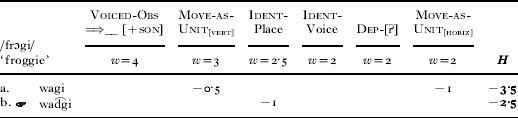
Voicing
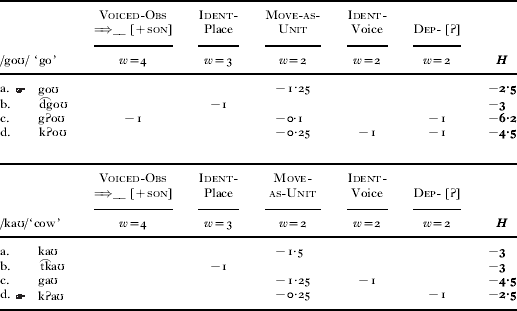
The regression analysis showed that Ben realized voiced velar targets with greater accuracy than voiceless velars. This contrast became especially salient in Stage 4, when voiced initial velars were realized faithfully, but voiceless initial velars systematically featured glottal stop epenthesis. Beginning in Stage 3, Ben received therapy targeting the velar–coronal place contrast in strong position, which could be expected to increase the weight of Ident-Place while also lowering the weight of Move.as-Unit. The transition from Stage 3 to Stage 4 has been modeled by lowering the weight of Move.as-Unit from 3 to 2 while raising the weight of Ident-Place to 3. The constraints Ident-Voice and Dep-[ʔ], which were not targeted in therapy, retain their original weights.
Table 9 depicts the behavior of voiced and voiceless velars in word-initial position in Stage 4. In ‘go’, the greater weight of Ident-Place relative to Move-As-Unit means that fully faithful candidate (a) is more harmonic than undifferentiated candidate (b). Candidates (c) and (d), which feature glottal epenthesis, are also less harmonic than (a) because they violate Dep-[ʔ] and either Voiced-Obstruent → __[+son] or Ident-Voice. In ‘cow’, the voiceless initial velar in faithful candidate (a) incurs a larger Move-As-Unit violation than its voiced counterpart, and (a) ties with undifferentiated candidate (b). Lessening the Move-As-Unit violation by producing a voiced velar, as in candidate (c), does not yield a more harmonic form due to the added penalty for violating Ident-Voice. However, postglottalized candidate (d) benefits more from its lower-magnitude Move-As-Unit violation than it loses by violating Dep-[ʔ]. Candidate (d), with glottal epenthesis, is thus selected as most harmonic.
Stage 4: voiced initial velars are faithful, but voiceless initial velars are postglottalized

When first introduced, Ben's pattern of glottal stop insertion adjacent to a velar was described as idiosyncratic and somewhat puzzling. Through the lens of a phonetically sensitive phonological model, though, it appears as a straightforward product of constraint interaction. In Stage 4, therapy activities targeting coronal–velar place contrasts had increased the weight of Ident-Place relative to Move-As-Unit, but the latter remained an active force in Ben's grammar. The candidate that best balances these competing forces will minimize the Move-As-Unit violation while violating only a lower-weighted faithfulness constraint – in this case, Dep-[ʔ]. In this light, Ben's pattern of glottal stop epenthesis appears as an instance of phonological conspiracy (Kisseberth, Reference Kisseberth1970): faced with multiple possible repairs for a markedness violation, the grammar chooses the form that violates the lowest-weighted faithfulness constraint. For other instances of conspiracy in developmental phonology, see Pater and Barlow (Reference Pater and Barlow2003) and Dinnsen and Farris-Trimble (Reference Dinnsen and Farris-Trimble2008b).
As Tables 6 to 9 have shown, the proposed system of constraints and weightings captures Ben's velar fronting patterns across multiple contexts and developmental stages. Without Move.as-Unit's ability to encode gradient differences in the magnitude of articulatory gestures, a unified treatment of the conditioning effects of prosodic context, voicing, and vowel context would not be possible.
OTHER CONSIDERATIONS
The present discussion would be incomplete without mention of another model that characterizes neutralization in strong position as the product of child-specific phonetic factors (Dinnsen & Farris-Trimble, Reference Dinnsen, Farris-Trimble, Dinnsen and Gierut2008a). In contrast with the articulatory analysis proposed here, Dinnsen and Farris-Trimble argue that neutralization in strong position reflects a child-specific perceptual bias. In adults, perception is influenced more strongly by initial/prevocalic cues than final/postvocalic cues (Fujimura, Macchi & Streeter, Reference Fujimura, Macchi and Streeter1978). Dinnsen and Farris-Trimble propose that children have the opposite bias, attending selectively to cues in final position. This is argued to lead children to exhibit greater faithfulness to final contrasts, which they perceive as more salient. However, preliminary perceptual results from children with PVF indicate that they do perceive the coronal–velar contrast at least as accurately in initial as in final position. The subject with PVF described by Chiat (Reference Chiat1983) demonstrated 100% correct discrimination of word-initial velar and alveolar stops. In the present study, the possibility of a perceptual explanation was addressed by engaging Ben in a perceptual discrimination task with digitized nonword stimuli. Twenty-four nonword pairs containing a minimal contrast in either initial or final position were randomly intermixed with twenty-three identical non-word pairs, and all pairs were presented twice over three testing sessions. The results did not support the hypothesis of a child-specific perceptual bias favoring final position: Ben correctly detected 68% of initial contrasts and 40% of final contrasts, a significant difference (χ2 (1, N = 78) = 6·25, p = 0·01). Ben did show overall decreased perceptual accuracy for the coronal–velar contrast he neutralized in production, but there was no evidence of an advantage for final position: he detected 45% of word-initial and 30% of word-final coronal–velar contrasts. This evidence points toward an articulatory rather than a perceptual factor as the phonetic motivation underlying child-specific patterns of positional neutralization.
CONCLUSION
This article revisited the child-specific pattern of positional velar fronting, which reverses a preference for neutralization in prosodically weak contexts that is strongly upheld across adult phonological typology. While it is possible to model PVF with adaptations of the formalism used for adult patterns of positional neutralization, this approach does not explain why neutralization in strong position is unattested in mature grammars. A phonetically based approach to child phonology offers a more explanatory account. Since child and adult speakers are subject to distinct low-level phonetic pressures, some degree of divergence between child and adult phonological patterns is naturally expected. As normal maturation brings the child's phonetic experience of speech production in line with that of the adult, the anomalous phonological processes will also be eliminated.
This article has offered a more specific, motor-based formulation of the insight that PVF can be modeled as the consequence of child-specific articulatory limitations (Inkelas & Rose, Reference Inkelas, Rose, Beachley, Brown and Conlin2003; Reference Inkelas and Rose2007). Children are known to show a diminished capacity for jaw-independent control of the tongue. Here it was proposed that this difficulty is phonologically encoded in the child-specific constraint Move.as-Unit. The ballistic movements that satisfy Move.as-Unit also predispose the child to produce undifferentiated gestures, which are perceived to have coronal place whenever the coronal region of closure is last to be released. This study was unable to provide direct evidence of undifferentiated linguopalatal contact in velar fronting, e.g. with electropalatography or ultrasound imaging. However, an ultrasound investigation comparing tongue shapes for coronal and velar targets in strong and weak contexts is now being launched.
The present study is also limited by its use of a single subject with phonological disorder. Future research will consider a larger sample of children, including typically developing children as well as children with phonological delay/disorder. If velar fronting data from other children do not show conditioning effects of voicing or vowel context, it will be necessary to conclude that Ben's pattern, in which velar production was influenced by gradient differences in articulatory force, is characteristic of only a subset of children with velar fronting. Because this analysis is based on stages of motor development that are well documented across typical maturation, though, there is reason to believe that these results will not prove entirely unique to Ben.
Finally, the phonetically sensitive constraint Move-As-Unit has the potential to account for other child-specific phonological patterns. The hypothesis that children are least able to use precise articulatory gestures in contexts that require the greatest force can offer insight into the entire class of processes of neutralization in strong position, and Move-As-Unit provides a tool for expressing these motor limitations within the phonological grammar. A model that considers how the child's phonological grammar can interact with the developing motor system has unique potential not only to capture child-specific phonological phenomena, but also to explain why child and adult grammars differ and how these differences are eliminated in the normal course of maturation.
APPENDIX A
Complete breakdown of tokens recorded across prosodic contexts and developmental stages. The predominant pattern(s) of velar production in each context are shaded gray

APPENDIX B
Summary of logistic regression model (reference level in parentheses)