Introduction
Posttraumatic stress disorder (PTSD) is a mental disorder, which occurs after exposure to traumatic events (e.g., war, natural disaster, accident, crime and abuse) (American Psychiatric Association, 2013). Previous research has revealed that it develops in only a small proportion of those who have been exposed to these traumatic events, which suggests that other factors preceding traumatic events may modify the association between exposure to these events and the development of PTSD (Castro-Vale et al. Reference Castro-Vale, van Rossum, Machado, Mota-Cardoso and Carvalho2016).
In this context, adverse childhood experiences (ACEs), which include psychological, physical, and sexual abuse and family members’ substance abuse and mental illness, might act as a possible mediator (Felitti et al. Reference Felitti, Anda, Nordenberg, Williamson, Spitz, Edwards, Koss and Marks1998). While it is well documented that ACE is associated with PTSD in adulthood (Brewin et al. Reference Brewin, Andrews and Valentine2000; Heim & Nemeroff, Reference Heim and Nemeroff2001), previous studies have also investigated the association between ACEs and the onset of PTSD after later exposure to life-threatening events, such as war or disaster (Astin et al. Reference Astin, Ogland-Hand, Coleman and Foy1995; Cabrera et al. Reference Cabrera, Hoge, Bliese, Castro and Messer2007; Iversen et al. Reference Iversen, Fear, Ehlers, Hacker Hughes, Hull, Earnshaw, Greenberg, Rona, Wessely and Hotopf2008; Fritch et al. Reference Fritch, Mishkind, Reger and Gahm2010; LeardMann et al. Reference LeardMann, Smith and Ryan2010; Rudenstine et al. Reference Rudenstine, Cohen, Prescott, Sampson, Liberzon, Tamburrino, Calabrese and Galea2015). For example, Cabrera et al. (Reference Cabrera, Hoge, Bliese, Castro and Messer2007) and Rudenstine et al. (Reference Rudenstine, Cohen, Prescott, Sampson, Liberzon, Tamburrino, Calabrese and Galea2015) assessed the effect of ACEs on the onset of PTSD among army veterans with combat experience; while the former study found that veterans with a greater number of ACEs had an increased risk of PTSD, the latter found no statistically significant association. In another study, Wahlstrom et al. (Reference Wahlstrom, Michelsen, Schulman and Backheden2010) showed that ACE was associated with the occurrence of PTSD among Swedish people who experienced the 2004 Indian Ocean earthquake and subsequent tsunami.
The comparatively limited research that has been undertaken to date on the association between ACEs, subsequent traumatic events in adulthood (e.g., combat exposure or the number of major life events) and PTSD means that the interaction effect between ACEs and other stressful life events in adulthood in predicting PTSD still remains comparatively little studied (McCranie et al. Reference McCranie, Hyer, Boudewyns and Woods1992; Bremner et al. Reference Bremner, Southwick, Johnson, Yehuda and Charney1993; Stein et al. Reference Stein, Tran, Lund, Haji, Dashevsky and Baker2005; Cabrera et al. Reference Cabrera, Hoge, Bliese, Castro and Messer2007; McLaughlin et al. Reference McLaughlin, Conron, Koenen and Gilman2010), while the research that has occurred has produced conflicting results. Specifically, while some studies suggest ACEs and traumatic events may have a synergistic effect on the onset of PTSD (Bremner et al. Reference Bremner, Southwick, Johnson, Yehuda and Charney1993; McLaughlin et al. Reference McLaughlin, Conron, Koenen and Gilman2010), other research has indicated that ACEs may act to inhibit the effects of subsequent threats or fear so that there is inverse association between traumatic events and the onset of PTSD (McCranie et al. Reference McCranie, Hyer, Boudewyns and Woods1992; Stein et al. Reference Stein, Tran, Lund, Haji, Dashevsky and Baker2005; Cabrera et al. Reference Cabrera, Hoge, Bliese, Castro and Messer2007). Further, most of the studies that have examined ACEs and traumatic events have focused on specific subpopulations, particularly military veterans (Blosnich et al. Reference Blosnich, Dichter, Cerulli, Batten and Bossarte2014) while very little research has been conducted to date among the older population to determine if the impact of ACEs stretches across the life course (Ogle et al. Reference Ogle, Rubin and Siegler2013).
Based on the previous literature, we hypothesised that ACEs might modify the association between exposure to the March 2011 Great East Japan earthquake and tsunami and the occurrence of PTSD among community-dwelling older adults. To examine this, as indicators of potentially traumatic events we used information on house damage and the loss of a relative/friend during the earthquake/tsunami, which was collected as a part of the Japan Gerontological Evaluation Study (JAGES).
Methods
Data
JAGES is an on-going epidemiological survey investigating social determinants of health among older people (i.e., 65 years or above) across Japan. For the current study, we used data from a subset of the project, which comprised residents in Iwanuma City, Miyagi Prefecture, one of the JAGES project research locations. In 2010, all residents aged 65 years or older who were not certified as needing long-term care services were invited to participate in the study (Hikichi et al. Reference Hikichi, Aida, Tsuboya, Kondo and Kawachi2016; Tsuboya et al. Reference Tsuboya, Aida, Hikichi, Subramanian, Kondo, Osaka and Kawachi2016). Subsequently in March 2011, the city, which faces the Pacific Ocean, suffered severe damage as a result of the earthquake and accompanying tsunami with 180 of its 44 187 residents (as of 2010) dying during this event.
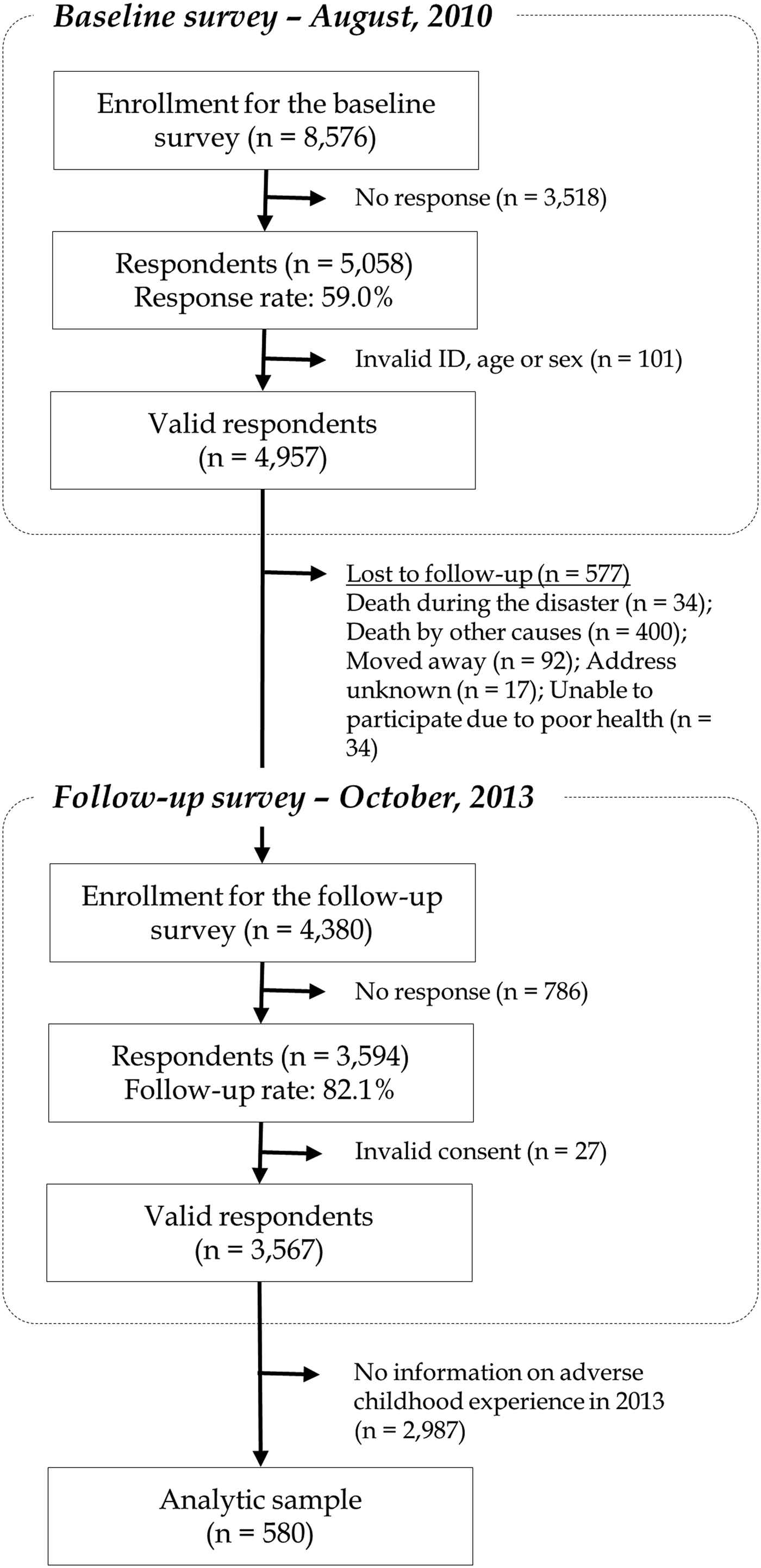
In 2013 (after the earthquake) the survey questionnaire was sent to 4380 of the 4957 participants who had originally participated in the survey in 2010 (before the earthquake), with 3594 (82.1%) of them responding. In addition to the standard survey questionnaire (which due to space limitations, obtained information on ACEs randomly from one in five of the participants), questions were also asked about damage inflicted by the tsunami and PTSD. After excluding those who did not provide information, 580 participants were included in the subsequent analysis. Participant inclusion in the 2010 and 2013 surveys is shown in Fig. 1.
Participants in the 2010 and 2013 waves of the JAGES project in Iwanuma City, Japan.

The research protocol was approved by the Ethics Committee for Research of Human Subjects at Nihon Fukushi University (ethical approval no. 10-05), the Ethics Committee for Medical Research at the University of Tokyo (ethical approval no. 10555), the Human Subjects Committee of the Harvard T.H. Chan School of Public Health and the Research Ethics Committee of Tohoku University. Informed consent was assumed with the voluntary return of the questionnaire.
Dependent variable
Information on PTSD was obtained in the 2013 survey using the Screening Questionnaire for Disaster Mental Health (SQD) (Fujii et al. Reference Fujii, Kato and Maeda2007; Hikichi et al. Reference Hikichi, Aida, Tsuboya, Kondo and Kawachi2016), which was originally developed to assess PTSD among those affected by the Kobe earthquake in Japan in 1995. This was validated against the Clinician Administered PTSD Scale and the Impact of Event Scale-Revised (Fujii et al. Reference Fujii, Kato and Maeda2007) and has been used to evaluate PTSD symptoms among the Kobe City population (Hikichi et al. Reference Hikichi, Aida, Tsuboya, Kondo and Kawachi2016; Tsuboya et al. Reference Tsuboya, Aida, Hikichi, Subramanian, Kondo, Osaka and Kawachi2016). The SQD asks participants about their reactions to experiencing a disaster (earthquake) in the past month and includes 15 questions with the following nine questions being used to identify those at risk of PTSD: ‘Do you have trouble falling asleep or sleeping through the night?’, ‘Do you have nightmares about the earthquake?’, ‘Do you feel irritable?’, ‘Do you feel that you are hypersensitive to small noises or tremors?’, ‘Do you avoid places, people, topics related to the earthquake?’, ‘Do you think about the earthquake when you do not want to?’, ‘Do you have trouble enjoying things you used to enjoy?’, ‘Do you get upset when something reminds you of the earthquake?’ and ‘Do you notice that you are making an effort to try not to think about the earthquake, or are trying to forget it?’. Affirmative answers were counted to generate a composite score (range: 0–15), which was then dichotomised with a score of six or more indicating possible PTSD.
Explanatory variables
Following the lead of previous studies that used this dataset (Hikichi et al. Reference Hikichi, Aida, Tsuboya, Kondo and Kawachi2016; Tsuboya et al. Reference Tsuboya, Aida, Hikichi, Subramanian, Kondo, Osaka and Kawachi2016), the extent of the damage caused by the earthquake and tsunami was assessed in two ways using information on: (1) damage to the respondent's house, which was based on a local government survey and certification; and (2) the loss of relatives or friends.
ACEs before the age of 18 were assessed in the 2013 survey with questions concerning: (1) loss of a parent, (2) parental divorce, (3) mother or father suffering a mental illness, (4) father's violence against the mother, (5) being beaten by a parent and injured, (6) being loved by a parent (reverse coded), (7) being insulted and verbally abused by a parent and (8) family financial trouble (Matsuyama et al. Reference Matsuyama, Fujiwara, Aida, Watt, Kondo, Yamamoto, Kondo and Osaka2016). Following the example of an earlier study (Matsuyama et al. Reference Matsuyama, Fujiwara, Aida, Watt, Kondo, Yamamoto, Kondo and Osaka2016) and for statistical purposes, the number of ACEs was summed and divided into two categories (i.e., 0 v. 1 or more).
Socio-demographic information obtained from the respondents in the 2013 survey included age (in years); sex (male or female); marital status (not married, married, unknown and missing); educational attainment (not graduated from high school (i.e., schooling of less than 12 years)); graduated from high school (i.e., schooling of 12 years); and obtained further education (i.e., schooling of more than 12 years)); and equivalent household income (i.e., less than 2 million yen; 2–4 million yen; and more than 4 million yen (1 million yen was approximately 10 000 USD as of November, 2013)). In addition, information was also obtained on respondents’ morbidity: hypertension, stroke, heart disease, diabetes, hyperlipidaemia, respiratory disease, diseases of the intestine, liver and gallbladder, musculoskeletal disease, injury (due to falling or fracture), cancer, eye disease, ear disease and other). A score was also generated (0–9) for the number of individual negative life events respondents had experienced in the past year: retired; started to live alone; experienced economic hardship; lost spouse; lost family members, relatives and close friends; suffered from disease; started to nurse family members; physical abuse from family members; and others. Information on baseline depression assessed with the Geriatric Depression Scale (GDS) was also incorporated in the models (with three score categories: 0–4; 5–15; and missing) (Sheikh & Yesavage, Reference Sheikh and Yesavage1986; Niino, Reference Niino1991).
Statistical analyses
A Poisson regression analysis with a robust variance estimator (Zhang & Kai, Reference Zhang and Kai1998; McNutt et al. Reference McNutt, Wu, Xue and Hafner2003) was used to investigate the effect of ACEs and the damage situation due to the earthquake and tsunami on the occurrence of PTSD given the relatively high prevalence of PTSD. Statistical analyses were conducted that examined the type of damage situation (i.e., damage to a house and loss of a relative/friend); we incorporated ACEs, each damage situation and interaction terms between ACEs and the corresponding damage situation while adjusting for the other covariates. Analyses were also undertaken after stratifying the respondents by the different ACE categories to determine if the impact of the earthquake/tsunami differed by the presence of ACEs.
All statistical analyses were conducted using Stata SE 13.0 (Stata Corp, College Station, TX) with the level of statistical significance set at p < 0.05. Results are presented as prevalence ratios (PR) and 95% confidence intervals (CI).
Results
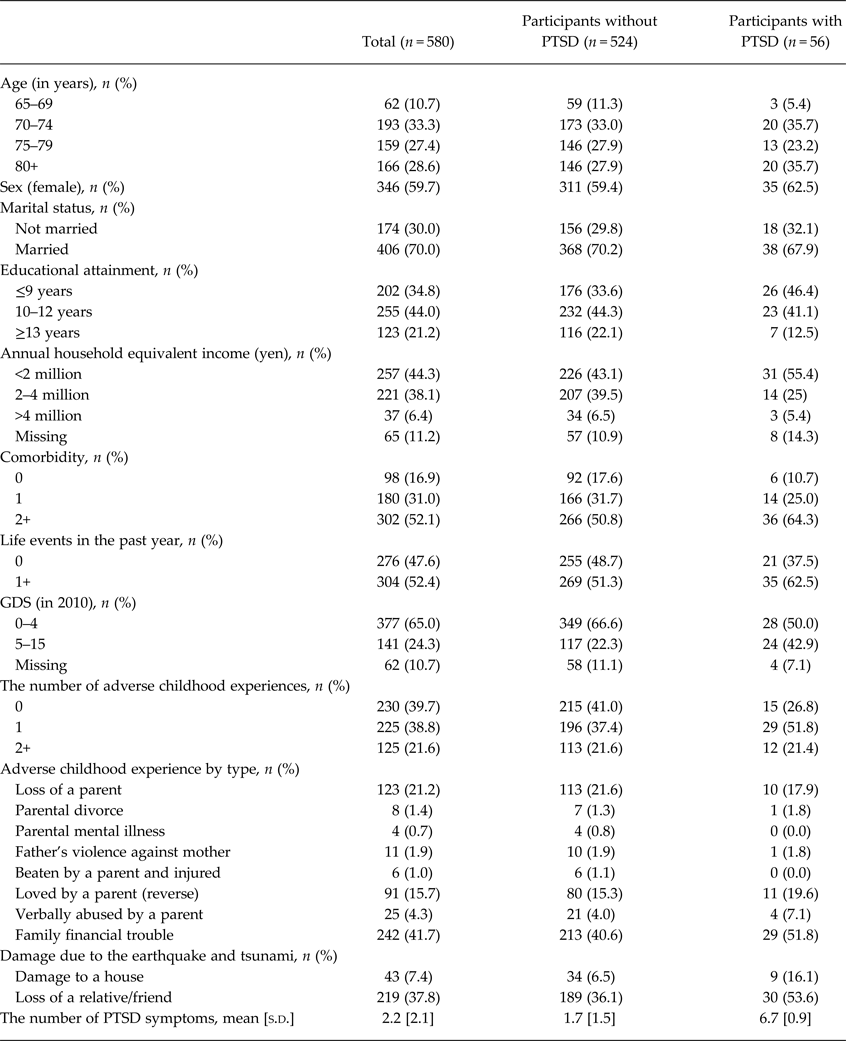
Information on the characteristics of the study participants and also stratified by the presence of PTSD is presented in Table 1. The prevalence of PTSD was 9.7% in this population in 2013 (after the earthquake). Participants’ mean age was 76.6 years (s.d. = 6.2) (data not shown in the table) and 59.7% were female. High school attendees (equivalent to 10–12 years of schooling) and those who had a further education comprised 44.0 and 21.2% of the participants, respectively. Just over two-thirds (70.0%) of the participants were married. In terms of annual equivalent household income, 44.3% of the study participants had less than 2 million yen, while 38.1% had a household income of 2–4 million yen. Just over half of the participants had two or more comorbid health conditions (52.1%) and had experienced at least one negative life event in the previous year (52.4%). A little over one-fifth (21.6%) of the participants had two or more ACEs, 38.8% experienced one event while 39.7% reported no ACEs. Types of ACE that were most commonly observed included family financial trouble (41.7%) and the loss of a parent (21.2%). In terms of the impact of the earthquake and tsunami, house damage was reported by 7.4% of the participants while 37.8% of them had experienced the loss of a relative or close friend.
Characteristics of the study participants in Iwanuma City, Japan in 2013

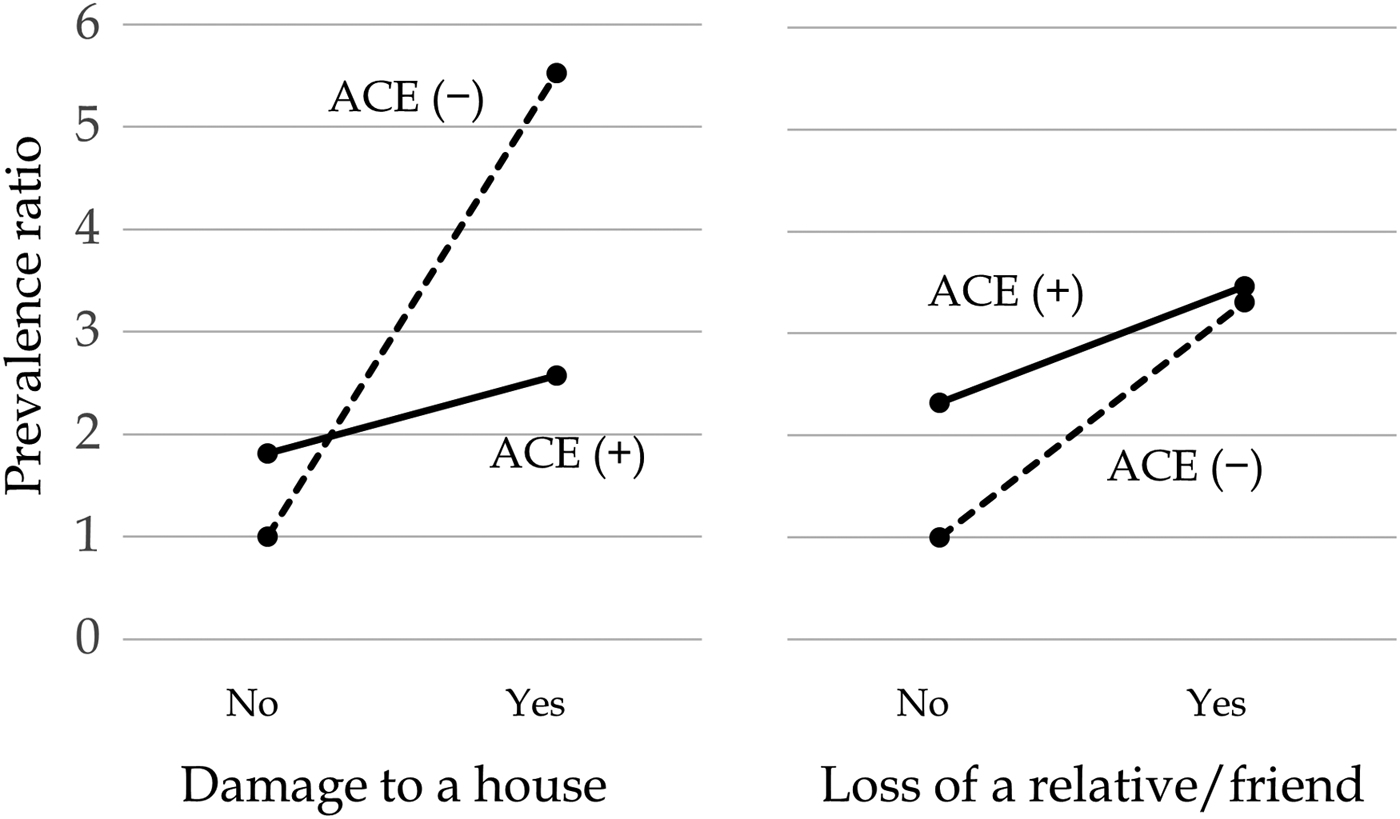
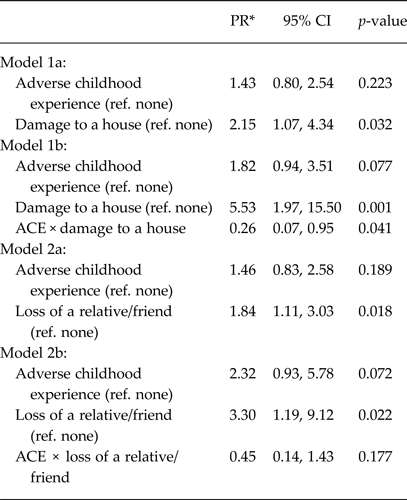
The results of a Poisson regression analysis that used a robust variance estimator to determine the association between PTSD, ACEs and the level of damage due to the earthquake and tsunami are presented in Table 2. In Model 1a the prevalence of PTSD was more than two times higher among those whose houses had been damaged (PR = 2.15, 95% CI = 1.07–4.34, p = 0.032) while ACE was not associated with PTSD (PR = 1.43; 95% CI = 0.80–2.54, p = 0.223). In Model 2a, the prevalence of PTSD was significantly higher among those who lost close friends or relatives (PR = 1.84, 95% CI = 1.11–3.03, p = 0.018) while ACE was again not statistically significant (PR = 1.46, 95% CI = 0.83–2.58). The interaction term was statistically significant only in relation to damage to a house (Model 1b: p = 0.041) and not significant in relation to loss of a relative/friend (Model 2b: p = 0.177). The results of the analyses including the interaction terms are depicted in Fig. 2.
Interaction effect between adverse childhood experiences and earthquake/tsunami damage in predicting the occurrence of PTSD.

Poisson regression analysis examining the association between adverse childhood experiences, personal trauma due to the March 2011 earthquake/tsunami and the occurrence of posttraumatic stress disorder among residents in Iwanuma City, Japan in 2013 (n = 580)

Models were adjusted for covariates (i.e., age categories (65–69; 70–74; 75–79; and 80+), sex, educational attainment, marital status (married; and not married), annual household equivalent income (less than 2 million yen, 2–4 million yen; and more than 4 million yen), comorbidity categories (none; one; and two or more comorbid health conditions), negative life events in the previous year (none; and one or more) and the Geriatric Depression Scale score (0–4; 5–15; and missing).
* PR: prevalence ratio with a robust variance estimator.
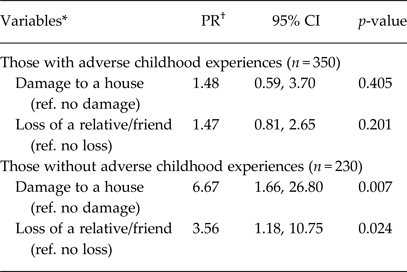
When the analysis was stratified by ACEs, earthquake/tsunami damage was associated with PTSD prevalence only among those without ACEs (Table 3). Specifically, among non-ACE respondents the PR of PTSD associated with house damage was 6.67 (95% CI = 1.66–26.80), while for the loss of a relative or a close friend it was 3.56 (95% CI = 1.18–10.75). In contrast, no statistically significant associations were observed among those with ACEs.
Poisson regression analysis examining the association between personal trauma due to the March 2011 earthquake/tsunami and the prevalence of posttraumatic stress disorder in Iwanuma City, Japan in 2013, stratified by the presence of adverse childhood experiences

* These variables were investigated separately in each model after adjusting for covariates (i.e., age categories (65–69; 70–74; 75–79; and 80+), sex, educational attainment, marital status (married; and not married), annual household equivalent income (less than 2 million yen, 2–4 million yen; and more than 4 million yen), comorbidity categories (none; one; and two or more comorbid health conditions), negative life events in the previous year (none; and one or more) and the Geriatric Depression Scale score (0–4; 5–15; and missing).
† PR: prevalence ratio with a robust variance estimator.
Discussion
This study showed an inverse interaction effect between ACEs and exposure to the 2011 Japanese earthquake/tsunami in predicting PTSD symptoms in 2013. While a positive association was found between damage as a result of the earthquake and tsunami (i.e., house damage and the loss of a relative/friend) and the occurrence of PTSD, further analyses showed that these effects were observed only among those without ACEs. Such associations were not found among those with ACEs.
The inverse interaction we observed between ACEs and a subsequent traumatic event in terms of predicting the occurrence of PTSD was also reported in an earlier study by Cabrera et al. (Reference Cabrera, Hoge, Bliese, Castro and Messer2007) where an interaction term between ACEs and combat exposure (low and high) was shown to be inversely associated with PTSD (as a continuous variable) among 4529 male soldiers; specifically, those without ACEs were more likely to develop PTSD due to intense combat exposure compared with those with ACEs. The authors suggested two possible reasons for this: (1) lower biological reactivity to combat exposure and (2) a ceiling effect resulting from previous trauma. Stein et al. (Reference Stein, Tran, Lund, Haji, Dashevsky and Baker2005) also found an inverse interaction effect between ACEs and combat exposure on PTSD symptoms among Gulf War veterans (n = 120) and hypothesised that those who had ACEs may have developed better coping methods to deal with stressful life events. Similarly, McCranie et al. (Reference McCranie, Hyer, Boudewyns and Woods1992) observed an inverse association between ACEs (operationalised as negative paternal parenting behaviours), combat exposure and PTSD among Vietnam veterans (n = 57) and argued that individual characteristics (e.g., coping resources) predating traumatic events (e.g., combat exposure) predict PTSD better when a subsequent traumatic event is less frequent and intense.
It is also possible that posttraumatic growth, which has been defined as ‘the experience of positive change that occurs as a result of the struggle with highly challenging life crises' (Tedeschi & Calhoun, Reference Tedeschi and Calhoun2004) and which has also been previously linked to ACEs (McMillen et al. Reference McMillen, Zuravin and Rideout1995; Woodward & Joseph, Reference Woodward and Joseph2003), might also help explain the interaction observed between ACEs, experiencing the earthquake/tsunami and the occurrence of PTSD in this study. Specifically, as this entails positive changes in self-perception and interpersonal relationships, those with ACEs might have recovered from or adapted to the psychological damage due to the earthquake/tsunami more rapidly than those without ACEs. While data were unfortunately not available to examine this possibility in the current study, future research should also determine the effects of coping methods, enhanced resilience or posttraumatic growth (Bonanno, Reference Bonanno2004; Tedeschi & Calhoun, Reference Tedeschi and Calhoun2004) among those who have ACEs.
Some previous research has found a positive interaction between ACEs and subsequent traumatic experience in predicting the occurrence of PTSD (McLaughlin et al. Reference McLaughlin, Conron, Koenen and Gilman2010) or mood and anxiety disorder combined (Sareen et al. Reference Sareen, Henriksen, Bolton, Afifi, Stein and Asmundson2013) (i.e., those with ACEs are more likely to develop PTSD compared to those without ACEs); thus, more research is needed to determine the specific effect of ACEs in the association between subsequent traumatic events and the occurrence of PTSD and whether it differs in relation to such factors as the exact form of ACEs, the population being studied (age, sex and ethnicity) and/or the form of the traumatic event experienced. For example, McLaughlin et al. (Reference McLaughlin, Conron, Koenen and Gilman2010) examined 14 life events in the previous year as a parameter of traumatic life events experienced in adulthood.
This study did not find a positive association between ACEs and PTSD, which has been observed in some previous studies (Brewin et al. Reference Brewin, Andrews and Valentine2000; Heim & Nemeroff, Reference Heim and Nemeroff2001). There are several possible explanations for this discrepancy. First, we used a questionnaire to evaluate disaster-specific PTSD, which might have limited our capacity to identify those at risk of PTSD in general (e.g., PTSD resulting from ACEs). Second, given that Brown et al. (Reference Brown, Anda, Tiemeier, Felitti, Edwards, Croft and Giles2009) found that in the USA those with six or more ACEs died on average 20 years earlier than those without ACEs, it is possible that some of those with ACEs who participated in the current study might have been healthier (i.e., there is a survivor effect), which might have acted to blur/mask the negative impact of ACEs on PTSD. Third, parental loss and family financial trouble, which were the most prevalent forms of ACE in this study, were common in Japan during the post-World War II period, which might have made these variables weaker in terms of their capacity to differentiate between respondents and thus, for predicting PTSD. However, it should nevertheless be emphasised that while ACEs did not predict the occurrence of PTSD due to the earthquake and tsunami, a difference was still found in the association between the damage situation due to the earthquake and tsunami and PTSD by the presence of ACEs (i.e., there was a higher risk of experiencing PTSD among those without ACEs).
Consistent with the result from the Tsuboya et al. (Reference Tsuboya, Aida, Hikichi, Subramanian, Kondo, Osaka and Kawachi2016) study that investigated the association between tsunami damage and depression using the JAGES Iwanuma dataset, the current study also showed that house damage had a bigger impact on mental health than the loss of a relative/friend. While the exact mechanism underlying this finding is uncertain, it is possible, as Tsuboya and colleagues speculated, that the loss of family members and friends might be a more common event among the older participants who comprised our study population, and that this fact may have contributed to a more rapid psychological adjustment. On the other hand, old people might feel it more unmanageable to rebuild damaged houses given the monetary, physical and other resources this might require, which may have thus worsened their psychological well-being more than the loss of a relative/friend. Alternatively, it is possible that experiencing certified property damage might also be a marker of a more traumatic personal experience during the earthquake/tsunami with the implications this carries for future mental health.
Study limitations
This study has several limitations. First, information on ACEs and PTSD was obtained from self-reports. For example, ACE was evaluated by the participants in 2013, 2 years after the disaster; this might have been problematic as this retrospective information may have been reported differently by those who developed PTSD and those who did not. Furthermore, PTSD was not clinically diagnosed in this study although the questionnaire was validated among those who experienced the Kobe earthquake in Japan in 1995 (Fujii et al. Reference Fujii, Kato and Maeda2007). Second, damage due to the earthquake and tsunami was self-reported and may have been subject to misreporting, although participants were requested to report house damage, which had been officially certified by local municipalities so this should have reduced any bias. Third, baseline information on PTSD was not available, which made it impossible to omit those who may have already had PTSD even before the earthquake and tsunami. Fourth, our study participants might not be fully representative of the older population in Japan in various ways. For example, the initial survey had a response rate of only 59% and was confined to people in Iwanuma City. Fifth, it is also possible that individuals who were the most traumatised and badly affected by these events might have been less likely to participate in the follow-up survey, which may have resulted in the associations in this study possibly being underestimated.
Conclusion
This study showed that following the Great East Japan earthquake/tsunami in 2011, a higher risk of developing PTSD symptoms was observed in 2013 particularly among older individuals without ACEs. This suggests that ACEs might affect how individuals respond to subsequent traumatic events later in life.
Acknowledgements
We are grateful for the participation of the population in Iwanuma and the support of the Iwanuma mayor's office and the Department of Health and Welfare of the Iwanuma City government.
Financial Support
This work was financially supported by a grant from the National Institutes of Health (R01 AG042463); JSPS KAKENHI from the Japan Society for the Promotion of Science (JP23243070, JP 22390400, JP24390469 and JP15H01972); a Health Labour Sciences Research Grant from the Japanese Ministry of Health, Labour and Welfare (H24-Choju-Wakate-009); and a grant from the Strategic Research Foundation Grant-Aided Project for Private Universities from the Japanese Ministry of Education, Culture, Sports, Science and Technology (S0991035). YI is financially supported by the Nippon Foundation.
Conflict of Interest
None.
Ethical Standard
The authors assert that all procedures contributing to this work comply with the ethical standards of the relevant national and institutional committees on human experimentation and with the Helsinki Declaration of 1975, as revised in 2008.
Availability of Data and Materials
All inquiries concerning the data are to be addressed to the data management committee via e-mail: dataadmin.ml@jages.net. All JAGES datasets have ethical or legal restrictions for public deposition due to inclusion of sensitive information from the human participants.