Introduction
Depression is among the most common behavioral and psychological symptoms of Alzheimer's disease (AD). Depressive symptoms are elevated preclinically and may be part of the preclinical phase in AD (Berger et al., Reference Berger, Fratiglioni, Forsell, Winblad and Bäckman1999). Studies have shown that depressive symptoms are persistent in their presence and fluctuating in their severity in AD (Lyketsos et al., Reference Lyketsos, Steinberg, Tschantz, Norton, Steffens and Breitner2000; Olin et al., Reference Olin, Katz, Meyers, Schneider and Lebowitz2002), being common in mild to moderate stages and less frequent in severe dementia (Lyketsos et al., Reference Lyketsos, Steinberg, Tschantz, Norton, Steffens and Breitner2000). One methodological concern in this area is that reported rates of depression in AD may depend not only on the severity of dementia but also on the tools used for the assessment of depression. The Diagnostic and Statistical Manual of Mental Disorders (DSM) criteria for major depression and/or minor depression are frequently used for the determination of depression in AD. A workgroup convened by the National Institutes of Mental Health (NIMH) proposed standardized diagnostic criteria for depression in AD, the NIMH-dAD Provisional Criteria (Olin et al., Reference Olin, Katz, Meyers, Schneider and Lebowitz2002; Teng et al., Reference Teng2008). The symptom profile of the NIMH-dAD criteria is similar to that of the fourth edition of the DSM (DSM-IV) criteria for major depression. The NIMH-dAD criteria omit the decreased ability to think and concentrate but include irritability, social isolation, and loss of pleasure in response to social contact replacing loss of interest in DSM-IV. Using the NIMH-dAD criteria, the rates of depression in AD have been reported to range from 22% to 54% (Olin et al., Reference Olin, Katz, Meyers, Schneider and Lebowitz2002; Starkstein and Mizrahi, Reference Starkstein and Mizrahi2006; Teng et al., Reference Teng2008).
Depression and dementia are both common in the elderly and are highly comorbid. Although depressive symptoms in the elderly with and without dementia are associated with poorer cognitive function and more neuropsychiatric symptoms, it remains controversial whether depression is an independent risk factor for AD or an early clinical sign. A meta-analysis showed depression to be associated with an increased risk of subsequent dementia (Jorm, Reference Jorm2000), whereas post-mortem pathological findings do not support the correlation between Alzheimer's pathology (plaques and tangles) and comorbid depressive symptoms (Wilson et al., Reference Wilson, Schneider, Bianias, Arnold, Evans and Bennett2003). Treatment of late life depression with antidepressants may improve cognitive functions in the elderly, though cognition may not necessarily return to normal (Butters et al., Reference Butters2000). Studies on the relationship between depression and dementia in Taiwanese patients with AD are few and the prevalence is reported in the middle of the range of Western findings (Liu et al., Reference Liu1999; Fuh, Reference Fuh2006). The aim of this study was to determine the rate of depression using the NIMH-dAD Provisional Criteria. We also compared the rate of depression with other assessment tools, including the DSM-IV (major depression), the International Classification of Diseases-9-Clinical Modification (ICD-9-CM) (neurotic depression), the Hamilton Depression Rating Scale (HAM-D) (Kertzman et al., Reference Kertzman, Treves, Treves, Vainder and Korczyn2002), and the depression domain of the Neuropsychiatric Inventory (NPI) (Cummings et al., Reference Cummings, Mega, Gray, Rosenberg-Thompson, Carusi and Gornbein1994). Finally, we compared other NPI behavioral and psychological symptoms in AD patients with and without depression.
Methods
Participants
The study was conducted in a 500-bed regional hospital in central Taiwan. A consecutive series of outpatients with AD registered in the dementia clinic were enrolled for this study from 1 July 2004 to 30 June 2008. The AD patients were diagnosed according to the criteria for primary degenerative dementia in DSM-IV and the criteria for probable AD developed by the National Institute of Neurologic and Communicative Disorders and Stroke–Alzheimer's Disease and Related Disorders Association (NINCDS–ADRDA).
Assessment tools
All patients received a structured interview of baseline demographic data and clinical history and laboratory studies, including complete blood count, basic chemistry, thyroid function tests, vitamin B12, serum or cerebrospinal fluid (CSF) studies for syphilis, and cerebral computed tomography (CT) or magnetic resonance imaging (MRI) to rule out other possible causes of dementia. The severity of dementia was established using the Clinical Dementia Rating (CDR) Scale and Sum of Boxes of CDR (CDR-SB) (Morris, Reference Morris1993). We used the Hachinski Ischemia Scale (HIS) to determine cerebral vascular risk (Hachinski et al., Reference Hachinski1975). Cognitive function was assessed using the Chinese version of the Cognitive Abilities Screening Instrument (CASI C-2.0) (Teng et al., Reference Teng1994), the Mini-Mental State Examination (MMSE) (Folstein et al., Reference Folstein, Folstein and McHugh1975), and the Frontal Assessment Battery (FAB) (Dubois et al., Reference Dubois, Slachevsky, Litvan and Pillon2000). Frequency and severity of neuropsychiatric symptoms, including depressive symptoms, were obtained from their main caregivers using the NPI and the 17-item HAM-D. Activities of daily living (ADL) function were assessed using the Instrumental Activities of Daily Living (IADL) scale and the Barthel Index (BI) (Mahoney and Barthel, Reference Mahoney and Barthel1965), with information provided by the main caregivers. The rates of depression were determined according to the following criteria: NIMH-dAD; DSM-IV major depression; ICD-9-CM neurotic depression; 17-item HAM-D (using two cut-off scores); and the NPI depression subscale. A behavioral neurologist or a geriatric psychiatrist interviewed all the patients and their main caregivers for the assessment of depressive symptoms as well as determination of depression. Cognitive tests of all the patients and the ADL function assessments according to their main caregiver were performed by two trained psychologists.
Statistical analysis
The Chinese version of SPSS 14.0 for Windows (SPSS Inc., Chicago) was used for statistical analyses. Comparisons between depressed and non-depressed subjects on demographic data, neuropsychological tests, total score of HAM-D, depression subscale (frequency × severity) of NPI, and the composite score of NPI were analyzed using an independent t-test. Sex and CDR were analyzed by the chi-square test (χ2). The rates of depression determined with different assessment tools (NIMH-dAD, DSM-IV major depression, ICD-9-CM neurotic depression, total HAM-D score ≥ 10, total HAM-D score ≥ 17, and depression subscale in NPI) and the comparisons across all assessments were analyzed using the Cochran's Q test. The post hoc comparisons between the NIMH-dAD criteria and other assessments were performed using the McNemar's test. The comparison of frequencies of depressive symptoms between patients with and without depression was analyzed by the χ2 test. The comparison of subscale scores in NPI between patients with and without depression was analyzed by a nonparametric test.
Results
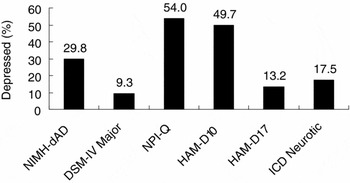
A total of 302 patients who met the NINDS–ADRDA criteria for probable AD participated in this study. Using the NIMH-dAD criteria, it was found that 90 (29.8%) of the AD patients had depression. The number of patients according to the CDR stages in the depressed group were very mild (19), mild (21), moderate (40), and severe (10), whereas in the non-depressed group the patients were very mild (80), mild (66), moderate (47), and severe (19). Assessment with the other depression scales showed that the frequency of depression was lowest using the DSM-IV major depression criteria (9.3%) and highest using the NPI depression subscale (54.0%) (Figure 1).
Rates of depression determined with different assessment tools (NIMH-dAD: NIMH Provisional Diagnostic Criteria for Depression in Alzheimer Disease; DSM-IV Major: DSM-IV Major Depression; NPI-Q: Depression Subscale in Neuropsychiatric Inventory; HAM-D10: Hamilton Depression Rating Scale- ≧ 10; HAM-D17: Hamilton Depression Rating Scale- ≧ 17; ICD Neurotic: ICD-9-CM Neurotic depression).

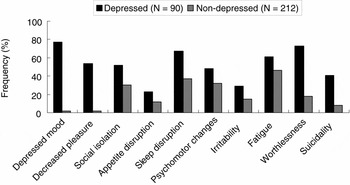
When we used the NIMH-dAD criteria to compare the presence of each depressive symptom in the NIMH-dAD criteria between the depressed and non-depressed groups, the depressed patients showed significantly higher depression across all symptoms, including depressed mood (χ2 = 188.578, df = 1, p < 0.001), decreased affect (χ2 = 116.730, df = 1, p < 0.001), social isolation (χ2 = 13.195, df = 1, p < 0.001), appetite disruption (χ2 = 6.517, df = 1, p = 0.014), sleep disruption (χ2 = 21.986, df = 1, p < 0.001), psychomotor changes (χ2 = 6.601, df = 1, p = 0.013), irritability (χ2 = 8.398, df = 1, p = 0.006), fatigue (χ2 = 5.600, df = 1, p = 0.023), worthlessness (χ2 = 84.087, df = 1, p < 0.001), and suicidality (χ2 = 49.188, df = 1, p < 0.001) (Figure 2). Comparison of each depressive symptom in the DSM-IV major depression criteria between depressed and non-depressed groups according to the DSM-IV major depression criteria failed to show significant between-group differences across all depressive symptoms. Similar to the DSM-IV major depression criteria, the between-group differences across all depressive symptoms were not significant according to the neurotic depression in ICD-9-CM, the depression subscale in NPI, the HAM-D score ≥ 10, or the HAM-D score ≥ 17.
Frequencies of individual NIMH-dAD symptoms in depressed and non-depressed participants.

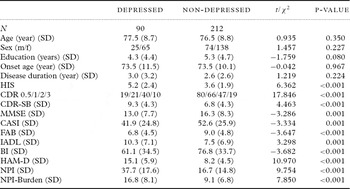
Given the stronger result for the NIMH-dAD criteria, we conducted further analyses using this instrument. Comparisons of demographic data between the NIMH-dAD depressed patients and nondepressed patients showed no significant difference in age (t = 0.935, df = 300, p = 0.576), onset age of dementia (t = –0.042, df = 300, p = 0.967), disease duration (t = 1.219, df = 293, p = 0.224), sex (χ2 = 1.457, df = 1, p = 0.227), and education (t = –1.759, df = 296, p = 0.080). The depressed group had higher CDR stages (χ2 = 17.836, df = 3, p < 0.001) and a higher total HIS (t = 6.362, df = 300, p < 0.001) score. A neuropsychological test battery, including MMSE (t = −3.286, df = 300, p = 0.001), CASI (t = −3.334, df = 300, p = 0.001), and FAB (t = −3.647, df = 300, p < 0.001) showed better performance in the non-depressed group. Comparisons of ADL using IADL (t = 3.298, df = 300, p = 0.001) and BI (t = −3.682, df = 300, p < 0.001) also showed better performance in the non-depressed group. The total HAM-D score (t = 10.970, df = 300, p < 0.001), the total NPI score (t = 9.754, df = 300, p < 0.001), and the sum of caregiver burden scores of NPI (t = 7.850, df = 300, p < 0.001) were significantly higher in the depressed group (Table 1). Literature has shown that poorer cognition and ADLs are likely to be seen together. To control the confounding of cognition to ADLs among depressed AD patients, we used univariate analysis of covariance and the results showed that basic ADL (BI) is still higher in the depressed group (t = 3.991, df = 1, p = 0.047).
Demographic and background characteristics of depressed and non-depressed participants determined by the NIMH-dAD criteria

HIS = Hachinski Ischemia Scale; CDR = Clinical Dementia Rating scale; CDR-SB = Sum of Boxes of CDR; MMSE = Mini-Mental State Examination; CASI = Cognitive Abilities Screening Instrument; FAB = Frontal Assessment Battery; HAM-D = Hamilton Depression Rating Scale; IADL = Instrumental Activities of Daily Living; BI = Barthel Index; NPI = Neuropsychiatric Inventory; NPI-Burden = Sum of caregiver burden scores of NPI; SD = standard deviation.
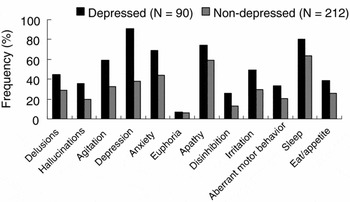
A comparison of NPI behavioral and psychological symptoms between the depressed and non-depressed groups according to the NIMH-dAD criteria using a nonparametric test showed significantly higher symptom frequency in the depressed group among most symptoms, including delusions (z = –2.888, p = 0.002), hallucinations (z = –2.984, p = 0.003), agitation (z = –4.945, p < 0.001), depression (z = –11.787, p < 0.001), anxiety (z = –5.158, p < 0.001), apathy (z = –3.718, p < 0.001), disinhibition (z = –2.689, p = 0.007), irritation (z = –3.519, p < 0.001), aberrant motor behavior (z = –2.305, p = 0.021), sleep disturbances (z = –4.392, p < 0.001), and eating/appetite disturbances (z = –2.658, p = 0.008). Euphoria was the only symptom that was not significantly different between the two groups (z = –0.381, p = 0.703) (Figure 3). The non-depressed AD group had a milder stage of dementia compared with the depressed group. It is possible that the higher NPI symptoms in depressed AD patients were because the patients were in the later stage of dementia. To control for the severity of disease, a logistic regression was used and there are still some NPI symptoms, including agitation (χ2 = 13.748, df = 1, p < 0.001), anxiety (χ2 = 46.505, df = 1, p < 0.001), irritation (χ2 = 7.840, df = 1, p = 0.005), disinhibition (χ2 = 4.495, df = 1, p = 0.034), and sleep disturbances (χ2 = 6.859, df = 1, p = 0.009), that were higher in depressed AD patients than non-depressed AD patients.
Frequencies of individual NPI domains in depressed and non-depressed participants.

Discussion
There are only a few studies on the relationship between depression and dementia in Taiwanese patients with AD. A community study on the elderly in Taiwan showed a one-month prevalence of major depression (5.9%) and neurotic depression (15.7%) (Chong et al., Reference Chong2001). In a study of 141 Taiwanese AD patients using the DSM-III-R criteria, seven (5.0%) were diagnosed with major depression, 11 (7.8%) with dysthymia, and five (3.5%) with depressive disorder not otherwise specified (Liu et al., Reference Liu1999). A review of behavioral and psychological symptoms of dementia (BPSD) in Taiwan found the frequency of depression to be 22%–50% in AD patients (Fuh, Reference Fuh2006). In our study, we used different tools to investigate the rates of depression and for the first time we used the NIMH-dAD criteria among Taiwanese patients with AD. Our results showed that the rate of depression determined with the NIMH-dAD criteria (29.8%) was higher than that with the DSM-IV criteria for major depression (9.3%), most likely because the NIMH criteria are more inclusive than the DSM-IV criteria. The NIMH criteria may minimize the risk of excluding patients with AD who suffer from clinically significant affective disturbances. On the other hand, this strategy may increase the rate of false positives in late stages of AD, when cognitive and motor deficits become more severe (Teng et al., Reference Teng2008). Although some investigators consider the NIMH-dAD criteria too lax (Starkstein and Mizrahi, Reference Starkstein and Mizrahi2006), we still agree with the necessity of modification of the DSM-5 criteria to NIMH-dAD criteria. The depressive and cognitive profiles of AD patients are distinct from those of normal individuals, and the criteria of diagnosis of depression in AD may also need adjustment. The rate of depression in AD using the NIMH-dAD criteria (29.8%) in this study is lower in comparison with several other studies conducted in Western countries, which have been reported to range from 43.7% to 53.3% (Vilalta-Franch et al., Reference Vilalta-Franch2006; Teng et al., Reference Teng2008; Barca et al., Reference Barca, Engedal and Selbaek2010). Why are the NIMH-dAD rates for depression in this Taiwanese population lower than those in previous studies from other cultures? We proposed that a good family and community support system, a good national health insurance system, good resilience, and a tradition of giving respect to the elderly might have positive effects. The rate of depression determined with the DSM-IV criteria in our study (9.3%) is similar to a cohort study conducted in Spain by Vilalta-Franch et al. (Reference Vilalta-Franch2012) (10.9%) and is higher than the community study on the elderly in Taiwan (5.9%) (Chong et al., Reference Chong2001).
The rate of neurotic depression in this study (17.5%) is similar to that of a community study in Taiwanese elderly (15.7%) (Chong et al., Reference Chong2001), while the rate of depression determined with NPI was higher than that obtained compared with other tools. This higher frequency may have occurred because the severity and frequency necessary for the diagnosis of depression in NPI are less restrictive and therefore may include mild depression and occasionally experienced depressive symptoms. It is also important to note the marked difference in probes for diagnostic symptoms between the NPI and other tools. NPI depressive symptoms include only mood-related symptoms, such as depressed mood, tearing, hopelessness, worthlessness, guilt, and suicidality. In this diagnostic system, depressive symptoms, such as psychomotor symptoms (retardation, agitation, and irritation), cognitive symptoms (poor concentration and memory), anxiety, sleep, and appetite were regarded as other BPSD and were not assessed. It is therefore not surprising that we found differences between the NPI depression frequency and the frequency based on the other instruments.
In our dementia clinic, we regularly use the HAM-D scale for the assessment of changes of depression in registered dementia patients. Although the HAM-D scale is usually used in the clinical trial setting as a severity measure instead of a diagnostic tool, some studies have suggested a cut-off score for depression in AD (Gilley and Wilson, Reference Gilley and Wilson1997; Draper, Reference Draper1999; Naarding et al., Reference Naarding, Leentjens, Kooten and Verhey2002; Raffaele et al, Reference Raffaele2002; Vasconcelos-Cunha et al., Reference Vasconcelos Cunha, Rocha and Melo2007; Luchsinger et al., Reference Luchsinger, Honig, Tang and Devanand2008). In our study, the rate of depression in AD determined with the total HAM-D score ≥ 10 was high (49.7%) and was similar to that obtained from the NPI depression subscale. The depression rate determined using a total HAM-D score ≥ 17 (13.2%) was far lower and was similar to that found with the DSM-IV major depression criteria.
In this study, when we used the NIMH-dAD criteria to compare the presence of depressive symptoms between the depressed and non-depressed groups, the depressed patients showed significantly higher depression across all the symptoms studied. Comparison of each depressive symptom between the depressed and non-depressed groups according to the DSM-IV major depression criteria failed to show significant between-group differences across all depressive symptoms. Similar to the DSM-IV major depression criteria, between-group differences across all depressive symptoms were not significant according to the other three tools. Based on this result, we consider the NIMH-dAD criteria to be a good assessment tool for the diagnosis of depression in AD.
Besides lower cognitive function (performance on CASI, MMSE, and FAB) and lower ADL (determined with BI and IADL) in depressed AD patients, our result showed a higher vascular risk on the Hachinski Ischemia Scale in depressed patients. A recent report on depression, vascular risk factors, and AD showed that HAM-D scores are higher in persons with vascular risk factors (hypertension, heart disease, and stroke), which in turn are related to higher AD risk (Luchsinger et al., Reference Luchsinger, Honig, Tang and Devanand2008). Our finding is also consistent with the established research linking late-life depression with cerebrovascular disease, the so-called “vascular depression” (Krishnan et al., Reference Krishnan2004).
In the second part of this study, we investigated the association of behavioral and psychological symptoms in Taiwanese AD patients with depression. We found that the depressed group, according to the NIMH-dAD provisional criteria, had higher frequency for most of the depressive symptoms and BPSD compared with the non-depressed group. Caregiver burden in the depressed group determined with the NPI was also higher in comparison with the non-depressed group. These findings are consistent with prior studies noting that depression causes excess disability among patients with dementia (Draper, Reference Draper1999; Zubenko et al., Reference Zubenko2003). Behavioral and psychological symptoms, including psychotic symptoms (delusions and hallucinations), psychomotor symptoms (apathy, agitation, and irritation), anxiety, disinhibition, aberrant motor behaviors, sleep behaviors, and eating/appetite behaviors, were all higher and more severe among depressed AD patients. The rates of euphoria in depressed as well as non-depressed groups were relatively low in our patient group, which may explain why euphoria was the only symptom that was not different between the depressed and non-depressed groups.
The study has limitations that should be noted. First, our research was conducted in only one hospital in central Taiwan. Therefore, selection bias may arise, and our findings may not be generalized to all Taiwanese patients with AD. Second, we did not analyze the relationship between severity of dementia and depression because the case numbers in different stages of dementia were unequal and the sample size of patients with severe stage dementia was too small to be compared with those in earlier stages. Future studies should target recruitment of severe dementia patients in order to clarify the relationship between severity of dementia and depression in Taiwanese patients.
In conclusion, comorbid depression is high in Taiwanese AD patients determined with the NIMH-dAD provisional criteria. The result of higher frequency for all depressive symptoms in the NIMH-dAD provisional criteria in depressed AD patients indicates that the NIMH-dAD diagnostic system may be a good assessment tool for the diagnosis of depression in AD in this population. It is also important to note clinically that depressed AD patients have a higher frequency of most behavioral and psychological symptoms, which may result in faster cognitive decline, poorer self-care, and more caregiver burden.
Conflict of interest
None.
Description of authors’ roles
P.Y. Chiu undertook the literature searches and data analyses, edited all authors’ contributions, and had main responsibility for revisions and drafts of the paper. T.J. Lai participated in data analysis and contributed to revisions and final drafts of the paper. D. Steffens contributed to data analysis, revisions, and final drafts of the paper. P.K. Chen participated in data analysis and contributed to revisions and final drafts of the paper. Y.C. Hsu and H.T. Huang undertook the literature searches and contributed to revisions.