

Significant outcomes
-
• Markedly lower incidences of delirium, when compared with previous studies and studies made on somatic wards.
Limitations
-
• In a register-based study like this, it is not possible to evaluate the validity of diagnoses or estimate possible underreporting.
Introduction
Delirium is a complex neuropsychiatric syndrome of acute onset caused by physiological abnormalities affecting the brain. It is characterised by disturbances of consciousness and cognition with a fluctuating course (Reference Cole1,Reference Huang, Inouye and Jones2). There are three subtypes of delirium on the basis of psychomotor behaviour: hypoactive, hyperactive, and a mixed form (Reference Inouye3). The syndrome is common and has serious outcomes, such as increased length of hospitalisation, aggravation of physical morbidity, and increased mortality (Reference Witlox, Eurelings, De Jonghe, Kalisvaart, Eikelenboom and van Gool4–Reference Tsai, Weng, Chou, Tsai, Hung and Su9).
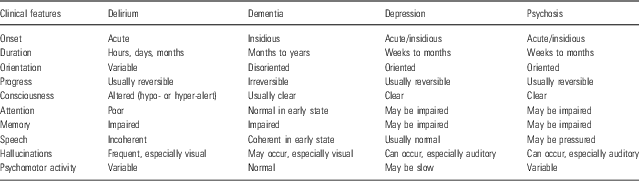
Despite the severity of delirium, it frequently goes unrecognised and is therefore inadequately treated (Reference Inouye, Foreman, Mion, Katz and Cooney10–Reference Gahr, Hügl and Freudenmann12). Common differential diagnoses of delirium are dementia, depression, and psychosis/schizophrenia, which make the syndrome highly relevant in psychiatric hospitals (Reference Huang, Inouye and Jones2,Reference Nicholas and Lindsey13). The similarities with symptoms of mental illnesses may lead to misdiagnosis of delirium. Table 1 shows delirium and the differential diagnoses of the syndrome with the clinical features that help distinguish them from one another (Reference Downing, Caprio and Lyness14–Reference Fong, Tulebaev and Inouye17).
Differential diagnoses of delirium

Only a small number of studies of the incidence of delirium in psychiatric patients have been conducted. A prospective Canadian study from 1997 with 401 psychiatric inpatients found a cumulative incidence of delirium to be two out of 100 admissions (Reference Patten, Williams, Haynes, Mccruden and Arboleda-Florez18). Another Canadian study from 1996 found an overall incidence of 15% among 199 hospitalised psychiatric patients based on retrospective data (Reference Ritchie, Steiner and Abrahamowicz19). A study from Sweden showed a prevalence of delirium of 44% in various care settings for the elderly including 717 patients aged 75 years and above (Reference Sandberg, Gustafson, Brannstrom and Bucht20).
The incidence of registered diagnoses is important to gain insight into the extent of the syndrome in psychiatric hospitals. An investigation of the patients according to sex, age, and place of diagnosis will advance our understanding of who has been diagnosed and where. No studies have used nationwide data covering an entire population to explore variations and patterns of diagnoses of delirium; furthermore, literature, in general, on delirium in psychiatric patients is sparse.
The aims of this study were (1) to analyse possible changes in the diagnostic incidence of delirium in psychiatric patients in Denmark from 1995 to 2011 and (2) to investigate the profile with regard to sex, age, and type of patient in Danish psychiatric patients diagnosed with delirium from 1995 to 2011.
Materials and Methods
The design of the study was a nationwide register-based study from 1995 to 2011.
Cases were selected from the Danish Psychiatric Central Research Register (DPCRR), which covers the entire Danish population (Reference Munk-Jorgensen and Mortensen21). We included data since 1995, 1 year after the introduction of International Classification of Diseases-10 (ICD-10).
The study populations consisted of all psychiatric patients diagnosed with delirium – main or auxiliary diagnoses. We included all types of delirium, all in accordance with ICD-10. To simplify, we divided delirium into three groups:
-
1. Delirium not induced by alcohol and other psychoactive substances (F.05.0 delirium not superimposed on dementia, F.05.8 other delirium, F.05.9 delirium unspecified);
-
2. Delirium superimposed on dementia (F.05.1);
-
3. Delirium in withdrawal state, drug, or alcohol associated (F.1x.03: acute intoxication due to psychoactive substance with delirium, F.1x.40 and F.1x.41: withdrawal state with delirium without and with convulsions) (22).
The three groups will be referred to as (1) unspecified delirium, (2) delirium with dementia, and (3) drug-related delirium henceforth.
Only first-time diagnoses with delirium were used to avoid including the same patients repeatedly.
The variables investigated were gender, age, and type of patient (outpatients, patients at the emergency ward, and inpatients). Age was divided into intervals of 10 years: 0–9, 10–19, 20–29, etc.
The following ICD-10 numbers were used to identify demented patients: F.00, F.01, F.02, F.03.
We included data from 1995, 1 year after ICD-10 had taken over from ICD-8, to ensure that the syndromes were based on the same diagnostic criteria, that is, the analyses would not be hampered by changes in the diagnostic system. We did not include data from 1994 because the data may be invalid owing to the change in the diagnostic system; the clinicians may have needed some time to become familiar with the new diagnostic criteria.
Statistics
Incidence rates were calculated as the number of first-time-ever diagnoses divided by the sum of the person-years of the population at risk, that is, the total number of persons in contact with the psychiatric health system of the same age range in the given year. Each person counts 1 year of risk, which means no correction for the time after diagnosis, time after discharge, or time after death. Rates are presented per 1000 person-years, which, in this study, is the same as per 1000 patients/ year. The incidence rates were age standardised, with the average age composition of patient in contact with psychiatry from 1995 to 2011 (23).
Statistical analyses were performed with STATA (v. 12). A 95% level of significance was used, a 95% confidence interval (CI), and a p-value of 0.05.
Linear regression analysis was performed with the calculation of estimated slope, β, with corresponding CI and p-value.
Results
A total of 15 680 individuals diagnosed with delirium was identified in the DPCRR between 1995 and 2011.
Diagnostic incidence
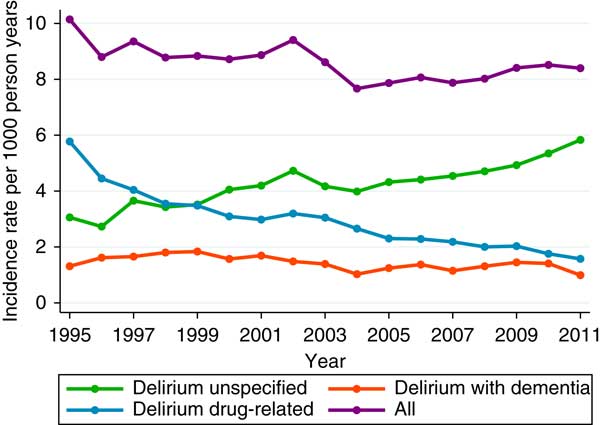
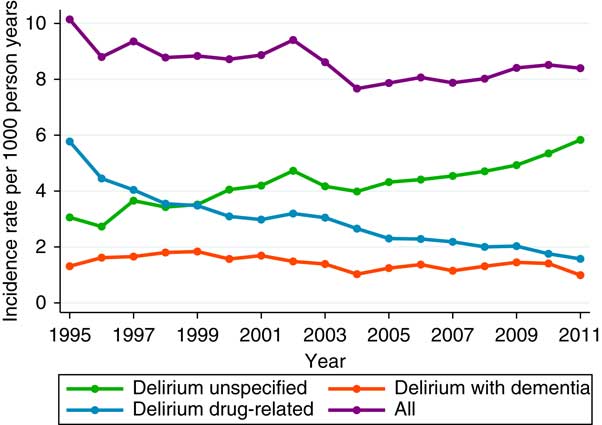
Figure 1 shows the development of the incidence rates of delirium per 1000 person-years. The incidence rate of unspecified delirium has increased (β = 0.15, 95% CI: 0.11–0.18; p ≤ 0.01), and the incidence rates of the other types of delirium have decreased. Drug-related delirium (β = −0.2, 95% CI: −0.24 to −0.16; p ≤ 0.01), and delirium with dementia (β = −0.03, 95% CI: −0.05 to −0.009; p ≤ 0.01). Delirium with dementia showed the lowest incidence rate. The incidence rate of delirium – all three types – decreased (β = −0.08, 95% CI: −0.14 to −0.04; p ≤ 0.01) and in 2011 it was 8.4/1000 person-years.
Incidence rates of diagnosed delirium 1995–2011, age standardised.
Sex
Men dominate in all three types of delirium during the period 1995–2011. This is the case for the three types of delirium separately and in total. When comparing the incidence rates of all types of delirium for men and women, the incidence rate ratio ranges between 1.64 and 2.22 (p ≤ 0.001) for the entire period.
Age
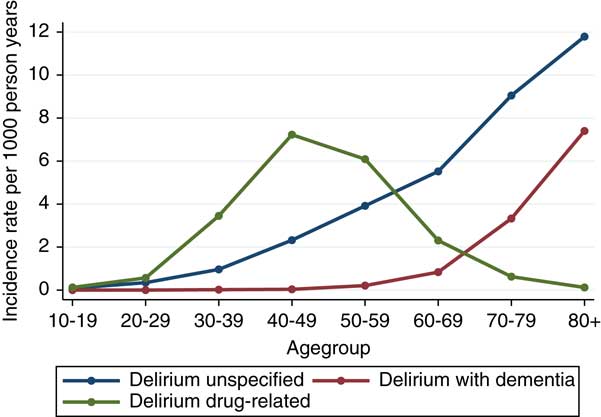
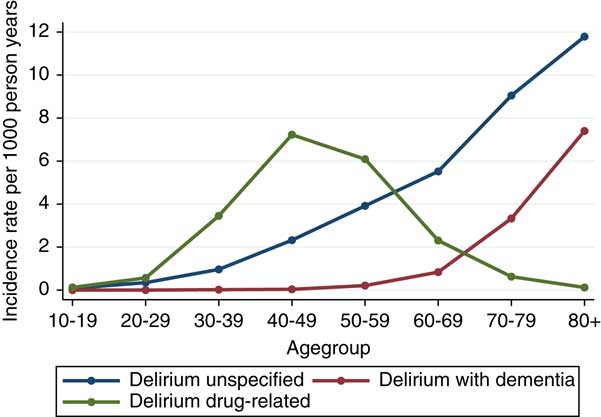
Figure 2 shows the incidence rates in the different age ranges. The three groups of delirium have different incidence peaks depending on the age. The age distribution does not show any difference with regard to the sex.
Incidence rates of age groups, age standardised.
In 2011, 7.6% of all inpatients over the age of 60 years were diagnosed with delirium.
Type of patient
The majority of delirium diagnoses occur in inpatients, with an average of 540 cases/year, compared with cases in outpatients and patients in the emergency ward, with an average of 280 and 140 cases/year, respectively. The incidence of diagnoses in inpatients has increased (β = 0.41, 95% CI: 0.25–0.56; p ≤ 0.001).
Unspecified delirium
Patients over the age of 40 years represent 96.5% of all diagnoses of unspecified delirium, and the focus in the following analysis of incidence rate is on inpatients, as they constitute the majority of patients. The incidence rate of inpatients over the age of 40 years has increased from 4.7 in 1995 to 17.4/1000 person-years in 2011. The increase in incidence rate/year is 0.7 (95% CI: 0.64–0.78; p ≤ 0.001) based on linear regression.
Delirium with dementia
Patients over the age of 60 years dominate in delirium with dementia (98.4%).
The incidence rate of delirium with dementia has decreased (see Fig. 1). The incidence rate of demented psychiatric patients has not shown the same significant decrease (β = −0.39, 95% CI: −0.87 to –0.09; p = 0.105).
In 2011, 2.6% of demented patients were diagnosed with delirium with dementia.
Drug-related delirium
Thirty to 69-year-olds represent 91.8% of drug-related delirium. The incidence rates for patients 30–69 years old diagnosed with drug-related delirium decreased from 12.8 in 1995 to 4.4 in 2011, a decrease of 65.6%.
Discussion
A total of 15 680 individuals diagnosed with delirium was identified in the DPCRR between 1995 and 2011. The incidence rate of the three diagnostic groups of delirium in total has decreased, reaching 8.4/1000 person-years in 2011.
The diagnosis of delirium is significantly more common in men, and the three groups of delirium showed a characteristic age distribution. In 2011, 7.6% of all inpatients over the age of 60 years were diagnosed with delirium. The majority of the diagnoses were done in inpatients, with an average of 540 cases/year.
We included data from 1995, 1 year after the introduction of ICD-10, to ensure that the syndromes are based on the same diagnostic criteria, that is, that the analyses would not be hampered by changes in the diagnostic system. We did not include data from 1994 because the data may have been invalid owing to the change in the diagnostic system – the clinicians may have needed some time to become familiar with the new diagnostic criteria. Even though the diagnoses are registered by ICD-10 codes, some of the diagnoses are most likely based on standardised assessment, but information about this is not included in the register.
The data exclusively include patients in contact with hospital-based mental health services. The DPCRR does not include patients in contact with private practicing psychiatrists and general practitioners. Denmark has a population of 5.5 million people and about 150 private practicing psychiatrists who provide exclusively office-based outpatient treatment, whereas more severe illnesses, for example, delirium, are mostly treated through the public hospital system (Reference Munk-Jorgensen and Andersen24). We can therefore expect delirium to be treated primarily in public hospitals that reports to the register used in this study.
In 2011, the incidence of delirium diagnoses was 8.4/1000 person-years, which is the same as 0.8% of the patients in 1 year. A study from Taiwan showed an incidence of simple delirium among psychiatric inpatients who were 65 years old to be 1.4% and in older inpatients it was 9.6 (Reference Huang, Tsai, Chan, Hwang and Sim25).
A prevalence study found that delirium occurs in about a fifth of general hospital inpatients (Reference Ryan, O'Regan and Caoimh26). This is supported by a review of studies on the subject, which concludes that delirium is common in medical inpatients, and the typical rates of delirium are 20–30% (Reference Ryan, O'Regan and Caoimh26,Reference Siddiqi, House and Holmes27). Though delirium is due to somatic disturbance, the syndrome is also frequent in psychiatric inpatients owing the risk factors as age, hospitalisation, and pharmacological treatment. Furthermore, psychoactive medicine is often reported as a delirium risk factor (Reference Fong, Tulebaev and Inouye17,Reference Burns, Gallagley and Byrne28,Reference Clegg and Young29).
Our study is based on a different methodology than the described studies, which makes them not directly comparable. However, it still indicates a possible difference, as we found lower incidences. This could be because of a true lower incidence of the syndrome owing to better prophylaxis or a lower incidence of registered diagnoses, despite an equal incidence of the syndrome that could be due to underreporting to the register or misdiagnoses or underdiagnoses of delirium in psychiatric departments. This calls for further research as it is truly problematic and highly relevant, as delirium is a serious state and identifying the syndrome is important for providing sufficient management (Reference Young and Inouye30). Aspects as consistent use of standardised assessment (e.g. confusion assessment method) and intensified awareness for patients at risk should be evaluated and improved (Reference Young, Murthy, Maggie, Akunne and O'Mahony31).
The characteristic age distribution corresponds with the present knowledge that age is a risk factor in developing delirium (Reference Burns, Gallagley and Byrne28,Reference Young, Murthy, Maggie, Akunne and O'Mahony31). Delirium is known to be a common condition in the elderly, affecting up to 30% of all elderly patients admitted to hospital (Reference Saxena and Lawley32). Another study states that delirium occurs in up to 50% of elderly hospital inpatients (Reference Rigney33). In the intensive care unit, delirium has been reported in 70–87% of elderly patients (Reference Pisani, Mcnicoll and Inouye34).
Our results showed that 7.6% of all psychiatric inpatients over the age of 60 years were diagnosed with delirium in 2011. This is markedly lower than in other studies. It is known that delirium in the elderly is often misdiagnosed or underdiagnosed (Reference Fong, Tulebaev and Inouye17). Studies suggest that between one-third and two-thirds of delirium goes unrecognised (Reference Siddiqi, House and Holmes27). A cross-sectional study showed that emergency physicians missed delirium in 76% of cases in elderly patients (Reference Han, Zimmerman and Cutler35), especially the hypoactive subtype, which is also the most common (Reference Fong, Tulebaev and Inouye17,Reference Fiels and Wall36). This may lead to inappropriate initiation of pharmacological intervention, such as antidepressant, and the failure of looking for the underlying cause of delirium.
A big challenge is to distinguish delirium from dementia (Reference Downing, Caprio and Lyness14,Reference Young and Inouye30). A prospective study from the USA has shown that delirium superimposed on dementia was less likely to be recognised by nurses and physicians (Reference Fick and Foreman37). Demented people have an increased risk of developing delirium, and a study found that the prevalence of delirium with dementia ranged from 22% to 89% of hospitalised and community populations aged 65 years and older (Reference Rigney33,Reference Fick, Agostini and Inouye38). A study found delirium to be present in ∼20% of 206 demented outpatients in a psychiatric hospital (Reference Hasegawa, Hashimoto and Yuuki39). Our study showed that 2.6% of demented people were diagnosed with delirium throughout 1 year, although they have an increased risk of the syndrome. This could be not only because of a true lower diagnostic incidence, but also because of underreporting as mentioned earlier in the article.
The direct consequences of not recognising delirium are vital, and an episode of delirium does also have a long-term effect on the patients. The available evidence suggests that delirium increases the risk of new-onset dementia in the long-term by sixfold at 3 year follow-up (Reference Maclullich, Beaglehole, Hall and Meagher40). Furthermore, people with pre-existing dementia suffer from an acceleration of cognitive decline following an episode of delirium (Reference Maclullich, Beaglehole, Hall and Meagher40,Reference Fong, Jones and Shi41).
Unspecified delirium is the most frequently diagnosed type of delirium. This may be because of the fact that it includes pre-dementia, which could explain the low incidence of delirium with dementia. We found that only a small percentage was diagnosed with delirium with dementia out of all demented patients during 1 year. This supports the need for further research on the matter, as it is difficult to distinguish delirium from dementia.
The decreasing incidence of drug-related delirium could be owing to referrals to somatic wards instead of psychiatric departments, improved prophylaxis, underdiagnosis, or misdiagnosed as unspecified delirium. The cause should be investigated further as drug-related delirium that is one of the most serious complications of alcohol withdrawal, with a mortality rate up to 15 (Reference Saddichha, Manjunatha, Prasad Sinha and Khess42).
Our findings support the characteristic age distribution associated with the different types of delirium. There is an age-correlated association with delirium with dementia, and the focus is on the middle-aged people when dealing with drug-related delirium. As age is a pre-disposing risk factor, this has clinical relevance in the preventive intervention of delirium.
A register-based study has its strengths and limitations. It is not possible to estimate possible underreporting diagnoses or to evaluate the validity of the diagnoses (Reference Byrne, Regan and Howard43). Furthermore, a non-linked one-register study such as this study does not contain information on possible confounders (Reference Anderson44).
Despite the limitations associated with a register-based study, it is useful to investigate a pattern of diagnosis and to get an overview of the incidence and development of a disease/syndrome at a national level (Reference Munk-Jorgensen and Ostergaard45).
In conclusion, our incidences were markedly lower when compared with previous studies. This suggests a possible underdiagnosis of delirium in psychiatric hospitals and should be investigated further, as delirium is a serious state and identifying the syndrome is important for sufficient treatment.
Acknowledgements
We thank Gurli Perto for her indispensable contribution to this project.
Conflict of Interest
None.
Ethical standards
No ethical research committee approval is needed as data is obtained from registers anonymously.