On a spring evening in 1909, Wilma Berger decided to go for a short walk near the lake after work. Twenty-year-old Berger, a white woman and the daughter of a prominent local doctor, was studying to be a nurse at the Henrotin Hospital in downtown Chicago. As she walked along Ontario Street and approached Lake Michigan, she suddenly felt a piercing pain from a blow to her head. In the next instant, a stranger's arm was around her neck and pulling her to the ground. Just as she came to her senses and prepared to stand up, a man sat on top of her, pinning her firmly down. The attacker clenched her throat with a choking grip with one hand and used his other hand to cover her mouth to prevent her from screaming. At first Berger panicked. But then she decided to relax and wait for her opportunity. As soon as she saw her chance, she caught hold of the man's sleeve, pulled his arms in toward her, and sent him flying through the air with a jiu-jitsu technique. She quickly scrambled to her feet. Seeing that he, too, was getting up, she threw him to the ground again. Berger immediately fled to safety knowing that she had successfully fought back against a violent surprise attack.Footnote 2
The publicity surrounding the incident vaulted Berger into local celebrity status as newspapers praised her mental prowess and physical skill in fighting off the attacker.Footnote 3 Reporters revealed that Berger had previously studied judo under Tomita Tsunejiro in New York City before teaching her own female students in Colorado Springs. She used her moment in the spotlight to advocate that all women train in the art of self-defense, and she began teaching a class of Chicago society women. The necessity of being able to protect oneself in the city was on the minds of many women who were pursuing jobs and venturing alone into the urban environment for the first time. Dr. Maude Glascow, a New York physician, was also a firm believer in the necessity of self-defense training for women. After hearing Berger's story, Glascow argued that “girls should be taught boxing so that they may be qualified to defend themselves against attacks by men, which have become so common of late. Woman has the same weapons for defending herself that man has, and a little instruction in the manner of using them would enable her to beat off brutal assailants.”Footnote 4 The ideas espoused by Berger and Glascow reflect a broader trend among women in the Progressive Era to empower not only their minds, but also their bodies in a larger campaign for social and political equality. These exceptional women sought to go beyond words and use their bodies as weapons in the battle to upend the existing hierarchy and claim their rights to exist in both the private and public spheres, free of harassment.Footnote 5
In the post second-wave feminist world, physical self-defense training for the purpose of female personal and political empowerment might not seem like such a revolutionary idea. In the 1960s and 1970s feminists openly advocated that women prepare themselves physically, psychologically, and politically to defend themselves against outside threats. Women flocked to self-defense classes that offered training in the physical and psychological skills to fight off muggers, rapists, and violent family members. The self-defense movement, as it came to be called, represented a way for women to physically express their independence and was part of a larger feminist movement to combat violence and achieve self-determination for women. Patricia Searles and Ronald Berger, when examining the radical roots of the movement in the second wave, argued that the feminist self-defense movement offered “an alternative view of women as strong, capable, and self-reliant.” The movement countered “the traditional patriarchal family structure that emphasizes women's passivity, deference, and dependence on men.”Footnote 6 Self-defense classes came to symbolize the feminist quest for liberation in the radical second wave.
Women growing up in the years after the peak of second-wave feminism have seen a revival of self-defense programs, many of which offer the opportunity to defeat larger-than-life, menacing opponents in padded attacker uniforms. In these courses, they learn to knee, elbow, and strike their attackers into submission almost as a rite of passage that signifies their entry into the adult and very dangerous world of femininity. Martha McCaughey conducted an ethnographic study of women in self-defense classes in the early 1990s. She noted that women undergo a sort of transformation where they “make their aggression, and the femininity that prevents it, conscious. They develop a new self-image, a new understanding of what a female body can do.” In this manner, much as with second-wave feminism, “the body, then, is not simply the locus of patriarchal power, ideology, or brutality; it is a potential locus of resistance.”Footnote 7 Women who sign up for these classes may not always consciously realize the feminist implications of their actions. Even so, scholars such as Kathryn Ziegler argue that these women “embody feminist politics as a method of resisting traditional, patriarchal norms of women being passive, submissive, and potentially victimized by men.”Footnote 8 McCaughey insisted that their actions are significant in that female self-defense practitioners “enact the deconstruction of femininity” and the reconstruction of an image of women as strong, powerful and capable.Footnote 9
It should come as no surprise to us then, that women in the Gilded Age and Progressive Era similarly found a way to make the political physical through empowering their bodies. Few scholars, however, have specifically examined or even acknowledged the efforts of this pioneering generation of feminists in pursuing boxing and jiu-jitsu as a means not only of self-defense but also of expressing their personal and political power.Footnote 10 We already know the stories of how militant suffragettes, especially in Great Britain, used their bodies in order to convey their discontent and resist oppression through marches, pickets, and hunger strikes. Many of these women also advocated using their bodies not only as an exhibition of women's strength but also as a weapon in their political struggle. Yet, perhaps just as important, even average women, with no direct association to suffrage organizations, expressed their newfound sense of freedom through physical training. Theater arts professor Diana Looser, in her study of female practitioners of jiu-jitsu in the early twentieth century, argues that these women “were attracted not only to the arts' literal defensive potential, but to the ways in which the demonstration of women's physical equality might have symbolic significance and wider practical applications at a time when women's campaigns for greater political rights and social freedoms were becoming increasingly visible.”Footnote 11
This article expands on Looser's framework to consider the ways in which women between the 1880s and 1920s empowered their bodies to fight violent stranger assaults, political disfranchisement, and family violence through their training in the “manly art” of self-defense. Self-defense training armed women with the physical skills they needed to defend themselves from attacks—or at least their fear of attack—on the streets as they negotiated their place in the public space of the city. Training in the traditionally masculine arts of self-defense also served as an explicit form of political protest for those who pursued feminist agendas. For some, self-defense training was especially personal, providing them with techniques to protect against abuse in their own homes. By subverting the status quo, they hoped to literally and figuratively challenge the patriarchal power structure that prevented them from claiming their equal rights as citizens and human beings.
The Emergence of Women's Self-Defense Training
Women's self-defense training appears to have gained its popularity from the emerging interest in physical culture in the last decades of the nineteenth century. Justified as a way of fulfilling a number of goals—from promoting the body of mothers to maintaining a healthy younger female physique—women's sports and awareness of the female body as an acceptable site of physical exercise became increasingly popular around the turn of the century.Footnote 12 Women across the country eagerly began practicing a range of sports from tennis and cycling to the more controversial sports of boxing and jiu-jitsu.
Harrie Irving Hancock published a series of books that encouraged women and children to study jiu-jitsu for health benefits. Hancock's three books described exercises and techniques for men, women, and children. In Physical Training for Women by Japanese Methods, Hancock argued that jiu-jitsu could strengthen women's bodies at the same time it prevented obesity. More than that, Hancock asserted the radical and anti-Victorian notion that physical training in martial arts challenged gender stereotypes of women as weak. “One of the phrases that should be stricken from the English language is, ‘the weaker sex,’” he wrote. “After a long experience in Japanese athletics the writer has no patience with women who consider that merely because of their sex they should be weaker than men. In Japan the women are not weaker, and in this country they have no right to be.”Footnote 13 Hancock's call to action was significant in that he insisted that women eagerly embrace martial art training as a way of expressing their newfound place in society: “The day has gone by when women prize weakness as a dainty attribute of their sex, and the science of jiu-jitsu points out the path for the new physical woman to pursue.”Footnote 14 Seemingly ahead of his time for gender norms, Hancock encouraged American women to adopt Asian physical culture as a way to strengthen their bodies and bolster their sense of selves.
Boxing was also heralded as having a wide range of health and practical benefits for women. The Washington Post announced in 1904 that the “Boxing Girl” has arrived. Anticipating the comments of critics, the author deemphasized the inherent violence in women's boxing training and focused instead on the potential health and beauty benefits of exercise of any kind. Physical fitness leaders reinvented and painted women's boxing in a much more feminine light. The “Boxing Girl” author insisted that by training in gyms and at home, women would avoid the brutality of competition fighting. The article highlighted the health advantages of boxing for women by explaining that the exercise tones and strengthens muscles while combatting weight gain. This focus on the femininity of the exercises justified women's participation in an activity previously limited to the male sphere.Footnote 15
Still, some critics vehemently denounced women's participation in these sports. Their arguments focused on deep-seated concerns about the masculine nature of boxing and jiu-jitsu and their potential to defeminize women and disrupt the “natural order.” In 1901, Reverend William Short of St. Peter's Episcopal Church, addressing graduates from the Mary Institute, a school for girls in St. Louis, denounced what he perceived as “masculine affections” in women. He insisted that women who attempt to exercise the “privileges and powers of man, social, political, and otherwise … are directing their efforts to develop in woman a sort of self-assertiveness and independence and to break down certain barriers of distinction between the sexes.” He further argued, “This imitation of mannish manners and masculine methods is simply vulgar.” Short condemned athletic clubs that trained girls in boxing as unladylike and “bordering on the indecent.”Footnote 16 This attitude opposing female self-defense training remained strong among professionals.Footnote 17 Ten years later, when Dr. Everett Beach, athletic director of the Los Angeles high schools, decided to ban boxing for girls at Los Angeles High School, he justified his decision by arguing that “it was not the aim of instructors to turn out a generation of feminine fighters, and there was no desire to develop an unnaturally combative disposition, ‘which would interfere with the natural laws of the home.’” After the ban, two female students—Fern Powell and Lauretta Davlin—expressed their intense disappointment. Both girls had been training in boxing for several months and found themselves “quite infatuated with the sport.” However, Beach insisted the ban was intended for their benefit. “Suppose a pretty girl's nose was broken while boxing,” said Beach. “It probably would mean permanent disfigurement, and might seriously injure her social prospects.”Footnote 18 Thus, Beach defended his decision by arguing that he was protecting young women physically as well as socially from the dangers of violent sport.
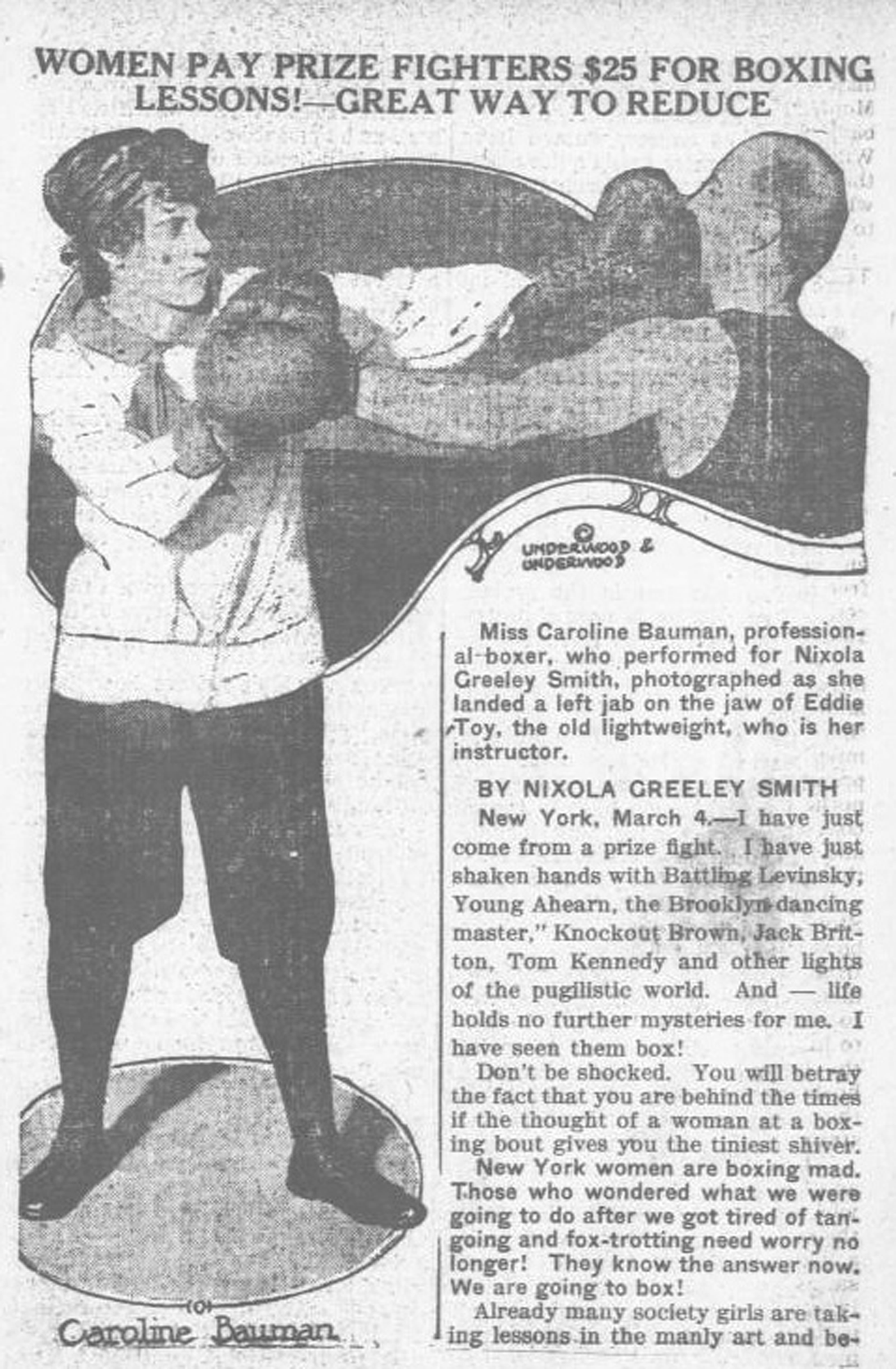
The desire to learn self-defense and improve their health encouraged many women to pay fighters to teach them boxing. Nixola Greeley Smith, “Women Pay Prize Fighters $25 for Boxing Lessons!” Day Book (Chicago), Mar. 4, 1915. Courtesy of Chronicling America, Library of Congress, http://chroniclingamerica.loc.gov.

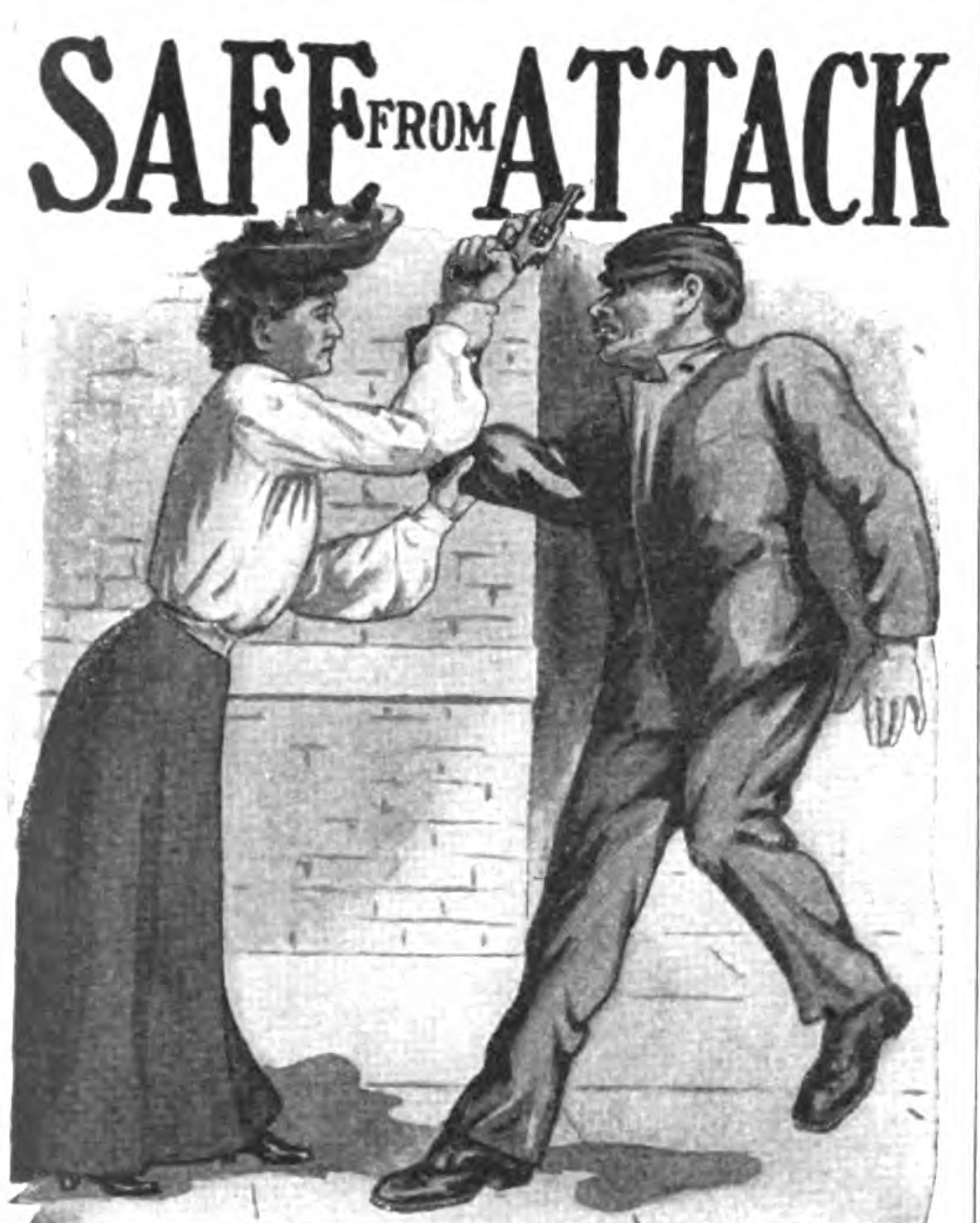
Ignoring the critics who told them that their bodies and natures were not intended for violence, female practitioners of self-defense continued to pursue these “masculine methods” with much interest and intensity in ways that challenged the “natural laws of the home.” Increasingly, women recognized self-defense as a means of defending themselves from potential attackers. Advertisements for jiu-jitsu and boxing classes flooded popular national magazines. Magazines such as Lippincott's and The Cosmopolitan advertised self-defense classes for women at the Yabe School of Jiu-Jitsu in Rochester, New York. The ads insisted, “As a means of self-defense, the man or woman versed in JIU-JITSU can protect themselves against persons twice their size and strength.”Footnote 19 Initially, popular magazines and newspapers described the study of self-defense as a “fad,” especially among society women who could afford to hire private instructors.Footnote 20 However, it appears to have been much more than a fad.
This ad for the Yabe School of Jiu-Jitsu in Rochester, New York, promised to equip women with the necessary techniques to protect them from dangers on the street. “Safe from Attack.” Cosmopolitan 39, May–October 1905. Courtesy of Google Books.
The rising popularity of jiu-jitsu and boxing classes is evident in the array of women who eagerly signed up for training.Footnote 21 In 1904, the women of Wesley Methodist Church in Chicago formed their own jiu-jitsu classes. Motivated less by a desire to improve their health and more by a concern about arming themselves with techniques to prevent victimization, the church ladies advocated carrying cayenne pepper as a means of defense against potential attackers.Footnote 22 Young women also signed up for lessons in self-defense on college campuses, as evidenced by images of Temple University girls practicing boxing and jiu-jitsu.Footnote 23 In 1914, fifty Spokane girls at Lewis and Clark High School enrolled in a self-defense class where the instructor, Jack Carnahan, insisted that they would learn techniques to stop attackers. “The girls believe that a couple of short hooks to the jaw, a jab from a skillfully handled umbrella, or a forced back flip on a hard pavement will do much more than moral suasion to repulse unwelcome attentions,” Carnahan remarked.Footnote 24 By 1920, more than 200 girls were reported studying boxing at the Albert Barnes Club in Philadelphia.Footnote 25
Although the expense of paying for lessons may have been prohibitive for working-class women, the practice of self-defense was not necessarily limited to women of the upper class. For those without the time or money to spend on costly lessons, the Yabe School offered free lessons through the mail. A few simple techniques would enable “a little woman to overthrow a big, powerful man,” affording “sure protection from attack by thieves and thugs.”Footnote 26 Newspapers published articles and illustrations that detailed step-by-step jiu-jitsu techniques to fend off a variety of potential attack situations. Women who could not pay for lessons might begin their own program of home training. Articles targeting female readers were intended to enable women to teach themselves in the privacy of their own homes.Footnote 27
Books offered more in-depth tutorials on how women could privately prepare for defensive combat. A number of authors besides Harrie Irving Hancock published training manuals for women. In 1904 Harry Hall Skinner insisted that the purpose of his book, Jiu-Jitsu, was to teach any man or woman how to “defeat a more powerful assailant.”Footnote 28 Emily Watts, a wealthy English socialite, started her jiu-jitsu training under the direction of Sadakazu Uyenishi. By 1906 she had published her own book, The Fine Art of Jujutsu, and was conducting classes for children. Her work, which included numerous photographs of herself and her colleagues applying their techniques to painful effect, further inspired more women to take up the study of self-defense.Footnote 29
Self-defense techniques available from mail-order pamphlets, newspaper articles, or books not only made training accessible to a wider range of women, but also apparently had some direct effect for women who took to heart the messages of instructors who insisted on the transformative potential of women's self-defense training. In October 1905, the New York Times reported an incident where a woman named Mary Steckler used self-defense techniques she had read about against a mugger. The assailant grabbed her pocket book as she was walking through Central Park. Rather than scream or freeze in terror, she put him in a jiu-jitsu hold. The angered attacker pushed her against a fence and threatened to kill her if she didn't give up her possessions. She refused to do so and instead held him in place until the police arrived. Her cool demeanor surprised the officers when they found her. She explained that she would never “run from any man of that kind who lives.” Although she had no formal training in self-defense, she told officers that every woman should learn jiu-jitsu.Footnote 30 The practical benefits of self-defense proved an effective motivator. The trend of women's self-defense training was spurred on not only by a new fascination with physical culture, but also by fears of the dangers that faced women as they moved into the public realm.
Self-Defense Training and Women in the Public Sphere
Women's self-defense training also emerged from a concern for women's safety as they stepped out of the protected domestic sphere and into the public sphere of the city. Rapid immigration, urbanization, and industrialization fueled anxieties about shifting social and gender norms. The presence of women in public generated cultural anxiety, as it challenged notions of separate spheres. The possibility that men would view these women in sexualized ways threatened the reputation of respectable women.Footnote 31 Beginning in the late nineteenth century, newspapers offered accounts of the perils that awaited unescorted women who ventured into cities by themselves. Reporters detailed dangerous encounters between women and “mashers,” a slang term used to describe men who make unwelcome sexual advances toward women. Some major cities such as Chicago and New York even trained female police officers to provide additional protection for women. These policewomen studied both armed and unarmed combat.Footnote 32 By the 1920s, the New York Police Department had apparently decided that the masher threat was so out of control that it warranted extra attention from the women's squad in the form of undercover sting operations. Mary Hamilton, chief of the New York women's squad, insisted that “many persons do not realize how serious [the masher threat] is.” Hamilton insisted that daily complaints from victims warranted swift action. Female officers trained in jiu-jitsu worked undercover to identify and arrest men who harassed women on the streets. Once convicted, the offender could serve up to six months in prison.Footnote 33
The extent of the actual versus the perceived threat of violence to women in cities is a subject of debate. At the time, some women publicly challenged the popular conception of the “masher” threat and accused the media of exaggerating the dangers of the city for dramatic effect. One female doctor who frequented the streets at all hours in the course of her duties posed the question to other female workers of whether or not “there is any such thing as a real masher?” She told reporters from the Washington Post, “I've been a doctor for twenty years, out at all hours and in all parts of town, and I've never met a masher.”Footnote 34 Historians have suggested, however, that late nineteenth- and early twentieth-century cities were indeed dangerous places. Jeffrey Adler's study of violence in Chicago concluded that the city had one of the highest homicide rates in the nation.Footnote 35 The idea that the modern world was a dangerous place for women was a theme that reflected larger concerns about industrialization, urbanization, and immigration. Whether these fears were warranted or not, economic and social change disrupted the existing social order and proved potentially threatening, especially as women's roles expanded and they moved increasingly into the public sphere.
Women who engaged in self-defense training confronted their perceived unsafe world head-on, thereby claiming public spaces as their own.Footnote 36 In 1889, the Los Angeles Times announced the opening of an athletic club for women in the city. The reporter insisted that the training of women in self-defense was essential to protect them from mashers. At a time when most women considered it socially unacceptable for men to speak to them in public, the specter of physical assault and especially rape engendered so much fear that it made the radical idea of female physical empowerment seem less threatening. One mother explained that she would feel more comfortable knowing that her three daughters were physically capable of defending themselves. “Our girls would not be insulted so often on the streets,” she asserted, “if the brainless puppies who make a business of annoying unprotected females know that our girls can strike out from the shoulder with telling effect.” She further argued, “The average women of today, except in England and some of the Eastern States, are as helpless as infants when they are alone; but how different it would be if they were taught the science of self-defense.”Footnote 37 This mother viewed self-defense training as enabling her daughters to stand up for themselves against male aggressors and assert their right to walk down public streets safely.
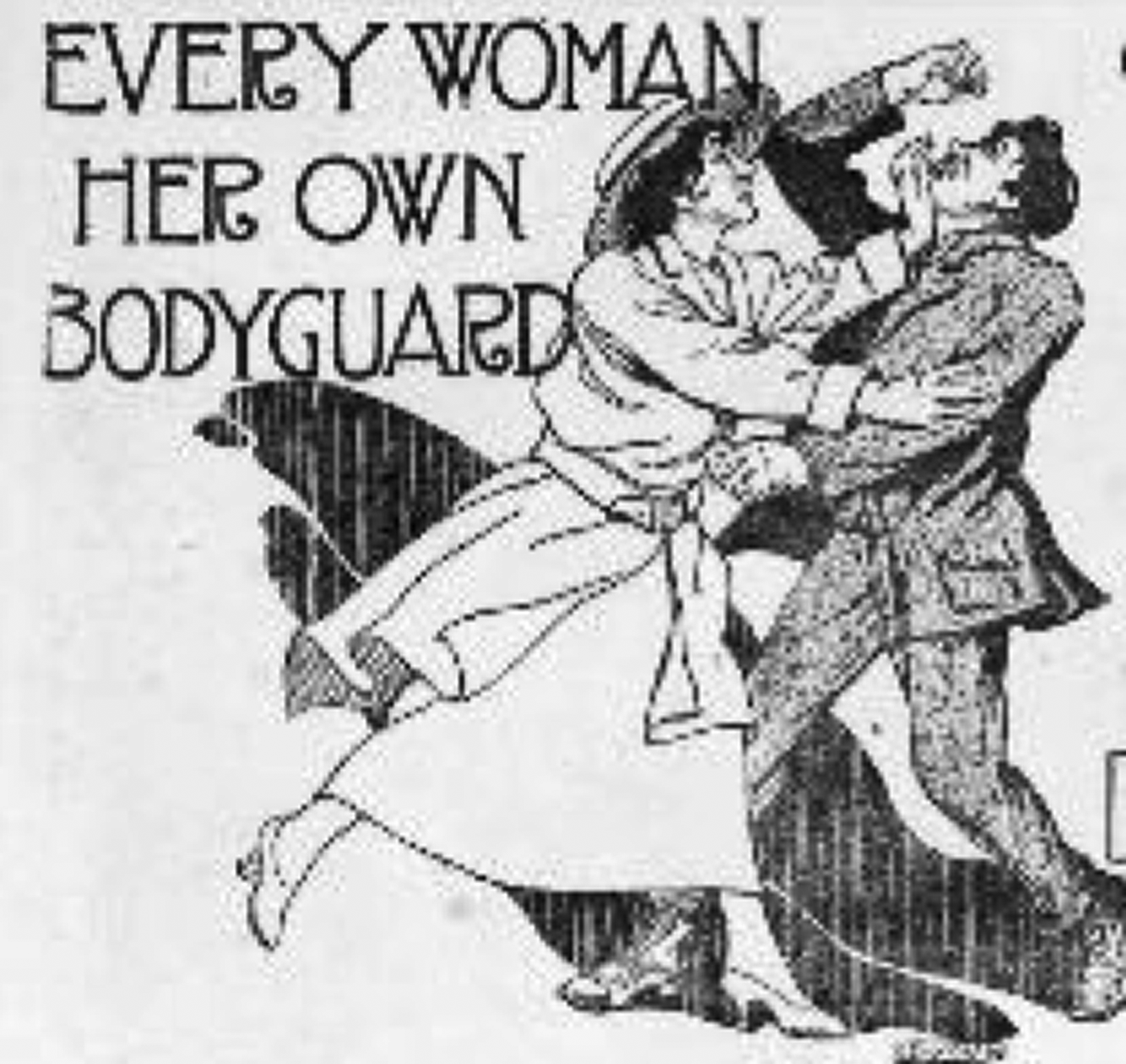
Newspapers published articles and illustrations that promised to teach women techniques that reveal “how even women of slight build can overcome and subdue a burly assailant.” Illustration to Edna Egan, “Every Woman Her Own Bodyguard.” Ogden Standard, Magazine Section, July 14, 1917. Courtesy of Chronicling America, Library of Congress, http://chroniclingamerica.loc.gov.
Stories of women successfully fending off violent assaults fueled the trend of female self-defense training. Sordid tales of women's victimization appeared in print media along with successful accounts of brave women fighting back through their own will and power. Newspapers reported that Blanche Bates fought off an attacker in the streets of New York in 1901. Bates credited her boxing training for her success in defending herself: “I would not advocate any woman going through life leaving behind a trail of bruised masculinity in her wake, but if a man insults her, she ought to know where to use her fist on him where it will do the most good.” Bates insisted that all women should be able to protect themselves from such insults by training in self-defense.Footnote 38 In 1902, the Washington Times reported another self-defense success story. A nineteen-year-old Pennsylvania girl was approached by a robber who refused to listen when she insisted that he leave her alone. She punched him on the jaw so hard that he landed on the grass behind him. The girl explained to reporters that she had studied boxing. Her success in debilitating her attacker offered further proof of the benefits of this type of training for women. The newspaper reporter reiterated a common theme about the dangers of the modern world when he wrote, “It is an unfortunate fact that most country places are not as safe for lone women as they were a generation ago.” Rather than suggest that women stay in the home to avoid these dangers, the reporter concluded instead that “it might be a good thing if more of them [women] were prepared to defend themselves.”Footnote 39 This idea of physical empowerment, although radical in its time, was part of a larger Progressive Era conversation about enabling women to navigate the potentially dangerous urban environment.
Self-Defense Training as Political Empowerment
Some women also recognized that training in boxing and jiu-jitsu had benefits extending beyond preparing to defend themselves against physical attack. Women's self-defense training had potential political implications as well. It is well known that Theodore Roosevelt eagerly advocated physical culture as a means not only of fighting emasculation and strengthening the bodies and the characters of American men, but as a way of strengthening the virility of the nation as a whole. Roosevelt sought to emulate these attributes by pursuing a variety of athletics, including boxing and jiu-jitsu.Footnote 40 Less well known is the fact that several elite Washington women determined to prove that they could take on any physical challenge that the president could in an effort to challenge preconceived notions of feminine weakness.
In 1904, when the president heard that prominent judo instructor Yoshiaki Yamashita was visiting the United States, he invited Yamashita to Washington to offer instruction.Footnote 41 Roosevelt saw the training as a way of reducing his weight and of garnering media attention and popular support in an election year. Martha Blow Wadsworth, a wealthy Washington heiress, was upset by Roosevelt's blatant political maneuverings and use of jiu-jitsu to elicit public attention. According to martial art historian Joseph Svinth, Wadsworth despised Roosevelt “so much that she insisted on duplicating virtually every physical feat he claimed, once riding a relay of fast horses several hundred miles in 24 hours just to spite him.” Wadsworth determined to organize a judo class for women and girls under the direction of Yamashita's wife, Fude. Students in the class soon included the wives and daughters of prominent Washington businessmen and politicians including Maria Louise “Hallie” Davis Elkins (wife of Senator Stephen Elkins) and her daughter Katherine Elkins, Grace Davis Lee (Hallie's sister), Jessie Ames (daughter of a former Civil War general and politician), and Re Lewis Smith Wilmer (wife of prominent Washington surgeon William Holland Wilmer).Footnote 42 The class for young girls included Katherine Brown, Frances Moore, Ogden Jones, and Margaret Perrin. Newspapers highlighted not only the social status of these women, but also their athleticism as a sign of the changing roles of women.
This new generation of women embraced judo not simply for physical exercise or to protect against potential mashers, but as a means to secure broader freedoms for themselves and for their daughters. An article in the San Francisco Chronicle noted that Katherine Elkins, one of the young participants in Fude's class, also excelled in a variety of sports.Footnote 43 Elite women who entered the physical arena found a way to balance the bodily, social, and cultural components of this new gendered identity. For example, one of the women told reporters, “I did not go into it to benefit myself physically. I went into it for the knowledge, and for the wonderful power which that knowledge gives.”Footnote 44 These elite women used their power to challenge the very definition of the “manly arts” by seizing for themselves the sense of liberation offered through self-defense training and converting it into a “womanly art.”
A children's class taught by Yoshiaki Yamashita for well-to-do Washingtonians in 1904. From Yoshiaki Yamashita Photograph Album (PH 006), courtesy Special Collections and University Archives, W.E B. Du Bois Library, University of Massachusetts Amherst, http://www.library.umass.edu/spcoll/ead/muph006.html.
The women who publicly practiced judo on the lawn of the White House clearly recognized their appropriation of the manly arts as signaling women's new role in the political arena. Some led suffrage organizations, thus exposing the tangible connections between physical and political empowerment in the Progressive Era. One of the noted female jiu-jitsu practitioners and guests of President Roosevelt, Jessie Ames (1882–1967), came from a politically connected family and was a noted political activist in her own right. Ames's father had been a Reconstruction-era governor and senator from Mississippi but then moved back to New England, where the family earned a fortune in flour milling. The children of this politically prominent family all established themselves as reform-minded professionals. In her later life, Jessie Ames worked for female freedom, most notably through the birth control movement.Footnote 45 Her sister took it a step further. Blanche Ames, a class of 1899 Smith graduate, led the Birth Control League and Woman Suffrage League of Massachusetts in the 1910s. Indeed, the Ames sisters' advocacy reveals the connections that such club and elite women saw between political and personal independence.
The example of the Washington women inspired others to take up self-defense training. As women continued to pursue the study of boxing and jiu-jitsu, critics softened their tone, favoring sarcasm or humor to outright condemnation. When the University of Illinois announced the introduction of boxing classes for women, a reporter declared it a “good thing” and then sarcastically added, “A man naturally wants a wife who is able to protect him from insult.”Footnote 46 The juxtaposition of gender roles in this statement was intended not only as humorous commentary regarding women's entry into the world of athletics, but also as commentary about women's advances in the political realm.
Although not all women embraced the links of their new physical abilities with women's new political and social freedom, there were clear connections. In 1912, Ethel Intropodi, a trained boxer, insisted that she had decided to study boxing in Chicago for personal rather than specific political reasons: “I am not a suffragette nor even a suffragist; but I do believe that a woman should be able to protect herself from that breed of brutes commonly known as mashers.” Intropodi insisted that women did not need to be weak, running away and screaming to a policeman. Instead, she insisted that a “girl of spunk and independence is able to take care of herself. If she can land a stinging blow behind the ear on one of these mashers, she is safe. If she can deliver a strong upper cut, or lead a ‘solar plexus’ blow, she can walk the streets unmolested and unafraid.” She went on to explain that not only is boxing healthy, but it “gives a woman a feeling of power that is exhilarating.”Footnote 47 Although Intropodi declined to identify herself as a feminist, she recognized the potential for physical empowerment of women through self-defense training. Through the assertion that women have the right to physically fight back against mashers and to safely walk the public streets, the practice of self-defense in itself became a form of political activism. Thus, although some women insisted that they studied self-defense simply for health or exercise, the entrance of women into the male-dominated field of self-defense had political implications that both reflected and shaped new attitudes by and toward women.
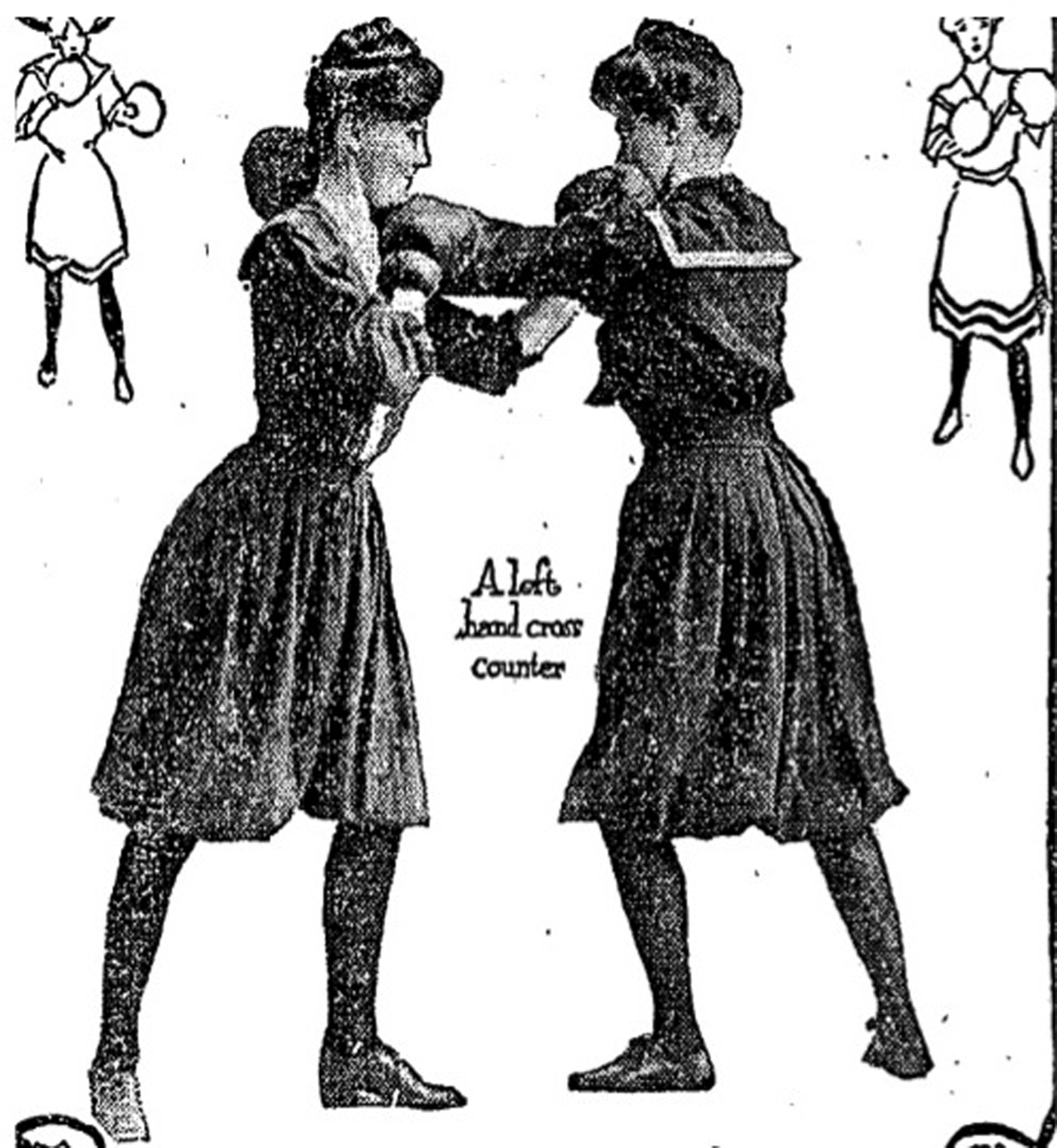
Women who trained in the “manly art” of boxing found the physicality of the sport liberating. “A Left Hand Cross Counter,” from “Boxing to Be a Fad for Women.” Chicago Daily Tribune, Oct. 26, 1902, 48. Courtesy of Chronicling America, Library of Congress, http://chroniclingamerica.loc.gov.
The link between self-defense for physical and political empowerment became explicit with the militant suffragettes of England. Jiu-jitsu had become popular among women in England as well as in America.Footnote 48 Employing more militant tactics than Americans, British women seeking the vote confronted men through direct action. Women such as Emmeline Pankurst and Mary Richardson went on hunger strikes, hurled objects at buildings and people, set fire to structures, and used their bodies as sites of protest to demonstrate for political rights. In this more radical context, self-defense training took on a more explicit political meaning. By 1909, Edith Garrud, who had studied under Sadakazu Uyenshi in England, was teaching jiu-jitsu to members of the Women's Social and Political Union (WPSU). These women explicitly pursued jiu-jitsu to protect themselves and WPSU leaders from assaults not by criminals but rowdy anti-suffragettes and the police.Footnote 49 This group of dedicated women had long advocated picketing, hunger strikes, and the destruction of public property to make their presence known to a government who refused to listen to their words. They had already refined the practice of using their bodies as a means of protest. Jiu-jitsu provided yet another avenue of using their bodies as a method of remonstrating against the physical and political oppression of the female body.
Garrud taught the women techniques that allowed them to take control of situations that they felt were out of their control. A member of the group explained, “I believe we will teach male rowdies who try to bother us a lesson. I have already ejected one or two disturbers of our meetings with a speed and dispatch that has surprised their lumbering masculine minds.”Footnote 50 By 1913, the WPSU leaders were advising all women in the movement to be trained in self-defense. Sylvia Pankhurst said to a suffragist meeting in Bromley in 1913, “We have not yet made ourselves a match for the police, and we have got to do it. The police know jiu-jitsu. I advise you to learn jiu-jitsu. Women should practice it as well as men.” She also advised the women to always go armed with their sticks to meetings in case they encountered hostility from outsiders.Footnote 51 The idea of armed suffragettes seemed extreme to many critics, who insisted that the new tactic in no way furthered the cause of women's suffrage. Others simply found it humorous.
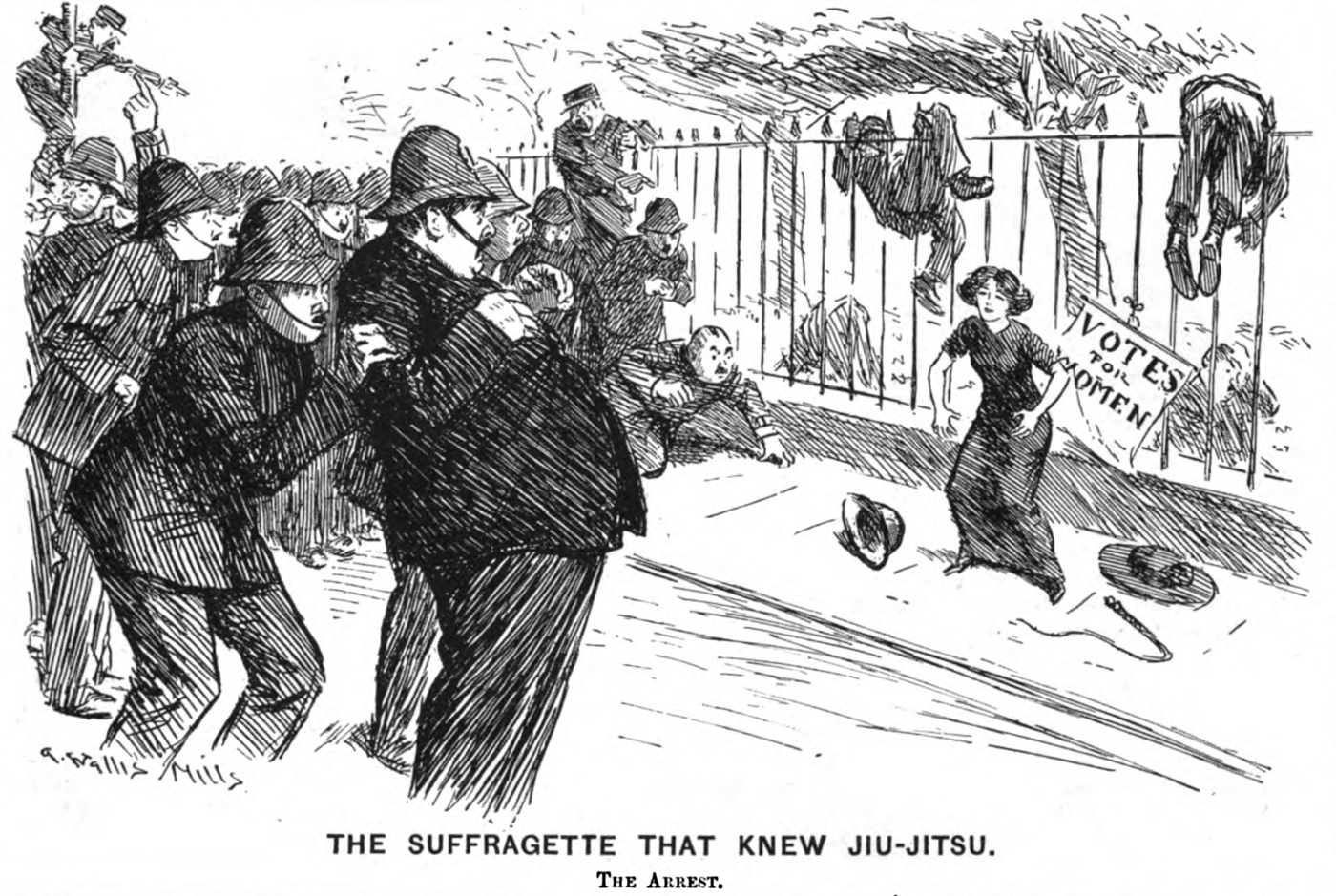
Popular magazines and newspapers made light of the situation by mocking the suffragettes who studied jiu-jitsu. A cartoon published in Punch in 1910 showed police officers terrified of approaching a suffragette, who had already disabled several of their colleagues with jiu-jitsu. The artist included the caption, “The Suffragette that Knew Jiu-Jitsu,” humorously suggesting that her newfound physical strength was a force to be reckoned with.Footnote 52 The patronizing tone of the cartoon, however, suggests that critics dismissed women's self-defense training and therefore the suffrage movement in general.Footnote 53 Indeed, the media's sexist portrayal of self-defense practitioners reflects a broader uncertainty and anxiety about how to make sense of these women who powerfully stretched the boundaries of acceptable female behavior.
Terrified police officers cower in fear of a suffragette armed with the knowledge of jiu-jitsu. “The Suffragette That Knew Jiu-Jitsu,” Punch, or the London Charivari, July 6, 1910, 9. Courtesy of the Internet Archive, https://archive.org/details/punchvol138a139lemouoft.
Seizing on any public attention that came her way, Garrud accepted many requests from interviewers and offered public demonstrations to highlight the advantages of self-defense training for all women. Garrud and her students did not shy away from the press. Rather they eagerly pursued the publicity. “Woman is exposed to many perils nowadays,” she argued, “because so many who call themselves men are not worthy of that exalted title, and it is her duty to learn how to defend herself, because ju-jutsu has over and over again been proved to be the most effective means, in moments of emergency, for repelling the attack of a ruffian; because it is easy to learn, and because it is, quite apart from its combative value, a splendid exercise; it is the very thing for women as well as men to take up thoroughly.”Footnote 54 Her comments echoed the arguments made by advocates of self-defense for women in the United States. Indeed some of Garrud's most radical assertions stemmed from how she wanted to transform women's bodies. Resisting the Victorian notion of the body as a site of weakness and in need of protection, Garrud and her jiu-jitsu followers suggested that not only should women learn these techniques to empower themselves, but also that doing so had political implications. At the same time, Garrud offered the suffragettes the physical training to fend off physical attacks to their cause.
American suffragists drew inspiration as well from the adoption of jiu-jitsu by English suffragettes, who deliberately trained to use their bodies as physical sites of political struggles. American suffrage organizations apparently did not emulate the militant zeal of their English cousins by organizing self-defense classes and promoting public exhibitions. Yet American suffrage leaders did recognize the connections between physical and political liberation and advocated self-defense for all women. Sofia Loebinger, a leader of a militant suffragist group in New York, expressed admiration for the English suffragettes who practiced jiu-jitsu: “Strong situations need strong women, and I am heartily in favor of the movement.” Although she admitted that it might not assist them directly in achieving the right to vote, she argued that “boxing would be a good thing for women if only to teach them to concentrate their minds on one thing at a time. The ballot, for instance.”Footnote 55 Loebinger recognized the transformative potential of physical training in strengthening women for the political battle that lay ahead. Moreover, for activists who used confrontational mass resistance techniques to demonstrate for the vote, arming themselves with these skills could serve them well on multiple fronts.
In 1915, Professor Emily Putnam used her Vassar anniversary address to advocate the training of all women in self-defense. Putnam had previously served as the first dean of Barnard College, and in 1910 she published The Lady: Studies of Certain Significant Phases of Her History. At the time of her Vassar address, Putnam was a professor of history at Barnard. Putnam offered a more in-depth feminist analysis that highlighted the broader dangers of gender stereotyping. Putnam decried women's subordinate political status in society, while suggesting that items of material culture such as skirts reinforced the objectification. This rhetoric would reappear again in feminist discourse fifty years later. For Putnam, the personal was indeed directly political insofar as clothing physically restricted a woman's right to autonomy:
If I might have my way, all girls would be trained to be manly. They would be stripped of their hampering dress, which is in itself a badge of physical incompetence. They would be practiced in dangerous sports, where life and limb depend on nervous control; public opinion would require of them the same standard of physical courage as it requires of boys; they would not be allowed to cry when they are hurt; the schools would have courses in not being afraid of things beginning with mice and progressing through men-under-the-bed to fire-arms; they would learn the ordinary arts of self-defense, and in view of their special liability to attack, would supplement these with the open carriage of weapons when circumstances rendered it advisable.Footnote 56
Beginning by condemning the restricting nature of women's clothing as well as the cultural restrictions on women's behavior that contributed to their development as “physical cowards,” Putnam took her case even further. Her radical suggestion (as one reporter labeled it) that women be trained in self-defense clearly reflected her belief in the potential of physical training to help women embody the political.
Self-Defense Training as Protection against Family Violence
Beyond the political implications of self-defense training, many instructors recognized that on a personal level, the study of self-defense could have revolutionary implications for women who suffered in abusive relationships. Although the issue of family violence was rarely openly addressed, it nonetheless plagued American families. The popular media focused on violent attacks by mashers or strangers as the main danger facing American women. But the real threats of violence were often closer to home. Historian Jeffrey Adler has revealed that domestic violence was the number one cause of homicide in early twentieth-century Chicago.Footnote 57 The police and court system occasionally intervened in exceptional cases of abuse, prosecuting husbands for abusing their wives.Footnote 58 More often, women seeking escape and protection from family violence turned to private charities organized by their churches or other Progressive Era organizations, which offered assistance and shelter to women. Although not originally intended as domestic violence shelters, many settlement houses and mission homes intended to rescue “fallen” women informally served as safe havens for women escaping violent home environments.Footnote 59 In performing this work that they viewed as charity, reform-minded middle- and upper-class women became cognizant of the level of family violence facing American women.
Although many popular magazines and newspapers offered creative advice on how women could defend themselves from attacks on the street (in this case using a hatpin as a weapon), the reality was that most violence women encountered was in the home. From “How to Defend Yourself,” San Francisco Call, Aug. 21, 1904. Courtesy of Chronicling America, Library of Congress, http://chroniclingamerica.loc.gov.
The leaders of national suffrage organizations were cautious in their approach to domestic violence for fear of alienating potential supporters in their effort to win the right to vote.Footnote 60 Moderate suffrage leaders recognized that women's political subordination in the public sphere went hand-in-hand with their subordination in the domestic sphere. In the mid-nineteenth century, Elizabeth Cady Stanton and Lucretia Mott openly condemned violence against women and used examples of domestic violence to support their argument for a woman's right to divorce. Enduring intense criticism for advocating divorce and accused of attempting to destroy the stability of American family life, moderate suffrage leaders by the 1890s chose to censor their own speech and focus more narrowly on women's suffrage. The movement experienced a sort of rebirth in the 1890s and 1900s, as National American Woman Suffrage Association (NAWSA) leaders tapped into changing popular sentiment toward woman suffrage and created an efficient political machine focused on the passage of federal and state suffrage amendments. Suffrage leaders hoped that once women had achieved the right to vote, they would be empowered to tackle other issues, such as violence against women.Footnote 61
Despite the reluctance of suffrage leaders to broach the subject of family violence, a number of other organizations did connect women voting with freedom from violent home lives. The Women's Trade Union League (WTUL), for example, had formed in 1903 to organize female workers but adopted a range of women's rights causes in the workplace, at home, and in politics. For the WTUL and its famed leader, Rose Schneiderman, advocating protective-labor legislation such as an eight-hour work day, campaigning for the right of women to vote, and combatting wife beating were all necessary to bring equality to the working class.Footnote 62 Female leaders of the temperance movement broached the subject of family violence directly, even as they continued their traditional practice of blaming family violence largely on alcohol. The Women's Christian Temperance Union (WCTU) recognized physical security against abusive husbands as a major goal in the women's rights agenda. Frances Willard argued that the vote would protect women against family violence resulting from alcohol consumption.Footnote 63 Yet Willard promoted public shaming and moral suasion against intemperance and spousal abuse, rather than advocating the empowering of women through self-defense training.
Advocates of self-defense training promoted a more radical approach to family violence. American discussions of women's self-defense included a common theme of providing women with an element of protection against the threat of violence in the home. An 1892 article in the St. Paul Daily Globe, in discussing the popular fad of women training in boxing, offered an amusing though significant warning to men: “Prospective husbands had better beware, not only of concealed claws but of well-trained fists.”Footnote 64 By 1915, De Witt Van Court, a boxing instructor in Los Angeles, felt more confident in offering a definitive statement about the domestic advantages of self-defense. He only half-jokingly suggested, “Such a course, girls, enables you to master the art of self-defense and that mastery might come in handy someday if you happen to marry a man who is inclined to become rambunctious.”Footnote 65
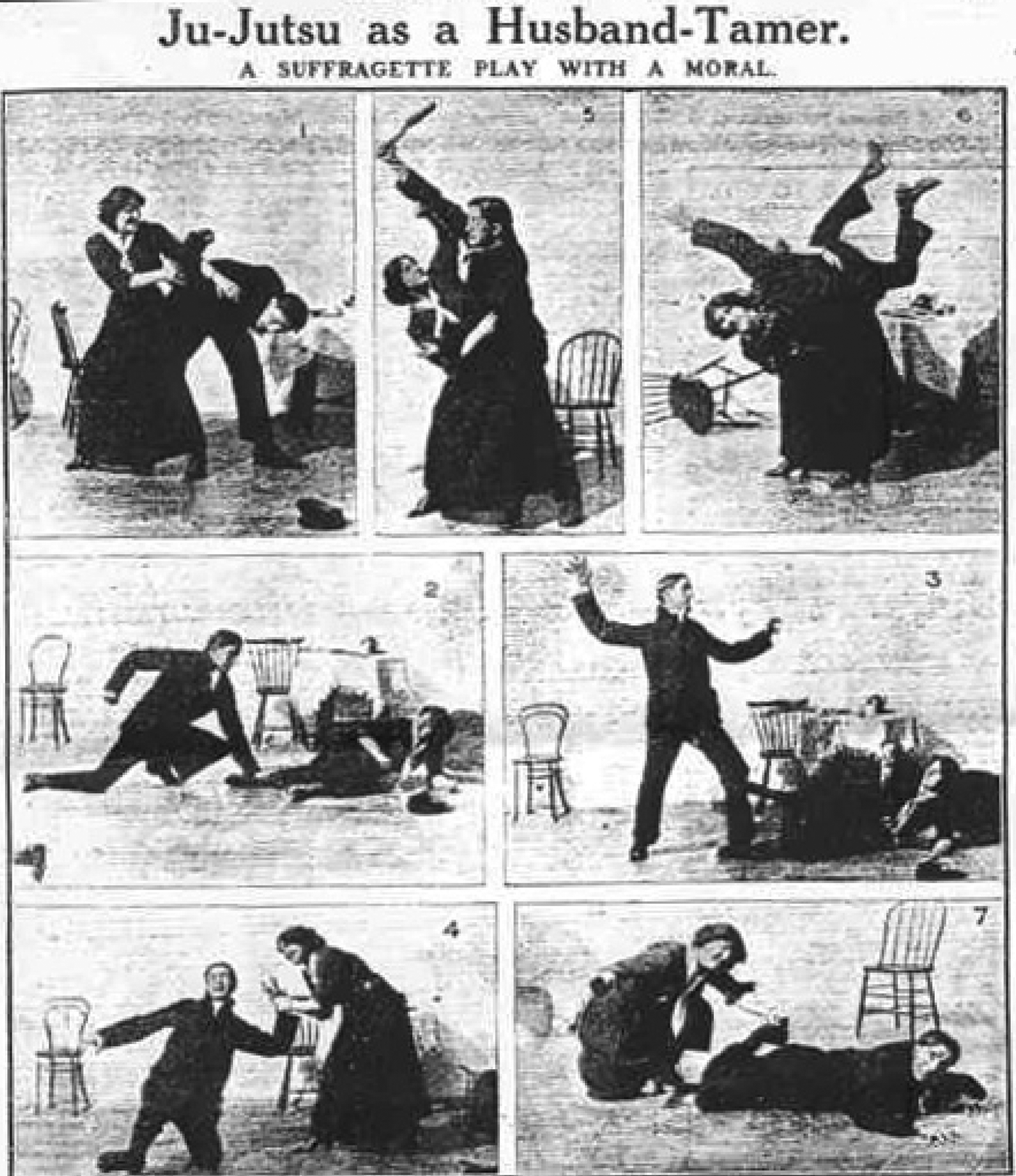
Radical English women more openly advocated the study of self-defense not only as protection on the street, but also as protection in the home. Edith Garrud, the well-known jiu-jitsu instructor who trained English suffragettes, offered public demonstrations of her skills through the performance of suffragette skits. A condensed version of one such play, illustrated with images of Garrud performing the techniques, was published in 1911 in Health and Strength magazine (a British magazine that focused on physical culture). The play, tellingly titled, “Ju-Jutsu as a Husband-Tamer,” recounted the story of a produce seller's wife who after being taught jiu-jitsu “tames her drunken husband into subjection.” The theme of family violence is clear throughout, as the husband makes several attempts to strike his wife. Each attack is thwarted by the woman's mastery of self-defense. His violent energy is redirected through jiu-jitsu techniques, and eventually he has no alternative but to surrender and agree to live in domestic harmony. The wife warns her husband, “When you're drunk I'll always be a match for you.” The husband is forced to concede, “Then I'll never get drunk again.” The play ends with husband and wife embracing and a suggestion of future domestic bliss.Footnote 66 Diana Looser has argued that Garrud's “message was clear: the physical practice of jujitsu had revolutionary potential for women, opening up unprecedented freedoms through new bodily acts.”Footnote 67 The idea that such training could empower women to defend themselves against domestic violence—the most personal and common form of violence and oppression of women—represented the culmination of women's success in challenging the patriarchal power structure.
Edith Garrud's play touched on the issue of domestic violence while only half-jokingly advocating jiu-jitsu as a potential cure for wife beating. “Ju-Jutsu as a Husband-Tamer: A Suffragette Play with a Moral,” Health & Strength, Apr. 8, 1911, 339, courtesy of Journal of Non-Lethal Combatives (Dec. 1999), http://ejmas.com/jnc/jncart_healthstrength_0100.htm.
In the early twentieth century, self-defense training came to symbolize the emerging status of the “new woman” who embraced personal and political independence. An article in the San Francisco Chronicle that highlighted the numerous female boxers in the country quoted a well-known athlete as saying that “the modern girl athlete is getting better every year. She is a very different creature from the old piano-playing, fancy-work type who was half the time afraid of being alive. This new type of woman is alive all over, all the time.”Footnote 68 Contemporaries also made explicit links between political and physical empowerment. The New York Tribune insisted in 1918 that the entrance of women into the sport of boxing was a sure sign that suffrage was “here to stay.”Footnote 69 Another article published in the Chronicle in 1922 noted the power of the new woman and offered a warning to potential burglars: “Life is not what is used to be even for burglars since women forgot how to scream. In the old days a marauder who encountered a stray female could be fairly certain that she would either cower beneath the sheets or yell for assistance. He acted accordingly. But now—what with higher education, bobbed hair, jiu-jitsu, knickerbockers and the like—she has ceased to function according to the best traditions of her sex. She neither cowers nor yells. And she may do almost anything.” In this and similar stories, modern women in the 1920s had empowered themselves intellectually, politically, fashionably, and physically. These multiple elements amounted to an independent identity for women who could not only vote, cut their hair and hemlines, drink and smoke in public, but also venture into the modern environments equipped with the skills to defend themselves.Footnote 70
Louise Le Noir Thomas, writing in 1917 in the Ogden Standard, similarly explained that much had changed in the lives of women. The idea that a woman was the “protected sex” who must busy herself with the gentle arts of singing, cooking, and sewing had long since disappeared. “In this feminist rebellion that has been occurring since suffrage was introduced in England, women have been drawn more and more into the business world” and therefore into “innumerable activities and interests that take them out of the snug seclusion of the home and make them subject to the dangers that exist on every highway.” Thomas argued that women “have refused to be called the ‘weaker sex,’ and the ‘pampered sex,’ and have shown such aversion to the ‘protection of the male,’ so-called that men have almost begun to take them at their word and treat them as equals in not only intellectuality, but in physical strength.” She further insisted, “It is not unwomanly to protect herself—rather it is unwomanly to be overpowered by the assailant.”Footnote 71
By the 1920s the association between physically strong women and politically capable women was clear. The entry of women into the world of the “manly arts” symbolized the success of women in penetrating the political world. Just as the female body had long been subjected to violence and abuse, women now used their bodies as a tool to fight against that abuse and violence and secure for themselves a newfound sense of freedom. Although not all women who pursued boxing and jiu-jitsu during this era recognized the revolutionary implication of their actions, most women noted the sense of personal strength that inevitably resulted from their physical activity. They embraced it as liberation from the oppressive gender stereotypes that had heretofore limited their activities and confined them to the domestic sphere.