INTRODUCTION
Phosphorus (P) is an essential nutrient required for crop growth and yield, but its low mobility in soil makes it one of the least phyto-available elements. Phosphorus deficiency is considered to be one of the greatest limitations in agricultural production (Schachtman et al. Reference Schachtman, Reid and Ayling1998; Lynch & Brown Reference Lynch, Brown, White and Hammond2008). It has been estimated that 5·7 billion ha of agricultural land worldwide is deficient in P. The concentration of phosphate in soil solution is generally <10 µm (Hinsinger Reference Hinsinger2001), which is well below the critical level that is needed for the optimal performance of crops (Batjes Reference Batjes1997; Johnston et al. Reference Johnston, Poulton, Fixen and Curtin2014).
To overcome limited P availability, plants have evolved a complex array of tightly controlled adaptive mechanisms for maintaining P homeostasis. One of the main morphological mechanisms is to maximize the ability of the root to absorb inorganic P (Pi) from the soil. This can be achieved by increased root growth, leading to increased root–soil contact, which is an important factor controlling the uptake of poorly mobile nutrients such as P in soils (Schjørring & Nielsen Reference Schjørring and Nielsen1987). It is well known that allocation of resources has a strong positive relationship with plant P status (Lambers et al. Reference Lambers, Shane, Cramer, Pearse and Veneklass2006; Niu et al. Reference Niu, Chai, Jin, Wang, Tang and Zhang2013), with many species allocating more biomass to roots when Pi is growth limiting (Brouwer Reference Brouwer1983). Steingrobe (Reference Steingrobe2001) reported a 25% increase in Pi uptake in sugar beet (Beta vulgaris L.) at limited P supply, attributable to enhanced root-length production compared with plants under high P supply conditions. Drew (Reference Drew1975) found that the quantity of lateral roots increased in areas of soil with high available P concentrations, when the plants were sensing an overall P deficiency.
Another morphological root trait that can be adapted to enhance P uptake is the number and shape of root hairs, which increases root–soil contact at a relatively low carbon (C) cost to the plant (Clarkson Reference Clarkson, Waisel, Eshel and Kafkafi1991). Root hairs are tubular-shaped cells specialized for nutrient uptake (Jungk Reference Jungk2001). They arise from epidermal cells called trichoblasts, which undergo tip growth perpendicular to the root and thereby increase the root surface area in contact with the soil (Dolan Reference Dolan2001). Considerable intraspecific variation in root-hair formation has been found among genotypes of white clover (Trifolium repens L., Caradus Reference Caradus1979), common bean (Phaseolus vulgaris L., Yan et al. Reference Yan, Lynch and Beebe1995), cowpea (Vigna unguiculata L., Krasilnikoff et al. Reference Krasilnikoff, Gahoonia, Nielsen, Vanlauwe, Diels, Sanginga and Merckx2001) and wheat (Triticum aestivum L.) and barley (Hordeum vulgare L., Gahoonia et al. Reference Gahoonia, Care and Nielsen1997, Reference Gahoonia, Nielsen and Lyshede1999; Delhaize et al. Reference Delhaize, James and Ryan2012; George et al. Reference George, Brown, Ramsay, White, Newton, Bengough, Russell and Thomas2014). Previous studies (Itoh & Barber Reference Itoh and Barber1983; Föhse et al. Reference Föhse, Claassen and Jungk1991) have shown that root hairs can result in differences in P uptake between plant species and they have been shown to be important under multiple stress conditions of both P deficiency and water limitation or P deficiency and acidity in high strength soils (Haling et al. Reference Haling, Simpson, Culvenor, Lambers and Richardson2011, Reference Haling, Brown, Bengough, Young, Hallett, White and George2013; Brown et al. Reference Brown, George, Thompson, Wright, Lyon, Depuy, Hubbard and White2012). Overall, the increase in root-hair density (RHD) and length in response to P deficiency is a well-researched phenomenon in plant biology (Schmidt Reference Schmidt2001; Gahoonia & Nielsen Reference Gahoonia and Nielsen2004; Raghothama Reference Raghothama, Sims and Sharpley2005; Peret et al. Reference Peret, Clement, Nussaume and Desnos2011; Brown et al. Reference Brown, George, Thompson, Wright, Lyon, Depuy, Hubbard and White2012, Reference Brown, George, Barrett, Hubbard and White2013a, Reference Brown, George, Dupuy and Whiteb), but questions remain over responses at low P availability and the impacts of different soils on the responses to P availability of different species and genotypes. Increased root-hair length (RHL) and numbers are considered to be adaptations that enhance Pi acquisition and a plant's competitive advantage when soil Pi is limiting for growth (Bates & Lynch Reference Bates and Lynch2001). However, it is also known that soil properties such as soil physical conditions including strength and macroporosity, soil water content and soil acidity also affect RHL (Haling et al. Reference Haling, Simpson, Culvenor, Lambers and Richardson2011, Reference Haling, Brown, Bengough, Valentine, White, Young and George2014).
In P-deficient conditions, up to 0·90 of total P uptake by plants can occur through root hairs and in many species they can contribute almost 0·70 of the total surface area of roots (Raghothama Reference Raghothama, Sims and Sharpley2005). It has been demonstrated that root systems with root hairs absorbed 78% more P than those without (Barley & Rovira Reference Barley and Rovira1970). However, for some species this effect was not observed (Dechassa et al. Reference Dechassa, Schenk, Claassen and Steingrobe2003; Pypers Reference Pypers2006). It thus appears that plasticity for RHL is not a universal trait but rather species- and genotype-specific, and also is highly interrelated to local soil environment. Due to the observed inconsistent responses of root hairs to P, it is necessary to investigate root-hair responses to P in different soils.
In wheat, a monocot with a fibrous root system, axial root growth is undeveloped compared with dicotyledons, resulting in different strategies to increase P acquisition. Wheat is one of the most important food crops in the world and its cultivation consumes much more P fertilizer than rice (Oryza sativa L.) or maize (Zea mays), both in terms of annual total consumption and consumption per unit area (FAO 2006). Therefore, improving the efficiency of P uptake in wheat is important for the sustainable use of P resources and an important aspect of the drive towards sustainable intensification of agriculture. As the ability of roots to utilize soil P is affected by many factors, not least soil P concentration, form and bioavailability, as well as rhizosphere processes, effective strategies for P management should involve multidisciplinary approaches which consider all these aspects (Li et al. Reference Li, Huang, Meng, Ma, Yuan, Wang, Zhang, Cui, Shen, Chen, Jiang and Zhang2011; Shen et al. Reference Shen, Yuan, Zhang, Li, Bai, Chen, Zhang and Zhang2011, Reference Shen, Li, Mi, Li, Yuan, Jiang and Zhang2013). The development of effective strategies requires better understanding of the root response to soil P supply, but also soil structure and seedbed conditions as highlighted by Poulton et al. (Reference Poulton, Johnston and White2013). Poulton et al. (Reference Poulton, Johnston and White2013) and Johnston et al. (Reference Johnston, Poulton and White2013) reported that the critical Olsen P for optimum yield of winter wheat grown on a well-structured silty clay loam soil and heavier textured soils was different. This is largely due to differences in soil structure which affect root growth, and thus acquisition of available soil P. Niu et al. (Reference Niu, Chai, Jin, Wang, Tang and Zhang2013) suggested that the effect of P deficiency on root-hair development should be investigated in soil experiments where P cannot easily diffuse to the root surface. There is a need to understand better what triggers root response and how this is affected by concentrations and availability of different forms of P in soils.
The present study reports the responses of wheat (T. aestivum L. cvar Bobwhite.) root traits to different levels of P fertilizer application in two contrasting soil types with a wide range of P availability imposed. The main hypotheses tested are that: (i) wheat root morphological traits will vary depending upon the quantity of P fertilizer added to soils (P availability) and (ii) these responses will vary in magnitude in different soils.
MATERIALS AND METHODS
Experimental design
The current experiment was conducted using thin-plate rhizotrons incubated in three separate growth cabinets (Sanyo 350HT, Sanyo Corporation, Japan). A total of 12 treatments with three replicates were investigated using a randomized complete block design, with individual cabinets acting as a block, and one replicate of each treatment in each cabinet. The treatments consisted of two different soils (the Rough and Barnfield soils), and six rates of P fertilizer additions (0, 10, 25, 50, 100, 200 mg P/kg dry soil). The Rough soil, collected from moderately sloping rough grazing grassland in Devon, UK, was a peaty gley soil with a sandy clay loam texture (Dystric Histic Gleysol according to FAO-UNESCO 1999) and Barnfield, collected from Rothamsted Research Experimental Station in Harpenden, UK, was a well-drained flinty loam (FAO Chromic Luvisol). Soil properties are presented in Table 1, where it can be seen that one of the most important differences between the two soils is their organic C content (42·4 g/kg for the Rough soil and 15·3 g/kg for the Barnfield soil).
Initial properties of the two untreated soils used in the experiment

* Ammonium nitrate–potassium index.
Topsoil (0–10 cm) was sampled, air-dried and passed through a 2 mm sieve. The soil was amended with solutions providing nitrogen (N), potassium (K), magnesium (Mg), manganese (Mn), boron (B), cobalt (Co), copper (Cu), zinc (Zn), molybdenum (Mo) and sulphur (S) as follows: 240 mg N/kg as ammonium nitrate (NH4NO3), 60 mg K/kg as potassium chloride (KCl), 19·2 mg Mg/kg as magnesium sulphate heptahydrate (MgSO4·7H2O), 1·8 mg Mn/kg as manganese (II) chloride tetrahydrate (MnCl2·4H2O), 0·42 mg B/kg as boric acid (H3BO3), 0·06 mg Co/kg as cobalt (II) sulphate heptahydrate (CoSO4·7H2O), 1·38 mg Cu/kg as copper (II) sulphate pentahydrate (CuSO4·5H2O), 1·2 mg Zn/kg as zinc sulphate heptahydrate (ZnSO4·7H2O), 0·18 mg Mo/kg as sodium molybdate dihydride (Na2MoO4·2H2O) and 25·8 mg S/kg as the forms mentioned above. An extra 200 mg K/kg as KCl was added to the Barnfield soil due to the low available K (Table 1). Soil treatments were prepared by adding nutrient solution and appropriate P solutions (as monopotassium phosphate, KH2PO4) to equal quantities of soils (100 g) in plastic bags. Soil moisture was adjusted to 50% water holding capacity with deionised water. The bags were mixed thoroughly by careful shaking, and the soils were allowed to stabilize for 1 week by incubating at 20 °C. The rhizotrons comprised two plates, one clear glass and one opaque plastic, each 120 mm × 240 mm. These were positioned facing each other, separated by 5 mm thick × 1 cm wide plastic strips placed on three sides, leaving the top open to allow plant growth, and two small gaps on the base for irrigation/drainage. The rhizotrons were filled evenly with 100 g dried soil sieved <2 mm to provide uniform bulk density throughout. Five wheat seeds (T. aestivum L. Bobwhite, a commercially available spring wheat variety used for milling) were sown in the rhizotrons 1 cm deep, taking care to ensure each was covered by soil. Each rhizotron was wrapped in aluminium foil to keep the roots in the dark, leaving the top and bottom open. Each rhizotron was placed in a separate tray with approximately 20 mm depth of water that was topped up periodically. The rhizotrons were kept at an angle of 20° to the vertical to induce root growth along the viewing face. All three growth cabinets were set with daytime conditions (16 h) of 20 °C and 60% humidity and night conditions (8 h) of 15 °C and 55% humidity. After 4 days, following germination of the seeds, seedlings were thinned to two seedlings per rhizotron and ungerminated seeds removed.
After 3 weeks, the rhizotrons were removed from the growth cabinets. This was deemed the optimum growth time for providing adequate root growth (Gahoonia et al. Reference Gahoonia, Care and Nielsen1997). Rhizotrons were disassembled and the roots carefully separated from the soil. Loose soil adhering to roots was shaken off, and mixed with the root-free soil to form the ‘bulk’ soil sample. The bulk soil and plants were prepared as described below to enable measurement of shoot and root dry matter, shoot P uptake, Olsen-P, root-length density (RLD), RHD and RHL.
Determination of plant total phosphorus and soil Olsen phosphorus
Plant dry matter was determined after 48 h in an oven at 80 °C. Dried samples of plant shoots were milled then digested with concentrated nitric and perchloric acids to determine total P using inductively coupled plasma atomic emission spectroscopy (Zhao et al. Reference Zhao, McGrath and Crosland1994). Soil Olsen P was determined using the molybdovanadophosphate method based on extraction from air-dried soil with 0·5 M sodium bicarbonate (NaHCO3) at pH 8·5 (180 rpm, 25 °C, 30 min) (Olsen et al. Reference Olsen, Cole, Watanabe and Dean1954).
Determination of root hairs
The method of root-hair determination was according to Vandamme et al. (Reference Vandamme, Renkens, Pypers, Smolders, Vanlauwe and Merckx2013). Prior to dismantling the rhizotrons, they were placed glass side up under a Nikon AZ zoom fluorescence microscope at 7·5 × magnification and 2–7 randomly selected root fragments with clearly visible root hairs adjacent to the rhizotron glass were photographed per rhizotron. The photographs were analysed using the Java imaging software program Image J (http://imagej.nih.gov/ij/), and RHL of ten root hairs, randomly selected but evenly distributed across the image, were measured. The mean half distance (rs) between root hairs on the root surface was determined by counting the number of focused root hairs on a 1 mm root fragment. Root-hair density was calculated as RHD = (π r s2)−1
Scanning and image analysis of roots
Roots were washed out with tap water and then rinsed three times with deionized water (Jing et al. Reference Jing, Zhang, Rengel and Shen2012). Cleaned root samples were dispersed in deionized water in a transparent tray (30 × 20 × 3 cm) and scanned at a resolution of 400 dpi (Epson Expression 1600, Seiko Epson, Nagano, Japan). To evaluate root length, the images were analysed using WinRHIZO software (Regent Instrument, Quebec, Canada). After scanning, the root samples were oven-dried for 48 h at 80 °C and weighed. After calculation of the total root length and soil volume, the RLD was obtained.
Statistical analysis
The differences between mean values were analysed by one-way ANOVA using the SAS statistical software (SAS Institute 1999). Significant differences among means were determined by LSD at P ⩽ 0·05. Phosphorus uptake was statistically related to root characteristics (RLD, RHL and RHD) with a stepwise regression model using PROC REG in GenStat (VSN International, Hemel Hempstead, UK, version 14.1.0.5943) with the option ‘stepwise’. The relationship between total dry matter and P dose/Olsen-P was described by an asymptotic regression equation using Regression Wizard in SigmaPlot (12.0). The equation is:
 $${\rm Total}\;{\rm dry}\;{\rm matter}\, = \,{y_0}\, + \,a\;\left( {1-{b^x}} \right)$$
where y 0 is the asymptotic total dry matter, a and b are range and rate parameters respectively, estimated by the maximum likelihood, and x is the P dose or Olsen-P.
RESULTS
Root characteristics
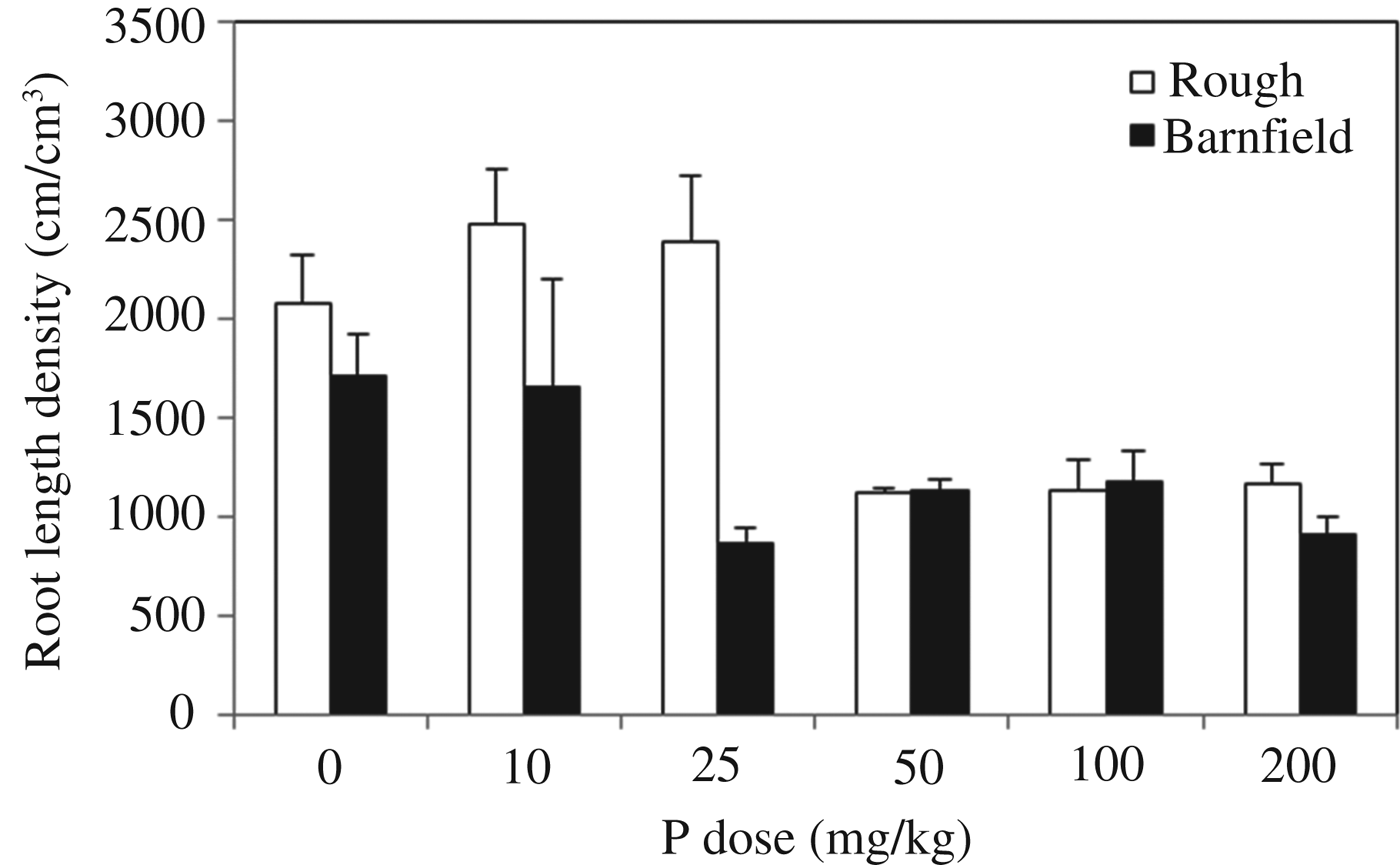
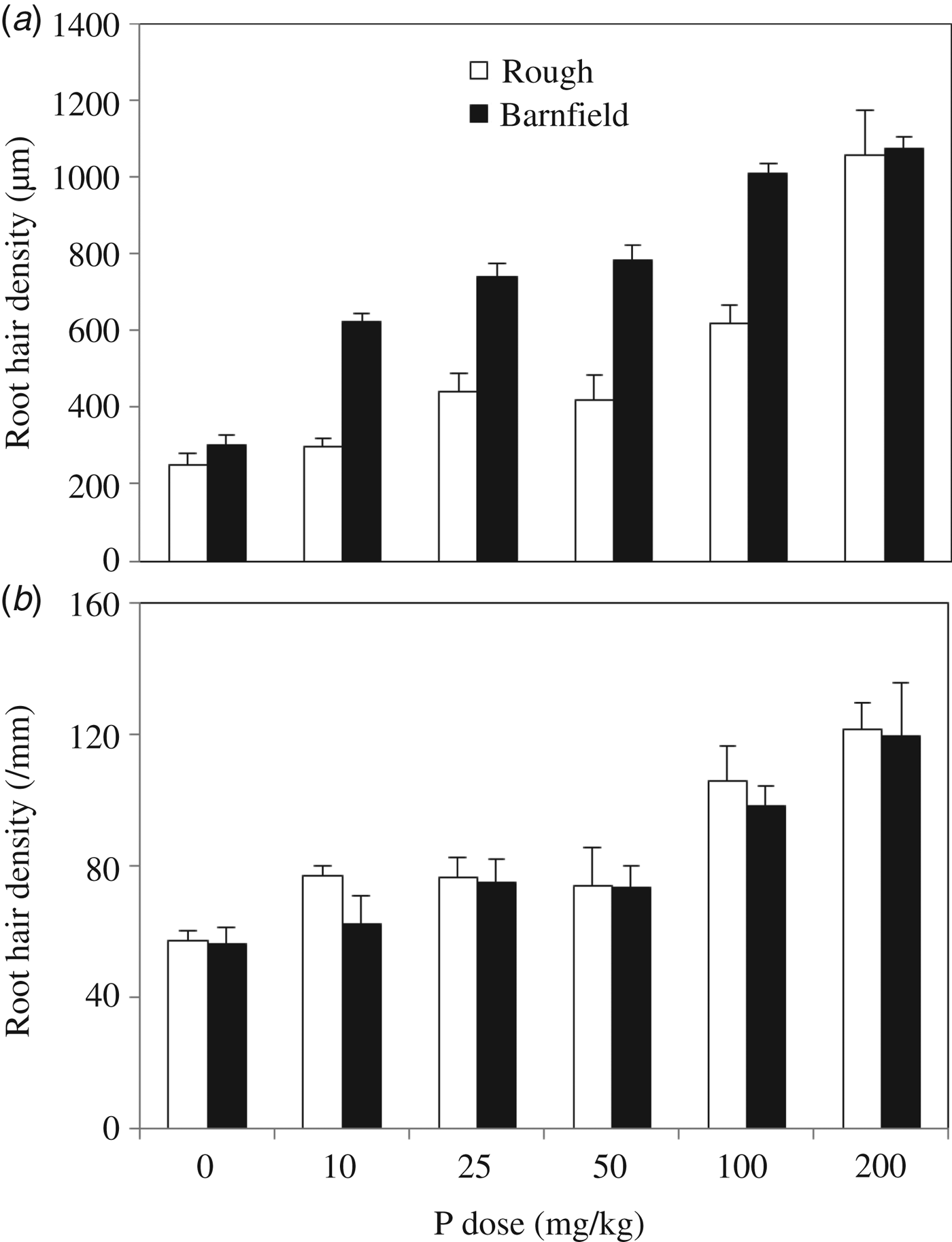
Root-length density generally decreased with increasing P additions, ranging from 2480 cm/cm3 (10 mg P/kg) to 1130 cm/cm3 (50 mg P/kg) in the Rough soil and from 1716 cm/cm3 (0 mg P/kg) to 865 cm/cm3 (25 mg P/kg) in the Barnfield soil. In the P treatments where no P or a small amount of P was added (0 and 10 mg P/kg), RLDs were significantly (P < 0·05) greater than in the larger P treatments (50, 100 and 200 mg P/kg) for both soils. Root-length density in the Rough soil was significantly (P < 0·05) greater than in the Barnfield soil in the 10 and 25 mg/kg treatments (Fig. 1). Root-hair length significantly (P < 0·05) increased in both soils (250–1054 µm for the Rough soil and 303–1075 µm for the Barnfield soil) as P additions increased. In the 200 mg P/kg treatments, RHL was 3 (Rough soil) and 2·5 (Barnfield soil) times longer than those in the respective 0 mg P/kg treatments. In the Barnfield soil, RHL was significantly (P < 0·05) greater (mean 77%) than in corresponding treatments of the Rough soil except for the 0 and 200 mg P/kg treatments (Fig. 2a). Root-hair density was also significantly (P < 0·05) increased by increasing P treatments in a similar way in both soils, ranging from 57 to 122/mm in the Rough soil and from 56 to 120/mm in the Barnfield soil. Overall, there was no significant difference in RHD between the Rough and Barnfield soils in corresponding treatments (Fig. 2b).
Root-length density of wheat in two soils (the Rough and Barnfield) under different phosphorus doses after 3 weeks’ growth. Data are mean + standard error of three replicates.
Root-hair length (a) and root-hair density (b) of wheat in two soils (the Rough and Barnfield) under different phosphorus doses after 3 weeks’ growth. Data are mean + standard error of three replicates.
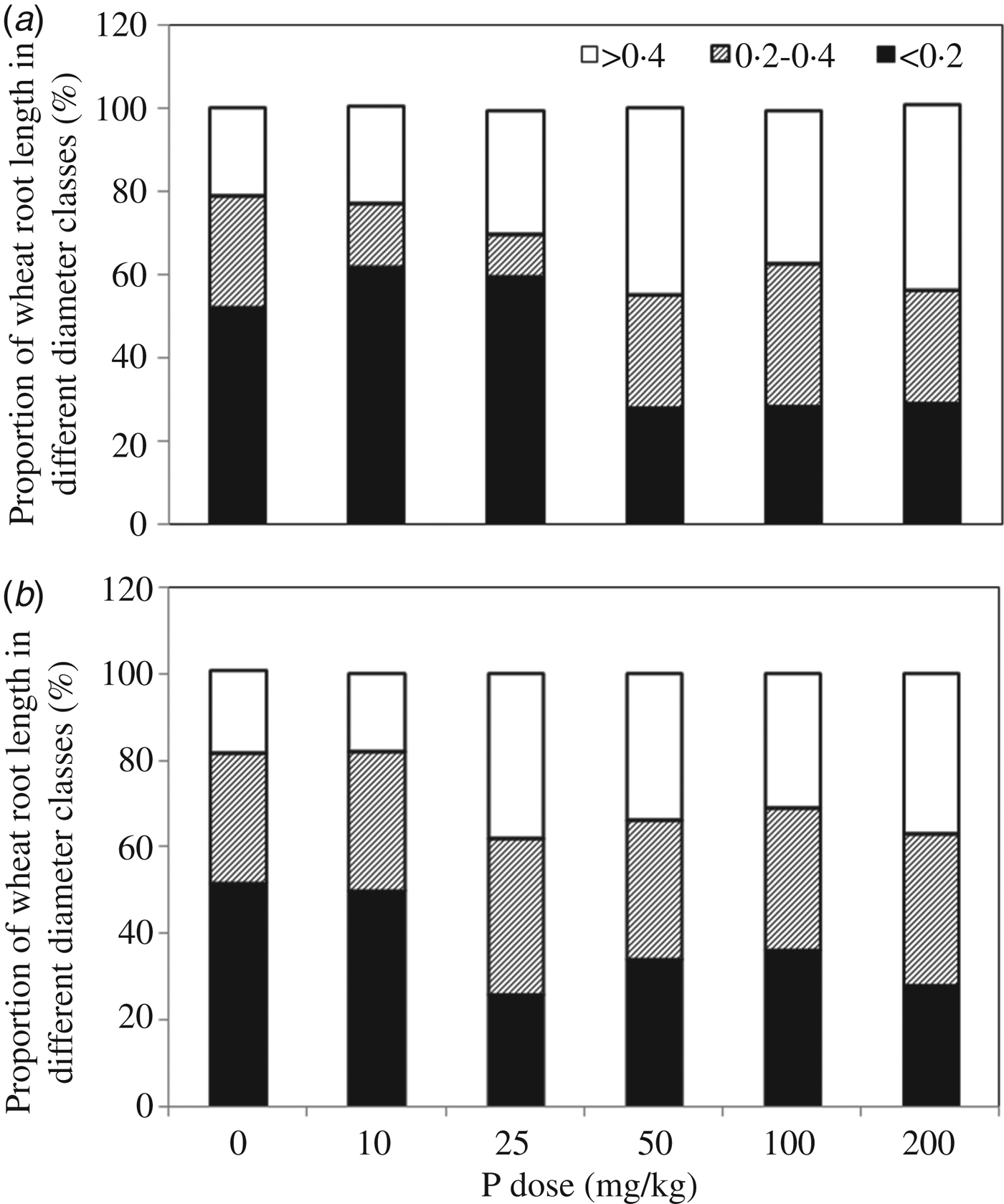
In the P treatments where no P or only a small amount of P was added (0 and 10 mg P/kg), there were significantly (P < 0·05) greater quantities of fine roots than in the higher P treatments (50, 100 and 200 mg P/kg) for both soils. The proportion of root length with a diameter <0·2 mm in the low P treatments was 100% greater in the Rough soil and 37% greater in the Barnfield soil than that in the high P treatments. In contrast, the proportion of root length in the diameter class >0·4 mm was lower in the low P treatments compared with the high P treatments (Fig. 3).
Proportion of wheat root length in different diameter classes in two soils (the Rough (a) and Barnfield (b)) under different phosphorus doses after 3 weeks’ growth.
A stepwise regression procedure relating shoot P uptake to root characteristics primarily identified RHD and RHL as explaining 0·85 of the variance accounted for (R 2). However, the regression produced a negative coefficient for RHL despite the positive relationship between this parameter and P uptake. It is a commonly occurring artefact where there is co-linearity or correlation between explanatory variables that leads to unstable estimates of regression coefficients where data vectors are not orthogonal. The problem can be overcome using a combination of principal component regression and ridge regression (Hoerl & Kennard Reference Hoerl and Kennard1970; Rook & Dhanoa Reference Rook and Dhanoa1992). Briefly, ridge regression assists in variable selection by exploring the ridge trace of a model and deselecting variables if they are unstable and have limited predictive power, or are stable but very small. Coefficients calculated from the original regression model are expressed in terms of principal components. Co-linearity associated with components with small latent roots is removed by excluding them from a re-run of the regression model. The coefficients resulting from the reduced model are transformed back to the original scale. Using the Ridge procedure in Genstat, the data were analysed to give the following regression equation:
 $$P\;{\rm uptake} = -1 {\cdot} 4238 + 0 {\cdot} 0163\;{\rm RHD} + 0 {\cdot} 0006\;{\rm RHL}$$
There is some bias to the estimates of coefficients produced in this way, since some information is excluded which can lead to a reduction the variance accounted for. In this case, R 2 was slightly reduced to 0·83.
Plant growth and phosphorus uptake
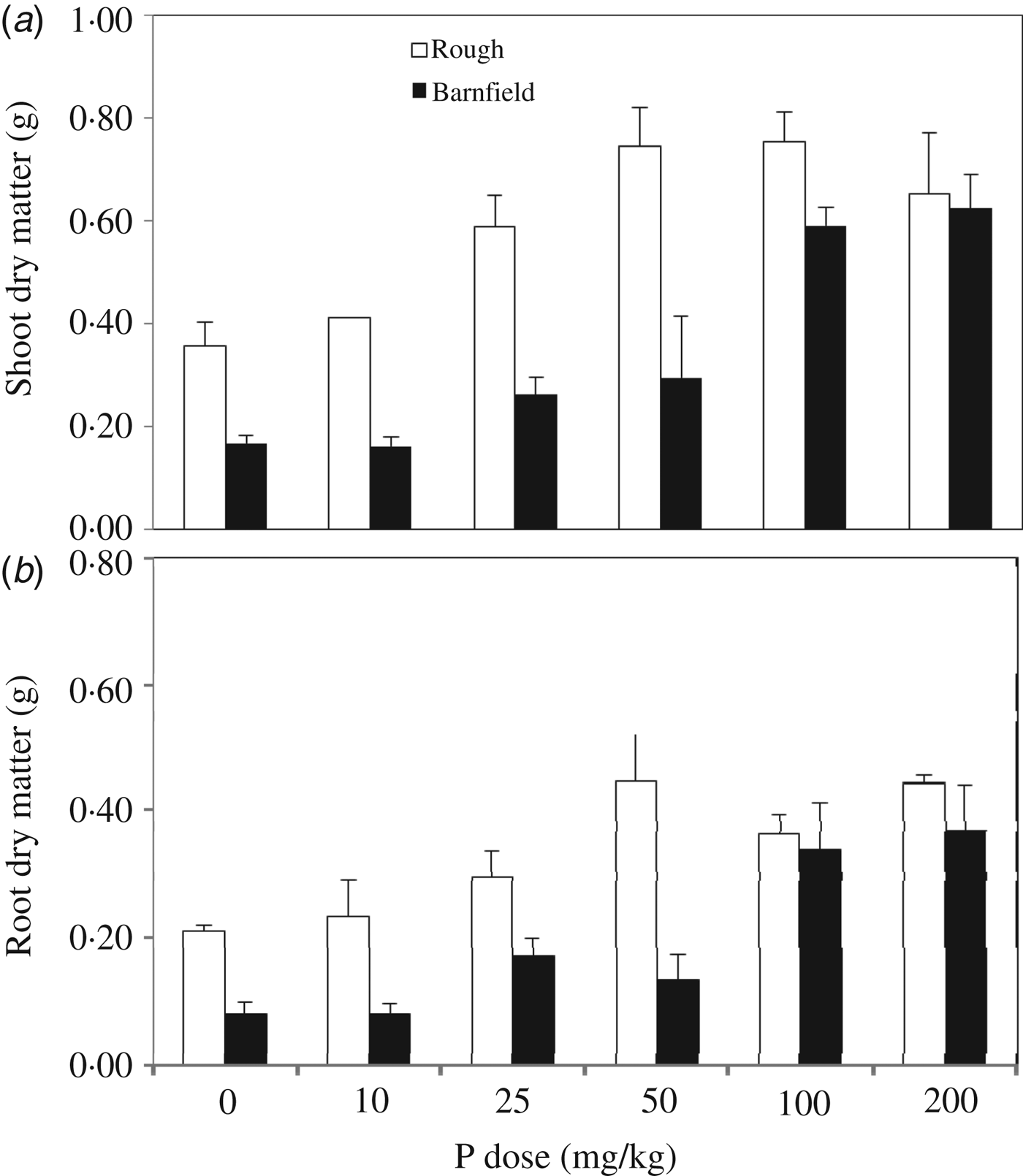
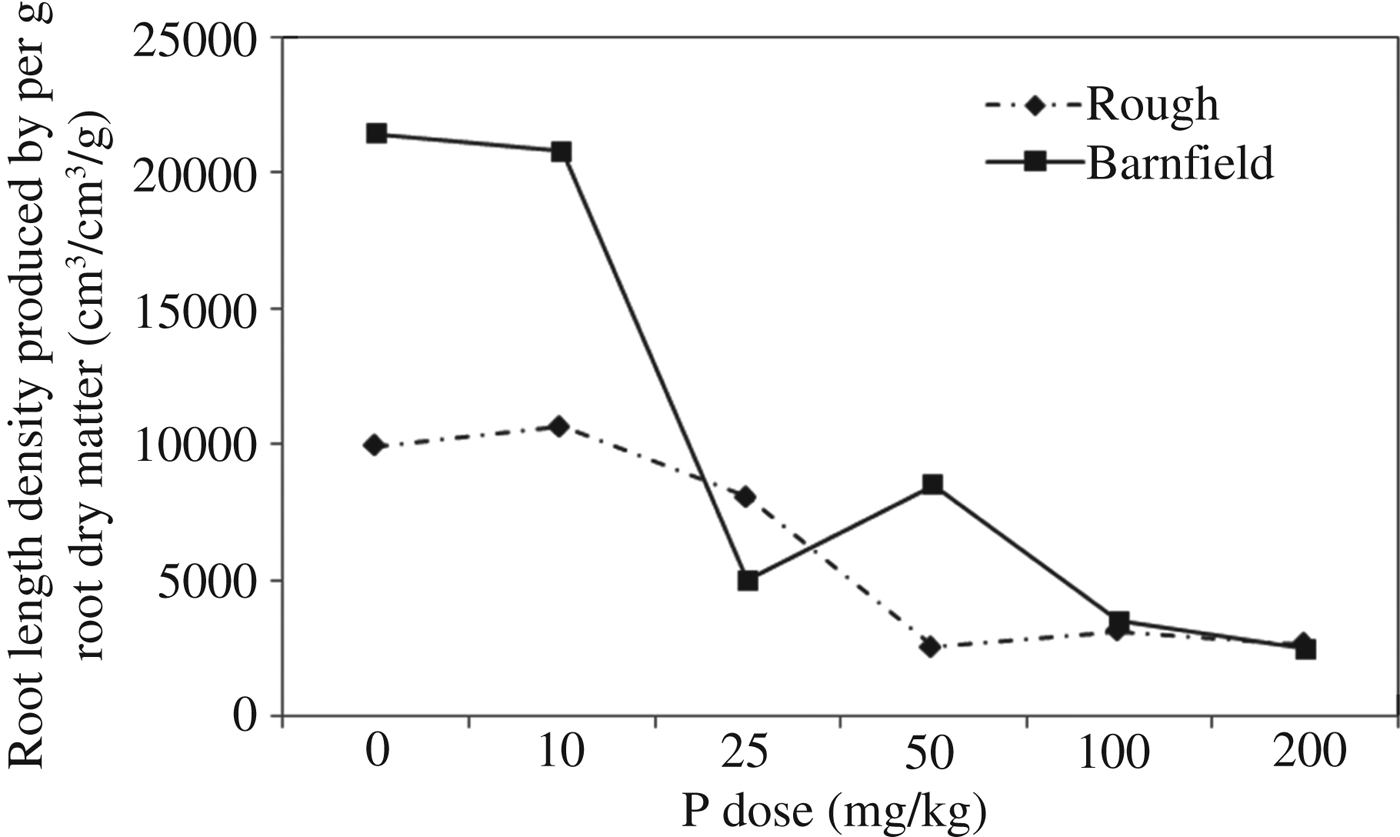
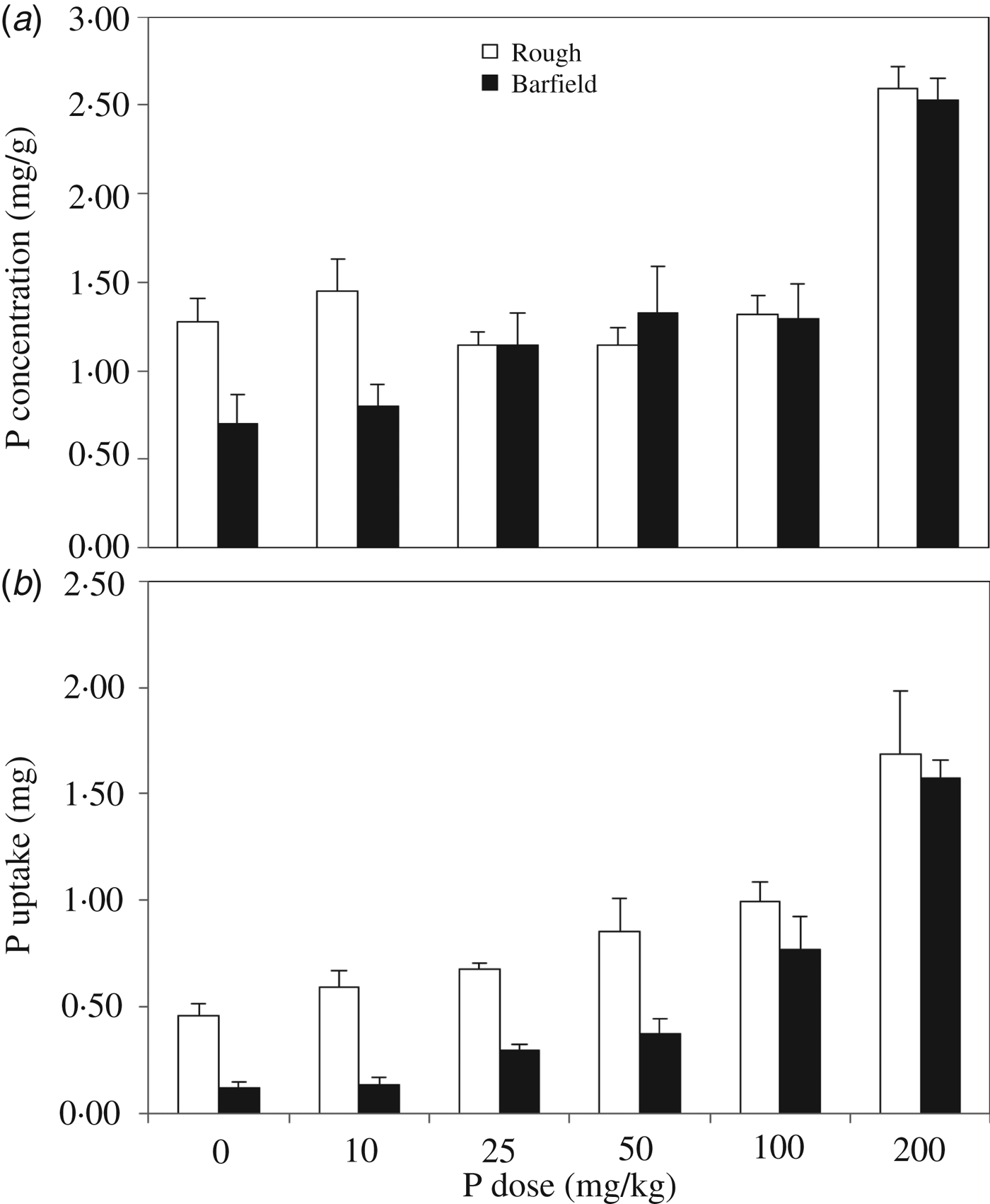
Shoot dry matter and root dry matter per rhizotron increased with P supply in the low P treatments, but did not significantly increase further when P doses were greater than 50 mg P/kg (for the Rough soil) or 100 mg P/kg (for the Barnfield soil) (Fig. 4). Figure 5 shows that RLD per gram root dry matter was greater in the low P treatments than in the high P treatments. It indicates that the wheat produced more roots with low C content in the low P treatments than in the high P treatments. Phosphorus addition significantly (P < 0·05) increased P uptake and P concentration in the wheat in both soil treatments (Fig. 6). Between the 0 to 200 mg P/kg doses, P uptake increased 3·7-fold in the Rough soil, and 13-fold in the Barnfield soil. Shoot P concentration increased 2-fold in the Rough soil and 3·6-fold in the Barnfield soil. Mean shoot and root dry matter and P uptake in the Rough soil treatments were greater than those in the Barnfield soil at all P treatment levels.
Shoot dry matter (a) and root dry matter (b) of wheat in two soils (the Rough and Barnfield) under different phosphorus doses after 3 weeks’ growth. Data are mean + standard error of three replicates.
Root-length density produced by per gram root dry matter in each rhizotron of wheat in two soils (the Rough and Barnfield) under different phosphorus doses after 3 weeks’ growth.
Shoot phosphorus (P) concentration (calculated as the product of shoot P uptake and shoot dry matter) (a) and P uptake (b) in each rhizotron of wheat in two soils (the Rough and Barnfield) under different P doses after 3 weeks’ growth. Data are mean + standard error of three replicates.
A statistically significant (P < 0·05) response of dry matter to P dose was observed in the Rough soil. To estimate the P addition required for optimal dry matter production (critical P = 0·90 maximum yield), dry matter was plotted against P addition. Regression analysis revealed that the response of dry matter to P dose significantly (P < 0·05) fitted an asymptotic regression equation in the Rough soil. The regression equations showed that the critical P value for 0·90 maximum yield was achieved by addition of 42·3 mg P/kg (giving initial Olsen-P values of 14·0 mg/kg) in the Rough soil. There was no clear asymptote for the Barnfield soil, meaning the critical P value could not be determined.
Soil Olsen-phosphorus and total phosphorus
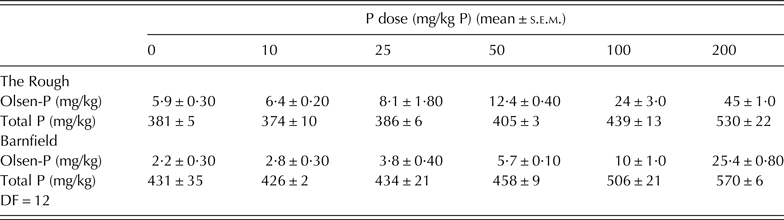
Olsen P increased with P addition in both soils, but changes in total P generally were not detected unless P additions were > 50 mg P/kg (Table 2). Olsen-P concentrations in the Rough soil treatments were significantly (P < 0·05) higher than those in Barnfield soil treatments in all corresponding P treatments. In the Rough soil, Olsen-P values generally equated to approximately 0·20 of the quantity of added P, while Olsen-P concentrations equated to about 0·09 of the added P in the Barnfield soil treatments, suggesting that the Barnfield soil adsorbs P more strongly than the Rough soil. However, total P concentrations in the Rough soils in all treatments were significantly (P < 0·05) less than those in corresponding treatments of the Barnfield soil (Table 2). After plant growth, Olsen-P decreased by 0·0–3·2 mg/kg (0·2–20·3%) in the Rough soil and 0·2–1·1 mg/kg (4·2–24·1%) in the Barnfield soil.
Soil Olsen-P and total P under different P doses after 3 weeks growth. Data are means of three biological replicates
P, phosphorus.
DISCUSSION
Effect of phosphorus supply on plant growth
As hypothesized, the morphological traits of wheat roots varied depending upon the quantity of P fertilizer added to the soils and the consequent differences in P availability in the two contrasting soils. Total dry matter results suggest that the optimal P addition rate is 50 mg P/kg for the Rough soil, and 100 mg P/kg for the Barnfield soil, with corresponding Olsen-P values of 12·4 and 10·1 mg/kg, respectively. Teng et al. (Reference Teng, Deng, Chen, Xu, Chen, Lv, Zhao, Zhao, He, Li, Tong, Zhang and Li2013) reported similar results for wheat (T. aestivum L.), with yield and P uptake increasing with P-fertilizer addition rates up to 100 mg P/kg, above which no significant increase occurred. Additionally, Poulton et al. (Reference Poulton, Johnston and White2013) and Teng et al. (Reference Teng, Deng, Chen, Xu, Chen, Lv, Zhao, Zhao, He, Li, Tong, Zhang and Li2013) suggested maintaining soil Olsen P at 20 mg/kg for optimal yield. The critical value of soil Olsen P is that below which crop yield responses to P application should be expected and above which crop yield responses to additional P are small (Mallarino & Blackmer Reference Mallarino and Blackmer1992). Critical values vary due to differences in soil properties (Johnston et al. Reference Johnston, Poulton and White2013). The Barnfield soil had lower organic C and higher clay content than the Rough soil (Table 1), which resulted in higher adsorption strength and capacity in the Barnfield soil, leading to lower Olsen-P than in the Rough soil at the same rates of P addition. Poulton et al. (Reference Poulton, Johnston and White2013) and Johnston et al. (Reference Johnston, Poulton and White2013) reported that the critical Olsen P for optimum yield of winter wheat grown on a well-structured silty clay loam soil and heavier-textured soils was different because these different properties affect P adsorption, rate of diffusion of adsorbed P into the soil solution, mineralization rates and microbial communities. However, when shoot P concentration and P uptake are considered rather than just biomass (Fig. 6), the optimal or ‘critical’ Olsen-P concentrations are higher for both soils. A significant increase occurs between treatments with 100 and 200 mg P/kg. This therefore suggests that the critical P value when considering P uptake rather than just biomass production after 3 weeks growth is >23·9 mg P/kg but <45·4 mg P/kg for the Rough soil and >10·1 mg P/kg but <25·4 mg P/kg for the Barnfield soil (Table 2).
Response of root traits to phosphorus supply
Contrary to some previous studies, RHD and RHL in treatments with low P supply was less than in treatments with greater P supply, but the RLD was greater under limited P supply conditions, as might be expected. Most studies demonstrate more root hairs are produced with declines in P availability below the critical P concentration (Brown et al. Reference Brown, George, Thompson, Wright, Lyon, Depuy, Hubbard and White2012, Reference Brown, George, Barrett, Hubbard and White2013a; Haling et al. Reference Haling, Brown, Bengough, Young, Hallett, White and George2013), highlighted in a recent review by Brown et al. (Reference Brown, George, Dupuy and White2013b). Genetic variation in root hairs has been found in many plant species, including wheat (T. aestivum L.), barley (H. vulgare L.), clover (T. repens L.), bean (P. vulgaris L.), turfgrass (Poa pratensis L.) and soybean (Glycine max) (Caradus Reference Caradus1979; Green et al. Reference Green, Beard and Oprisko1991; Yan et al. Reference Yan, Lynch and Beebe1995; Gahoonia & Nielsen Reference Gahoonia and Nielsen1998; Wang et al. Reference Wang, Liao, Yan, Zhuang and Dong2004). Root hairs have been shown to respond plastically to low P conditions whereby root hairs become longer under low P conditions (Föhse & Jungk Reference Föhse and Jungk1983; Bates & Lynch Reference Bates and Lynch1996; Gahoonia et al. Reference Gahoonia, Nielsen and Lyshede1999), but for some species this effect has not been observed (Dechassa et al. Reference Dechassa, Schenk, Claassen and Steingrobe2003; Pypers Reference Pypers2006). Different plant species employ different strategies to respond to P-deficiency, such as root exudation of organic acids and acid phosphatases, so the root hairs of some species do not become longer under low P conditions. It thus appears that plasticity for root hairs is not a universal trait but rather species- and genotype-specific. Vandamme et al. (Reference Vandamme, Renkens, Pypers, Smolders, Vanlauwe and Merckx2013) reported that RHL was not affected by the level of P availability except for one genotype, and P treatment had no significant effect on RHL in barley (H. vulgare L.) mutants, although P-deficiency did cause an increase in RHL in the wild type (Brown et al. Reference Brown, George, Barrett, Hubbard and White2013a). It suggests that species with root hairs that are not responsive to P must rely on other traits, such as root exudation of organic acids, acid phosphatase and mycorrhizal fungal associations to respond to P-deficiency.
Wheat plants develop more roots under limited P supply conditions as observed in the present study, but it is possible that in the current case the plants were so stressed that at limited levels of P availability the ability of the plant to produce functioning cell membranes was affected and the expected initiation of root hairs and their elongation was compromised. Only as increasing amounts of P were supplied as fertilizer did greater membrane integrity allow root hairs to increase in response to P-stress. This is partially supported by the extremely small shoot P concentrations observed in the stressed plants, which are much smaller than those seen in equivalent studies on other cereal species such as barley (H. vulgare L., Brown et al. Reference Brown, George, Thompson, Wright, Lyon, Depuy, Hubbard and White2012). These levels are approaching the physiological minimum levels of P required by plants to survive, as discussed by Veneklaas et al. (Reference Veneklaas, Lambers, Bragg, Finnegan, Lovelock, Plaxton, Price, Scheible, Shane, White and Raven2012). Only at additions of 200 mg P/kg did plants achieve P concentrations suggestive of potential P sufficiency. Increasing P availability from the current point may have demonstrated the expected decline in root hair with increasing P availability. In the present study, even at the higher Olsen-P concentration from additions of 200 mg P/kg, plants still needed to grow more root hairs to capture more soil P due to the low rate of diffusion in these two soils, suggesting a potential difference in critical P supply level between shoot dry biomass response and root morphological changes in terms of root hair and root length. Haling et al. (Reference Haling, Brown, Bengough, Valentine, White, Young and George2014) reported that root-hair development depends on soil porosity and strength, and in high-strength soil, RHL was shorter than that in low-strength soil. The different root-hair response compared with other studies is possibly due to differences in the bulk density (0·69 g/cm3 in the rhizotrons) and strength of the two soils used in the current experiment. The results from the present study also indicated that the morphological changes in root length and root hairs were highly regulated by the integrated effects of plant P status and soil P availability as affected by soil physical, chemical and biological traits (Shen et al. Reference Shen, Yuan, Zhang, Li, Bai, Chen, Zhang and Zhang2011, Reference Shen, Li, Mi, Li, Yuan, Jiang and Zhang2013). Moreover, a complex trade off or complementary effects could exist between root-length and root-hair development to enhance P acquisition efficiently from varied soil environmental conditions (Marschner Reference Marschner1995). The current observations are limited to a single genotype and the response could vary greatly between genotypes as has been observed in responses of RHD and RHL to P deficiency in wheat (T. aestivum L.) and barley (H. vulgare L., Delhaize et al. Reference Delhaize, James and Ryan2012; George et al. Reference George, Brown, Ramsay, White, Newton, Bengough, Russell and Thomas2014).
Phosphorus uptake increased significantly with RHD. The largest and smallest P uptake was observed, for both soils, with the highest and lowest RHDs, respectively. The stepwise regression procedure suggests that P uptake was most strongly related to RHD and RHL, being consistent with previous studies (Vandamme et al. Reference Vandamme, Renkens, Pypers, Smolders, Vanlauwe and Merckx2013). Vandamme et al. (Reference Vandamme, Renkens, Pypers, Smolders, Vanlauwe and Merckx2013) showed that P uptake efficiencies were to a large extent related to soybean (G. max) root-hair development (length and density), while Brown et al. (Reference Brown, George, Barrett, Hubbard and White2013a) demonstrated that barley (H. vulgare L.) relied on root hairs as a response to P-deficiency in favour of other mechanisms such as relationships with mycorrhizal fungi. In other studies, Gahoonia & Nielsen (Reference Gahoonia and Nielsen1998) provided direct evidence for the participation of root hairs in P uptake by barley (H. vulgare L.). Interestingly, Hill et al. (Reference Hill, Simpson, Moore and Chapman2006) compared the root morphological parameters of various pasture species grown in pots fertilized with six P addition rates and found that root adaptations were triggered at or near the critical soil P supply for 0·90 of maximum shoot mass, as was observed in the present study with the Rough soil.
The importance of root hairs cannot be considered in isolation. Other root characteristics such as RLD will also have an important role to play in determining the ability of a plant to acquire P. Many authors including Ryser & Lambers (Reference Ryser and Lambers1995) report that greater RLD is important for acquiring nutrients when availability is limited. In the current experiment, it was observed that variation in RLD associated with the experimental treatments, with plants under P-deficient conditions having longer thinner root systems than treatments with greater available P. The different textures of the Rough and Barnfield soils may also have influenced root growth and development, and thus acquisition of available soil P. Further research is required to determine the relationship between the texture of the Rough and Barnfield soils and the root traits.
Data presented in the present study suggest that wheat does not completely overcome extreme P-deficiency by producing longer and denser root hairs; this seems to occur only when plants are suffering from mild P-deficiency and approaching critical P. Instead, longer, thinner root systems were observed, which may be a foraging response to P-deficiency (Steingrobe Reference Steingrobe2001). It suggests that agronomic solutions to P-deficiency, such as addition of Pi fertilizers are also extremely important and that dependency only on plant responses to extreme P deficiency are not sufficient for optimum plant growth in some cases. However, breeding crop plants to produce fine lateral roots with longer and denser root hairs in response to extreme P-deficiency may be beneficial and should be a focus of future research. Moreover, in low-input agricultural systems where mild and chronic nutrient deficiency is more likely to occur, targeting improvement in RHD and RHL will be important with regard to increasing productivity in P deficient soils, thus contributing towards agricultural sustainability with regard to P.
CONCLUSIONS
In conclusion, it was observed that wheat develops a greater RLD when P supplies are limited, and greater RHD and RHL at relatively high P supplies. The increased RLDs in response to P supplies were inhibited at the critical soil P supply of 50 mg P/kg for the Rough soil, and at 25 mg P/kg for the Barnfield soil. Data presented here are contrary to the studies on root hairs found in the literature in that they demonstrate an increase in RHD and RHL with increasing P supply. However, unlike many studies that have compared mildly P deficient plants with plants that have sufficient or luxuriant P supply, it was presented that a comparison between extremely P-deficient plants with mildly P deficient conditions in the given soils. Improvement in lateral root and root-hair responses in wheat at extreme P-deficiency may be a worthy target for breeding more sustainable genotypes for future agroecosystems.
The authors are grateful to the financial support of Beijing Higher Education Young Elite Teacher Project (grant no. YETP0313), Chinese Universities Scientific Fund (grant no. 2014JD073), National Natural Science Foundation of China (grant nos 41173083, 41473068, 31330070, 31121062) and the Programme of the Ministry of Agriculture of China (948 Program) (grant no. 2011-G18). Rothamsted Research receives funding from the Biotechnology and Biological Sciences Research Council (BBSRC), UK. Thanks to Liz Dixon, Enrique Cancer Beroya and Denise Headon for assistance with laboratory analyses.