Introduction
The Midland Valley of Scotland is a SW–NE striking Devonian–Carboniferous sedimentary basin bounded to the NW and SE by the Highland Boundary and Southern Uplands Fault systems, respectively. Recent research has demonstrated that the basin's syn-tectonic and post-depositional (Variscan) deformation is consistent with a dextral transtensional origin (Underhill et al., Reference Underhill, Monaghan and Browne2008). That the Weaklaw Vent on the East Lothian coast (c. 24 km ENE of Edinburgh) lies close to the extrapolated Southern Upland Fault (or its closely related Crossgatehall Fault) is considered not to be fortuitous. The vent has remarkable features concerning its volcanology, mineralogy and geochemistry. It was the focus of extensive low-temperature, carbo-hydrothermal metasomatism that, among complex compositional changes to the whole-rock compositions, was the introduction of a wide range of incompatible elements.
The major faults affecting the Firth of Forth in SE Scotland are shown in Fig. 1. The Southern Upland Fault, commonly taken to define the southern boundary of the Midland Valley Terrane, separates the lower Palaeozoic (Ordovician) of the Southern Uplands Terrane from the Upper Palaeozoic (Devonian/Carboniferous) terrane of the Midland Valley across most of southern Scotland (Floyd, Reference Floyd1994). However, the Southern Upland Fault is untraceable towards the ENE beyond a point ~20 km south of Edinburgh where it either terminates or has an en echelon replacement by the Lammermuir and Dunbar–Gifford Faults (Fig. 1). The latter is regarded as a shallow and relatively insignificant feature at depth, as may also be the Dunbar–Gifford Fault (Max Reference Max1976). It is suggested that the Southern Upland Fault persists north-eastwards beneath the younger Carboniferous of the Midlothian coal-field and that it, or one of its splays, controlled the coastal trend between Port Seton and Eyebroughy (Fig. 1). To its south-east the Midland Valley Terrane may be overthrust by the Lower Palaeozoic rocks of the Southern Uplands (Bluck Reference Bluck1983; Hall et al., Reference Hall, Brewer, Mathews and Warner1984), a hypothesis supported by the occurrence of Ordovician high-grade metamorphic xenoliths a few kilometres to the east (Badenszki et al., Reference Badenszki, Daly, Whitehouse, Kronz, Upton and Horstwood2019).
General map showing major faults in SE Scotland. The horizontal dash ornamentation (after Max, Reference Max1976) marks the aeromagnetic lineament that may coincide with a seaward extension of the Southern Upland Fault. The red square denotes the field area in Fig. 2. WF – Weaklaw Fault.

A sketch map of Weaklaw. The ornament for the Weaklaw Vent diagrammatically indicates the concentration of cored bombs and their decrease eastwards towards their unconformable contact with the Garleton Hills Volcanic Formation.

The north-eastern extrapolation of the Southern Upland Fault, that forms the generally accepted geological southern margin of the Midland Valley, is postulated to pass off-shore between Port Seton and Eyebroughy (Fig. 1), (cf. Floyd Reference Floyd1994; McKerrow and Elders, Reference Mckerrow and Elders1989; Max, Reference Max1976), whilst a fault occupying the same position is referred to as the Firth of Forth fault by Bluck (Reference Bluck and Trewin2002). A further argument favouring the ENE persistence of the Southern Upland Fault (or a related fault) concerns the extension of a magnetic lineament (characteristic of zones in the Southern Uplands Terrane) that passes close to this coastline. In brief, the crust between the Lammermuir Fault and the hypothesised Southern Upland Fault extension may not be regarded as part of the Midland Valley Terrane but rather as an anomalous sector of the Southern Uplands Terrane (Max, Reference Max1976). Strike-slip activity on the boundary fault systems of the Midland Valley resulted in the creation of several NNE–SSW striking folds and several intra-basinal wrench faults including the Ardross, Pentland and Southern Upland Faults. Sub-surface data demonstrate that the fault extension passes to the west of this coast before tipping out to the north-east (Ritchie et al., Reference Ritchie, Johnson, Browne and Monaghan2003; Underhill et al., Reference Underhill, Monaghan and Browne2008). We suggest that it passes west of the Weaklaw Vent by less than 500 m and that late Carboniferous movement along it may have triggered the volcanism.
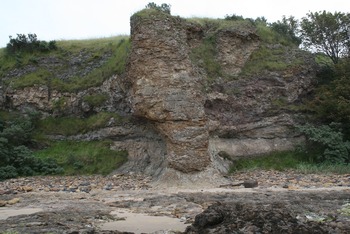
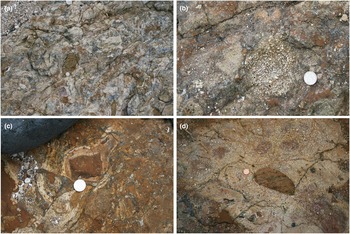
The Weaklaw Vent, situated close to the islands of Fidra and Eyebroughy, was a part of the extensive Carboniferous–Permian magmatic activity in Scotland (Kirstein et al., Reference Kirstein, Davies and Heeremans2006). Its most obvious manifestation is as two vertical buttresses, ~45 m apart and each ~5 m broad, that stand out from the sea-cliffs (Figs 2 and 3). Known locally as the Hanging Rocks, they are composed of pyroclastic materials. The lava bombs and spatter seen in the Hanging Rocks are most easily examined in the wave-cut platform exposures beneath them, where they are composed dominantly of variably amygdaloidal, globular lava agglutinates and bombs. All have been altered comprehensively to assemblages dominant in carbonates and clays. The lavas are commonly rich in spherical/sub-spherical dolomite amygdales, so abundant in some that they appear to have erupted virtually as a froth. The low-temperature alteration of the lavas is such that the original petrography is comprehensively obscured (Figs 4a and 4b).
View of one of the Hanging Rocks, a rocky prominence standing out from the vegetated sea-cliffs. The Hanging Rocks are composed of agglutinated lava spatter and composite bombs also exposed on the fore-shore. The country rocks are Visean Garleton Hills Volcanic Formation.

Examples in the wave-cut platform below Hanging Rocks. (a) ‘White trap’ agglutinate, inferred to be former basaltic spatter, metasomatised to a carbonate-/ clay-rich assemblage. (b) A volcanic bomb of ‘white trap’ (metasomatised basanite) containing a high concentration of near-spherical dolomite-filled amygdales. (c) An angular metasomatised peridotite xenolith surrounded by altered lava. (d) A metasomatised peridotite xenolith, surrounded by altered basaltic ‘white trap’, containing dark green schlieren interpreted as mineralised shear zones containing chrome-rich clays. Several smaller peridotitic fragments, generally enclosed by ‘white trap’ (i.e. ‘cored bombs’) can be discerned. Width of coin (a–c) = 24.5 mm; (d) = 25.9 mm.

Contrasting lithologies, generally darker coloured and typically surrounded by the lava were clearly xenoliths. These are abundant in the Hanging Rocks and the wave-cut platforms beneath them. The xenoliths (recognised as altered peridotites by Duncan, Reference Duncan1972), typically enveloped in ovoid lava coatings, will be referred to as cored bombs. Many of the xenoliths are angular (Fig. 4c) and almost invariably exhibit a planar foliation shown by green schlieren (Fig. 4d). Although the silicates are wholly pseudomorphed, a ‘ghost petrography’ is just discernible though the alteration products. This, together with comparison of relic spinels in the Weaklaw samples (discussed below) with those of fresh peridotites from the Late Carboniferous (possibly Permian?) basanite intrusions in the surrounding area of East Lothian and on Fife (the land lying north of the Firth of Forth, Fig. 1) leaves little room for doubt that Weaklaw, before alteration, had been the site of an eruptive basanite closely comparable petrologically to these others.
The volcanology, indicated by the Weaklaw site was, however, distinct. The Hanging Rocks present unstable cliffs (Fig. 3), the foreshore outcrops are ephemeral subject to the changing cover by sand and seaweed, and inland exposures are non-existent. Whilst these problems obviate any detailed study of the anatomy of the Weaklaw volcano the observations allow the following comments. A contact between the Weaklaw deposits and the welded Marine Villa ignimbrites (Visean of the Garleton Hills Volcanic Formation) is indicated diagrammatically on Fig. 2. This contact is interpreted as an unconformity between two very contrasting sequences of pyroclastic rocks. Those to the west are unwelded, well-stratified tuffs with a large percentage of sedimentary clasts together with juvenile mafic clasts. These, probably disturbed by post-consolidation mass-flow, appear to grade westwards into tuffs in which ultramafic clasts increasingly appear on approach towards the Hanging Rocks. We suggest that these belong to a phreatomagmatic cone denoting an early stage of the Weaklaw eruptions before it entered its more productive terminal phase.
The unusual abundance of the mantle xenoliths in and around the Hanging Rocks, coupled with their large sizes (up to 40 cm), testifies to high-energy eruption. The cored bombs and the spatter are evidence of sub-aerial eruption from one of more conduits in the immediate vicinity. We envisage the Hanging Rocks as possibly representing a pair of vertical-sided eruptive conduits that cut the sub-horizontal strata of the early Carboniferous Garleton Hills Volcanic Formation (Figs 2 and 3). They do not persist seawards and appear to have abrupt northern terminations. If they were conduits cessation of eruption may have been attended by magma withdrawal permitting them to become choked with partially molten material. To have entrained such large (and abundant) mantle samples the magma clearly attained surface level at high velocities, presumably erupting as lava fountains. However, this paper is restricted to describing some of Weaklaw's remarkable mineralogical and geochemical features and must leave any more sophisticated interpretation of the volcano to others.
Analytical methods
Major-element compositions were determined using an X-ray fluorescence spectrometer (XRF) at the School of GeoSciences, University of Edinburgh. Samples were fused with a lithium metaborate-lithium carbonate flux containing La2O3 as a heavy absorber (Johnson Mathey, Spectroflux 105), using a method similar to that developed by Norrish and Hutton (Reference Norrish and Hutton1969). Sample powder was dried at 110°C overnight, and a nominal, but precisely weighed, 1 g aliquot was ignited at 1100°C to determine loss on ignition (LOI). The residue was then mixed with flux in a sample:flux ratio of 1:5 based on the unignited sample weight. The mixture was then fused at 1100°C in Pt 5% Au crucibles in a muffle furnace. After initial fusion, the crucible was re-weighed, and any weight loss from the flux was compensated with additional flux to maintain the 1:5 sample flux ratio as closely as possible. After a second fusion and homogenisation over a Meker burner the molten sample flux mixture was cast onto a graphite mould and flattened with an aluminium plunger. During this process, the mould and plunger were kept at 220°C on a hot-plate.
Trace-element concentrations were determined on pressed powder samples. Eight grams of rock powder were mixed thoroughly with eight drops of a 2% solution of polyvinyl alcohol. The mixture was formed into a 40 mm disc backed and surrounded by an aluminium foil cup, by compression between two tungsten carbide discs at a pressure of 1.6 t/cm.s2. The fused discs and pressed powder pellets were analysed on a Philips PW2404 X-ray fluorescence spectrometer with a Rh-anode primary X-ray tube. Corrections for matrix effects on the intensities of the major-element fluorescence lines were made using theoretical alpha coefficients calculated using Philips in-house software. The calculations allowed for the extra flux replacing volatile components in the sample lost during the LOI step, so that analytical totals should be 100% less the LOI. The spectrometer was calibrated using a suite of ten USGS and CRPG standards, the values of which are given in Govindaraju (Reference Govindaraju1994). Calibration lines show that accuracy and precision are closely similar, with an average 1σ value across the 10 elements of 0.03 wt.%.
Corrections for the matrix effects on the intensities of major-element lines were made using theoretical alpha coefficients calculated on-line using in-house Philips software. The coefficient intensities of the longer wavelength trace-element lines (La, Ce, Nd, Cu, Ni, Co, V, Ba and Sc) were corrected for matrix effects using alpha coefficients based on major-element concentrations measured at the same time on the powder samples. Matrix corrections were applied to the intensities of the other trace-element lines by using the count rate from the RhKα1 Compton scatter line as an internal standard (Reynolds, Reference Reynolds1963). Line overlap corrections were applied using synthetic standards. The spectrometer was calibrated using USGS and CRPG standards using the values reported by Jochum et al. (Reference Jochum, Seufert and Thirlwall1990) for Nb and Zr and Govindaraju (Reference Govindaraju1994) for the other elements.
Mineral identification and quantitative phase analysis by X-ray diffraction (XRD) were carried out using a Bruker-AXS Advance 8 powder diffractometer (School of GeoSciences, University of Edinburgh) in Bragg-Brentano (reflection) geometry, equipped with a Cu tube, (wavelength Kα1 = 1.540596 Å), and a NaI detector. Variable slits were used, and the samples were measured in the range 2–65°2θ. Identification of minerals was made using Bruker EVA software and the International Centre for Diffraction data PDF-4 + 2015 diffraction database. Quantitative analysis was determined by the Rietveld method (Rietveld, Reference Rietveld1969) using the program Topas 3.1 (Bruker-AXS).
Complementary work on the clays resulting from hydrothermal alteration was carried out at The James Hutton Institute, Aberdeen. A clay sized fraction of <2 μm was separated from a vent rock sample for XRD analyses by mounting on a glass slide as an oriented specimen to enhance diffraction from the 001 series. The clay was scanned using Cu radiation. Additionally, the pressed powder pellet (as used for XRF analysis) and a sample of the dyke were McCrone milled and spray-dried to produce random powder specimens, which were quantified by a full-pattern fitting method (Omatoso et al., Reference Omatoso, Mccarty, Hillier and Kleeberg2006).
Electron-microprobe analysis of spinel was undertaken using a CAMECA SX5FE at the Department of Lithospheric Research, University of Vienna. Analyses was conducted under ‘standard’ conditions: acceleration voltage 15 kV; sample current 15 nA; counting times 10 or 20s; natural silicates and synthetic oxides as standards; and the PAP correction procedure (Pouchou and Pichoir, Reference Pouchou, Pichoir, Heinrich and Newbury1991) applied to all acquired data. Counting times were increased to 40 s to improve detection limits for Ni (~500 ppm) and Ca (~300 ppm) in olivine.
Major- and trace-mineral abundances were determined with the QEMSCAN 4300 at the Camborne School of Mines, Exeter University following the methodology of Gottlieb et al. (Reference Gottlieb, Wilkie, Sutherland, Ho-Tun, Suthers, Perera, Jenkins, Spencer, Butcher and Rayner2000) and Pirrie et al. (Reference Pirrie, Butcher, Power, Gottlieb, Miller, Pye and Croft2004). The analyses included 7.7 million energy dispersive X-ray spectra collected in a 10 μm raster across the thin-section surface. The electron back-scattering coefficient and the interaction of the characteristic X-rays were matched to a spectral database (a modified version of the Intellection Pty Ltd, LCUS SIP) for mineral identification. A comparison of neighbouring spectra forms the basis for identification of particle sizes and mineral associations and the result is visualised in a false-colour image.
The Weaklaw Vent
We apply the term ‘Weaklaw Vent’ to the narrow (<200 m) outcrop on the foreshore between low-water and the low sea-cliffs [Ordnance survey grid reference: NT 498 858; lat/long: 56.0624N, 2.8077E]. It was mapped by Day (Reference Day1916; 1923) as composed of a distinctive NE–SW trending strip of volcanic rocks. The Hanging Rocks provide near-vertical sections cutting sub-horizontal pyroclastic and lava units of the Lower Carboniferous Garleton Hills Volcanic Formation (Fig 3), and the foreshore presents a good sub-horizontal section (subject to change according to movement of beach deposits). Some 100 m west of the vent early Visean shales and mudstones crop out: these shallow-water sediments (Fig. 2) have been down-faulted against the Garleton Hills Volcanic Formation although the fault-zone itself is not exposed. According to McAdam and Tulloch (Reference Mcadam and Tulloch1985) the fault extends NNW–SSE but this conflicts with Day (Reference Day1916) and air-photographs. We conclude that the vent was probably emplaced along a NE–SW trending fault, as indicated by Day (Reference Day1916), close to the postulated offshore fault between Port Seton and Eyebroughy. Day (Reference Day1916, Reference Day1923) described the complex strip of vent rocks as comprising an ‘intrusion breccia’, lying along a NE–SW trending fault, traceable seawards for ~500 m and considered that the ‘intrusion’ either post-dated the fault or was synchronous with it. Day (Reference Day1916) also described a thin (<0.5 m) sill, of vesicular degraded basalt visible only at low-tide, connected to the ‘intrusion breccia’ within (the Visean) shale and ironstone, hornfelsing the former. Rather than ‘degraded basalt’ Day (Reference Day1923) uses the term ‘white trap’, a quarrymans’ and miners’ term for hydrothermally altered basalt or dolerite.
According to Francis (Reference Francis1960) the Hanging Rocks are breccias marginal to a neck rather than a basalt intrusion and “that it is difficult, in places, to find a junction between breccia and the neck agglomerate which marginally contains much debris from the surrounding bedded tuffs and agglomerates”. Francis (Reference Francis1960) noted the high content of altered basalt in the Hanging Rocks breccia. Although, in part, the vent does consist of a volcanic breccia, most is an agglutinate composed of ovoid-to-amorphous masses of cream/white, highly altered, lava (Fig. 4a). Many of these masses (up to 1 m across) were volcanic bombs that, together with spatter, accumulated to form what we infer to have been a cone around the paired eruptive vents now composing the Hanging Rocks. The resultant altered basalt is typically rich in near-spherical amygdales (~1–2 mm diameter) representing vesicles filled by dolomite. Some sub-rounded ‘bombs’ are so amygdaloidal (Fig. 4b) as to represent former basaltic pumices or a magma froth.
X-ray diffraction analysis shows the ‘white trap’ to be composed mainly of carbonate (~75% modal), dominantly ankerite with subordinate dolomite and calcite, together with < 6 vol.% ferro-magnesian phases (antigorite, lizardite and phlogopite). Resistant brown material, commonly present interstitial to the ‘white-trap’ is composed essentially of quartz, ankerite/dolomite with some siderite, and subsidiary kaolinite. The vent lacks evidence of having resulted from a phreatomagmatic eruption and is regarded as due to vigorous de-gassing of vapour-saturated magma. Morphologically the ensemble could be taken as surficial eruption products and the present erosional level must be close to the original palaeo-surface.
Mantle xenoliths
A high proportion of the carbonated basaltic bombs contains ultramafic cores ranging up to ~40 cm in diameter (Fig. 4c,d) that were identified initially as highly altered mantle xenoliths from the presence of relic Cr-spinel and petrographic indication that they were formerly olivine-rich (Duncan, Reference Duncan1972). The xenoliths have experienced such pervasive carbonation that all high-temperature silicates (presumed to have been olivine, clinopyroxene and orthopyroxene) have been pseudomorphed, by magnesian carbonates (dolomite and ankerite), clays and quartz. Regardless of the extensive chemical alteration, petrographic textures remain sufficiently intact under plain-polarised light to show an original peridotite fabric. Only relics of spinel remain of what is inferred to have been the original mineralogy (Duncan, Reference Duncan1972). The only other components in the xenoliths were minute crystals of chalcopyrite and rutile. Whilst the former may have survived from the pre-metasomatised rock, the latter is inferred to be a secondary product of the metasomatism.
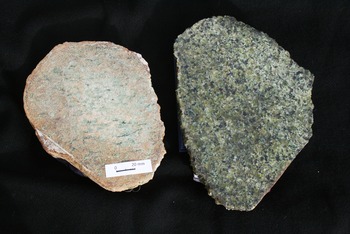
Three common characteristics of the ‘peridotitic’ cores are that they: (1) commonly have coatings of the altered basalt and appear to have been erupted as ‘cored bombs’; (2) had cooled enough to have undergone brittle fracture by the time of their entrainment (Fig. 4c); and (3) typically possess a marked foliation (Fig. 4d), shown by the parallel orientation of pale- to dark-green schlieren or lenticles (up to 20 mm long and ~2 mm thick) in the creamy-white matrices (Fig. 4d). A cut-slice of one of the larger metasomatised xenoliths showing the foliation and colour variation is shown in Fig. 5. For comparison, a slice of fresh spinel lherzolite is also shown to illustrate how the Weaklaw xenoliths may have appeared prior to foliation and recrystallisation.
A cut slice of metasomatised peridotite xenolith from a coastal outcrop at Weaklaw showing a greenish foliation. For comparison a slice of a fresh spinel llerzolite xenolith (from Argentina) is shown to reflect the presumed appearance of the Weaklaw xenolith had it not been metasomatised. Scale bar = 20 mm.

Spinels
The yellow-brown spinels in the Weaklaw xenoliths are corroded and embayed and occur only sparsely (Fig. 6a). Their margins are in places spongy with cavities filled by hydrous Al–Si phase(s) (Fig. 6b), however massive margins also occur. The spinels are aluminous (Cr/(Cr + Al) = 0.08–0.09, Table 1) and their composition is uniform across the grains. It is unchanged in the marginal spongy parts which suggests that the minerals were subjected to dissolution and not to chemical alteration that would have affected the composition of the spongy margins (Fig. 6b). This suggests that the spinels probably preserve their primary mantle composition. Spinel has been reported to show comparable resistance to complete dissolution in the altered peridotites of Crommyonia (Greece) (Mitsis et al., Reference Mitsis, Godelitsas, Göttlicher, Steininger, Gameletsos, Perraki, Abad-Ortega and Stamatakis2018) and also in the ultramafic enclaves at Almaden (Spain) (Morata et al., Reference Morata, Higueras, Dominguez-Bella, Parras, Velasco and Aparicio2001).
Back-scattered electron images. (a) A homogenous chrome-spinel grain showing smoothly embayed margins. The less reflective material is ankeritic carbonate and the least reflective component is clay. Note clay and carbonate (in crudely concentric zonation) pseudomorphing olivines, scale bar = 500 μm). (b) A spinel grain showing the spongy nature of the margins. Spinel is light-grey, darker grey filling of fissures and pores is probably a hydrous Al–Si clay mineral.

Compositions of spinel in xenolith WV 21 with spinel from the (fresh) spinel lherzolites at Brigs of Fidra (Downes et al., Reference Downes, Upton, Handisyde and Thirlwall2001) and Ruddon's Point, Fife (Upton et al., Reference Upton, Downes, Kirstein, Bonadiman, Hill and Ntaflos2011) for comparison.

The spinel composition (Table 1) resembles that of the spinels in fresh peridotite xenoliths from the near-by Brigs of Fidra basanite (Downes et al., Reference Downes, Upton, Handisyde and Thirlwall2001) and those of the basanitic neck at Ruddon's Point, close to the Ardross Fault (Fig. 1.) (Upton et al., Reference Upton, Downes, Kirstein, Bonadiman, Hill and Ntaflos2011). The similarity is sufficient for us to claim that the Weaklaw xenoliths were, prior to metasomatism, comparable to the spinel lherzolites common in basanite intrusions and diatremes elsewhere in East Lothian and in Fife (Fig. 1: Upton et al., Reference Upton, Downes, Kirstein, Bonadiman, Hill and Ntaflos2011).
Clays
Whereas the clay patches within the altered peridotite are typically colourless in plain-polarised light some show, to varying degrees of intensity, a blue–green colouration. Such clays are commonly found adjacent to the corroded spinel margins and have Cr2O3 contents (from SEM analysis) of up to 10 wt.%. The clays and carbonates are intergrown complexly (Fig. 6a). This assemblage is inferred to have resulted from reaction between CO2 and forsteritic olivine and also from reaction with the pyroxenes and partial reaction with the spinel. X-ray diffraction analyses of the green schlieren show them to be a complex fine-grained association of clays, chlorites, carbonates and (opaline) quartz. In a high-magnification image the crystalline form of some of the clays can be seen, with kaolinite and smectite crystals distinguishable (Fig. 7).
A high-magnification image (scale bar = 10 μm) of contrasted clays in the green schlieren from a re-crystallised lherzolite xenolith. The more rectilinear crystals to the left, mainly composed of SiO2, Al2O3 and ~10 wt.% Cr2O3, are identified as kaolinite whereas those with more crinkly forms to the right are smectites with higher contents of MgO and ~30 wt.% Cr2O3.

An attempt to hand-pick the darker green components from crushed schlieren material under water (for improved colour discrimination) for XRF analysis failed as they promptly disaggregated into a green (assumed) colloidal solution. The inference is that the clay component undergoes rapid hydration causing loss of coherence and dissemination into nano-particles. After evaporation of the ‘solution’ the evaporite was analysed by XRF (Table 2). It has ~27 wt.% LOI with a high concentration of Cr (11,360 ppm). Whilst the K2O content is 0.19 wt.%, the concentrations of Rb (44 ppm) and Ba (1105 ppm) are also notably higher than in the whole-rock data by factors of ~5 and 22 times, respectively. Very chrome-rich smectite, volkonskoite, from the Akerman area in Russia, has been described as being associated with colloidal, organic carbon-bearing chromium allophanoids (Gudoshnikov et al., Reference Gudoshnikov, Ignat'ev and Kiselev1968; Foord et al., Reference Foord, Starkey, Taggart Jnr. and Shawe1987), we suggest that a comparable association exists in the Weaklaw chrome-clays.
Compositions (XRF) of the chrome-rich clay concentrates from schlieren in a metasomatised peridotite xenolith.

nd – not detected
No satisfactory analysis by electron micro-probe could be made on account of the material being very fine-grained and polymineralic. However, one species of phyllosilicate, analysed by microprobe gave K2O contents ranging from 2.99 to 4.76 wt.%. Such a large-ion lithophile element (LILE) may be accommodated in Cr-muscovite (fuchsite) although this was not detected by X-ray diffraction. In the three chemical analyses (evaporite, ‘random powder’ as used for XRF, and the <2 μm clay fraction) the values for LILE, although differing widely, range up to 0.78 wt.% K2O, 1488 ppm Rb, 7 ppm Cs, and 1488 ppm Ba, which indicate collectively the significant presence of LILE. Again, relying on the translation from Aleksandrov et al. (Reference Aleksandrov, Ignat'ev and Kobjak1940) in Foord et al. (Reference Foord, Starkey, Taggart Jnr. and Shawe1987), high-Cr clay, volkonskoite, was identified as a heterogeneous mixture including crypto-crystalline silica, kaolinite and adsorbed alkaline-earth elements. We suggest that the alkali and alkaline-earth elements reported in Table 2 may likewise be adsorbed onto the Cr-rich clays. Mitsis et al. (Reference Mitsis, Godelitsas, Göttlicher, Steininger, Gameletsos, Perraki, Abad-Ortega and Stamatakis2018) also noted an enrichment in LILE (specifically Rb and Ba) in Cr-bearing clays from altered ophiolitic rocks in Greece. In the Weaklaw schlieren chromium reaches its highest concentration in the <2 μm clay fraction (Table 2). We conclude that chromium from former Cr-spinel and Cr-diopside was scavenged by the metasomatic agent and re-precipitated as smectitic clays: some of the latter may classify as volkonskoite (Foord et al., Reference Foord, Starkey, Taggart Jnr. and Shawe1987) though more generally they are Cr-montmorillonite or Cr-beidellite. Analyses of the Weaklaw Cr-clay concentrates (Table 2) also show Ni, Co and V contents up to 348, 158 and 2432 ppm, respectively. Other ‘exotic’ trace components that would not have been expected in a peridotite include Pb (533 ppm) and P (1082 ppm: Table 2). We conclude that the green clays in the ultrabasic xenoliths at Weaklaw, whilst being dominantly Cr-smectites, are complex and merit further investigation.
Whole-rock compositional changes due to metasomatism
At Brigs of Fidra (Fig. 2) the peridotite xenoliths are hosted by intrusive basanite (Downes et al., Reference Downes, Upton, Handisyde and Thirlwall2001). As mantle xenoliths on both sides of the Firth of Forth are contained in basanitic intrusions or vents, the assumption is that the Weaklaw xenoliths were brought up by basanite magma similar to that of Fidra and Brigs of Fidra a few hundred metres to the east. (From here on the terms ‘metasomatised peridotite’ and ‘metasomatised basalt’ will be contracted to ‘meta-peridotite’ and ‘meta-basalt’ regardless of the inferred low-temperature nature of the recrystallisation). Comparison of the meta-peridotite composition with that of the un-altered Brigs of Fidra peridotite (Table 3) shows that among the major elements the Weaklaw samples have undergone extensive loss of Si, Ti, Mg and Na but addition or enhancement of Al, Fe, Mn and Ca. For the meta-basalt, in comparison with the fresh basanite from the Brigs of Fidra intrusion (Fig. 2), alteration led to depletion of Si, Ti, Al, Fe, Na and (slightly) K and gain in Ca and Mn. The high carbonate content of the metasomatised rocks indicates that CO2 was a dominant component of the metasomatising agent.
XRF whole-rock representative compositions of metasomatised-basanite host and metasomatised-peridotite xenoliths with data of unaltered peridotite and basanite (analogues from Brigs of Fidra east of the Weaklaw occurrences) together with the axial and marginal facies of the younger tuffisite dyke.*

* [1] WL21, meta-somatised peridotite; [2] WL31, meta-somatised peridotite; [3] peridotite; Brigs of Fidra (data from Downes et al., Reference Downes, Upton, Handisyde and Thirlwall2001); [4] WL32, meta-somatised basalt ('white trap'); [5] WL33, meta-somatised basalt ('white trap'); [6] BOF 10, basanite, Brigs of Fidra; [7] WL28, speckled tuffisite; [8] WL29, speckled tuffisite; [9] WL30, brown tuffisite. [7] and [8] are from the axial and [9] from the marginal facies of the younger tuffisite dyke.
The enrichment of the meta-peridotite in Fe, Mn, Ca, Sr and volatiles would be expected as a natural outcome of the loss of Si, Mg etc. whereas the increase in Cr, V and Sc may reflect re-distribution of elements from the host basanite (Fig. 8). Mitsis et al. (Reference Mitsis, Godelitsas, Göttlicher, Steininger, Gameletsos, Perraki, Abad-Ortega and Stamatakis2018) note that Cr-bearing clays produced by metasomatic alteration of ultramafic rocks can be highly enriched in a range of elements including V and Sc. However, the increases in Rb, Ba, Zr, Nb, Pb and light rare earth elements (LREE), relative to their concentrations in the (supposed fresh analogue) peridotite, are attributed to their introduction by the metasomatising agent.
Multi-element data for (a) the metasomatised peridotite and (b) metasomatised basalt, normalised against corresponding values for unaltered peridotite and basanite samples taken ~1 km to the east (Brigs of Fidra). The diagrams illustrate the elemental gains and losses incurred by the metasomatism. Note the overall enrichment in all the selected trace elements (except Ni) in the ‘peridotite’ and the general depletion of Ba and Sr in the ‘ basanite’, relative to the other trace elements.

Consideration of the compositions of the meta-basanite compared to the fresh basanite indicates that the alteration subtracted Ba, Sr and Nb but added Ni, Cu, Pb, U and Th. There appears to have been a fall in the Th/U ratio from ~3.7 (fresh basanite) to ~0.3 (metasomatised basanite). The ratios of Zr/Nb and Y/Ce tend to be relatively robust with respect to alteration processes: the metasomatism caused little change in Zr/Nb ratios in the host: 4.31 in the fresh basanite and 4.39 in the meta-basalt. Alteration of the basanite caused reduction of the Y/Ce ratio from 0.33 to 0.28, implying either Y loss or Ce gain. There was also Y/Ce reduction in the peridotite xenoliths from 3.08 to (a mean of) 0.34 brought about by metasomatism.
Carbonate-rich tuffisite.
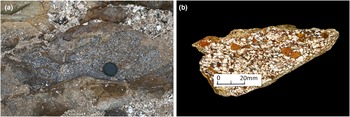
A dyke-like feature, up to 30 cm wide, cross-cuts the Weaklaw vent (Fig. 9a). The width and orientation changes across the outcrop. Lacking fine-grained chilled margins it appears not to be a magmatic dyke but more akin to the tuff dykes (tuffisites) described from this part of the coast by Francis (Reference Francis1960). However, it differs from the latter in lacking wall-rock materials and its most distinctive characteristic is its content of white fragments, up to 60–70% modally, that do not exceed 5 mm across and are homogeneous, anhedral and typically angular (Fig. 9a,b): superficially they resemble feldspar phenocrysts. They are opaque in thin-section and XRD analysis shows them to consist predominantly of kaolinite and illite (with the former exceeding the latter by a factor of 10). We suggest that they originated as alkali feldspars that were subsequently pseudomorphed and broken during rapid emplacement by a fluid.
(a) Tuffisite cutting Weaklaw ejecta (lens cap = 50 mm wide. (b) A polished surface of a sample from the tuffisite dyke. The angular white clasts, composed mainly of kaolinite, are considered to represent altered alkali feldspar.

Petrographically there are some indications of a flow-pattern in the tuffisite. Additional to the supposed feldspar pseudomorphs the dyke contains small sub-rounded clasts (up to 10 mm) with colours varying from black to brown and white. The speckled dyke interior grades into more homogenous brown material, the colouring of which is ascribed to its content of goethite. Whole-rock XRF compositions of samples from the tuffisite and its marginal brown facies are presented in Table 3. SiO2 ranges from 48–58 wt.%, with ~20–24 wt.% Al2O3, 2–5 wt.% Fe2O3, 3–6.5 wt.% CaO and 11–16 wt.% LOI. Although there is variability among the trace elements, concentrations of Zr, Nb, Y, LREE, U and Th are consistently high (Table 3). Zr and Nb exhibit values of 2560 ppm and 305 ppm respectively (with a Zr/Nb ratio of 8.83). The LREE (La, Ce and Nd) summations range from 630–817 ppm; Th 46–56 ppm and U from 3–5 ppm (mean Th/U is 13). In brief, the speckled tuffisite samples show higher contents of Zr, Nb, Y, LREE and Th than any other samples in this study. The dyke matrix is very fine grained. Use of QUEMSCAN indicates a zircon modal content in one thin-section of 0.24% (median grain-size ~45 μm). Ilmenite, rutile and niobo-rutile (ilmenorutile) are associated predominantly with the carbonate. Niobo-rutile (0.2% modal) is the presumed principal host for Nb whilst apatite and zircon are likely to host the REE.
The goethite-rich marginal facies lacking the white-speckles has notably high Ni (350 ppm) and Zn (290 ppm). Relative to the speckled central facies, Ba and the high field-strength element (HFSE) contents are much reduced in the marginal sample whilst Sr is distinctly higher. This trace-element behaviour is consistent with fluid interaction, mobilisation and residual enrichment. Large-ion lithophile elements are known to be mobilised by high- and low-temperature alteration processes (Kirstein et al., Reference Kirstein, Davies and Heeremans2006). In particular, high- and low-temperature fluids rich in CO2 and H2O can promote LILE and HFSE element mobilisation (Humphris and Thompson, Reference Humphris and Thompson1978; Berkesi et al., Reference Berkesi, Guzmics, Szabó, Dubessy, Bodnar, Hidas and Ratter2012).
The ‘dyke’ also contains sparse anhedral but crudely isometric clasts up to 10 mm diameter that appear homogeneous but with colours varying from dark brown, through pale brown to creamy white (Fig. 9b). Powders drilled from three examples across this colour spectrum were also analysed by XRD. According to these data the darkest clast is composed mostly of carbonate (calcite and dolomite), with ~9 vol.% feldspar and <2 vol.% clays. The pale brown clast has less than half as much carbonate together with ~37 vol.% feldspar and ~23 vol.% clay whilst the creamy-white clast has <3 vol.% carbonate but 63 vol.% feldspar and c. 29 vol.% clay. All three could have been dominantly composed of feldspar but exhibiting varying degrees of carbonation and hydration. The average material from the speckled dyke central facies is composed of ~56 vol.% carbonate (roughly equal amounts of calcite, dolomite and ankerite) and ~33 vol.% clays (dominantly kaolinite). The remaining 10 vol.% is composed of quartz, anorthite, microcline, orthoclase, ilmenite, goethite and zircon with none exceeding 3 vol.%. Material drilled from the matrix surrounding the white fragments consists of ~89 vol.% carbonate (dominantly calcite).
Discussion
Xenolithic evidence on the deep structure of East Lothian
The distribution of localities where magmas have brought up xenoliths of mantle and/or deep crustal lithologies supports the contention that there is a major crustal dislocation west of East Lothian. At Partan Craig, ~7 km east of Weaklaw, xenoliths of high-grade gneisses (Graham and Upton, Reference Graham and Upton1978), identified recently as having late Ordovician (and possibly lower Silurian) ages (Badenszki et al., Reference Badenszki, Daly, Whitehouse, Kronz, Upton and Horstwood2019), underlie the upper Palaeozoic successions. Within the Weaklaw Vent itself small (<15 mm) fragments of high-grade metamorphic rocks (graphitic quartzo-feldspathic gneisses) have been found (pers. comm. Peder Aspen). On the supposition that these too are Ordovician, they support the contention that the fault block between the extrapolated trace of the Southern Uplands Fault and the Dunbar-Gifford and Lammermuir Faults composes part of the Southern Uplands rather than the Midland Valley terrane (Max, Reference Max1976). Offset a few kilometres to the north and west of the extrapolated Southern Uplands Fault is the trace of the Ardross Fault (Fig. 1). Spinel lherzolite xenoliths occur in late Carboniferous vents along the latter but are unknown between these faults. The xenolith distribution may be taken to provide supplementary evidence that the change of orientation of the Port Seton / Weaklaw coastline relates to the terrane boundary (Max, Reference Max1976).
Chronological implications
Mantle xenolith localities in Scotland are distributed widely around the north, west and south of Scotland (Upton et al., Reference Upton, Aspen and Chapman1983). The features of the Weaklaw xenoliths, however, render them unique. The vent is dominantly filled by basaltic bombs that were subsequently recrystallised and the presence of mantle xenoliths in a presumed former silica-deficient basaltic host indicates closer affiliation to the later Carboniferous alkali dolerite (basanitic) sills of East Lothian than to the ‘transitional’ olivine basalts typical of the Visean. Although precise age determinations have yet to be made on any of the East Lothian alkali dolerite intrusions, their stratigraphic relationships suggest their ages to be tens of millions of years younger than the Dinantian volcanism. The East Lothian mafic intrusions are comparable to the late intrusions in Fife for which a Namurian or younger age has been proposed (Francis and Hopgood, Reference Francis and Hopgood1970; Forsyth and Chisholm, Reference Forsyth and Chisholm1977; McIntyre et al., Reference McIntyre, Cliff and Chapman1981). However, a K–Ar age quoted in Downes et al. (Reference Downes, Upton, Handisyde and Thirlwall2001) for Fidra is 264 ± 10 Ma which, if substantiated, would render it Permian. The precise age is irrelevant here other than to suggest that the Weaklaw eruption is many millions of years younger than the Visean Garleton Hills Volcanic Formation that it intercepts. The tuffisite and metasomatism are likely to have been pene-contemporaneous.
Whereas the alkali dolerites sills (e.g. Fidra) along this coast were trapped in Carboniferous strata, the Weaklaw magma clearly reached the surface. The vent products in and around the Hanging Rocks contain a prolific amount of the ultramafic inclusions that make Weaklaw outstanding among the many other Scottish xenolith locations. Both the quantity and size of the entrained peridotite samples imply a greater ascent rate for the host magma than at any other site in the British Isles. Its lack of recognition until that by Duncan (Reference Duncan1972) is undoubtedly due to the subsequent carbonation that precluded discovery. The composition of the protolith is considered to have approximated that of the spinel lherzolites at Brigs of Fidra regarded as typical for the lithospheric mantle in the region (Downes et al., Reference Downes, Upton, Handisyde and Thirlwall2001). The agglutinated assemblage of highly vesicular bombs resembles that of surficial eruptive products implying that the exposure probably reflects an erosional depth of less than a few tens of metres. Accordingly, consideration of the outcrop on the foreshore as (very roughly) approximating to a palaeo-surface, the metasomatic fluid must, at this level, have been gaseous. If so the post-eruptive hydrothermal flux would probably have been manifest in fumarolic activity (cf. Mitsis et al., Reference Mitsis, Godelitsas, Göttlicher, Steininger, Gameletsos, Perraki, Abad-Ortega and Stamatakis2018). We contend that the Weaklaw phenomena may have been triggered by late Carboniferous (or Early Permian (?) trans-tensional movement of the postulated fault which: (1) promoted adiabatic mantle melting; (2) provided a channel for magma ascent; and (3) sheared the peridotite.
The relatively high contents of HFSE, LREE and actinide elements in the cross-cutting tuffisite dyke and, to a lesser degree in the peridotites, invites speculation concerning the source of the metasomatic fluid. The crust beneath Weaklaw is ~30 km thick of which the uppermost ~3 km is of arenaceous lower Carboniferous and ‘Old Red Sandstone’ (i.e. Devonian and Upper Silurian). Xenolithic evidence indicates that these overlie lower Palaeozoic, largely calc-alkaline igneous rocks (Badenszki et al., Reference Badenszki, Daly, Whitehouse, Kronz, Upton and Horstwood2019). The composition of the lower crust (~15 km thick (Bamford et al., Reference Bamford, Nunk, Prodehl and Jacob1977), inferred from xenolithic evidence (Downes et al., Reference Downes, Upton, Handisyde and Thirlwall2001; Upton et al., Reference Upton, Downes, Kirstein, Bonadiman, Hill and Ntaflos2011) is dominantly made of meta-dioritic and meta-gabbroic cumulates. As none of these sub-Weaklaw crustal rocks is a probable source for the incompatible element-rich carbonic fluid, the most plausible hypothesis is that it arose from small-melt fractions in the mantle.
Structural implications
The NE–SW trend of the coast west of Weaklaw is roughly co-linear with the offshore trace of the Southern Upland Fault (or its closely-related Crossgatehall Fault: Fig. 1). Lying between this and the paired Dunbar–Gifford and Lammermuir Faults is the East Lothian fault-block in which deep-source xenoliths are comparatively common whereas they are unknown further to the north-west until the Ardross Fault is reached. The basanitic magmas responsible for the dolerite sills and minor intrusions along the coast between Port Seton and Weaklaw (Howells Reference Howells1969; Williamson Reference Williamson and Palmer2003) are probably also related to the postulated off-shore NE–SW fault zone. Additionally there are five cryptovents occurring along this coast containing intrusive tuffs and breccias containing vesicular, devitrified glassy particles. Some of the cryptovents give evidence for initial uplift and post-eruptive collapse suggesting high-pressure discharge of gas or super-critical fluid. That the matrices to the tuffisites and breccias comprise carbonate and kaolinite provides some reason to consider them affiliated with the Weaklaw phenomena.
Geochemistry and mineralogy of the xenoliths
The foliation characteristic of the Weaklaw xenoliths is ubiquitous (Figs 4d and 5). This pre-dates their entrainment and might reflect shearing of the protolith caused by movement on the hypothetical off-shore fault (Fig. 1). The green colouration of the schlieren is due to one or more Cr-rich clays (smectites) resulting from dissolution and reprecipitation of chromium from the former peridotite. Both Ce and U are redox-sensitive and can be enriched preferentially during fluid–rock reactions due to oxidation to Ce(IV) and U(VI). The introduction of Rb, Ba, Sr, Zr, Nb, Y, Pb and LREE to the peridotites was due to the metasomatism. The trace-element behaviour is consistent with an interaction of the rocks with CO2 and probably halogen-rich fluids, resulting in differential additions and leachings, possibly due to complex ion formation (Bau, Reference Bau1996).
Comparable situations where Cr-rich phyllosilicates have been recrystallised by metasomatic fluids in hydrothermally-altered ultramafic associations have been described, e.g. by Mitsis et al. (Reference Mitsis, Godelitsas, Göttlicher, Steininger, Gameletsos, Perraki, Abad-Ortega and Stamatakis2018). The ophiolitic rocks experienced hydrothermal alteration that leached different elements in relation to ‘intense post volcanic activity’ (Mitsis et al., Reference Mitsis, Godelitsas, Göttlicher, Steininger, Gameletsos, Perraki, Abad-Ortega and Stamatakis2018), a phenomenon that probably occurred at Weaklaw. The Cr2O3 content of some of the resultant clays reaches ~14 wt.% and they were also enriched in As, Se, Ni, V, Sc and Tl but depleted in LILE, HFSE and in Cu and Zn. The alteration of minerals in serpentinites through post-volcanic hydrothermal activity was accomplished via geothermal degassing in a very acid environment that led to the mobility of some elements (Mitsis et al., Reference Mitsis, Godelitsas, Göttlicher, Steininger, Gameletsos, Perraki, Abad-Ortega and Stamatakis2018). Spinel was highly susceptible to the alteration losing Al, Cr, Fe and Mg, as were the olivines that lost Fe, Mg and Si. In another comparable situation in Spain, Morata et al. (Reference Morata, Higueras, Dominguez-Bella, Parras, Velasco and Aparicio2001) record the generation of fuchsite and Cr-rich chlorites and illites in hydrothermally-altered ultramafic enclaves in which former Cr-spinels had reacted under highly acid conditions (pH < 0.3), losing Al, Cr, Fe and Mg. The liberated Cr3+ was accommodated in octahedral suites in the clay lattices. At Weaklaw post-eruptive alteration by carbo-hydrothermal processes enriched the lherzolites in incompatible elements from Rb to Nd, whereas the host basanite was most notably enriched in U.
The cross-cutting carbonate/clay-rich Weaklaw tuffisite has a remarkable concentration of Zr, Nb, Y, LREE, U and Th. We presume that the tuffisite shared the same metasomatic event as the basanite and its xenoliths but we have no knowledge of its pre-metasomatic geochemistry and mineralogy. The alteration of the Weaklaw rocks was so comprehensive that passage of the metasomatising fluids is likely to have continued over a substantial period. Judging from data on mineral alteration in hydrothermal systems (Reyes, Reference Reyes2000) it is probable that the Weaklaw fluids were acidic with temperatures between 100–200°C. As noted above, both Mitsis et al. (Reference Mitsis, Godelitsas, Göttlicher, Steininger, Gameletsos, Perraki, Abad-Ortega and Stamatakis2018) and Morata et al. (Reference Morata, Higueras, Dominguez-Bella, Parras, Velasco and Aparicio2001) considered that the metasomatic fluids in their respective Greek and Spanish occurrences had been acidic.
The wide variation in the resultant geochemistry of the Weaklaw meta-peridotites and meta-basanites was presumably dictated by the initial permeability and porosity of their un-metamorphosed precursors, characteristics linked to their physical and chemical differences. The peridotite would have been a coarse-grained holocrystalline rock whereas the basanite was essentially glassy or micro-crystalline. The gross disparity in their initial major- (Al, Mg, Ca and Na) and trace-element compositions (Ni, Cr, V, Sc, Ba, Sr and HFSE) would also have been a factor determining which elements were preferentially redistributed. The data suggest that the fluids donated K, Rb, Ba, Sr, Pb, Zr, Nb, LREE etc., indicating that the metasomatism could not have been due to reactivated ground-waters alone. Whilst ground-waters were most likely involved as dilutants, a deep-source CO2-rich component was presumably implicated. The introduction of rare earth and other ‘exotic’ elements further hints at their complexing with fluorine (Kirstein et al., Reference Kirstein, Hawkesworth and Garland2001) although we have no independent evidence for this. However, a recent account of post-magmatic expulsion of fluids rich in F and CO2 metasomatising local rocks suggests a parallel with the Weaklaw phenomena (Ranta et al., Reference Ranta, Stockmann, Wagner, Fusswinkel, Sturkell, Tollefsen and Skelton2018). These authors describe a 55 m wide dolerite dyke in the Grønnedal-Ika alkaline complex, South Greenland, intruded into carbonatite, that acted as a conduit for hydrothermal fluids. The fluids altered the composition of the surrounding carbonatite up to a distance of 40 m. Light rare earth elements, Nb, Ta, Sr, Mn and P were mobilised and (primary) siderite was oxidised to magnetite.
The high concentrations of Zr, Nb, Y, REE, U and Th in the Weaklaw tuffisite are particularly enigmatic. If our interpretation that the white clay-rich clasts in the dyke are chemically and mechanically degraded alkali feldspars is correct then the associated HFSE concentration is consistent with the (hypothetical) feldspars having been derived from volatile-rich per-aluminous magmas (Upton et al., Reference Upton, Finch and Slaby2009) with a significant volatile component. The enrichment in HFSE has been attributed speculatively to scavenging and subsequent concentration of incompatible elements by fluxing of CO2-rich fluids in the lithospheric mantle. The only other concentration of Zr, REE, Nb and Th known in south-central Scotland is that of a xenolith (amongst a suite of spinel lherzolites and pyroxenites) from Ruddon's Point in the vicinity of the Ardross Fault, Fife (Aspen et al., Reference Aspen, Upton and Dickin1990; Upton et al., Reference Upton, Finch and Slaby2009) composed of anorthoclase, corundum, zircon, apatite and yttro-niobate. Its crystallisation was attributed to enriched fluids ascending through the lithospheric mantle in advance of the basanite host magma. At Weaklaw, however, this inferred sequence is reversed. The relationship of the Weaklaw and Ruddon's Point enrichments is not known but we suggest they may be closely related.
Summary
The major faults, including the Southern Upland Fault, splay out within the recently-formed Laurussian continent, forming a rift valley across the Lothians, widening NE from ~10 km to ~18 km and bounding the Southern Uplands terrane (Fig. 1). During the later Carboniferous, lithospheric trans-tension promoted small-scale mantle melting, producing basanitic magmas. Some of these, ascending via the inferred off-shore fault zone, intruded Carboniferous strata as sills but at Weaklaw they erupted sub-aerially. The peridotitic cores to many of the basaltic bombs in the Weaklaw vent are regarded as retrograded analogues of the fresh rocks occurring nearby on Fidra Island. The ubiquitous foliation (schlieren) in the xenoliths is regarded as originating through mantle shearing, as evidenced in some of the xenoliths brought up by vents along the (Fife) Ardross Fault (Chapman, Reference Chapman1976). The characteristic green colour of these schlieren is due a complex of chrome-rich clays, predominantly di-octahedal smectite. Vent eruption was followed by intrusion of a small tuffisite body, principally composed of clays and carbonates, containing ‘sharp’ kaolinite-rich clasts inferred to have resulted from mechanical break-down of alkali feldspars. Whole-rock analyses of the tuffisite showed enhanced contents of Zr, Nb, Y, REE, U and Th. Whilst its petrogenesis remains enigmatic, we suggest that these trace elements were introduced by a CO2 and probably halogen-rich metasomatic fluid.
The Weaklaw vent is considered have been the site of an unusually high-energy eruption, followed by prolonged passage of chemically aggressive carbonic fluids. The siting and orientation of the Weaklaw Vent, in conjunction with its content of sheared mantle xenoliths prompts the speculation that it was associated with the Southern Upland Fault. Right-lateral trans-tensional movement of the latter affected strata up to, and including, the Visean but diminished in the Namurian and Westphalian. West of Weaklaw the coast-line swings from an approximately WNW–ESE orientation to NE–SW, making it essentially co-linear with the trace of the hypothetical fault, suggesting that the geography has been fault-controlled. A linear magnetic anomaly (indicated diagrammatically in Fig. 1) is coincident with this lineament (Max, Reference Max1976). The occurrence of Ordovician meta-igneous xenoliths in a vent ~7 km east of Weaklaw (Badenszki et al., Reference Badenszki, Daly, Whitehouse, Kronz, Upton and Horstwood2019; Upton et al., Reference Upton, Aspen, Graham and Chapman1976) suggests that the fault marks the northerly limit of Ordovician rocks at relatively shallow depth, defining the terrane boundary between the Southern Uplands and the Scottish Midland Valley.
Because the Weaklaw metasomatic fluid was reacting with sub-aerial eruptive products we suggest that the term mantle ‘de-gassing’ is not inappropriate for the phenomena described above. The un-preposessing appearance of the rocks, camouflaged by the secondary alteration, was doubtless a principal reason for their neglect. None-the-less Weaklaw has a number of unique features that invite further study.
Acknowledgements
Assistance in the field from W. Gilmour and C. Pin is acknowledged gratefully. We are grateful to G.O. Fridleifsson for advice concerning the low-temperature alteration and to E. Badenszki, F. Albarede and Bill Griffin for helpful comments. We thank Stavros Vrachiotis (for collecting the drone footage that added to our understanding of the Hanging Rocks) and also to Sandra Mather for map drafting and Zoe Hamill for photography. We are grateful to our three reviewers whose criticisms helped revision of the manuscript.