Introduction
Experiencing a change in memory as one gets older is a common phenomenon. For example, in a Norwegian community survey, almost half of the participants over age 30 voiced a memory-related complaint (Holmen et al., Reference Holmen2013). This type of concern, expressed directly by the individual (as distinct from impairments detected through objective cognitive testing), has been variously called subjective cognitive complaint (Slavin et al., Reference Slavin2010), subjective memory complaint (Buckley et al., Reference Buckley2013), and subjective memory impairment (Jessen et al., Reference Jessen2013), among other terminologies. In response to this lack of standardization (Abdulrab and Heun, Reference Abdulrab and Heun2008), an effort to develop a common designation for cognitively unimpaired adults reporting a change in memory was undertaken by an international group of researchers, which resulted in the emergence of the term Subjective Cognitive Decline (SCD) (Jessen et al., Reference Jessen2014). This choice emphasizes that it is self-reported, that it can affect several cognitive domains (not necessarily restricted to memory), and finally that it encompasses the idea of a temporality.
In the context of a prevailing interest in an early detection of Alzheimer's Disease (AD) (Dubois et al., Reference Dubois2016), SCD has gained attention because of its possible association with a future cognitive decline (Jonker et al., Reference Jonker, Geerlings and Schmand2000; Jessen et al., Reference Jessen2013; Rönnlund et al., Reference Rönnlund, Sundström, Adolfsson and Nilsson2015). Although SCD increases the risk of AD, according to a recent meta-analysis (Mitchell et al., Reference Mitchell, Beaumont, Ferguson, Yadegarfar and Stubbs2014) 89% of individuals with SCD will not convert to dementia over the course of four years. In fact, SCD is a complex phenomenon and its onset involves several determinants.
Interestingly, main other significant correlates of SCD are psychological factors. For example, the intensity of depressive symptomatology, in populations not characterized for major depressive disorders, is consistently found to be associated with SCD (Slavin et al., Reference Slavin2010; Balash et al., Reference Balash, Mordechovich, Shabtai, Giladi, Gurevich and Korczyn2013; Buckley et al., Reference Buckley2013), as is anxiety (Slavin et al., Reference Slavin2010; Buckley et al., Reference Buckley2013).
Another striking finding is the association between SCD and enduring personal characteristics, which suggests that the latter may influence the report of a cognitive complaint. The feature most frequently considered is the personality trait of neuroticism (Pearman and Storandt, Reference Pearman and Storandt2004, Reference Pearman and Storandt2005; Slavin et al., Reference Slavin2010; Merema et al., Reference Merema, Speelman, Foster and Kaczmarek2013). Alternative dimensions such as trait-like self-esteem (Pearman and Storandt, Reference Pearman and Storandt2004) and ruminative style have also been examined (Chin et al., Reference Chin, Oh, Seo and Na2014).
Finally, Pearman et al. (Reference Pearman, Hertzog and Gerstorf2014) suggested that SCD could emanate from self-referent beliefs, themselves based on self-schemas, but they did not directly test this possibility. The concept of schema was introduced in clinical psychology by Beck (Reference Beck1967). Subsequently, transcending and enriching Beck's cognitive theory, Young et al. (Reference Young, Klosko and Weishaar2003) proposed both a model and a therapy based on early maladaptive schemas (EMSs), defined as: “broad pervasive themes or patterns regarding oneself and one's relationship with others, developed during childhood and elaborated throughout one's lifetime, and dysfunctional to a significant degree.” Young et al. (Reference Young, Klosko and Weishaar2003) identified 11, 15, and later 18, thematic-content EMSs grouped into five domains according to basic unfulfilled needs: Disconnection and rejection, Impaired autonomy and performance, Impaired limits, Other-directedness, and Overvigilance and inhibition.
Since EMSs are thought to be stable and to influence one's perception of oneself and of the surrounding world, we hypothesized that they might also guide one's perception of day-to-day memory failure. EMSs are known to play a central role in personality disorders (Young et al., Reference Young, Klosko and Weishaar2003; Barazandeh et al., Reference Barazandeh, Kissane, Saeedi and Gordon2016). They have been increasingly explored in clinical populations suffering from various disorders (e.g. mood disorders, obsessive-compulsive disorders, and schizophrenia) (Hawke and Provencher, Reference Hawke and Provencher2011). Whether they are involved in SCD has not yet been explored, but there are sound reasons to propose that this might be the case. When a memory-related stressful situation occurs (e.g. not retrieving the title of a movie at a social gathering), EMSs (e.g. vulnerability to harm or illness EMS) are expected to activate and promote a negatively biased interpretation of the situation (e.g. this is catastrophic, I am ill). This could then result in the expression of a complaint about one's memory (e.g. my memory is declining).
The current study aims to explore the psychological factors that contribute to SCD, with an additional emphasis on personal profound core beliefs through investigation of Young's EMSs. Because the study is exploratory, it seeks first to identify which of the 15 content-specific Young's EMSs are the most related to SCD severity and then to examine the influence of Young's EMSs together with depression and anxiety on SCD severity.
Methods
Participants
A total of 76 subjects aged 50–85 with intact cognitive functioning were recruited between May 2012 and November 2014 through an advertisement published in a health insurance journal offering free participation in an intervention on SCD and taking place at the Institut de la Mémoire et de la Maladie d'Alzheimer (IM2A). Specifically, it was stated “Do you complain about your memory? If you are between 50 and 85 years old, are in good health and have access to the internet, you can be a candidate to participate in a psychoeducation program about memory, launched by the Memory Institute in Paris with the sponsorship of Malakoff Médéric.” All participants provided informed consent prior to participation.
Procedures
We carried out a three-stage inclusion procedure. In response to the advertisement, 186 subjects contacted us at their initiative by email or telephone. In this first exchange, the practical aspects about the program were explained. All interested candidates (n = 111) were then screened by a trained neuropsychologist at the IM2A during a visit which comprised a recording of sociodemographic status and medical history, a neuropsychological examination and a semi-structured interview to assess depressive symptomatology.
Regarding cognitive abilities, our main inclusion criteria for the study was preserved storage memory abilities. Besides scoring at least 26 on the Mini-Mental State Examination (MMSE) (Folstein et al., Reference Folstein, Folstein and McHugh1975; Kalafat et al., Reference Kalafat, Hugonot-Diener and Poitrenaud2003), participants were eligible if they at least scored 42 on the total recall score of the Free and Cued Selective Reminding Test (FCSRT) (Buschke et al., Reference Buschke, Sliwinski, Kuslansky and Lipton1997; Van der Linden et al., Reference Van der Linden and Van der Linden2004). Those who were found to have cognitive performance lower than our threshold were advised to report this information to their general practitioner and were offered the possibility of seeing a neurologist from our memory clinic.
Exclusion criteria were a history of neurological disorder and a severe level of depression defined as a Montgomery and Asberg Depression Rating Scale (MADRS) (Montgomery and Asberg, Reference Montgomery and Asberg1979) score above 35. Those who were excluded because of their depression level were advised, for their own interest, to take care of their affective state as a matter of priority. They were provided with the contact information of appropriate health professionals.
Third, subjects who fulfilled the inclusion requirements (n = 78) were then asked to complete a set of online questionnaires. All questionnaires were in French. Two participants left the study before completing the online questionnaires. The data reported here were part of a larger study investigating the efficacy of an intervention on SCD. The results of the latter are not published yet.
All participants gave their informed consent, and the present study was approved by the Pitié-Salpêtrière Hospital review board (Comité de protection des personnes – CPP) and was filed with the Commission Nationale de l'Informatique et des Libertés.
Measures
Screening phase
Cognitive abilities
The MMSE was used to assess global cognition (Folstein et al., Reference Folstein, Folstein and McHugh1975; Kalafat et al., Reference Kalafat, Hugonot-Diener and Poitrenaud2003). This extensively used 30-point instrument includes an evaluation of orientation, registration, attention and calculation, recall, language, and ability to follow simple commands.
The FCSRT (Buschke et al., Reference Buschke, Sliwinski, Kuslansky and Lipton1997; Van der Linden et al., Reference Van der Linden and Van der Linden2004) was used to assess episodic memory. The FCSRT is a psychometrically validated and very sensitive tool to detect early memory impairment that is specifically related to AD (Dubois et al., Reference Dubois, Slachevsky, Litvan and Pillon2000; Sarazin et al., Reference Sarazin2007). This test based on a list-learning task in which participants are required to learn 16 words of 16 different semantic categories over the course of three trials. The score used for the screening phase was the total recall (sum of the three free + cued recalls) and the score used for the analyses was the total free recall (sum of the three free recalls) with the maximum score being 48.
The neuropsychological examination comprised not only the MMSE and FCSRT, but also other tests (verbal fluency test (Cardebat et al., Reference Cardebat, Doyon, Puel, Goulet and Joanette1990), Frontal Assessment Battery (Dubois et al., Reference Dubois, Slachevsky, Litvan and Pillon2000), and Trail Making Test (Tombaugh, Reference Tombaugh2004)) that were performed as part of the standard cognitive assessment of our memory clinic. We chose to use the FCSRT in particular for further analysis since FCSRT is a good clinical marker of episodic memory impairment (Sarazin et al., Reference Sarazin2007).
Depressive symptoms
The MADRS (Montgomery and Asberg, Reference Montgomery and Asberg1979; Lemperière et al., Reference Lemperière1984), a ten-item clinician-rated scale, was used to measure depressive symptom severity. The total score ranges from 0 to 60. A cut-off value of above 35 was used to define severe depression.
Online self-report questionnaires
Subjective cognitive decline
The McNair & Kahn scale (McNair) (McNair and Kahn, Reference McNair, Kahn, Crook, Ferris and Bartus1983; Poitrenaud et al., Reference Poitrenaud, Israël, Barrère, Le Roch, Michel, Derouesné and Gely-Nargeot1997) a 24-item self-rated questionnaire was used to assess the perceived frequency of day-to-day cognitive difficulties. Participants were asked to rate how often they experience cognitive difficulties on a Likert scale ranging from 0 = never to 4 = most of the time. The total score ranges from 0 to 96, with higher score indicating more SCD.
Psychological state
The Hospital Anxiety and Depression Scale (HADS) (Zigmond and Snaith, Reference Zigmond and Snaith1983; Lépine et al., Reference Lépine, Godchau, Brun and Lempérière1985) made of two seven-item subscales was used to assess anxiety on the one hand and depression on the other hand. The HADS is used systematically in our Memory clinic as a standard evaluation. In addition, the HADS is widely used across studies on memory complaint (e.g. Buckley et al., Reference Buckley2013), is easy and quick to fill out, and also well suited for online questionnaires.
The participants were asked to rate each item on a four-point scale from zero to three, three being the most severe. The anxiety and the depression score, ranges from 0 to 21. Typical cut-off values are of eight for each subscale (Zigmond and Snaith, Reference Zigmond and Snaith1983).
The State-Trait Anxiety Inventory (STAI-Y) (Spielberger et al., Reference Spielberger, Gorsuch, Lushene, Vagg and Jacobs1983; Bruchon-Schweitzer and Paulhan, Reference Bruchon-Schweitzer and Paulhan1993) is a self-report tool with two subscales assessing state anxiety and trait anxiety. For the current study, we only used the 20-item trait-anxiety subscale since state anxiety was already being assessed by the HADS-A. Each item was rated on a 4-point Likert scale. Scores range from 20 to 80, with higher scores indicating greater levels of anxiety.
The Young schema questionnaire (YSQ) (Young, Reference Young and Brown2001; Lachenal-Chevallet et al., Reference Lachenal-Chevallet, Mauchand, Cottraux, Bouvard and Martin2006) was used in its short form to assess Young's EMSs. This questionnaire comprises 75 items measuring 15 EMSs grouped into five big domains (Table 2). The participant was asked to rate each item on a six-point Likert scale ranging from 1 = completely untrue of me to 6 = describes me perfectly. A score for each EMS ranging from 5 to 30 was provided.
Statistical analysis
First, zero-order Pearson's correlations were performed to examine the relationship between the self-reported cognitive complaint severity and psychological variables and to identify which of the 15 EMSs evaluated on the YSQ were the most related to SCD severity. These EMSs will be the ones introduced in the subsequent analyses.
Second, in order to evaluate the influence of EMSs, depression and anxiety on cognitive complaint severity hierarchical multiple regressions analysis were conducted, while controlling for the effects of demographics and objective cognition. For all analyses, the McNair score was our main outcome measure. Analyses were performed using SPSS Version 21.
Results
Characteristics of the sample
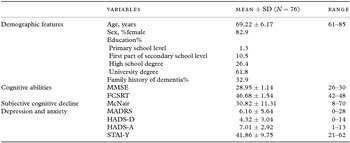
Characteristics of participants (demographic features, cognitive abilities, SCD, depression, and anxiety) are displayed in Table 1. The 76 participants had an average age of 69.22 ± 6.1 years and 92.1% were retired. The majority were women (82.9%) and 61.8% had completed higher education (University degree). Also, 55.3% were married or in a relationship. All participants lived in independent housing and 36.8% lived alone. 32.9% stated having a family history of dementia. The mean MMSE score was 28.95 ± 1.14. With respect to affective state, the levels of depressive and anxiety-related symptoms were below the pathological cut-off scores.
Demographic, cognitive, and psychological characteristics of the sample

MMSE, Mini-Mental State Examination; FCSRT, Free and Cued Selective Reminding Test total recall; MADRS, Montgomery and Asberg Depression Rating Scale; HADS-D, Hospital Anxiety and Depression Scale Depression score; HADS-A, Hospital Anxiety and Depression Scale Anxiety score; STAI, State-Trait Anxiety Inventory Trait score.
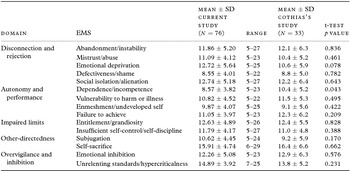
Regarding EMSs, scores on the YSQ-SF are presented in Table 2. Mean scores were compared to those found in a community sample of French elders (Cothias et al., Reference Cothias, Camart, Martinez and Deseez2011). Despite the age difference between the two groups (t = −10.8, p < 0.001), scores on the YSQ were similar except for the dependence/incompetence EMS.
Results of the Young Schema Questionnaire-Short Form (YSQ-SF)

EMS, Early Maladaptive Schema.
Correlations between subjective cognitive decline and other study variables
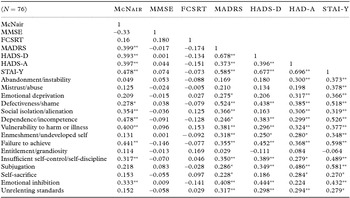
Correlations between SCD, cognitive scores, Young's EMSs, depression, and anxiety are presented in Table 3. The McNair score did not correlate with any of the neuropsychological scores. Instead, it significantly and positively related to psychological variables. It was highly (r > 0.400; p < 0.005) correlated with the STAI-Y, and the following EMSs: Dependence/incompetence, Failure to achieve and, Vulnerability to harm or illness (All belong to the Impaired autonomy and performance domain).
Correlations among study variables

*p < 0.05; **p < 0.01; MMSE, Mini-Mental State Examination; FCSRT, Free and Cued Selective Reminding Test total free recall, MADRS, Montgomery and Asberg Depression Rating Scale; HADS-D, Hospital Anxiety and Depression Scale Depression score; HADS-A, Hospital Anxiety and Depression Scale Anxiety score; STAI-Y, State-Trait Anxiety Inventory Trait score.
Hierarchical regression analysis
We conducted hierarchical multiple regression analyses to evaluate the contribution of depression, anxiety, and EMSs on SCD intensity. In order to avoid multicollinearity issues, we included only one measure of depression and one measure of anxiety. We chose the MADRS (over the HADS-D) and the STAI-Y (over the HADS-A) on the basis of their higher correlation to the McNair score.
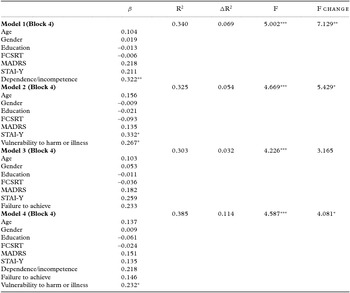
Models of regression predicting the McNair score are presented in Table 4.
Regression coefficients and model summary of hierarchical regressions with self-reported cognitive complaint severity as the outcome

*p < 0.05; **p < 0.01; *** p < 0.001; FCSRT, Free and Cued Selective Reminding Test total free recall; MADRS, Montgomery and Asberg Depression Rating Scale; STAI-Y, State-Trait Anxiety Inventory Trait score.
The EMSs that we focused on in this set of analyses are the three aforementioned which were found to be the most correlated to SCD intensity in the previous correlation analysis. We therefore ran three separate models, each of it including a different EMS at its final stage i.e. Dependence/incompetence (Model 1), Failure to achieve (Model 2), and, Vulnerability to harm or illness (Model 3). A final model (Model 4) was carried out including the three schemas together.
The first steps of this analysis are common to the three models. We entered in a first block (Block 1, (F(4, 71) = 0.327, ns)), the demographic characteristics (age, gender, education level) and memory abilities (FCSRT). Second, we entered depression (MADRS) into the model (Block 2) and it accounted for an additional 15.8% of variance in the McNair score (F(5, 70) = 2.996, p = 0.017), with a total of 19.6% accounted for. Then, anxiety (STAI-Y) was entered into the model (Block 3) resulting in a 9.4% increase of explained variance (F(6, 69) = 4.268, p = 0.001) with a total of 27.1% variance accounted for.
The final step (Block 4) of the models differed in that it included either a distinct EMS (Models 1 to 3) or the three EMS together (Model 4).
The addition of the independence-incompetence EMS (Model 1) predicted a further 6.9% of variance (F(7, 68) = 5.002, p < 0.001).The overall predicted variance of the McNair score was 34.0% and in this final model, only the dependence/incompetence EMS (β = 0.322, p = 0.009) contributed independently to SCD intensity.
The addition of the Vulnerability to harm or illness EMS (Model 2) explained a further 5.4% of variance (F(7, 68) = 4.669, p < 0.001). The overall predicted variance of the McNair score was 32.5%. In this final model, the Vulnerability to harm or illness EMS (β = 0.267, p = 0.012) and the STAI-Y (β = 0.332, p = 0.023) contributed independently to SCD intensity.
The addition of the Failure to achieve EMS (Model 3) did not result in a significant change of the variance. The overall predicted variance of the McNair score was 30.3% (F(7, 68) = 4.226, p < 0.001).
In a final analysis, we included the three EMSs together (Model 4) and this resulted in adding 11.4% of the variance with the final model accounted for 38% of the variance in SCD intensity (F(10, 65) = 4.180, p < 0.001). In this final model, only the Vulnerability to harm or illness EMS (β = 0.267, p = 0.046) contributed independently to SCD intensity.
Discussion
The goal of this study was to explore how inner personal-related features, depression, anxiety, influence the severity of a self-perceived cognitive decline among deficit-free adults.
As expected, our results confirmed the well-known relationship between SCD, depression and anxiety, but, remarkably, they also revealed a significant positive association between SCD intensity and Young's EMSs in the category of “Impaired autonomy and performance.”
Using depression, anxiety and EMSs as predictors, we provided a comprehensive model of SCD severity which accounted for 38.5% of the observed variance in the McNair score.
Influence of anxiety and depression
As recommended by Chin et al. (Reference Chin, Oh, Seo and Na2014), we considered among our set of psychological features of interest not only depression but also anxiety. Both were highly positively correlated with the McNair score. In addition, depression and anxiety symptomatology (Block 3) together accounted for 27% of the variance in SCD severity. The predictive contribution of depression in SCD is supported by a considerable amount of evidence in the literature (Balash et al., Reference Balash, Mordechovich, Shabtai, Giladi, Gurevich and Korczyn2013). Interestingly, our results also underscore the significant and perhaps underappreciated role of trait anxiety.
Nevertheless, neither depression nor anxiety contributed significantly to the final models when EMSs were also included as predictive factors, with the exception of Model 4.
Influence of Young's EMSs
Young's EMSs are especially interesting because they entail not only an organizational level but also a thematic-content level (Dozois and Beck, Reference Dozois, Beck, Dobson and Dozois2008). Among the fifteen EMSs that were assessed through the questionnaire, six EMS were positively correlated (p < 0.01) with the McNair score. We observed stronger associations between the report of everyday memory difficulties measured by the McNair and the EMSs belonging to the “Impaired autonomy and performance” domain (i.e. Dependence/incompetence, Vulnerability to harm or illness, and Failure to achieve). Furthermore, our hierarchical regression analyses indicate that EMSs are of great relevance for predicting SCD. In models 1, 2, and 4, only the EMSs retained a significant beta value when all variables were included into the model. This is consistent with the proposal of Merema et al. (Reference Merema, Speelman, Foster and Kaczmarek2013), who postulated that affective state explains only a small part of the variance once one controls for the effects of more enduring characteristics, namely, personality features in the study by Merema et al. and EMSs in the current study.
This also raises the possibility that EMSs may act as mediators between affective state and SCD. For instance, individuals exhibiting the Dependence/incompetence EMS might have more depressive symptoms and be more likely to report a memory complaint, but in this case the two (depression and SCD) might not be directly related, the relationship potentially being explained by the presence of the EMS. Future analysis will be necessary to investigate this hypothesis. Interestingly, Crane et al. (Reference Crane, Bogner, Brown and Gallo2007) showed that the relationship between depressive symptoms and subjective memory complaint was mediated by negative cognitive bias (hopelessness, a wish to die, and low self-esteem).
The three aforementioned EMSs involve expectations about oneself and the world that “interfere with one's ability to separate oneself and to function independently” (Young et al., Reference Young, Klosko and Weishaar2003). Individuals with these EMSs perceive themselves as unable to survive independently and to perform successfully (Young et al., Reference Young, Klosko and Weishaar2003).
In particular, the Dependence/incompetence EMS was found to be the most powerful predictor of the McNair score. Individuals with this EMS believe that they are not capable of dealing with their everyday responsibilities efficiently and without assistance. It is likely that subjects with this EMS hold a negative perception of their memory and tend not to trust their own abilities. According to Young et al. (Reference Young, Klosko and Weishaar2003), they are generally more passive and lack initiative. This may cause a lack of adaptation to age-related cognitive changes and contribute to the expression of the memory complaint. This assumption is consistent with Derouesné (Reference Derouesné2003), who reported that subjects with SCD do not have confidence in their abilities, leading them to avoid memory-related situations and as a consequence not to use appropriate strategies in such situations. These considerations, also supported by the correlation with the Failure to achieve EMS, imply that SCD may reflect a broader belief of “not being capable of.” Our results therefore, corroborate Pearman and Storandt's conclusion (Reference Pearman and Storandt2004, Reference Pearman and Storandt2005) that low self-esteem plays a key role in memory complaint.
The Vulnerability to harm or illness EMS, which corresponds to a broadly anchored fear of illness with the conviction that something terrible is going to happen, was also found to affect the intensity of SCD. This EMS bears some similarities to the dependence-incompetence EMS but also differs in that it encompasses a catastrophic perception of the environment. This finding may imply that SCD is in some cases related to a fear of dementia.
Surprisingly, a few EMSs from non-performance based domains were correlated with SCD, albeit to a lesser extent than the three specific EMSs used in our regression analyses.
For instance, the Social isolation/alienation EMS from the “Disconnection and rejection” domain was correlated (r = 0.354, p < 0.01) with SCD. Reporting a memory complaint might in some cases be a manifestation of feeling different or isolated. Conversely, it is also possible that experiencing a decline, although subjective, may contribute to a social withdrawal.
As for the association of SCD with the Emotional inhibition EMS from the “Overvigilance and inhibition” domain (r = 0.333, p < 0.01), one possible explanation is that for someone exhibiting an excessive reluctance to reveal their feelings and needs, it might be easier to report a complaint about cognitive function than to communicate an emotional state.
Ultimately, we assume that SCD may primarily be driven by profound long-term inner beliefs about oneself that do not specifically refer to self-perceived memory abilities. Given the unconditional nature of EMSs and their role in information processing, it is likely that subjects filter information about their memory idiosyncratically with core beliefs they hold about themselves.
Limitations
This study bears several limitations that are necessary to mention. First, our sample was made up of individuals willing to participate in an SCD intervention and consisted largely of highly educated women. Our results should therefore be interpreted with caution and cannot be generalized to the whole population.
A second limitation relates to the instruments we used, namely online self-reports, whose psychometric features might differ from paper-pencil versions. Also, one study has reported the difficulty of scoring certain items of the YSQ in older subjects (Cothias, Reference Cothias, Camart, Martinez and Deseez2011). However the participants of this study were much older than the ones of our study. In addition, it is worth noting that the correlation between the two instruments assessing depression was 0.678 (p < 0.01). The type of administration (self-reported vs. clinical-rated) may lead to slightly divergent results and scores were fairly low on both scales. Moreover, the symptoms evaluated by the MADRS and HADS-D do not completely overlap. On the one hand, MADRS comprises core items of depression including sleeping problems and loss of appetite. On the other hand, HADS-D does not contain somatic items but does assess anhedonia.
Finally, during the inclusion phase, we did not specifically notice patients with excessive and over-generalized medical complaint behavior. However, we did not assess hypochondria per se, and it is possible that this information is pertinent to understanding SCD.
Clinical implications and perspectives
Our findings have significant clinical implications. As SCD becomes an increasingly frequent source of worry and motive for seeking informal help or medical assistance, it is all the more important to improve our understanding of the underlying correlates of SCD in order to provide individuals with optimal care. Since, we found that profound enduring patterns are associated with SCD at an individual level, it may be worth including the assessment of EMSs alongside other psychological evaluations in order to better apprehend patient complaints.
Also, psychoeducation groups with a focus on aging, often developed by institutions or health insurance companies, constitute a potentially valuable approach for subjects seeking help for a SCD. A specific focus on EMSs might also be worthwhile to include in this type of intervention. The association that we uncovered between SCD and the Isolation EMS suggests that this population would benefit from opportunities to relate with other people; group intervention therefore likely represents a relevant option.
Furthermore, SCD individuals may not form a homogeneous group (Chin et al., Reference Chin, Oh, Seo and Na2014). Defining a more detailed typology of SCD individuals will be a priority in future works. For instance, one could delineate subgroups of SCD individuals, each based on a prominent thematic content EMS. This may lead to the design of more tailor-made SCD interventions with potentially greater benefits.
In this study, we assumed that EMSs were present before the onset of SCD since EMSs are believed to be stable over time. Thus, we hypothesize that SCD may originate from EMSs in the frame of the diathesis-stress model (Ingram and Luxton, Reference Ingram, Luxton, Hankin and Abela2005). However, one could argue that the opposite might also be true, that is, that the presence of SCD would influence how participants rate schemas on the questionnaire. Future longitudinal studies, assessing EMSs before the onset of SCD, should help clarify this point and determine whether EMSs constitute a vulnerability factor to SCD.
Finally, in an effort to identify individuals with SCD who are at risk for AD, determinants of self-reported cognitive complaint should be compared between subjects for whom the absence of an underlying neurological process has been more formally identified (e.g. no evidence of amyloid burden) and subjects with no cognitive impairment but exhibiting evidence of pathology (e.g. presence of amyloid burden).
Conclusion
Here, for the first time, we have addressed the role of profound self-beliefs in SCD. Expressing a complaint about memory could be apprehended as part of a global and consistent way of feeling, thinking and behaving.
We found evidence that specific EMSs belonging to the “Impaired autonomy and performance” domain are key predictors of SCD.
Conflict of interest
None.
Description of authors’ roles
C. Tandetnik designed the study, collected the data and wrote the paper. T. Hergueta assisted with the development of the research question, the design of the study and with the recruitment of participants. P. Bonnet assisted with the statistical design of the study and with the statistical analysis. B. Dubois oversaw the study and assisted with the recruitment of participants. C. Bungener supervised the study and the data collection and assisted with writing the article.
Acknowledgments
We thank Malakoff Médéric for the support provided and all the participants who took part in the study. We thank Daniel Holoch for his assistance in editing the manuscript.