INTRODUCTION
Head and neck cancers make up 3–4% of all cancer registrations in New Zealand, with 772 registrations and 202 deaths due to this disease in 2007.1 Most patients will receive radiation therapy (RT) during their treatment, resulting in severe oral mucositis in up to 60% of patients, which increases to 92% when patients receive chemoradiation.Reference Clarkson, Worthington, Furness, McCabe, Khalid and Meyer2 This painful condition adversely affects patients’ ability to speak and eat, often resulting in weight loss and decreased quality of life (QoL). In extreme cases, treatment must be delayed to allow for healing; this may compromise local tumour control and thus patient survival.Reference Clarkson, Worthington, Furness, McCabe, Khalid and Meyer2–Reference Rosenthal and Trotti5
There is currently no gold standard for the prevention or treatment of oral mucositis.Reference Clarkson, Worthington, Furness, McCabe, Khalid and Meyer2,Reference Rosenthal and Trotti5,Reference Keefe, Schubert, Elting, Sonis, Epstein, Raber-Durlacher, Migliorati, McGuire, Hutchins and Peterson6 Patients in this trial used baking soda mouthwashes, benzydamine hydrochloride, nystatin and additional pain medication for oral mucositis when necessary. In severe cases, patients were fed through percutaneous endoscopic gastrostomy (PEG) tubes.
New Zealand manuka honey has potent antibacterial properties due to its high methylglyoxal contentReference Mavric, Wittmann, Barth and Henle7 and has been used in the treatment of severe burns, diabetic leg-ulcers and infected surgical sites.Reference Molan8,Reference Chambers9 More recently, certain types of honey were shown to exhibit anti-inflammatory activity.Reference van den Berg, van den Worm, van Ufford, Halkes, Hoekstra and Beukelman10–Reference Leong, Herst and Harper12 Four small clinical trials have reported that oral administration of undiluted honey from tea plant,Reference Biswal, Zakaria and Ahmad13 thyme,Reference Motallebnejad, Akram, Moghadamnia and Moulana14 cloverReference Rashad, Al-Gezawy, El-Gezawy and Azzaz15 and wild honey from Western Ghats forests in IndiaReference Khanal, Baliga and Uppal16 significantly decreased the extent of radiation-induced oral mucositis in head and neck cancer patients. This study aims to validate these results, using New Zealand manuka honey and a very similar trial methodology as that used in the previous four honey studies, to facilitate comparison of outcome measures.
METHODOLOGY
The trial was approved by the New Zealand Multi-Region Ethics Committee (MEC/08/11/142) and is registered by the Australia New Zealand Clinical Trials Registry (ACTRN12608000180314). All participants gave written consent before the start of RT treatment.
This study was originally set up as a randomised, multi-centre clinical trial following the methodology from previous honey trials, using 20mL undiluted manuka honey.Reference Biswal, Zakaria and Ahmad13–Reference Rashad, Al-Gezawy, El-Gezawy and Azzaz15 However, the first six honey patients pulled out in the first week due to severe nausea, vomiting and severe stinging sensations in the mouth. We obtained ethical approval to amend the protocol and the next 12 honey patients diluted 10mL of honey in 30 mL of water or non- carbonated drinks.
Trial outcomes
We determined the effect of manuka honey on (1) severity of oral mucositis, (2) weight and (3) patient QoL during RT treatment.
Patient recruitment and participation flow
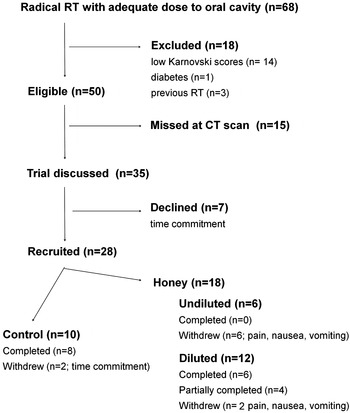
The severity of mucositis was assessed by dividing the mouth into 14 different anatomical regions (more detail is given under ‘measurements’). Eligible patients had to receive RT of 40 Gy to at least two of these 14 anatomical regions. Eligible patients were identified at the time of first consultation with the radiation oncologist. Recruitment occurred between March 2009 and February 2010. Specific exclusion criteria were: diabetes mellitus, allergy to honey, previous RT to the head and neck, evidence of metastatic disease and Karnofsky performance status score of less than 70%. A total of 28 patients were recruited (Figure 1); ten patients received standard care and 18 patients received manuka honey in addition to standard care. The first six honey patients used undiluted honey and the next 12 honey patients used diluted honey (1:3). A total of 18 patients yielded data for analysis: eight (out of ten) control patients, ten (out of 12) diluted honey patients, six of whom used honey for 6 weeks and a four who used honey for only 4 weeks of their RT treatment due to honey-related side effects. Data analysis compares three groups of patients: those who used honey for 6 weeks, those who used honey for 4 weeks and those who did not use honey at all (control patients).
Consort diagram. A total of 28 patients entered the trial but only 18 patients yielded data for analysis: eight (out of ten) control patients, ten (out of 12) diluted honey patients, six of whom used honey for 6 weeks and four of whom used honey for 4 weeks.

Randomisation
The first 20 patients were randomised (using computer-generated random numbers) to the undiluted honey arm (n = 6), diluted honey arm (n = 4) and control arm (n = 10). Because there were so many issues with honey-related side effects even after diluting the honey, the next eight patients were assigned to the diluted honey arm to test patient compliance.
Standard care
All patients were educated on good oral hygiene, soft tooth brushes, fluoride toothpaste, avoiding hot spicy food, alcohol and tobacco and sipping small quantities of water. Patients used baking soda mouthwashes (1 teaspoon in 1 glass of water), difflam (benzydamine hydrochloride), nystatin (anti-fungal) and pain medication (panadol, NSAIDS, opioids or xylocaine viscous), when necessary. Patients were fed through PEG tubes if their nutritional status became compromised.
Honey treatment
In addition to standard care, patients were given clear oral and written instructions on how to use the honey. The first six honey patients swirled 20 mL of undiluted honey around the mouth, three times a day: 15–30 min prior to RT, 15–30 min after RT and 6 h later. On weekends patients took honey morning, afternoon and evening. The next 12 patients swirled 10 mL of honey diluted in 30 mL of water or non-carbonated drinks, to be taken three times a day as per original protocol.
Medical grade 10+ UMF manuka honey was provided by Comvita NZ Ltd. The honey was collected from one area in New Zealand and distributed into pottles (200 mL) at the Comvita NZ Ltd production plant in Tauranga and gamma sterilised (25kGy) at Schering Plough sterilisation plant in Upper Hutt. The honey was tested for toxins by Hill Laboratories in Hamilton.
Measurements
Oral mucositis was scored three times a week during the RT appointment, using a multi-site scoring system adapted from Epstein et al.Reference Epstein, Silverman, Paggiarino, Crockett, Schubert, Senzer, Lockhart, Gallagher, Peterson and Leveque17 The mouth was divided into 14 anatomical areas: upper and lower gingiva, upper and lower vermillion lip, upper and lower labial mucosa, ventral and dorsal tongue, left and right buccal mucosa, soft palate, hard palate, floor of mouth and the oropharynx. Each of the 14 areas was given a mucositis score between 0 and 4 (0 = within normal limits or healed, 1 = erythema, 2 = patchy ulceration/pseudomembranes, 3 = confluent ulceration/pseudomembranes and 4 = necrosis). Scores for each area were added up and divided by the number of areas at risk (receiving at least 40 Gy as determined by the RT plan) to compensate for differences in dose to the mouth. Mucositis was scored by a dedicated research radiation therapist at each of the three hospitals. Each of these radiation therapists had received training by a radiation oncologist in using the scoring system during a workshop prior to patient recruitment to reduce inter-scorer variability.
Weight measurements of each patient were taken before treatment and weekly during treatment in the RT department.
Food and drink diary. Patients were asked to record their daily food, drink and medication intake.
For QoL measurements, patients filled in two validated questionnaires before treatment and every 2 weeks during treatment. The European Organisation for Research and Treatment of Cancer (EORTC) QLQ-30 is a validated 30-item self-report instrument, specifically developed for patients with cancer.Reference Aaronson, Ahmedzai, Bergman and Bullinger18 Patients also filled in the validated EORTC H&N 35, which contains 35 items assessing disease-specific symptoms and treatment side effects experienced by head and neck cancer patients.Reference Bjordal, Hammerlid, Ahlner-Elmqvist, de Graeff, Boysen, Evensen, Biörklund, de Leeuw, Fayers, Jannert, Westin and Kaasa19
We compared the overall QoL scores (Q30), which varied between 1 (very bad) and 7 (excellent). We also grouped a number of questions to form a pain domain (Q9: pain, Q19: interfere with daily activities, Q31: pain in mouth, Q32: pain in jaw, Q33: soreness in mouth, Q34: painful throat) and a domain that represented difficulty in swallowing (Q35: problems swallowing liquids, Q36: problems swallowing pureed food, Q37: problems swallowing solid food, Q41: dry mouth, Q42: sticky saliva, Q 44: sense of taste). Each of these items was scored between 1 (not at all) and 4 (very much). The scores for the items were added up to give a pain domain score and a swallowing domain score that varied between 6 (no problems at all) and 24 (severe pain or severe difficulty in swallowing).
Statistical analysis. Statistical significance of differences in mean mucositis scores weight loss scores and QoL scores for the different arms were calculated using unpaired two- tailed student’s t-tests (Microsoft Excel 2010), with p < 0.05 being considered statistically significant.
RESULTS AND DISCUSSION
Patient demographics
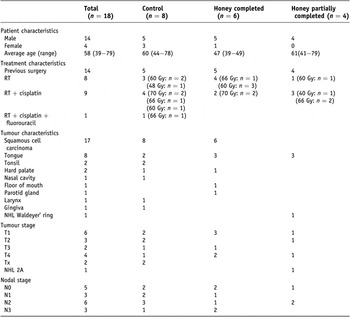
Patient characteristics, treatment regimens and tumour characteristics for the three arms are shown in Table 1. Palmerston North Hospital recruited 13 patients, Wellington Hospital recruited 13 patients and Dunedin Hospital recruited 2 patients. The majority (78%) of patients were male. The average age of the patients who completed the honey trial was slightly lower (47, range 39–49) than the patients who used 4 weeks of honey (61, range 41–79) and patients who did not use honey at all (60, range 44–78). Almost all (17: 94%) of tumours were squamous cell carcinomas and eight (56%) of these were located on the tongue.
Patient, treatment and tumour characteristics

With respect to treatment, 14 patients (78%) had previous surgery, 9 patients (56%) received concurrent cisplatin and 1 patient received cisplatin/fluorouracil chemotherapy. The RT varied; patients in Palmerston North Hospital received intensity-modulated radiation therapy (IMRT), all other patients received conformal RT. Treatment regimens varied (Table 1); 16 patients received their total dose in 2 Gy fractions, 1 patient received 48 Gy in 20 fractions and 1 patient received 36 Gy in 20 fractions followed by 4 Gy in 2 fractions.
Undiluted manuka honey was not well tolerated
The first six honey patients, who used 20 mL of undiluted honey, pulled out of the trial within the first week because of severe nausea, vomiting and stinging pain in the mouth. Although Motallebnejad et al.Reference Motallebnejad, Akram, Moghadamnia and Moulana14 excluded patients who experienced severe stinging sensations when taking honey, they did not mention how many of their patients presented with this problem. The other three honey trials did not report any honey-associated adverse events.Reference Biswal, Zakaria and Ahmad13–Reference Khanal, Baliga and Uppal16 Our patients complained of the taste, texture, viscosity, sweetness and severe stinging of the honey. Patients who had undergone previous surgery found it difficult to move the undiluted honey around in their mouth. Diluted honey was better tolerated, but even then only six (out of 12) patients used honey during the entire 6 weeks of RT treatment.
Diluted manuka honey did not affect oral mucositis but decreased weight loss
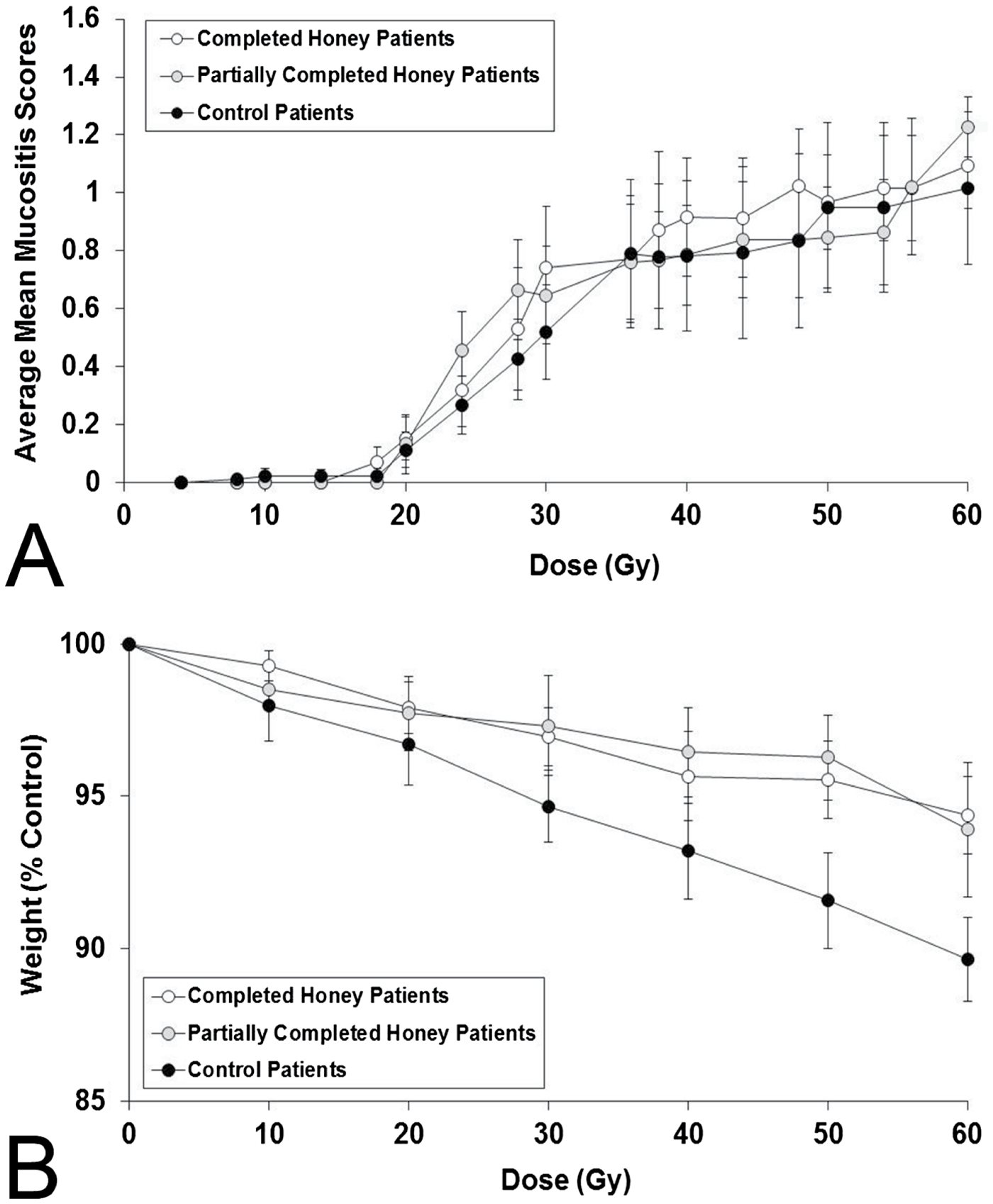
Although we were unable to validate the results of the previous honey trials,Reference Biswal, Zakaria and Ahmad13–Reference Khanal, Baliga and Uppal16 we did evaluate the effect of diluted honey on oral mucositis, weight and QoL. A comparison of data between the three groups of patients (using honey for 6 weeks, 4 weeks or 0 weeks) showed no difference with respect to the extent of oral mucositis during treatment nor the dose at onset (Figure 2a). These findings are in sharp contrast with those of the previous three honey trials.Reference Biswal, Zakaria and Ahmad13–Reference Khanal, Baliga and Uppal16 Despite differences in the types of honey, mucositis scoring and reporting systems and standard care for control patients, all four trials reported a significant reduction in severe oral mucositis in their small cohort of honey patients (n = 20). The main difference between these three trials and our trial is that we diluted the honey (1:3) which is highly likely to have affected its bioactivity.
Effect of manuka honey mouthwash on mucositis scores (a) and weight (b). Results are averages SEM of eight control patients (black symbols) and six patients who completed the honey trial (used honey for 6 weeks: white symbols) and four patients who partially completed the honey trial (used honey for 4 weeks) (grey symbols). * Statistically significant difference between both arms (Unpaired two-tailed Student’s t-test, p < 0.05).
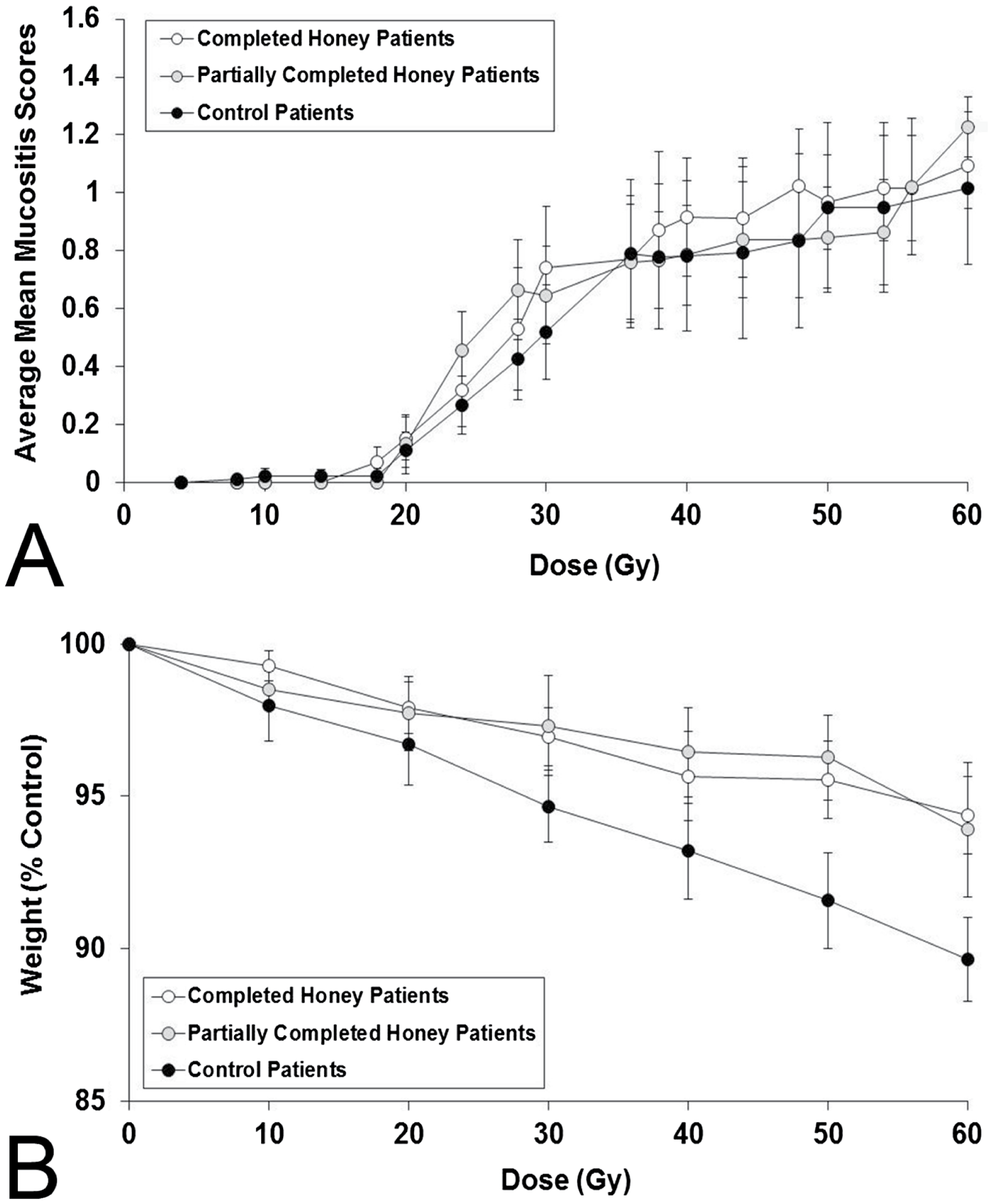
However, although patient numbers were very small, weight measurements showed that manuka honey may have contributed to an amelioration of weight loss in patients who used honey for any length of time when compared with control patients (Figure 2b), which corroborated previous findings by Biswal et al.Reference Biswal, Zakaria and Ahmad13 and Motallebnejad et al.Reference Motallebnejad, Akram, Moghadamnia and Moulana14
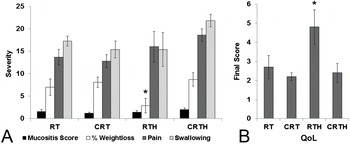
In order to tease out the effect of cisplatin chemotherapy with and without honey on the extent of mucositis, percentage weight loss and several aspects of QoL, we divided the patients into four groups. Scores were compared between patients that received radiation (RT; n = 3), radiation plus honey (RTH; n = 5), chemoradiation (CRT; n = 5) and chemoradiation plus honey (CRTH; n = 5) (Figure 3). Mucositis scores did not differ significantly among the four groups, whereas the RTH group experienced significantly less weight loss than both the CRT and CRTH groups. The decrease in weight loss between the RTH and RT groups was not significant.
Effect of manuka honey with and without cisplatin on different measures. (a) Extent of maximum average mucositis score, percentage weight loss, pain severity and difficulty in swallowing and B. final QoL scores. Measures are averages ± SEM of 3RT (radiation), 5CRT (chemoradiation), 5RTH (radiation and honey) and 5CRTH (chemoradiation and honey) patients. * Statistically significant difference between RTH and all other arms (unpaired two-tailed Student’s t-test, p < 0.05).

Diluted manuka honey increases overall QoL at the end of treatment
We compared the overall QoL scores at the start and end of treatment. The average overall QoL scores at the start of treatment were very similar among the four groups (results not shown), but the scores at the end of treatment were significantly higher for the RTH group than for the other three groups (Figure 3b). We also grouped several questions of both questionnaires together in a pain domain and a swallowing domain (see ‘methodology’ section). All groups scored similarly in both domains, although the CRTH group had more difficulty in swallowing than the other groups. There was no significant difference between the four arms with respect to the amount of pain medication or nutritional support (in the form of fortisip liquid food and PEG feeding). None of the patients on the trial experienced treatment delays. These results show that manuka honey appears to ameliorate RT-induced weight loss and increases overall QoL scores but this effect is completely abrogated by cisplatin chemotherapy. Previous honey trials tested honey in patients who had not undergone previous surgery and only received RT.Reference Biswal, Zakaria and Ahmad13,Reference Motallebnejad, Akram, Moghadamnia and Moulana14,Reference Khanal, Baliga and Uppal16 Patients in the trial by Rashad et al.Reference Rashad, Al-Gezawy, El-Gezawy and Azzaz15 did receive cisplatin but had not undergone previous surgery. In our trial, five out of eight control patients and nine out of ten honey patients had undergone previous surgery, which is likely to have contributed to pain and difficulty in swallowing. In addition, a total of five out of eight control patients and five out of ten honey patients received chemoradiation. It is possible that patients in our cohort experienced more severe mucositis than patients in previous trials and that the honey was too diluted to affect mucositis scores but was still effective in decreasing weight loss and increasing QoL scores in the absence of cisplatin chemotherapy.
Limitations of the current study
We acknowledge that our study is limited by very low patient numbers; we stopped the trial early because preliminary analysis showed that the diluted honey did not decrease the extent of oral mucositis and there were still significant issues with patient compliance due to the honey-related side effects. We could not blind the trial because we could not find an acceptable placebo. The taste and oral sensation of honey is very difficult to reproduce. The research radiation therapists could not be kept blinded to the trial arms because they saw the patients every day and patients tended to talk about their experience with the honey, especially if it caused side effects. Although we randomised the first 20 patients using computer-generated numbers, the next eight patients were all assigned to the diluted honey arm so that we could more rapidly test patient compliance. However, patient, tumour and treatment characteristics seemed to be evenly spread between both arms. The research radiation therapists were all trained in the multi-site mucositis scoring system to minimise inter-scorer variability.
In conclusion, in contrast to previous honey trials in Malaysia, Egypt, Iran and India, diluted manuka honey did not decrease the extent and onset of radiation-induced oral mucositis. However diluted honey appeared to ameliorate radiation-induced weight loss and increase QoL in the absence of cisplatin chemotherapy. Further research into the effect of a more concentrated buffered honey mouthwash on oral mucositis is therefore warranted, particularly in patients treated with RT alone.
Acknowledgements
The authors acknowledge Comvita NZ Ltd, who supplied the honey for this trial free of charge.
Declaration of interest The authors declare no conflict of interest. This study was supported by a research grant of Otago University (New Zealand).