The present study considers the electrophysiological correlates of language processing from a new perspective: that of information structure processing in a second language (L2). Information structure relates primarily to the interface between syntactic or prosodic form and pragmatic function, and, among other functions, it establishes focal relations between constituents (Lambrecht, Reference Lambrecht1994). In English, the predominant means of marking focus (i.e., the new or relevant information about the topic of an utterance) is by word accent (i.e., stress or pitch accent). For example, in the sentence, “I’m eating CURRY for dinner,” the spoken language marks “curry” as focal via stress and allows it to carry an informational meaning (e.g., it delivers new or relevant information, perhaps in response to a preceding question) or a contrastive sense (e.g., the speaker contrasts curry with other dining options that may already be stored in working memory). French also has ways of instantiating contrastive and informational focus, but, compared to English, it relies more heavily on syntactic constructions (Lambrecht, Reference Lambrecht1994). One such construction is the French focus-marking c’est “it is” cleft, illustrated in the sentence from Gérard de Nerval’s Sylvie, “C’est une image que je poursuis, rien de plus [It is an image that I’m pursuing, nothing more]” (1853/2006, p. 30). Such clefts consist of a copula clause (c’est une image) followed by a relative clause (que je poursuis); une image is the focal clefted noun and is coindexed by the two clauses.
As the c’est cleft provides pragmatic and semantic information via a syntactic construction, it lends itself to experimental manipulations that affect both syntax and semantics and allows for investigation into processing phenomena that differ from simple semantic and syntactic violations, which have been widely studied. Moreover, as an interface phenomenon, the processing signatures associated with this structure can inform as to the possibility of nativelike processing at the syntax-pragmatics interface (e.g., Sorace, Reference Sorace2000). Additionally, as different types of focus are predicted to incur different burdens on working memory capacity (Cowles, Reference Cowles2003), brain-based measures that reflect working memory load may be used to test these predictions.
Using the event-related potential (ERP) methodology, we consider the processing of informational focus and contrastive focus in French as a first language (L1) and as a L2. This neuroimaging technique can reveal indices of nativelikeness in L2 processing and working memory load without relying on behavioral data. For the processing of clefted nouns compared to nonfocal words in a sentence, previous findings led us to hypothesize a word-long increase in positivity in L1 French. For the processing of contrastive focus relative to informational focus, we hypothesized an early increase in negativity at the clefted noun, which would reflect an increased working memory load for L1 French speakers. For L2 French learners, we predicted that L2 proficiency would modulate the nativelikeness of processing for the same focus structures, with higher proficiency learners more closely resembling native speakers.
The theoretical motivations for this study are twofold. First, the results add to the existing (and somewhat mixed) literature describing the neural substrates engaged by focus processing, and, in particular, our experiment follows up on work testing Cowles’s information structure processing hypothesis (Cowles Reference Cowles2003; Cowles, Kluender, Kutas, & Polinsky, Reference Cowles, Kluender, Kutas and Polinsky2007). Second, the question of the modulatory effect of L2 proficiency on focus processing is related to the dynamic progression of ERPs previously observed for morphosyntactic processing over the course of L2 learning (e.g., Osterhout et al., Reference Osterhout, Poliakov, Inoue, McLaughlin, Valentine, Pitkanen and Hirschensohn2008; Steinhauer, White, & Drury, Reference Steinhauer, White and Drury2009; White, Genesee, & Steinhauer, Reference White, Genesee and Steinhauer2012).
LITERATURE OVERVIEW
French Focus Structure
Lambrecht (Reference Lambrecht1994, Reference Lambrecht, Haspelmath, König, Oesterreicher and Raible2001, Reference Lambrecht, Breul and Göbbel2010) has shown that the dominant strategies for indicating focus vary as a function of language-specific constraints on syntax and prosody. For example, English, to a large extent, uses word-level stress accent to identify focal status and enjoys relative freedom in its placement. In comparison, although French also uses stress accent for focus marking, a language-specific constraint against focal elements in preverbal position forces French to rely frequently on syntactic constructions that place the focal element in postverbal position (Carter-Thomas, Reference Carter-Thomas, Banks, Eason and Ormrod2009; Katz, Reference Katz2000; Lambrecht, Reference Lambrecht, Breul and Göbbel2010). Consider the following examples, which reflect a familiar register of spoken French and English and which use small caps to denote word accent and focus. Given the question Qui c’est qui va à Amsterdam? “who’s going to Amsterdam?” an appropriate answer in English would be Fred is going to Amsterdam, in which the focal element is preverbal. By contrast, in French the answer would not be the equivalent *Fred va à Amsterdam “Fred is going to Amsterdam” but rather C’est Fred qui va à Amsterdam “It’s Fred who is going to Amsterdam,” in which the focal element is not preverbal but instead follows the verb est. The use of focus-marking clefts in French also extends to arguments that are not preverbal. For example, as an answer to when’s he going to Amsterdam?, English speakers would say He’s going to Amsterdam tomorrow. French natives, in response to the equivalent question Quand c’est qu’il va à Amsterdam?, would say C’est demain qu’il va à Amsterdam “It’s tomorrow that he’s going to Amsterdam” in place of Il va à Amsterdam demain “He’s going to Amsterdam tomorrow.” For purposes of illustration, the responses in these question-and-answer pairings are more verbose than other possible responses likely to occur in spontaneous speech (e.g., who’s going to Amsterdam? Fred.); however, such pairings of focus structures are attested and are predicted to be felicitous by virtue of their corresponding focus structures (e.g., Lambrecht, Reference Lambrecht1994; Myers, Reference Myers2007), and judgment data from native and L2 speakers support their felicity (Reichle, Reference Reichle2010a).
In the case of spoken English, then, stress accent is exploited to provide a pragmatically appropriate response, whereas French tends to employ the c’est . . . que cleft construction to indicate focus in both written and spoken modalities (Carter-Thomas, Reference Carter-Thomas, Banks, Eason and Ormrod2009; Reichle, Reference Reichle2012). This cleft expresses a single proposition by way of biclausal syntax, with a copula clause and a relative clause sharing a referent (Lambrecht, Reference Lambrecht, Haspelmath, König, Oesterreicher and Raible2001), and, when situated in discourse, it leads interlocutors to expect subsequent utterances to have congruous focus structures. Congruous focus structures in discourse are those that felicitously treat information that is no longer new or relevant as topical and treat information that is expected to be new or relevant to the interlocutor as focal. Consider the following utterances spoken in the presence of a hammer on a table.
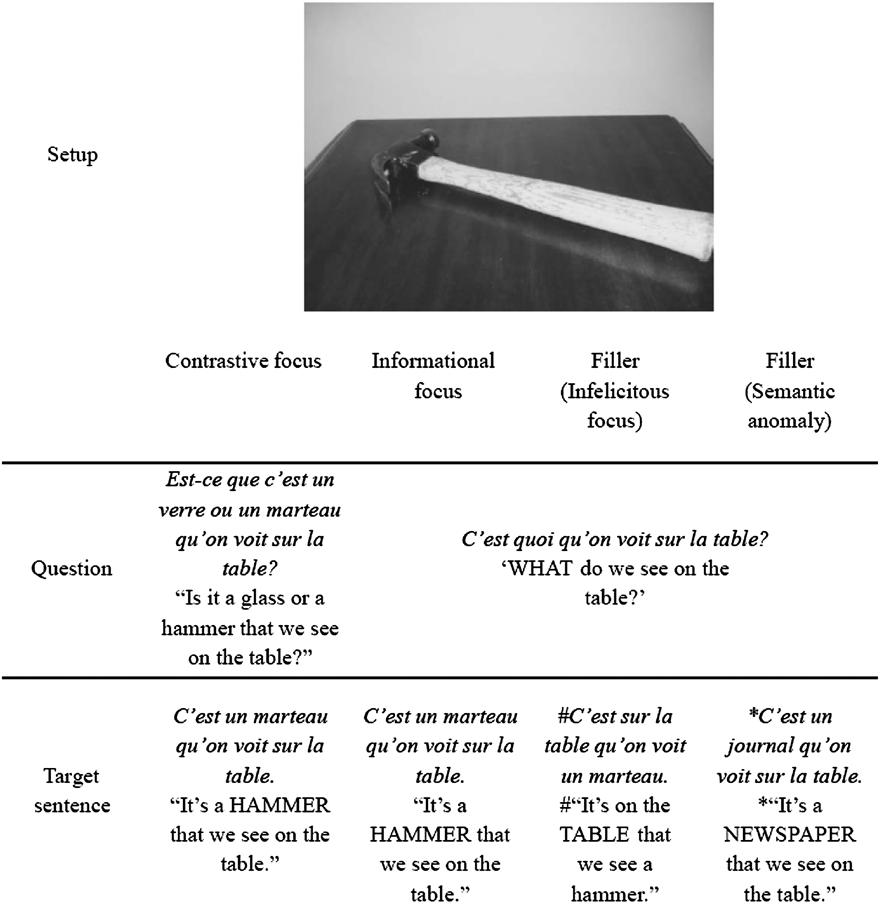
(1) C’est quoi qu’on voit sur la table?
it is what that one sees on the table
“what do we see on the table?”
(2) C’est un journal ou un marteau qu’on voit sur la table?
it is a newspaper or a hammer that one sees on the table
“Is it a newspaper or a hammer that we see on the table?”
(3) C’est un marteau qu’on voit sur la table.
it is a hammer that one sees on the table
“We see a hammer on the table.”
(4) #C’est sur la table qu’on voit un marteau.
it is on the table that one sees a hammer
#“We see a hammer on the table.”
The question in (1) contains a c’est cleft that places focus on quoi “what”; this creates the expectation that the referent coindexed with quoi will be the focal element in the response. A response like (3) is felicitous—if somewhat wordier than is absolutely necessary—because the referent coindexed with the focal quoi in the question (un marteau “a hammer”) is also focal in the response. This is an instantiation of informational focus, as it is informing the listener of (i.e., activating) a new or inactive referent. The pairing of question (2) with the response in (3), in contrast, does not activate a new referent but rather selects one previously active member of a set and is, therefore, an instantiation of contrastive focus. Finally, sentence (4) is infelicitous or incongruous (as indicated by #) as a response to (1) or (2) because sur la table “on the table” is marked as focal, despite previously being treated as a topic. Hupet and Tilmant (Reference Hupet and Tilmant1986) found that native French speakers prefer—and more quickly comprehend—felicitous clefts over sentences lacking clefts when the delivery of focused information is predicted by context. Similarly, Reichle (Reference Reichle2010a, Reference Reichle2012) found that native speakers consider pairings such as (1) and (3) to be more acceptable than infelicitous pairings such as (1) and (4) and read them more quickly.
We expect that one difference between types of focus (at least in terms of processing) is that contrastive focus requires a set of referents to remain active in working memory until focus is delivered, whereas informational focus does not require the activation of a set of referents. Contrastive focus should therefore place a greater burden on working memory compared to informational focus, and this difference should be reflected in ERPs. The question of working memory load is particularly important in light of McDonald’s (Reference McDonald2006) and Hopp’s (Reference Hopp2010) accounts of L2 processing as being hindered by reduced access to cognitive processing capabilities such as working memory. Under these accounts, differential ERP indices of working memory load may reflect reduced access to working memory (and, therefore, nonnativelike processing) in the L2.
From the angle of L2 acquisition, the focus-marking c’est cleft is interesting inasmuch as it relates to the syntax-pragmatics interface, and the second motivation of the present study is to investigate the possibility of nativelike processing of this interface phenomenon by L2 learners. Sorace has proposed that phenomena at the syntax-discourse interface can pose problems for near-native L2 learners (e.g., Sorace, Reference Sorace2000; Sorace & Serratrice, Reference Sorace and Serratrice2009). For example, in Italian discourse, the presence or absence of a subject pronoun depends on prior mention of the referent of that pronoun. If the referent is already established in the discourse, the subject pronoun is not required, and its absence is felicitous. Thus, Italian subject pronoun occurrence is determined by the topic and focus states of referents in the utterance. In contrast, English lacks subject pronoun optionality and thus cannot use this syntactic mechanism in structuring topic and focus at the syntax-semantics interface. Sorace suggests that the discourse feature associated with subject optionality may remain unspecified in advanced L2 learners of Italian due to these L1-L2 differences. As for focus marking, English and French employ different discourse-dependent strategies to mark topic and focus; thus, we may expect Anglophone learners of L2 French to have problems acquiring and processing these strategies.
ERP Signatures of Language Processing
ERP Signatures of L1 and L2 Processing
The ERP technique measures changes of voltage at the scalp that reflect the electrical activity of postsynaptic potentials in the cortex; this technique is used as an online measure of processing. In this section, we summarize four relevant ERP patterns, or effects, that are reliably elicited by linguistic stimuli: the N400, P600, left-anterior negativity (LAN), and P3 effects.
Prior work on the ERPs of L1 and L2 processing has not extensively treated interface phenomena but has, rather, centered on more prototypical semantic and morphosyntactic phenomena. Traditional approaches to these areas of processing have tended to dichotomize the ERPs of semantic and morphosyntactic processing (although see Kutas, Van Petten, & Kluender, Reference Kutas, Van Petten, Kluender, Traxler and Gernsbacher2006, for a review of findings contra this dichotomy). Anomalies related to semantics generally elicit a N400 effect, which is a right-posterior or bilateral increase in negativity 400 ms after the presentation of a lexical or semantic violation, such as “I took a bite of the windmill” (Kutas & Hillyard, Reference Kutas and Hillyard1980). Van Berkum (2009) has portrayed the N400 as a reflection of effortful retrieval of conceptual information from semantic long-term memory, modulated by context and relevance signals such as word choice and, notably, focus marking. The major ERP effect associated with morphosyntax violations is the P600 effect, a late increase in positivity in the centroparietal region of the scalp approximately 600 ms after the presentation of syntactic violations, such as “The cats won’t eating the food” (Osterhout & Holcomb, Reference Osterhout and Holcomb1992; Osterhout & Nicol, Reference Osterhout and Nicol1999). Various causes for syntactic reanalysis elicit a P600 effect, including garden-path sentences, phrase structure anomalies, verb tense anomalies, subject-verb agreement anomalies, and violations of grammatical gender (e.g., Osterhout, McLaughlin, & Bersick, Reference Osterhout, McLaughlin and Bersick1997; Wicha, Moreno, & Kutas, Reference Wicha, Moreno and Kutas2004). Phrase structure and morphosyntax violations often lead to a LAN that precedes a P600, although the LAN is present with less reliability and uniformity than the P600 (Neville, Nicol, Barss, Forster, & Garrett, Reference Neville, Nicol, Barss, Forster and Garrett1991; Osterhout & Holcomb, Reference Osterhout and Holcomb1992; Steinhauer & Connolly, Reference Steinhauer, Connolly, Stemmer and Whitaker2008). The LAN has been suggested to reflect an increase in working memory load (Cowles, Reference Cowles2003; van Berkum, Brown, & Hagoort, Reference van Berkum, Brown and Hagoort1999). Finally, the P3 or P300 component is a positive shift peaking around 300 ms that is believed to correspond to the resolution of uncertainty; it has been documented in experimental contexts that are both linguistic and nonlinguistic in nature (Sutton, Braren, Zubin, & John, Reference Sutton, Braren, Zubin and John1965). The P3 has been observed for the processing of focus markers other than the c’est cleft (Bornkessel, Schlesewsky, & Friederici, Reference Bornkessel, Schlesewsky and Friederici2003; Cowles et al., Reference Cowles, Kluender, Kutas and Polinsky2007; Magne et al., Reference Magne, Astésano, Lacheret-Dujour, Morel, Alter and Besson2005) and is therefore a plausible candidate for an index of focus marking in the context of interest.
Given that contrastive focus and informational focus may be expected to place different burdens on working memory—that is, the processing of contrastive focus requires that a set of referents remain active in working memory, whereas the processing of informational focus does not—it is plausible to expect that the presence of a LAN may reflect the more working-memory-intensive instantiations of focus marking. A P3 effect may be expected when focus marking is used as a vector of information delivery and thereby resolves uncertainty. In other words, for the processing of syntactically marked focus structure, P3 and LAN effects are both possible candidates for processing signatures.
That said, the story becomes more complicated when one considers that the processing of a late-learned (and possibly incompletely learned) L2 may not resemble the processing of the mature native language. Here, too, most previous findings have related to N400 and P600 effects. Adult L2 learners usually exhibit a N400 effect in their L2 for semantic anomalies, although sometimes of a weaker amplitude or altered latency compared to what they would exhibit for their L1 (see Mueller, Reference Mueller2005, for an overview). For syntactic anomalies, in contrast, low-proficiency learners do not consistently exhibit P600 (or biphasic LAN/P600) effects; rather, they show an early negativity that more closely resembles a N400 than a LAN, or they show a P600 effect of relatively low amplitude (e.g., Weber-Fox & Neville, Reference Weber-Fox and Neville1996). Higher proficiency learners, in contrast, may exhibit nativelike signatures, and recent studies have reported evidence for nativelike processing among learners with higher levels of classroom training time, immersion time, or L2 proficiency (e.g., Gillon Dowens, Vergara, Barber, & Carreiras, 2010; McLaughlin, Osterhout, & Kim, Reference McLaughlin, Osterhout and Kim2004; McLaughlin et al., Reference McLaughlin, Tanner, Pitkänen, Frenck-Mestre, Inoue, Valentine and Osterhout2010; Osterhout, McLaughlin, Pitkänen, Frenck-Mestre, & Molinaro, Reference Osterhout, McLaughlin, Pitkänen, Frenck-Mestre and Molinaro2006; Rossi, Gugler, Friederici, & Hahne, Reference Rossi, Gugler, Friederici and Hahne2006; Steinhauer et al., Reference Steinhauer, White, King, Cornell, Genesee and White2006; Tanner, Osterhout, & Herschensohn, Reference Tanner, Osterhout, Herschensohn, Chandlee, Franchini, Lord and Rheiner2009) as well as for grammatical features that are similar between the L1 and L2 (Foucart & Frenck-Mestre, Reference Foucart and Frenck-Mestre2011). McLaughlin et al. (Reference McLaughlin, Tanner, Pitkänen, Frenck-Mestre, Inoue, Valentine and Osterhout2010), Osterhout et al. (Reference Osterhout, McLaughlin, Pitkänen, Frenck-Mestre and Molinaro2006), and Steinhauer et al. (Reference Steinhauer, White and Drury2009) characterize these tendencies in terms of a sequence of L2 ERP components that change as a function of L2 proficiency. Novice learners presented with morphosyntactic errors exhibit a N400. Then, as proficiency increases, they show a small P600, then a larger P600, and a possible bilateral or lateralized anterior negativity followed by a P600 like that observed for native speakers.
One might plausibly expect to see a similar sequence of qualitative and quantitative changes in the L2 ERP components elicited by the processing of focus structure. However, such a sequence would presumably not involve N400 and P600 effects because the processing of felicitous focus structure does not relate to semantic or morphosyntactic violations. Instead, the L2 trajectory of focus processing ERPs would likely consist of different ERP components, such as the P3 or LAN effects, that increase in amplitude with increasing L2 proficiency. Such a trajectory would be consistent with the notion that L2 speakers exhibit ERPs that are closer in amplitude and timing to those of native speakers as their proficiency increases.
ERP Correlates of Focus Structure Processing
Previous ERP investigations of focus processing in the L1 provide additional reasons to expect negativity or positivity effects for the processing of the French c’est cleft. The ERP studies most directly relevant to the present investigation have tested Cowles’s information structure processing hypothesis, which predicts differential ERPs for different focus structures. The reasoning behind this hypothesis is that different information structures correspond to different levels of mental activation of referents, which, in turn, elicit different ERPs as referents are tracked across discourse and integrated into the mental representation of meaning.
Cowles et al. (Reference Cowles, Kluender, Kutas and Polinsky2007) examined the ERPs for focus structure violations in wh-question-and-answer pairs containing English it clefts. The fact that the N400 effect is modulated by cloze probability (Kutas & Hillyard, Reference Kutas and Hillyard1984) can be interpreted as evidence that prior semantics restricts the choice of possible referents in an utterance. Along the same lines, Cowles and colleagues hypothesized that much like the semantics of prior discourse, prior information structure also limits the possible referents in an utterance. If this is the case, then an unexpected or infelicitous information structure could lead to the same N400 observed for semantic violations. Cowles and colleagues also formulated hypotheses relating to the P600 component: In constructions in which a syntactic position is reserved for a focus-bearing constituent, a mismatch should result in a P600, as a mismatch between the focal element and the syntactic position could be processed as a phrase structure violation. Adult native English speakers were visually presented with a context paragraph that ended with a wh-question asking which member of a set of nouns was the patient of some action. Participants then read target sentences featuring cleft constructions that either congruously marked the patient as focal or incongruously marked the agent as focal. Target words in anomalous sentences elicited an increase in negativity from 200 to 500 ms postonset. The authors tentatively interpreted the negativity as a N400 and suggested that the lack of a prominent peak on this negativity could be due to dampening by a superimposed positivity. They also found a late positivity for the clefted word in both the control and anomalous cases; the authors suggested this could be a manifestation of the P3 component (Sutton et al., Reference Sutton, Braren, Zubin and John1965), as the delivery of focus information could be interpreted as the resolution of uncertainty. These findings give us reason to believe that the processing of focal elements elicits a positive component, regardless of whether the focus is congruous or incongruous.
Cowles (Reference Cowles2003) used similar items to assess whether contrastive focus, which requires that a set of referents be kept active in working memory, is associated with different ERPs from informational focus, which does not require activation of a referent set. Identical setup contexts and target sentences were used across conditions; the crucial difference was the question preceding the target sentence, which created an instantiation of contrastive focus (Which referent did X?) or informational focus (Did anyone do X?) in the response. According to Cowles’s information structure processing hypothesis, the differences in discourse context created by the questions would elicit divergent ERPs in the target sentences. The results supported this hypothesis: There was a nonlateralized anterior negativity for the contrastive focus items, which was interpreted as being similar to a LAN corresponding to increased working memory load, as members of the referent set were kept active in anticipation of focus marking at the clefted noun.
Other studies have observed positivity effects for focus processing. Bornkessel et al. (Reference Bornkessel, Schlesewsky and Friederici2003) examined German native speakers’ ERPs for the processing of nouns in licensed and unlicensed topic and focus positions. For subjects and objects receiving contextually predicted focus, a positivity from 280 to 480 ms was observed. This positivity was tentatively identified as an instance of the P3 component and was interpreted as a marker of focus integration. Stolterfoht and colleagues presented native German-speaking participants with stimuli that forced them to revise their parse of the sentence’s focus structure or to revise the implicit prosodic structure of the written sentence (Stolterfoht & Bader, Reference Stolterfoht, Bader and Steube2004; Stolterfoht, Friederici, Alter, & Steube, Reference Stolterfoht, Friederici, Alter and Steube2007). A bilateral positivity was observed from 350 to 1,100 ms posttarget word for the focus structure revision stimuli, and a widely distributed negativity was observed from 450 to 650 ms for the implicit prosody revision stimuli. Magne et al. (Reference Magne, Astésano, Lacheret-Dujour, Morel, Alter and Besson2005) examined the role of prosody in the processing of French focus structure. Incongruous accents elicited an increased positivity from 300 to 1,050 ms when the target word was sentence medial, but when the target word was sentence final, it elicited an increased negativity from 150 to 1,050 ms. Notably, the authors interpreted the positivity as a P3 effect, again suggesting a link between focus marking and the resolution of uncertainty.
To summarize, the results from previous studies of information structure have been mixed. Some of the studies have found increased positivity for the processing of congruous information structure that seems to reflect the resolution of uncertainty (e.g., Bornkessel et al., Reference Bornkessel, Schlesewsky and Friederici2003; Cowles et al., Reference Cowles, Kluender, Kutas and Polinsky2007; Hruska, Steinhauer, Alter, & Steube, 2000), whereas others have seen anterior negativities corresponding to working memory load (Cowles, Reference Cowles2003). At the same time, various effects have been seen for the processing of incongruous information structure, ranging from increased negativities reflecting a lack of expected focus (Hruska et al., 2000) to positivities in the same context (Magne et al., Reference Magne, Astésano, Lacheret-Dujour, Morel, Alter and Besson2005), to biphasic N400-P600 patterns for information structure mismatch (Hruska & Alter, Reference Hruska, Alter and Steube2004), and to a lack of any significant effect for extraneous word accent (Hruska et al., 2000). As the Cowles et al. (Reference Cowles, Kluender, Kutas and Polinsky2007) and Cowles (Reference Cowles2003) studies tested structures that resembled those used to mark focus in French, we hypothesized, on the basis of their findings, that native French speakers exposed to focus-marking syntactic constructions would display P3 effects signifying the resolution of uncertainty at the clefted noun as well as a LAN corresponding to an increase in working memory load for the processing of contrastive focus compared to informational focus. As for the question of the nativelikeness of L2 processing signatures for the same items, we hypothesized that L2 proficiency would modulate the nativelikeness of ERPs.
PRESENT STUDY
As previously stated, there were two theoretical motivations for the present study. We first wanted to test Cowles’s (Reference Cowles2003) information structure processing hypothesis using contrastive focus and informational focus instantiated by the French c’est cleft. Second, it was our desire to add to the recent studies examining the modulatory effect of L2 proficiency on nativelikeness of processing signatures and to add the novel element of focus structure to such an investigation.
We therefore designed an ERP experiment to address the following research questions:
1. Does processing contrastive focus elicit an early increase in negativity compared to processing formally identical informational focus constructions? Following Cowles (Reference Cowles2003), we predicted an early anterior increase in negativity for contrastive focus at clefted nouns.
2. Does the processing of clefted nouns receiving informational or contrastive focus elicit a word-long positive shift? In light of previous findings, we hypothesized a positive shift at focal clefted nouns compared to other words in the sentence; such a positivity would reflect the integration of focus marking—that is, retrieval of the focus-marking sense of the cleft construction.
3. With respect to the previous research questions, does L2 proficiency modulate the nativelikeness of L2 ERPs? We hypothesized that L2 proficiency would modulate the amplitude of the ERPs for the conditions described previously. Such results would be consistent with the modulatory effect of L2 proficiency previously observed for violations of morphosyntax.
METHOD
Participants
Two participant groups took part in the study: adult L1 speakers of French (n = 12; 5 males, 7 females) and adult L2 learners of French (n = 24; 6 males, 18 females), all of whom spoke English as a L1. Testing took place at an ERP lab at a public university in the United States, and participants were members of the local French-speaking community or the university. Learners with a minimum of four semesters of classroom French instruction at the university level were considered for inclusion in the L2 group; members of this group ranged from fifth-semester students to those at more advanced levels (including graduate students in French). Second language proficiency was operationalized as the average of their self-reported speaking, reading, listening, and pronunciation levels, as measured by the Language Experience and Proficiency Questionnaire (LEAP-Q); this questionnaire was chosen for its external validity, as measured by its correlation with other (non-self-reported) measures of L2 proficiency (Marian, Blumenfeld, & Kaushanskaya, Reference Marian, Blumenfeld and Kaushanskaya2007). Self-ratings were on a scale from 1 (least nativelike) to 10 (most nativelike). The overall average of proficiency ratings was 6.53 (SD = 1.48). Participants’ age of exposure (AoE), operationalized here as the age of initial classroom exposure to the L2, was also collected. Average AoE was 15.4 years (range = 7–24 years; SD = 4.04). To help confirm the validity of the self-reported measures, L2 learners also completed a cloze test adapted from a college-level French text (see the Appendix). Performance on the cloze test correlated strongly with average self-reported proficiency ratings (r = .73, p < .001).
All participants were at least 18 years of age and were right-handed. The average age at the time of testing was 31.5 years for the L1 speakers (range = 19–48; SD = 8.73) and 25.6 years for the L2 learners (range = 18–48; SD = 7.08). Nineteen of the L2 participants had spent time in a French-speaking environment (M = 0.77 years). Seven of the L2 learners also spoke Spanish, and, in all cases, this was a classroom-taught, late-learned foreign language. Three L2 participants were late classroom learners of German, and two were late classroom (college-level) learners of Italian. One L2 learner was a bilingual speaker of Tagalog. On average, the L2 learners reported being exposed to French 14% of their time during the week (range = 0–40%).
The L2 group was further split into two subgroups to allow for additional analyses. The high-proficiency L2 subgroup consisted of 12 participants (3 males, 9 females) with average self- reported proficiency ratings of 7 or greater (overall M = 7.70; SD = .46); the low-proficiency L2 subgroup was composed of 12 participants (3 males, 9 females) with average self-reported proficiency ratings of less than 7 (overall M = 5.36; SD = 1.18). An independent-samples t test confirmed a significant difference in average self-reported proficiency ratings between the two subgroups, t(22) = 6.36, p < .001. Participants were closely matched for AoE between the two L2 subgroups to control AoE as a variable; this was done in an effort to minimize the effects of variables other than proficiency across subgroups (Birdsong, Reference Birdsong2006). The average AoE for the low-proficiency subgroup was 16 years (range = 7–24; SD = 4.44), and the average AoE for the high-proficiency subgroup was 14.75 years (range = 10–23; SD = 3.50). An independent-samples t test confirmed that there was no significant difference in AoE between the subgroups, t(22) = .755, p > .458.
In an accompanying behavioral task, participants judged the acceptability of each sentence after reading it. The results of this task have previously been reported in the context of another behavioral study (Reichle, Reference Reichle2010a). To briefly summarize those findings, we found that the judgments for all participant groups approached ceiling for the informational focus, contrastive focus, and semantic filler items (96.5–99.5% accuracy). This suggests that all participants were capable of comprehending the stimuli. At the same time, participants in all groups encountered difficulty judging the accuracy of the infelicitous focus fillers (L1 = 47.3%; low L2 = 24.9%; high L2 = 53%), which suggests that explicit knowledge of focus marking for the lower proficiency learners differed from that of the other groups. The electroencephalographic (EEG) data of several of the participants whose behavioral data have already been reported were affected by a blocked channel (T8), which prevented their inclusion in the ERP analysis reported here.
Materials
Participants were shown photographs of household objects. These images were followed by questions and responses relating to the photographs, and the pairing of the question and the response instantiated contrastive or informational focus. The responses were the target sentences, which consisted of 50 informational focus sentences, 50 contrastive focus sentences, and 100 fillers (see Figure 1). The fillers were part of another experiment and consisted of 50 sentences containing a semantic anomaly and 50 sentences containing an infelicitous focus structure configuration, the results for which have previously been reported (Reichle, Reference Reichle, Chandlee, Franchini, Lord and Rheiner2009). The target sentences in the informational and contrastive focus conditions had identical surface forms and differed only by the preceding question. The lexical items used in the target sentences were balanced across conditions. Stimuli were presented in eight randomized blocks of 25 items. The blocks were presented in different orders between participants to minimize list effects.
Sample items.

The visual modality was chosen for stimuli presentation to eliminate L2 learners’ auditory comprehension as a potentially confounding factor. This was especially important for the low-proficiency L2 learners, as low levels of listening proficiency could have impeded their comprehension of the stimuli. As an anonymous reviewer noted, the choice of written stimuli might seem unintuitive given that the c’est cleft is most typical of spoken French and, consequently, the low-proficiency learners may have had little experience with it in written form. Given the trade-off between naturalistic stimuli and auditory processing concerns, we made a judgment call in favor of written stimuli. We argue that the choice of written items is in line with Cowles’s (Reference Cowles2003) and Cowles et al.’s (Reference Cowles, Kluender, Kutas and Polinsky2007) previous work on English it clefts (which are much rarer and less conventionalized than the French cleft) and that auditory processing concerns regarding the learners outweighed the desire for more naturalistic spoken stimuli. We used photographs for context to reduce the need to provide the participants with elaborate contextual information provided via written text or auditory presentation.
Procedure
Participants were seated approximately 1 m away from a monitor in a sound-attenuating shielded booth. For each item, the participant was presented with a photograph of a household object on a table followed by a question and response relating to the contents of the photograph. The photographs were presented onscreen for 3 s followed by a 1 s pause. The question portion of the item then appeared onscreen for 3 s, after which a fixation crosshair appeared for 1 s. The target sentence (i.e., the response to the question) was then presented one word at a time, with each word appearing at the center of the screen for 300 ms. The interval between the onsets of each word in the target sentence was 650 ms. Using a small response box held in their right hand, participants indicated whether they thought the target sentences would be acceptable in spoken French. An acceptable sentence was defined for the participants as one that they could imagine a person saying that would not seem unusual given the preceding context. After 10% of the items, a yes/no question about the contents of the preceding image (e.g., “Was the apple in the image red?”) was displayed for 3 s, during which time the participant pressed a yes or no button on a response box; this was to ensure that the participants were attentive to the images and to break up the monotony of stimulus repetition.
Before presentation of stimuli, participants were given a brief pretest of vocabulary items. Participants were first asked if they recognized the content words used in the experimental stimuli. They were then shown the definitions of the words, followed by photographs corresponding to each of the words (these were the same photographs seen during the experiment). This was to ensure that all participants, particularly the low-proficiency L2 speakers, understood the content words in the stimuli. Participants were also shown a list of 10 decontextualized sentences typical of informal spoken French (Myers, Reference Myers2007), such as Où que tu vas? “Where are you going?” Y a le téléphone qui sonne “The phone’s ringing,” and T’as mal au genou? Non, c’est mon pied qui me fait mal “Your knee hurts? No, it’s my foot that hurts.” Participants were informed that the experiment was meant to reflect a register of spoken French similar to that of these decontextualized sentences, and they were asked to verify that they could imagine situations in which these decontextualized example sentences could be spoken, despite the fact that they are usually not written. No data were collected from this task; rather, it was meant to informally acclimate participants to the use of constructions typical of spoken French and to counteract the influence of normative attitudes toward the written modality.
EEG Data Recording and Analysis
EEG data were obtained using a SynAmps hardware system and Scan 4.2 software package from Neuroscan, Inc. Fourteen electrode channels (F3, Fz, F4, F7, F8, T7, T8, C3, Cz, C4, P3, Pz, P4, Oz) were used to acquire the EEG signal, which provided a montage that allowed for analyses of several levels of hemisphere and anteriority factors. These channels were referenced to the linked average of the right and left mastoid. Blink detection was performed using data from the VEOG channel. All impedances were kept below 5 kΩ. A band pass filter of 0.01–100 Hz was used, and data were sampled at a rate of 250 Hz.
One-word epochs consisted of a 100 ms prestimulus onset baseline followed by a 900 ms span poststimulus onset. Epochs with extreme values of ±75 µv were screened for eye blink artifacts or excessive movement and were rejected from further analysis. Under this screening procedure, 9% of epochs were rejected. In light of prior research (e.g., Cowles et al., Reference Cowles, Kluender, Kutas and Polinsky2007), a 200–800 ms time window was used for word-by-word comparisons, and a time window of 200–500 ms was used to test for the presence of LAN and P3 effects. The Greenhouse-Geisser corrected values are reported for all ANOVAs in which sphericity was violated. Due to the asymmetrical electrode montage, separate ANOVAs were conducted for midline and lateral sites, with further pairwise comparisons conducted when effects of condition were present. For all midline ANOVAs, midline site (Fz, Cz, Pz, Oz) was used as a within-subject repeated-measure factor. For all lateral ANOVAs, hemisphere (left, right) and lateral site (central, parietal, temporal, frontotemporal, frontal) were used as within-subject repeated-measures factors.
RESULTS
Informational versus Contrastive Focus
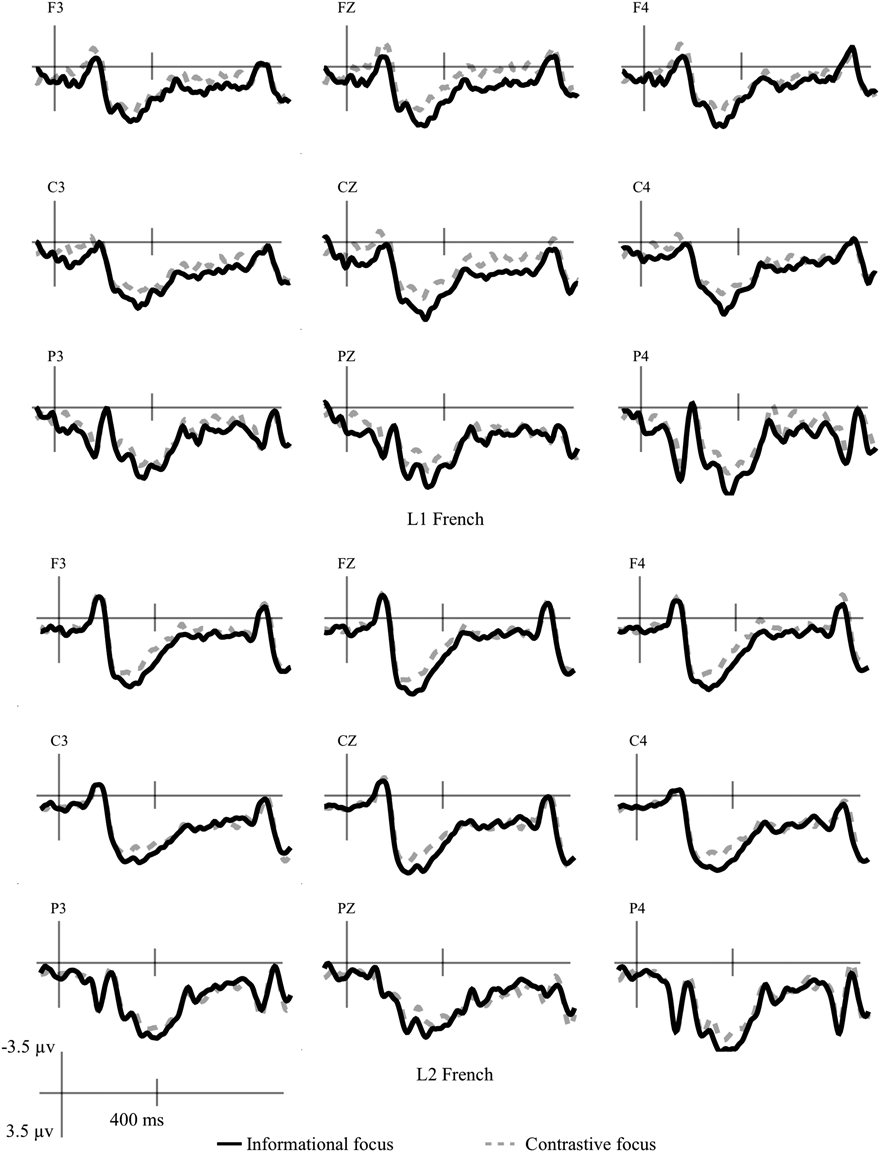
Within the 200–500 ms time window, midline and lateral ANOVAs were performed on mean amplitude data with group (L1 French, L2 French) as a between-subject factor and focus condition (informational, contrastive) as a within-subject repeated-measures factor (see Figure 2).
Averaged responses to the clefted noun for the informational and contrastive focus conditions for both subject groups (L1 French, L2 French). Negative voltage is plotted above the x-axis.
For the midline ANOVA, there was a significant effect of focus condition, F(1, 34) = 7.522, p = .010, partial η2 = .181, reflecting an increase in negativity for contrastive focus compared to informational focus. The interaction of focus condition and midline site was significant, F(2.465, 83.825) = 7.115, p < .001, partial η2 = .173, with the effect largest at anterior sites. The interaction of group and focus condition was not significant at midline sites, F(1, 34) = 0.511, p = .480, partial η2 = .015. For the lateral ANOVA, there was a significant effect of focus condition, F(1, 34) = 11.063, p = .002, partial η2 = .246, corresponding to an increase in negativity for contrastive focus. The interaction of focus condition and hemisphere was significant, F(1, 34) = 10.275, p = .003, partial η2 = .232, with the effect largest over the right hemisphere. The interaction of group and focus condition was not significant at lateral sites, F(1, 34) = 0.001, p = .978, partial η2 < .001. These results indicated the presence of an increase in negativity at the clefted noun from 200 to 500 ms for contrastive focus compared to informational focus, supporting our hypothesis.
Modulatory Effect of L2 Proficiency
To address the hypothesis that L2 proficiency modulates the nativelikeness of focus processing, additional ANOVAs were separately performed on the L2 French data using L2 proficiency (as determined by the averaged speaking, reading, listening, and pronunciation scores on the LEAP-Q) as a continuous covariate. The midline ANOVA showed no significant main effect of focus condition, F(1, 22) = 1.461, p = .24, partial η2 = .062, nor was there a significant interaction of focus condition and L2 proficiency, F(1, 22) = 2.580, p = .122, partial η2 = .105; there was a marginal interaction of focus condition, midline site, and L2 proficiency, F(2.400, 52.801) = 2.586, p = .075, partial η2 = .105. The lateral ANOVA showed no main effect of focus condition, F(1, 22) = 2.34, p = .14, partial η2 = .096. There was a significant interaction of focus condition and L2 proficiency, F(1, 22) = 4.801, p = .039, partial η2 = .179, a finding that supported our hypothesis that proficiency would modulate L2 ERPs.
In light of the significant interaction of focus condition and L2 proficiency across lateral sites in the L2 French group, we regressed L2 proficiency against effect size, as measured by the difference in mean amplitude between focus conditions (informational focus minus contrastive focus) averaged across all sites. This correlation fell at the limit of significance (r = .399, p = .053), again suggesting a modulatory effect of L2 proficiency on ERP effect size.
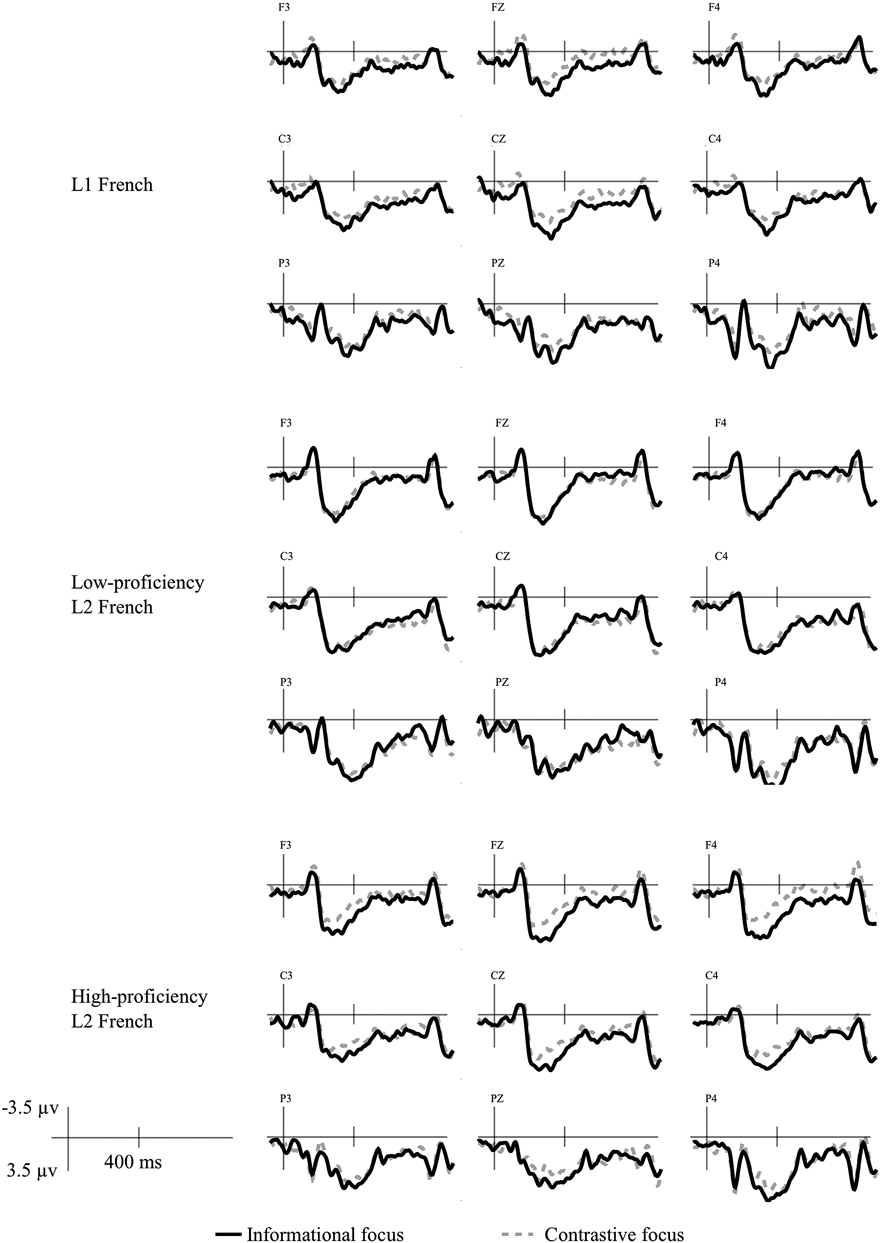
To further assess the relationship between brain responses to focus processing and L2 proficiency, the L2 French group was divided into two subgroups. Under separate subgroup ANOVAs, the low- and high-proficiency L2 subgroups displayed divergent brain responses (Figure 3). The low-proficiency group did not show a significant effect of focus condition at midline site, F(1, 11) = 0.163, p = .694, partial η2 = .015, or at lateral sites, F(1, 11) = 0.570, p = .466, partial η2 = .049, nor was there an interaction between focus condition and midline site, F(2.308, 25.391) = 0.044, p = .971, partial η2 = .004. There was a significant interaction of focus condition and hemisphere, F(1, 11) = 4.929, p = .048, partial η2 = .309, making the increased response at left hemisphere sites the only effect of condition for this subgroup. The high-proficiency subgroup exhibited a significant main effect of focus condition at lateral sites, F(1, 11) = 14.552, p = .003, partial η2 = .569, and a marginal main effect of focus condition at midline sites, F(1, 11) = 3.826, p = .076, partial η2 = .258. Interactions were significant between focus condition and midline site, F(1.999, 21.991) = 7.314, p = .004, partial η2 = .399, and focus condition and hemisphere, F(1, 11) = 11.978, p = .005, partial η2 = .521. In other words, the high-proficiency subgroup’s responses were more widespread, with increasingly large divergences between conditions at more anterior and right-lateralized sites.
Averaged responses to the clefted noun for the informational and contrastive focus conditions for L1 French and the two L2 French subgroups (high proficiency, low proficiency). Negative voltage is plotted above the x-axis.
Positive Shift for Clefted Nouns
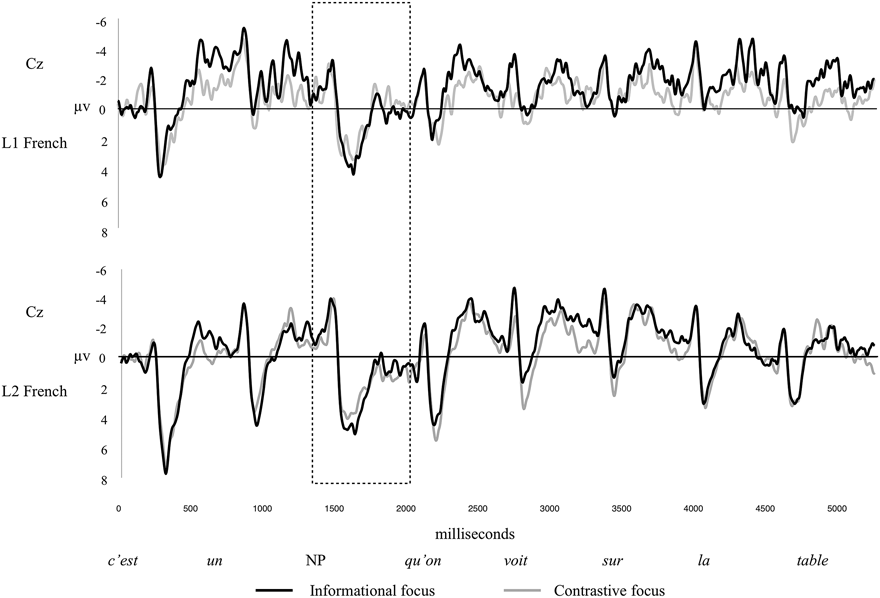
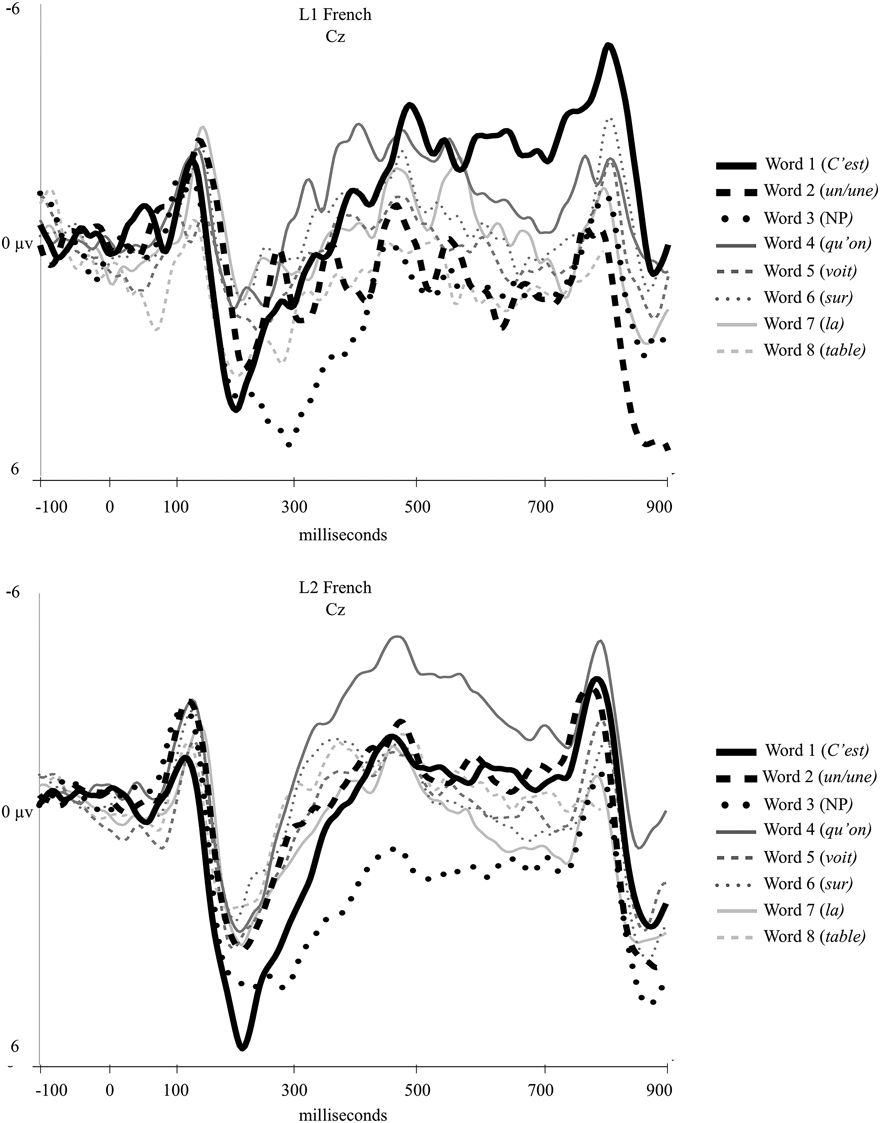
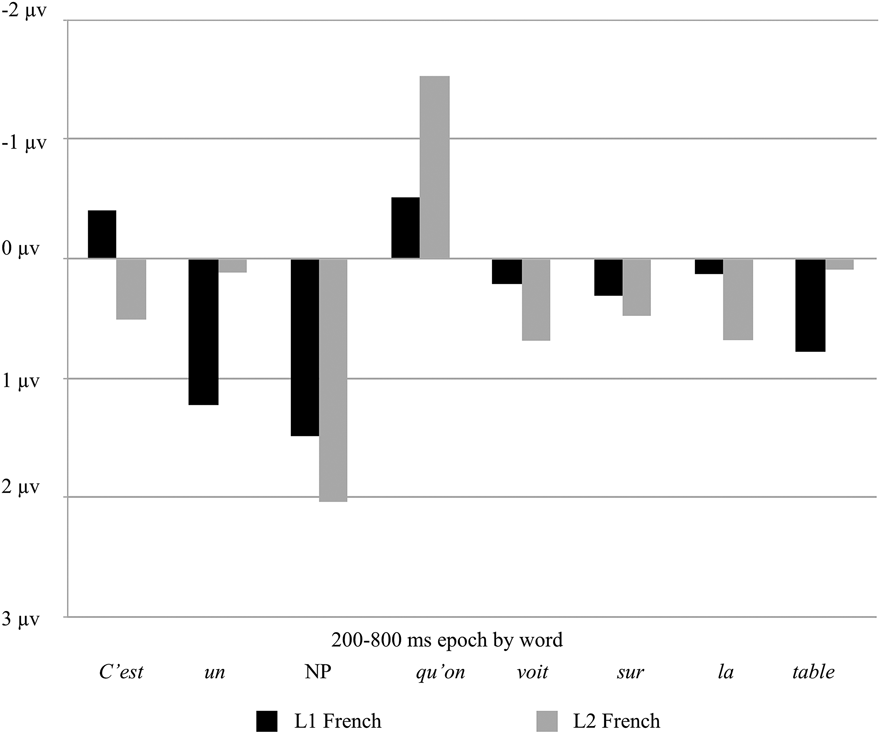
To test whether the clefted noun elicited a word-long positive shift compared to other words in the sentence, a repeated-measures ANOVA was conducted on word-length mean amplitude data averaged across midline sites using a 200–800 ms time window (Figure 4 and Figure 5). Group (L1 French, L2 French) was used as a between-subject factor, and focus condition (informational, contrastive) and word position (1, 2, 3, 4, 5, 6, 7, 8) were within-subject repeated-measures factors. There was no effect of focus condition, F(1, 34) = 1.065, p = .309, partial η2 = .030, nor was there an interaction of focus condition and group, F(1, 34) = 0.603, p = .443, partial η2 = .017. These results indicate that there was no difference between informational and contrastive focus at the word-length level and that both L1 French and L2 French groups displayed similar responses at the word level. There was a significant main effect of word, F(4.524, 153.824) = 12.977, p < .001, partial η2 = .276, and an interaction of word and group, F(4.524, 153.824) = 3.533, p = .006, partial η2 = .094. Mean amplitudes for each word (collapsed across focus conditions) are shown for the L1 French and L2 French groups in Figure 6.
Sentence-long grand average ERPs for both subject groups (L1 French, L2 French) for both conditions at site Cz. Responses to the clefted noun are highlighted. Negative voltage is plotted above the x-axis.
Grand average ERPs for each word pooled across focus conditions at site Cz. Negative voltage is plotted above the x-axis.
Word-by-word comparison of the average mean amplitude over midline sites. Negative voltage is plotted above the x-axis.
Given the main effect of word, pairwise comparisons were conducted between the clefted noun and the other words in the sentence (collapsed across focus condition and group). The clefted noun was significantly more positive than all other words (p = .005 compared to un, p < .001, as compared to all other words). As Figure 6 illustrates, the positive shift for the clefted noun was significantly larger than that observed for sentence-final words. The L2 French group showed higher amplitude responses as compared to the L1 French group for the clefted noun and the words qu’on, voit, sur, and la, whereas there was a reversal of response polarity at c’est.
To determine whether L2 proficiency modulated responses, a separate repeated-measures ANOVA was performed for the L2 French group only, using L2 proficiency as a covariate. The interaction of word and L2 proficiency was not significant, F(3.866, 85.056) = 1.031, p = .395, partial η2 = .045, which suggests that proficiency did not modulate ERPs at the word level.
DISCUSSION
Informational versus Contrastive Focus
In response to our first research question, which asked whether the processing of contrastive focus elicits an early increase in negativity compared to the processing of formally identical informational focus constructions, we predicted an early anterior increase in negativity for contrastive focus at clefted nouns. The main effect of focus condition on the midline and lateral ANOVAs reflected an increase in negativity at the clefted noun from 200 to 500 ms for contrastive focus compared to informational focus, supporting our hypothesis. Lateral and midline interaction effects indicated that the distribution of this effect was anterior and right lateralized. This effect can be interpreted in two ways. One explanation—also raised by Cowles (Reference Cowles2003) and previously put forth by Reichle (Reference Reichle, VanPatten and Jegerski2010b)—is that this is an anterior negativity for the clefted noun receiving contrastive focus. Such a negativity could be related to the LAN, which Cowles (Reference Cowles2003) interpreted as an index of working memory load (following work by van Berkum et al., Reference van Berkum, Brown and Hagoort1999). An increased load on working memory for contrastive focus makes intuitive sense: In this condition, the set of possible answers to the wh-question is activated by the preceding question and remains active (and, thus, in working memory) until resolution of uncertainty at the clefted noun. Although the anterior negativity in the present study is right lateralized, rather than left lateralized, the anterior negativity seen by Cowles (Reference Cowles2003) was broadly distributed, which suggests that left lateralization is not a requisite feature for the anterior negativity that reflects working memory in focus processing. Other studies have noted that there is a high degree of variability in the lateralization of LANs as a function of both L1 and L2 proficiency (Pakulak & Neville, Reference Pakulak and Neville2010; Steinhauer et al., Reference Steinhauer, White and Drury2009); we interpret the lack of left lateralization for our anterior negativity as being consistent with this variability and that our results represent a LAN-like effect. Under this interpretation of the results, we can say that the hypothesized early increase in negativity for contrastive focus was observed. Although the early anterior negativity was not left lateralized, we interpret it as being closer to a LAN than to another negativity effect (e.g., N400) due to its lack of a prominent peak and its anterior distribution. Similarly, because of the lack of a typical N400 peak latency, we do not attribute the observed effects to semantic priming.
One could also reverse the comparison and classify this as an anterior increase in positivity for informational focus as compared to contrastive focus. Given Cowles et al.’s (Reference Cowles, Kluender, Kutas and Polinsky2007) findings regarding an early positivity marking information delivery in cleft sentences, one might conclude that our informational focus items created a higher degree of uncertainty by virtue of the open-ended wh-question that preceded the target sentences. This uncertainty is a function not of the identity of the clefted noun—indeed, the participants had just seen an image giving its identity—but rather of the uncertainty that this referent will be given as the response to the question. The contrastive focus items, by comparison, induced a lower degree of uncertainty because the set of possible responses to the question was activated prior to the presentation of the target sentence. When this uncertainty was resolved at the clefted noun, the stronger positivity for informational focus clefts was a P3, indicating a stronger effect of resolution. However, the effect seen in the present study had a more anterior distribution than a typical P3 effect.
Modulatory Effect of L2 Proficiency
We hypothesized that L2 proficiency would modulate the amplitude of the ERPs for focus processing. Analyses using L2 proficiency as a covariate suggested that responses differed between low- and high-proficiency subjects. The correlation between effect size and L2 proficiency indicates that the negativity for contrastive focus (relative to informational focus) became larger with increasing proficiency. Moreover, the separate L2 subgroup analyses showed no evidence of a main effect for focus condition among low-proficiency L2 learners, whereas high-proficiency learners and the L1 French participants did show an effect. In other words, L2 proficiency appears to modulate the nativelikeness of the processing of this focus phenomenon in the L2, thus supporting our hypothesis in response to our third research question. It should be noted that the pooled L2 French subgroups did not exhibit processing signatures that differed significantly from those of native speakers, suggesting that nativelike processing is possible when looking at the learner group as a whole.
Although the ERP effects in question are qualitatively different from those seen for the processing of morphosyntax violations, the presence of nativelike processing for high-proficiency L2 learners is consistent with the previously established finding from the domain of morphosyntax that proficiency modulates nativelikeness of processing (e.g., Osterhout et al., Reference Osterhout, McLaughlin, Pitkänen, Frenck-Mestre and Molinaro2006; Steinhauer et al., Reference Steinhauer, White and Drury2009). Additional work would be necessary to determine whether there is a link between L2 ERPs and learner proficiency with this specific focus-marking construction, as opposed to global L2 proficiency (cf. White et al., Reference White, Genesee and Steinhauer2012).
Positive Shift for Clefted Nouns
Our hypothesis was supported in response to our second research question, which asked if the processing of clefted nouns receiving informational or contrastive focus elicits a word-long positive shift. The finding that clefted nouns receiving informational and contrastive focus were associated with a word-long positive shift—and that the shift was even greater than the one observed for sentence-final words—is consistent with findings from Cowles et al.’s (Reference Cowles, Kluender, Kutas and Polinsky2007) study of English focus-marking clefts. They interpreted a similar positive shift as a marker of information delivery (or resolution of ambiguity) at the cleft. They argued that because this type of cleft construction provides an answer to a preceding question, the focused clefted noun is especially salient, whereas the material that follows such a cleft is generally the topic and thus less salient. Cowles and colleagues concluded that reliable indicators of focus (i.e., clefts, word order, or other focus-marking strategies) elicit P3b components at the focused word and at the end of the sentence. Bornkessel et al. (Reference Bornkessel, Schlesewsky and Friederici2003) and Stolterfoht et al. (Reference Stolterfoht, Friederici, Alter and Steube2007) similarly identified positivities as markers of focus integration. Our results are consistent with these findings.
Proficiency Effects Reconsidered
One unexpected finding was that the positive shift for clefted nouns was present not only for the L1 group but also for the L2 group. Furthermore, L2 proficiency did not modulate the responses within the L2 group. In other words, despite the presence of proficiency effects for the processing of contrastive versus informational focus at the clefted noun, there were no proficiency effects when comparing the positivity at the clefted noun to other words. This is, therefore, an instance of nativelike processing, irrespective of L2 proficiency.
The presence of this positive shift for the L2 group speaks to both the speed and manner of L2 focus structure interpretation. We view the increased positivity at the focused clefted noun for L2 learners as a sign that these learners are integrating focus information—and thereby resolving uncertainty—shortly after reading these constructions. As the word-by-word comparisons for the L2 groups yielded results comparable to those of the native speakers and showed no modulatory effect of L2 proficiency, we see this as evidence that all groups resolve this type of uncertainty in the same way. It is possible that L1 English learners of French benefit from positive transfer stemming from the roughly analogous focus-marking it cleft in English and that this facilitative effect leads to nativelike L2 focus processing. Another possibility is that the nativelike processing signatures are simply the result of complete acquisition of the L2 structure. Further work is needed before reaching any conclusions about the mechanisms underlying this nativelike L2 processing.
It is interesting to note that the low-proficiency L2 subgroup showed a less widespread response for the comparison of contrastive and informational focus, despite the fact that they displayed a nativelike word-long positive shift. In other words, they appear to be retrieving focus marking from the cleft construction in general (much as native speakers would), but they do not appear to fully distinguish between the two types of focus. McDonald (Reference McDonald2006) provides a possible explanation: The learners may have acquired the structure, but these quantitative differences may be due to processing difficulties stemming from reduced working memory capacity or processing speed in the L2. For example, the lower proficiency learners may not be keeping all members of the contrastive referent set active in working memory so as to free their limited working memory resources for other purposes. In a follow-up to the present study we have more directly examined L2 processing capabilities, rather than L2 proficiency, as the factors modulating the nativelikeness of focus processing (Reichle, Tremblay, & Coughlin, Reference Reichle, Tremblay and Coughlin2013).
CONCLUSION
To summarize, we found evidence of an early right-anterior negativity for the processing of nouns receiving contrastive focus relative to informational focus. This negativity was interpreted as a reflection of increased working memory load. We also observed word-long positive shifts for clefted nouns compared to other words in the sentence, which we interpret as an index of a resolution of uncertainty at the clefted noun. Most important, L2 French learners exhibited ERPs comparable to those of L1 French speakers, suggesting the possibility of nativelike processing. At the same time, L2 proficiency modulated the nativelikeness of these responses for the processing of contrastive focus compared to informational focus.
We first relate our findings to the question of focus processing. Our interpretation of the increased positivity for the processing of clefted nouns is similar to the one espoused by Cowles et al. (Reference Cowles, Kluender, Kutas and Polinsky2007): Information is delivered at focus-marking clefts, and the associated positivity reflects the resolution of the ambiguity from the preceding question. That this holds true for English clefts (Cowles, Reference Cowles2003; Cowles et al., Reference Cowles, Kluender, Kutas and Polinsky2007) as well as for French clefts is not altogether surprising. What is notable, however, is that this focus-marking strategy is claimed to be a more frequently occurring default strategy in French than in English (e.g., Carter-Thomas, Reference Carter-Thomas, Banks, Eason and Ormrod2009; Katz, Reference Katz2000). The fact that two languages with different functional motivations for using a formally identical construction display equivalent ERP signatures for information delivery is indicative of a degree of processing uniformity despite functional differences across languages.
We found evidence for our hypothesized early negativity for contrastive focus. The finding that different ERPs are elicited by formally identical constructions marking informational and contrastive focus supports Cowles’s information structure processing hypothesis. Whether these differences result from a higher level of uncertainty for informational focus or whether they are due to an increase in working memory load under contrastive focus, these findings reinforce the notion that focus processing is intrinsically linked to preceding discourse context.
Crucial for our other research questions was the discovery that L2 speakers of French exhibited ERPs similar to those of native speakers for focus structure processing. The positive shift for information delivery seen in the L2 learner group suggests that the learners did integrate the focal information into processing. At the same time, we found a relationship between L2 proficiency and the effect of condition between contrastive and informational focus. Even if, as suggested previously, all L2 learners process the clefts as vectors of information delivery, it does not appear that the discourse-induced subtleties between informational and contrastive focus were distinguished in processing by low-proficiency learners.
We relate this finding to Sorace and colleagues’ work on the L2 syntax-discourse interface. As Sorace and Serratrice (Reference Sorace and Serratrice2009) claim, processing factors are more likely to affect L2 processing at external (rather than internal) interfaces. The focus-marking constructions we tested fall at one such interface—that is, the syntax-pragmatics interface. Nonnativelike processing was observed but only for low-proficiency L2 speakers and only in the context of contrastive versus informational focus. If contrastive focus places a higher load on working memory than informational focus does, then the quantitatively less nativelike processing among our low-proficiency learners may be due to this higher load on working memory. Their processing may already be taxed by the burden on working memory, and, if they are prone to processing limitations at the syntax-pragmatics interface, as Sorace and Serratrice suggest, processing is hindered overall, leading to less-than-nativelike ERPs (cf. Havik, Roberts, Van Hout, Schreuder, & Haverkort’s, Reference Havik, Roberts, Van Hout, Schreuder and Haverkort2009, findings on the effect of working memory span on L2 processing in a self-paced reading task).
Finally, these results add detail to the picture of L2 ERPs painted by McLaughlin et al. (Reference McLaughlin, Osterhout and Kim2004), Osterhout et al. (Reference Osterhout, McLaughlin, Pitkänen, Frenck-Mestre and Molinaro2006), Steinhauer et al. (Reference Steinhauer, White and Drury2009), and others. Our findings are consistent with the notion that L2 speakers exhibit ERPs that are closer in amplitude and timing to those of native speakers as their proficiency increases. They also call to mind a point of caution noted by Steinhauer et al.: The N400 to P600 to LAN/P600 sequence of L2 ERP effects has been well researched for certain morphosyntax violations, but it may differ for other syntactic structures. The results of the present study suggest that the sequence does indeed differ for this focus-marking syntactic construction inasmuch as nativelikeness consists of an early negativity for contrastive focus. Future work is needed to elucidate the differences in ERP effects that correspond to different constructions, particularly in light of the finding that individual variation in proficiency with respect to specific grammatical structures elicits differential ERP effects (White et al., Reference White, Genesee and Steinhauer2012).
We conclude with a methodological note. The present ERP data for syntactic focus structure in the written modality partially overlap with those observed for similar phenomena in the oral modality (e.g., Hruska & Alter, Reference Hruska, Alter and Steube2004; Magne et al., Reference Magne, Astésano, Lacheret-Dujour, Morel, Alter and Besson2005). We welcome future investigations to determine if the correspondence between visual and auditory presentation is consistently observed as well as investigations that use ellipses or other structures typical of such exchanges in spoken French. Such work has the potential to overcome the limitations inherent to visually presenting structures typical of the spoken language.
APPENDIX CLOZE TEST (ADAPTED FROM BLOOD & MOBAREK, 2004)
Le sport le plus populaire au Québec, vraiment le hockey. Et puis, on peut , quand on observe les athlètes américains, les qui jouent pour les équipes américaines, on voit y en a beaucoup qui viennent du . Et puis que, malgré qu’au Québec, on perdu notre équipe nationale, mais le sport a même survécu. Et puis, à chaque année, hiver, on a le tournoi international de peewee. Mais peewee, pas vraiment les grands athlètes. C’est jeunes mais ce qui est intéressant, c’est qu’ a des équipes internationales qui viennent à . On a les peewees du Japon, les de l’Allemagne. Et puis quand j’étais plus , j’allais jouer au hockey à l’aréna publique et les peewees venaient jouer. Alors, c’était intéressant de pouvoir aller à l’aréna et j’étais jeune, il y avait des athlètes, y avait des gens de mon âge venaient d’Europe, qui venaient du Mexique, qui jouer au hockey à Québec pour le. Et puis, aussi, récemment, le football universitaire vraiment populaire à Québec parce qu’on gagné. Et puis quand une équipe gagne sûr que ça devient plus populaire. Alors ce moment il y a vraiment le football universitaire commence à vraiment prendre l’envoi Québec.