INTRODUCTION
Archaeological and historical records provide undeniable evidence that, through all times, on every inhabited continent, human beings have identified certain spaces as sacred (Verschuuren et al. Reference Verschuuren, Wild, McNeely, Oviedo, Verschuuren, Wild, McNeely and Oviedo2010, Pungetti Reference Pungetti, Fu and Jones2013). Sacred spaces are remarkably diverse (Keller Reference Keller2014), ranging in size from the shade of a single tree to vast landscapes, including rarely visited remote islands and bustling, built-up environments. Sacred spaces are the places people go to contemplate, communicate, commemorate and celebrate. They are spaces endowed with meaning and imbued with stories about the creation of the world, the journeys of teachers and the achievements of ancestors (Basso Reference Basso1996).
Plants and animals are integral to sacred spaces as symbols of their central narratives, as participants in the sensory environment and as sources of material for spiritual practice. In turn, sacred spaces play important roles in biodiversity conservation. Sacred spaces are often associated with unique biophysical features (e.g. mountain peaks, desert oases, forest groves and deep caverns) and therefore provide refuge for rare species (Hughes & Swan Reference Hughes and Swan1986). Although many sacred spaces are small, they comprise networks of sites that contribute to conservation at broader scales (Bhagwat & Rutte Reference Bhagwat and Rutte2006). In addition to safeguarding rare species, sacred spaces are sources of knowledge and experience that impact the ethos of visitors, thereby contributing to biodiversity conservation in other parts of the landscape (Dudley et al. Reference Dudley, Higgins-Zogib and Mansourian2009). Because conservation in sacred spaces is driven by local values, it often benefits from broader community support than state-run policies and programmes (Ormsby & Bhagwat Reference Ormsby and Bhagwat2010, Frascaroli Reference Frascaroli2013, Klepeis et al. Reference Klepeis, Orlowska, Kent, Cardelus, Scull, Eshete and Woods2016).
Woody plants are particularly important inhabitants of sacred spaces. Tall, spreading trees (e.g. the mugumu (fig) of the Kikuyu, the yaxche (kapok) of the Maya or the asvattha (pipal) of Hindus and Buddhists) are often considered sacred in their own right (Karangi Reference Karangi2008, Zidar & Elisens Reference Zidar and Elisens2009, Granziera Reference Granziera2010). Sacred groves and forests are found on every continent except Antarctica (Bhagwat & Rutte Reference Bhagwat and Rutte2006). Trees are important symbols of strength and endurance; many species can live for centuries, bearing witness to the durability of traditions and providing a sense of continuity across generations. Trees and shrubs transform their sensory environment, providing shade and shelter, perfuming the air and playing host to birdsong. Woody plants also provide important materials for spiritual practice: to build places of worship, to illuminate celebrations, to prepare special foods for holidays or to fashion musical instruments.
Ethiopia is a centre of botanical diversity with over 6000 indigenous vascular plant species, of which approximately 10% are endemic (Kelbessa & Demissew Reference Kelbessa and Demissew2014). Although the environmental history of Ethiopia's northern highlands is contentious, researchers agree that much of the area was forested (Friis et al. Reference Friis, Demissew and Breugel2011) and that most trees have been cleared for crop and livestock production (Pankhurst Reference Pankhurst1995, Wøien Reference Wøien1995, McCann Reference McCann1997, Darbyshire et al. Reference Darbyshire, Lamb and Umer2003, Nyssen et al. Reference Nyssen, Poesen, Moeyersons, Deckers, Haile and Lang2004, Klepeis et al. Reference Klepeis, Orlowska, Kent, Cardelus, Scull, Eshete and Woods2016). Today, farmers plant and protect useful trees and shrubs within their crop fields, grazing areas, hedgerows, yards and home gardens. Several species of Eucalyptus, introduced in the 19th century as a faster-growing source of fuel wood and construction material, dominate the woody vegetation (Tefera et al. Reference Tefera, Ruelle, Asfaw and Tsegay2014). Visitors to the northern highlands soon realize that almost any sizeable patch of indigenous trees indicates the presence of a church.
The Ethiopian Orthodox Tewahedo Church (EOTC) is one of the oldest Christian institutions in the world, founded in the 4th century by two Syrian brothers who converted the King of Aksum (an ancient empire in what is now northern Ethiopia) to Christianity. The term Tewahedo (‘being made one’ in Geez and Amharic) refers to complete union of the divine and human natures of Christ, a belief that divided the Ethiopians (along with the Armenian, Coptic, Indian and Syrian Orthodox churches) from the rest of Christianity after the Council of Chalcedon in 451 CE (Isaac Reference Isaac2012). The EOTC is the largest of the non-Chalcedonian churches, with an estimated 30 million followers, 400 000 clergy and 35 000 churches (Wassie et al. Reference Wassie, Teketay and Powell2005).
Ethiopian churches are typically associated with unique landscape features, such as hilltops, edges of precipices and natural springs, and are usually surrounded by trees and shrubs. A recent survey of 348 church forests across northern and central Ethiopia (Aerts et al. Reference Aerts, Van Overtveld, November, Wassie, Abiyu, Demissew and Daye2016) found that most are relatively small (2.48 ± 0.24 ha). Nonetheless, ecologists have conducted numerous studies showing that church forests harbour species that are rare in the rest of the landscape and therefore contribute to biodiversity conservation at local and regional scales (Wassie et al. Reference Wassie, Teketay and Powell2005, Reference Wassie, Sterck and Bongers2010, Aerts et al. Reference Aerts, Van Overtveld, Haile, Hermy, Deckers and Muys2006, Reference Aerts, Van Overtveld, November, Wassie, Abiyu, Demissew and Daye2016, Mulat Reference Mulat2013, Meshesha et al. Reference Meshesha, Tsegay and Telake2015).
Although Ethiopia's church forests have been described as remnants or relics of the pre-agricultural landscape, it is important to recognize that they are influenced by humans and are not simply pieces of the past (Sheridan Reference Sheridan2009, Klepeis et al. Reference Klepeis, Orlowska, Kent, Cardelus, Scull, Eshete and Woods2016). Most church forests have – at some point in their history – been diminished and degraded by human activities, including redistribution of church land to farmers, illegal encroachment and unsanctioned exploitation of forest resources (Wassie et al. Reference Wassie, Teketay and Powell2005, Reference Wassie, Sterck, Teketay and Bongers2009, Aerts et al. Reference Aerts, Van Overtveld, November, Wassie, Abiyu, Demissew and Daye2016). Nevertheless, comparison of historical aerial photographs with satellite imagery reveals that church forests have proven remarkably resilient in the midst of dynamic agricultural landscapes (Scull et al. Reference Scull, Cardelús, Klepeis, Woods, Frankl and Nyssen2017). Conservation of these forests is attributed to a combination of religious traditions and legal structures (Wassie et al. Reference Wassie, Teketay and Powell2005), as well as effective collaboration between authorities and community members (Klepeis et al. Reference Klepeis, Orlowska, Kent, Cardelus, Scull, Eshete and Woods2016). Because the future of church forests ultimately relies on local people, there is a clear need to understand the knowledge, values and specific practices that underlie their conservation (Bongers et al. Reference Bongers, Wassie, Sterck, Bekele and Teketay2006).
The objective of this paper is to explore why and how communities conserve trees and shrubs within their church forests. Based on interviews with members of the clergy and laity in the Debark District (northwestern Ethiopia), the paper investigates why people value certain woody plants within their sacred spaces and how they cultivate and conserve those species. Based on these findings, the paper examines the spatial distributions of trees in relation to sacred spaces and identifies opportunities for collaborative research and stewardship driven by local knowledge and values.
METHODS
Study area
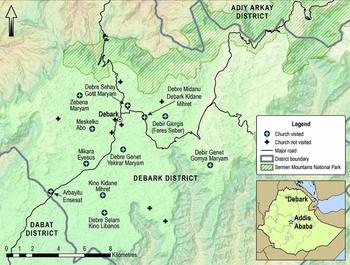
The Debark District is located on the western slopes of the Semien Mountains in North Gonder, Amhara Regional State (Fig. 1). The study focused on the dega (cool highland) agroecological zone between 2300 and 3200 m above sea level (Hurni Reference Hurni1998), including 201 km2 in six rural kebeles (sub-districts). Annual rainfall within the study area ranges between 600 and 1200 mm per year; 90% of the precipitation falls between May and October (FEWS-NET 2014). Average monthly temperatures range between night-time lows of 2.3°C in December and day-time highs of 23.6°C in April (WorldClim 2015). Most Debark residents are subsistence-orientated farmers, practicing mixed crop and livestock agriculture. At the time of the most recent national census, the population of Debark District was nearly 160 000, of which 95% were Orthodox Christians (FDRE-PCC 2008). There are 20 churches located within the study area, including five within Debark town and 15 in the surrounding rural communities.
Map showing church locations within the study area (Debark District, Ethiopia).

Data collection and analysis
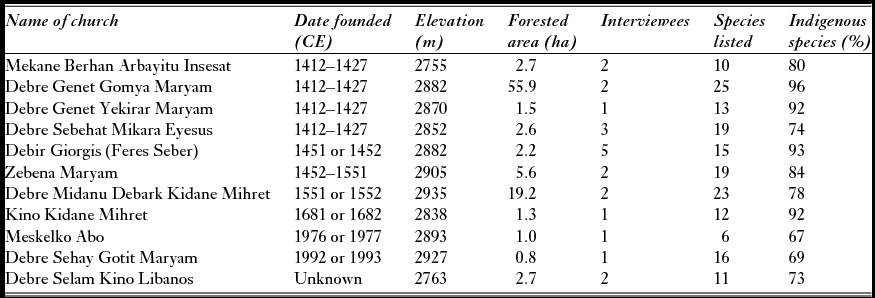
Semi-structured interviews were conducted at 11 of the 15 rural churches in April 2013 (Table 1). Written permission was granted by EOTC offices in Debark and informed oral consent was obtained prior to each interview. Interviews were conducted with individuals and small groups at the edge of each church compound. Interviewees included 12 priests, one catechism teacher, one monk, one church manager and seven lay church attendees, all men. Interviews began with free-listing (Martin Reference Martin2004, Quinlan Reference Quinlan2005), a standard ethnobotanical technique used to generate an inventory of the plants known to local people, in this case the woody species found within their church forest. Interview questions focused on the value of woody plants, their uses within the church compound, their cultivation and their conservation status (Supplement S1; available online).
Ethiopian Orthodox church forests visited in the Debark District of northwestern Ethiopia, including the date of founding according to local clergy, elevation, forested area mapped in Google Earth, number of interviewees, the count of species listed and the proportion of species indigenous to Ethiopia.

To ensure accurate documentation of the plants named during interviews, voucher specimens were collected and deposited at the Ethiopian National Herbarium at Addis Ababa University, where they were identified by reference to relevant volumes of the Flora of Ethiopia and Eritrea (Hedberg & Edwards Reference Hedberg and Edwards1989, Edwards et al. Reference Edwards, Tadesse and Hedberg1995, Reference Edwards, Tadesse, Demissew and Hedberg2000, Hedberg et al. Reference Hedberg, Edwards and Nemomissa2003, Reference Hedberg, Kelbessa, Edwards, Demissew and Persson2006, Tadesse Reference Tadesse, Hedberg, Friis and Edwards2004) and comparison with authenticated herbarium specimens. Analysis of interview data was conducted in ATLAS.ti (Scientific Software Development GmbH) using codes that included the names of plants, cultivation status, categories of use, other values to the church, conservation practices and observations of change.
The forested area of each church was determined using aerial photographs in Google Earth. The origins of plant species were obtained from the Flora of Ethiopia and Eritrea (volumes cited above) and the proportion of indigenous species at each church was calculated by dividing the number of indigenous species by the total number of species listed. The frequency of occurrence for each species was calculated by dividing the number of churches where the species was listed by the total number of churches. The overall cultivation status of each species (i.e. always, sometimes or never planted) was compiled across all churches. In addition, the proportion of plants per cultivation status was calculated by dividing the number of species reported within each cultivation status by the number of species listed at that church.
RESULTS
The significance of woody plant diversity in sacred space
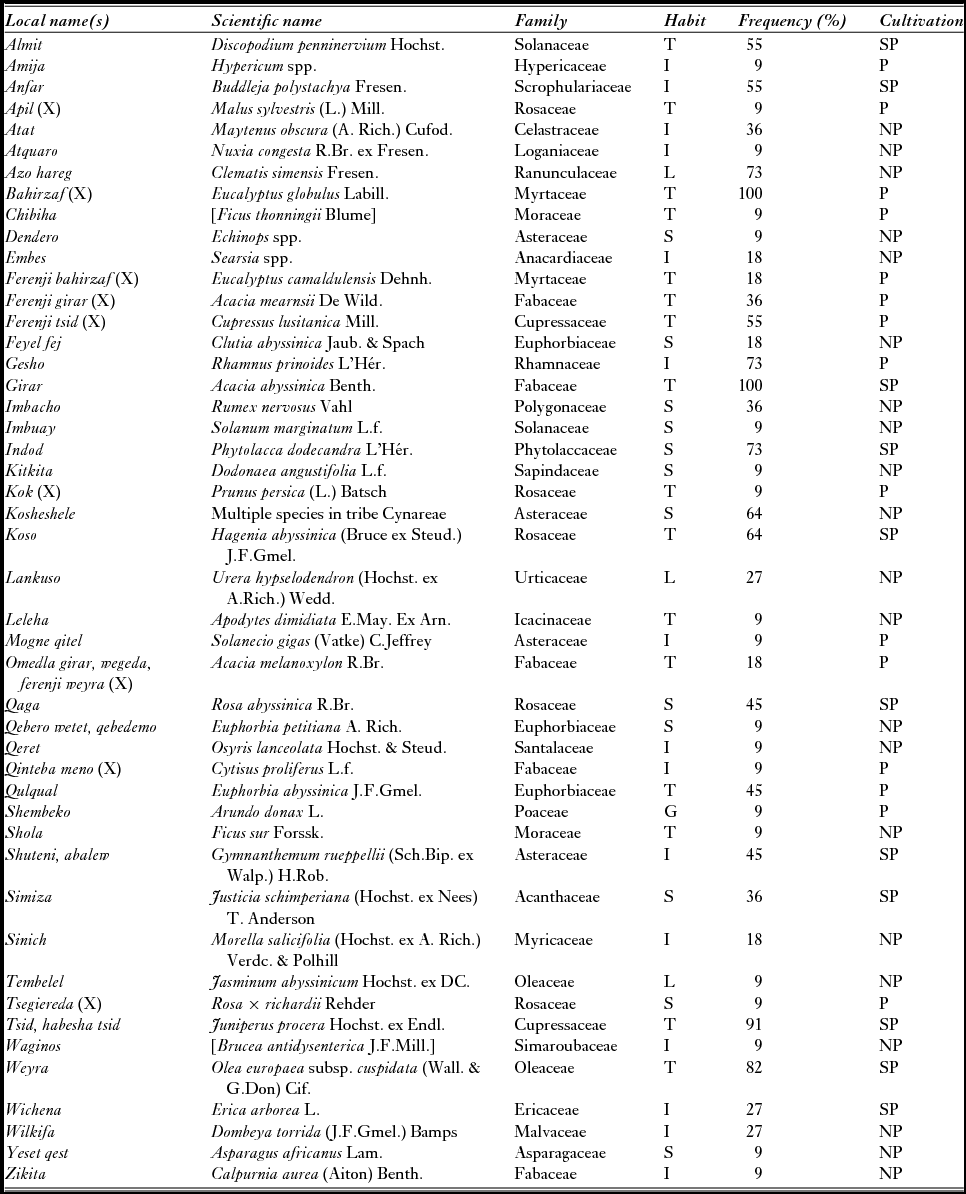
Across the 11 churches, interviewees named 47 woody plants, including 43 trees and shrubs, three woody climbers and one woody graminoid (Table 2). The plants identified belong to 29 families, with the greatest number in the Rosaceae and Fabaceae (five species each), followed by Asteraceae (four species) and Euphorbiaceae (three species). Most species (38) are indigenous; the remaining nine were introduced to Ethiopia. The greatest number of species was listed at Debre Genet Gomya Maryam, the largest church forest in the study area (55 ha). By contrast, the lowest number of species were reported at Meskelko Abo, which was founded in the 1970s and has one of the smallest church forests (Table 1).
Woody plants listed or observed at 11 churches in the Debark District (Ethiopia), including frequency of occurrence per church; all indigenous unless otherwise indicated. X = Introduced to Ethiopia; T = Tree, S = Shrub, I = Intermediate (shrub or tree), L = Woody climber, G = Woody graminoid; P = Always planted; NP = Never planted; SP = Sometimes planted, sometimes grows on its own.

The most frequently listed species were bahirzaf (Tasmanian blue gum, Eucalyptus globulus, introduced, listed at all churches), girar (Acacia abyssinica, indigenous, also listed at all churches), tsid (African juniper, Juniperus procera, indigenous, listed at 91% of the churches) and weyra (African olive, Olea europaea subsp. cuspidata, indigenous, listed at 82% of the churches). When asked which woody plants are most important for their church, interviewees identified one or two of these same species, most commonly tsid (55%), followed by bahirzaf (45%) and weyra (18%).
Tsid and weyra were often discussed together because they are valued for many of the same reasons. Priests at four churches emphasized that these two species beautify their church compounds. At another four churches, it was said that both species live for centuries and that the presence of such old trees attests to the longevity of the church as both a physical space and an institution. One priest said that tsid are ‘like our eyes,’ meaning that they are vital to the church and have witnessed its long history. Another priest described how each of the tsid within his church compound tells a story and that the story is lost whenever one of them dies.
While priests at one church said they never use tsid because it is valued as a living tree, interviewees at six other churches said that tsid is used for constructing and repairing church buildings. At three churches, interviewees added that tsid is used to fashion furniture, including cabinets to hold sacred books and vestments. Weyra was less often used for construction (by only two priests), but its durable wood is preferred to fashion a maresha (traditional ard plough), which the clergy use to till church land. Five priests mentioned that weyra leaves are used to wash the feet of the faithful during the Holy Week (Tselote Hamus, Maundy Thursday). One priest said that charcoal made from weyra is used to burn incense (primarily frankincense, Boswellia spp.) in the church. Weyra wood is also used to smoke the containers for tella, a local beer prepared at most churches and consumed on holidays.
Bahirzaf (meaning ‘tree from overseas’) was introduced to Ethiopia in the late 19th century, but did not reach Debark until the 1940s (Abe Asqe Amdesukassue, personal communication, 2012). Bahirzaf was observed at all churches and was often the most abundant woody species. At six churches, priests said that they use bahirzaf to construct and repair church buildings. Whereas in the past they had used tsid, the harvest of indigenous trees is officially prohibited, so bahirzaf is a faster-growing and legal alternative. However, the most frequent explanation for the importance of bahirzaf (at eight churches) was that selling it provides cash income for the church.
Interviewees mentioned several other woody plants that are used within the church. Girar is used for construction and as charcoal for burning incense; its spiny branches are used to construct dry-wood fences. Ferenji tsid (‘foreign cedar’, Mexican white cedar, Cupressus lusitanica), an exotic species that was promoted during the communist Derg regime (1972–1991), was listed at 55% of churches and named as a construction material. Gesho (shiny-leaf buckthorn, Rhamnus prinoides) is an indigenous species that was listed at 73% of the churches; its leaves and stems are used as the bittering agent for tella. Qulqual (Euphorbia abyssinica) is another indigenous species listed at many churches (45%); it is commonly planted as a living fence and its wood is used to fashion containers and drums to accompany the singing of sacred music.
Cultivation and conservation of Debark's church forests
Of the 47 woody species named by interviewees, only 21 (45%) were consistently reported to grow on their own (i.e. are never planted). By contrast, 15 species were reported as always planted, including all nine introduced and six of the indigenous species. The remaining 11 species (all indigenous) are both planted and grow on their own. Interestingly, tsid and weyra belong to the latter category, as they are reported both to grow on their own and to be planted, even at some of the oldest churches. Interviewees at five churches, including three from the 15th century, said that the oldest tsid were planted at the time of their church's founding. At two other churches built in the 15th and 16th centuries, interviewees said that some of the tsid around their churches were older than the churches themselves, but that other tsid had been planted since the churches had been built.
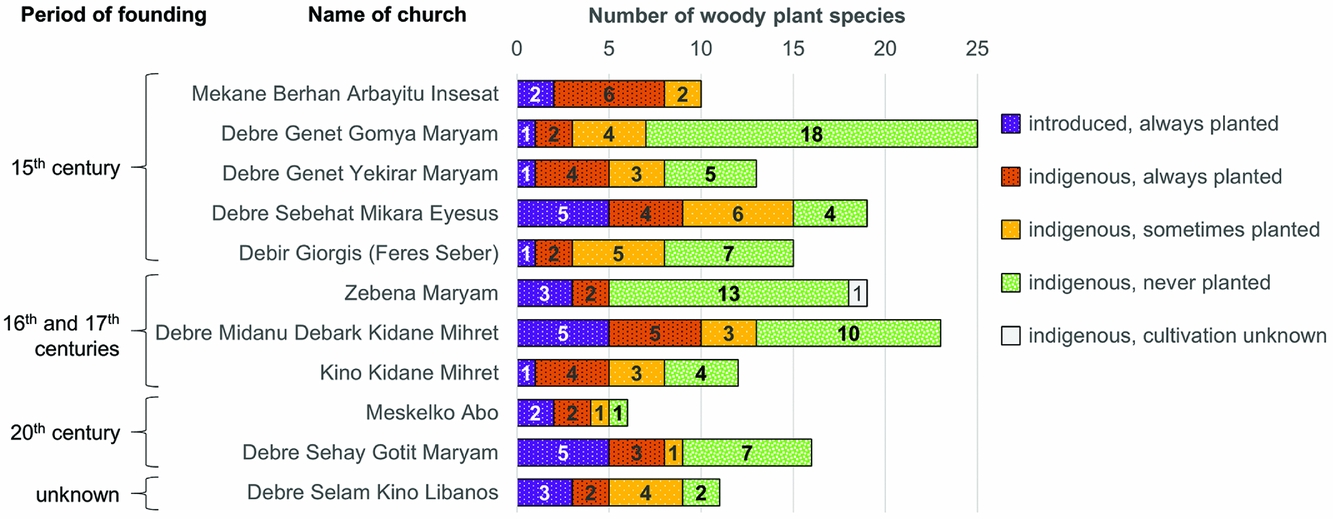
The proportion of species that are planted varies among churches (Fig. 2). The highest proportion of species that are always planted (eight of ten species) was reported at Mekane Berhan Arbayitu Insesat, whereas the lowest (three of 25) was at Debre Genet Gomya Maryam, both founded in the 15th century. The elder monk at Gomya Maryam said that the tsid forest beyond the churchyard was originally planted by angels and now regenerates on its own. The extensive forest at Gomya Maryam is well known and priests at two other churches expressed their admiration for its ability to regenerate without human assistance. The notability of such an exception further indicates that humans are involved in the regeneration of other church forests.
Cultivation status of woody species reported at church forests by clergy and other community members (Debark District, Ethiopia).

Rather than diminish the value of church forests, local knowledge that many of the trees around their churches were planted is a source of inspiration, both to conserve trees as a legacy of ancestors and to carry on the tradition of planting. Both priests and laypeople were enthusiastic about planting trees, especially indigenous species. When asked about changes in their forests, interviewees at seven of 11 churches said that populations of tsid and weyra have remained the same because they are protected by the community and because they replant any trees that are harvested. At only one church did priests say that they have been struggling to protect trees from exploitation by local communities; at five others, the clergy emphasized that the conservation and restoration of church forests is driven by the local community.
Interviewees also identified specific threats to their church forests. Two lay church attendees at Zebena Maryam said that the number of trees is declining due to fuelwood collection and efforts to replant trees are thwarted by grazing. At Debir Giorgis, priests said that they had cut tsid around their church to clear a passage for a new electric line and lacked funds to purchase saplings for replanting. The priest at Yekirar Maryam said that trees around his church are dying because the landscape is becoming drier. At Gomya Maryam, the elder monk said that drier conditions have led to an increase in the number of tsid, while wichena (tree heather, Erica arborea) is in decline.
DISCUSSION
The list of woody plants generated at Debark's churches includes rare species named by farming families during a previous study of the same area (Tefera et al. Reference Tefera, Ruelle, Asfaw and Tsegay2014). During the previous study, only 13 of 55 woody plants named in the course of 60 interviews were observed during a vegetation survey of their villages and farmlands. During targeted searches to collect voucher specimens, farmers often directed the researchers to their church forests. Indeed, 30 of the 55 species named by those farmers were observed during visits to churches for the present study, confirming that church forests contain woody plants that are rare in the surrounding landscapes.
Comparison with vegetation surveys of church forests in South Gonder (Wassie et al. Reference Wassie, Teketay and Powell2005, Reference Wassie, Sterck and Bongers2010) reveals important similarities: tsid is the most common tree in both areas, whereas bahirzaf and weyra were more common in Debark. The number of species reported per church in Debark was much lower than for church forests in South Gonder. Most of Debark's forests are considerably smaller and located at higher elevations than those studied in South Gonder. Furthermore, the use of free-listing to identify the species known to local people is not expected to generate as complete an inventory as a vegetation survey.
The most striking result from this study is that a considerable fraction of the species at each church have been planted (Fig. 2). Interestingly, the proportion of species that are planted appears unrelated to the age of the church or the size of its forest, as some of the oldest and largest forests include many cultivated species. The number of planted species is higher than previous studies in other parts of Ethiopia, where only exotic species have been reported as planted (Wassie et al. Reference Wassie, Teketay and Powell2005, Reference Wassie, Sterck and Bongers2010, Aerts et al. Reference Aerts, Van Overtveld, Haile, Hermy, Deckers and Muys2006, Reference Aerts, Van Overtveld, November, Wassie, Abiyu, Demissew and Daye2016). However, it is unclear whether researchers have asked local people about the cultivation status of indigenous species. The presence of species frequently planted by farmers (such as gesho and qulqual) suggests some cultivation.
The narrative that emerges from Debark is that the church founders and subsequent generations of clergy and laity have been planting and replanting the trees in their forests, including the species considered the most important symbols of the church, tsid and weyra. This narrative serves as a basis for community participation in the conservation and restoration of church forests. Local people share a reverence for old trees, but not because they represent a prehistorical landscape. Rather, the age of these trees testifies to their stewardship by past generations and inspires communities to carry on the traditions associated with church forest conservation. At the same time, these trees remain important to the sacred space, so their conservation is not a mere matter of custom, but an expression of their continued sociocultural and ecological significance.
Spatial arrangement of woody plants in sacred space
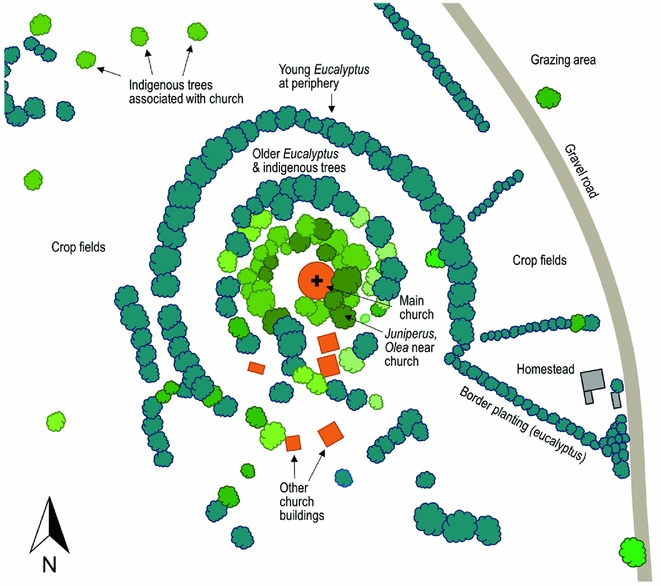
The architecture of a traditional Ethiopian church can be described as an ‘embedded sanctuary’ (Heldman Reference Heldman1992), consisting of concentric circular enclosures (for a description of the interior of an Ethiopian church, see Isaac Reference Isaac2012). The pattern of nested circles established within the church extends to the outside as a series of low stone walls and rings of trees (Fig. 3). These spaces are considered sacred: when passing a church, Orthodox Christians will stop to kiss the outer walls or touch them with their foreheads; during the liturgy, many attendees participate from outside, standing or sitting under the shade of the trees, and the EOTC considers these individuals to have attended the mass (Sellasie & Tamerat Reference Sellasie and Tamerat1970).
Schematic diagram of the spatial arrangement of trees around an Ethiopian Orthodox church based on aerial photography of Debre Selam Kino Libanos in the Debark District; diagram elements are not drawn to scale.

At most churches in Debark, old indigenous trees such as tsid and weyra are more abundant close to the centre of the compound, whereas introduced species, mainly bahirzaf, are common at the edges. This pattern indicates that the centre of the forest has been conserved longest, whereas the plantings at forest edges represent recent expansion. The arrangement is also explained by practical considerations; for example, bahirzaf planted at the edge of churchyards can be felled without risking damage to church buildings. The spatial distribution of species also reflects their different values. At the heart of the church compound, old tsid and weyra testify to the endurance of the church, whereas the bahirzaf at the periphery signify its interactions with the outside world, including engagement with market economies.
During an interview at Debre Midanu Debark Kidane Mihiret, one priest pointed to an isolated tsid at least 1 km away in the middle of a crop field and said that farmers protect that tree because they consider it to be a part of the church. Indeed, interviews with farmers who live close to churches confirmed that they consider the tsid in their fields and villages to belong to the church and therefore do not harvest them for use. The sparse trees found near many churches may indicate the historical extent of their forests and therefore provide evidence for the clearing of forests and expansion of agricultural land. On the other hand, the persistence of these trees shows that the influence of the church extends beyond its stone walls into the surrounding landscape, inspiring farmers to protect woody plants within their farmlands.
Opportunities for collaborative conservation
Supporting activities initiated by communities is the most important approach for collaborative conservation efforts. In addition, the challenges identified during interviews reveal knowledge gaps to be addressed by participatory research. For example, grazing was frequently identified as a primary threat to indigenous seedlings and saplings. One potential innovative solution is the use of qaga (Rosa abyssinica, listed at five Debark churches) as a ‘nurse’ plant to protect weyra saplings from browsers (Aerts et al. Reference Aerts, Negussie, Maes, November, Hermy and Muys2007). Another approach is to reinforce the stone walls, which has been shown to increase species richness and density of seedlings (Woods et al. Reference Woods, Cardelús, Scull, Wassie, Baez and Klepeis2017). Participatory research might include experimentation with these and other options to measure their efficacy in promoting seedling establishment and survival. One critical issue is that local nurseries distribute mainly bahirzaf seedlings; training community members to propagate and support natural recruitment of the trees that they value within their own forests might reduce project costs and conserve germplasm adapted to local conditions.
The proliferation of bahirzaf is considered a primary threat to church forests (Amare et al. Reference Amare, Mekuria, T/wold, Belay, Teshome, Yitaferu and Tessema2016, Reynolds et al. Reference Reynolds, Stave, Shimekach and Wassie2017). Due to its many advantages, Debark farmers are planting bahirzaf rather than indigenous species, so that it dominates the woody vegetation (Tefera et al. Reference Tefera, Ruelle, Asfaw and Tsegay2014). Due to high rates of evapotranspiration, bahirzaf exacerbates local effects of global climate change by depleting surface water and groundwater. In addition, planting bahirzaf and other exotic species around Afromontane forest fragments may have deleterious effects on native bird diversity (Wethered & Lawes Reference Wethered and Lawes2005). At the same time, bahirzaf is an alternative fuelwood and construction material that reduces the demand for tsid, weyra and other indigenous trees and could be an important source of funds for protection and restoration activities. Researchers could make an important contribution to church forest conservation by measuring the hydrological and ecological impacts of bahirzaf and developing guidelines regarding the best landscape position and density of new plantings.
CONCLUSION
Ethiopian Orthodox church forests tell a hopeful story about the potential for community-driven conservation in sacred spaces. These small patches of forest are far more than remnants of the pre-agricultural past; they demonstrate an enduring commitment to biodiversity as part of sacred spaces. In the Debark District, communities value the woody plants around their churches for beautifying their places of worship, testifying to the endurance of the churches, contributing to the structures of church buildings and for use in church rituals. Interestingly, many of the indigenous trees and shrubs found in these forests – including tsid and weyra at some of the oldest churches – are known to have been planted by past generations. This knowledge inspires further protection and replanting of indigenous trees.
The study of Debark's church forests adds to a body of evidence that local people play an important role in the ecology of their sacred spaces, in this case facilitating the regeneration of rare indigenous species (see also Ormsby & Ismail Reference Ormsby and Ismail2015). Such active engagement with the ecosystem represents a different approach to conservation from that of a conventional park or protected area. Therefore, efforts to strengthen biodiversity conservation in these and similar sacred spaces should invest in human ecological relations with particular plants and animals and support the conservation of those species through collaborative initiatives based on a mutual understanding of values. Ultimately, the knowledge and stewardship ethics that emerge within sacred spaces can extend to surrounding landscapes, expanding their contribution to biodiversity conservation at broader scales.
ACKNOWLEDGEMENTS
The authors thank Amanuel Berhanie and Fekadu Alem for their skill and enthusiasm as research assistants. We thank the Debark Betekihnet Tsihfet Bet for granting us permission to conduct interviews, as well as the priests and others who shared their knowledge of their church forests with us. We are grateful to Stephen Morreale, Alison Power, Timothy Fahey, Mekbib Fekadu, the editors of this journal and three anonymous reviewers for thoughtful suggestions that improved the manuscript.
FINANCIAL SUPPORT
Research funds were provided by the National Science Foundation through a Graduate Research Fellowship (DGE-0707428) and the Food Systems and Poverty Reduction Integrative Graduate Education and Research Traineeship at Cornell University (0903371).
CONFLICT OF INTEREST
None.
ETHICAL STANDARDS
The authors assert that all procedures contributing to this work comply with applicable ethical standards of the relevant national and institutional committees on human experimentation and with the Helsinki Declaration of 1975, as revised in 2008. Informed oral consent was obtained from all participants in this study.
Supplementary material
To view supplementary material for this article, please visit https://doi.org/10.1017/S0376892917000534