I. INTRODUCTION
Fe-based bulk metallic glasses (BMGs) possess considerably superior properties including high strength, good magnetic properties, abundant natural resources, low material cost, etc. Such unique properties enable them to be candidates for magnetic functional applications. Reference Wang, Dong and Shek1–Reference Inoue and Takeuchi3 However, the soft magnetic Fe-based MGs usually have poor glass-forming ability (GFA). To improve the GFA of Fe-based glassy alloys, great efforts have been devoted and many strategies have been used. These strategies can be divided into two categories: one is to scavenge heterogeneous nucleation sites out of the undercooled liquids of alloys and the other is through adjusting the compositions of alloys. There are some special strategies for scavenging the heterogeneous nucleation sites in Fe-based alloys, such as pure raw materials, flux melting, minor rare earth elements doping, and ultrahigh vacuum casting. Reference Shen and Schwarz4–Reference Chrobak, Nosenko, Haneczok, Boichyshyn, Kotur, Bajorek, Zivotsky and Hendrych14 However, these strategies may lead to increases in the unit cost and the cycle time for the production of BMGs, and limit their industrial applications. Especially, it is widely accepted that oxygen severely deteriorates the GFA of an alloy, and the metallic glasses have usually been prepared in high vacuum or argon atmosphere. For adding a new element or substituting a non-magnetic element for Fe in Fe-based BMGs, the non-magnetic elements will result in a remarkable decrease in saturation magnetization (M s) or deterioration in other magnetic properties. Reference Jian, Luo, Tao and Yan12,Reference Stoica, Roth, Eckert, Schultz and Baro15–Reference Inoue, Shen and Chang24 How to improve the GFA without deteriorating the M s of the soft magnetic Fe-based metallic glasses still is the key for advancing materials development in this field.
In this paper, we report that the critical diameter (D cr) of Fe76Si9B10P5 glassy alloy increases significantly from 1 to 3 mm by replacing argon with oxygen as the casting atmosphere, which means that oxygen can significantly enhance the GFA of the alloy without deteriorating the soft magnetic properties. We have investigated the effect of oxygen on GFA of Fe-based BMGs, and the underlying mechanism concerning the influence of casting atmospheres on GFA was clarified.
II. EXPERIMENTAL
A. Materials
A multicomponent alloy ingot with a nominal composition of Fe76Si9B10P5 was prepared by induction melting the mixtures of pure Fe metal (99.99 wt.%), pure B (99.9 wt.%) and Si crystals (99.999 wt.%), and pre-alloyed Fe–P (99.99 wt.%, 18 wt.% P) alloy (99.9 wt.%) under a highly purified argon atmosphere.
B. Preparation
Cylindrical rods with a constant length of 40 mm and different diameters of 1–4 mm were produced by copper mold casting with a Rapid Quench Machine System. The casting chamber of the Rapid Quench Machine System was evacuated to ∼5 × 10⁻³ Pa and then filled with high pure argon (99.99%), air (21 mass% O, 99.99%), helium (99.99%), nitrogen (99.99%), or oxygen (99.99%) to preset pressure, respectively. The ingots were molten and then were cast into the copper mold with different injection gases corresponding to the chamber atmosphere. To ensure the reproducibility, the D cr was determined only after three amorphous rods with the D cr were obtained. Glassy ribbons with a thickness of 25 μm were produced by melt spinning.
C. Characterization
Microstructure of the cast rods was examined by x-ray diffractometer (XRD) with Cu Kα radiation and Tecnai-F20 transmission electron microscope (TEM; FEI Corporate, Hillsboro, OR). Glass transition temperature (T g) and crystallization temperature (T x) were estimated by differential scanning calorimetry (DSC) at a heating rate of 0.67 K/s. Magnetic properties of saturation magnetization (I s) and coercive force (H c) were measured at room temperature with a vibrating sample magnetometer (VSM) under an applied field of 800 kA/m and a B-H loop tracer under a field of 800 A/m, respectively. The contents of oxygen and nitrogen in the master alloy and BMG samples were measured using an EMGA-620W oxygen/nitrogen analyzer (HORIBA Ltd., Kyoto, Japan).
III. RESULTS AND DISCUSSION
A. Dependence of GFA on casting atmosphere species
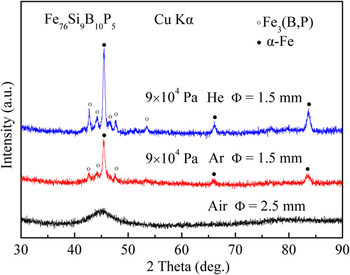
Figure 1 shows the XRD patterns of as-cast Fe76Si9B10P5 rods prepared in argon, air, and helium atmospheres under chamber pressure of 9 × 10⁴ Pa, respectively. The pattern of the rod specimen with a diameter of 1.5 mm fabricated in argon atmosphere shows crystalline diffraction peaks identified as Fe3(B,P) and α-Fe phases, suggesting that this sample is a partially amorphous structure. On the contrary, for the sample with a diameter of 2.5 mm prepared in air, it can be seen that the pattern consists of only a broad amorphous peak and has no evidence of the existence of crystalline phase. Apparently, these results show that the GFA of Fe76Si9B10P5 alloy increases obviously in air condition compared with that in Ar atmosphere. Here, it is noteworthy that the unusual enhancement of GFA has not been reported for any alloy so far.
XRD patterns of as-cast Fe76Si9B10P5 rods prepared in argon, air, and helium atmospheres, respectively.

Kato et al. have reported that helium as the casting atmosphere can lead to an improvement of cooling effect, especially in the low temperature range. Reference Setyawan, Kato, Saida and Inoue25,Reference Setyawan, Kato, Saida and Inoue26 The knowledge has been applied to improve the GFA of Zr65Al7.5Ni10Pd17.5 glassy alloy, and the D cr was increased from 5 mm in argon atmosphere to 7 mm in helium. The reason is attributed to the higher thermal conductivity of helium compared with that of argon during the low temperature range. Reference Ito, Ueki and Nakamura27 However, the XRD pattern of the as-cast Fe76Si9B10P5 rod with a diameter of 1.5 mm prepared in helium atmosphere shows strong diffraction peaks characterized as Fe3(B,P) and α-Fe phases compared with the one fabricated in air that presents only amorphous characteristic even with a larger diameter. This demonstrates that the better thermal conductivity of chamber atmosphere does not attribute to the unusual enhancement in GFA of Fe–Si–B–P alloys. Therefore, we can fairly conclude that oxygen or nitrogen in air may lead to the significant change in GFA since the main compositions of air are oxygen (about 21% by volume) and nitrogen (about 78% by volume).
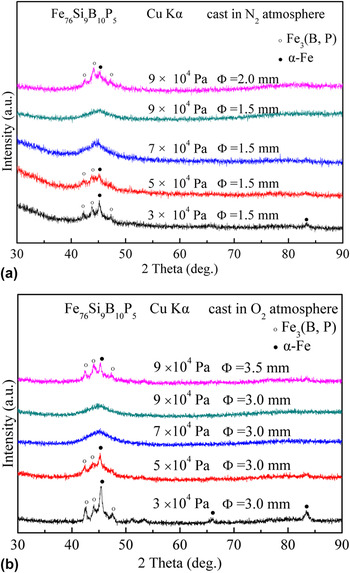
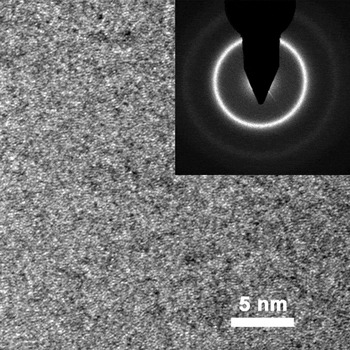
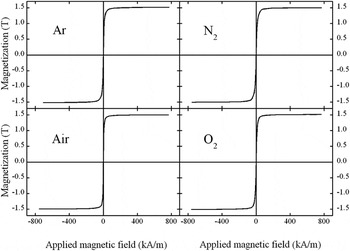
To elucidate the effect of oxygen and nitrogen on the GFA, the Fe76Si9B10P5 alloy rods synthesized in the two atmospheres were prepared subsequently. Figures 2(a) and 2(b) show the XRD patterns of as-cast Fe76Si9B10P5 rods prepared in nitrogen and oxygen atmospheres with various diameters under different chamber pressures, respectively. As shown in Fig. 2(a), the specimen with a diameter of 1.5 mm cast in nitrogen atmosphere under a pressure of 3 × 10⁴ Pa exhibits sharp diffraction peaks superimposed on a broad halo, implying the existence of crystalline phases. When the pressure of nitrogen increases to 9 × 10⁴ Pa, the diffraction peaks become weaker and disappear gradually. However, we cannot get a fully amorphous rod with a diameter of 2.0 mm in nitrogen atmosphere even under a pressure of 9 × 10⁴ Pa, revealing that the nitrogen casting atmosphere does not give an obvious enhancement in the D cr of Fe76Si9B10P5 glassy alloy. On the contrary, as shown in Fig. 2(b), the structure of the as-cast 3 mm diameter Fe76Si9B10P5 rods changes successively from crystalline to fully glassy structure as the pressure of oxygen gradually increases from 3 × 10⁴ to 7 × 10⁴ Pa, indicating that the casting in oxygen atmosphere can significantly improve the GFA of the alloy. Moreover, the 3.5-mm-diameter sample cast under pressure of 9 × 10⁴ Pa, even though partially crystallized, still keeps very high fractions of amorphous phase which can be judged from the broad diffraction background in its XRD pattern. The fully amorphous nature of the 3-mm-diameter rod prepared in oxygen atmosphere is further confirmed by the homogeneous contrast in the high-resolution TEM image and the broad halo ring in the selected area electron diffraction (SAED) pattern, as shown in Fig. 3. Therefore, these results clearly suggest that oxygen is not always playing a negative role in improving the GFA, as previous reports argue that oxygen would increase the heterogeneous nucleation sites of oxide, which will deteriorate the GFA. Reference Wang11,Reference Lu and Liu28 Figure 4 shows the hysteresis M-H loops of Fe76Si9B10P5 glassy alloys cast in argon, nitrogen, air, and oxygen. It can be found that these samples display similar M-H loop shape and exhibit similar values of I s and H c. The glassy alloy exhibits excellent soft magnetic properties, and its value of I s is about 1.51 T and H c is about 1.6 A/m, regardless of the applied casting atmosphere.
XRD patterns of as-cast Fe76Si9B10P5 rods with various diameters prepared in (a) nitrogen (N2) and (b) oxygen (O2) atmospheres.

High-resolution TEM image and corresponding SAED pattern taken from the cross section of the as-cast Fe76Si9B10P5 rod with a diameter of 3 mm prepared under oxygen atmosphere.

Hysteresis M-H loops of Fe76Si9B10P5 glassy alloys prepared in argon, nitrogen, air, and oxygen, respectively.

B. The influence of casting atmospheres on the component and thermal stabilities of Fe76Si9B10P5 glassy alloy
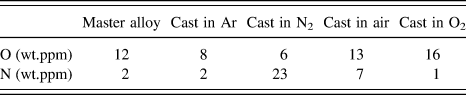
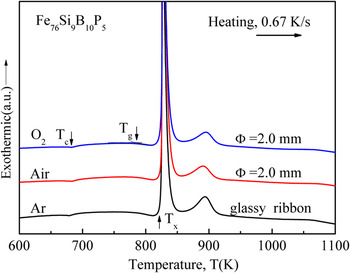
It has been reported that a proper doping of oxygen (0.1 at.%) can improve the GFA in some Fe- and Zr-based alloys. Reference Wang, Yang, Lim and Li29,Reference Li, Gao, Jiao, Wu and Lu30 However, the mechanism for the effectiveness of casting atmosphere species on GFA of Fe76Si9B10P5 glassy alloy seems to be different from that of doping oxygen in the BMG systems. Table I shows the contents of oxygen and nitrogen in the master alloy and the BMG rods prepared in various casting atmospheres. The order of oxygen content is consistent with the previous reports. Reference Meng, Li, Pang, Wang, An, Yin, Song and Wang31,Reference Wang, Zhang, Gebert, Roth and Schultz32 The difference in oxygen or nitrogen contents among the BMG samples prepared in various atmospheres is small enough to be ignored, suggesting that oxygen or nitrogen is not introduced into the alloy even casting in oxygen or nitrogen atmosphere. Thermal stabilities of the fully glassy rods with a diameter of 2 mm prepared in air and oxygen atmosphere were studied by DSC, together with the data for the melt-spun glassy alloy ribbon prepared in argon atmosphere (as shown in Fig. 5). No appreciable difference in T g, T x, or crystallization process is observed between the melt-spun ribbon and the rod samples, which provides supportive evidence for the results of oxygen and nitrogen content analyzed using the oxygen/nitrogen analyzer. From the above-described results and analyses, it is expected that oxygen in casting atmosphere appears to act as a kind of catalyst toward the enhancement of GFA for Fe76Si9B10P5 glassy alloy.
Oxygen and nitrogen contents of the master alloy and as-cast Fe76Si9B10P5 glassy rods with a diameter of 2 mm prepared in various atmospheres.

DSC curves of as-cast Fe76Si9B10P5 glassy rods with a diameter of 2 mm prepared in air and oxygen atmospheres, together with the data for the melt-spun glassy ribbon prepared in argon atmosphere.

C. The underlying mechanism concerning the influence of casting atmospheres on GFA of Fe76Si9B10P5 glassy alloy
We try to understand the origin of the enhancement of GFA in oxygen atmosphere from thermodynamic and kinetic points. The heterogeneous nucleation rate Reference Tumbull and Fisher33,Reference Turnbull34 can be defined as:
 $$I\; \propto\; D\exp \left( { - {{16{\rm{\pi \sigma }}_{{\rm{L}}-{\rm{C}}}^3 } \over {3kT({\rm{\Delta }}G_{{\rm{L}}-{\rm{C}}} )^2 }}\;f({\rm{\theta }})} \right)\quad ,$$
where D is the atomic diffusion coefficient, k the Boltzmann's constant, T the absolute temperature, ΔG L–C the free energy difference between the liquid and crystal, f(θ) = (2 − 3cos θ + cos3θ)/4 the catalytic factor with θ as wetting angle, σL–C the liquid-crystalline interfacial tension. During the casting of BMGs in gas, the σL–C can be defined as:
 $${{\rm{\sigma }}_{{\rm{L}}-{\rm{C}}}} = {{{{\rm{\sigma }}_{{\rm{W}}-{\rm{G}}}} - {{\rm{\sigma }}_{{\rm{W}}-{\rm{C}}}} - {{\rm{\sigma }}_{{\rm{L}}-{\rm{G}}}}\cos \phi } \over {\cos {\rm{\theta }}}}\quad ,$$
where φ is the contact angle of liquid and σL–G is called the surface tension of liquid. The corresponding schematic diagram is shown in Fig. 6. It is known that surface tension is an important thermal parameter of a metal or alloy, and the value of the surface tension is a reflection of the nature of the surface of the specimen. Certain elements prefer to surface sites which are known as surface active components. And the presence of active components (even at concentrations of ppm) at the surface results in a dramatic decrease in surface tension. According to Eqs. (2) and (1), the change of σL–G induced by the species of the atmosphere can significantly vary, then the I (may in many orders of magnitude) Reference Nastar and Clouet35 and the GFA. The thermal enthalpies between O and the elements Fe, Si, B, and P are −824, −910, −1272, and −2984 kJ/mol, respectively. These data show that the P is the most reactive among the four elements. It was reported that the σL–G of Fe–P alloy liquid decreases with an increase of phosphorus content, and contamination with oxygen or nitrogen will cause the lack of phosphorus on the Fe–P alloy surface, which can significantly increase the σL–G of Fe–P alloy. Reference Xue, Jiang, Sui, Ding and Hu36 During the casting procedure in our study, the phosphorus on the free surface of the alloy melt is inevitably contaminated by the oxygen or nitrogen atmosphere, resulting in an increase of the σL–G of the alloy melt. The liquid-crystalline interfacial tension σL–C will increase as the φ > 90° in practice. Then the I will decrease based on Eq. (1). During the preparation of Fe76Si9B10P5 BMG, it was usually observed that if crystallization occurred, crystallites would be formed on the surface of the rod, which is similar to the previous report in FeSiBPC alloy system. Reference Lavorato, Fiore, Tiberto, Baricco, Sirkin and Moya37 Hence, it can be deduced reasonably that if the nucleation on the surface was suppressed, the GFA of the whole bulk sample would be improved. The high phosphorus-scavenged ability of oxygen can explain reasonably why the composition of the alloy remains unchanged and consequently the magnetic properties are maintained.
Schematic diagram of heterogeneous nucleation. (W = wall, G = gas, L = liquid, C = crystal, θ = wetting angle, φ = contact angle of liquid.)

IV. CONCLUSIONS
The GFA of Fe76Si9B10P5 glassy alloy increases significantly by casting in oxygen atmosphere. The unusual beneficial effect of oxygen is attributed to the reduced nucleation rate resulting from the enhancement of surface tension of the alloy melt. The results change the conventional wisdom on the effect of oxygen on the GFA of an alloy and might provide a novel method to improve the GFA of Fe–Si–B–P glassy alloys without alloying any elements. Our results have implications for simultaneously achieving higher I s, enhanced GFA, and excellent soft magnetic properties in Fe–Si–B–P glass-forming alloys.
ACKNOWLEDGMENTS
This work was supported by the National Natural Science Foundation of China (Grant Nos. 51201174 and 51377113) and the Qualified Personnel Foundation of Taiyuan University of Technology (QPFT) (No: tyutrc-201370a).