Introduction
22q11.2 deletion syndrome (22q11DS) is associated with increased risk for schizophrenia (Murphy, Reference Murphy2005) and is characterized by high rates of attenuated psychotic symptoms (Baker & Skuse, Reference Baker and Skuse2005; Debbané et al. Reference Debbané, Glaser, David, Feinstein and Eliez2006; Schneider et al. Reference Schneider, Debbané, Bassett, Chow, Fung, van den Bree, Owen, Murphy, Niarchou, Kates, Antshel, Fremont, McDonald-McGinn, Gur, Zackai, Vorstman, Duijff, Klaassen, Swillen, Gothelf, Green, Weizman, Van Amelsvoort, Evers, Boot, Shashi, Hooper, Bearden, Jalbrzikowski, Armando, Vicari, Murphy, Ousley, Campbell, Simon, Eliez and International2014). Negative symptoms, such as anhedonia, amotivation or social withdrawal, constitute an integral part of the 22q11DS profile, as they are present in approximately 60–80% of adolescents and young adults (Stoddard et al. Reference Stoddard, Niendam, Hendren, Carter and Simon2010; Schneider et al. Reference Schneider, Van der Linden, Glaser, Rizzi, Dahoun, Hinard, Bartoloni, Antonarakis, Debbané and Eliez2012). Despite negative symptoms are core features of the 22q11DS phenotype, the mechanisms underlying their expression remain largely unknown in this syndrome.
Alterations of the reward system have been proposed as one of the core mechanisms contributing to the emergence of negative symptoms in schizophrenia. Historically, patients with psychosis were described as having global impairments in the experience of pleasure, referred to as anhedonia (Thomsen, Reference Thomsen2015). Yet, empirical findings later revealed that some components of the reward system were specifically altered in psychosis (Gard et al. Reference Gard, Kring, Gard, Horan and Green2007, Reference Gard, Sanchez, Cooper, Fisher, Garrett and Vinogradov2014; Favrod et al. Reference Favrod, Ernst, Giuliani and Bonsack2009; Chan et al. Reference Chan, Wang, Huang, Shi, Wang, Hong, Ma, Li, Lai and Kring2010; Trémeau et al. Reference Trémeau, Antonius, Cacioppo, Ziwich, Butler, Malaspina and Javitt2010; Wynn et al. Reference Wynn, Horan, Kring, Simons and Green2010; Oorschot et al. Reference Oorschot, Lataster, Thewissen, Lardinois, Wichers, van Os, Delespaul and Myin-Germeys2013; Mote et al. Reference Mote, Minzenberg, Carter and Kring2014; Edwards et al. Reference Edwards, Cella, Tarrier and Wykes2015; Lui et al. Reference Lui, Wang, Shi, Au, Wong, Chu, Kring, Cheung and Chan2015). Indeed, neuropsychological and neurobiological studies suggest that hedonic capacity can be subdivided in several components, including learning, desire, effort/motivation, anticipatory and consummatory pleasure. In the present study we focused on two components underpinned by largely distinct neural mechanisms (Berridge, Reference Berridge2003, Reference Berridge2007; Kring & Barch, Reference Kring and Barch2014): anticipatory (i.e. pleasure related to future activities) and consummatory pleasure (i.e. pleasure experienced in the moment). Various methodologies have been used to assess these two components in patients with schizophrenia, ranging from hedonic judgments (Trémeau et al. Reference Trémeau, Antonius, Cacioppo, Ziwich, Butler, Malaspina and Javitt2010; Edwards et al. Reference Edwards, Cella, Tarrier and Wykes2015) to questionnaires (Gard et al. Reference Gard, Kring, Gard, Horan and Green2007; Favrod et al. Reference Favrod, Ernst, Giuliani and Bonsack2009; Chan et al. Reference Chan, Wang, Huang, Shi, Wang, Hong, Ma, Li, Lai and Kring2010; Wynn et al. Reference Wynn, Horan, Kring, Simons and Green2010; Mote et al. Reference Mote, Minzenberg, Carter and Kring2014; Lui et al. Reference Lui, Wang, Shi, Au, Wong, Chu, Kring, Cheung and Chan2015), and momentary assessments (Oorschot et al. Reference Oorschot, Lataster, Thewissen, Lardinois, Wichers, van Os, Delespaul and Myin-Germeys2013; Gard et al. Reference Gard, Sanchez, Cooper, Fisher, Garrett and Vinogradov2014). The majority of studies has shown that schizophrenia is not associated with a ‘consummatory’ deficit, but rather an ‘anticipatory’ impairment. However, some evidence also indicated that both components are altered in schizophrenia (Strauss et al. Reference Strauss, Wilbur, Warren, August and Gold2011; Schlosser et al. Reference Schlosser, Fisher, Gard, Fulford, Loewy and Vinogradov2014). In addition, most studies reported that reduced anticipatory and consummatory pleasure scores were related to reduced functional outcome (Gard et al. Reference Gard, Kring, Gard, Horan and Green2007; Chan et al. Reference Chan, Wang, Huang, Shi, Wang, Hong, Ma, Li, Lai and Kring2010; Buck & Lysaker, Reference Buck and Lysaker2013) and increased negative symptoms (Gard et al. Reference Gard, Kring, Gard, Horan and Green2007; Favrod et al. Reference Favrod, Ernst, Giuliani and Bonsack2009; Loas et al. Reference Loas, Monestes, Ameller, Bubrovszky, Yon, Wallier, Berthoz, Corcos, Thomas and Gard2009; Chan et al. Reference Chan, Wang, Huang, Shi, Wang, Hong, Ma, Li, Lai and Kring2010; Mote et al. Reference Mote, Minzenberg, Carter and Kring2014; Li et al. Reference Li, Lui, Geng, Li, Li, Wang, Tan, Cheung, Kring and Chan2015b ).
To date, the experience of pleasure has been examined mostly in participants with chronic schizophrenia but few included individuals at clinical high risk (CHR) for psychosis or scoring high on schizotypy scales. In individuals with CHR or with high negative schizotypy traits (anhedonia), alterations in both anticipatory and consummatory pleasure were reported in most studies (Martin et al. Reference Martin, Becker, Cicero, Docherty and Kerns2011; Gooding & Pflum, Reference Gooding and Pflum2012; Schlosser et al. Reference Schlosser, Fisher, Gard, Fulford, Loewy and Vinogradov2014; Li et al. Reference Li, Lui, Geng, Li, Li, Wang, Tan, Cheung, Kring and Chan2015b ), whereas one study reported alterations in the anticipatory pleasure component only (Shi et al. Reference Shi, Wang, Cao, Wang, Wang, Zong, Xu, Tse, Hsi, Stone, Lui, Cheung and Chan2012). Findings in participants with high positive schizotypy are more controversial. Martin et al. (Reference Martin, Becker, Cicero, Docherty and Kerns2011) found no difference in anticipatory and consummatory pleasure compared to controls, whereas Shi et al. (Reference Shi, Wang, Cao, Wang, Wang, Zong, Xu, Tse, Hsi, Stone, Lui, Cheung and Chan2012) observed higher scores on the two pleasure dimensions in individuals with high positive schizotypy. In summary, studies revealed evidence for reward components alterations along the continuum of psychosis. Moreover, these alterations appear to be closely related to negative symptoms, especially anhedonia, whereas no clear association with positive symptoms has been reported. Although patients with 22q11DS are at genetic high risk for psychosis, investigation of anticipatory and consummatory pleasure has never been conducted in this syndrome.
Several genes have been identified as playing a role in the modulation of the reward system. Among those, the catechol-O-methyl transferase gene (COMT) has been examined extensively due to its role on dopamine degradation. Because it is located on the 22q11.2 locus, patients with 22q11DS are hemizygous this gene. A functional polymorphism of the COMT gene, resulting in a valine (Val) to methionine (Met) substitution, leads to a 30% reduction in enzymatic activity and consequently to an accumulation of dopamine (Chen et al. Reference Chen, Lipska, Halim, Ma, Matsumoto, Melhem, Kolochana, Hyde, Herman, Apud, Egan, Kleinman and Weinberger2004). In healthy participants, the number of Met alleles was shown to be positively correlated with activation in the ventral striatum-prefrontal circuit (Dreher et al. Reference Dreher, Kohn, Kolachana, Weinberger and Berman2009; Lancaster et al. Reference Lancaster, Linden and Heerey2012). In patients with 22q11DS, it has been recently highlighted that the Met polymorphism is associated with increased activity in the posterior cingulate and parietal regions during reward anticipation (van Duin et al. Reference van Duin, Goossens, Hernaus, da Silva Alves, Schmitz, Schruers and van Amelsvoort2016) and higher levels of negative symptoms (Schneider et al. Reference Schneider, Van der Linden, Glaser, Rizzi, Dahoun, Hinard, Bartoloni, Antonarakis, Debbané and Eliez2012) compared to Val carriers.
To date, the exploration of the links between reward alterations and structural abnormalities of the reward system has been scarce. The reward system involves a network of brain regions including the ventral tegmental area (VTA), the nucleus accumbens (NAc), the amygdala, and frontal areas such as the prefrontal cortex (PFC) and the orbito-frontal cortex (OFC) (Haber & Knutson, Reference Haber and Knutson2010). Previous diffusion tensor imaging (DTI) studies reported white-matter (WM) microstructural alterations in regions related to the reward system in patients with schizophrenia (Quan et al. Reference Quan, Lee, Kubicki, Kikinis, Rathi, Seidman, Mesholam-Gately, Goldstein, McCarley, Shenton and Levitt2013; Bracht et al. Reference Bracht, Horn, Strik, Federspiel, Razavi, Stegmayer, Wiest, Dierks, Müller and Walther2014; de Leeuw et al. Reference de Leeuw, Bohlken, Mandl, Kahn and Vink2015; James et al. Reference James, Joyce, Lunn, Hough, Kenny, Ghataorhe, Fernandez, Matthews and Zarei2016). A reduction of the frontostriatal WM integrity has been particularly reported (Quan et al. Reference Quan, Lee, Kubicki, Kikinis, Rathi, Seidman, Mesholam-Gately, Goldstein, McCarley, Shenton and Levitt2013; de Leeuw et al. Reference de Leeuw, Bohlken, Mandl, Kahn and Vink2015; James et al. Reference James, Joyce, Lunn, Hough, Kenny, Ghataorhe, Fernandez, Matthews and Zarei2016). To the best of our knowledge, only one study to date investigated the putative association between WM integrity of the reward system and negative symptoms in schizophrenia (Bracht et al. Reference Bracht, Horn, Strik, Federspiel, Razavi, Stegmayer, Wiest, Dierks, Müller and Walther2014). The authors reported that WM changes of the left VTA-amygdala and NAc-OFC were negatively correlated with negative symptoms while WM changes of the left NAc-amygdala were positively associated with positive symptoms. The integrity of the reward system and its putative link with negative symptoms has never been examined in 22q11DS. Nevertheless, structural connectivity has been examined and showed widespread alterations in most WM tracts (Barnea-Goraly et al. Reference Barnea-Goraly, Menon, Krasnow, Ko, Reiss and Eliez2003; Simon et al. Reference Simon, Wu, Avants, Zhang, Gee and Stebbins2008; Sundram et al. Reference Sundram, Campbell, Azuma, Daly, Bloemen, Barker, Chitnis, Jones, van Amelsvoort, Murphy and Murphy2010; da Silva Alves et al. Reference da Silva Alves, Schmitz, Bloemen, van der Meer, Meijer, Boot, Nederveen, de Haan, Linszen and van Amelsvoort2011; Radoeva et al. Reference Radoeva, Coman, Antshel, Fremont, McCarthy, Kotkar, Wang, Shprintzen and Kates2012; Ottet et al. Reference Ottet, Schaer, Cammoun, Schneider, Debbané, Thiran and Eliez2013a , Reference Ottet, Schaer, Debbané, Cammoun, Thiran and Eliez b ; Villalon-Reina et al. Reference Villalon-Reina, Jahanshad, Beaton, Toga, Thompson and Simon2013; Jalbrzikowski et al. Reference Jalbrzikowski, Villalon-Reina, Karlsgodt, Senturk, Chow, Thompson and Bearden2014; see Scariati et al. Reference Scariati, Padula, Schaer and Eliez2016 for a review).
The accumbofrontal tract is one of the main tracts within the reward system, connecting the NAc and the OFC. Whereas the NAc plays a central role in the reward circuit by regulating the neurotransmission of dopamine in the brain, the OFC, along with the VTA, constitutes a major input of the NAc (Haber et al. Reference Haber, Kunishio, Mizobuchi and Lynd-Balta1995; Haber, Reference Haber and Gottfried2011). For this reason, we choose to focus on this tract for a first examination of WM integrity within the reward system. Although some DTI studies examined WM integrity of the entire reward system (Bracht et al. Reference Bracht, Horn, Strik, Federspiel, Razavi, Stegmayer, Wiest, Dierks, Müller and Walther2014; James et al. Reference James, Joyce, Lunn, Hough, Kenny, Ghataorhe, Fernandez, Matthews and Zarei2016), the accurate extraction of WM tracts in these areas remains challenging. Indeed, most techniques do not adequately exclude adjacent tracts in small subcortical regions, which may lead to significant biases in the observed findings. For this reason, we extracted DTI measures in the accumbofrontal tract using an atlas that was previously validated against post-mortem histological studies (Karlsgodt et al. Reference Karlsgodt, John, Ikuta, Rigoard, Peters, Derosse, Malhotra and Szeszko2015).
This study is a first attempt to investigate hedonic capacity, structural connectivity of the reward system and their links with negative symptoms in 22q11DS. First, we examined anticipatory and consummatory dimensions of pleasure in 22q11DS patients and healthy controls. Based on previous studies in CHR populations (Martin et al. Reference Martin, Becker, Cicero, Docherty and Kerns2011; Gooding & Pflum, Reference Gooding and Pflum2012; Schlosser et al. Reference Schlosser, Fisher, Gard, Fulford, Loewy and Vinogradov2014; Li et al. Reference Li, Lui, Geng, Li, Li, Wang, Tan, Cheung, Kring and Chan2015b ), we expected to observe significant impairments in both dimensions of pleasure in individuals with 22q11DS compared to controls. Moreover, we hypothesized that anticipatory pleasure would be related to negative symptoms but not with positive symptom severity. Secondly, we investigated the COMT polymorphism influence on hedonic capacity in 22q11DS patients. In accordance with previous work in the 22q11DS population (van Duin et al. 2016), we hypothesized that Met carriers will have reduced hedonic capacity compared to Val carriers. Moreover, the implication of general and adaptative functioning on the two dimensions of pleasure have been examined. We hypothesized that these potential confounds will not have a direct influence on pleasure dimensions. Finally, we investigated WM integrity of the accumbofrontal tract along with its associations with hedonic scores and negative symptoms. We expected to observe an alteration of the accumbofrontal tract in participants with 22q11DS, which would be related to impaired hedonic capacity and higher negative symptom severity.
Material and method
Participants
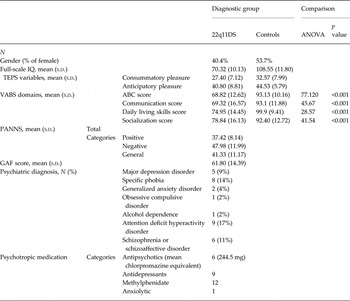
Fifty-two patients with 22q11DS aged between 11 and 31 years were included in the study. They were recruited through parent associations and word of mouth. The presence of the 22q11.2 microdeletion was confirmed in all participants using quantitative fluorescent polymerase chain reaction. Fifty-four controls, including siblings (N = 36) and unrelated controls (N = 19) (see Supplementary Table S1 for a comparison between siblings and unrelated controls, all p > 0.05) aged between 11 and 31 years were included and were screened for the presence of any neurological problem, psychological or learning difficulties (Table 1).
Participant characteristics, psychiatric diagnosis and psychotropic medication

TEPS, Temporal Experience of Pleasure Scale; VABS, Vineland Adaptive Behaviour Scale; PANSS, Positive and Negative Syndrome Scale; GAF, Global Assessment of Functioning.
A subgroup composed of 46 patients [mean age = 18.8 ± 4.29 years, 20 (43.5%) females] and 35 controls [mean age = 18.7 ± 4.98 years, 18 (51.4%) females] was included in the DTI analyses. The other participants were excluded due to the absence of MRI acquisition (N = 13) or bad quality of the data (N = 15).
Written informed consent was obtained from participants and their parents under protocols approved by the Institutional Review Board of the Department of Psychiatry of the University of Geneva Medical School.
Clinical assessment
The presence of psychiatric disorders was evaluated in adolescents below 18 years using the Diagnostic Interview for Children and Adolescent – Revised (Reich, Reference Reich2000) and the mood and psychosis supplement of the Kiddie-Schedule for Affective Disorders and Schizophrenia Present and Lifetime version (K-SADS-PL; Kaufman et al. Reference Kaufman, Birmaher, Brent, Rao, Flynn, Moreci, Williamson and Ryan1997). Adult participants were screened using the Structured Clinical Interview for DSM-IV Axis disorders (SCID-I; First et al. Reference First, Spitzer, Gibbon and Williams1996). The severity of positive and negative symptoms was assessed using the Positive and Negative Syndrome Scale (PANSS; Kay et al. Reference Kay, Fiszbein and Opler1987). The PANSS is composed of a positive, negative and general psychopathology subscale. All symptoms are rated on a seven-point severity scale (ranging from 1 to 7).
Intellectual functioning
Participants under 17 years old completed the Weschsler Intelligence Scale for children III – R (WISC-III-R; Weschsler, Reference Weschsler1991), and those above 17 years old completed the Weschsler Adult Intelligence Scale – III (WAIS-III; Weschsler, Reference Weschsler1997) to obtain an evaluation of global intellectual functioning (Table 1).
Questionnaires
All participants completed the French version of the Temporal Experience of Pleasure Scale (TEPS; Gard et al. Reference Gard, Gard, Kring and John2006; Favrod et al. Reference Favrod, Ernst, Giuliani and Bonsack2009), which was specifically developed to measure anticipatory (e.g. ‘I look forward to a lot of things in my life’) and consummatory dimensions of pleasure (e.g. ‘The smell of freshly cut of grass is enjoyable to me’). This questionnaire is composed of 18 items rated on a six-point Likert scale ranging from 1 (very false for me) to 6 (very true for me).
The parents of all participants completed the Child Behaviour Checklist (CBCL; Archenbach, Reference Archenbach1991) or the Adult Behaviour Checklist (ABCL; Archenbach, Reference Archenbach1991) to obtain a global parental report of behavioural difficulties. In particular, we used the anxious-depressed t score as a measure of anxiety/depression.
The Vineland Adaptive Behaviour Scale (VABS) was administered to parents of 43 individuals with 22q11DS and 30 controls to assess adaptive functioning. Data were missing for nine individuals. In addition to the adaptive behaviour composite score, the VABS provides information about three specific dimensions: communication, daily living skills, and socialization. Age appropriate standardized scores were used (mean = 100, s.d. = 15).
To access the general functioning, the Global Assessment of Functioning (GAF) was used in all patients.
COMT genotyping
Blood samples were collected and analysed for 49 participants with 22q11DS (DNA could not be collected for five participants). Polymorphism of the COMT gene was determined by polymerase chain reaction-restriction fragment length polymorphism analysis with the restriction enzyme NIaIII (Lachman et al. Reference Lachman, Papolos, Saito, Yu, Szumlanski and Weinshilboum1996). Twenty-three participants were Met158 homozygous and 26 were Val108. The two groups did not differ in age (F 1,47 = 3.14, p = 0.083) or gender (F 1,47 = 0.423, p = 0.519) distribution.
Structural connectivity (DTI)
DTI images were acquired using a Siemens Trio 3-T scanner and the following parameters were used: number of directions = 30, b = 1000 s/mm2, TR = 8800 ms, TE = 84 ms, flip angle = 90°, acquisition matrix = 128 × 128, field of view = 25.6 cm, 64 axial slices, slice thickness = 2 mm.
Data pre-processing and analysis were performed using the FSL Diffusion Toolbox (FSL version 5.0; Oxford, UK, http://fsl.fmib.ox.ac.uk/fsl). The Brain Extraction Tool (BET, Smith, Reference Smith2002) was employed to remove skull and non-brain tissue. The effect of eddy currents and head-motion displacements were corrected using an affine registration of the 31 diffusion volumes to the first b0 volume using FSL's linear registration tool.
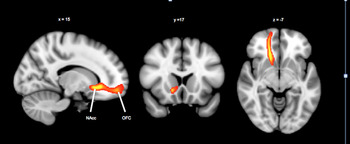
Fig. 1 shows the accumbofrontal tract generated in the study from Karlsgodt et al. (Reference Karlsgodt, John, Ikuta, Rigoard, Peters, Derosse, Malhotra and Szeszko2015), (http://karlsgodtlab.org/HBM_accumbofrontal/). The bilateral accumbofrontal tract was normalized to each participant's diffusion space using FSL's linear registration tool (Jenkinson & Smith, Reference Jenkinson and Smith2001) applying the affine parameters obtained by co-registering the first b0 DTI volume to the MNI152 T1 1-mm template. The tracts were then visually inspected to confirm successful registration in each subject. A diffusion tensor model was fit at each voxel in the brain from the corrected scans using the DTIFIT (http://fsl.fmrib.ox.ac.uk/fsl/fslwiki/FDT/UserGuide#DTIFIT) tool. Scalar anisotropy and diffusivity maps were obtained from the resulting diffusion tensor eigenvalues (λ 1, λ 2, λ 3). The Fractional Anisotropy (FA), an index of WM integrity (Mukherjee & McKinstry, Reference Mukherjee and McKinstry2006) was calculated from the standard formula:
 $${\rm FA =} \sqrt {\displaystyle{3 \over 2}} \,\displaystyle{\eqalign{&\sqrt {(\lambda 1 - \left\langle {\left. \lambda \right\rangle} \right.)^2 (\lambda 2 - \left\langle {\left. \lambda \right\rangle} \right.)^2 + (\lambda 3 - \left\langle {\left. \lambda \right\rangle} \right.)^2} \cr & \qquad\qquad \sqrt {\lambda 1^2 + \lambda 2^2 + \lambda 3^2}} \over {\sqrt {\lambda 1^2 + \lambda 2^2 + \lambda 3^2}}}. $$
Atlas of the accumbofrontal tract as defined in Karlsgodt et al. (2015).

The axial diffusivity (AD) and radial diffusivity (RD) correspond to the principal and the perpendicular direction of the diffusion tensor and are thought to reflect axonal (Song et al. Reference Song, Sun, Ju, Lin, Cross and Neufeld2003; Budde et al. Reference Budde, Xie, Cross and Song2009; Whitford et al. Reference Whitford, Kubicki, Schneiderman, O'Donnell, King, Alvarado, Khan, Markant, Nestor, Niznikiewicz, McCarley, Westin and Shenton2010) and myelin (Song et al. Reference Song, Sun, Ju, Lin, Cross and Neufeld2003; Whitford et al. Reference Whitford, Kubicki, Schneiderman, O'Donnell, King, Alvarado, Khan, Markant, Nestor, Niznikiewicz, McCarley, Westin and Shenton2010) integrity, respectively. AD is defined as the largest eigenvalue (λ 1) whereas RD was calculated as the average of the two smaller eigenvalues:
 $${\rm RD} = \displaystyle{{\lambda 2 + \lambda 3} \over 2},$$
Mean FA, AD and RD of the entire tract were then extracted for the analyses (Supplementary Table S2).
Statistical analyses
First, we checked internal consistency of the TEPS dimensions by calculating Cronbach alphas. Group differences on the TEPS anticipatory and consummatory pleasure dimensions were then examined using univariate ANOVAs. Because no significant difference between groups for age, gender and anxiety/depression were found, no supplementary ANCOVAs were conducted. To examine the impact of pleasure scores on negative and positive symptoms in patients with 22q11DS, linear regression models predicting the PANSS positive or the PANSS negative scores were performed with anticipatory and consummatory pleasure scores, CBCL/ABCL anxious-depressed scores, IQ, gender and age as independent variables. To investigate the implication of potential confounds; spearman correlation between the GAF/VABS measures and the two pleasure dimensions were conducted. Finally, to test the COMT polymorphism influence on the hedonic capacity in 22q11DS patients, ANOVAs comparing the two pleasure dimensions between Met and Val carriers were conducted.
For DTI analyses, we investigated group difference in FA, RD and AD using the Mann–Whitney U test. Group comparisons were conducted using age, gender, and WM volume as covariates. To examine the association between structural connectivity and pleasure or symptom scores, we conducted a series of Spearman correlations with age and gender as covariates. Behavioural analyses were conducted in SPSS v. 22 (IBM Corp., USA), whereas neuroimaging analyses were performed using Matlab 2014b (MathWorks, USA).
Ethical standards
The authors assert that all procedures contributing to this work comply with the ethical standards of the relevant national and institutional committees on human experimentation and with the Helsinki Declaration of 1975, as revised in 2008.
Results
Behavioural data
Internal consistency analyses revealed a good reliability of the TEPS scales in both groups (Cronbach's α > 0.7). TEPS anticipatory and consummatory pleasure scores were significantly and positively correlated in both groups (patients: r = 0.28, p = 0.047; controls: r = 0.54, p < 0.001).
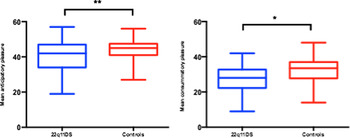
Group comparisons (Fig. 2) revealed that patients with 22q11DS had significantly lower scores on the anticipatory (F 1,101 = 6.21, p < 0.014) and consummatory (F 1,106 = 12.58, p = 0.001) dimensions of the TEPS compared to the control group. Supplementary analyses were conducted to investigate the association between the two pleasure dimensions and potential confounds. Results revealed that the VABS composite, communication and daily living skills domains, the GAF score and IQ were not significantly correlated with the TEPS pleasure dimensions (all p < 0.05). However, the VABS socialization domain was positively correlated with the anticipatory pleasure score (r = 0.432 p = 0.004). To better understand this association, we conducted a post-hoc mediation analysis using a Sobel test. Specifically, we examine whether the indirect effect of the anticipatory pleasure dimension on negative symptoms via the mediator is significantly different from zero. Results revealed that the VABS socialization score mediated the association between these two variables (z = −2.57, p = 0.01).
Group comparison of hedonic components. **p < 0.01. *p < 0.02.

Finally, to test the hypothesis that the COMT polymorphism influence hedonic capacity in 22q11DS, ANOVAs comparing the anticipatory and consummatory pleasure scores between Met and Val carriers were conducted. Results revealed that patients with the Met polymorphism had significantly lower scores on the TEPS anticipatory (F 1,46 = 5.99, p = 0.018) and consummatory (F 1,47 = 4.013, p = 0.048) dimensions compared to Val carriers.
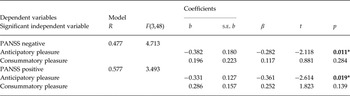
In patients with 22q11DS, linear regressions revealed significant associations between the TEPS anticipatory pleasure score and the PANSS negative (t = −2.306, p = 0.026) and positive scores (t = −2.288, p = 0.027) (Table 2). No significant association was observed for the consummatory pleasure score. When participants diagnosed with a psychotic disorder and under antipsychotic medication (N = 6) were excluded from the analyses, results remained unchanged, except that the association between the anticipatory pleasure dimension and the PANSS positive score was no longer significant.
Linear regression models examining the association between anticipatory and consummatory pleasure and PANSS positive and negative symptoms in patients with 22q11DS

PANSS, Positive and Negative Syndrome Scale
Model with full-scale IQ and anxious/depressed score as predictors.*p < 0.05.
DTI results
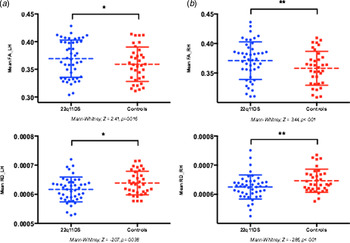
Patients with 22q11DS showed a bilateral increase of FA (right side: Z = 3.44, p < 0.01; left side: Z = 2.41, p= 0.016) and decrease of RD (right side: Z = −2.88, p < 0.01; left side: Z = −2.07, p = 0.038) compared to controls in the accumbofrontal tract (see Fig. 3). The mean AD values on both sides of the tract was not significantly different between the two groups (p > 0.05). No significant correlation between the DTI measures and pleasure dimensions or psychotic symptoms was observed (all p > 0.05).
Mean DTI measures in the accumbofrontal tract presenting significant differences between groups. The value of mean FA ranges between 0 (isotropic diffusivity) and 1(anisotropic diffusivity). The values of RD are expressed in mm2/s. The horizontal bars indicate the means and s.d. per group.

Discussion
The present study showed that participants with 22q11DS and healthy controls differed in their experience of pleasure. In line with our hypothesis, 22q11DS participants showed impaired anticipatory and consummatory pleasure compared to controls. In patients with 22q11DS, anticipatory pleasure was significantly associated with negative symptoms and, to a lesser extent, with positive symptoms. On the other hand, consummatory pleasure was unrelated to the symptomatology. The COMT polymorphism analyses revealed that Met carries report lower anticipatory and consummatory pleasure than Val carries. Regarding DTI analyses, we identified WM microstructural changes in terms of bilateral increased FA and reduced RD in the accumbofrontal tract in patients with 22q11DS compared to controls. However, no significant association between the DTI measures and TEPS dimensions or symptomatology was observed.
This is the first study showing a significant alteration of anticipatory and consummatory pleasure in patients with 22q11DS. Dopamine being the main neurotransmitter involved in the reward system (Lippa et al. Reference Lippa, Antelman, Fisher and Canfield1973), it is likely that some genes involved in the dopaminergic pathway, such as the COMT gene, contribute to this hedonic impairments. The COMT gene is located on the 22q11.2 locus, resulting in a COMT haplo-insufficiency in 22q11DS patients. Functional variation of the COMT gene could contribute to explain part of the variability of hedonic impairments in 22q11DS. Indeed, we observed that Met carriers had significantly lower scores on the TEPS dimensions compared to Val carriers. In line with this result, few studies conducted in healthy participants as well as a recent study conducted in 22q11DS showed that the Met polymorphism is associated with increased cerebral activation in the reward system during reward anticipation (Dreher et al. Reference Dreher, Kohn, Kolachana, Weinberger and Berman2009; Lancaster et al. Reference Lancaster, Linden and Heerey2012; van duin et al. Reference van Duin, Goossens, Hernaus, da Silva Alves, Schmitz, Schruers and van Amelsvoort2016). Taken together, these results suggest that the polymorphism of the COMT gene is associated with variations in hedonic capacity.
As expected, both pleasure dimensions were decreased in patients with 22q11DS, which is consistent with previous studies in populations at CHR for psychosis (Schlosser et al. Reference Schlosser, Fisher, Gard, Fulford, Loewy and Vinogradov2014; Li et al. Reference Li, Lui, Geng, Li, Li, Wang, Tan, Cheung, Kring and Chan2015b ). Despite this global alteration, the association between the anticipatory and consummatory pleasure dimensions was barely significant in patients, whereas a strong correlation was found in controls. This result points to some form of independence between the two reward components in 22q11DS. In line with this finding, we also observed a distinct pattern of associations between both dimensions of pleasure and negative symptom severity, with significant correlations being observed for the anticipatory dimension only. Thus, negative symptoms, such as anhedonia, amotivation or social withdrawal, appear to be exclusively related to an alteration of the anticipatory component in 22q11DS. It remains unclear at this stage why individuals at risk display a more generalized pattern of hedonic impairments compared to patients diagnosed with schizophrenia, in which specific alterations of the anticipatory component were mostly reported (Gard et al. Reference Gard, Kring, Gard, Horan and Green2007, Reference Gard, Sanchez, Cooper, Fisher, Garrett and Vinogradov2014; Favrod et al. Reference Favrod, Ernst, Giuliani and Bonsack2009; Chan et al. Reference Chan, Wang, Huang, Shi, Wang, Hong, Ma, Li, Lai and Kring2010; Trémeau et al 2010; Wynn et al. Reference Wynn, Horan, Kring, Simons and Green2010; Oorschot et al. Reference Oorschot, Lataster, Thewissen, Lardinois, Wichers, van Os, Delespaul and Myin-Germeys2013; Mote et al. Reference Mote, Minzenberg, Carter and Kring2014). It has been frequently shown that patients at CHR with or without 22q11DS often encounter co-morbid symptoms, particularly anxiety and depression (Fusar-Poli et al. Reference Fusar-Poli, Nelson, Valmaggia, Yung and McGuire2014; McAusland et al. Reference McAusland, Buchy, Cadenhead, Cannon, Cornblatt, Heinssen, McGlashan, Perkins, Seidman, Tsuang, Walker, Woods, Bearden, Mathalon and Addington2015; Schneider et al. Reference Schneider, Armando, Pontillo, Vicari, Debbané, Schultze-Lutter and Eliez2016). In this context, decreased consummatory pleasure may rather be related to co-morbid symptoms than to attenuated symptoms of psychosis. The fact that alterations of the ‘consummatory’ component were reported in patients suffering from major depression (Sherdell et al. Reference Sherdell, Waugh and Gotlib2012; Li et al. Reference Li, Mou, Jiang, Yang, Shen, Jin, Dai, Liu, Mao, Zhang and Yuan2015a ) may further reinforce this hypothesis. Our findings further suggest that anticipatory, but not consummatory pleasure, is associated with positive symptom severity. To our knowledge, only two studies (Cassidy et al. Reference Cassidy, Lepage, Harvey and Malla2012; Shi et al. Reference Shi, Wang, Cao, Wang, Wang, Zong, Xu, Tse, Hsi, Stone, Lui, Cheung and Chan2012) providing conflicting results have investigated the associations between these reward components and positive symptoms of psychosis. Indeed, whereas Cassidy et al. (Reference Cassidy, Lepage, Harvey and Malla2012) reported no significant association in patients with schizophrenia, Shi et al (2012) observed increased anticipatory and consummatory pleasure in individuals with positive schizotypal traits. However, it is important to note that this result was mostly driven by the few patients diagnosed with a psychotic disorder. This evidence suggests that in patients with higher symptom severity, decreased anticipatory pleasure may also be related to positive symptoms.
The second aim of this study was to examine putative brain correlates of hedonic alterations in 22q11DS. We observed increased FA and reduced RD in the accumbofrontal tract in patients with 22q11DS compared to controls. Increased FA is commonly associated with WM integrity (Mukherjee & McKinstry, Reference Mukherjee and McKinstry2006), whereas a reduction in RD is related to increased myelination (Song et al. Reference Song, Sun, Ju, Lin, Cross and Neufeld2003; Whitford et al. Reference Whitford, Kubicki, Schneiderman, O'Donnell, King, Alvarado, Khan, Markant, Nestor, Niznikiewicz, McCarley, Westin and Shenton2010). These results contrast with previous findings showing reduced FA and increased RD in frontostriatal regions in patients with schizophrenia (Quan et al. Reference Quan, Lee, Kubicki, Kikinis, Rathi, Seidman, Mesholam-Gately, Goldstein, McCarley, Shenton and Levitt2013; de Leeuw et al. Reference de Leeuw, Bohlken, Mandl, Kahn and Vink2015; James et al. Reference James, Joyce, Lunn, Hough, Kenny, Ghataorhe, Fernandez, Matthews and Zarei2016). They are, however, consistent with previous DTI findings in patients with 22q11DS reporting increased FA and reduced RD in other WM tracts (Jalbrzikowski et al. Reference Jalbrzikowski, Villalon-Reina, Karlsgodt, Senturk, Chow, Thompson and Bearden2014; Perlstein et al. Reference Perlstein, Chohan, Coman, Antshel, Fremont, Gnirke, Kikinis, Middleton, Radoeva, Shenton and Kates2014; Kates et al. Reference Kates, Olszewski, Gnirke, Kikinis, Nelson, Antshel, Fremont, Radoeva, Middleton, Shenton and Coman2015). Our findings suggest alterations in myelin development in the accumbofrontal tract in 22q11DS. Axonal integrity of this tract seems to be preserved, as indicated by the lack of statistically significant differences in AD. The mechanisms underlying increased myelination of certain tracts in 22q11DS are not fully understood. However, one of the genes located in the 22q11 locus, the Nogo-66 receptor gene, is associated with myelin-mediated inhibition of axonal sprouting. Individuals with 22q11DS being hemizygous for this gene, this might affect the development of myelination and result in an increased myelination of certain WM tracts. A previous study reported an association between decreased RD and Nogo-66 gene expression in 22q11DS (Perlstein et al. Reference Perlstein, Chohan, Coman, Antshel, Fremont, Gnirke, Kikinis, Middleton, Radoeva, Shenton and Kates2014). However, the specific association between the Nogo-66 gene and WM integrity of the accumbofrontal tract has never been tested and further investigations are needed to validate this hypothesis.
Alterations of the accumbofrontal tract have been previously associated with positive symptom severity in patients with schizophrenia (Bracht et al. Reference Bracht, Horn, Strik, Federspiel, Razavi, Stegmayer, Wiest, Dierks, Müller and Walther2014). Contrary to our hypothesis, no significant correlation between the DTI measures and pleasure dimensions or psychotic symptoms was observed. Several interpretations can be made regarding this lack of association: first, we focused on two pleasure dimensions while others pleasure components (learning, desire or effort/motivation) have not been investigated in this paper. Secondly, only one tract within the reward system was examined. Consequently, our understanding of the association between WM integrity of the reward system, hedonic experiences, and negative symptoms remains limited. Further studies investigating all of the pleasure components as well as the WM integrity of the entire reward system are therefore needed.
This study present several limitations. First, we administered the TEPS to measure the anticipatory and consummatory pleasure experience, which is currently the only self-reported instrument validated in French. Unfortunately, this scale does not cover all types of hedonic experiences, particularly social pleasure. Additional instruments, such as the Anticipatory and Consummatory Interpersonal Pleasure Scale (ACIPS, Gooding & Pflum, 2012), should be included in future studies. Second, the TEPS requires the ability to project oneself in the future, whereas previous studies observed alterations of temporal perception in 22q11DS (Debbané et al. Reference Debbané, Glaser, Gex-Fabry and Eliez2005). The influence of future thinking impairments on these results should be further examined. Third, given the preliminary nature of this study, no multiple comparison correction was applied and should be realized in future studies. Fourth, a combination of healthy siblings and unrelated controls has been used as comparison group, which may have reduced group differences due to shared genetic variants between patients with 22q11DS and their siblings. Fifthly, the association between negative symptoms and anticipatory pleasure has only been investigated in a cross-sectional way in the current study; longitudinal studies will be required to examine the causal relationship between these two phenomena. Moreover, further studies investigating all the pleasure dimensions are needed. An additional limitation is that the two pleasure dimensions have been investigated using subjective measures and not with reward processing task. Finally, due to the complexity of extracting WM tracts within the reward system, we focused on the accumbofrontal tract as a first attempt to identify brain correlates of hedonic alterations in 22q11DS. Future studies including the remaining WM tracts of the reward system are needed to better characterize these associations.
Conclusions
The present study revealed that patients with 22q11DS exhibit anticipatory and consummatory deficits compared to healthy controls. The anticipatory pleasure component appears to be related to negative symptom severity, whereas the clinical correlates of consummatory pleasure impairments remain unclear. Evidence for structural changes of the accumbofrontal tract in terms of increased FA and reduced RD were further identified in the 22q11DS group. These findings suggest abnormalities in myelination of the accumbofrontal tract, whereas axonal integrity seems to be preserved. For the first time in the literature, an association between anticipatory pleasure and negative symptom severity has been reported in 22q11DS, even if the neural correlates of this phenomenon remain unclear at this stage. Future studies focusing on the reward system should be conducted but this study already suggests that clinical interventions targeting anticipatory pleasure impairments should be considered in this population (Perivoliotis & Cather, Reference Perivoliotis and Cather2009).
Supplementary material
The supplementary material for this article can be found at https://doi.org/10.1017/S0033291716003482.
Acknowledgements
The authors thank in particular, Frédérique Sloan Bena and Maryline Gagnebin who analysed and provided the genetic informations and for their reading of the revised version of the manuscript. We thank all the families who contributed to the study as well as the family associations (Génération 22, Connect 22, Relais 22, and Creaf 22) for their ongoing support. Special thanks go to S. Menghetti, A. Zaharia, J. Maeder, L. Chamberyon, A. Buckel, I. Mottet and M. Mansion from the Office Médico-Pédagogique Research Unit for their help in data collection and scoring.
This work was supported by research grants from the Swiss National Science Foundation (grant no. 324730_144260) and The National Centre of Competence in Research ‘Synapsy – The Synaptic Bases of Mental Diseases’ (grant no. 324730_121996). Maude Schneider (grant no. 162006) and Marie Schaer (grant no. 145760) were supported by a fellowship by the Swiss National Science Foundation.
Declaration of Interest
None.