Anxiety disorders are prevalent in approximately 6–18% of youth aged from 6 to 17 and are considered the most prevalent psychiatric disorders in youth (Copeland et al., Reference Copeland, Shanahan, Costello and Angold2011). In a typical classroom, more than 10% of the students will present with excessive levels of anxiety, and youth with anxiety have been found to experience anxiety-related impairments in social, academic, and behavioural functioning (Rapee et al., Reference Rapee, Bőgels, Van Der Sluis, Craske and Ollendick2012; Swan & Kendall, Reference Swan and Kendall2016). Indeed, a growing literature documents several academic impairments due to anxiety, including lower academic achievement (Das et al., Reference Das, Halder and Mishra2014; Castagna et al., Reference Castagna, Calamia and Davis2021; Grills-Taquechel et al., Reference Grills-Taquechel, Fletcher, Vaughn, Denton and Taylor2013) and excessive school absenteeism (Ingul & Nordahl, Reference Ingul and Nordahl2013). Excessive anxiety is not only associated with academic impairment concurrently (de Lijster et al., Reference de Lijster, Dieleman, Utens, Dierckx, Wierenga, Verhulst and Legerstee2018) but also prospectively (Essau et al., Reference Essau, Lewinsohn, Olaya and Seeley2014; Suldo et al., Reference Suldo, Gormley, DuPaul and Anderson-Butcher2014).
School factors, such as teachers, peers, academic performance expectations, classroom interactions, extracurricular performances, and school violence also contribute to and/or maintain anxiety symptoms (see Compton et al., Reference Compton, Villabo and Kristensen2019). For instance, children with separation anxiety experience intense anxiety during morning drop-off time, may need school staff to assist them to exit their parent’s car and to calm them down once in school, and may miss class time due to visiting the school nurse to call or checking in with their parent. These symptoms interrupt students’ classroom participation and interfere with learning as they are often distracted by anxious thoughts that something dire may happen to their parent(s) or themselves (Ehrenreich et al., Reference Ehrenreich, Santucci and Weiner2008). Children with generalised anxiety experience excessive and persistent worry often triggered by academic expectations, are preoccupied with fears of making mistakes, failing tests or assignments, and disappointing their teachers and parents — all of which negatively impair their attention, academic performance, and classroom behaviour (Jarrett et al., Reference Jarrett, Black, Rapport, Grills-Taquechel and Ollendick2015). Youth with social anxiety have excessive fears of embarrassing themselves, being criticised, or not being liked or accepted by peers (Elizabeth et al., Reference Elizabeth, King, Ollendick, Gullone, Tonge, Watson and Macdermott2006), which can be debilitating in the classroom. These children often avoid answering or asking questions in class, approaching teachers for help, working in groups, talking to peers, or trying out for extracurricular activities (Stein & Stein, Reference Stein and Stein2008).
Because of these anxiety-related manifestations in the classroom, teachers are in a unique position to identify and assist students with excessive anxiety because they interact with students daily and have a normative reference group to evaluate whether anxiety is excessive or not. Unfortunately, teachers receive little to no training in children’s mental health in general or in anxiety specifically as part of their professional training (Council of Accreditation of Educator Preparation, 2015). In a recent systematic review of teacher training programs for student mental health, Ohrt and colleagues (Reference Ohrt, Deaton, Linich, Guest, Wymer and Sandonato2020) concluded that most teacher trainings are focused on identifying the signs and symptoms of common psychiatric disorders to improve mental health literacy rather than a focus on classroom strategies to address these symptoms. Moreover, none of the studies reviewed focused specifically on anxiety. This deficit in training leaves teachers ill equipped to recognise and appropriately respond to the needs of students who manifest excessive anxiety (Gable et al., Reference Gable, Tonelson, Sheth, Wilson and Park2012).
As a first step in addressing this gap in teacher training, it is important to investigate teachers’ current knowledge of anxiety and use of evidence-based anxiety reduction strategies in the classroom. Knowledge of anxiety includes identifying core symptoms such as physiological arousal and somatic symptoms (e.g., heart racing, stomach aches), maladaptive cognitions, and behavioural avoidance. Evidence-based strategies for anxiety reduction target these core manifestations and include teaching relaxation skills, modelling and teaching how to challenge and change anxious thoughts, and reducing anxiety-related avoidance (Chorpita, Reference Chorpita2007; Conroy et al., Reference Conroy, Hong, Poznanski, Hart, Ginsburg, Fabiano and Comerin press).
To date, only a handful of studies have examined teacher knowledge of student anxiety and/or use of anxiety reduction strategies. Headley and Campbell (Reference Headley and Campbell2013) examined 315 elementary schoolteachers’ knowledge of anxiety symptoms in children. Teachers completed a self-report questionnaire on items that included demographics and teaching experience, open-ended questions about their definition of anxiety, and identifying signs of anxiety. Results indicated that while teachers were able to identify key signs of anxiety, they were less knowledgeable about the difference between adaptive (e.g., protective) and maladaptive anxiety (e.g., excessive). Results also indicated that although teachers may recognise the gravity of student anxiety, that recognition does not promote referrals for services. Layne and colleagues (Reference Layne, Bernstein and March2006) examined which student anxiety symptoms teachers were best able to identify (e.g., social, separation) and whether this observation was influenced by the students’ age and gender. Teachers nominated students with excessive anxiety in their classroom and these students (N = 453 in Grades 2–5) completed the Multidimensional Anxiety Scale for Children (MASC). Results indicated that teachers correctly nominated students with high anxiety (i.e., consistent with high MASC scores) regardless of students’ gender or age, suggesting that teachers should be involved in identifying students with anxiety. In contrast, Cunningham and Suldo (Reference Cunningham and Suldo2014) examined teachers’ knowledge of anxiety via their ability to identify students with excessive anxiety (and depression) among a sample of 4th and 5th graders (N = 238). Students completed two questionnaires, the MASC and the Children’s Depression Inventory (CDI). Similar to the previous study, teachers nominated students that they believed demonstrated symptoms of anxiety and depression. Relevant results indicated that teachers successfully identified only 40.7% of students with elevated anxiety, revealing a high miss rate and a need for additional training in signs of anxiety to better identify these students. Finally, Splett and colleagues (Reference Splett, Garzona, Gibson, Wojtalewicz, Raborn and Reinke2019) examined teachers’ ability to identify the seriousness of internalising and externalising symptoms and the need for intervention after reading case vignettes. Results indicated that teachers accurately identified severe internalising problems but were less accurate and less likely to identify moderate or subclinical symptoms. One implication of these findings is that teachers may miss the early emergence of anxiety problems and fail to intervene to prevent their exacerbation and the onset of severe problems.
Taken together, studies assessing teacher knowledge of student anxiety, though few in number, suggest teachers do have some basic knowledge of anxiety and are able to identify some but not all students with elevated levels of anxiety. No studies assessed use of evidence-based anxiety reduction strategies and whether knowledge was related to use of these strategies in the classroom. Finally, studies failed to examine predictors of knowledge and use of anxiety reduction strategies. Identifying predictors of both teacher knowledge and use of anxiety reducing classroom behaviour can identify gaps in teacher education and inform targets for teacher training.
Guided by extant research and theories proposed by Han and Weiss (Reference Han and Weiss2005) and Guskey (Reference Guskey2002), two potential factors are hypothesised to predict teacher behaviour related to using anxiety reduction strategies. These include (1) systemic factors (e.g., organisational openness to change, communication among staff, the degree of autonomy allowed by teachers in the school) and (2) teacher factors (e.g., self-efficacy, teacher burnout). With respect to systemic factors, school policies that support mental health interventions increase the likelihood of teachers effectively implementing anxiety reduction strategies (see Mahoney et al., Reference Mahoney, Weissberg, Greenberg, Dusenbury, Jagers, Niemi, Schlinger, Schlund, Shriver, VanAusdal and Yoder2020). With respect to teacher factors, decades of research on teacher characteristics such as self-efficacy and burnout have found that higher self-efficacy is associated with higher quality classroom processes (Dicke et al., Reference Dicke, Parker, Marsh, Kunter, Schmeck and Leutner2014; Zee & Koomen, Reference Zee and Koomen2016).
The current study extends the literature on understanding teacher knowledge of anxiety and use of anxiety reduction strategies by examining the extent of teacher knowledge of the signs of anxiety and evidence-based anxiety reduction strategies (Aim 1), the relation between teacher knowledge and use of anxiety reduction strategies in the classroom (Aim 2), and systemic and teacher specific correlates of both teacher knowledge and use of anxiety reduction strategies in the classroom (Aim 3). It was hypothesised that teacher knowledge would be modest but that higher teacher knowledge would be associated with greater use of anxiety reduction skills in the classroom. In addition, lower burnout, greater school support, and higher teacher self-efficacy were expected to be positively associated with teacher knowledge and use of anxiety reduction skills.
Method
Participants
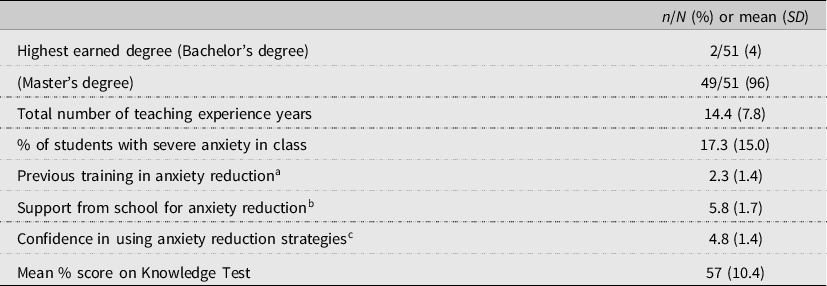
Fifty-one volunteer elementary school teachers participated (98% female; 98% White and 2% Black). Teachers were employed within 12 public school districts in the northeast United States. Teachers ranged in age from 23 to 63 years old (M age = 42.30 years, SD age = 10.10 years) and had between 0.5 and 33 years of teaching experience. Most teachers had limited training in anxiety reduction for students. Data on educational backgrounds are presented in Table 1.
Teacher baseline professional characteristics

Note: a1 = None, 7 = A lot; b1= Not at all, 7 = Very supportive; c1 = Not at all; 7 = Extremely confident.
Measures
Teacher Background Form
The Teacher Background Form, developed for the current study, is a 16-item measure completed by teachers about their personal and professional background. The form consists of 13 background questions (e.g., age, gender, ethnicity, education level, years teaching) and three questions (rated on a 7-point Likert-type scale) that assess teachers’ confidence in implementing anxiety reduction strategies (1 = Not at all, 4 = Somewhat confident, 7 = Extremely confident), support of their school system for teachers implementing anxiety reduction strategies (1 = Not at all, 4 = Somewhat supportive, 7 = Very supportive), and their amount of previous training in anxiety reduction (1 = None; 4 = Some, 7 = A lot).
Teacher Knowledge of Anxiety Assessment
(TKAA; adapted from Ginsburg et al., Reference Ginsburg, Becker, Kingery and Nichols2008). The TKAA consists of 10 short-answer and 15 multiple-choice questions measuring teachers’ knowledge of anxiety symptoms and evidence-based anxiety reduction strategies. The multiple-choice items were adapted from a similar measure used for school clinicians (Ginsburg et al., Reference Ginsburg, Becker, Kingery and Nichols2008) while the open-ended questions were developed for the current study. Sample multiple-choice items include ‘Which of the following teacher behaviours may increase student anxiety?’ and ‘Which of the following is the best strategy for addressing behavioural avoidance in the classroom?’ The 10 open-ended questions measure teachers’ ability to apply their knowledge to answer questions based on brief vignettes describing students with anxiety (e.g., based on the vignette, ‘What is a parent behaviour that might be maintaining or exacerbating the student’s anxiety?’; ‘An activity is coming up that you anticipate the student will be nervous about. List two different evidence-based strategies to help reduce the student’s anxiety and prepare them for this activity’). Scores represent total percentage correct. Data from a recent open trial of an anxiety teacher training revealed significant increases on this measure from pre- to post-training (Piselli et al., Reference Piselli, Pella, Chan and Ginsburgin press).
Classroom Strategies Questionnaire
The Classroom Strategies Questionnaire developed by the research team, and completed by the teacher assesses their use of evidence-based anxiety reduction strategies in classroom. More specifically, the strategies assessed reflect those that are consistent with cognitive behavioural treatment (CBT) for paediatric anxiety, such as relaxation skills (e.g., deep breathing, progressive muscle relaxation), using coping (rather than anxious) thoughts, and encouraging brave and autonomous rather than avoidant behaviour. In the current study, 10 items were rated using a 5-point Likert-type scale (0 = Never; 4 = Daily) that reflect the frequency of teachers’ use of evidence-based anxiety reduction strategies (e.g., praising student independence and autonomy, encouraging the use of coping self-talk) during the past month. A total score summing all items was calculated and higher total scores represent more frequent use of anxiety reduction strategies. In the current study, internal consistency measured by Cronbach’s alpha was .83.
Teacher Efficacy Beliefs Scale
(Tschannen-Moran & Woolfolk, Reference Tschannen-Moran and Woolfolk Hoy2001). The Teachers’ Efficacy Beliefs Scale is a 12-item measure completed by teachers. Teachers responded to each item on a 9-point, Likert-type scale (1 = Nothing; 9 = A great deal) indicating the extent of their perceived capability to impact the students’ learning. Sample items include ‘How much can you do to get children to follow classroom rules?’ and ‘How much can you do to help your students value learning?’ A total score was calculated where higher sum scores indicate greater feelings of efficacy. The measure demonstrates good construct validity (Tschannen-Moran & Woolfolk, Reference Tschannen-Moran and Woolfolk Hoy2001) and internal consistency, measured using Cronbach’s alpha, in both previous studies (α = .85; Edinger & Edinger, Reference Edinger and Edinger2018) and in the current sample (α = .88).
Maslach Burnout Inventory for Educators
(MBI; Maslach et al., Reference Maslach, Jackson and Leiter1996). The MBI Educators Survey is a 22-item version of the original MBI for use with educators to assess teacher burnout. Teachers respond on a 7-point scale (0 = Never; 6 = Every day) indicating frequency of job-related feelings. The measure contains three subscales: Depersonalisation (five items; e.g., ‘I don’t really care what happens to my students’), Personal accomplishment (eight items; e.g., ‘I deal very effectively with the problems of my students’), and Emotional exhaustion (nine items; e.g., ‘I feel burned out from my work’). Scores on each subscale are summed and higher scores reflect a higher degree of teacher burnout; there is no total score. The measure has strong reliability properties (Gold et al., Reference Gold, Roth, Wright, Michael and Chen1992). In the current sample, Cronbach’s alphas were .71 (Depersonalisation), .82 (Personal accomplishment), and .92 (Emotional exhaustion).
Organizational Readiness Questionnaire
(Lehman et al., Reference Lehman, Greener and Simpson2002). The Organizational Readiness Questionnaire is a 25-item measure that was adapted from the Texas Christian University Organizational Readiness for Change. Teachers rated each item using a 5-point scale (1 = Disagree strongly; 5 = Agree strongly). The measure has five subscales: Cohesion (six items; e.g., ‘Staff members at your school work together as a team’; Cronbach’s alpha for the current sample .81), Autonomy (five items; e.g., ‘You feel free to generate your own lesson plans and activities’; Cronbach’s alpha for the current sample .74), Communication (five items; e.g., ‘Your school’s staff is always kept well informed’; Cronbach’s alpha for the current sample .85), Stress (four items; e.g., ‘You are under too many pressures to do your job effectively’; Cronbach’s alpha for the current sample .71) and Change (five items; e.g., ‘It is easy to change procedures at your school to meet the needs of students’; Cronbach’s alpha for the current sample .66). Higher sum scores on each subscale indicate a greater degree of agreement with that particular construct. There is no overall or total score.
Procedures
Data for the current study were collected at baseline as part of the Teacher Anxiety Program for Elementary Students (TAPES; Ginsburg et al., Reference Ginsburg, Pella, Piselli and Chan2019). TAPES is a 3-year study funded by the Department of Education to develop and compare two teacher trainings and culminates with a randomised controlled trial. The study is designed to enhance teachers’ capacity to identify and reduce anxiety symptoms in their students using a teacher-led, school-home intervention. The university’s Institutional Review Board, school district-level administrators, and school principals approved this study. Teachers were recruited for the study via emails and flyers, in-person presentations at teacher staff meetings, and via word of mouth. Interested teachers contacted study staff to learn more about the study and if interested were consented and randomised to one of two teacher trainings. Data used in this study were collected prior to training.
Data Analyses
Descriptive statistics were used to examine teacher knowledge of anxiety (Aim 1). Pearson correlations between teacher knowledge and behaviour (as measured by the Classroom Strategies Scale) were run to examine whether teacher knowledge was related to teacher behaviour (Aim 2). To achieve Aim 3, initially, bivariate Pearson correlation coefficients were used to determine how each of the nine interested predictors were related to each of the two outcomes (i.e., teacher knowledge test scores, and classroom strategies scales). Next, multiple-predictor regression models were used to examine the adjusted association when more than one predictor was significantly related to an outcome at 5% level in the initial bivariate analysis.
Results
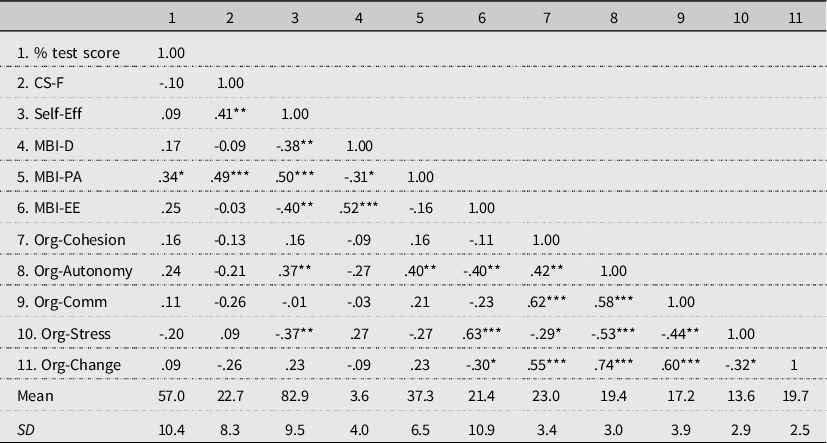
Table 1 displays descriptive statistics of the sample as well as scores on the Teacher Knowledge Test. The average total score for the sample was 57% correct (range was 33–76%). The correlation between percent correct on Teacher Knowledge Assessment and Classroom Strategies score was not statistically significant (r = −.10, p = .51). Several teacher factors were statistically significant correlates of teacher knowledge or use of anxiety reduction classroom strategies. Specifically, MBI Personal Accomplishment subscale scores were positively correlated with scores on the Teacher Knowledge Assessment (see Table 2) and the total score on the Teacher Self-efficacy Scale and MBI Personal Accomplishment subscale scores were positively correlated with the Classroom Strategies score (see Table 2). None of the systemic factors were statistically significant correlates of teacher knowledge or use of anxiety reduction classroom strategies. The multiple-predictor regression model revealed that MBI Personal Accomplishment subscale scores were a stronger predictor of teachers’ use of anxiety reduction strategies in classroom than scores on the Self-Efficacy scale score, with adjusted regression coefficients (95% confidence interval) equal to 0.49 ([0.13, 0.86]; p = .01) and 0.19 ([-0.05, 0.44]; p = .13) respectively.
Bivariate Pearson correlation matrix

Note: % test score, Teacher Knowledge of Anxiety Assessment score; CS-F, Classroom Strategies Scale, frequency; Self-Eff, Teacher Self-Efficacy Beliefs Scale, total score; MBI-D, Maslach Burnout Inventory for Educators, Depersonalisation subscale; MBI-PA, Maslach Burnout Inventory for Educators Personal, Accomplishment subscale; MBI-EE, Maslach Burnout Inventory for Educators, Emotional Exhaustion subscale; Org-Cohesion, Organisational Readiness Questionnaire, Cohesion subscale; Org-Autonomy, Organisational Readiness Questionnaire, Autonomy subscale; Org-Comm, Organisational Readiness Questionnaire, Communication subscale; Org-Stress, Organisational Readiness Questionnaire, Stress subscale; Org-Change, Organisational Readiness Questionnaire, Change subscale.
*p < .05, **p < .01, ***p < .001
Discussion
The current study examined the extent to which teachers are knowledgeable about the manifestations of excessive student anxiety and evidence-based anxiety reduction strategies (Aim 1), as well as the relation between teacher knowledge and use of anxiety reduction strategies in the classroom (Aim 2). Predictors, both systemic (e.g., school and workplace factors) and teacher specific characteristics (e.g., teacher burn out, self-efficacy), of teacher knowledge and use of anxiety reduction strategies in the classroom were also examined (Aim 3). It was hypothesised that knowledge would be modest and teachers with greater knowledge would use more evidence-based strategies in their classroom. It was also hypothesised that school and teacher factors would predict knowledge of student anxiety and use of anxiety reduction strategies. Overall, findings revealed that teacher knowledge of anxiety was limited and unrelated to their self-reported use of anxiety reduction strategies in the classroom. The most robust predictor of both teacher knowledge and use of anxiety reduction strategies was teachers’ personal sense of accomplishment at work.
Consistent with our hypothesis and extant research, teachers’ overall knowledge about anxiety and evidence-based anxiety reduction strategies was modest; the average score on the knowledge assessment was 57% correct. This knowledge assessment examined whether teachers were familiar with the three core manifestations of anxiety. These core manifestations include physiological and somatic symptoms (e.g., headaches, stomach aches, racing heart, dizziness), anxious thoughts (e.g., ‘What if I get the wrong answer and fail, others kids will laugh at me’), and behavioural avoidance (e.g., refusing to speak or answer a question in class, eating alone, not using the bathrooms, escaping to the nurse’s office). In light of the low knowledge scores, teachers would benefit from additional training in the identification of these key signs of anxiety. Additionally, providing teachers with training in the use of free and widely available standardised screeners for student anxiety such as the School Anxiety Scale or the Screen for Child Anxiety and Related Emotional Disorders seems warranted to increase identification and appropriate referral of students with anxiety.
Other content covered on the knowledge assessment was related to the management of excessive anxiety in students. Specifically, teachers were given vignettes of students exhibiting anxiety and asked to indicate how they would help the student. Correct responses included evidence-based anxiety reduction strategies that map onto the core manifestations of anxiety. These include relaxation strategies (to lower physiological arousal and somatic symptoms), cognitive restructuring (to challenge and alter unrealistic and anxiety provoking thoughts), and gradual exposure or facing of fears (to reduce avoidant behaviour, which is known to maintain excessive anxiety). These strategies are the core components of CBT and their use by non-mental health school personnel such as nurses (Ginsburg et al., Reference Ginsburg, Drake, Muggeo, Stewart, Pikulski, Zheng and Harel2020) and teachers (Anticich et al., Reference Anticich, Barrett, Silverman, Lacherez and Gillies2013; Barrett et al., Reference Barrett, Lock and Farrell2005; Barrett & Turner, Reference Barrett and Turner2001) is increasing and shows promise for reducing student anxiety. However, knowledge of these strategies appears low. Taken together, the current findings are consistent with published data on teachers’ opinions indicating they do not feel knowledgeable or equipped to deal with student anxiety (Gable et al., Reference Gable, Tonelson, Sheth, Wilson and Park2012; Reinke et al., Reference Reinke, Stormont, Herman, Puri and Goel2011). Consequently, teacher professional development curriculums should prioritise training in the management of student anxiety via evidence-based strategies.
The second aim of this study examined whether teachers’ knowledge of student anxiety was associated with their self-reported use of anxiety reduction strategies in the classroom. In contrast to our hypotheses, the correlation between knowledge and behaviour was essentially zero (-.10), indicating that the two constructs were unrelated (despite being reported on by the same informant). The absence of a relation between knowledge and behaviour suggest that didactic training (which may increase knowledge) is not sufficient to ensure behaviour change and increase skill acquisition or use. Indeed, research has shown that skill acquisition by teachers requires training that includes active learning approaches such as modelling and rehearsal or role plays and must be applied in an authentic classroom setting with students with ongoing performance feedback (Beidas & Kendall, Reference Beidas and Kendall2010; Stormont et al., Reference Stormont, Reinke, Newcomer, Marchese and Lewis2015). Meta-analyses indicate that with adequate training and coaching teachers can effectively deliver classroom-based social-emotional curricula with numerous positive effects on student outcomes (Durlak et al., Reference Durlak, Weissberg, Dymnicki, Taylor and Schellinger2011). Thus, an active learning approach to training for anxiety reduction appears warranted and may increase the application of knowledge gleaned in training, as knowledge alone appears insufficient.
The third aim of this study examined potential predictors of both teacher knowledge and behaviour. A total of nine variables were examined, encompassing systemic school factors (such as organisational openness to change, communication among staff, the degree of autonomy allowed by teachers in the school), as well as teachers’ personal characteristics such as feeling burnt out and professional self-efficacy. Findings revealed that teachers who expressed higher levels of personal accomplishment, reflected in reports that they understood their students’ feelings, were adept at dealing with students’ problems, could easily create a relaxed atmosphere for their students, and were energised and exhilarated by working with students, had higher knowledge of anxiety and higher use of anxiety reduction strategies. Teachers reporting higher work self-efficacy, such as beliefs in their ability to motivate and help students learn, implement classroom management strategies to reduce disruptive behaviour and increase following rules, also endorsed using more anxiety reduction strategies in their classrooms. The positive relation between self-efficacy and sense of accomplishment and use of anxiety reduction skills is consistent with models of teacher behaviour change when adopting mental health interventions (Guskey, Reference Guskey2002; Han & Weiss, Reference Han and Weiss2005). For instance, higher teaching self-efficacy (i.e., teachers’ beliefs that they are capable of implementing the new skills; Stein & Wang, Reference Stein and Wang1988) has been related to higher teacher adoption, implementation and sustained use of new skills (Tschannen-Moran & Hoy, Reference Tschannen-Moran and Woolfolk Hoy2001). Related, when teachers experience success in improving student behaviour and attribute improvements in students’ behaviours to their use of new skills (a key feedback loop from students), it enhances teachers’ beliefs about the new skills they are using, their own efficacy, and their motivation to continue using the new skills increases (Datnow & Castellano, Reference Datnow and Castellano2000; Guskey, Reference Guskey2002). Teachers who bring a high level of enthusiasm and efficacy beliefs for using anxiety reduction skills such as exposure, relaxation and cognitive restructuring are likely to see the positive impact on students and, consistent with this mode, continue to use these skills.
The relationship between knowledge, self-efficacy, personal accomplishment and utilisation of classroom strategies merits further examination in subsequent work, particularly their temporal ordering and direction of causality (if any). It may be that high self-efficacy drives teachers both to seek out additional knowledge independently and to use what they have learned. Conversely, it may be that self-efficacy serves as a mediating factor between knowledge and its application, such that teachers both need to know what to do and believe they can do it before these strategies are put into practice. Collecting data over time to investigate these relationships would offer critical additional insight and could help to guide the training and coaching of teachers to effectively utilise evidence-based anxiety reduction strategies in the classroom.
In contrast with extant models of teacher behaviour, however, the current study did not find that systemic factors such as school priorities and workplace policies were related to teacher knowledge or use of anxiety reduction skills. Several interpretations for this finding are possible. It may be that the participating schools were generally supportive of school-based interventions for anxiety (resulting in a restricted range on scores). Indeed, the school districts that we collaborated with for this study all indicated that addressing anxiety was a high priority to address for their students, and the teachers all volunteered due to their own interest in the topic. The sample size may have been too small (insufficient power to detect small effect) or the systemic factors measured in the current study may be less relevant for anxiety specifically. Future studies should include a larger and more diverse sample and include additional systemic factors such as supportive relationships with supervisors and administration or organisational climate at the school level, among others.
Findings from the current study should be evaluated in the context of several limitations. Specifically, measures of teacher use of anxiety reduction strategies in the classroom were based on teacher report and could be biased and may not be consistent with observed behaviour. The measure of knowledge, while used in previous studies, was developed by the researchers and not validated by other research teams. The sample of elementary teachers were volunteers, small, and homogeneous (mostly White, female teachers with master’s degrees) and thus are not a representative sample which limits the generalisability of findings.
Conclusions
The results of the current study suggest teachers could benefit from additional training on identifying student anxiety and using evidence-based strategies to address anxiety in the classroom. When examining the factors that may make a teacher more likely to be aware of and use those strategies, a history of accomplishment and a belief in one’s ability to change the classroom environment appear to be important (and more important than school policies or supports). While exploratory, the results highlight two key conclusions to guide future study. First, given the high prevalence of child anxiety and the significant impact it has on school functioning, there remains a significant need to improve teacher knowledge about pediatric anxiety disorders. Second, the results make a compelling case for training methods that go beyond a simple informational or didactic format and focus particularly on application of skills within the classroom context and support for teachers when first implementing these skills. Increasing knowledge is necessary, but not sufficient — we must identify efficacious tools for empowering teachers to act on their knowledge of student anxiety if we are to aid in changing the trajectories of anxious youth in schools. School counsellors and/or psychologists are in an ideal role, given their mental health training, to provide education and support to teachers regarding the identification (e.g., via brief assessment tools) of students with anxiety and in the provision of classroom-based interventions to reduce student anxiety.
Funding
This research was supported by a grant from the Institute of Education Sciences, U.S. Department of Education, through Grant R324A170071 awarded to Dr Golda S. Ginsburg. The opinions expressed are those of the authors and do not represent views of the Institute or the U.S. Department of Education.
Conflict of interest
The authors declare that they have no conflict of interest.
Ethical approval
All procedures performed in this study involving human participants were in accordance with the ethical standards of the Institutional Review Board of UConn Health.
Informed consent
Informed consent was obtained from all individual participants included in the study.