During the United Nations (UN) Fourth World Conference on Women in Beijing, China (Beijing 95), members acknowledged the need to increase women's formal political participation within legislative bodies (United Nations 1996, 79). This is in line with literature that suggests that female parliamentarians tend to focus on substantive matters that are directly tied to the needs of women and children, such as health and education (Bolzendahl Reference Bolzendahl2011; Bolzendahl and Brooks Reference Bolzendahl and Brooks2007; Brady Reference Brady2009; Swiss, Fallon, and Burgos Reference Swiss, Fallon and Burgos2012). One of the priorities that emerged from Beijing 95, therefore, was the implementation of national political gender quotas (Crocker Reference Crocker2007). Since the signing of the Beijing Platform for Action by 189 member states, the number of political gender quotas adopted has skyrocketed. In the 1980s, the number of countries that had adopted some form of gender political quotas was just above 20. In the 1990s, this number jumped to more than 60—many countries began implementing quotas after Beijing 1995. In the 2000s, the number continued to surge to well over 100 countries (Krook Reference Krook2009).
With the rise in quotas, scholars have turned their attention to factors contributing to quota adoption. These studies are particularly interested in determining why some countries are more likely to adopt quotas, and they reveal a range patterns, both domestic and international (Krook Reference Krook2006). The literature is vast and rich and includes cross-national quantitative studies (Anderson and Swiss Reference Anderson and Swiss2014; Bush Reference Bush2011; Hughes, Krook, and Paxton Reference Hughes, Krook and Paxton2015; Thames and Williams Reference Thames and Williams2013) along with in-depth qualitative studies (Bauer Reference Bauer2012; Galligan Reference Galligan2006; Krook Reference Krook2009; Towns Reference Towns2010) that attempt to uncover the mechanisms leading to quota adoption. The findings suggest that multiple forces working together contribute to quota adoption, including, but not limited to, benefits gained by political elites or parties choosing to adopt quotas (Caul Reference Caul1999; Htun Reference Htun2004; Krook Reference Krook2009; Krook and O'Brien Reference Krook and O'Brien2010; Meier Reference Meier2004), the success of transnational and local women's activism (Htun and Jones Reference Htun, Jones, Molyneux and Craske2002; Krook Reference Krook2009; Piatti-Crocker Reference Piatti-Crocker2011), the diffusion of quotas within regions (Htun and Jones Reference Htun, Jones, Molyneux and Craske2002; Krook Reference Krook2006; Piatti-Crocker Reference Piatti-Crocker2011; Towns Reference Towns2010), and global pressures to adhere to world polity or regional expectations, in some cases to ensure continued access to donor funding (Anderson and Swiss Reference Anderson and Swiss2014; Bush Reference Bush2011; Krook Reference Krook2009; Thames and Williams Reference Thames and Williams2013; Towns Reference Towns2012). Quota adoption is particularly salient among postconflict countries attempting to create and rebuild their political structures (Anderson and Swiss Reference Anderson and Swiss2014; Fallon, Swiss, and Viterna Reference Fallon, Swiss and Viterna2012; Bush Reference Bush2011; Hughes Reference Hughes2009; Hughes and Tripp Reference Hughes and Tripp2015).
Despite the wealth of knowledge created by these studies, few cross-national quantitative studies across developing countries focus specifically on (1) the difference in adoption of reserved seats and legislated quotas in comparison to political party quotas, (2) the role of Beijing 95, and (3) neighboring country effects (the likelihood of adopting quotas when a neighboring country does so). In this article, we begin by examining whether the diffusion of quotas differs for reserved and legislated seats versus political party seats. Most research on quota adoption uses only legislated seats or combines legislated and reserved seats (Adams and Becker Reference Adams and Becker2007; Anderson and Swiss Reference Anderson and Swiss2014; Bush Reference Bush2011; Hughes, Krook, and Paxton Reference Hughes, Krook and Paxton2015; Paxton, Hughes, and Painter Reference Paxton, Hughes and Painter2010). Yet the mechanisms for adopting reserved seats and legislated quotas, which are adopted at the national level, most likely differ from political party quotas, which are adopted at the political party level.
We then turn our attention to Beijing 95. Although many scholars acknowledge the role of Beijing 95 in contributing to quota adoption globally, this is often attributed to women's activism within nation-states, as well as the general pattern of increased quota adoption after 1995 (Fallon, Swiss, and Viterna Reference Fallon, Swiss and Viterna2012; Htun and Jones Reference Htun, Jones, Molyneux and Craske2002; Piatti-Crocker Reference Piatti-Crocker2011; Sacchet Reference Sacchet2008; Towns Reference Towns2012). To our knowledge, no quantitative cross-national study has examined whether there is a direct link between Beijing 95 and the diffusion of quota adoption globally.
Finally, we explore quota diffusion. A number of studies indicate that regional effects increase quota adoption (Ballington Reference Ballington2004; Bauer Reference Bauer2012; Htun and Jones Reference Htun, Jones, Molyneux and Craske2002; Thames and Williams Reference Thames and Williams2013; Towns Reference Towns2010). As the number of countries within a region adopting quotas increases, other countries in the region will follow suit. This pattern is attributed to the exchange of ideas locally, the role of regional organizations in encouraging adoption (such as the Southern African Development Community [SADC], which encourages member countries to institute gender quotas at a threshold of 50%), as well as the pressure to adhere to regional expectations (Bauer Reference Bauer2012; Htun and Jones Reference Htun, Jones, Molyneux and Craske2002; Rogers Reference Rogers2003; Thames and Williams Reference Thames and Williams2013). Building on these findings, we explore whether countries are quicker to adopt quotas when their neighbors have done so than when they face regional or global influences to do so. Theoretically, because there should be more exchange and communication between neighboring countries, quota adoption should spread faster between neighbors than it does regionally (Shor n.d.; Wejnert Reference Wejnert2005).
Following studies arguing that developing countries must be examined separately from developed countries given their different governing structures and economic, political, and social histories (Dahlerup and Friedenval Reference Dahlerup and Freidenval2005; Matland Reference Matland1998; Stockemer Reference Stockemer2014; Viterna and Fallon Reference Viterna and Fallon2008), we focus our attention on developing nations. Drawing from a sample of 134 developing countries between 1987 and 2012, we use event history analysis to examine whether and how three primary factors, highlighted in previous qualitative and quantitative studies, may contribute to the adoption of gendered political quotas across developing countries: (1) quota diffusion patterns based on quota type, (2) the influence of Beijing 95, and (3) the role of contagion and neighboring country effects.
QUOTA ADOPTION
Quota Type
Quota adoption, as suggested by Krook (Reference Krook2014), should be examined according to the means by which quotas are adopted, whether through constitutional amendments, legislative changes, or political party implementation. Constitutional and legislative adoption requires awareness and support at the national level to lead to adoption. These types of quotas may consist of legal quotas that stipulate the minimum threshold that party lists must uphold for women's participation, or they may consist of reserved quotas that set aside a certain number of seats in the legislature for women. Political party quotas, alternatively, only require change within a party and are often instituted to encourage women's presence within the parties. Thus, national-level awareness is not needed, and the quotas should, theoretically, be easier to implement.
Although the means by which quotas are adopted differ according to the type of quota, most quantitative scholars either group all quota types together, or they tend to rely on legislative quotas, as they are easier to measure, as opposed to voluntary party quotas, which are more difficult to track and are sometimes unavailable (Adams and Becker Reference Adams and Becker2007; Anderson and Swiss Reference Anderson and Swiss2014; Bush Reference Bush2011; Hughes, Krook, and Paxton Reference Hughes, Krook and Paxton2015; Paxton, Hughes, and Painter Reference Paxton, Hughes and Painter2010). Yet given the difference in how political party quotas are adopted in comparison to reserved and legislated quotas, we argue that a preliminary analysis of existing political party data is necessary to understand possible variations in quota adoption processes across developing countries. Unfortunately, it is not possible to identify quota policies for all parties in all countries in every given year, as party quota data are often limited to the largest or most visible parties in a country, with some smaller parties included. Yet because the largest parties should theoretically have the greatest effect on women's legislative representation, we argue that a preliminary analysis of existing data should provide insight into quota diffusion differences according to quota types. Specifically, we aim to examine variation in adoption processes among reserved and legislative quotas in comparison to political party quotas, with attention given to the role of Beijing 95 and neighboring country effects.
Transnational Activism and Beijing 1995
Regardless of the type of quota adopted, studies consistently find that women's activism contributes to the process (Htun and Jones Reference Htun, Jones, Molyneux and Craske2002; Krook Reference Krook2009; Piatti-Crocker Reference Piatti-Crocker2011). Outside of local and national activism, scholars suggest that Beijing 95 played a large role in the diffusion of quotas. For example, women from Argentina were invited to discuss the Argentinian quotas within forums used to prepare for Beijing 95 across Latin America (Piatti-Crocker Reference Piatti-Crocker2011). During this same time frame, women parliamentarians across Latin America met in São Paulo to discuss quotas in Argentina, which led to a call for action in adopting quotas and became central to forums preparing for Beijing 95 (Htun and Jones Reference Htun, Jones, Molyneux and Craske2002). Similarly, a Brazilian Women's Coalition discussed proposals for Beijing 95 across 25 states, and in the same year, a quota policy was passed in the National Congress (Sacchet Reference Sacchet2008). Other scholars suggest that activists from postconflict countries that instituted quotas propelled quota adoption to the forefront of Beijing 95 (Chen Reference Chen2010; Krook Reference Krook2006).
Once included within the Platform for Action, quota adoption was legitimized and provided support for activists seeking to implement quotas (Htun and Jones Reference Htun, Jones, Molyneux and Craske2002; Towns Reference Towns2012). After Beijing 95, the momentum continued. Fallon, Swiss, and Viterna (Reference Fallon, Swiss and Viterna2012), for instance, show that quota adoption significantly increased after the Beijing 1995 conference. Towns (Reference Towns2010) demonstrates that activists and the role of Beijing 95 contributed to quota adoption when supported by (and aligned with) other transnational institutions, such as the World Bank, the United Nations Development Programme, and the Inter-Parliamentary Union. Others similarly mention the role of Beijing 95 along with the role of localized women activists in quota implementation (Galligan Reference Galligan2006; Krook Reference Krook2009).
Although all of these studies demonstrate the diffusion of ideas and activism surrounding quota adoption, they do not demonstrate a direct link between Beijing 95 and adoption across developing countries. One study, by Hughes, Krook, and Paxton (Reference Hughes, Krook and Paxton2015), does show the role of the international women's movement in quota adoption. Nonetheless, they do not specifically examine the influence of Beijing 95. Instead, they combine three variables to measure the international women's movement: (1) women's international nongovernmental organizations; (2) the cumulative count of international conferences, UN treaties, and UN groups related to women; and (3) yearly resources of United Nations Development Fund for Women. Using this measure, they find that the international women's movement has been one of the greatest influences on quota adoption. However, they also find that countries with increased women's international nongovernmental organizations that simultaneously experienced transnational pressures from the international women's movement were less likely to adopt quotas after Beijing 95. They theorize that this finding may suggest a “recoiling” reaction by government officials toward activists, hindering the adoption of quotas. On the one hand, the finding is counterintuitive, as previous research finds that increased activism leads to quota adoption. On the other hand, it suggests that activism created through Beijing 95 may have had a limited impact on quota adoption because of the recoiling affect. We build on the foregoing studies by focusing specifically on the role of Beijing 95 in contributing to quota adoption across developing countries.
Contagion and Norm Cascades
In addition to the role of Beijing 95, the diffusion of quotas through world polity pressures is often linked to global or regional effects—or the notion that as more countries adopt quotas regionally (or globally), the more likely it is that other countries in that region (or worldwide) will adopt quotas. The diffusion of ideas and practices is attributed to the exchange of ideas between nations (such as through policy negotiations, trade, or activism), the role of regional organizations encouraging action (such SADC), as well as regional or global pressure to adhere to regional or global expectations (Krook Reference Krook2009; Piatti-Crocker Reference Piatti-Crocker2011; Rogers Reference Rogers2003; Towns Reference Towns2012; Wejnert Reference Wejnert2002). Adoption prompted by such processes typifies what Finnemore and Sikkink (Reference Finnemore and Sikkink1998) call a “norm cascade,” resulting in the spread of new institutions and norms among diverse countries.
Numerous studies on quota adoption demonstrate these effects regionally. Towns (Reference Towns2010), drawing on qualitative analysis, argues that party quotas, especially in socialist parties, started within Latin America before spreading to Africa and the Middle East. Piatti-Crocker (Reference Piatti-Crocker2011) further shows that quotas diffused across Latin America after the initial adoption of quotas in Argentina, and Htun and Jones (Reference Htun, Jones, Molyneux and Craske2002) demonstrate that the diffusion of quota adoption across Latin America was, in part, fueled by preparations for Beijing 95. Thames and Williams (Reference Thames and Williams2013) support these studies and find that regional counts contribute to the adoption of legislative quotas using cross-national quantitative analysis on democratic countries from developed and developing countries. Bush (Reference Bush2011), when examining developing countries cross-nationally and over time, however, finds that regional diffusion is not significant. Although qualitative studies reveal mechanisms of diffusion across countries and regions, findings from quantitative studies are contradictory. Whether regional diffusion is significant cross-nationally and over time across developing countries remains unclear.
Additionally, whether neighboring country effects play a more direct role is also unknown. We would expect to find an increased likelihood of quota adoption as a result of neighboring country effects given the proximity of nations, suggesting increased exchange of information. Previous studies have argued that increased proximity is central to the diffusion of ideas and practices (Brown Reference Brown1989; Strang and Meyer Reference Strang and Meyer1993), while others have found that neighboring country diffusion, more so than regional effects, is central to the spread of legislation and policy (Shor n.d.; Wejnert Reference Wejnert2005).
Our Contribution
Building on existing literature, we make three additions. First, we test whether constitutional and legislated quotas, in comparison to political party quotas, are adopted differently across developing countries. We offer preliminary data analysis using existing political party quotas to determine whether there are different mechanisms at play in the adoption process. Second, we examine the role that Beijing 95 had on quota adoption across developing countries. Although many qualitative studies, often limited to a handful of countries, demonstrate that Beijing 95 contributed to quota adoption, and a few quantitative studies suggest that participation in Beijing 95 contributed to quota adoption, to our knowledge, no cross-national and longitudinal study has directly examined whether participation within Beijing 95 contributed to quota adoption. Finally, we explore the role of neighboring country effects in comparison to regional and global effects to test the influence of mimicry and contagion on diffusion. Although all demonstrate norm cascades across developing countries, the processes by which the cascades take place differ.
METHODS AND DATA
To assess the effects of Beijing 95 and norm cascades on the adoption of different types of electoral quotas across the developing world, we use event history modeling on a sample of 134 low- and middle-income countries over the 25-year period from 1987 to 2012.
Method
Event history models are used to analyze the risk or timing of an event of interest (Allison Reference Allison1984; Blossfeld and Rohwer Reference Blossfeld and Rohwer2002; Cleves, Gould, and Gutierrez Reference Cleves, Gould and Gutierrez2002). Event history techniques have been used previously to explain international norm adoption and diffusion, including electoral quotas (Anderson and Swiss Reference Anderson and Swiss2014; Bush Reference Bush2011; Cole Reference Cole2013). Building on this literature, we analyze the timing of electoral quota adoption in the developing countries in our sample using exponential accelerated failure time (AFT) event history models that take the following form:
 $${\log} \left( {t_j} \right) = x_j {\rm \beta} + z_j$$
These linear models predict logged survival time (t) based on a vector of covariates (x) and their corresponding vector of regression coefficients (β). An exponential AFT model assumes a constant hazard baseline rate, with changes in the predicted timing of quota adoption attributable to each model's covariates.
Because we model five dependent variables (five categories of quota adoption) in the analysis that follows, the number of country-year observations in our sample varies with each set of analyses depending on left- and right-censoring of country cases. In the risk set for our main analysis of the adoption of any nonparty quotas, we have 2,769 country-year observations for 134 countries with 48 failures and a mean exit time from the risk set of 20.8 years. Countries enter into the risk set in 1987 or in their year of independence and exit after adopting a quota or at the end of the analysis period in 2012, resulting in a maximum time at risk of 25 years.
Data
Sample
Our sample of countries ranges from 129 to 134, depending on the type of quota adoption we model, as certain countries are left-censored out of the sample with specific quota types. The largest sample is associated with our models of voluntary party quota adoption and reflects 2,912 country-year observations between 1987 and 2012.Footnote 1 The smallest sample size is found in the models of nonparty, reserved seat quotas, with only 1,686 country-years between 1996 and 2012. We include all countries with available data that had real gross domestic product (GDP) per capita below $10,000 (constant 2005 U.S. dollars) in 1980, even if their income eventually exceeds that threshold as a result of economic growth.
Quota Adoption
Our analysis examines the timing of adoption of electoral quotas between 1987 and 2012. Using data from the International IDEA/Inter-Parliamentary Union/Stockholm University Global Database of Quotas for Women (http://www.quotaproject.org) (IDEA 2012), we coded the year of adoption of five electoral quotas in two ways: (1) by the source of the quota (constitution, legislation, or party) and (2) by the type of quota (reserved seat or legislated candidate).
The first group reflects what the QuotaProject.org database identifies as the source of the quota, indicating whether the quota is specified in a country's constitution, another piece of legislation, or by a political party. In our analysis, we group the constitutional and legislated quotas together as nonparty quotas. In contrast, the second group mirrors the Quota Project's coding of quota type: we coded the nonparty quotas to distinguish between legislated candidate quotas and reserved seat quotas. This indicates whether quotas specify a set number of reserved seats or a certain proportion of candidates, regardless of the legal source of the quota (constitution or legislation).
We focus, first, on the source of quota legitimacy because it is that source that must be modified to enable adoption of quotas as an institution. Differentiating quotas in this manner assumes that the process of adoption will vary depending on whether it is a constitutional change, a reform to legislation, or a change in party policy. We code only the initial adoption of a quota during the period of study, and there are no repeat events in our samples. In the event that a country adopted multiple types of quotas during the period, our combined nonparty quota measure reflects the earliest quota for either nonparty option.Footnote 2 We look to the difference between reserved seat and legislated candidate quotas because these types, regardless of source, have very different implications for the functioning of electoral machinery (Krook Reference Krook2009).
Sixty-three countries adopted any form of quota in our sample between 1987 and 2012. This includes 48 nonparty quotas and 27 party quotas.Footnote 3 Seventy-one of our sample countries never adopted an electoral quota during our 25-year period of analysis.
The Correlates of Quota Adoption
We structure our analysis around two sets of factors drawn from the research literature on electoral quotas outlined earlier in the paper: (1) the transnational influence of activism and (2) contagion/mimicry effects at multiple levels. We also account for development indicators previously shown to influence quota adoption, and we control for other transnational influences such as human rights treaties and foreign aid flows. For time-varying covariates, we lag the independent variables three years behind the year of analysis, allowing time for the “effect” of different factors to act on processes of quota adoption.
Transnational influences
First, we analyze the effects of Beijing 95 on quota adoption. We also include women's international nongovernmental organizations (WINGOs) to compare women's general transnational activism with that specifically tied to Beijing 95.
Representation at Beijing World Conference on Women: One of our chief innovations in this study is to measure the effects of the Beijing 1995 conference not only through the temporal effect of the pre- and post-Beijing era but also through the level of national representation a country had through civil society organizations (CSOs) accredited to the world conference on women process. The variable is coded as follows: 0, pre-Beijing period; 1, post-Beijing period, no CSOs represented the country; 2, post-Beijing period, lower level of CSO representation (fewer than 10 CSOs present); and 3, post-Beijing period, higher level of CSO representation (more than 10 CSOs present). By accounting for Beijing in this fashion, we hope to measure not only the well-documented influence of the conference but also the CSO channels through which some of its influence may have effected changes in societies in the subsequent years. Because this measure can act as a proxy for women's movement organizations, we do not include it and the WINGO membership count in the same models.
WINGO membership count: To account for the influence of the international women's movement, we include a count of WINGOs in which a country's citizens are members, a measure developed by Paxton, Hughes, and Green (Reference Paxton, Hughes and Green2006). Because this original measure was only collected in certain years, we use linear interpolation to fill in missing values in the variable. The mean number of WINGO memberships for a country in our sample is approximately six organizations.Footnote 4
Second, we account for the transnational normative influences through contagion and mimicry on the diffusion of electoral quotas. We measure this by assessing the extent of quota adoption at three levels: global, regional, and neighboring countries. Here we also control for the effects of human rights treaties and international aid as factors shaping the quota adoption process.
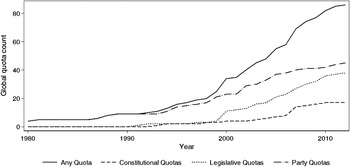
Global electoral quota counts: For each type of quota presented in the analysis that follows, we calculated global annual counts of countries that previously adopted that type of quota. This results in five global quota count measures: any quota, constitutional quotas, legislated quotas, all nonparty quotas, and party quotas. Figure 1 shows the trends in four of these counts over the period from 1980 through 2012.
Global quota counts, 1980–2012.

Regional electoral quota prevalence: In keeping with earlier studies (Bush Reference Bush2011; Thames and Williams Reference Thames and Williams2013), we also account for the influence of the regional prevalence of electoral quotas. This measure is a proportion of the countries in a given region that had already adopted the various forms of electoral quotas.
Neighboring country quotas: To account for contagion or norm cascade effects beyond the global and regional levels, we also include a measure of whether any neighboring country previously adopted the respective quota type. Using the Correlates of War direct contiguity website, we coded a dummy variable indicating whether a country's neighbors have adopted quotas (Stinnett et al. Reference Stinnett, Tir, Diehl, Schafer and Gochman2002). In our primary sample, 90 of 121 countries (74%) have a neighboring country that adopted quotas at some point in our sample period.
Human rights treaty ratifications: We include an annual count of the UN human rights treaties and relevant optional protocols ratified by a country in a given year. The data are drawn from the Nominal Commitment to Human Rights Global Survey dataset, with a maximum possible number of ratifications of 15. Our sample ranges from a minimum of zero ratifications to a maximum of 12 in the 1987–2012 period.
Foreign aid: We include aid per capita (constant 2005 U.S. dollars) as a measure to account for the influence of external resource flows on quota adoption (World Bank 2014). To account for skewness, we log this variable after adding a small constant to account for those countries receiving no aid in a given year.
Development indicators
Our models also account for the other socioeconomic and political indicators of development.
Region: We include regional dummy variables for the six broad geographic regions where our sample countries are located: Latin America, Sub-Saharan Africa, North Africa/Middle East, Asia-Pacific, and Eastern Europe. With the highest regional prevalence of electoral quotas (39.4% in 2012), we use Latin America as the reference category.
GDP per capita (constant 2005 U.S. dollars): We account for level of economic development in a country using GDP per capita in real-dollar terms. Mean GDP per capita in our sample is $2,519 (World Bank 2014). We include a logged measure of GDP per capita to account for skewness.
Female secondary education enrollment rate: Education is recognized as a critical determinant of social development and girls' ability to access education is a significant marker of women's status in a society. More educated women and girls are better able to engage in political processes and more likely to advocate for gender equity (Kabeer Reference Kabeer2005). We include the gross female secondary enrollment rate in our models to account for women and girls' education as a measure of social development (World Bank 2014). Owing to significant gaps in the female education data available from the World Bank, we fill in missing years where possible with linear interpolation.
Electoral system: Electoral quotas have long been associated with proportional representation electoral systems (Dahlerup and Freidenvall Reference Dahlerup and Freidenval2005; Tripp and Kang Reference Tripp and Kang2008). To account for the possible effects of electoral system, we include a three-category measure with plurality/first-past-the-post systems as the reference category and mixed electoral and proportional representation systems coded separately (IDEA 2005).Footnote 5
Democracy: One of many indices of the level of democracy or autocracy used by social scientists, we include the Polity IV score for a country to account for democratic quality over the period of our analysis (Marshall, Jaggers, and Gurr Reference Marshall, Jaggers and Gurr2009). Our sample mean Polity IV score ranges from a low of –2.5 in 1988 to a high of 2.8 in 2008, indicating a trend toward increased democracy across our sample although still relatively low average scores.
Transition from civil strife: We include a civil strife transition dummy variable based on Fallon, Swiss, and Viterna's (Reference Fallon, Swiss and Viterna2012) coding of democratic transitions for all countries that experienced a transition to democracy following civil strife in the post-1975 period.Footnote 6
RESULTS
Nonparty and Voluntary Party Quota Adoption
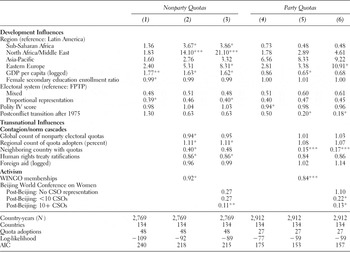
First we analyze the factors influencing the adoption of any nonparty (constitutional and legislated) and voluntary party electoral quotas for women. Table 1 shows the estimated time ratios for each group of factors in a nested model structure. Models 1–3 analyze the rate of nonparty quota adoption. Models 4–6 examine the adoption of party quotas. Comparing the two types of quotas, we see some interesting similarities and notable differences.
Event history models of world polity effects on electoral quota adoption, 1987–2012

Notes: Time ratios (exponentiated coefficients) shown. * p < .05; ** p < .01; *** p < .001.
Models 1 and 4 control for aspects of national development on quota adoption. In the case of nonparty quotas (Model 1), we see that both female secondary education and proportional representation electoral systems speed the adoption of quotas, while wealthier countries experience a slower time to adoption. For party quotas, the only statistically significant effect is that of the Polity IV score, showing that more democratic countries are likely to adopt party quotas sooner.
Turning to our measures of transnational effects, we see differing patterns of influence when it comes to the contagion/norm cascade factors but similar effects for transnational activism. For nonparty quotas, the time ratios of each of the contagion measures except foreign aid have a p-value below .05 in Model 2. In Model 3, only regional quota proportion and human rights treaty ratifications suggest we should reject the null hypothesis. Notably, the global and neighboring country effects, along with treaty ratifications, are predicted to reduce the time to quota adoption in Model 2, while regional quota proportion increases it. The direction and magnitude of effects are consistent in Model 3, although the p-values for global and neighboring country effects now exceed the usual significance threshold. For party quotas, the only contagion/norm cascade measure associated with the rate of quota adoption is the effect of neighboring countries. In Model 5, for instance, a country with a neighboring country with electoral quotas would be likely to see a party adopt a quota in 85% less time than one without, all else being equal. In these results, the effects of contagion and mimicry resulting in possible norm cascades around quota adoption vary across (1) the type of contagion influence and (2) the source of the quota.
Transnational activism, on the other hand, appears to have a more consistent effect on quota adoption, regardless of quota source. In the case of both nonparty quotas (Models 2 and 3) and party quotas (Models 5 and 6), we see that WINGO memberships and CSO representation at the Beijing 1995 conference are associated with more rapid quota adoption.Footnote 7 For nonparty quotas, each additional WINGO membership predicts an 8% reduction in the time to quota adoption, all else being equal. For party quotas, this effect is doubled, with each new WINGO membership in a country associated with a 16% reduction in the time to the quota being adopted. The effects of transnational activism are also shown in the influence of CSO participation in the Beijing 95 conference. In Models 3 and 6, we see that countries represented at Beijing by more than 10 CSOs are predicted to adopt a nonparty quota in only 11% the time of an equivalent pre-Beijing country and adopt party quotas in only 13% the time. For party quotas, even those countries that were represented by only a few CSOs are also predicted to adopt party quotas much more rapidly than the reference category, all else being equal. Despite the consistency of these results, evaluating the model fit for these models using the AIC statistics tells us that for nonparty quotas, Model 3 is the preferred model, while for party quotas, it is Model 5. This implies that the Beijing representation measures is the best metric for transnational activism for nonparty quotas, while for party quotas, WINGO memberships offer a better-fitting model.
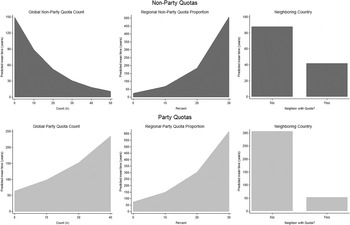
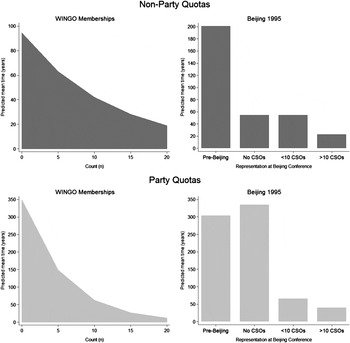
To contextualize the effects of transnational influence in Table 1, we graphically depict the relative size of the contagion and activism effects in Figures 2 and 3 by predicting a median time to quota adoption, holding all else equal. Time ratios closest to zero indicate the strongest effect on shortening time to quota adoption (more rapid adoption) and thus lower median time to quota, while those closer to one indicate weaker effects (less rapid quota adoption) and a predicted higher median time to adoption.
Global, regional, and neighboring country contagion effects on predicted median time to quota adoption.

Transnational activism effects on predicted median time to quota adoption.

Figure 2 shows the predicted median times for the three contagion measures for both nonparty and party quotas.Footnote 8 The results for regional and neighboring country effects are consistent between the two quota types: regional levels of quota prevalence are associated with slower adoption, while the effect of neighboring country quotas is to hasten the adoption of quotas. This neighboring country effect is also much stronger for party quotas than for nonparty quotas.Footnote 9 Global quota counts, on the other hand, have an opposing effect between quota types: increased numbers of countries globally adopting nonparty quotas over time is associated with a shorter time to nonparty quota adoption, while the opposite holds for party quotas.
Both of the transnational activism measures depicted in Figure 3 have the effect of reducing time to quota adoption—if any measure had a time ratio greater than one, we would witness an increase in predicted quota adoption time (slowing in the adoption rate). Here, increases in either WINGO memberships or in the number of organizations representing a country at the Beijing 95 conference sharply reduce the predicted time to quota adoption, except in the case of post-Beijing countries with no representation as it relates to party quotas.
In Figure 3, the strongest effect on reducing quota adoption time is for those countries in the post-Beijing period with high levels of CSO representation at the meeting—countries in the post-Beijing high-representation category (more than 10 CSOs) have a predicted median time smaller than any of the other Beijing categories. Likewise, the effects of WINGO memberships, when multiplied by many memberships, acts to quickly reduce the time to quota adoption, especially in the case of party quota adoption.
Overall, the results in Table 1 make a compelling case for the transnational influence of contagion/norm cascades and activism on quota adoption.
Adoption of Candidate versus Reserved Seat Quotas
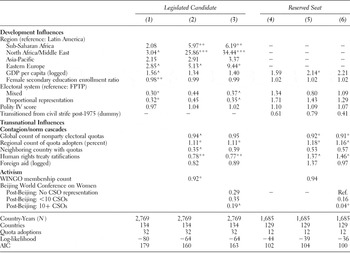
The source of quota legitimacy and the type of quota itself (candidate quotas versus reserved seat quotas) emerge from different histories and mobilization processes and therefore are most likely contribute to different diffusion processes (Krook Reference Krook2009). To test whether the transnational influences we isolate earlier do equally well at explaining the adoption of candidate and reserved seat quotas, we repeat our analysis on two subsets of our nonparty quotas sample. These results are shown in Table 2.Footnote 10
Event history models of world polity effects on various types of electoral quota adoption

Notes: Time ratios (exponentiated coefficients) shown. ^ p < .1; * p < .05; ** p < .01; *** p < .001.
In the case of legislated candidate quotas (Models 1–3), our results show that regional contagion effects are associated with slower adoption, while human rights treaty ratifications predict more rapid adoption. The direction of the effects on both the global and neighboring country contagion measures is in keeping with our findings in Table 1, but their associated p-values exceed the usual threshold. The effects of transnational activism also support our hypotheses in the case of the WINGO membership measure; the direction and magnitude of the Beijing measures are similar to our results in Table 1 but are not statistically significant.
The reserved seat quotas in Models 4–6 are affected by the global and regional count variables in a similar manner as the nonparty quotas in Table 1. In the case of transnational activism, the WINGO membership measure does not support rejection of the null hypothesis, while in the case of the Beijing measure, countries with a high level of representation at Beijing are predicted to have a 96% faster adoption rate than those with no representation (the reference category).
Overall, our models of different sources and types of quota adoption support our hypothesis that the transnational influences of both contagion and activism are valuable predictors of quota adoption.
DISCUSSION
Our findings shed light on the quota adoption process across developing countries when considering variation across quota types, the influence of Beijing 95, and patterns of global, regional, and neighboring country effects. Before highlighting quota types and norm cascades, we begin with women's activism.
Women's Activism
The effect of the presence of WINGOs and participation in Beijing 95 on faster quota adoption is consistent across nonparty and party quotas. Although an increased presence of WINGOs leads to faster adoption of quotas, adoption is significantly faster in countries that also had greater participation in Beijing 95. The post-Beijing era in general saw more quota adoptions than the pre-1995 period. However, we additionally find that the post-Beijing effect is conditioned on the amount of representation countries had at that conference. Our analysis reveals that countries with greater representation at Beijing 95 were more rapid adopters of quotas. Although these findings support qualitative studies demonstrating the role of local women's activism in quota adoption (Bauer Reference Bauer2004; Franceschet Reference Franceschet2001; Gray Reference Gray2003; Krook Reference Krook2009), they contradict Hughes, Krook, and Paxton (Reference Hughes, Krook and Paxton2015), who show that countries with more activist organizations tied to the international women's movement are less likely to adopt quotas.
The primary difference in results is likely related to our focus on Beijing 95, where quota adoption was discussed as necessary for future activism. Most participants were aligned with these goals. Hughes, Krook, and Paxton (Reference Hughes, Krook and Paxton2015) do not focus on aligned goals tied to a specific event, as seen with our Beijing 95 variables. Given these differences in approach, our results indicate that when goals are clear and aligned, the domestic context for women's rights and activism can play a critical role in translating world society norms of gender equality and women's political empowerment into the adoption of electoral quotas.
Quotas: Difference and Diffusion
How quotas diffuse across developing countries depends on the type of quotas—whether they are nonparty or party quotas. In terms of nonparty quotas, global and neighboring country counts lead to quicker adoptions of quotas, while regional counts lead to slower adoptions of quotas when WINGOs are included in the models. However, only regional counts lead to slower adoption when Beijing 95 is included in the model. This finding runs counter to many of the qualitative studies that demonstrate the connections between countries leading to adoption, whether through activists sharing experiences after the quota adoption in Argentina or through preparatory meetings for Beijing 95.Footnote 11 Our results do not invalidate these findings. Nonetheless, our results suggest instead that global influences have a stronger effect on quotas adoption than regional counts. For example, this may indicate that Beijing 95, an international conference with activists attending from across the globe, may have had such a significant impact that activists in different parts of the world worked simultaneously to implement quota policy. The global counts thus increased faster than the regional counts for nonparty quota implementation, and when Beijing 95 occurred, countries with higher representation were quicker to adopt, leading to a sharp increase in global quota counts (seen in Figure 1, post-1995).
On the flip side, however, we find that among party quotas the effects of neighboring countries lead to quicker adoption than regional or global counts. Although we acknowledge this as preliminary analysis due to data limitations, the results suggest that the process of party quotas adoption differs from nonparty quota adoption. In comparison to constitutional and legislative quotas, party quotas require only a change in party policy, while constitutional reforms or a new electoral law imply national support. We therefore argue that neighboring country effects leads to faster party quota adoption because these quotas are simpler to implement, in addition to the close proximity of neighboring countries allowing for the exchange of successful ideas and practices.
In the case of party quotas, we further find that transitioning from civil strife leads to faster adoption of quotas. Interestingly, countries transitioning from civil strife are not consistently quicker to adopt nonparty quotas. Yet in the case of party quotas, postconflict countries are faster adopters, at a rate 80% faster than non-postconflict countries. In line with previous research (Bush Reference Bush2011; Fallon, Swiss, and Viterna Reference Fallon, Swiss and Viterna2012), our findings support the notion that postconflict transition provides an opportunity for reform in cases in which an altogether new political system is put in place or through the active participation of various groups, or indeed political parties, in postconflict rebuilding and peace processes. Ruptures in social and political systems brought about by conflict can, in this way, prove to be transformative. If political parties adopt quotas after transition, this may also indicate the role played by women's activism and movement groups in that party's policy process during transition, as suggested by the qualitative literature (Franceschet, Krook, and Piscopo Reference Franceschet, Krook, Piscopo, Franceschet, Krook and Piscopo2012; Hassim Reference Hassim2006). Activists within a party may find more space to push for gender equality and quotas in the postconflict period because of their contributions to the group within and before the conflict (Hassim Reference Hassim2006; Viterna and Fallon Reference Viterna and Fallon2008).
Some additional unexpected findings emerged when examining adoption across different quota types. For example, countries that use proportional representative systems are more likely to adopt nonparty political quotas and legislated candidate quotas. Proportional representation systems are more flexible and adaptable to instituting legislated candidate seats because proportional representation systems are predicated on parties' candidate lists. By requiring a certain threshold of women on candidate lists, a proportional representation system is well suited for legislated candidate quotas. Similarly, countries with lower GDP per capita adopted nonparty quotas at a faster rate. This may suggest that these countries, which are less central to the world polity network because of their lower-income status (Beckfield Reference Beckfield2003, Reference Beckfield2008), may seek greater legitimacy through the adoption of such quotas or other world society norms (Meyer et. al Reference Meyer, Boli, Thomas and Ramirez1997; Towns Reference Towns2012). Finally, although human rights treaty ratifications were occasionally significant in speeding up quota adoption, they were only consistent in faster implementation of nonparty and legislated candidate quotas. This may relate to the normative content of certain human rights treaties and the extent to which they are able to shape state policies and practices once ratified. Indeed, treaties such as the Convention on the Elimination of all Forms of Discrimination Against Women have been shown to play a central role in shaping state approaches to gender equality, including the adoption of quotas (Cole Reference Cole2013). In this respect, treaty ratifications are much more likely to be associated with quotas that have their source of legitimacy in constitutions or legislation than those that are simply voluntary policies of political parties.
CONCLUSION
Our study highlights three findings. First, we demonstrate the importance of women's activism through transnational influences of Beijing 95. Although increased presence of WINGOs leads to quicker adoption of quotas, countries with a greater participation in Beijing 95 adopted quotas at an even more accelerated rate. Transnational activism through Beijing 95 has been central to the global diffusion of quotas across developing countries. When a movement is centered on a specific goal, our findings suggest that the effects are stronger.
Second, our results illustrate that different types of quotas are diffused through different methods. For example, countries that have signed human rights treaties are faster to adopt legislated candidate quotas. In terms of nonparty quotas, countries that have lower GDP per capita and proportional representational systems are faster in adopting these. The former pattern most likely indicates the need for legitimacy within the larger world polity, while the latter suggests the adaptability of these types of government structures. Additionally, countries that transition from civil strife are more likely to witness parties adopt quotas, supporting existing studies.
Third, tied to the differences between quota types is how they are shaped by different patterns of regional, global, or neighboring country quota adoption. Countries are quicker to adopt nonparty quotas as global counts increase. Regional counts, however, lead to slower adoption. These patterns suggest the influence of transnational pressures, such as Beijing 95, in contributing to the quota adoption process rather than processes of emulating regional players. Given the sharp regional differences in quota adoption, this counterintuitive effect of regional quota prevalence is perhaps unsurprising. Further complicating the role of contagion and diffusion through norm cascades, countries are quicker to adopt voluntary party quotas through contact with neighboring countries (as opposed to global and regional counts) that have already adopted party quotas—indicating both the easy exchange of information, as well as the easier process of implementing party quotas as opposed to nonparty quotas.
Our study has contributed to understanding the process of quota adoption across developing countries, particularly in terms of activism, norm diffusion, and quota adoption based on quota type. Future research should continue to build on this and other existing studies. Central to this process is focusing on creating a more reliable database on voluntary political party quotas and exploring the process of quota adoption for them. Our study suggests that the processes differ dramatically. More research and better data is needed in this area. Additionally, more studies need to do more to compare and contrast the distinctions between quota adoption processes in the developed and developing countries. Are global actors equally implicated in both cases? Does world society influence penetrate equally within developed and developing societies? Does the level of women's organizing and activism affect quota adoptions in the same way across these contexts? All these questions merit further attention in an analysis that actively compares developed and developing country samples. We believe our study has added to this process and hope that it will encourage others to continue to engage such questions.