INTRODUCTION
It has been well documented that increased light interception has the ability to substantially increase maize grain yields. This has been achieved through such practices as increasing plant population (Cox, Reference Cox1997; Nunez and Kamprath, Reference Nunez and Kamprath1969; Westgate et al., Reference Westgate, Forcella, Reicosky and Somsen1997), reducing row spacing (Lutz et al., Reference Lutz, Camper and Jones1971; Murphy et al., Reference Murphy, Yakubu, Weise and Swanton1996; Ottman and Welch, Reference Ottman and Welch1989; Porter et al., Reference Porter, Hicks, Lueschen, Ford, Warnes and Hoverstad1997) and through research suggesting that leaf architectures of modern maize hybrids can optimize light interception to increase grain yield (Stewart et al., Reference Stewart, Costa, Dwyer, Smith, Hamilton and Ma2003). Other studies have shown that leaf architecture and rapid canopy closure from higher plant populations and reduced row spacing can ultimately reduce weed pressure and total weed biomass production (Teasdale, Reference Teasdale1995). Sujatha et al. (Reference Sujatha, Van Gessel and Mulford2004) found that in irrigated production systems horizontal leaf architectures from the maize hybrids could assist in integrated weed management with the potential to decrease herbicide rates.
Research by Bosy and Aarssen (Reference Bosy and Aarssen1995) showed that germination rates and germination success of eight weed species, without genetic or environmental variation were highly dependent on seed orientation. Patten and Van Doren Jr. (Reference Patten and Van Doren1970) found that maize planted with the proximal end of the seed down resulted in earlier more complete emergence with more seedling growth. This method was also found to be beneficial when soil temperatures were higher and under moisture stress. Prasad and Nautiyal (Reference Prasad and Nautiyal1995) showed that seedling survival and mean germination time were best when seeds were planted with the radicle end down. Bowers and Hayden (Reference Bowers and Hayden1972) showed that the adverse influence of having the hypocotyl end down was attributed to seed rotation within the soil. For controlled plantings, lying flat orientation is recommended due to both its high frequency of occurrence and high emergence. They noted that the lying flat orientation (hypocotyl up) was preferable for beans since it was easiest to achieve, and this orientation consistently had better emergence. Also, planting seeds with the hypocotyl end standing up, allowed the plumular hook to break a path through which the cotyledons could follow. This method also resulted in very high emergence rates.
Delayed germination rates (days to emergence) can result in heterogeneous maize stands, which can often lead to over application of fertilizers, pesticides and supplemental irrigation because late emerging plants compete for nutrients and often produce little to no yield (Daft, Reference Daft2008). Martin et al. (Reference Martin, Hodgen, Freeman, Melchiori, Arnall, Teal, Mullen, Desta, Phillips, Solie, Stone, Caviglia, Solari, Bianchini, Francis, Schepers, Hatfield and Raun2005) noted that methods which homogenize maize plant stands and emergence may decrease plant-to-plant variation and could lead to increased grain yields. Hodgen et al. (Reference Hodgen, Ferguson, Rundquist, Schepers and Shanahan2007) found that if maize plants are delayed by as little as four days, the yield depression of that individual delayed plant was as much as 15%.
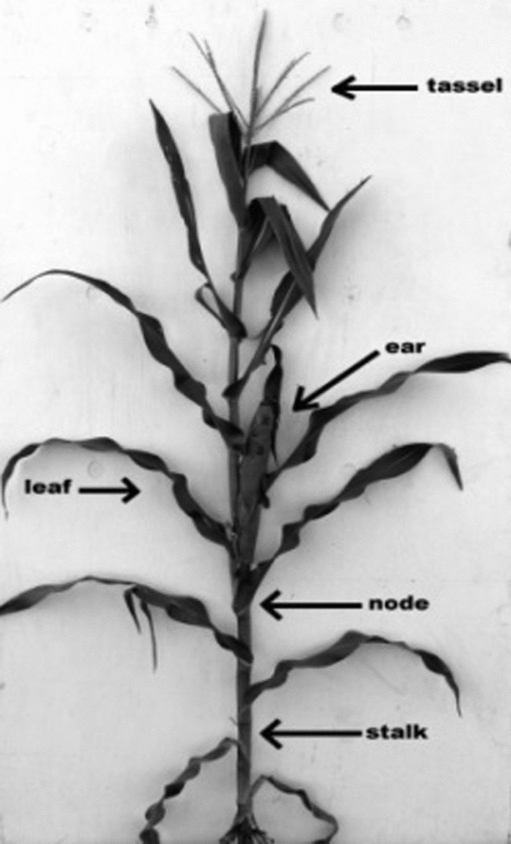
Even though there is substantial genetic variation within today's maize hybrids, the relative anatomy of maize plants is still uniform with leaf patterns on one side, virtually identical (on a 180° plane) to the other side (Figure 1). Fortin and Pierce (Reference Fortin and Pierce1996) found that random orientation of seed resulted in random ear leaf azimuths. When seed orientation at planting was controlled, 60–74% of ear leaves (leaves 11 or 12) developed in the same direction as the embryo orientation. Additionally, Toler et al. (Reference Toler, Murdock, Stapleton and Wallace1999) conducted field studies to investigate the interaction of light interception and leaf orientation on maize grain yield. Seed orientations were manipulated to achieve across-row and with-row leaf orientations as well as a more conventional random seed orientation treatment. The seed orientation that produced across-row leaf orientation produced 10–20% higher maize grain yields compared to the random seed orientation treatment.
Representation of corn leaves, showing that leaf symmetry of corn hybrids are virtually identical on a 180° plane.

The aforementioned research suggests that if seed orientation could be manipulated to produce favourable leaf orientation (across row) and more homogeneous maize seedling emergence, this would allow for more homogenous maize stands that have less interplant competition, increased light interception, reduced weed pressure (quicker canopy closure) and the ability to potentially increase seeding rates while increasing maize grain yields. The objective of this study was to identify which seed placement and arrangement could result in plant architecture with leaves orientated perpendicular to the row and to understand the effect the of seed position on emergence rate.
MATERIALS AND METHODS
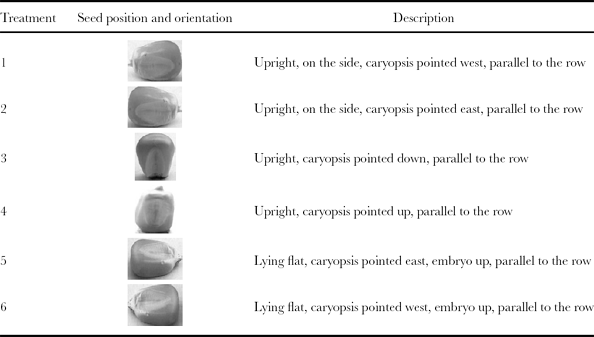
To investigate the effects that seed orientation (direction of the radicle) and position (cotyledon location) have on leaf angle and emergence rates, trials were conducted in October 2009 at Oklahoma State University greenhouse facilities. Seeds were planted 2.5 cm deep using ‘medium flats’, in a seed tray filled with Redi-earth (Sun Gro), a porous, lightweight growing medium that contains vermiculite and Canadian sphagnum peat moss. The plants were irrigated every day and no fertilizer was used. Ten seeds were planted for each of the six treatments, referred to as experiment 1 (E1) (Table 1), that led to further studies (experiment 2 (E2) and experiment 3 (E3)) (Tables, 2 and 3, respectively). The hybrid used in experiment 1 and 2 was Pioneer 33B54. These studies were utilized to identify which treatment could provide leaf orientation across the row (perpendicular to the row).
Treatment structure with the seed position illustration, orientation and description of each treatment for experiment 1.

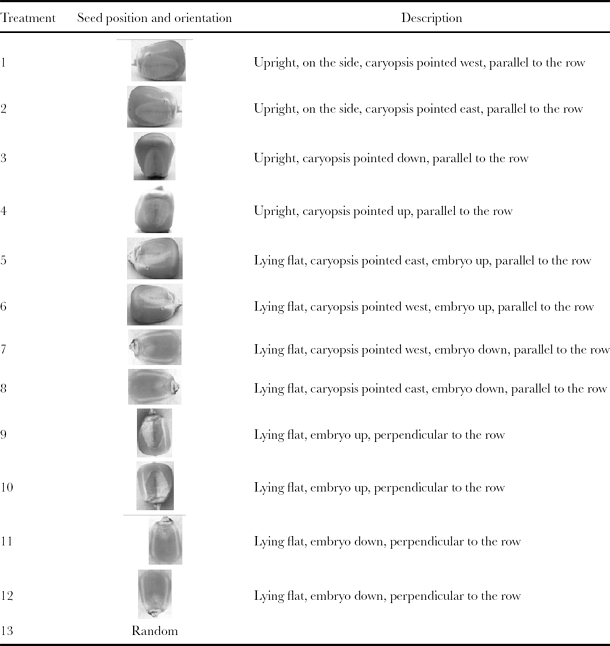
Treatment structure with the seed position illustration, orientation and description of each treatment for experiment 2.

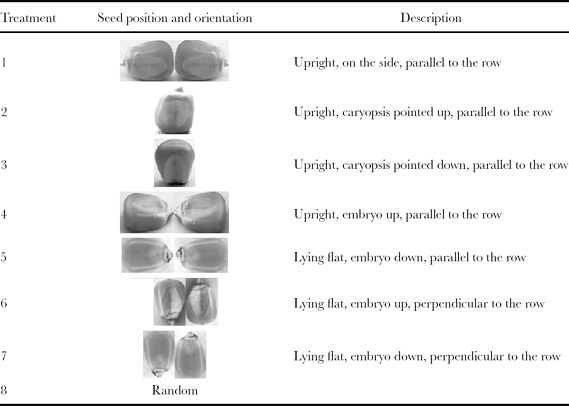
Treatment structure with the seed position illustration, orientation and description of each treatment for experiment 3.

Days to emergence was measured by observing the experiment every day at 08:00 hours after planting; a seed was considered emerged when the coleoptile was first visible at the soil surface. Leaf angle for the second to fourth leaf was quantified for each plant within treatment. The leaf angle was measured in relation to row direction and assessed using Adobe Illustrator CS4 software (Adobe, 2010). To measure leaf angle digital photos were taken directly over the top of each plant canopy when the plant was at the three-leaf stage. The digital photos were imported into Adobe Illustrator CS4 software, then, using a tool provided by the software, the axes (X and Y) were drawn over the picture to serve as a reference. Then lines were drawn over the midrib and leaf angle was measured in relation to the X axis (maize row) (Figure 2).
Method used to measured leaf angle. (1) Digital pictures taken above the canopy of each plant. (2). Pictures imported into Adobe Illustrator CS4 software. 3. ‘Y’ and ‘X’ axis were drawn to serve as a reference. (4). Leaf angle was measured using a tool provided by the software, capable of estimating the angle (α) in relation to the ‘X’ axis (corn row).

Following experiment 1, experiment 2 was established (Table 2). This trial consisted of 13 treatments and 10 seeds of E1 and adding seed orientations that were perpendicular to the row (90° in relation to the row) with cotyledon up and down, and with radicle pointed in different directions (left and right), plus a random treatment. The random treatment was established by physically tossing the maize seed into the pot, and the position in which the seed landed in the pot was kept. No preferential position was noticed after the seed was tossed into the pot.
The third experiment (E3) (Table 3) was designed to test five commercial Dekalb hybrids (DKC6169VT3, DKC6342VT3, DKC6172RR2, DKC6122RR2 and DKC6346RR2). This experiment had eight treatments, using a similar treatment structure to E2, except that treatments with the same position but different orientation were combined into single treatments.
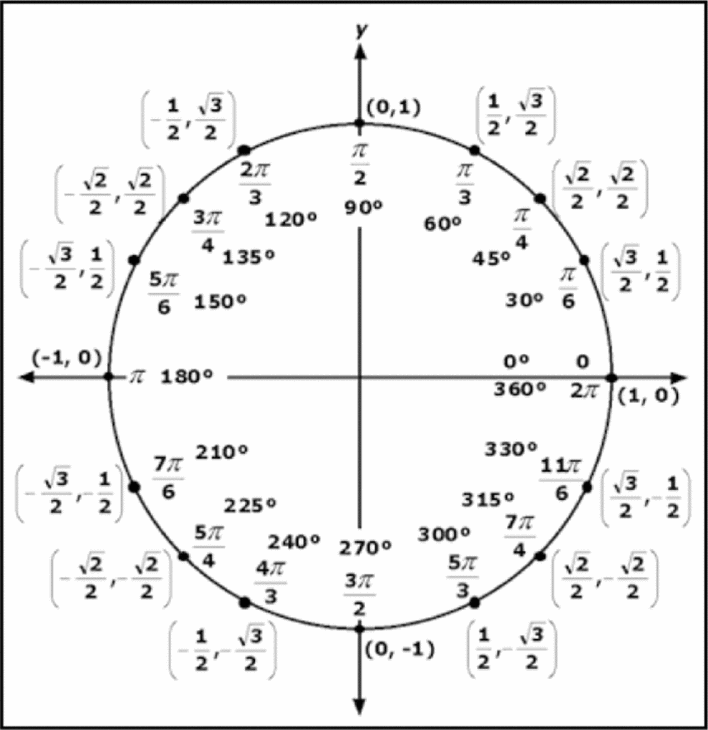
After being measured, leaf angles were transformed so leaves with angles higher than 90° would fall in the first quadrant (between 0° and 90°). To do this, a trigonometric circle was used (Figure 3). Therefore, when measured angles were in quadrants 2, 3 and 4, the corresponding angle in the first quadrant was used. For example if the angle measured was 120°, 240° or 300°, then on a 0° to 90° range the angle would be 60°.
Trigonometric circle used to convert the angles from quadrants 2, 3 and 4 to first or composite quadrant angles. For example if the angle measured was 120°, 240° or 300°, then on the first quadrant (0° to 90° range), the angle would be 60°.

Emergence rate as well as leaf angles were measured using the same method as in E1, although photos were taken at the four-leaf stage. Data was analysed using SAS (2002). Analysis of variance was performed on all experiments and the mean square error was subsequently used to determine the standard error of the difference (s.e.d.) between two equally replicated means, and this is reported for all dependent variables analysed. Leaf angles were classified individually for each plant, then, using the computed averages, leaf angles were expressed as a percentage within angle ranges. This data was then analysed through a frequency distribution where 0° to 15°, 15° to 30° and 30° to 45° would be the ranges where leaves were more parallel. Similarly, 45° to 60°, 60° to 75° and 75° to 90° were the ranges where leaves were more perpendicular to the row. For this study leaves that were no more than 30° from perpendicular were considered to be acceptable. In other words for leaves to be considered perpendicular to the row, leaf angles should fall between 60° and 90° degrees. Percentages of leaves falling between 60° and 90° were then computed, and reported as that likely to provide an acceptable leaf architecture, and where overlap was improbable. The underlying principle involved in this work was to avoid leaves of one plant overlapping the leaves of another plant and in this fashion improve the plant's capacity to intercept light.
RESULTS
Experiments 1 and 2
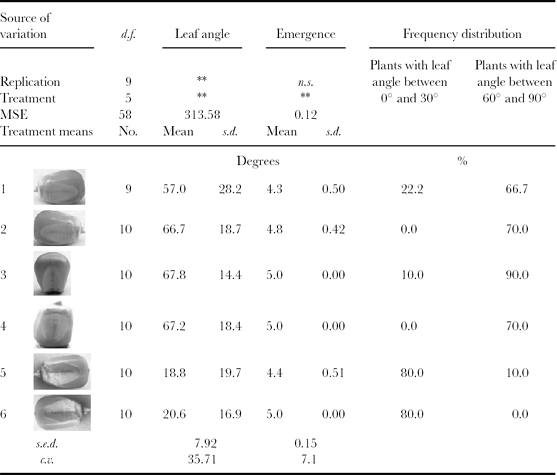
Analysis of variance showed that there was a significant effect of seed orientation on resulting leaf angle. Treatments evaluated in E1 provided evidence that it is possible to manipulate plant architecture and that some of the treatments produced higher percentages of leaf angles either in the across-row orientation or with-row orientation, and these treatments deserved further investigation. Based on these results, there were three seed placements that could result in a possible across-row leaf orientation and these were evaluated in E2 (treatments 3, 5 and 6). For treatment 3, seeds were planted upright, parallel to the row and radicle pointed down, resulting in 90% of leaf angles falling between 60° and 90° (across row or perpendicular to the row). For treatments 5 and 6 the seed placement was very similar, seeds lying flat, cotyledon up, parallel to the row, pointed left and right, resulting in 80% of the leaf angles falling between 0° and 30° (Table 4 and Figure 4), which is a with-row leaf orientation pattern. These were not the desired results, although it was supposed that if seeds had been rotated 90° in relation to the row, the majority of leaf angles would shift accordingly and fall between 60° and 90°, an across-row leaf orientation. Leaf angle means, emergence rate means and percentage of plants within angle ranges for each treatment are reported in Table 4.
Results for experiment 1 showing seed position, leaf angle means and frequency distribution (percentage of plants within angle ranges).

d.f.: degrees of freedom; c.v.: coefficient of variation; MSE: mean square error; No.: number of observations; n.s.: not significant; s.e.d.: standard error of the difference between two equally replicated means.
**significant at the 0.05 probability levels respectively.
Illustration of leaf angle for treatment 5 where corn seeds were planted lying flat, embryo up, and caryopsis parallel to row from experiment 1, which resulted in 80% of the plants with leaves overlapping each other. This picture shows that if the above-mentioned seed position is used corn leaves will overlap each other reducing light interception.

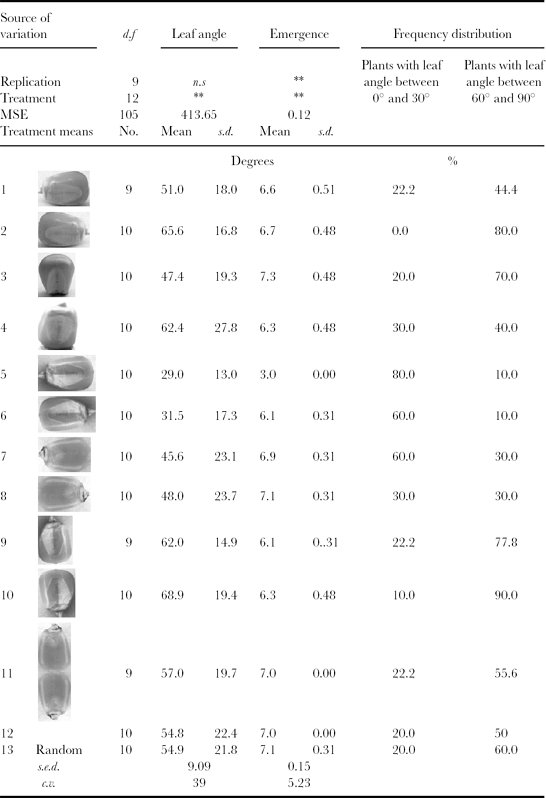
Experiment 2 was also used to confirm the findings in E1 and to test treatments that were likely to provide the desirable leaf angle in relation to the row (leaf angles in the 60° to 90° range). In E2 treatments 3, 9 and 10 had 70%, 78% and 90% of leaf angles in the 60° to 90° range respectively (Table 5; Figure 5 for treatment 10). The random seed placement had 60% of leaf angles in the 60–90° range. These treatments are likely to provide leaf angles across the row, which could increase light interception and consequently increase yield in addition to other benefits provided by the manipulated plant geometry. Treatments 5 and 6 produced a high percentage of plants with leaves parallel to the row, which according to Peters (Reference Peters1961) and Toler et al. (Reference Toler, Murdock, Stapleton and Wallace1999) could possibly cause shading in the crop and reduce yields. Moreover, when the same treatments used in E1 and E2 were compared, similar results were obtained. In three of four trials, when seeds were placed flat, embryo up, seeds parallel to the row, this resulted in 80% of leaf angles between 0° and 30°. Treatments 1 and 2 had similar configuration but had dissimilar results with 44% and 80% of plants in the more-across-row angle range, respectively (Table 5). The results observed in E2, as far as emergence rates, were comparable to the findings from Patten and Van Doren Jr. (Reference Patten and Van Doren1970) and Bowers and Hayden (Reference Bowers and Hayden1972). Maize seeds had a more rapid emergence rate when planted with the radicle down (treatment 3) and when planted with hypocotyls up (treatments 5, 6, 9 and 10) compared with the seeds planted with radicle up (treatment 4), planted with hypocotyls down (treatments 7, 8, 11 and 12) and planted on their side with the embryo facing the adjacent row (treatments 1 and 2) (Table 5). For E1 there was no treatment that resulted in a faster emergence rate. This finding was not consistent with that reported by Bowers and Hayden (Reference Bowers and Hayden1972) and Prasad and Nautiyal (Reference Prasad and Nautiyal1995).
Results from experiment 2, showing seed position, leaf angle means and frequency distribution (percentage of plants within angle ranges).

d.f.: degrees of freedom; c.v.: coefficient of variation; MSE: mean square error; No.: number of observations; n.s.: not significant; s.e.d.: standard error of the difference between two equally replicated means.
** significant at the 0.05 probability levels.
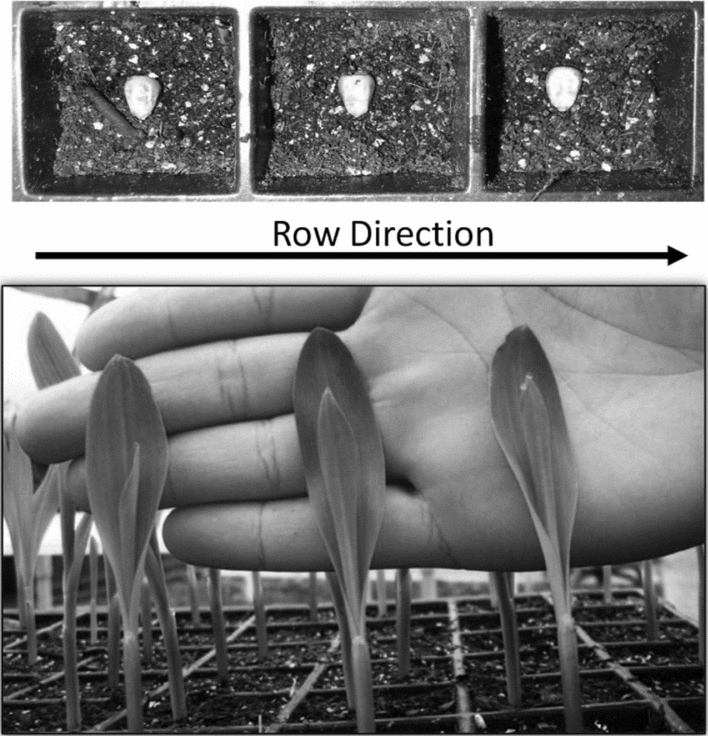
Seed orientation at planting determines the emerging leaf plane azimuth. This illustration of treatment 10 is from experiment 2 where seeds were lying flat, embryo up, caryopsis perpendicular to the row (top figure) and the resulting emerging leaf pattern where leaves were perpendicular to the row (bottom figure).

Experiment 3
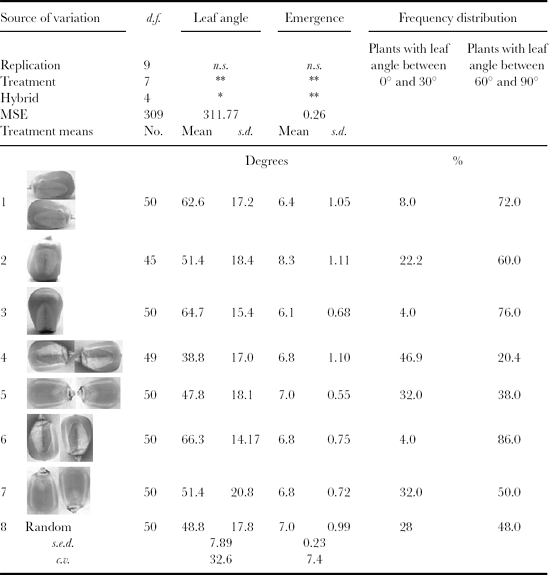
In experiment 3, five commercial Dekalb hybrids were used and a total of 500 seeds were planted using the same treatment structure in E2 but treatments with the same placement but different orientation were grouped together (e.g. treatments 1 and 2 from E2). Results observed in E3 were comparable to that reported for E1 and E2. When seeds were upright, caryopsis pointed down and seeds parallel to the row (Table 6, Treatment 3), 76% of plants had emerging leaf angles that were perpendicular to the row (60° to 90° considered acceptable). When seeds were flat, embryo up, caryopsis perpendicular to the row (Table 6, Treatment 6), 86% of plants had leaf angles that were considered perpendicular to the row (60° to 90°). Also, in E3, maize seeds planted upright on the side with the embryo facing the next row (Treatment 1) also produced 72% of plants with leaf angles considered to be perpendicular to the row. The random seed placement resulted in 48% of plants with an across-row leaf orientation. The result in E3 regarding Treatment 1 was consistent with what was found in E2. For emergence, seeds that were upright, caryopsis pointed down parallel to the row (Treatment 3) had faster emergence rates (mean of 6.1 days). Equally efficient in emergence were seeds planted upright on the side (Treatment 1, Table 6).
Results from experiment 3, showing seed position, leaf angle means and frequency distribution (percentage of plants within angle ranges).

d.f.: degrees of freedom; c.v.: coefficient of variation; MSE: mean square error; No.: number of observations; n.s.: not significant; s.e.d.: standard error of the difference between two equally replicated means.
*, **, significant at the 0.10 and 0.05 probability levels respectively.
CONCLUSIONS
Combined, these studies found that placement and arrangement of maize seed can influence emergence rate and leaf orientation. Furthermore, this study showed that it is possible to manipulate plant geometry and potentially achieve more efficient light interception. The desired across-row leaf orientation was found for several seed placements as shown in Figure 6 (maize seeds planted flat with the cotyledon up). Homogenous leaf orientation in the crop canopy could make it possible to collect better by-plant sensor measurements such as reflectance data. For example the GreenSeeker™ sensor collects normalized difference vegetation index values that are narrow along the row, but wide with the row. These narrow sensor measurements along-the-row could allow for by-plant recognition. If leaf angles were consistently perpendicular to the row, seeing each plant becomes easier with the narrow along-the-row sensor readings. This could in turn improve by-plant in-season prediction of yield potential and ensuing nitrogen recommendations coming from by-plant sensor readings. Furthermore, controlled leaf geometry could possibly facilitate planting higher populations with the potential for increasing grain yield or permit the preservation of yields with reduced plant populations. Mechanizing seed placement that would result in homogeneous leaf orientation perpendicular to the row is conceptually possible.
Treatment 10, experiment 2 showing an across-row leaf orientation. A repeated leaf pattern that resulted from the placement of corn seeds laying flat, embryo up, caryopsis pointed perpendicular to the row.