Surgical site infection (SSI) is one of the most common forms of healthcare-associated infections,Reference Mangram, Horan, Pearson, Silver and Jarvis 1 accounting for 22% of such infections. A total of 157,000 cases per year are estimated to occur in the United States on the basis of recent epidemiologic data.Reference Magill, Edwards and Bamberg 2 SSI occurs in 2%–5% of all patients who have undergone inpatient surgery.Reference Cruse 3 SSI also accounts for up to $10 billion of additional costs annually.Reference Engemann, Carmeli and Cosgrove 4 , Reference Kirkland, Briggs, Trivette, Wilkinson and Sexton 5
Surveillance is one of the key methods for preventing SSI.Reference Mangram, Horan, Pearson, Silver and Jarvis 1 Surveillance data can also be used as a quality indicator for SSI care in terms of comparing hospital performance. However, surveillance data should be analyzed with caution because the simple incidence of SSI may be affected by unmodified risk factors associated with patient characteristics that are irrelevant to hospital performance.
In the National Nosocomial Infections Surveillance (NNIS) and its successor, the National Healthcare Safety Network (NHSN), the incidence of SSI was assessed by the category of surgical procedure. The system also utilizes the NNIS risk index, including wound class, duration of operation, the American Society of Anesthesiologists (ASA) score, and use of laparoscope for risk stratification.Reference Culver, Horan and Gaynes 6 , Reference Gaynes, Culver and Horan 7 A revised risk stratification method was implemented in 2011. 8 This method, generally based on a model proven to have better predictive power than the NNIS risk index, uses the robust database of the NHSN SSI surveillance from 2006 to 2008.Reference Mu, Edwards, Horan, Berrios-Torres and Fridkin 9
In gastric surgery, wound class and use of a laparoscope, 2 of the risk factors in the NNIS risk index, were not significant in the final modelReference Mu, Edwards, Horan, Berrios-Torres and Fridkin 9 and excluded from risk stratification in NHSN. 8 Gastric surgery is not a common surgical procedure in the United States. The NHSN database used in the studyReference Mu, Edwards, Horan, Berrios-Torres and Fridkin 9 involved a relatively small number of surgical cases, which might have lacked sufficient power to generate an appropriate risk adjustment model. Furthermore, the procedures in the United States are mainly bariatric operations for the treatment of obese and diabetic patients. This fact may mask some of the important risk factors associated with gastric surgery, rendering the analysis using NHSN data inapplicable to surgical patient populations in other countries.
In Asian countries including Japan, total gastrectomy (GAST-T) and distal gastrectomy (GAST-D) comprise 2 major types of gastric surgery. One study performed in TaiwanReference Lo, Chen, Wu, Lo, Hsieh and Lui 10 and another in JapanReference Migita, Takayama and Matsumoto 11 indicated that a GAST-T had a substantially higher risk for SSI than a GAST-D. The epidemiology and risk factors of SSI following gastric surgery have not been described well in the literature with the exception of a few reports from a group in Korea.Reference Jeong, Kim and Han 12 – Reference Jeong, Ann and Kim 14
The aim of this study was to describe the incidence of SSI and identify the risk factors associated with SSI in patients who have undergone different types of gastric surgery, using Japan Nosocomial Infections Surveillance (JANIS), Japan’s national database for healthcare-associated infections.
METHODS
Data on SSI in patients who underwent gastric surgery between 2012 and 2014 were extracted from the JANIS database. The surgical procedures were divided into 3 categories: GAST-T, GAST-D, and other types of gastric surgery (GAST-O). A total of 10,281 cases of GAST-T, 17,386 cases of GAST-D, and 8,385 cases of GAST-O were included in the study. Approval for data extraction was granted by the Japanese government’s Ministry of Health, Labour and Welfare. The institutional review board at Yamagata University School of Medicine gave their approval for this project.
The methodology of JANIS has been described elsewhere in detail.Reference Morikane, Honda, Yamagishi, Suzuki and Aminaka 15 In short, it was established in 2000 by the Ministry of Health, Labour and Welfare of Japan. JANIS currently collects SSI surveillance data from more than 400 institutions (as of May 2016) and is the largest SSI database in Japan. It is almost equivalent to the NHSN system, except that participation in JANIS is voluntary, and variables collected include the NNIS modified risk index (wound class, ASA score, duration of operation, and use of laparoscope), age, sex, and data on emergency operations and device implantation.
Before the statistical analysis for the factors associated with SSI following gastric surgery, the association between the incidence of SSI and selected continuous or categorical variables was examined and modified to fit the statistical model. Continuous variables, such as the duration of the operations and patients’ age, were converted to 4 quartiles, and the incidence of SSI was compared. The variable was then either dichotomized or trichotomized (if there was a definite cut-off point[s]). In the absence of a cut-off point, the variable was regarded as continuous. In this case, duration of operation was divided by 10. Categorical variables, such as ASA and wound class, were examined in the same way for possible dichotomization or trichotomization.
Potential risk factors associated with SSI in each type of procedure were first assessed using univariate modeling analysis. A comparison between categorical variables was made using a χ2 test. Variables with P<.10 in the univariate modeling analysis were considered potential independent variables and entered into the logistic regression model. The multivariate model was developed using forward stepwise logistic regression. Variables were retained in the final model if the 2-tailed P<.05. All of the statistical analyses were performed using SAS, version 9.4 (SAS Institute).
RESULTS
Incidence of SSI and Trends Over Time
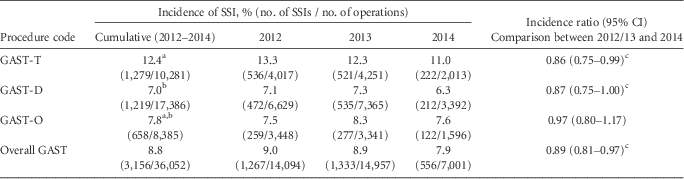
Cumulative incidence of SSI in gastric surgery during the study period was 8.8% (3,156/36,052). A total of 378 hospitals were included in the analysis. The incidence of SSI in each hospital differed considerably (median [interquartile range], 7.1% [3.3%–11.1%]). The number of surgical cases in each hospital also differed (minimum, 1; maximum, 677; median [interquartile range], 72 [28–130]). The incidence of SSI in GAST-T was significantly higher than in GAST-O, whereas SSI incidence in GAST-O was significantly higher than in GAST-D. The decrease in the incidence of SSI in GAST-T, GAST-D, and all gastric surgeries in 2014 compared with 2012-2013 was statistically significant (Table 1).
Incidence of Surgical Site Infection (SSI) Following Gastric Surgery in 2012–2014

NOTE. GAST-D, distal gastrectomy; GAST-T, total gastrectomy; GAST-O, other type of gastric surgery.
a Relative risk of SSI in GAST-T with the reference of GAST-O: 1.59 (95% CI, 1.45–1.73).
b Relative risk of SSI in GAST-O with the reference of GAST-D: 1.12 (95% CI, 1.02–1.22).
c Indicates statistically significant decrease in 2014.
Modification of Variables Other Than Dichotomous Variables
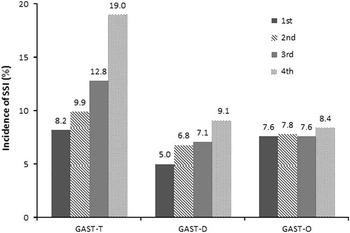
We found no definite cut-off point at which to rationalize dichotomization of the duration of operation in GAST-T and GAST-D (Figure 1), and therefore we divided the value by 10 and regarded it as continuous variable. In GAST-O, there was no increase in incidence up to the third quartile, but a considerable increase at the fourth quartile, so this variable was dichotomized as “≤252 minutes or ≥253 minutes.”
Incidence of surgical site infection (SSI) following gastric surgery by quartile of duration of surgery. GAST-D, distal gastrectomy; GAST-O, other type of gastric surgery; GAST-T, total gastrectomy. The higher cut-off points for duration in the first/second/third quartile (in minutes) were 214/269/334 for GAST-T, 192/245/305 for GAST-D, and 98/164/252 for GAST-O.

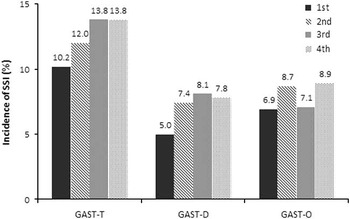
The difference in the incidence of SSI between the quartiles by age is shown in Figure 2. On the basis of the difference in incidence between the adjacent quartiles, the age variable was trichotomized as “≤63, 64≥ age ≤70, ≥71” in GAST-T—that is, the third and fourth quartiles were combined. For GAST-D, the variable was dichotomized as “≤63 or ≥64”—that is, the first quartile or other. In GAST-O, no definite cut-off point was found at which to rationalize dichotomization and therefore age was regarded as a continuous variable.
Incidence of surgical site infection (SSI) following gastric surgery by quartile of age. GAST-D, distal gastrectomy; GAST-O, other type of gastric surgery; GAST-T, total gastrectomy. The upper cut-off points for age in the first/second/third quartile were 63/70/77 for GAST-T and GAST-D, and 61/69/77 for GAST-O.

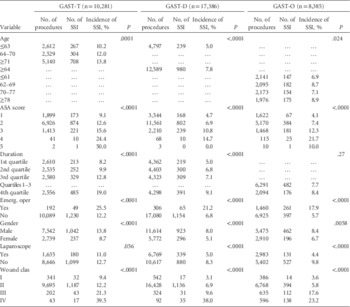
There was a considerable difference in the incidence of SSI between each ASA score group and wound class for all types of surgery (Table 2), so these variables were retained without modification.
Univariate Analysis for Risk Factors for Surgical Site Infection (SSI) Following Gastric Surgery

NOTE. ASA, American Society of Anesthesiologists; GAST-D, distal gastrectomy; GAST-O, other type of gastric surgery; GAST-T, total gastrectomy.
Risk Factors for SSI in Gastric Surgery
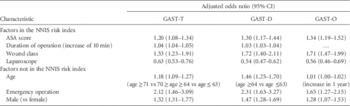
The risk factors associated with SSI by univariate modeling analysis are shown in Table 2. All collected variables except duration of operation in GAST-O were statistically significant on univariate analysis and were entered into the multivariate logistic regression models. In the final model, all variables in every procedure were retained (Table 3); however, the adjusted odds ratios of the selected variables were substantially different between the various surgical procedures, as well as between emergency operation and male gender. The C-indexes of the multivariate logistic regression models of GAST-T, GAST-D, and GAST-O were 0.651, 0.655, and 0.689, respectively.
Multivariate Analysis for Factors Independently Associated With Surgical Site Infection Following Gastric Surgery

NOTE. ASA, American Society of Anesthesiologists; GAST-D, distal gastrectomy; GAST-O, other type of gastric surgery; GAST-T, total gastrectomy; NNIS, National Nosocomial Infections Surveillance.
DISCUSSION
In Japan and other Asian countries, gastric cancer is one of the most frequently encountered forms of cancer, for which the standard treatment is tumor resection with lymph node dissection. As a result, among the operations collected in JANIS, gastric surgeries were the second most numerous after colon surgeries. The number of operations included in this study (36,052) was more than 4 times as large as the number (8,223) reported in the landmark study by NHSNReference Mu, Edwards, Horan, Berrios-Torres and Fridkin 9 in the same length of time (3 years).
Furthermore, gastric surgery is generally classified into 3 different types, namely, GAST-T, GAST-D, and GAST-O. We therefore formed different surgical procedure codes for our surveillance system in 2012 to differentiate these 3 types of surgery. The separate assessment of risk factors associated with each type of surgery using a large cohort was the chief strength of this study.
The overall incidence of SSI differed significantly by surgery type, with GAST-T showing the highest incidence among the 3 types. A GAST-T involves multiple intestinal anastomoses including esophagojejunostomy and jejuno-jejunostomy, which are subject to leakage. It also involves the manipulation of the pancreas, which can be complicated by a pancreatic fistula. This may explain the higher incidence of SSI following GAST-T than GAST-O or GAST-D.Reference Migita, Takayama and Matsumoto 11 Also, GAST-D is the simplest and best established among the various types of gastric resection and reconstruction procedures. Compared with GAST-D, GAST-O is diverse and includes types of operation not frequently performed. Surgical techniques for these operations may not be as sophisticated as those required for GAST-D, a fact that might explain the significantly higher incidence of SSI following GAST-O than GAST-D.
The diversity of procedures included in GAST-O may explain the trend towards decreasing incidence over time. The incidence of SSI in GAST-T and GAST-D decreased probably owing to efforts made at each hospital to improve quality. However, this was not the case in GAST-O. Because of the diversity of procedures, it might have been difficult for each hospital to implement measures to decrease SSI following GAST-O.
The 4 variables included in the NNIS modified risk index (duration, wound class, ASA score, and laparoscopy) remained significant in the multiple regression model except for duration in GAST-O. One explanation for this exception is that operations included in GAST-O were heterogeneous. In general, the 4 variables were still essential in the risk adjustment. Also, the difference in the odds ratio for those variables between the various types of surgery was minimal.
Age was significant for all types of gastric surgical procedure. One study in TaiwanReference Lo, Chen, Wu, Lo, Hsieh and Lui 10 and another in JapanReference Imai, Ueda and Kanao 16 reported increasing age as a risk factor for SSI following gastric surgery. In contrast, an NHSN study showed that age was not a significant risk factor.Reference Mu, Edwards, Horan, Berrios-Torres and Fridkin 9 As already mentioned, diseases included in the NHSN’s analysis and ours may differ, as may the age distribution. Patients receiving bariatric surgery are either young or middle-aged, but gastric cancer patients are generally older. The first quartile for age in all types of procedure in the current research was greater than 60 years, a fact that may support our hypothesis.
Male sex, which is also a typical unmodifiable variable, was a risk factor in all types of gastric surgery and therefore warranted being incorporated into the risk adjustment model. One Japanese studyReference Migita, Takayama and Matsumoto 11 and 2 Korean studiesReference Jeong, Kim and Han 12 , Reference Kim, Kim and Song 13 also indicated male sex as a risk factor for SSI following gastric surgery. In our group’s previous study on colorectal surgery, we detected the same trend.Reference Morikane, Honda, Yamagishi, Suzuki and Aminaka 15 These data indicate that male sex is a common risk factor for SSI following gastrointestinal surgery. Again, in the NHSN study, age was not a risk factor for SSI, indicating the difference in the subject population in their study and ours.
This study had a number of limitations. First, JANIS is a national surveillance based on voluntary reporting by Japanese hospitals. Given the nature of surveillance data, validation has yet to be performed. However, the overall incidence of SSI described in this study was similar to that of a previous report based on SSI surveillance involving careful and timely evaluation of suspected SSI cases at a Japanese hospital.Reference Morikane, Nishioka, Tanimura, Noguchi, Konishi and Kobayashi 17 Therefore, we believe that the quality of data in this study was good enough to offer a reasonably accurate assessment of SSI in Japan. Second, data were reported by approximately 400 Japanese hospitals with more than 200 beds. Therefore, the findings in this study may not be generalizable to all hospitals regardless of size. Third, collected variables were restricted to those in the surveillance system. Body mass index was identified as a risk factor for SSI following gastric surgery in several studies,Reference Jeong, Kim and Han 12 , Reference Hirao, Tsujinaka and Imamura 18 , Reference Ozalp, Zülfikaroğlu and Göçmen 19 whereas medical school affiliation and hospital bed size were found to be risk factors in the research using NHSN data.Reference Mu, Edwards, Horan, Berrios-Torres and Fridkin 9 Unfortunately, these variables were not assessed in our study.
In conclusion, we investigated the risk factors for SSI following gastric surgery in Japan. Besides the traditional 4 factors in the NNIS modified risk index for stratification, there were others that should be incorporated into the stratification in order to better adjust risk and allow meaningful comparisons of SSI incidence at different centers to be made as an index of hospital performance.
ACKNOWLEDGMENTS
We thank all the hospitals participating in the JANIS system. We are indebted to James R. Valera for the correction of English of the manuscript.
Financial support. The Ministry of Health, Labour and Welfare, Japan (grant H24-Shinkou-Ippan-010).
Potential conflicts of interest. All authors report no conflicts of interest relevant to this article.