Introduction
In the United States, an estimated 240 million calls are made to 9-1-1 each year.Reference Crowe, Levine, Rodriguez, Larrimore and Pirrallo 1 When a perceived emergency occurs in the out-of-hospital setting, the public is accustomed to a response by Emergency Medical Services (EMS). 2 Little is known about the public’s experience with EMS and their perceptions of those who provide prehospital care. While key informants interviewed for the EMS Workforce Agenda (University of California; San Fransisco, California USA) believed that the public has favorable views of EMS, little research has been conducted to assess beliefs among the American population. 3 Most previous research has focused on patient satisfaction with EMS. 4 - Reference Colwell, Pons and Pi 8 Meanwhile, it is believed that much of the public is unaware of the vital skills that Emergency Medical Technician-Basics (EMT-Basics) and EMT-Paramedics possess for emergency situations as these professionals continue their struggle to be recognized as more than “ambulance drivers.” 3
The expectations of the public and their perception of those who provide EMS services are important for the recognition and advancement of the profession and could have an important impact on the recruitment and retention of EMT-Basics and EMT-Paramedics. 3 Whereas fire and police tend to be recognized during important public safety incidents, often EMS is not mentioned in the media.Reference Risavi, Buzzard and Heile 9 Furthermore, when it comes to providing support for government funding of EMS, public opinion plays a vital role. No previous studies have assessed the public’s perceptions of EMS on a national level. The objective of this study was to assess the public’s experience, expectations, and perceptions related to EMS.
Methods
Study Design/Participant Selection
A population-based telephone interview of adults in the United States was conducted in the fall of 2010. The sample was randomly selected through a computer program using a clustered stratified sampling strategy based on zip codes across the continental 48 states. Business numbers were excluded and only personal landline phone numbers were included in the sample.
Survey Instrument
The questionnaire was developed with input from key stakeholders including state EMS officials, members of the fire service, a member of the National Registry of EMTs’ (NREMT; Columbus, Ohio USA) Board of Directors, and researchers at Kent State University (Kent, Ohio USA). The final survey instrument consisted of 112 items aimed to assess utilization of EMS and perceptions related to those who provide out-of-hospital care. Participant demographic variables including age, race, political beliefs, and household income were also collected.
The survey was pilot tested at the Social Research Laboratory at Kent State University before data collection was initiated. The Institutional Review Board of the American Institutes for Research (Washington, DC USA) approved this project.
Data Collection
Trained interviewers from the Kent State University’s Social Research Laboratory used a structured protocol to perform data collection. Interviewers identified themselves as calling on behalf of the NREMT to conduct a survey of public opinions related to EMS. Potential respondents were informed that their participation was voluntary and that their individual answers would be kept confidential. Interviewers also informed respondents that the full survey would take an estimated 20 minutes to complete and that participation could be discontinued at any time.
Data Analysis
Responses were downloaded into a de-identified analytical data file in a Microsoft Excel spreadsheet (Microsoft Corp.; Redmond, Washington USA). Variables collected through a 10-point rating scale were dichotomized to a score of six or higher indicating agreement and five or lower indicating disagreement. Descriptive statistics were calculated. Comparative analyses between those who used EMS at least once in the past five years and those who did not use EMS were conducted using χ2 and t tests. All data analyses were performed using STATA IC/12 (StataCorp; College Station, Texas USA).
Results
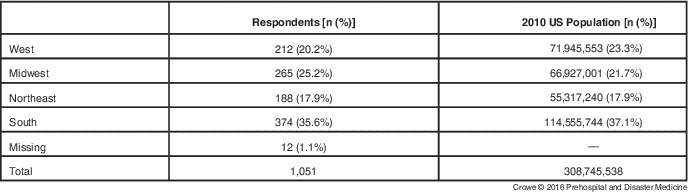
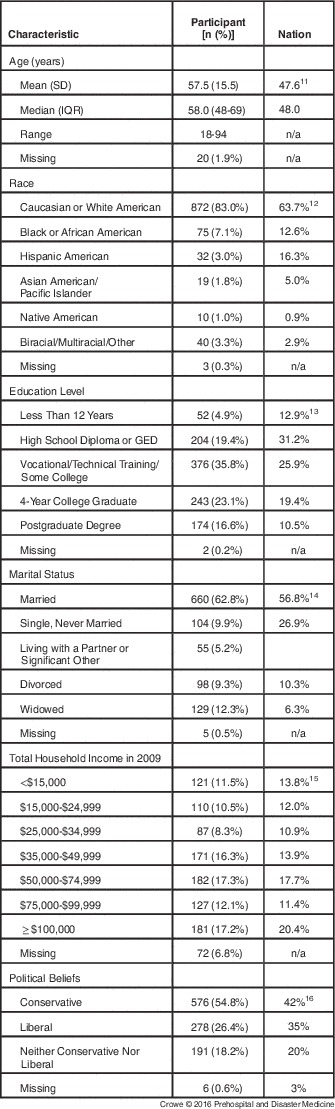
A total of 2,443 individuals were contacted by phone and 1,348 agreed to complete the survey (55.2%). There were 297 individuals who requested to drop out during the phone interview, leaving a total of 1,051 (43.0%) full survey responses for analysis. Table 1 shows the geographic distribution of the respondents compared with data from the 2010 US Census.Reference Bogosian 10 Demographic characteristics of the respondents along with national estimates are displayed in Table 2.Reference Mackun and Wilson 11 - 16 Participants ranged in age from 18 to 94 years with an average age of 57.5 years. Most were Caucasian or white (83.0%), married (62.8%), and held conservative political beliefs (54.8%).
Respondent Geographic Distribution by US Census RegionReference Bogosian 10

Participant Demographic Characteristics and National Demographic Estimates

Abbreviation: GED, General Educational Development.
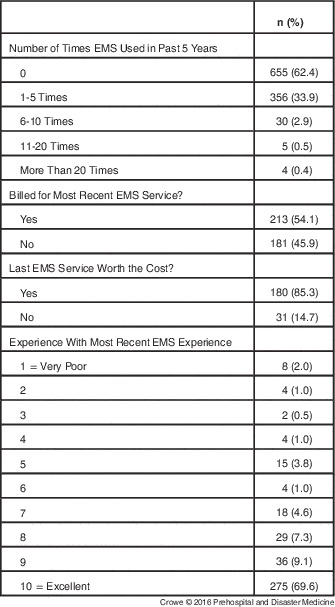
Over one-third (37.6%) of respondents had used EMS within the past five years. Over one-half (54.1%) were billed for their most recent EMS service and of those billed, most (85.3%) believed the service was worth the cost. Of those who used EMS within the past five years, over two-thirds (69.6%) rated their most recent experience as “excellent” (Table 3). Respondents were also asked whether or not they would agree to participate in a research project related to the care provided if they were a patient treated by EMS. Nearly two-thirds of all respondents (64.6%) reported that they would consent to participate in an EMS research project.
Utilization of EMS Among Respondents

Abbreviation: EMS, Emergency Medical Services.
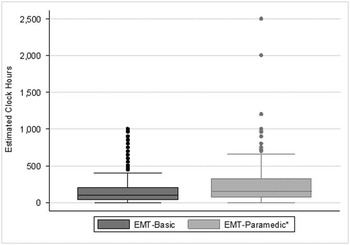
Another series of items aimed to measure the public’s expectations related to EMS care and their knowledge of differences between EMT-Basics and EMT-Paramedics. Figure 1 shows the distribution of public beliefs regarding the proportion of patients that survive cardiac arrest when EMS services are received. The median response was that 60.0% of patients survive (IQR: 40.0%-75.0%). Over one-half (56.7%) of respondents believed that EMT-Basics and EMT-Paramedics provide the same level of care. Figure 2 displays the distribution of responses when asked to estimate how many clock hours of training EMT-Basics and EMT-Paramedics receive. Responses regarding the number of hours of training received by EMT-Basics ranged from one to 2,000 hours, while this figure ranged from one to 5,000 hours for EMT-Paramedics. The median number of hours estimated for EMT-Basic education was 100 hours (IQR: 40-200 hours), while the median for EMT-Paramedic education was 150 hours (IQR: 75-320 hours). Almost all respondents (99.3%) believed that EMT-Paramedics were required to take fewer than 1,000 clock hours of training.
Public Perception of Percentage of Patients that Survive Cardiac Arrest When EMS Services are Received. Abbreviation: EMS, Emergency Medical Services.

Public Perception of Clock Hours of Training Required for EMTs and Paramedics. Abbreviation: EMT, Emergency Medical Technician. *There were two additional outlying estimates for paramedic clock hours at 4,000 and 5,000 hours.

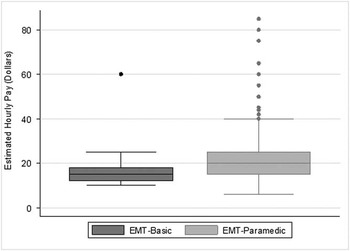
Respondents were asked to indicate how much they believed EMT-Basics and EMT-Paramedics are paid hourly (Figure 3). Responses ranged from $10 to $60 per hour for EMT-Basics with a median of $15 per hour (IQR: $12-$18 per hour). The range of estimates for an EMT-Paramedic’s hourly salary ranged from $6 to $85 per hour with a median of $20 (IQR: $15-$25 per hour).
Public Perception of Hourly Pay for EMTs and Paramedics. Abbreviation: EMT, Emergency Medical Technician.

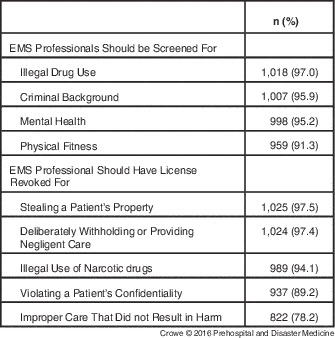
On the subject of prehire screening the vast majority of respondents agreed that EMT-Basics and EMT-Paramedics should be screened for illegal drug use (97.0%), criminal background (95.9%), mental health (95.2%), and physical fitness (91.3%). Furthermore, >90% of respondents agreed in EMS licensure revocation for stealing a patient’s property (97.5%), deliberately withholding or providing negligent care (97.4%), and the illegal use of narcotic drugs (94.1%) (Table 4).
Public Perception of EMS Screening and Causes for Licensure Revocation

Abbreviation: EMS, Emergency Medical Services.
Analysis by EMS Utilization
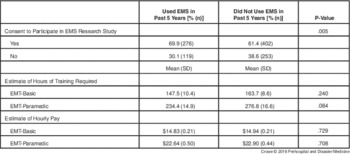
A comparative analysis between those who had used EMS within the past five years and those who had not examined reported willingness to consent to participate in EMS research, estimates of required hours of training, and hourly pay for EMT-Basics and EMT-Paramedics (Table 5). A significantly greater percentage of those who had used EMS at least once in the past five years reported a willingness to consent to participate in EMS research compared with those who had not used EMS (69.9% vs. 61.4%, P=.005). However, no differences were seen in estimates of hours of training required for EMT-Basics (147.5 vs. 163.7 hours; P=.240) and EMT-Paramedics (234.4 vs. 276.8 hours; P=.084). Similarly, there were no differences in perceptions of hourly wages for EMT-Basics ($14.83 vs. $14.94; P=.729) and EMT-Paramedics ($22.64 vs. $22.90; P=.708).
Comparison of Public Perception by EMS Utilization Status

Abbreviations: EMS, Emergency Medical Services; EMT, Emergency Medical Technician.
Discussion
This study was the first known investigation aimed to assess the public’s experience with and perceptions of EMS on a national level. Expectations related to cardiac arrest survival when EMS services are received were found to be overly optimistic as one-half of respondents believed that at least 60% of patients survive. This finding is consistent with previous literature, which has suggested that much of what the public knows about EMS likely stems from the media or television series. 2 For example, a 1996 assessment of cardiac arrest survival rates on three popular television shows found that over two-thirds of patients appeared to survive cardiac arrest to hospital discharge.Reference Saad 17 Another more recent study of survival rates after cardiopulmonary resuscitation (CPR) on two popular television series showed similar results with a survival rate near 70%.Reference Diem, Lantos and Tulsky 18 Meanwhile, actual survival rates after prehospital cardiac arrest depend on multiple factors including whether the arrest was witnessed, bystander CPR, patient’s age, and first presenting rhythm and are much lower than those depicted on television.Reference Portanova, Irvine, Yi and Enguidanos 19 A study of patients who suffered out-of-hospital cardiac arrest and were subsequently treated by EMS providers found that fewer than 10% of patients survived to hospital discharge.Reference Søholm, Hassager and Lippert 20 Unrealistically positive beliefs among members of the public regarding cardiac arrest survival could lead to uninformed decisions regarding whether to initiate resuscitation attempts as well as unjust resentment or anger towards EMS professionals when resuscitation efforts are unsuccessful.
In general, responses were favorable regarding public perception of EMS services by those who had used EMS in the past five years. Most rated their most recent experience as excellent, which is similar to results from a study by Studnek et al,Reference Doering 6 where about two-thirds of patients rated their overall quality of care as excellent. While customer satisfaction research in prehospital EMS is scant, investigations from other areas of health care have shown important correlations between patient satisfaction and better outcomes, more repeat business, and stronger collections.Reference Idris, Guffey and Pepe 21 In the hospital setting, patient experience of care is considered an important quality measure and the Hospital Consumer Assessment of Healthcare Providers and Systems data must be submitted for reimbursement by Medicare (Centers for Medicare and Medicaid; Baltimore, Maryland USA) for certain programs.Reference Kennedy, Tevis and Kent 22 Many EMS systems have adopted patient experience of care surveys; however, few studies of prehospital patient experience have been conducted. Further research is needed to explore the underlying factors affecting patient experience and its impact for EMS.
The results of this study suggest that few individuals understand the differences in level of care provided as over one-half of respondents believed that EMT-Basics and EMT-Paramedics provide the same level of care. Furthermore, no significant differences were found for the hours of training respondents believed EMT-Basics and EMT-Paramedics receive. While the length of EMT-Basic and EMT-Paramedic educational programs can vary considerably, a rough estimate for EMT-Basic education is 110-150 hours, while EMT-Paramedics receive around 1,000-1,200 hours of training.Reference Petrullo, Lamar, Nwankwo-Otti, Alexander-Mills and Viola 23 , 24 Almost all respondents greatly underestimated the hours of training for EMT-Paramedics. Future initiatives are needed to increase awareness of the different levels of EMS professional and the types of interventions that can be performed by providers at a given level.
The median pay estimates of $15.00 per hour for EMT-Basics and $20.00 per hour for EMT-Paramedics found in this study were in line with those from the Journal of EMS’ 2010 Salary and Workplace Survey, which found that, assuming a 40-hour workweek, median hourly wages for EMT-Basics ranged from $10.30 to $18.06 per hour, while this figure ranged from $15.79 to $19.79 per hour for EMT-Paramedics. 25 The perception of pay for EMT-Basics and EMT-Paramedics tells about the perceived value of the services and the profession. In addition to the advancement of the profession, pay and incentives play an important role in the recruitment and retention of the EMS workforce. 3
This study found that most respondents believed EMS professionals should be screened for illegal drug use, criminal background, mental health, and physical fitness. Respondents believed in revocation of an EMS professional’s license for stealing a patient’s property, withholding or providing negligent care, illegal narcotic drug use, violating patient confidentiality, and improper care even if it did not result in patient harm. Background checks are important in a profession of great public trust such as EMS. However, certification and licensure background check requirements vary greatly from state to state and many rely solely on self-reporting.Reference Greene and Williams 26 Future studies are needed to describe states’ processes for screening before granting EMS licensure and revocation of licensure and their impact on protecting the public.
Finally, while slightly more of those who had utilized EMS services within the past five years reported that they would be willing to consent to be included in an EMS research study, there were no differences in their perceptions of hours of EMS training requirements and hourly pay for EMT-Basics and EMT-Paramedics. Having used EMS did not appear to increase the knowledge of individuals regarding differences in training requirements for EMTs and Paramedics. Further targeted initiatives are needed to educate the public with regards to the training and skills of different provider levels of EMS professionals.
Limitations
This study is subject to several limitations that should be noted. First, the sample of telephone numbers only included landlines. This sampling frame did not include households with cell phones only. In 2010, an estimated total of 23.9% of households were cell phone only.Reference Kirkwood 27 Generalizability of these findings is cautioned as respondents tended to be white, older, more highly educated, and more conservative than the general public during the study period (Table 2). Additionally, gender data were not collected.
Conclusions
This study of the use and perceptions of EMS among members of the US public showed that most of those who had used EMS services in the past five years rated their experience as excellent. Nevertheless, expectations related to cardiac arrest survival rates after receiving prehospital care were overly optimistic. Knowledge of the differences in the education and skills between EMS professionals certified at different provider levels appears to be lacking, as most respondents did not distinguish between the level of care provided by EMT-Basics and EMT-Paramedics and the vast majority greatly underestimated the number of training hours required for EMT-Paramedics.