Introduction
Research on choral singing and choral participation provides evidence on the various musical and non-musical (physical, social and psychological) benefits for children and adults of this type of activity (Clift & Hancox, Reference CLIFT and HANCOX2001, Reference CLIFT and HANCOX2010; Chorus America, 2003, 2009). However, there has been little research on the preparation of choral conductors and what there is tends to come from the USA (Fuelberth, Reference FUELBERTH2004; Billingham, Reference BILLINGHAM2008), where the professional preparation of choral conductors is believed to be more systematic and structured than in the UK (Durrant & Varvarigou, Reference DURRANT and VARVARIGOU2008; Ruocco, Reference RUOCCO2008). Although some studies have identified the necessary attributes of an effective choral conductor educator (Gumm, Reference GUMM1993, Reference GUMM2004, Reference GUMM2007; Durrant, Reference DURRANT2003), the extant literature on choral conducting mainly focuses on technical issues, e.g. conductors’ gestural vocabulary (Cofer, Reference COFER1998; Leman, Reference LEMAN, Thurman and Welch2000), on suggested warm-up exercises, on repertoire selection (Stufft, Reference STUFFT1998; Persellin, Reference PERSELLIN2000) and on rehearsal pacing and planning techniques (Brunner, Reference BRUNNER1996; Munson, Reference MUNSON1998; Zielinski, Reference ZIELINSKI2005). The aim of this paper is to present a theoretical framework that could facilitate the examination and description of the process of choral conducting preparation in diverse choral conducting education contexts. The data that are presented come from the first author's doctoral thesis, which explored and described the process of choral conducting preparation in five programmes: three programmes offered in Higher Education (one at a conservatoire and two at university departments) and two short courses offered by two different independent bodies that cater for choral conducting education in the UK.
Taking research on the benefits of choral singing (Unwin et al., Reference UNWIN, KENNY and DAVIS2002) and participation (Kennedy, Reference KENNEDY2002; Chorus America, 2003, 2009; Durrant, Reference DURRANT2005) into account, it could be assumed that people who lead and organise choral singing activities in schools and communities have opportunities to receive tuition in choral conducting, as would be the case with those who lead orchestral groups. Such tuition would develop their skills, understanding and awareness about their role and responsibilities as conductors. Yet, the limited number of research studies on choral conducting education in the UK suggests quite the opposite – that choral conducting education is not widespread and an area still to be explored and developed (Durrant, Reference DURRANT1994; Varvarigou, Reference VARVARIGOU2009). Before going any further, we need to clarify that this paper discusses the preparation of choral conductors who lead school, community and church (mostly amateur) choirs. While recognising that singing activities in certain socio-cultural traditions around the world are not formally conducted, that is not within the remit of this paper.
The attributes of an effective conductor
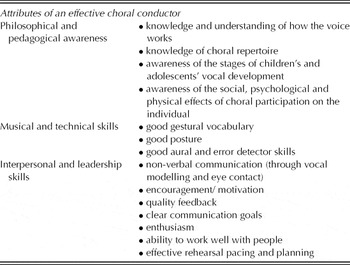
Whether choral conducting is teachable or not has troubled researchers who seem to agree that an efficient conductor should possess various attributes, such as refined conducting gestures and movements, rehearsal strategies, enthusiasm and commitment. In the UK, Durrant (Reference DURRANT1994, Reference DURRANT2003) explored the definition of ‘effective’ conducting and suggested a tripartite model towards a ‘deeper’ choral communication, which is a communication that encourages responsiveness from the singers. The tripartite ‘supermodel choral conductor’ consists of principles related to knowledge of the choral repertoire, human voice, understanding of the nature of the conductor's role (termed ‘philosophical principles underpinning role’, including pedagogical principles); ‘musical-technical skills’ (such as aural skills, gestures, rehearsal strategies) and ‘interpersonal and leadership skills’ (ways of fostering motivation and enjoyment of singing) (Table 1).
Examples of elements in the key attributes of an effective choral conductor (Durrant, Reference DURRANT2003, pp. 100–102)

In America, Gumm (Reference GUMM1993) identified eleven choral-teaching styles, which can be characterised by various patterns, so-called ‘dimensions’ (eight dimensions have been identified), of self-reported behaviour. Two later studies by Gumm (Reference GUMM2004, Reference GUMM2007) showed that the choral conducting profession needs to establish a better match between teaching behaviours, teaching styles and the standards in music within the choral classroom. In Gumm's later study (Reference GUMM2007) college students were asked to rate methodical and sociable characteristics of their conductors. The ‘methodical’ items to be rated included presentation of material, course organisation, preparation for the class, ‘helped me learn’ and overall effectiveness. The ‘sociable’ items rated respect, accessibility and enthusiasm. The findings of the study suggested that college students appreciated supporting teaching behaviours such as praise and positive feedback but they also preferred not to simply be told what to do, but instead to be asked for their insights into the ensemble experience. The results also pointed out that the more able, hard-working and experienced the musicians, the less attention they paid to their conductors’ sociability. They were instead focused on the activity itself. On the contrary, those motivated by their enjoyment for the music being performed sought a conductor with developed sensitivity and sociability. This finding particularly stresses the significance of interpersonal skills as part and parcel of the choral conductor's role, especially when working with children or non-professional singers. Are all of Durrant's ‘attributes’ and Gumm's ‘characteristics’ teachable? In particular, can the ‘inter-personal skills’ and ‘sociable items’ be effectively addressed in a teaching context?
Particular attention to the leadership skills of conductors was given by Armstrong and Armstrong (Reference ARMSTRONG and ARMSTRONG1996) who stressed that conductors can have a transforming impact on their students as often, due to rehearsal requirements of many music programmes, students spend more time with the conductor than with any other educator. Furthermore, Apfelstadt (Reference APFELSTADT1997) explained that there are key skills, which can be teachable, that describe effective choral leadership. These skills are divided into two groups: (i) musical (i.e. artistic intuition, musicality/expressiveness and aural sensitivity) and (ii) extra-musical (i.e. articulateness, confidence, effort, enthusiasm and initiative). Yet, Apfelstadt recognised that some people achieve or naturally possess a leadership characteristic that is difficult to label, which represents an artful combination of musical and extra-musical skills. Although this elusive quality, which makes some people stand out immediately, can be broken down into its components and analysed it is impossible to duplicate or mimic. Therefore, she suggested that through rehearsal planning that addresses the areas of preparation, presentation and evaluation, all of which can be taught in choral conducting education programmes, students can increase their effectiveness as choral leaders. She concluded by saying that the pursuit of leadership skills is a lifelong task. Finally, Barresi (Reference BARRESI2000) put emphasis on conductors’ (i) personal qualities, such as commitment, dedication, motivation, enthusiasm and trust towards the singers; (ii) professional understanding (i.e. children's vocal development, repertoire, basics of singing instruction) and (iii) technical competence (i.e. effective vocal modelling, a ‘good ear’ for vocal tone, pitch accuracy and rehearsal management).
Theoretical perspective 1: effective teaching and learning environments
Outside the field of choral education, research on effective learning environments within higher education (Entwistle, Reference ENTWISTLE, Entwistle and Tomlinson2007) and the workplace (Eraut, Reference ERAUT2004, Reference ERAUT, Entwistle and Tomlinson2007) has identified several characteristics that are believed to help people learn. To begin with, Entwistle underlines that teaching and learning in higher education can be seen as an interactive system that depends on the characteristics of the learner, the specific nature of the subject matter and the teaching–learning environment. Therefore, he proposes a set of seven concepts (empathy, enthusiasm, explanation, clarity, structure, level and pace) that can describe the (effective) interactions between learner characteristics, subject-based teaching activities and other aspects of the overall teaching and learning environment provided for learners and experienced by them in different ways.
Eraut (Reference ERAUT2004, Reference ERAUT, Entwistle and Tomlinson2007) carried out research into how people learn in the workplace and his studies identified three favourable conditions for learning: (i) feedback and support from the environment, as the environment has a huge effect on performance and motivation; (ii) commitment to the work and the colleagues by participation in groups and through appreciation of the value of one's work; and (iii) personal agency, by which he referred to the participants’ choices, competence and progress. The contextual factors that could influence learning in the workplace were also identified. These are (i) the encounters and relationships with people at work, (ii) the allocation and structuring of the work and (iii) the individuals’ participation and expectations of their performance and progress.
Theoretical perspective 2: cognitive apprenticeship contexts
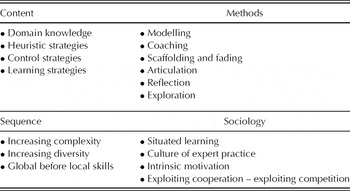
The theoretical construct of cognitive apprenticeship (Collins et al., Reference COLLINS, BROWN, NEWMAN and Resnick1989) enquires into teaching the processes that experts use to handle complex tasks and on learning through guided experience on cognitive (subject knowledge) and metacognitive (self-correction, self-monitoring) levels, rather than physical skills and processes. The emphasis on the word ‘cognitive’ draws attention to the fact that apprenticeship techniques reach well beyond the physical skills more formally associated with traditional apprenticeship, to the kind of cognitive skills normally related to conventional schooling. To facilitate considerations related to pedagogical and theoretical issues on teaching and learning, Collins et al. (Reference COLLINS, BROWN, NEWMAN and Resnick1989) developed a framework, which describes four dimensions that constitute any learning environment (see Table 2). Each dimension is characterised by several features that, according to the authors, should be considered in constructing and evaluating learning environments (Collins et al., Reference COLLINS, BROWN, NEWMAN and Resnick1989, pp. 476–477). Overall, cognitive apprenticeship suggests that learning has to be understood with respect to a practice, as a whole, within its multiplicity of relations – both within the community and with the world at large. Choral conducting tuition shares similarities with cognitive apprenticeship environments, as choral conductors practise through rehearsing with their choirs as well as receive coaching in gestural and vocal technique from experts.
Cognitive apprenticeship – characteristics of ideal learning environments

This article examines theoretical constructs that deal with learning in higher education, the workplace and in cognitive apprenticeship environments because choral conducting education in the UK is situated either within higher education institutions or in apprenticeship-like settings (e.g. short programmes or workshops offered by independent bodies), where conductors learn through observation of others and ‘on the job’ (Varvarigou, Reference VARVARIGOU2009). The heuristic theoretical framework that is proposed draws on theories on effective learning within diverse environments and wishes to offer a supportive theoretical grounding for the exploration of choral conducting education in the UK today.
Theoretical perspective 3: theories of expertise
The traditional underlying assumption about conductors is that good conductors are born, not made, a perception that is refuted by contemporary research on expertise acquisition (Chi, Reference CHI, Ericsson, Charness, Feltovitch and Hoffman2006; Feltovitch et al., Reference FELTOVITCH, PRIETULA, HOFFMAN, Ericsson, Charness, Feltovitch and Hoffman2006; Hunt, Reference HUNT, Ericsson, Charness, Feltovitch and Hoffman2006; Lehmann & Gruber, Reference LEHMANN, GRUBER, Ericsson, Charness, Feltovitch and Hoffman2006; Zimmerman, Reference ZIMMERMAN, Ericsson, Charness, Feltovitch and Hoffman2006; Ericsson et al., Reference ERICSSON, PRIETULA and COOKERY2007). Existing studies on choral conducting practice have so far illustrated that in order to be called ‘experts’, effective choral conductors need to possess several attributes (see Table 1). Theories of expertise have influenced the suggested framework and challenge the common perception that, in order to be effective, choral conductors must be charismatic (Lebrecht, Reference LEBRECHT1991). Mieg (Reference MIEG, Ericsson, Charness, Feltovitch and Hoffman2006) underlines that declaring someone an expert is a social act, which may or may not correspond to an intrinsic characteristic of the person so designated. Zimmerman's research (Reference ZIMMERMAN, Ericsson, Charness, Feltovitch and Hoffman2006) highlights that through deliberate practice, which entails (i) high level of concentration, (ii) the structuring of specific training tasks to facilitate setting appropriate personal goals, (iii) monitoring informative feedback and (iv) opportunities for repetition and error correction, the individuals can develop various levels of expertise (Zimmerman, Reference ZIMMERMAN, Ericsson, Charness, Feltovitch and Hoffman2006, p. 705). So, contrary to the everyday belief that ‘highly talented’ musicians need not practise as much as the less talented, accumulated hours of practice are an irrefutable predictor of excellence. The issue regarding choral conductors and practising is that they can only effectively practise in front of a choir.
A suggested framework
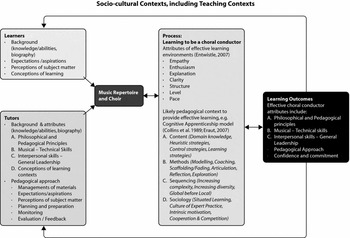
This article brings together theories on effective teaching and learning environments with an intention to suggest a theoretical framework that could enhance and inform choral conducting education. The framework that is described in the following paragraphs (see
Fig. 1) considers time (extent and duration of tuition) and location (teaching contexts) as determinant parameters of effective education. However, it acknowledges that more than the time and location, it is the experience of interacting with the music and the singers, in particular social surroundings (socio-cultural contexts where practice takes place, i.e. schools, community centres or church) and under the guidance of experts that seem to produce desired changes in the learner. The ultimate goal of the suggested framework is to be inclusive of all the parameters that could potentially affect the process of the education of choral conductors and to suggest methods and practices that can maximise learners’ development.
Fig. 1

The tutors
In all teaching contexts the tutors are expected to possess a range of necessary skills and knowledge that allow them to support learners’ learning and development. In choral conducting education, tutors are expected to have a certain level of expertise in musical and technical skills, interpersonal and leadership skills as well as awareness of their roles as practitioners and educators (see Table 1). However, a knowledgeable and experienced choral conductor is not necessarily an effective educator. An effective choral conductor educator should ideally adopt a pedagogical approach that enables learners to grow within their learning context. Some suggested attributes for effective teaching applied from a wider research perspective (Jennings, Reference JENNINGS1994) are related to (i) management of (choral) material, (ii) the tutor's expectations/aspirations, (iii) the tutor's perceptions of the subject matter, (iv) planning and preparation, (v) monitoring the learners’ development and (vi) evaluation through feedback (Box 1).
Box 1 Example from a teaching and learning session – Evaluation through feedback to the Learner (L7) from the Tutor (T2) and her peers (L5, L7, L10, L11, L12, L13)
Session 4: Feedback to L7
L7: It was harder than I thought it would be. I think I know this very well so I don't need to look at the copies and I don't know why I was looking at it.
L10: She wasn't mouthing the words.
L11: She does not move the body.
L7: I have stopped moving my head.
T2: You've come a long, long way since the last time.
L12: I liked it. I understood everything.
Joke – learners laugh.
L13: S7 has a sense of authority when she is conducting.
L4: Good sense of phrasing: crescendo and decrescendo.
T2: How did that compare to what you saw the last time?
L5: She was very relaxed but sometimes the face wasn't helping.
T2: We have to create the atmosphere of holiness with the face. Therefore, the intimacy is in the gestures; in your presentation of the music . . ..
***
T2: Again, it's just about exploring stuff. And the problem with the conductor is that we don't really see ourselves. That is why it is quite useful to look at the videos and think: am I doing what I need to do? Am I efficient? Am I vocally friendly? Is what I am doing with my gestures helping and enabling the voice rather than limiting and inhibiting it? If you are copying the conductor, and I have seen examples of people copying their conductor, that can be inhibiting rather than enabling what we want to do. But we are all different shapes and sizes, so we all have different frames or ways to operate, so I am looking at the way gesture has and can impact on vocal health. And that impacts on people's attitudes towards what's music and towards singing.
The learners
Eraut's studies suggested that due to their diverse backgrounds (knowledge, abilities, biographies and previous experiences) learners, even in the same course, often begin their training from different starting points from one another. What is more, learners often have different learning needs and it is not uncommon that at times they might have to ‘unlearn’ skills or attitudes in order to re-learn new ones (Rogers et al., Reference ROGERS, HALLAM, CREECH and PRETI2008). Furthermore, the learners often have their own expectations and aspirations of their learning context (Box 2), as well as their own perception of the subject matter, for example, what the role of a choral conductor is in diverse conducting environments. These perceptions are believed to influence both the process and learning outcome of their training (Richardson, Reference RICHARDSON, Entwistle and Tomlinson2007).
Box 2 Comments from a variety of Learners on their expectations from the different choral conducting education programmes in which they participated
• I always enjoyed singing in choirs and would love to try and lead a choir myself. Also I think that it would be a useful skill for my future job as a music teacher.
• I have never conducted before and felt this would be an essential skill for my future career in teaching.
• [I want] to know myself. What is the role of a conductor, how can I improve the singers to sing what I wanted them to sing.
• A thorough programme of targets to be mastered over six months would be great. At the moment, everyone has their own personal issues; it makes it hard to stay focused. If everyone thought of the same issue at the same time, each at their own level, we could go into much more depth, and could achieve more over the six months period.
• As I am primary school teacher and choir leader, the SATB material whilst good to sing, is not what I will be using with my choir.
The repertoire and choir
Although conductors select and prepare the repertoire and plan their rehearsals in private, there is no choral rehearsal without singers. The engagement of the singers with interesting and challenging repertoire enhances their enjoyment of and motivation for participation as well as their musical development (Corbin, Reference CORBIN1995; Persellin, Reference PERSELLIN2000). Satisfaction and development are major benefits from choral participation and, therefore, should not be neglected during the process of the conductors’ preparation (Box 3).
Box 3 Reflective comment by two Learners on how the choice of repertoire affected their conducting in rehearsal
• I was most surprised by the choir's reaction to me personally. I certainly felt that they were ‘on my side’. On reflection. I think the connection I achieved was much down to enthusiasm for the material [Weeping, by Dan Heymann] and trusting that they could do what I was asking.
• Working with boys has made me more conscious of choosing music in an appropriate key with manageable range. Singing in parts is particularly useful to provide differentiation for individuals as their voices change.
The process of learning to be a choral conductor
With regard to the education process, the theoretical construct of cognitive apprenticeship has drawn attention to the significance of opportunities for reflection, exploration and problem solving, repetition with informative feedback from a teacher and other participants, observation, modelling of systematic expert performance and interaction with peers and experts. Choral conducting education could possibly benefit from an educational context, where the tutors, learner-conductors and singers, offer and receive regular feedback that provides some kind of social validation of their performance. In choral conducting practice such validation could encourage articulation, exploration and reflection on the part of the learner-conductors, which can lead to an ‘in-depth’ interaction between the tutor(s) and the learners, through discussion, modelling and scaffolding practice. In addition, effective learning environments should have clear targets on what is to be achieved and should structure learning in a way that the targets can be successfully fulfilled over time. When learning ‘on the job’ occurs, which appears to be having full application to the practice of choral conductors over the years, Eraut also identifies confidence and commitment (personal agency), feedback and support and challenge and value of one's work as favourable conditions for learning (Box 4).
Box 4 Example from a choral conducting education session – Interaction between Learner (S4) and Tutor (T3)

The learning outcomes
An effective preparation should support learner conductors to acquire attributes that allow them to lead their choral groups with confidence, commitment and success. These attributes are related to skills and knowledge concerning effective choral conducting practice (see Table 1) and a pedagogical approach that allows them to be more effective choral educators. Research suggests that learners tend to adopt, in their role as tutors, a pedagogical approach similar to the one they have experienced as learners (Prosser et al., Reference PROSSER, MARTIN, TRIGWELL, Entwistle and Tomlinson2007). With reference to the parameter of time, theories of expertise have repeatedly underscored that deliberate practice is a fundamental element towards the development of expertise in every domain (Zimmerman, Reference ZIMMERMAN, Ericsson, Charness, Feltovitch and Hoffman2006). Learners in choral conducting should realise that in order for them to achieve autonomous and refined cognitive, physiological and motor skills they must practise and personally adapt their skills to dynamic contexts (i.e. their own conducting environments) over time, which in Fig. 1 is what the arrows that return from the learning outcomes to the learners and tutors indicate. The development of musical and pedagogical skills, knowledge and awareness need to inform the way tutors and learners refine their practice and respond to the needs of their environments (Box 5).
Box 5 Comments from Learners on self-perceived development
• I came to the course having done conducting studies in South Africa. My conducting style has changed, as my singers tell me. [I am] shaping the sound and shaping the singers to get the music I want. I try to get into the shoes of the composer, and I mean that the course helped me to become an immersive conductor for myself, my singers and my listeners.
• My ability to express music through gesture has improved and my passion for singing has been strengthened. I am enthusiastic to continue working in schools to develop my conducting skills but most importantly to give students the opportunity to discover their voices and enjoy singing.
• This has been a very useful module, as someone who started the course describing myself as ‘not a singer’ my confidence has escalated. I now feel armed with many skills to continue after the course in running a choir. The secondary school I will be going into in September has a very strong choral reputation . . . with the music department being full of singers and vocal coaches; I will have many more people to continue learning from.
The socio-cultural contexts, including teaching contexts
The socio-cultural communities of practice in which individuals are a part are believed to colour the ways the individuals understand their learning and practising contexts and act within them. To illustrate, at an individual level, choral conductors’ musical preferences and repertoire choices (often influenced by the environment where they conduct such as a church or school environment) might have a bearing upon the education process (Kennedy, Reference KENNEDY2002). At a collective level, choral conductors’ cultures, traditions, religions, professional environments and resources might also influence the education process. Possible interferences are cultural ‘obligations’ such as participation in choral festivals or competitions (Price & Chang, Reference PRICE and CHANG2005); choral practice embedded in a culture where movement is an integral element of the singing activity, such as in the gospel tradition (Graham et al., Reference GRAHAM, SHEDD and WALKER2003) or the lack of support from one's professional environment might interfere with the process of preparation and, by extension, the outcomes of an individual's development.
Taking everything into account, the suggested framework offers a lens through which to examine choral conducting education in diverse contexts and it wishes to be a dynamic and responsive framework to both the biographies and needs of individuals and to the wider socio-cultural expectations.
Conclusion and implications
Research studies emphasise the benefits from choral participation for the individual and the society. However, the sole responsibility for planning and leading rehearsals and performances falls on one individual in each choral context: the conductor. Although the various responsibilities attached to a choral conductor's role have been identified, little attention has been given on his or her education, especially in the UK. The suggested framework for effective education of choral conductors proposed here draws on research on effective teaching and learning environments within higher education, the workplace and in apprenticeship settings. Theories of expertise have also been used to support evidence that effective choral conductors can be nurtured through education – as long as the learners have opportunities to practise with a choir and when an ‘expert’ is teaching.
Research in music education that seeks to define high-quality preparation in choral conducting education should provide a basis for strengthening the position of choral activities in schools and communities. If choral conductors can be prepared effectively in professional practice, more people will be encouraged to take up the role of choral conductor with confidence, which in turn, will enable more children and adults to experience satisfaction from choral participation.
Some implications firstly for policy makers are that more choral conducting schemes of work should be developed and their focus should not be solely on providing conductors with technical preparation in gestural competence, but on offering learners support in confidence development and opportunities for practical experiences with choirs. Secondly, tutors in choral conducting education environments in conservatoires, universities or shorter courses should use methods such as reflective practice, collaborative learning and regular feedback during their teaching. Singers, as vital components of the choral rehearsal might be encouraged to participate in the process by providing feedback to their learner-conductor. Lastly, it is hoped that this framework could inform further exploratory studies on interactive music making activities within education.
Acknowledgements
Many thanks to George Primentas and ANTIFORMA Design http://www.antiforma.co.uk for the design of Fig. 1.