


Introduction
Human-animal interactions are an important part of a behavioural management programme for research animals (Turner & Bayne Reference Turner and Bayne2023) as they can occur frequently and impact animal welfare, health, and scientific outcomes (Rushen et al. Reference Rushen, Taylor and de Passillé1999; Waiblinger et al. Reference Waiblinger, Boivin, Pedersen, Tosi, Janczak, Visser and Jones2006; Mellor et al. Reference Mellor, Beausoleil, Littlewood, McLean, McGreevy, Jones and Wilkins2020; Rault et al. Reference Rault, Waiblinger, Boivin and Hemsworth2020). Every interaction between an animal and a human handler is a learning opportunity for the animal and can influence the valence of the relationship (Waiblinger et al. Reference Waiblinger, Boivin, Pedersen, Tosi, Janczak, Visser and Jones2006; Rault et al. Reference Rault, Waiblinger, Boivin and Hemsworth2020). If human-animal interactions are negatively perceived by the animal, this can lead to chronic fear and stress, impacting behaviour and physiological processes (Rushen et al. Reference Rushen, Taylor and de Passillé1999; Waiblinger et al. Reference Waiblinger, Boivin, Pedersen, Tosi, Janczak, Visser and Jones2006; Rault et al. Reference Rault, Waiblinger, Boivin and Hemsworth2020). Within the 3Rs principle of refinement, those working with research animals should aim to use practices that minimise pain and distress, improve animal welfare, and where possible, provide positive experiences for the animals (Russell & Burch Reference Russell and Burch1959; Prescott & Lidster Reference Prescott and Lidster2017; Bayne & Turner Reference Bayne and Turner2019).
Refined handling refers to patient, behaviour-centred handling techniques in which the animal handler focuses on animal response and uses optimal practices to reduce fear and stress (O’Malley et al. Reference O’Malley, Hubley, Moody and Turner2022). For the purposes of this paper, refined rodent handling refers specifically to the way in which animals are lifted out of the cage, also referred to as low stress or non-aversive handling. There is over a decade of empirical evidence demonstrating that lifting mice (Mus musculus) from their cage by the tail is aversive (Hurst & West Reference Hurst and West2010; Ghosal et al. Reference Ghosal, Nunley, Mahbod, Lewis, Smith, Tong, DA and Herman2015; Ono et al. Reference Ono, Sasaki, Nagasaki, Torigoe, Ichii, Sasaki and Agui2016; Gouveia & Hurst Reference Gouveia and Hurst2017; Clarkson et al. Reference Clarkson, Dwyer, Flecknell, Leach and Rowe2018, Reference Clarkson, Leach, Flecknell and Rowe2020; Nakamura & Suzuki Reference Nakamura and Suzuki2018). Tunnel, cup, and body handling are preferred handling methods. Tunnel handling refers to gently guiding the animal into the tunnel to lift them out of the cage (other in-cage furniture or devices can also be used, such as huts; Bodnar et al. Reference Bodnar, Makowska, Schuppli and Weary2025). Cup handling is specific to mouse handling, in which the animal is gently scooped into the palm of the hand using one or both hands. Body handling refers largely to rat (Rattus norvegicus) handling, in which the animal is gently scooped around the mid part of the body and lifted from underneath using one or both hands. Refined handling methods for mice result in reduced anxiety and stress (Gouveia & Hurst Reference Gouveia and Hurst2013; Ghosal et al. Reference Ghosal, Nunley, Mahbod, Lewis, Smith, Tong, DA and Herman2015; Ono et al. Reference Ono, Sasaki, Nagasaki, Torigoe, Ichii, Sasaki and Agui2016; Clarkson et al. Reference Clarkson, Dwyer, Flecknell, Leach and Rowe2018, Reference Clarkson, Leach, Flecknell and Rowe2020), reduced depressive-like states (Clarkson et al. Reference Clarkson, Dwyer, Flecknell, Leach and Rowe2018, Reference Clarkson, Leach, Flecknell and Rowe2020), reduced aggression (Mertens et al. Reference Mertens, Vogt, Gass, Palme, Hiebl and Chourbaji2019), reduced fear towards humans (Nakamura & Suzuki Reference Nakamura and Suzuki2018; Gouveia & Hurst Reference Gouveia and Hurst2019; Roughan & Sevenoaks Reference Roughan and Sevenoaks2019; Henderson et al. Reference Henderson, Dani, Serrano, Smulders and Roughan2020a), improved reproduction parameters (Hull et al. Reference Hull, Reynolds and Nunamaker2022), improved bodyweight maintenance (Redaelli et al. Reference Redaelli, Bosi, Luzi, Cappella, Zerbi, Ludwig, Di Lernia, Roughan, Porcu and Soranna2021), and reduced variation in behaviour tests (Gouveia & Hurst Reference Gouveia and Hurst2017; Nakamura & Suzuki Reference Nakamura and Suzuki2018; Henderson et al. Reference Henderson, Dani, Serrano, Smulders and Roughan2020a). There is less evidence on the impacts of handling strategy on rat welfare, but tail handling can be a common method used with rats as well (Burn et al. Reference Burn, Camacho and Hockenhull2023). In addition to the potential for tail degloving when restraining rats by the tail, Lorenzini and colleagues (Reference Lorenzini, Bucherelli, Giachetti and Tassoni1990) report that tail handling is aversive in rats, resulting in reduced exploration as measured with step-through latency in a two-box apparatus test. Handler-reported stress is noted during tail handling, with rats showing more defaecation and less sniffing of the handlers’ hand when tail handling is used (Burn et al. Reference Burn, Camacho and Hockenhull2023). Combined, these results suggest that tail handling should be avoided to reduce risks to rat welfare. Preferred methods may be those that support rats from below, such as cupping, chest- and bottom-supported holds, and tunnel handling as described in Burn et al. (Reference Burn, Camacho and Hockenhull2023). Although, a recent study showed that social housing may influence rat stress response to handling, with socially housed rats lifted with a thoracic hold showing less evidence of stress and single-housed rats who were lifted with bite gloves or tunnels showing the most evidence of stress (Kylie et al. Reference Kylie, Cooper, Kurpinski, Chase, Muzyka and Plachta2024). Another recent study showed no difference in socially housed rat stress response across handling methods, including tail handling (O’Malley et al. Reference O’Malley, Paterson, Kylie, Thurston, Tambadou, Ekundayo, Puoliväli, Collymore and Turner2026). Together, these studies show more work is needed to better understand refined handling for rats.
Despite the evidence that refined handling is beneficial to animal welfare, there has been relatively low uptake of these practices on a wide scale across biomedical research facilities due to perceived challenges based on animal temperament (i.e. jumpy, aggressive), increased time requirements for refined handling, incompatibility with other methods (i.e. restraint), and attitudes of coworkers (O’Malley et al. Reference O’Malley, Hubley, Moody and Turner2022; Burn et al. Reference Burn, Camacho and Hockenhull2023; Young et al. Reference Young, Goldsteen, Nunamaker, Prescott, Reynolds, Thompson-Iritani, Thurston, Martin and LaFollette2023). This may be because changing handling practices across a facility may seem an enormous hurdle to undertake. In 2022, a global CRO launched an initiative to promote refined handling of mice and rats, aiming to use change management strategies to facilitate long-term human behaviour change, which is presented fully in O’Malley et al. (Reference O’Malley, Paterson, Kylie, Thurston, Tambadou, Ekundayo, Puoliväli, Collymore and Turner2026, in press). The CRO aimed to transition to refined handling techniques company-wide over a 2–3-year period, with a targeted goal of removing mice and rats from their home cage at least 85% of the time with refined handling. The 85% threshold was used, rather than 100%, to allow for flexibility and opportunities for problem-solving. This was especially useful in challenging situations, such as handling fractious rat populations prone to biting, or procedures such as sexing and receiving animals at intake, where there was more resistance to refined handling due to concerns with increased time. Personnel were encouraged to implement refined handling where they could, in order to meet the 85% implementation, while being encouraged to evaluate these challenging situations to see how refined handling could be implemented in the future. This encouraged creativity, empowerment, and facility-level ownership. The 85% threshold also allowed for early reinforcement to maintain positive momentum (O’Malley et al. Reference O’Malley, Thurston, Murray, Turner and Nunamaker2026, in press). The objective of this project was to use surveys to assess uptake and attitudes towards refined handling across the 4-year initiative. Our specific aims were to: (1) benchmark handling practices prior to change efforts; (2) capture key concerns and resources needed for change; (3) assess progress throughout the initiative; and (4) determine if different approaches were needed for particular regions and business units.
Materials and methods
Surveys and methods used to anonymously collect data from employees were reviewed for ethical consideration and approved a priori by the corporate legal office.
The refined handling initiative was organised by Global Animal Welfare (GAW) within Charles River Laboratories (Wilmington, MA, USA), a global CRO. GAW is a corporate group that focuses on animal welfare risk management and policy development, related employee training, and animal behavioural management programmes. At the time of initial survey, the company had four global business units working with rodents including Research Models and Services (RMS) commercial breeding facilities, Discovery and Safety Assessment (DSA) drug research, development, and safety testing facilities, Biologics (BIO) the biologics testing and analytical services, and Insourcing Solutions (IS CRADL) providing management and staffing support and the CRADL contract vivarium laboratories. Throughout the initiative, there were 68 sites working with rats and/or mice within the company. The sites were located in Canada, China, Finland, France, Germany, Hungary, Ireland, Italy, Netherlands, UK, and the US.
Surveys development and distribution
Cross-sectional questionnaires were used at three time-points to assess handling practices, including what methods employees were trained to use, considerations for handling methods based on animal population or condition, occurrence of bites, opinions, experiences, and challenges with refined handling, and support and resources for transitioning to refined handling. Questionnaires were sent out in March–April 2022, July–August 2023, and June–July 2025. The surveys were developed by GAW and modified slightly for each assessment to address the changing strategy based on progress towards refined handling (for full surveys for each year, see Supplementary material 1, 2 and 3 [relating to 2022, 2023 and 2025, respectively). The surveys were administered using SurveyMonkey® (San Mateo, CA, USA). Survey links were shared using internal list servs.
For each survey, handling method was assessed separately for rats and mice, and further divided by different groups of animals, which included young adults, infant and juvenile, older and/or less handled, and pregnant. For the purposes of the surveys, the following definitions were provided (see Table 1)
Definitions provided about handling methods for rats (Rattus norvegicus) and mice (Mus musculus) in the surveys

Table 1. Long description
The flowchart consists of three stacked rectangular boxes, each representing a specific year.Top box: 2022ã Goal: benchmark handling practices at the start of the refined handling initiativeã 14 questions across 3 sections: site information, current handling methods, refined handlingã Minimum 1 response per site from supervisorsã Not anonymousã 37 total responses collected across 29 sitesMiddle box: 2023ã Goal: track progress towards refined handlingã 25 questions across 4 sections: site information, rat handling, mouse handling, resources and trainingã Minimum 1 response per site from supervisorsã Not anonymousã 67 total responses collected across 42 sitesBottom box: 2025ã Goal: assess handling practices, attitudes, and experiences with refined handling after most sites had transitioned to using refined handlingã 34 questions across 4 sections: demographics, rat handling, mouse handling, resources and trainingã Cascaded to all rat and mouse handlers company-wideã Anonymousã 255 responses collected across 37 sites
An overview of each survey is provided in Figure 1. The first survey conducted in March 2022 to benchmark current handling practices, capture concerns about using refined handling techniques, and understand what resources would be needed to promote use of refined handling prior to the formal efforts to promote the use of refined handling. There were 14 questions across three sections: site information, current handling methods, and questions about refined handling. When asking about handling methods, participants were asked to check all handling methods that apply (based on definitions provided in Table 1) for the four groups of animals (young adult; infant and juvenile; older and/or less handled; pregnant). The survey was sent to all Charles River facilities with mice and/or rats across business units. Sites were asked to submit at least one response per site but encouraged to submit multiple responses to capture differences in handling practices between departments, where relevant. The survey was offered in English, Chinese, French, German, and Spanish using DeepL (Cologne, Germany) for translations, with additional review from fluent speakers for each language. A total of 55 unique emails were sent out to capture various departments within the facilities.
An overview of each survey, into handling practices involving mice (Mus musculus) and rats (Rattus norvegicus) including number of questions, target population for responses, and total responses received.

Figure 1 Long description
Figure summarizes three surveys. 2022: benchmark practices, 14 questions, 37 responses from 29 sites, non-anonymous supervisor responses. 2023: progress assessment, 25 questions, 67 responses from 42 sites. 2025: attitudes and implementation assessment, 34 questions, anonymous survey of handlers, 255 responses from 37 sites.
A second survey was conducted in July 2023 to identify progress towards adoption of refined handling. There were 25 questions across four sections: site information, handling methods for rats, handling methods for mice, and resources and training. For this survey and the following survey, participants were asked to quantify what percentage of animals were handled using each method by animal group with the following options provided: 0–10%; 11–25%; 26–50%; 51–75%; and 76–100%. The survey was sent out to all sites with rats and/or mice across business units. Sites were asked to submit at least one response but were encouraged to submit multiple responses to capture differences across departments, where relevant. The survey was offered in English, Chinese, Dutch, Finnish, French, German, Hungarian, Italian, and Spanish using DeepL for translations, with additional review from fluent speakers for each language. For the first two surveys, specific individuals at each facility (i.e. site heads, attending veterinarians) were contacted to fill out the survey. These individuals could forward the survey as they saw fit based on site structure and potential differences in handling practices across teams or departments. For the first two surveys, the main goal was to get responses from site or department leadership on handling practices and on what they saw as the main barriers to implementing refined handling, and to better understand what resources would be needed so that the organising committee could provide targeted education and support. Therefore, the responses for the first two surveys were not anonymous. The third and final survey was conducted in June 2025 to assess handling practices and attitudes towards refined handling following three years of targeted efforts to implement refined handling across facilities. There were 34 questions across 4 sections: demographics, handling methods for rats, handling methods for mice, and resources and training. Sites were asked to cascade the survey to all rodent handlers to capture individual perspectives and experiences. The survey was offered in English, Chinese, Dutch, Finnish, French, German, Hungarian, Italian, and Spanish using DeepL for translations, with additional review from fluent speakers for each language. For this survey, responses were anonymous. The only identifying information collected was facility, role, and length of time working at the facility, and length of time working with rats and/or mice. The change in survey method for the third survey was a result of the evolving change management practices and ongoing observations and feedback throughout the four-year initiative. There was a recognition that what was being reported in the surveys by leadership may not be reflected in actual handling practices observed by other personnel. There was also a desire to get varied perspectives on the transition from refined handling from personnel working directly with the animals and get honest feedback on the change management practices, therefore the third survey was anonymous.
In each survey, there were some terms or company-specific programmes that may not be common or well understood externally. These items are described as follows:
-
• Muscle memory: automatic procedural memory related to motor skills (i.e. animal handling techniques);
-
• Campus training: on-demand training provided on company learning management system;
-
• iConnect page: internal company webpage dedicated to the refined handling initiative; and
-
• Training short: on-demand videos that are approximately 15 min and released throughout the year.
Data analysis
Data were summarised using descriptive statistics from SurveyMonkey and using RStudio (RStudio 2022.12.0+353, Vienna, Austria) (R Core Team Reference Team2022). The readxl (version 1.4.3) (Wickham & Bryan Reference Wickham and Bryan2023), car (Fox & Weisberg Reference Fox and Weisberg2019), and msme (version 0.5.4) (Hilbe & Robinson Reference Hilbe and Robinson2025) packages were used. Responses were removed if the user’s site was not indicated. Blank responses were also removed prior to analyses. Handling data presented as percentages were rounded to the nearest whole number. Model fit was determined using the Pearson-based dispersion parameter from the msme package in R (Hilbe & Robinson Reference Hilbe and Robinson2025). To assess the fixed effects of animal group, region, business unit, and species on the response variables, the Anova function type 3 from the car package (Fox & Weisberg Reference Fox and Weisberg2019) was used to obtain the likelihood ratio Chi-Squared test statistic, degrees of freedom, and P-values.
The effects of region and business unit on tail handling for the 2022 survey were assessed using Poisson regression with indication of tail handling as the response variable. Region, business unit, and animal group were included as fixed effects. To assess the effect of region and business unit on refined handling implementation, a Poisson regression was used with implementation response as the response variable, and region and business unit as fixed effects. For challenges, the challenge was used as the response variable, with region and business unit as fixed effects.
For handling methods assessed in the 2023 and 2025 surveys, handling method was summarised according to whether the majority handling method was tail or refined handling, with each scored as yes if responses indicated over 51% of animals in that group were handled with that method (selecting 51–75% or 76–100% in the survey; or selected 26–50% across methods but only indicated refined handling was used). For refined handling, selecting either body/cup handling and/or tunnel handling were considered “refined handling” for mice and rats. Responses were treated as binary. For descriptive statistics of handling method, number of total responses for majority tail handling or majority refined handling was divided by the total number of responses for that animal group, per species (i.e. rats: young adults; infant/juvenile; older and/or less handled; and pregnant). Poisson regression was used to assess the effects of region, business unit, and animal group on whether sites used majority tail handling or majority low stress handling.
For anticipated or experienced challenges, needed resources, and useful resources, responses were summarised, then a Poisson regression was used to assess the effects of region and business unit. For the effects of refined handling, results were summarised for rats and mice. Responses were combined for “much better” and “better” to indicate a positive effect and “much worse” and “worse” were combined for a negative effect, then a Poisson regression was used with region, business unit, and species as fixed effects.
For the qualitative analysis, two personnel not involved in the refined handling initiative for the department were recruited to assess the sentiment of the responses to “Do you have any other comments about low stress handling for rats and mice you would like to share?” Open-ended responses were removed if no text was entered or if the text was “none”, “no”, or “NA”. Comments were translated to English using DeepL (Cologne, Germany), where applicable. The qualitative assessors were blinded to year, region, business unit, and site. The analysis took place in Excel®. Assessors were asked to select sentiment towards refined handling based off a drop-down menu of options (very positive, positive, neutral, negative, very negative). Assessors were asked to identify themes using free text, providing 1–2 keywords. In the instance of disagreement between the qualitative assessors, a third reviewer involved in the initiative (CIO) but blinded to year, region, business unit, and site, decided on final assessment (16 of 43 responses).
Results
Responses
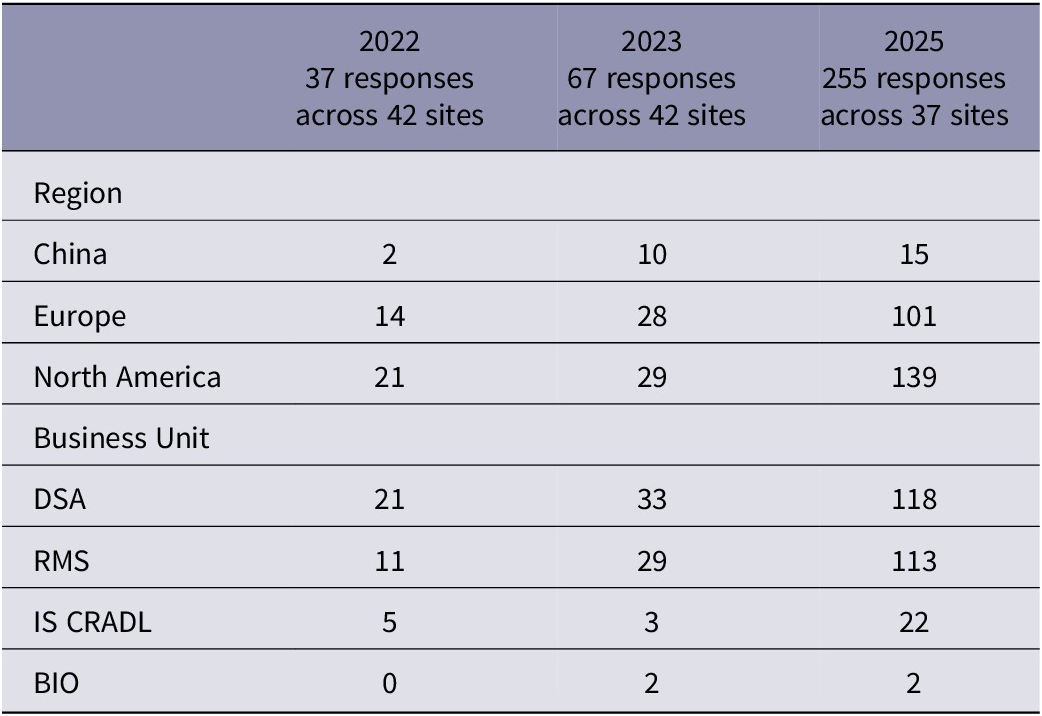
Survey responses are provided in Table 2.
Total survey responses for 2022, 2023, and 2025, including total responses and number of sites, as well as responses by region and business unit. DSA: Discovery and Safety Assessment, drug research, development, and safety testing; RMS: Research Models and Services, commercial breeding; IS CRADL: Insourcing Solutions, management and staffing support, and CRADL contract vivarium; BIO: Biologics, biologics testing and analytical services

Table 2. Long description
Survey responses increased from 37 responses across 29 sites in 2022, to 67 across 42 sites in 2023, and 255 across 37 sites in 2025. Most responses came from North America and Europe. DSA and RMS were the largest business units represented in all years.
Handling methods: Mice
For the 2022 survey, 81% (30/37) of sites used tail handling to some extent with mice. Handling methods were different based on group of mice handled (Figure 2). There was a difference in tail handling based on animal group (χ2 = 11.761; df = 3; P = 0.008). Tail handling was the predominant method for young, adult mice and older and/or less handled mice. Infant and juvenile mice were tail handled the least (estimate: –0.969, SE: 0.354; P = 0.006), being primarily body handled. There were no regional or business unit differences in tail handling for mice in 2022 (P > 0.05).
Handling methods used for mice (Mus musculus) in 2022 by animal group (37 responses), prior to starting the refined handling initiative (respondents could select all methods that applied).

Figure 2 Long description
Tail handling was most common for young adult mice (81%) and older and/or less handled mice (78%). Infant and juvenile mice were more often body handled. Tunnel or device use ranged from 24% to 38%. Multiple handling methods could be selected.
In 2023, tail handling was still the primary method of handling young adult mice and older and/or less handled mice (Figure 3). There were no regional or business unit differences for tail handling mice in 2023 (P > 0.05), but animal group had an effect (χ2 = 15.11; df = 3; P = 0.002) with infant and juvenile mice (estimate: –1.023, SE: 0.364; P = 0.005) and pregnant mice (estimate: –1.073, SE: 0.398; P = 0.007) being tail handled less. There was a regional difference in using refined handling methods in 2023 (χ2 = 13.158; df = 2; P = 0.001), with North American sites being less likely to use refined handling as their primary handling method compared with the other regions (estimate: –1.041, SE: 0.356; P = 0.003). There were no business unit differences in refined handling for mice in 2023 (P > 0.05).
Handling methods used for mice (Mus musculus) in 2023 (67 responses) and 2025 (255 responses) by animal group, comparing whether animals were majority tail handled (> 51% tail handling) or majority refined handled (> 51% cup and/or tunnel handling).

Figure 3 Long description
Refined handling increased across all mouse groups from 2023 to 2025, becoming the primary method in roughly 74% to 80% of responses by 2025. Majority tail handling declined in all groups, especially young adults and older and/or less handled mice.
In 2025, refined handling was the primary method of handling for all groups of mice (Figure 3). There were no regional or business unit differences in using tail handling (P > 0.05). There were animal group differences (χ2 = 8.126; df = 3; P = 0.043), with infant and juvenile mice (estimate: –0.811, SE: 0.318; P = 0.011) and pregnant mice (estimate: –0.587, SE: 0.297; P = 0.048) being tail handled less than the other animal groups. There were no regional, business unit, or animal group differences in using refined methods in 2025 (P > 0.05).
Handling methods: Rats
For the 2022 survey, 79% (23/29) of sites used tail handling to some extent with rats (meaning that it was indicated on the survey that tail handling was used with one or more groups of animals, counted as a binary yes or no), but body handling was the primary method of handling for all animal groups, indicated by a higher percentage of sites reporting using body handling over tail handling for each animal group. There were differences in handling method based on group of rats (χ2 = 15.116; df = 3; P = 0.002) (Figure 4), with tail handling being used most often with young adult and older and/or less handled rats. Infant and juvenile rats (estimate –1.749, SE: 0.542; P = 0.001) and pregnant rats (estimate: –1.056, SE: 0.410; P = 0.010) were tail handled the least. There were no regional differences in tail handling for rats (P > 0.05). The RMS business unit was more likely to use tail handling for rats (estimate: 0.787, SE: 0.319, P = 0.014) compared with the other business units (χ2 = 6.834; df = 2; P = 0.033).
Handling methods used for rats (Rattus norvegicus) in 2022 by animal group (37 responses), prior to starting the refined handling campaign (respondents could select all methods that applied).

Figure 4 Long description
Body handling was the most common rat handling method across all groups. Tail handling was used most with older and/or less handled rats (62%) and young adults (51%), and least with infant, juvenile, and pregnant rats.
In 2023, refined handling was the primary method for all animal groups (Figure 5). There was a business unit effect for tail handling rats (χ2 = 13.881; df = 3; P = 0.003), with DSA being less likely to use tail handling (estimate: –2.049, SE: 0.841; P = 0.015) compared to other business units. Similarly to 2022, there was an animal group effect (χ2 = 7.664; df = 3; P = 0.05), with infant and juvenile rats (estimate: –1.163, SE: 0.572; P = 0.042) and pregnant rats (estimate: –1.359, SE: 0.642; P = 0.034) less likely to be tail handled. There were no regional effects of using refined handling with rats in 2023 (P > 0.05).
Handling methods used for rats (Rattus norvegicus) in 2023 (67 responses) and 2025 (255 responses) by animal group, comparing whether animals were majority tail handled (> 51% tail handling) or majority refined handled (> 51% cup and/or tunnel handling).

Figure 5 Long description
Refined handling was the dominant method for all rat groups in both years and increased further by 2025. Tail handling was uncommon and declined to 1% to 7% of responses by 2025 depending on animal group.
In 2025, refined handling was again the primary method for all groups of rats (Figure 5). There were animal group differences (χ2 = 10.048; df = 3; P = 0.018) with infant and juvenile (estimate: –1.838, SE: 0.759; P = 0.016) and pregnant (estimate: –1.155, SE: 0.572; P = 0.043) rats being tail handled less, compared with young adult rats and older and/or less handled rats. There were no regional or business unit differences (P > 0.05).
Bite rate
The bite rates for mice and rats across the three surveys are presented in Figure 6. The reported number of people never or rarely bit increased for each year of the survey for mice and rats. However, people being bitten often by mice increased to 7% in 2025 from 5% in 2022 and 2% in 2023. The people being bitten often by rats also increased from 0% in 2022 to 2% in 2023 but returned to 0% in 2025. There were no regional or business unit differences in bite rate (P > 0.05).
Bite rate data for mice (Mus musculus) and rats (Rattus norvegicus) across surveys, presented as percentage of responses.

Figure 6 Long description
Handlers reporting they were never or rarely bitten increased from 2022 to 2025 for both species. Rat bite frequency declined substantially. Mouse bites generally declined, although a small proportion reported being bitten often in 2025.
Employee opinions regarding refined handling techniques
At the start of the refined handling initiative in 2022, 95% (36/38) of participants indicated that employees had heard of refined handling. When asked if refined handling could be implemented at their facility, 4% (16/38) indicated yes; 34% (13/38) were unsure; and 21% (8/38) believed it was already implemented. Only 1 response said no, stating “volume of animals, time constraints” as the reason why not. There were no regional or business unit differences in questions related to refined handling implementation (P > 0.05). In 2023, when asked if there was a plan to phase out tail handling, 48% indicated yes for rats and 55% indicated yes for mice. There were no regional or business unit differences in plans to phase out tail handling in 2023 (P > 0.05).
The main challenge experienced or anticipated by employees for refined handling in 2022 was that it would take too much time (71%; 26/38). Other responses are summarised in Figure 7(a). There were no regional or business unit differences in experienced or anticipated challenges (P > 0.05). In 2023, the main challenge experienced or anticipated by employees and managers was also that it would take too much time (66%; 44/67). Other responses are summarised in Figure 7(a). There were regional differences. Personnel based in Europe were less likely to indicate that not enough training was provided (estimate: –2.473, SE: 1.121; P = 0.027; χ2 = 8.902; df = 2) and or to have biosecurity concerns (estimate: –2.741, SE: 1.321; P = 0.038; χ2 = 8.401; df = 2), compared with sites in North America and China. There were also business unit differences in responses, with DSA sites less likely to report inability to see animals well (because of the addition of a tube to the home cage) as a challenge compared with the other business units (estimate: –2.847, SE: 1.416; P = 0.044; χ2 = 16.258; df = 3).
Experienced or anticipated challenges of implementing refined handling, based on (a) 2022 (n = 37) and 2023 (n = 67) not asked by species and (b) 2025 (n = 255) by species survey responses.

Figure 7 Long description
In 2022 and 2023, the most common anticipated challenge was increased time. In 2025, the main challenges were muscle memory, additional time requirements, and concerns related to bites, visibility, or training. Responses differed somewhat between mice and rats.
In 2025, muscle memory (55%, 97/175 for mice; 67%, 75/112 for rats) and additional time requirements (61%; 107/175 for mice; 49%; 55/112 for rats) were the main challenges personnel had experienced transitioning to refined handling. Other responses are summarised in Figure 7(b). There were regional differences with personnel in Europe (estimate: –1.026, SE: 0.401; P = 0.011; χ2 = 11.119; df = 2) and North America (estimate: –1.410, SE: 0.418; P < 0.001; χ2 = 11.119; df = 2) less likely to report that refined handling was awkward to use in isolators compared with personnel in China. Personnel in Europe were more likely to report that refined handling was difficult to learn (estimate: 1.501; SE: 0.749; P = 0.045; χ2 = 12.269; df = 2) compared to personnel in North America and China. There were species differences, with personnel working with rats less likely to report inability to see animals well (estimate: –0.623, SE: 0.294; P = 0.034; χ2 = 4.876; df = 1) and experiencing more bites (estimate: –0.745, SE: 0.296; P = 0.012; χ2 = 7.076; df = 1) as challenges. There were no business unit differences in survey responses (P > 0.05).
In 2023 and 2025, participants were asked what resources offered had been most useful in learning more about refined handling. In 2023, the top response was the virtual workshop (24%; 16/66), followed by iConnect page (17%; 11/66), and videos (12%; 8/66). There were no regional or business unit differences (P > 0.05). In 2025, the most useful resources are summarised in Figure 8. The top useful resources were on-site training (77%; 195/255) and ability to practise on live animals (60%; 150/255). There were regional differences in that personnel in Europe (estimate: –1.667, SE: 0.498; P = 0.001; χ2 = 20.004; df = 2) and North America (estimate: –2.441, SE: 0.540; P < 0.0001; χ2 = 20.004; df = 2) did not find discussions with other sites as useful as personnel in China. There were no business unit differences (P > 0.05).
Training and other resources that were reported as useful by employees after implementing refined handling, as reported in the 2025 survey (n = 255).

Figure 8 Long description
On-site training was rated most useful (77%), followed by opportunities to practice on live animals (59%). Discussions, videos, workshops, online training materials, and webinars were selected less frequently.
In addition to asking what resources were useful for successfully implementing refined handling in 2023 and 2025 after the initiative was started, employees were also asked what resources would be needed to implement and/or maintain refined handling. The resources developed and used to implement or maintain refined rodent handling across the three surveys are presented in Figure 9. In 2022 and 2023, the top selected resource participants needed to implement refined handling as the primary method of handling at their facility was in-person hands-on training (2022: 60%, 22/37; 2023: 57%, 38/67) followed by on-demand training (2022: 34%, 12/37; 2023: 37%, 25/67). In 2023, personnel in Europe were less likely to need more evidence about refined handling compared with personnel in North America and China (estimate: –1.984, SE: 0.894; P = 0.027; χ2 = 6.633; df = 2). There were no business unit differences (P > 0.05) in needed resources to implement refined handling. In 2025, hands-on training was again the preferred resource to maintain refined handling (69%; 131/189). Personnel in Europe (estimate: –1.816, SE: 0.498; P = 0.0002; χ2 = 14.033; df = 2) and North America (estimate: –1.854, SE: 0.514, P = 0.0003; χ2 = 14.033; df = 2) were less likely to indicate that on-demand trainings were needed compared with those in China. Personnel in Europe (estimate: –1.629, SE: 0.468; P = 0.001; χ2 = 11.326; df = 2) and North America (estimate: –1.386, SE: 0.468; P = 0.003; χ2 = 11.326; df = 2) were also less likely to state that more evidence was needed compared with personnel in China. There were no business unit differences (P > 0.05).
Resources that participants reported were needed to start to implement and/or maintain refined handling, as reported in the 2022 (n = 37), 2023 (n = 67), and 2025 (n = 255) surveys during the transition to refined handling.

Figure 9 Long description
Hands-on training was the most commonly requested resource in all survey years. Other resources included on-demand training, additional evidence, group discussion, one-on-one discussions, and live virtual workshops.
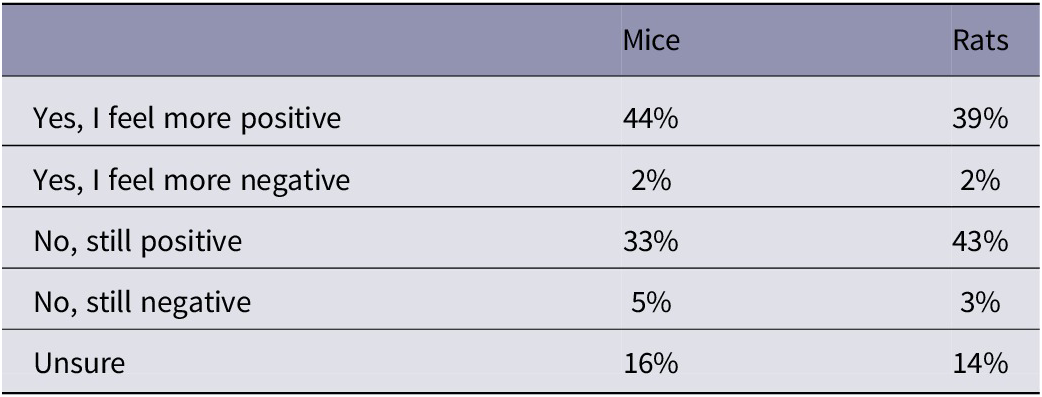
In 2025, personnel were asked if and how their feelings towards refined handling had changed. The majority of personnel felt positively about refined handling; with 44 and 39% saying they feel more positively about refined handling for mice and rats, respectively, and 33% for mice and 43% for rats saying their feelings had not changed, they still feel positively about refined handling. Only 7% for mice and 5% for rats stated they feel negatively about refined handling. The full results are presented in Table 3. There were no species, regional, or business unit differences in response (P > 0.05).
The 2025 responses (n = 255) to if and how participants’ feelings towards refined handling had changed, presented for mice (Mus musculus) and rats (Rattus norvegicus)

Table 3. Long description
Most respondents reported positive views. For mice, 44% felt more positive and 33% remained positive. For rats, 39% felt more positive and 43% remained positive. Only 2% to 5% reported negative views, with 14% to 16% unsure.
Personnel were also asked what effects refined handling had on their job. The responses for mice and rats are presented in Figures 10(a) and (b), respectively. For mice, ease of working with animals and relationship with animals improved with refined handling (≥ 50% indicated much better or better). The aspect of their job that worsened was work speed (32% selecting worse or much worse). For rats, ease of working with animals, job stress, relationship with animals, and job satisfaction all improved with refined handling (≥ 50% indicated much better or better). Similar to mice, work speed was the main aspect of their job that was perceived to worsen (18% selecting worse or much worse). There were regional differences in response. Personnel in Europe were less likely to say that ease of working with animals (estimate: –1.885, SE: 0.699; P = 0.007; χ2 = 7.895; df = 2), job ease (estimate: –1.234, SE: 0.442; P = 0.005; χ2 = 8.035; df = 2), and sample collection/procedures (estimate: –1.792, SE: 0.647; P = 0.006; χ2 = 8.677; df = 2) were perceived to be worse with refined handled compared with personnel in the North America and China. Personnel in North America were less likely to indicate that job stress improved (estimate: –0.655, SE: 0.27; P = 0.015; χ2 = 10.194; df = 2) compared with those from Europe and China. Personnel in Europe (estimate: –2.953, SE: 0.888; P = 0.001; χ2 = 14.533; df = 2) and North America (estimate: –1.382, SE: 0.616; P = 0.025; χ2 = 14.533; df = 2) were less likely to indicate that job satisfaction became worse, compared with those from China. Additionally, personnel in Europe (estimate: –1.007, SE: 0.342; P = 0.003; χ2 = 8.582; df = 2) and North America (estimate: –0.626, SE: 0.319; P = 0.049; χ2 = 8.582; df = 2) were less likely to indicate that work speed became worse compared with personnel in China. There were also differences based on species. Personnel working with rats were less likely to say job ease (estimate: –0.572, SE: 0.268; P = 0.033; χ2 = 4.798; df = 1) and work speed became worse (estimate: –0.555, SE: 0.202; P = 0.006; χ2 = 7.889; df = 1) compared with personnel working with mice. There were no business unit differences (P > 0.05). In 2025, 69% of respondents indicated that they saw the benefits of refined handling with rats, and 67% indicated this for mice. There were no regional or business unit differences in whether personnel saw the benefits of refined handling (P > 0.05).
The perceived effects of refined handling on working with (a) mice (Mus musculus) and (b) rats (Rattus norvegicus), based on employee responses in the 2025 survey (n = 255). Responses of “much better” and “better” were combined into “better”, as well as responses of “worse” and “much worse” were combined into “worse”.

Figure 10 Long description
Most respondents reported improved relationships with mice (67%) and easier work with animals (60%). Job satisfaction and stress improved for many respondents. Work speed was the area most often reported as worse (32%).; Relationships with rats (71%), ease of working with animals (64%), job satisfaction (53%), and job stress (50%) were commonly reported as improved. Work speed was the most frequently reported negative impact but affected a minority of respondents (18%).
For the qualitative analysis, there was a shift in sentiment towards refined handling from 2022 to 2025. In 2022, there were a total of 15 open-ended responses. Two responses had a positive sentiment (positive or very positive) towards refined handling, while six responses were neutral, and seven responses were negative (negative or very negative). The positive responses were related to animal welfare, human-animal relationships, and handler safety. The negative responses included themes related to fears about handler and animal safety, loose and escaped animals, resources (i.e. having enough tunnels), time, and reluctance towards adopting the technique. The negative responses were primarily from North America (10) with one from China, with the majority of negative responses from DSA. In 2023, there were nine total open-ended responses, of which three were positive responses towards refined handling, four were neutral responses, and two were negative. The positive responses were again related to animal welfare and human-animal relationships. The negative responses were related to concerns about training, evidence of benefits for the animals, time to implement, reluctance of employees to change their techniques, and cost for purchasing tunnels. Both negative responses were from North America and DSA. In 2025, there were 19 open-ended responses, 10 positive responses toward refined handling, 8 neutral, and one negative. The one negative response was from North America and IS CRADL. The positive responses were related to animal welfare, efficacy, animal response, and human-animal relationships. The negative response was related to animal welfare, specifically mentioning “chasing the animal around the cage until it can be cupped or placed into a tunnel” and refined handling taking longer, which indicates poor refined handling technique and potential need for retraining of personnel.
Additionally, open-ended responses indicated differences in attitude towards refined handling based on species at the beginning of the initiative. Open-ended responses from the 2022 survey indicated differences in perception based on the species: “rats – prefer not grabbing by the tails because it increases their propensity towards aggression. Body handling is preferred method for rat handling. Mice – tail handling is the preferred method for mouse handling due to mice activity levels”; “I don’t pick up rats by the tail, most of them are way too heavy and it would hurt them. As for the mice, I did not know it was an issue”; “Picking up the rat by the tail is an outdated technique and we are aware of the benefits of using other technique for the animal comfort. For the mice, the tail method is used as long as the animal is not suspended but supported by the hand or the base of the tail is used.” Species-related comments were not a key theme in subsequent surveys.
Discussion
In 2022, a global CRO launched a major animal welfare initiative to implement refined handling practices for mice and rats across all company business units, including facilities across 11 countries. Change management strategies were implemented to achieve widespread adoption of refined handling, with 100% of sites using refined handling practices by 2025, detailed in O’Malley et al. Reference O’Malley, Paterson, Kylie, Thurston, Tambadou, Ekundayo, Puoliväli, Collymore and Turner2026 (in press). This paper presents data from three surveys conducted throughout the initiative to capture changes in handling practices, employee attitudes towards refined handling, perceived utility of education and training resources, and effects of refined handling on employee job.
At the beginning of the refined handling initiative (2022), tail handling was prominently used with mice. This is similarly reflected in populations outside of this CRO, with data collected in 2021 showing tail handling is widely used with mice (Young et al. Reference Young, Goldsteen, Nunamaker, Prescott, Reynolds, Thompson-Iritani, Thurston, Martin and LaFollette2023). Body handling was primarily used with rats, showing a species difference at the beginning of the initiative. Despite little evidence on preferred handling methods in rats, handlers opted for body handling (vs tunnel handling). Similar results were reported in previous surveys on handling methods with rats, where various forms of body handling (i.e. shoulder saddle and chest-and-bottom support) were more common than tail handling (Burn et al. Reference Burn, Camacho and Hockenhull2023). This was additionally reflected in the open-ended responses, where personnel recognised tail handling as aversive to rats but did not feel the same about tail handling in mice. For both mice and rats, young adults and older and/or less handled animals were most likely to be tail handled in all three surveys. By 2025, the percentage of animals in these groups being handled by the tail decreased to 14% for young adult mice, 25% for older and/or less handled mice, 3% for young adult rats and 7% for older and/or less handled rats, respectively. Young adult mice and rats were sometimes considered difficult to handle due to being quick and “jumpy”. This is reflected in previous survey work, where 50% of participants believed that for some strains of mice, refined handling is not possible and tail handling is necessary (Young et al. Reference Young, Goldsteen, Nunamaker, Prescott, Reynolds, Thompson-Iritani, Thurston, Martin and LaFollette2023). Personnel were advised to use two-handed body or cup handling or to use a tunnel for these groups of animals. Older and/or less handled animals were reported to be more likely to bite, which is why personnel opted for tail handling. This trend was also reported from external populations of rat handlers based on qualitative analysis of why different handling methods are selected (Hockenhull et al. Reference Hockenhull, Camacho and Burn2026). For mice, a tunnel was recommended to add protection for the handler. Tunnel handling could be effective for rats as well to reduce bites (Burn et al. Reference Burn, Camacho and Hockenhull2023; Hockenhull et al. Reference Hockenhull, Camacho and Burn2026), although increased stress for tunnel handling has been reported for rats, which should be further investigated (Kylie et al. Reference Kylie, Cooper, Kurpinski, Chase, Muzyka and Plachta2024). For rats, a 15-min training short was developed from a site with experience working with fractious rats, advising employees on how to habituate animals to handling, including approach to avoid animal startling, and for certain aggressive populations, wearing bite gloves to help handlers feel more confident.
Bite data were collected to address occupational health and safety concerns about injuries and personnel safety. This concern was reflected in previous surveys conducted on mouse handling by 14% of participants (Young et al. Reference Young, Goldsteen, Nunamaker, Prescott, Reynolds, Thompson-Iritani, Thurston, Martin and LaFollette2023) and was one of the most common concerns reflected by rat handlers as well (Burn et al. Reference Burn, Camacho and Hockenhull2023; Hockenhull et al. Reference Hockenhull, Camacho and Burn2026). The bite rate data collected as part of the current study reflected that implementing refined handling resulted in fewer bites, with people never or rarely getting bitten increasing from 52% in 2022 to 68% in 2025 for mice, and from 59% in 2022 to 90% in rats. However, there was an increase in personnel often getting bitten by mice, increasing from 5% in 2022, to 2% in 2023, to 7% in 2025. In rats, bite rate fluctuated as well, from 0% in 2022, to 2% in 2023, and back to 0% in 2025. Increased bite rate in a small population of personnel may reflect a learning curve as refined handling was being implemented, reflecting poor technique as handlers practised and received feedback. One open-ended response reflected this: “People that tend to struggle handling mice end up chasing the mouse around the box with the tunnel even though they were trained not to and then get the mouse worked up. At this point they either get bit, give up because it’s taking too much time, or they lose the mouse on the bank” (i.e. bank refers to cage rack). During training for refined handling, it is important to communicate to personnel signs of fear and stress to watch for in mice and rats so that they can adjust their practices based on animal response, improve handling practices, and reduce risk of injury to themselves and the animals. However, as the survey responses were voluntary and therefore reflected personal reflections of bites, rather than true reported number of bites, further research would be needed to better understand the impacts of handling method on bite rate, while controlling for other factors, such as handler experience level.
Regional differences were noted in the survey responses. In the qualitative analysis of open-ended responses, most of the negative responses toward refined handling came from personnel in North America, particularly from US DSA (discovery and safety assessment) sites. This was also reflected in the 2023 survey, in which it was noted that facilities in North America were less likely to have adopted refined rodent handling practices and were more likely to say more evidence is needed on refined handling. This contrasts with data collected in 2021 from external rodent handlers, where the US reported higher use of refined handling; however, the population was 79% from the US, with fewer participants from Europe and Canada which could have skewed the results (Young et al. Reference Young, Goldsteen, Nunamaker, Prescott, Reynolds, Thompson-Iritani, Thurston, Martin and LaFollette2023). Personnel in China also stated more evidence was needed in the 2023 and 2025 surveys. Negative attitudes towards refined handling from personnel in North America seemed to have been resolved by the 2025 survey with no regional differences in handling method identified, and despite personnel from China stating more evidence is needed, there were no differences in handling methods in China in 2025, showing uptake of refined handling similar to the other regions. Other regional differences included personnel in North America and China having biosecurity concerns with refined handling and personnel in China saying refined handling is awkward to use in isolators and wanting more on-demand trainings. Most of the CRO’s facilities in China are RMS (i.e. rodent breeding) facilities, meaning personnel at these facilities have a different scope of work, often working at a fast pace due to the large volume of animals being processed for customer orders. RMS personnel also work in barrier rooms or isolators therefore biosecurity would be a big concern for that population. RMS personnel also do not have regular access to computers due to being in barrier rooms, meaning they are less likely to engage with live virtual educational opportunities, such as webinars, making on-demand training a preferred option. The on-demand training materials were translated and reviewed by native speakers, possibly making them more useful to non-English speakers as well. There were some other business unit differences, with RMS personnel more likely to use tail handling in rats in 2022. Again, this is due to work with large volumes of animals including sexing, weighing, and packing animals for customer orders. Anecdotally, RMS personnel reported tail handling as being easier to allow them to handle and reliably sex the animals more easily, speeding up work processes. However, over the three-year time-frame of the project, RMS personnel were able to adapt to a one-handed cupping technique for mice and rats to allow similar processing time. DSA personnel were less likely to state inability to see animals well as a challenge of including a tunnel in the home cage, due to less of a need to quickly assess animals and because they had fewer animals observe every day compared with RMS personnel.
Generally, most personnel felt positively about refined handling following the initiative, as reflected in the 2025 survey, either changing their opinions on it and feeling more positive after implementing refined handling, or stating they still feel positive. The benefits of refined handling were seen as having a better relationship with the animals and improved ease of working with the animals for mice. For rats, additional benefits were improved job satisfaction and improved job stress. This is also reflected in the change in sentiment in the open-ended responses, where personnel who felt positively about refined handling mentioned human-animal relationships and animal welfare. Similar comments were provided in qualitative analyses on the positive impacts of refined handling, where participants stated improved job satisfaction and job ease, and decreased stress for animals and handlers (O’Malley et al. Reference O’Malley, Hubley, Moody and Turner2022). Few personnel felt negatively about refined handling in 2025. For those that did, work speed was the primary area that got worse with refined handling (31% for mice; 19% for rats). The main challenges with implementing refined handling were related to increased time to complete tasks, the cost of purchasing tunnels, and training personnel on new handling techniques, similar to what has been reported in other studies on people’s attitudes towards refined handling (Henderson et al. Reference Henderson, Smulders and Roughan2020b; O’Malley et al. Reference O’Malley, Hubley, Moody and Turner2022; Young et al. Reference Young, Goldsteen, Nunamaker, Prescott, Reynolds, Thompson-Iritani, Thurston, Martin and LaFollette2023; Hockenhull et al. Reference Hockenhull, Camacho and Burn2026).
Assessing handling practices through site surveys is convenient for gauging general information and important for soliciting feedback that can allow for targeted training and communications to address employee needs and concerns, particularly related to region and business unit.
Study limitations
However, there were limitations to the surveys. For the first two surveys, facilities were asked to provide at least one response per facility but could provide more responses to reflect differences in practices between departments. Some facilities submitted multiple responses while others only submitted one. The personnel submitting the response were often site management, attending veterinarians, or facility trainers, rather than personnel in each animal room, and the surveys were not anonymous. Thus, the survey responses might not have fully reflected what was happening facility-wide for handling practices, as well as perceived or anticipated challenges, needed resources, and bite data. The responses for the first two surveys could reflect personal bias rather than a true reflection of practices and attitudes. Facilities reported recidivism through the process (and this was anticipated), in which it was believed that all animal handlers were using refined handling practices, but in-person room-level observations indicated that some personnel were still tail handling. In the 2025 survey, the aim was to cascade the survey to all rodent handlers to get a truer sense of handling practices and reflections on the transition to refined handling to address these limitations. Based on number of responses across the three surveys, the 2025 survey captured the experiences of more personnel working hands-on with rodents compared with previous surveys, but engagement may still have been affected by response bias towards those who either felt positively or negatively about refined handling and/or those more likely to engage in digital solicitation.
Animal welfare implications
Refined handling methods with mice and rats lead to improved animal welfare. One of the main challenges with promoting refinements is employee support, training, and sustained implementation. Monitoring employee attitudes, challenges, and needed resources around refined handling over time showed that through targeted communications and training, personnel can adopt new practices that benefit animal welfare and human-animal relationships.
Conclusion
The work presented here reflects a four-year refined handling initiative within a global contract research organisation, to better understand rodent handling practices, including challenges, resources, and attitudes across business purpose and regions as personnel transitioned to using refined handling methods. Additional information about this initiative are reported in O’Malley et al. Reference O’Malley, Paterson, Kylie, Thurston, Tambadou, Ekundayo, Puoliväli, Collymore and Turner2026 (in press). The multiple surveys implemented as part of monitoring change management over three years demonstrated that based on targeted efforts to implement refined handling with mice and rats, refined handling became the default handling method across animal groups, with self-reported animal bite rates decreasing for both mice and rats, and employees reporting that ease of working with animals and their relationship with the animals improved after implementing refined handling. In-person training and resources, followed by readily accessible virtual training and visual aids were the most useful tools to implement and maintain refined handling mice and rats. The main challenges were muscle memory (i.e. automatic procedural memory related to motor skills) and increased time to complete tasks as a result of learning a new handling method. The surveys demonstrated that were differences in implementing refined handling strategies based on region, business unit, and species, suggesting that different resources and strategies may be needed to successfully transition to refined handling. Collecting feedback at different timepoints throughout the project allowed the global animal welfare group to adjust training resources and tools to ensure success.
Supplementary material
The supplementary material for this article can be found at http://doi.org/10.1017/awf.2026.10130.
Acknowledgements
The authors would like to thank the employees at Charles River who contributed to the surveys and implemented refined handling.
Competing interests
None.






 Open access

