“The special train of German technology in the Sudentengau demonstrates that . . . the German engineer is also a great activist and propagandist.”
Fritz Todt in Eger, November 24, 1938Punctually at 4:05 on the morning of March 31, 1938, a new diesel locomotive left the Holzkirchen Bahnhof in Munich, pulling the first traveling “achievement exhibition” (Leistungsshau) of German technology.Footnote 1 It had been nineteen days since the Anschluss, and on April 10 all Greater Germany would vote its approval of incorporating Austria into the Reich. Despite their use of terror to influence the Austrian vote and virtual assurance of electoral success, the National Socialists embarked on an extensive propaganda effort in Austria to ensure a wide margin of victory there. Hitler campaigned throughout Austria during the last ten days before the vote, making six major speeches, and other top Nazi officials made electioneering tours.Footnote 2 Famous for constructing the Autobahn network, Fritz Todt, Inspector General for German Highways, and the engineers of the NSDAP Central Office for Technology, organized a traveling propaganda exhibit to display German technology under the motto “Austria's chimneys will smoke again.”Footnote 3 It was the first of three “Voyages of Technology” undertaken by Todt and his Nazi engineers.
Although only minor episodes in the history of the Third Reich, these voyages of technology are significant for a number of reasons. In the decades since the publication of Karl-Heinz Ludwig's classic study of Nazi engineers, much has been written on the “coordination” of German engineers, the role of engineers in Nazi projects ranging from Autobahn construction to wartime “wonder weapons,” and the place of technology in Nazi ideology.Footnote 4 It is now evident that Nazi ideology embraced modern technology and that engineers such as Gottfried Feder and Fritz Todt sought to use party institutions to control the German professional engineering societies while seeking enhanced status and political power for engineers in the Third Reich. It has also become apparent that this Deutsche Technik ideology varied considerably in nature and influence under the diverse leadership of Feder, Todt, and Albert Speer.Footnote 5 Historian Thomas Klepsch has described Nazi ideology as having a racist, anti-Semitic, anti-Bolshevik “gravitational core,” with other peripheral elements as “satellites” whose importance was pragmatically determined by historical circumstances.Footnote 6 Deutsche Technik was just such a peripheral ideological element, whose orbit drifted near and then away from the active core of Nazi beliefs.Footnote 7 These voyages of technology took place when Deutsche Technik was at its most influential, coming as they did after the so-called “Reordering of Technology” in 1937—which brought the German engineering professions under tighter party control—and prior to the restrictions placed by the war, and particularly Albert Speer, on spreading Todt's ideology.Footnote 8 They provide a specific example of “reactionary modernism” at its zenith, clarifying the role that Nazi engineers assigned for technology in Nazi society.Footnote 9 These little-known exhibitions are one of the best examples we have of Nazi engineers serving as propagandists, carrying their message directly to the public. In short, they demonstrate Deutsche Technik in practice.
The voyages of technology should be seen in the context of recent historical research that explores how Nazi propaganda appealed to the German population and transformed values during the Third Reich. Claudia Koonz has shown how Nazi propaganda helped to form an “ethical” consensus among Germans willing to eliminate those perceived as threatening the well-being of the nation.Footnote 10 Similarly, Jeffrey Herf has demonstrated how wartime Nazi propaganda successfully branded the Jews as enemies who desired the destruction of Germany and who were responsible for World War II.Footnote 11 David Welch has argued that Nazi “national community” (Volksgemeinschaft) propaganda was more effective than often assumed in providing social integration and stability.Footnote 12 Peter Fritzsche has described how ideology and propaganda helped “racially groom” Germans to see the world in racial terms.Footnote 13 Certainly Volksgemeinschaft propaganda reinforced the exclusion of all those considered “community aliens” (Gemeinschaftsfremde).Footnote 14 Key to these studies is an appreciation that Nazi propaganda had a very real impact on the German population and that the concept of an egalitarian Volksgemeinschaft, united by race and Nazi values, was an attractive ideal for many Germans. It was an ideal that, as Jill Stephenson and Norbert Frei have written, was left unfulfilled and lost its attraction amid the sacrifices of the war.Footnote 15 These voyages of technology illustrate how Nazi engineers used propaganda in the prewar period to convert their “Volk comrades” to a positive acceptance of modern technology. Nevertheless, when Todt and his engineers sought greater influence on German foreign policy, the canceling of a further voyage to eastern Europe suggests that the regime and its plans for conquest placed limits on the use of technology as propaganda.
Growing out of the “history of the everyday” methodology of the 1980s, historians now emphasize that a key component within Nazi propaganda was its appeal to nascent consumerism in Germany—even though, due to the regime's fiscal restraints and investment in rearmament, it was “Volksgemeinschaft on a budget.”Footnote 16 Wolfgang König has detailed how, despite often limited diffusion, “Volksproducts” such as the radio (Volksempfänger), refrigerator (Volkskühlschrank), and Volkswagen combined Nazi propaganda and “consumer society” policies.Footnote 17 While denying its “ecological” nature, Thomas Zeller has placed the Nazi Autobahn in the context of a “racially defined emerging consumer society,” a concept reinforced by Shelly Baranowski's description of how the “Strength through Joy” organization substituted nonmaterial rewards and experiences for true mass consumption.Footnote 18 As Jonathan Wiesen puts it in his recent analysis of commerce in the Third Reich, economic difficulties “did not dispel popular visions of a thriving consumer marketplace.”Footnote 19 According to Paul Betts, such studies show that the regime's inability to make good on its promises in no way detracted from the symbolic importance of these socioeconomic projects. He argues that “dreams of deferred gratification and postwar affluence” only became more intense with Nazi limitations on consumer spending and wartime sacrifices.Footnote 20 This process is best summarized by Peter Fritzsche, who notes that “it was not so much durables as the promise of prosperity that was consumed.”Footnote 21 The voyages of technology are an example of how Nazi propaganda not only addressed economic anxiety but also reinforced consumerist aspirations.
Press releases and unpublished communications aboard the trains offer a unique glimpse into the mind-set of Nazi engineers, particularly their overt anti-Semitism, which stands in stark contrast to the traditional picture of the “apolitical” engineer and lends credence to the argument that it was anti-Semitism that linked Nazi technical thought to the other core elements of Nazi ideology.Footnote 22 Anti-Semitism was overtly expressed in the propaganda disseminated on these traveling exhibitions and marks Fritz Todt, the Nazi engineers, and their ideology as more far more openly anti-Semitic than the picture painted many years ago by Thomas Parke Hughes, who labeled Todt an “acquiescing auditor” who drew back from “explicit anti-Semitism.”Footnote 23 Deutsche Technik was undoubtedly anti-Semitic in character.
Last, the Nazi technical ideology, as articulated on these voyages, is directly relevant to the endless, vast debate on Nazi “modernization.”Footnote 24 Whether one is convinced that the Nazis were conscious modernizers or is skeptical of the whole enterprise of applying modernization theory to National Socialism, one can observe here the specific manner in which Nazi engineers presented modern technology to the public. With the bombast typical of Nazi propaganda in general, they transformed rhetoric aimed at politicizing German engineers themselves—in courses given at the “Reich School for Technology” on the Plassenburg and articles in the party “techno-political” journal Deutsche Technik—to appeals for public support, presenting modern technology as essential to the economic and social well-being of the national community.Footnote 25 When it came to the Volksgemeinschaft, these Nazi engineers were both committed modernizers and fervent exclusionists.Footnote 26
This essay focuses on the propaganda used by Nazi engineers on the voyages of technology and makes no attempt to address the contradictions that may have existed between technological promise and the reality of its implementation in Austria or the Sudetenland. Numerous historians have pointed to examples of Nazi technical rhetoric not matching results, and there is no question that the Third Reich saw its share of technological failures, ranging from mass motorization—not a single Volkswagen was ever produced for private use—to its incapacity effectively to pursue an atomic bomb.Footnote 27 Similarly, we know that the Autobahnen were far from the economic panacea we will see portrayed in these voyages of technology.Footnote 28 The historical literature proves that Nazi technology often failed to achieve its stated aims, sometimes due to overriding economic and political priorities, sometimes as a result of the nefarious influence of a fundamentally irrational ideology. As Karl-Heinz Ludwig and Jeffrey Herf argued some time ago, the irrational strain in Nazi ideology certainly contributed to the inefficiency of the Nazi war effort.Footnote 29
We should be cautious, however, not to overemphasize the discrepancy between Nazi rhetoric and Nazi technical accomplishment, for the symbolic and psychological impact of Nazi ideology was often crucial. Autobahn construction, for example, while having little real impact on employment, nevertheless provided a lasting illusion of economic recovery and technological progress.Footnote 30 Recent scholarship has shown the absolute centrality of Nazi ideology to the evolution of life in Nazi Germany. Ranging from its effect on workers to its formative influence among the Order Police, the SS security apparatus, and SS engineers, there is no longer any question that Nazi ideology altered the perceptions and behavior of many who lived under its sway.Footnote 31 Ideology was among the caustic mix of factors that led even basically nonideological “Pennemunders” to acquiesce in murderous criminality.Footnote 32 Indeed, Nazi ideology “worked its way into the most mundane corners of everyday life.”Footnote 33 These studies make clear that historians should systematically consider the ideological and symbolic implications of Nazi projects, as well as their actual implementation, when judging their influence. It is best to follow Adam Tooze's sage description of Nazism as an “ideological-pragmatic synthesis” in which the regime combined “ideological motivation with the pragmatic necessities of power.”Footnote 34 The voyages of technology display both aspects of this synthesis at work.
* * *
The Austrian Voyage of German Technology was officially a combined project of the Central Office for Technology of the Nazi Party, the NS League of German Technology (NS-Bund Deutscher Technik) which grouped together the principal German engineering associations, and the Office for Technical Science in the German Labor Front; the latter, however, took part little in its execution.Footnote 35 Fritz Todt participated from April 3-5, making speeches in Wels, Styr, Linz, and Salzburg and again on April 8 in Graz.Footnote 36 It was primarily the engineers of the Central Office for Technology, headed by Todt's deputy, Karl-Otto Saur, who made up the main traveling group, working, eating, and sleeping in the cramped quarters of the train for most of the ten-day journey—the source of good-natured friction among the participants.Footnote 37
Karl-Otto Saur, whom Albert Speer later self-servingly referred to as “not an agreeable fellow” (kein angenehmer Typ), and whom Adolf Hitler named in his testament as Speer's successor, was the epitome of the ambitious Nazi engineer.Footnote 38 Brusque of manner, caustic, and contemptuous of subordinates, Saur was nevertheless seen by other Nazis as an “organizer par excellence.”Footnote 39 He is infamous for later heading the “Fighter Staff” (Jägerstab) in Speer's Ministry for Armaments and War Production—an undertaking so intimately linked to Nazi genocide that his labor-hungry office maintained telephone contact with the ramp at Auschwitz where Hungarian Jews were selected for either work or execution.Footnote 40 Adam Tooze has described him as “pugnacious,” an “intemperate bully,” and a “fanatical slave-driver.”Footnote 41 Saur had become Todt's right-hand man by directing the “bringing into line” (Ausrichtung) of German engineering associations during the “reordering of German technology” in 1937.Footnote 42 Like Albert Speer, Saur had joined the NSDAP only in 1941.Footnote 43 Contrary to Todt or Speer, however, Saur projected the image of a classic Nazi “old fighter”: corpulent, abrasive, and openly anti-Semitic—hardly the common perception of the detached, “apolitical” engineer.
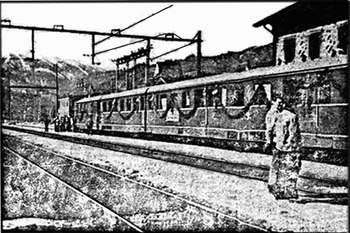
In addition to Saur, many of the leading engineers of the NSDAP Central Office for Technology participated in the Austrian voyage. Among them, Dr. Otto Streck, head of Technical-Political Education, was co-responsible for the exhibits; Dr. Flemming of the Press Office handled the press service; Link, in charge of the Office for Organization, was responsible for the travel; and Schneider, Central Office Treasurer, shared responsibility for financing, provisioning, and accommodations. Much of the propaganda during the voyage was penned by Josef Greiner.Footnote 44 In all, twenty-six individuals, including two secretaries, made up the entourage.Footnote 45 See Figure 1.
The Austrian Voyage Train. Source: Grazer Volkblatt, April 9, 1938, Bundesarchiv NS 14/5, folio 1; enhanced by Gaëlle Guse.

The traveling exhibition consisted of two trains: a diesel locomotive and cars and a second train pulled by a steam locomotive. As the trains were not purpose built, exhibition spaces were developed on the railway cars: in the diesel locomotive itself; in first-, second-, and third-class coaches; and in a sleeping car. Displays in the German Railway cars showed how new materials developed with the goal of economic autarky could provide both comfort and efficiency. Sheets and linen, curtains, upholstery, blankets, luggage racks, and carpeting were made of synthetic materials, ranging from cellulose to rayon to synthetic leather. The Linz newspaper Arbeitersturm delighted in the fact that “even the third-class wagon is upholstered”—upholstery whose source was not Australian sheep farms or American cotton plantations, but German forests.Footnote 46 Window and door frames were made of lightweight metal alloy, developed to replace the Reichsbahn's reliance on copper and brass.Footnote 47 Piping of sundry sorts was of synthetic rubber. Among other items exhibited were “silent” gears of synthetic resin and lightweight metal for Zeppelin construction.Footnote 48 In the towns where the train stopped for presentations, the engineers set up further displays with photographs, drawings, and models covering the whole range of Nazi activity, both technical and sociopolitical. Autobahn construction, models of the House of German Art in Munich and the Party structures in Nuremberg, “Winter Help,” “Strength through Joy,” “Labor Service,” and the “new Wehrmacht” were all featured.Footnote 49 The film “Adolf Hitler's Highways through Germany” was shown at various indoor and outdoor settings a total of sixty-six times to an estimated 75,000 viewers.Footnote 50
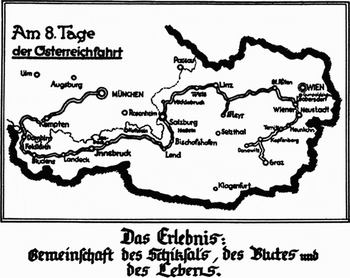
The itinerary for the Austrian voyage led from Vorarlberg into the Tyrol, to Upper Austria and the Salzburg region, from there across to Lower Austria, south to Styria, and then returned north, ending in Vienna.Footnote 51 In all, the train traveled approximately 2,200 kilometers, stopping for exhibitions in nineteen locations. If one accepts the Nazi's statistics, 132,000 people visited this “rolling achievement exhibition.” Among the propaganda materials handed out were 330,000 copies of the techno-political journal Rundshau Deutscher Technik; 262,000 photo-folios on the Labor Front's “Beauty of Work” program; 140,000 pamphlets about a planned “Beauty of Work” program for Austria; 65,000 printed likenesses of Hitler; and 55,000 swastika flags.Footnote 52 See Figure 2.
Map of the Austrian Voyage Itineary. The legend reads, “The Experience: Community of Fate, Blood, and Life.” Source: Bundesarchiv NS 14/5, folio 1; enhanced by Gaëlle Guse.

As the Austrian voyage wound its way through Vorarlberg and Tyrol, exhibits and speeches emphasized how German technology could reduce Austrian unemployment. Factories would be reopened and new jobs created, particularly by the extension of the Autobahnen into Austria. The Nazi engineers blamed the Schuschnigg government and, in Jenbach, Jewish factory owners, for closed factories and economic hardship: “Better times began for Jenbach as soon as Jewish domination ended.”Footnote 53 After joining the train on the third day in Wels, Fritz Todt continued on this theme. He argued that 15,000 Austrian workers could have already been employed on highway construction, had not the Austrian government rejected as “political highways” his earlier offer to extend the Autobahnen into Austria.Footnote 54 The next day in Steyr, Todt promised to end unemployment “in a few months,” principally through highway construction.Footnote 55 That night, in Linz, site of the Hermann-Goering-Works, Todt joked about what was to become, in effect, a point of dispute between Goering and himself: the distribution of workers between the Hermann-Goering-Works and Autobahn construction.Footnote 56 This emphasis on economic improvement through technology became even more pronounced as the train descended into the industrial region of Lower Austria. In Neunkirchen, engineers estimated that half of the men were out of work. Typical of the train's propaganda, one engineer reported that “yearlong suffering was etched into the face of nearly every visitor.”Footnote 57
Not only were press releases filled with pathos about economic conditions, but they also dwelt on the “suffering” of Nazi sympathizers, such as the mother whose son, having fled persecution by the Austrian authorities, died in Upper Bavaria.Footnote 58 The train personnel made continual reference to the supposed discrimination to which Austrian Nazis and their supporters had been subjected prior to the Anschluss. Enthusiastic response to the exhibits gave the false impression that depressed industrial communities had, overnight, changed their political color from red to brown. In Steyr, a community that the engineers regarded as having been “mostly communist” only a few weeks earlier, Todt warned that every missing vote would be a blemish on the residents.Footnote 59 No reference was made, even in the train's internal newsletter, to the brutal measures being taken throughout Austria to eliminate opposition to the Nazis.Footnote 60
Most of the technology on display was presented as strengthening the nation as a whole as opposed to benefiting individual households. Nevertheless, typical of Volksgemeinschaft propaganda, appeal was also made to potential consumerism—even if the public had little money to spend on technical innovations. The Nazi engineers commented repeatedly on what may have been true “astonishment” shown by visitors when seeing such new materials as fiberglass, Plexiglas, and synthetic rubber.Footnote 61 Greiner wrote that visitors in Linz could not believe that these “wonderful technical creations would now be at their disposal” or that German technology would improve their well-being to such an exceptional extent, a sentiment echoed in the local newspaper in Graz.Footnote 62 In Neunkirchen, hard hit by unemployment, “the proud achievements of German technology must have appeared to most people as an unbelievable luxury, in which they themselves hardly hoped to share.”Footnote 63 A stated purpose of the exhibits was to show the Volk that technology “makes work easier, multiplies efficiency, and brings the fulfillment of wishes and dreams closer.”Footnote 64 The local newspaper in Steyr echoed the train's propaganda: engineers would help to solve social problems, for “the machine has become a friend of the Germans.” No longer leaving men without bread, technology was now a “welcome and powerful helper” that would raise living standards higher and higher.Footnote 65 Thus the exhibits not only stressed technical prowess and its implications for employment, but also contained latent promise of future consumption and an improved life for Volk comrades.
In addition to smugness about German technological superiority, press releases from the train, particularly those of Josef Greiner, reflected the technical ideology espoused by Fritz Todt, namely a concern for “humanizing” technology and broadening contacts between technicians and laymen. After becoming the Third Reich's “chief engineer” following the demise of Gottfried Feder in 1934, Todt proposed a technical ideology that emphasized both politicizing German engineers and, at the same time, awakening the German public to the value of modern technology for the national community.Footnote 66 Technology would help to attain Volk harmony. The common interest between technicians and the general public would become evident by showing how technology served the entire community. A press release from the train entitled “Technology Found the People” put it this way:
This is the great revelation of this voyage: the direct path of technology to the people does not pass through technical schools, museums, or journals, but rather from heart to heart. Only when the mutual interests between the technician and the simplest worker and simplest housewife, the old man and the child, are made apparent does that which journals publish and museums display attain any true validity. Only when the people come to know the technician and what he wants through direct dialog, only when they themselves can hold the technically created object in their hands, will the spark of love and enthusiasm for technology be ignited.Footnote 67
To transform the status of technology, however, it was considered necessary first to transform the technician himself, creating a new political consciousness among engineers. The engineer was to become a more complete member of the Volk community by being drawn out of his narrow realm of specialization. His newfound consciousness would allow him to become a political being, actively striving toward the wider goals that the Führer established for the nation. Central to this process was indoctrinating the engineer in the new technical ideology, the outstanding example being “techno-political” courses held for engineers at the “Reich Castle for Technology,” the Plassenburg.Footnote 68 Consequently, the direct contact between technician and Volk experienced on the Austrian voyage not only informed the layman of the advantages of technology, but also had the reciprocal effect of creating true National Socialist technicians, or, more precisely, setting the example to be followed. Thus the same press release stated:
Earlier it would have been unthinkable for a technical-scientific organization to take part actively in election propaganda. Only out of the total conception of National Socialism, in which each individual not only works in his own specialty, but also on the realization of great political tasks, could this voyage be completed.Footnote 69
Not all German engineers accepted this National Socialist view of their role; several studies have demonstrated the limits of Nazi “coordination” of the German professions.Footnote 70 In the case of the Austrian voyage, at least the Association of German Chemists (VDCh) was highly reluctant to have their work translated into propaganda, particularly at the expense of falsifying statistics. As the voyage was being prepared, Dr. W. Foerst of the VDCh wrote to Dr. Flemming of the Press Office complaining strongly that he would not be pressured to produce statistics other than those provided by the Reich Delegate for Chemistry or the Economic Group Chemistry. To give unsubstantiated statistics, he argued, would be illegal, and any statistics used should be verified by the Office of Economic Improvement (Amt für Wirtschaftsausbau). He concluded that “We can make no election propaganda with export statistics in the chemical area, for they are mostly regressive.”Footnote 71
Once the distinction between the ideal envisioned by Nazi ideologues and its qualified acceptance by the engineering societies is made clear, however, and allowing for the exaggerations and pompous declarations emanating from the train, this propaganda nevertheless accurately reflected the National Socialist conception of technology as expressed by Fritz Todt and the engineers of the Central Office of Technology. Engineers were to take a prominent place in the national community. His values reoriented, the engineer would become an active, politically conscious comrade, benefiting from direct contact with the masses he served. Engineers became symbols of an acceptable, indeed desirable, modernity.
* * *
The apparent success of the Austrian voyage of technology as propaganda led to another traveling exhibit, under similar circumstances, into the Sudentenland between November 24 and December 4, 1938. Again the voyage was part of an election campaign for a plebiscite to approve annexation to the Reich. Coming nearly two months after the Munich conference and the arrival of German troops in the Sudentenland and four months before Hitler's triumphant arrival in Prague, the Sudenten Voyage, like its predecessor, presented German technology as an economic panacea and indispensible to the new National Socialist society. Even prior to the voyage, its techno-political orientation was made clear: “Inconspicuously, yet forcefully, the political application (Einsatz) of technology will become as evident to the visitor as the development of a machine, the fabrication of plastic, or a chemical process.”Footnote 72
Organized at the behest of Gauleiter Konrad Henlein and the Sudenten Nazi Party, the Sudeten voyage of technology was again directed by Karl-Otto Saur, who quickly confirmed his reputation as an abrasive taskmaster, particularly in his handling of the railroad personnel; in the internal train communication, Saur is satirized as the chief who “eats railway workers for breakfast.”Footnote 73 Saur's coworkers called him “Reich Cog-Railway General First Class,” chiding him to use a more respectable tone with his subordinates and to abstain from referring to them with such epithets as “assholes.”Footnote 74 The masculine camaraderie among the Nazi engineers is evident in both the train newspaper and its satirical internal newsletter, wherein the participants were identified as Link (“the quiet pol” and “ladies man”), Kurz (“with the well-formed, poetic, classically graceful speech”), Priemer (“the flying Labor Front propagandist”), and Heil (the “Commander of Etiquette” [Sitten-Kommandant]), who were joined by Führer, Schneider, Flemming, Josef Greiner, and Heinrich Himmler's brother, Gebhard, who headed the Office for Professional Questions (Berufsfragen) in the Central Office for Technology.Footnote 75 Fifty-nine individuals made up the traveling contingent, including thirty German Railway employees.Footnote 76 Of note is the fact that the train's private “house notices” (Hausmitteilungen) satirized not only the engineers, but also the exhibit visitors, often with a caustic sense of superiority, in contrast to the comradely tone of the train's propaganda.Footnote 77 These engineers may have been sincere propagandists, but they often saw themselves as superior to the masses that their propaganda said they were meant to serve.
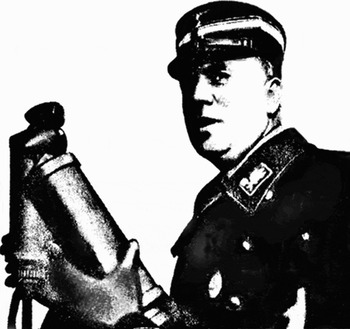
Robert Ley, head of the German Labor Front, briefly inspected the train in Leipa, where the director of the Czech railroads and other ranking Czech dignitaries also visited; Saur turned down an invitation to take the train to Prague for “technical and also political reasons.”Footnote 78 Todt himself traveled with the train only from Wiesau in Upper Palatinate to its first stop in Eger, where he turned it over to Konrad Henlein's representative, declaring, “One hears again that technology has little political impetus (Auftrieb) and that in general technicians engage in little political activity in their work . . . The Special Train of German Technology demonstrates that at the right moment the German technician is also a great activist and propagandist.”Footnote 79 See Figure 3 above.
Fritz Todt speaking in Eger, Sudetenland, November 24, 1938. Source: Rundschau Deutsche Technik, Dec. 1, 1938, Bundesarchiv NS 14/5, folio 2; enhanced by Gaëlle Guse.

The Sudenten voyage was run on a grander scale than its predecessor. Two separate trains with three locomotives and a total of sixteen railroad cars took part.Footnote 80 This time one train was built expressly for exhibition purposes. One exhibit showed synthetic materials developed primarily through new chemical processes: vanadium extracted from iron ore sediments; high-performance tools created through alloying and thermal processing; new rust-free, acid-proof, heat-resistant steel (to replace rare or imported minerals); plated steel girders; steel and alloy parts for automobiles and aircraft; synthetic rubber, textiles, and plastics. The “wonder work” was a model of a motor made from Plexiglas, as designed by Cologne engineer Peter Koch. As on the Austrian voyage, the German Railways presented textiles made from cellulose, synthetic fibers, and rubber; metal parts from lightweight alloys; synthetic pipes and conduits; and upholstery constructed from wood waste.Footnote 81 Displays and models abounded in the exhibit on “New Construction in the Third Reich,” including the Autobahn system and its impressive bridges, a model home for Hitler Youth (the Julius-Streicher Settlement), a “garden city” settlement, a Zeppelin field, and the new Strength through Joy steamship Wilhelm Gustloff.Footnote 82 Added especially for the Sudenten voyage were exhibits on economic recovery and reconstruction in Austria, similar plans for the Sudentenland, and a display on the Westwall defensive line being built by the Organization Todt along the French frontier.Footnote 83 The second train had two regular second-class cars that served as offices and sleeping quarters for the engineers, two platform cars to carry a new KdF-Volkswagen and field kitchens, a provisions car made of lightweight metal, and a baggage car with twenty-seven tons of propaganda material.Footnote 84 The train had its own post office, printing press, and radio-film center.
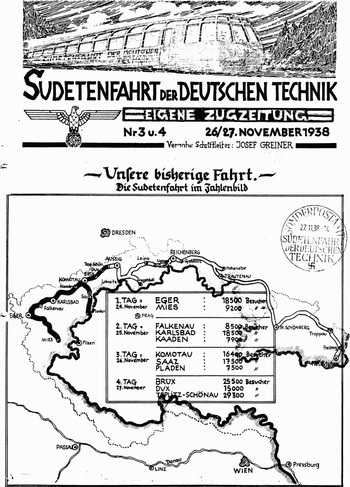
From Eger, the trains passed through the heart of industrialized Bohemia: through Falkenau, with its large chemical and electrical plants; Karlsbad, center of the porcelain industry; Komotau, railroad construction center; through the coal-mining region around Brux; through the Sudenten chemical center in Aussig; to the new “Gau capital” Reichenberg, home region of Ferdinand Porsche, creator of the Volkswagen. From there the exhibition visited the eastern Sudentenland before returning to Reichenberg. Covering 2,500 kilometers with twenty-seven official stops, the Sudeten voyage was an even larger success than the Austrian voyage: 312,000 visitors in ten days and 185 film presentations—sometimes shown ten or more times at a single stop—seen by an additional 120,000. The crew distributed 220,000 pictures of Hitler, 300,000 “Winter Help” postcards, and thirty-four tons of Labor Front material. Supposedly “nearly one in every ten Sudenten Germans saw the exhibition.”Footnote 85 See Figure 4.
The Train Newsletter showing the Sudenten Voyage Itinerary and Visitors' Statistics after the Fourth Day. Source: Bundesarchiv NS 14/5, folio 2; enhanced by Gaëlle Guse.

This trip had a stronger consumerist orientation than the Austrian voyage. In addition to the new Volkswagen for display, radios and vacuum cleaners were exhibited to demonstrate “technology in the service of the family.” Technology would ease working conditions, improving performance and public health.Footnote 86 The primary thrust of the technical exhibits remained the display of technology for industrial use, but technology for improved household living found its place—and the Volkswagen must have engendered reveries of motoring. Consumerist fantasies were reinforced when the 100,000th visitor to the train, a highway worker from Jechnitz, was awarded a radio; the 200,000th was given a washing machine; and the 300,000th a refrigerator.Footnote 87 Sudeten Germans could look forward to “healthier homes, greater joy in life and leisure, and truly valuable goods [Kulturgüter].”Footnote 88
One wonders if the peasants or workers who visited the exhibits found most of the highly technical items presented as intrinsically interesting as the engineers themselves did. This was certainly a concern of Saur in planning the voyage. Sensitive to what must have been perceived weaknesses of the Austrian voyage, he insisted that exhibits be organized so that the visitor needed “the least possible expenditure of his own conceptual ability.”Footnote 89 Propagandist Josef Greiner was defensive about exhibits that could not easily be understood by visitors and claimed in the Völkischer Beobachter prior to the voyage that the method of presentation did not allow “fatigue and boredom,” that walking through the exhibits would be an enrichment rather than an effort, that short explanatory text was used only when absolutely necessary. Exhibits would contain fewer statistics (“the horror of all exhibition visitors”) and no complicated models. To his mind, the simplicity and logic of the technical presentations were unequaled in Europe.Footnote 90
Of perhaps greater interest than alloys and girders for most visitors were the displays and models depicting economic recovery, massive construction projects, and the attendant political propaganda. As on the Austrian voyage, the exhibits went far beyond technological innovation to encompass a vast range of Nazi projects. Not only was heavy emphasis placed on “Strength through Joy” and “Beauty of Labor” projects, but the whole scope of Nazi political, economic, and even military activity was represented. Typical are some of the titles of picture and photo displays: “Germany's Iron Army,” “Goals of the Four-Year Plan,” “Demonstrations of Political Will,” “Free Peasants on Free Soil,” “Socialism of the Act,” “Soldiers of the Spade,” “Germany Builds!,” “No Strength without Joy,” “Combat Troops of the Movement.” The Sudeten voyage engineers truly were, as they called themselves, “active propagandists” (Propagandisten der Tat) for the regime.Footnote 91
That large crowds awaited the trains and visited the exhibits is attested to by photographs in the press.Footnote 92 Nevertheless, and without denying what must have been the genuine attraction of the “Wonder-Train of Technology,” part of the motivation for many visitors had to have been the hot chocolate, cake, sausages, and bread given out by the field kitchens accompanying the exhibits. Tickets for free food were distributed to those considered needy by the trains’ advance party prior to its arrival at a destination.Footnote 93 By the seventh day of the voyage, it was estimated that more than one-third of the 223,600 visitors had been fed in the kitchens.Footnote 94 At its conclusion, the train had distributed at least 115,000 packs of biscuits; 80,000 portions of chocolate; and 35,000 sausage and bread rations.Footnote 95 One visitor in Komotau voiced what must have been a common sentiment: what pleased him most was that, in addition to the marvelous exhibits, he could eat his fill without it costing anything!Footnote 96
As on the Austrian voyage, attacks on the Jews were frequent, further evidence that Todt and his engineers were much more openly anti-Semitic than has sometimes been thought.Footnote 97 The train's engineers reported back with enthusiasm to their wives how Karlsbad was proud that there were no Jews left in the city, that the “Jewish hotel” and the “Jewish nursing home” were remnants of the past.Footnote 98 In Leipa, the Jews had “disappeared” along with the Czechs.Footnote 99 “Infamous Jewish policies” were blamed for keeping wage levels low for miners in Falkenau, due to the “sadistic greed” of Jewish mine owners and coal merchants.Footnote 100 On this voyage, however, not only were the Jews attacked as harbingers of economic ruin, but the Czechs as well. A Jewish-Czech-capitalist conspiracy was singled out as the cause of the Depression.Footnote 101 The Prager Börsenjuden became the collective scapegoat blamed for factory closings in northern Bohemia. In Karlsbad, the closing of textile and glass factories was blamed on “the catastrophic policies of Czech-Jewish high finance.”Footnote 102 Josef Greiner declared that Sudeten technology was no longer to serve capital, for the profit of companies and their stockholders, but for the well-being of the whole society.Footnote 103 Such phrases suggest that, in addition to anti-Semitism, considerable anticapitalism, similar to that espoused by Todt's predecessor Gottfried Feder, still permeated the Central Office for Technology.
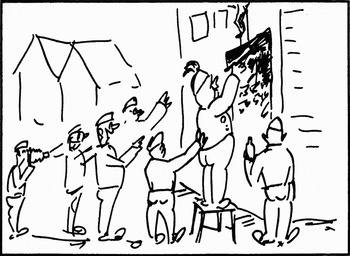
A telling example of the engineers’ anti-Semitism occurred in Deutsch-Gabel. While visiting the town, Saur and a group of engineers chanced upon a 300-year-old Jewish monument inscribed in Hebrew. Receiving no satisfactory explanation for the monument from the mayor's office, and despite assurances that its presence brought the town significant tourist revenue, Saur decided to take matters into his own hands. After acquiring black weather-resistant varnish and fortifying themselves with the local brew, the engineers, accompanied by townspeople and a journalist, proceeded to obliterate the inscription. This petty vandalism completed, they spent the rest of the day drinking and “terrorizing” the inhabitants—indeed, beating up two individuals, proclaiming themselves “active propagandists” of whom the infamous Julius Streicher himself would have been proud, cleansing the Sudetenland of “disgraceful Jewish-Bolshevik culture.”Footnote 104 See Figure 5.
Sketch of Jewish Monument Destruction in Deutsch-Gabel (from internal train newsletter). Source: Bundesarchiv NS 14/5, folio 2; enhanced by Gaëlle Guse.

The actions of Todt's close subordinates, engineers who claimed to represent Todt's ideals, suggests strongly that, while not a raging anti-Semite, Todt was not the “outsider” who did not identify with Nazi racial laws and who simply was “bound” to the party line, as portrayed by Franz Seidler.Footnote 105 The overt anti-Semitism displayed by the Nazi engineers during these voyages corroborates Thomas Zeller's argument that Todt's Deutsche Technik ideology, which Zeller labels a “peripheral segment” of Nazi ideology, was linked to Nazism's core beliefs by its anti-Semitic character.Footnote 106 Indeed, for Jeffrey Herf, the racial struggle between Aryan and Jew was central to Nazi understanding of technology.Footnote 107
Todt and the Central Office for Technology engineers viewed the Sudenten Voyage as more than mere election propaganda. It was also to serve as a catalyst for solving practical problems, as is shown by an interview with Rupert Glass, Todt's choice to head the Sudenten Office for Technology.Footnote 108 Lamenting the deleterious effect of Czech rule, Glass outlined specific areas where technical expertise was needed, the first being road building and highway construction in order to lower unemployment.Footnote 109 Glass enumerated further the need for levees and dikes in the mountainous areas subject to flooding, the general shortage of adequate housing, the need to replenish the forest economy by new plantings and the draining of swamps, and finally the planned integration of the Sudenten economy into the Four-Year Plan with its goal of national self-sufficiency. He struck a völkisch note in his desire to renovate villages that “especially in the industrial areas show marks of a capitalistic culture-less time.” Glass reflected the current in Nazi technical thought that sought a balance between mechanization and the industrial worker, claiming that true National Socialists see human concerns next to technical ones: “We want never to forget that it is the worker who realizes, with us, the creations of technology . . . Where it is possible to ease the lot of the worker without the loss of jobs, it is for us to provide for the sensible introduction of the machine.” Glass concluded menacingly that the incorporation of all Sudeten engineers into the NS League of German Technology (NSBDT), the Nazi umbrella engineering association, was a prerequisite to fulfilling these projects.Footnote 110
Glass's views are representative of the technical ideology fostered by Fritz Todt and indicative of the position allotted technology in the Nazi worldview by 1939. Technology, neither the symbol of decadent modernization seen by “blood and soil” fanatics, nor simply a utilitarian tool for rapid economic development, would serve Volk cohesiveness. Technology's transformation was integral to the “spiritual revolution” envisioned by Todt and like-minded Nazi ideologues. The harmony of the national community was to extend beyond social integration to encompass man, machine, and nature in a collectivist whole, the outstanding example being the Autobahnen, with their attempt to express the German soul through an artistic synthesis of highway and landscape.Footnote 111
Fritz Todt was responsible for this emphasis on creating a harmony of man, machine, and nature and on unifying technology and art, themes to which he repeatedly returned in his speeches and writings—often using the pseudo-philosophic jargon of the Nazi zealot.Footnote 112 Since the essence of technology is a consequence of the laws of nature, argued Todt, the outward form of technological works should express this inner essence.Footnote 113 Technical works “should correspond to their spiritual content: a power station should not appear beautiful, but rather strong. A bridge should be daring in form, a pylon slender, a locomotive heavy and swift.”Footnote 114 The Autobahnen were “to make out of nature and technique one perfect unit” that reflected “the deeper and spiritual movement of the National Socialist revolution . . . a psychic and cultural renovation of the German citizen.” The highways, built with “artistic feeling and a love of nature,” would lend a new character to the German landscape, the vastness of the scene helping Germans to “think on broader lines than was heretofore possible.”Footnote 115 Artists would be inspired by the “heroic conception of a technical problem,” and highway construction engineers would draw inspiration “by viewing the landscape with the eye of the artist.”Footnote 116 This ideology found expression in various forms on the voyages of technology. For example, “Beauty of Labor” propaganda stressed the need for clean, well-lit working conditions, including “above all else, flowers, flowers wherever possible: on the workbench . . . on the writing table, everywhere else.”Footnote 117 As with Autobahn aesthetics, natural beauty and technological innovation went hand in hand for Nazi propagandists.
* * *
Following the Austrian and Sudenten voyages of technology, it was evident that technology could be useful propaganda. The Nazi engineers now sought to use German technological achievements for diplomatic and propaganda purposes beyond the frontiers of the Reich. By so doing they would have a greater voice in foreign policy decisions. This reflects both Todt's technocratic ideal of the role of engineers as political leaders, plus the desire of Todt and Saur for more power vis-à-vis the other political fiefdoms of the Third Reich.
A meeting of Central Office of Technology personnel took place in Munich on January 26, 1939, to plan a third voyage of technology through eastern Europe, with stops in Poland, Czechoslovakia, Hungary, Romania, Yugoslavia, Greece, Bulgaria, and Turkey. This “southeast voyage” was to take place between May 17 and June 10, 1939. According to Saur, the voyage would support the declared aim of the Economics Ministry that southeastern Europe “must be conquered for Germandom and above all for the German market.” The overall purpose was political and economic rather than purely propagandistic, hence visits to the exhibits were to be limited to twenty-four members of the host country's government, plus a further thousand individuals representing political groups, industry, and economic affairs, in addition to the residents of the official German community. Exhibits were to reflect the needs of the countries visited: agricultural technology, settlement planning, road and railroad construction, and energy development. Estimating its cost at 200,000 Reichsmark, Saur claimed that the voyage would demonstrate that Germany was not interested in the southeast due to pretensions of power (Machtanspruch), but because of the chances for “reciprocal economic and cultural fertilization.” Xavier Dorsch, at the time head of the Foreign Bureau in the Central Office for Technology, cautioned that the voyage “must be politically scrutinized and prepared.” Given anticipation that the rest of Czecho-Slovakia, as it had been re-titled, would be incorporated into the Reich, Dorsch openly posed the question that must have been on the mind of all the participants: “Should Prague be visited?” Dorsch and Heil were tasked with informing Alfred Rosenberg of the project.Footnote 118
At least one precedent existed for such a propaganda exhibit traveling through southeast Europe to enhance German foreign policy. In the late winter or early spring of 1938, a “Strength through Joy” exhibit entitled “Joy and Work” containing photographic displays, models of leisure ships and resorts, and Beauty of Labor furnishings traveled throughout Yugoslavia, Bulgaria, and Romania to Greece, where it was visited by the king.Footnote 119 By the following year, however, the annexation of the Sudentenland and Hitler's bellicose intentions had shifted the foreign policy context considerably.
A second planning meeting occurred on February 16, 1939, in the offices of the Inspector General for Highways (Todt) in Berlin. Present were Saur, Link, Schneider, Dr. Kurz, Greiner, and Dorsch for the Central Office of Technology; Dr. Garben of the Foreign Office; representatives of the German railroad; exhibit specialists; and Heil as the liaison with Alfred Rosenberg's office. Saur again emphasized the political nature of the trip, adding that the voyage should demonstrate “the highest technical achievement of the Third Reich” and should be “tailored to the consumer of the individual country.” A number of specialized technical developments, such as the electron microscope, were to be combined with exhibits of more general interest. ”If the voyage were to display only specialized technical achievements,” said Dorsch, “there is the danger that what is shown would be of great personal interest for the visiting ministers, but of no practical meaning for their country and people.” Reference was made to the fact that both France and England were planning similar exhibitions in eastern Europe, to which Saur replied that “we, however . . . want to show something completely new on the basis of [our] experience.” Due to the political orientation of the voyage, Dr. Garben suggested that the foreign legations of the countries concerned be invited to a demonstration showing. It was made clear that the voyage would not be made public until the Minister of Economics, Walther Funk, and the Minister of Foreign Affairs, Joachim von Ribbentrop, had given their approval; Dorsch was to contact Funk and von Ribbentrop that same afternoon.Footnote 120
Despite Joseph Goebbels laying claim to an “age of technology” at the Berlin Auto Show the following day, interests other than those of Todt and Saur intervened, and planning for the southeastern voyage was abruptly halted.Footnote 121 Internal disputes, such as the rivalry between Funk and von Ribbentrop, plus the opposition of those who disliked the incursion of the Central Office for Technology into foreign affairs, quite possibly were decisive. Certainly the increasingly tense international situation played a role. Hitler secretly lectured Wehrmacht officers three times in January-February 1939 to prepare for the coming conflict, as he contemplated his next foreign policy move. The fact that the voyage was planned to travel through Poland, whose refusal to reach accommodation on Danzig had hardened Hitler's approach, and through what remained of Czecho-Slovakia, which Hitler had decided to smash militarily, probably made the voyage an impossibility.Footnote 122 Further research is required to determine the exact reasons, but the planned southeastern voyage of technology was dropped and never became public knowledge.
This development is significant both politically and ideologically. The expanding role for engineers envisioned by Fritz Todt and Karl-Otto Saur, a Nazified form of technocracy, which had found expression in the “reordering” of the technical associations under the party in 1937, in the Plassenburg courses, and in the Voyages of Technology, was temporarily halted. For the moment, Todt and the Nazi engineers were limited to “techno-political” control within the Reich. Their authority and influence would later increase after Todt became Minister of Armaments and Munitions in 1940. From the standpoint of Nazi ideology, it suggests that, while engineers had been integrated into the Nazi worldview and had come to be seen as essential to the national community, there were limits to how far the party hierarchy was willing to go in proselytizing Todt's specific technical ideology. The vision of man, machine, and nature linked harmoniously together to serve the national community might make good propaganda for Volk comrades, but it could not take precedence over political and military goals.Footnote 123
The cancellation of the southeast voyage of technology is an indication of the limits of reactionary modernism within National Socialism, at least as concerns actively spreading Todt's technical ideology beyond the frontiers of the Reich. And the abrupt end of the southeastern voyage is a mild forerunner of what was to happen to the Central Office for Technology and its educational, press, and propaganda functions once Albert Speer succeeded Fritz Todt in 1942: they were shut down in the name of the war effort.Footnote 124 By that time the regime was going in two opposing directions in what could be labeled the paradox of “fanatical utilitarianism.” As the war progressed, elements of Nazi ideology not essential to the central racist dynamic of the movement began to lose influence to a more utilitarian approach, a tendency that accelerated in the last years of the war. This was true of “German physics,” for example, and it was true of Todt's Deutsche Technik ideology.Footnote 125 At the same time, however, especially after 1942, the regime returned to what Hans Mommsen labels a Kampfzeit mentality, exposing and carrying to unthinkable extremes the brutal, irrational core elements of Nazi ideology.Footnote 126 In the desperation of pending defeat, concepts of a technocratic, future-oriented, harmonious community were replaced with frantic calls for active defense of a disintegrating Volksgemeinschaft.
* * *
The last Nazi voyage of technology had none of the political goals of its predecessors. It was, however, highly symbolic as a concrete expression of Todt's technical ideology at its apogee, coming just prior to the outbreak of the war. A pleasure cruise to the Norwegian fjords for some 1,500 German technicians and representatives of German industry on the new Strength through Joy steamship Robert Ley from May 10 to 16, 1939, the Norwegian Voyage of German Technology was far from devoid of ideological overtones.Footnote 127 The passengers, generally selected through their local NS League of German Technology chapters, included leading party figures (Todt, Rosenberg), Transportation Minister Julius Dorpmüller, scientists, economists, and SA and military officers.Footnote 128 A few foreign guests were invited, who were certainly impressed by what Shelley Baranowski describes as a combination of “technological glitz and creature comfort.”Footnote 129 Reports from the cruise marveled over the ship as a technical “masterpiece,” the “grandiose mountain and water world” of the fjords, and the camaraderie developed in a myriad of leisure activities, ranging from enjoying the sports and sun decks to dancing, games, and evening entertainment.Footnote 130
Most passengers were engineers, prompting Todt to defend the voyage in an interview as more than simply a “floating engineer congress.” He argued that his task was to alter the engineers’ narrow professionalism and the impression, often shared by engineers themselves, that they served only material purposes. Not mere automatons, engineers were endowed with a mission in the life of the Volk, and they had the duty to participate fully in all aspects of community life. Therefore, for Todt, the Norwegian voyage was a pause in the everyday grind that would rejuvenate the engineer for his future efforts and awaken his interest in the world beyond his working environment. “Shoptalk” was supposedly limited to one hour per day. The beauty of the fjords would confirm the engineer's attachment to nature, and cultural evenings would renew his taste for Kultur.Footnote 131 Or, as the National Socialist newspaper Rheinfront put it in describing the voyage, the engineer could no longer lead the life of a “technical monk,” a “drawing board hero.” He must be transformed from an “all-too-serious, dignified gentleman” into a “more active, youthful individual” accomplished in “the art of living.”Footnote 132 A luxurious modern steamship, filled with dynamic, dedicated engineers and floating amid the beauty of the Norwegian fjords, was highly symbolic of Todt's ideal: the harmony of man, machine, and nature.
The voyage was seen as furthering the goal of “reeducating” the engineer. “Technicians themselves,” said Todt, “are not the people with whom one can realize the highest political mission. For that, it is necessary to form and to educate engineers politically.”Footnote 133 The Norwegian voyage was a natural extension of the Plassenburg courses aimed at indoctrinating engineers in the new technical ideology. It was a convenient way to bring together leading technicians in an atmosphere conducive to cooperation and mutual exchange of ideas, while at the same time furthering the Nazi ideological program. To hold the voyage up as an example for other engineers, an article describing the voyage was prepared for forty-three different professional engineering journals in Germany, in addition to articles in the popular press.Footnote 134
While on the Norwegian voyage, Alfred Rosenberg granted an interview that was published for the opening of the annual convention of the German Engineering Association (VDI) in May. It is a useful way to conclude our reflection of the Nazi voyages of technology, because it treats the role of technology as seen by a key Nazi ideologue, but one who was not an engineer, just prior to the transforming impact of World War II.Footnote 135 The interviewer first made clear that the National Socialists desired a synthesis of technology and Kultur, ending a perceived or real dichotomy.Footnote 136 Humans would have the feeling of mastering the machine, moving from an era where the machine was an expression of a purely materialistic conception of life, to the “techno-political epoch.” The principles of völkisch life and the Nazi worldview would determine the character (Wesen) of technology in the new period.
Rosenberg agreed that technology and Kultur had been alienated, due to a lack of understanding on the part of politicians and economists. The National Socialists placed the ideological attitude of the technician in the foreground, for “even the best specialist who is without a new conviction [Gesinnung] would be of extremely limited use to us. Only his ideological-political knowledge enables him to produce works conforming to the new, many-sided consciousness [Lebensgefühl].” Once reeducated, the technician could set about solving practical problems. Through the application of technology, Rosenberg envisioned healthy housing, successful resettlement projects, and the creation of new industrial centers, echoing in some ways the previously discredited settlement projects of Gottfried Feder or those later developed by the SS for the east.Footnote 137 “National Socialism,” declared Rosenberg, “has opened the eyes of the Volk to the meaning of technology” and technology had become “a natural expression [Äusserung] of the nation.” The airplane, radio, and automobile were now part of the political life of the country: millions could be sworn to an oath at the same time, and great communal gatherings were possible in an instant. And through technology, the defense of the nation was secured. Rosenberg, paraphrasing Hitler, concluded that the Nazi revolution “affords technology a new social status in which the principles of technology, politics, and thought [Idee] are brought into harmony.” Within four months of Rosenberg's interview, the Wehrmacht was deep within Poland and the Third Reich had embarked on a war of conquest and self-destruction that obliterated Nazi fantasies of a harmonious, technocratic Volksgemeinschaft.
* * *
The Nazi voyages of technology illustrate that by 1938–39, Deutsche Technik had become a mainstream element within Nazi Volksgemeinschaft propaganda, with technology presented as essential for the well-being of the national community. Based on assumptions of Aryan creative genius and on technocratic aspirations, Fritz Todt's Deutsche Technik ideology was a key component of the Nazi worldview in the prewar period. In addition, these voyages heightened underlying consumerist aspirations, but because the Nazis stymied immediate mass consumption, for fulfillment in the future. As seen with the aborted plans for a southeast voyage, however, Todt's technological propaganda was limited to the Greater Reich by the regime's commitment to war in 1939. It would later disappear entirely in the reorganization for “total war.”Footnote 138
The voyages of technology make clear that the role of technology in a National Socialist society was predicated on a dual transformation. The engineer was brought into the mainstream of the Volk community through reeducation (the Norwegian voyage), and Germans were taught the value of technology to the community (the Austrian and Sudenten voyages). For Nazi ideologues, the engineer stood with the soldier and the peasant farmer as an integral, if less traditional, member of the national community. The collectivist impulse in National Socialism embraced the engineer and projected a society in which man, machine, and nature functioned in harmony. It was, however, an exclusionist society, and the blatant anti-Semitism of Nazi engineers shows how technology was linked to the racist, genocidal core elements of Nazi ideology.
Fritz Todt and his engineers constantly referred to National Socialism as a “spiritual revolution,” entailing a massive change in perceptions among both engineers and the German public. We should remain skeptical as to what extent most German engineers adhered to Todt's vision or resembled the racist ideologues of the Central Office for Technology.Footnote 139 Yet our current understanding of life in the Third Reich suggests that, far from meaningless rhetoric, this “brown revolution of the mind,” as it has been called, found substantial echo among a population that came to identify a secure, prosperous future with National Socialism.Footnote 140 Access to modern technology was an essential ingredient of that future, one that Todt and his engineers presented with pride and enthusiasm on the voyages of technology.