Evidence suggesting that the growth of civic roots in adolescence may be crucial to the long-term development of citizenship1
As early as the 1920s, Mannheim (1952) suggested that around the age of 17 years, individuals enter a crucial period of experimentation that leads to the creation of a new political generation. In the 1960s, Erikson (1968) described adolescence as the time when individuals develop an identity that helps guide their interactions with society later in life. Such ideas about a critical period for the development of civic roots are supported by research showing, for example, that involvement in organized youth activities during adolescence leads to participation in religious, community, and political organizations in adulthood (Beane et al. 1981; Hanks and Eckland 1978; Ladewig and Thomas 1987; Otto 1976; Verba et al. 1995; for a review, see Youniss, McLellan, and Yates 1997).
The term “youth” in this study is used interchangeably with “adolescence,” which occurs during approximately the second decade of life (age 11–20 years).
The effects of such discussions may be particularly beneficial for youth when the discussions involve their parents. Verba, Schlozman, and Brady (1995), for instance, demonstrated that individuals who grow up in homes where they discussed current events with their parents and saw their parents participating in civic activities become, on average, more involved in political activities in adulthood than do other persons. Lake Snell Perry and Associates (2002) found in a study of young persons (age 15–25 years) that having parents who discussed politics with them during adolescence was the strongest parent-related predictor of several important civic measures including volunteering (33% versus 22% among other young persons) and registering to vote (75% versus 57% among other young persons age 18–24). In addition, Andolina et al. (2003) reported that young persons (age 18–25 years) who grew up in families where they regularly heard political discussion voted, volunteered, and were otherwise civically involved at higher rates than youth who did not experience this type of home environment.
These findings raise an interesting question: Which qualities, if any, make some parents more effective than others at discussing current events in ways that lead to better civic outcomes for their adolescent children? Do the personal characteristics parents bring to these discussions matter? Or is the act of discussion, by itself, the key element underlying the positive connection between family political discussion and civic outcomes in youth?
Research with high school students indicates that having some prior knowledge about the issue of interest is necessary to have high-quality discussions about current events in social studies classes (Hess 2004). In extending this logic to the family, we ask whether youth-parent discussions of current events may be more effective at enhancing youth civic development when parents have higher, versus lower, levels of knowledge about politics and government. However, researchers also report that the act of discussion creates new knowledge, which can promote the decision-making that leads to civic action (Barber 2003). Thus, it may be that the act of discussion is the more important link in the chain of events connecting family political discussion to youth civic development.
The present study explores these issues by taking advantage of the rich citizenship data gathered from adolescents and their parents by the U.S. Department of Education's National Household Education Survey (NHES) in 1996.3
NHES is a random digit-dial, computer-assisted telephone survey. In 1996, NHES was conducted in three successive interviews with household representatives (69.9%), parents (62.5%), and youth (53.4%). Response rates for parents and youth include the response rates for the prior interview/s. The data used in the current study are from “CD-ROM: National Household Education Surveys of 1991, 1993, 1995, 1996, and 1999: Data Files and Electronic Codebook” (NCES 2002-005) ordered from the U.S. Department of Education. The data can be downloaded from www.icpsr.umich.edu.
The Research Design
Four measures were developed from the NHES items to represent civic outcomes in youth: monitoring national news, political knowledge, public communication skill (Could you write to a public official or speak at a public meeting?), and community service.4
“Monitoring national news” measures how often youth attend to national news via print and broadcast media. “Political knowledge” indicates how many of five political-knowledge questions they answered correctly. “Public communication skill” is a 3-point scale (based on two yes/no questions) indicating how capable youth think they are of communicating their ideas in public. “Community service” reports how often they performed community service in the past school year (i.e., never, sporadically, regularly).
In preliminary analyses we used a weighted subsample of 1,313 adults (who also participated in the 1996 NHES but were not parents of the youth who were surveyed) to identify civic-involvement (CI) variables that correlated highly with political behaviors such as voting or contributing money to a political campaign. Most youth are barred by age, economic, and other restrictions from participating in many of these political activities, and the 1996 NHES did not assess such behaviors in its youth sample. However, because the survey did measure CI variables in both its adult and youth samples, we were able to use the CI variables linked to political behaviors in the adult sample as surrogate measures of political behavior in the youth sample. This research approach is supported by the findings of Jennings and Niemi (1981).
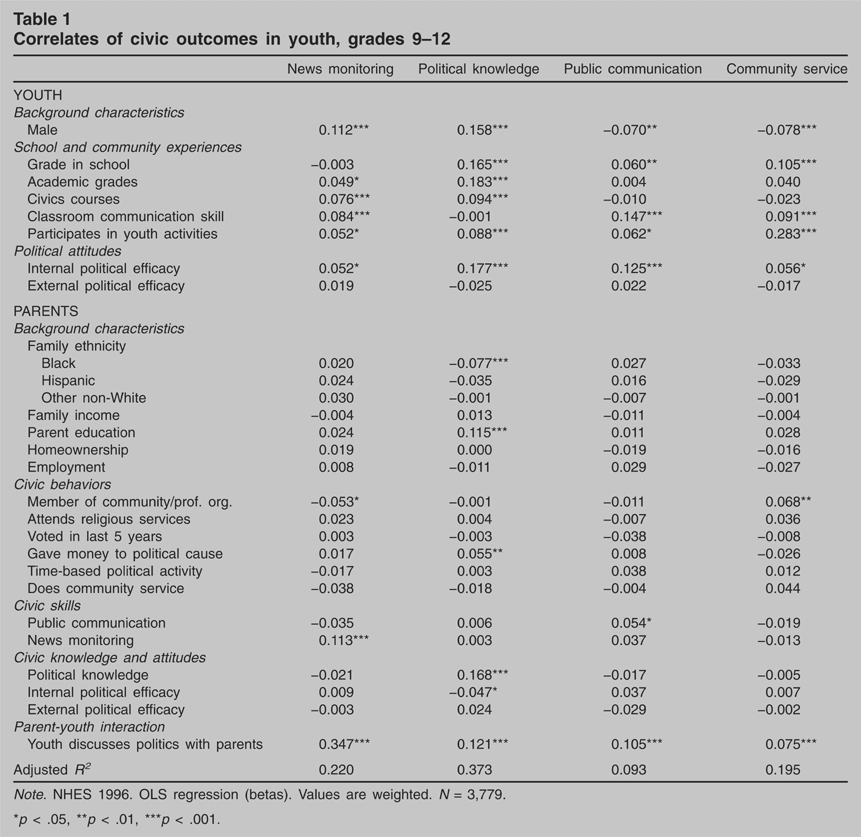
To evaluate parent characteristics, variables were developed to measure parents' civic skills, behaviors, knowledge, and attitudes, as well as background characteristics such as family income and ethnicity (Table 1).6
The ethnicity of the youth was used as the measure of family ethnicity.
Some youth who reported doing community service may also have reported that service as an organized youth activity, although this possibility seems low. Our youth activities variable combined NHES measures of participation in student government, other school activities (“such as sports teams, safety patrol, or school clubs”), and out-of-school activities (“such as music lessons, scouting, church or temple youth groups, or organized team sports like soccer”). The community service variable measured participation in service or voluntary activities “like tutoring other students, visiting senior citizens, and so on.”
Correlates of civic outcomes in youth, grades 9–12

In the first step of analysis, we used OLS regression to determine which parent qualities predict the four youth civic outcomes. Given the results of earlier research, we expected that family political discussion would be positively linked to youth political knowledge, news monitoring, and perhaps to other outcomes as well. Next, we used interaction analysis to answer the question asked in the title: Which parent qualities matter in regard to the influence of family political discussion on the civic development of youth? Finally, we looked at the results collectively to identify patterns that might provide additional insight about the mechanisms linking parent qualities, family political discussion, and positive civic outcomes in youth.
Important Parent Qualities
Results from the initial regressions support earlier findings that youth-parent political discussion has a strong and broad influence on a range of youth civic outcomes. Family political discussion weakly to strongly predicts all four of the outcome variables and is the strongest parental predictor for all but one of them (Table 1).8
Following the example of Nie, Junn, and Stehlik-Barry (1996), we define a strong effect with OLS regression as a standardized coefficient (beta) of .20 and above, a moderate effect as between .10 and .19, and a weak effect as below .10. Also, because even small effects can achieve statistical significance in samples as large as the one used in the current study, small significant effects should be interpreted with caution.
The finding that family political discussion is broadly linked to youth civic development conforms to cognitive developmental theory, which argues that young persons construct meaning and knowledge about the political world through social interaction—in this instance, with their parents (Torney-Purta 1992; 1995; Haste and Torney-Purta 1992). The give-and-take of family political discussion, the data suggest, provides opportunity for youth to construct their own political understanding from the civic raw materials at hand (e.g., political information, meanings, and so forth gleaned from parents, teachers, books, television, and other media).
In addition, the regression results identified other parent characteristics that are linked to youth civic development, including the parents' education, political knowledge, news monitoring, internal political efficacy, giving money to a political cause, and membership in community or professional organizations. Each of these measures was related to at least one of the four youth civic outcomes and was therefore tested for possible interaction with the youth-parent discussion variable.
Parent Qualities that Matter for Family Discussion
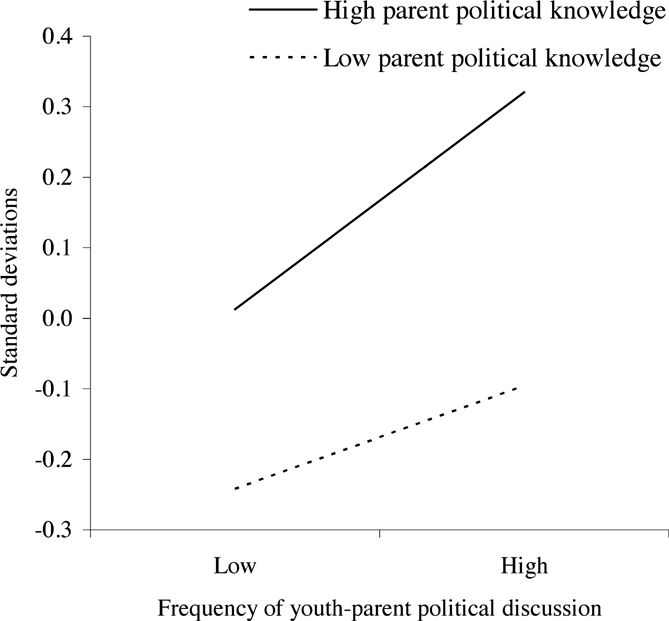
The interaction tests revealed one interaction—parent political knowledge and youth-parent political discussion interact in predicting the level of youth political knowledge.9
A marginally significant (p < .10) interaction was also found between parent education and youth-parent political discussion in predicting youth political knowledge.
Mean levels of youth political knowledge were estimated from the regression results. To estimate the means, all predictors in the equations, except for parent political knowledge and youth-parent political discussion, were centered on 0.

Youth political knowledge
Although the mechanism of the interaction between parent political knowledge and family political discussion is not specified, the results suggest an interaction between two theories: cognitive developmental and political socialization. The latter theory views civic development as the passing of political knowledge, values, and behaviors from an older generation to a younger one (Dudley and Gitelson 2002; Flanagan and Sherrod 1998; Haste and Torney-Purta 1992; Jennings and Niemi 1981). Cognitive developmental theory, as outlined above, proposes that youth construct their own political understanding of the world. Both theories are supported in the present findings, which suggest that family political discussion allows parents to serve as an important source of political knowledge that youth can use in constructing their own political knowledge.
Further analyses, however, failed to yield interactions with family political discussion for any other civic outcome apart from youth political knowledge. It follows that the act of discussion, itself, may be the key element when the youth civic outcome is news monitoring, public communication skill, or community service. Also, for these three outcomes, it may be that news media, public officials, and community organizations are, along with parents, important sources of the civic raw material that youth use in constructing their understanding of the political world.
Regression analysis is able to show important links between variables, but it does not indicate the direction of causality. In this study, we generally assume that parents develop their civic-related qualities before their children do, owing to the age differences between them, and that the direction of causality runs from parent to child. Causality can, however, flow in the opposite direction, as demonstrated by evaluations of the Kids Voting USA curriculum, which is taught during election years in several states (McDevitt and Kiousis 2004; Saphir and Chaffee 2002). These studies in four states found that students who participated in the intervention at school often initiated political discussions with their parents that led to enhanced civic outcomes for both youth and parents. In addition, other youth-level factors, such as youth news monitoring or participation in civics courses at school, might lead youth to family political discussions, as suggested by Comber (2006), rather than the reverse.
Are Parent Background Qualities Important?
The pattern of findings presented in Table 1 suggests that who parents are in terms of their background characteristics is less important for youth civic development than what parents do with their adolescent children and what parents know about politics and government. For three of the civic outcomes (news monitoring, public communication skill, and community service), none of the parent background measures (ethnicity, income, education, homeownership, and employment) was significant. For each of these outcomes, which involve the development of civic behaviors or skills, what parents do with their children (i.e., discuss politics and current events) is the strongest parental predictor.
The fourth youth civic outcome—political knowledge—differs qualitatively from the other three in that it involves, in part, the transmission of knowledge from one generation to the next. In this case, what parents know about politics is the strongest parental predictor (Table 1). And, as the interaction analyses demonstrated, parents play an especially important role in the development of youth political knowledge when they function both as a source of political information (i.e., they have a high degree of political knowledge) and as a frequent participant in discussions that help youth fashion that information into their own political understanding.
In addition, the results suggest that parents' background characteristics do play a role when the outcome is youth civic knowledge (Table 1). Parent education—a measure of socioeconomic status—was positively associated with this outcome, a finding consistent with earlier research on youth political knowledge (Niemi and Junn 1998). Although some have argued that well-educated parents confer socioeconomic advantage to their children in the political arena (Gimpel, Lay, and Schuknecht 2003; Verba, Schlozman, and Brady 1995), these parents may also provide their children with access to additional sources of civic information such as books, magazines, newspapers, electronic media, and enhanced education from which to draw in constructing their understanding of the political world.
The finding that being Black is negatively associated with youth civic knowledge (Table 1) may be linked to a historic lack of access to the civic resources described above. It might also be that this finding reflects the effects of a “youth bulge”—a cohort of youth age 16 to 25 that is relatively large compared with the adult population of a society. Hart et al. (2004) found that youth in communities with high youth/adult ratios scored lower on measures of political knowledge than did youth in communities with low youth/adult ratios. However, using a 1996 NHES subsample that overlaps the one employed in the current study, the researchers did not find any correlation (negative or positive) between Black ethnicity and youth political knowledge in a regression that included a youth-bulge measure. When the negative relationship between youth bulge and political knowledge was accounted for (controlled statistically), there was no negative link between Black ethnicity and political knowledge. Together, the results from that study and the current one suggest that Black communities may experience youth bulges that adversely affect youth political knowledge. They also suggest that the current study's findings—that parents are an important source of political discussion and knowledge—may extend to other adults in the community as well. This interpretation, however, goes beyond the current data and thus remains for the moment in the realm of speculation.
Conclusion
Since at least the 1950s, social scientists have been debating how and to what extent parents influence the civic development of their children. The results presented here suggest that parents who take the time to talk with their adolescent children about the public affairs of the day can have a positive influence on the civic development of those youth. And in some instances, that influence is considerable.
The results also indicate that, yes, the qualities that parents bring to these family discussions do matter when the outcome is youth political knowledge. This finding is theoretically important because it sheds light on the mechanisms of civic development. The positive effects of family political discussion support the idea that youth construct their own political meaning. The interaction finding, in turn, indicates that this construction process is even more effective when youth have immediate access to a supply of civic raw material in the form of parent political knowledge. These theoretical findings will likely find application in settings beyond the family.
Author Bios
Hugh McIntosh completed a doctorate in developmental psychology at The Catholic University of America in 2006, with a dissertation on The Development of Active Citizenship in Youth. His current work as an independent researcher includes the continuing evaluation of a comprehensive civic engagement intervention at Hudson High School in Massachusetts.
Daniel Hart is director of the Center for Children and Childhood Studies at Rutgers University in Camden, NJ. His work focuses on the development of personality, identity, and morality in urban contexts. His recent work includes “High School Predictors of Adult Civic Engagement: The Roles of Volunteering, Civic Knowledge, Extracurricular Activities, and Attitudes” (American Educational Research Journal, 2007).
James Youniss is the Wylma and James R. Curtin Professor of Psychology at The Catholic University of America. His recent work has been focused on assessment of community service programs insofar as they promote civic and moral development in youth.