

Recently, the US Department of Health and Human Services finalized a new set of rules in the Office of Civil Rights for its newest division (HHS 2019). This so-called “Conscience and Religious Freedom Division” now provides enforcement of existing protections for healthcare providers in their “fundamental and unalienable rights of conscience and religious freedom,” including their right to refuse to provide patients with certain drugs and services they deem objectionable (HHS 2018a; 2018b). At face value this might sound odd: why the perceived need to protect providers from their patients rather than the reverse?
One of the primary motivations for this policy change involves the morning-after pill—an over-the-counter (OTC) hormonal treatment taken after sexual intercourse to reduce the chance of unwanted pregnancy. Around 11% of US women of reproductive age have used emergency contraception (Daniels, Jones, and Abma Reference Daniels, Jones and Abma2013), and the World Health Organization includes these levonorgestrel pills on its core list of essential medicines (WHO 2019, 46, 22.1.1). Yet some healthcare professionals who oppose abortion refuse to provide these later-acting contraceptives to patients at various pharmacies and hospitals, especially at Catholic facilities (Bucar Reference Bucar1999; Smugar, Spina, and Merz Reference Smugar, Spina and Merz2000; Cantor and Baum Reference Cantor and Baum2004; Davidson et al. Reference Davidson, Pettis, Joiner, Cook and Klugman2010; Chiarello Reference Chiarello2013). As Carolyn McLeod has argued, these denials are not a “mere inconvenience” but an ethical harm to patients because denial interferes with their ability to continue seeking the drug and to maintain their moral identity and sense of security (McLeod Reference McLeod2010; contra Fenton and Lomasky Reference Fenton and Lomasky2005).
In addition to the ethical problems of provider refusals of emergency contraceptives, such refusals are contested on empirical grounds. Unlike with abortion pills (for example, RU-486) that indisputably cause abortion, these refusals are premised on the value-laden empirical claim that they may also cause abortion. Antiabortionists and women's-health advocates disagree over how the morning-after pill works, and their epistemic disagreement over “the facts” of its mechanism is rooted in different ontological, ethical, and political values (see ChoGlueck Reference ChoGlueck2021). How can we make sense of these epistemic and ethical stakes in the debates over emergency contraception and “conscientious refusal”?
Feminist philosophers have provided a multitude of answers to the challenges raised by values in science.Footnote 1 Because science is inescapably value-laden, these scholars do not seek freedom from all values but rather means by which to distinguish legitimate from illegitimate influences of values on science (Anderson Reference Anderson2004; see also Douglas Reference Douglas2009; Elliott Reference Elliott2017). Accordingly, existing feminist approaches reject a sharp fact–value distinction but maintain the need for more normative guidance about the interrelations between science and values beyond the mere presence of bias (Richardson Reference Richardson2010). Feminists have paid special attention to the sexist values—ideologies that support unfair social hierarchies by legitimizing male domination of cisgender women and other “weaker” genders—such as how androcentrism in biology and anthropology erases the uniqueness of women and their positive contributions to human evolution (Schiebinger Reference Schiebinger2001). Feminist critiques differ primarily in their emphasis: One approach focuses on the epistemic detriments of sexist values in science on knowledge-production itself (Anderson Reference Anderson2004; Lloyd Reference Lloyd2005; Clough Reference Clough2013). The other attends to the unjust social consequences of science laden with oppressive values (Kourany Reference Kourany2010; Hicks Reference Hicks2014).
Rather than emphasizing either the epistemic nature of the problem or its ethical character, I provide an alternative normative framework for evaluating sexist science. I argue that sexist values and gender norms are illegitimate in reproductive medicine because they undermine epistemic autonomy and enable epistemic oppression. I concentrate on “zygote-centric” values, which compose a sexist ideology that focuses the attention of scientists and healthcare professionals toward fertilized embryos (zygotes) and away from women (or, more precisely, people with uteruses) and their health.Footnote 2
I contend that purported scientific knowledge that is laden with sexist values leads to novel forms of epistemic injustice and oppression in medicine (Fricker Reference Fricker2007; Dotson Reference Dotson2014; Pohlhaus Reference Pohlhaus2014). This article demonstrates how one specific knowledge-claim embedded with zygote-centric values has harmed individuals by deceiving them and imposing certain beliefs on them in a disrespectful and coercive manner. At the collective level, these epistemic harms contribute to patriarchy through paternalism and misogyny, shaping people with uteruses into “good mothers” and punishing “bad mothers” (Bartky Reference Bartky, Diamond and Quinby1988; Manne Reference Manne2018). Interrogating these gender norms illustrates how zygote-centric claims affect different people differently, particularly poor women, women of color, Indigenous women, and disabled women, who are perennially stereotyped as “bad” mothers like “welfare queens” and “unfit” parents (see Roberts Reference Roberts1997; Ross et al. Reference Ross, Roberts, Derkas, Peoples and Toure2017). Antiabortion providers have sought to misogynistically “correct” their “unbecoming” behavior with even more refusals, exacerbating preexisting health disparities by race and class (Yang Reference Yang2020).Footnote 3
To demonstrate the epistemic injustice and oppression enabled by zygote-centric knowledge, I conduct a case study of how these values entered the science at the US Food and Drug Administration (FDA) involving the morning-after pill Plan B. After section I provides background, section II analyzes how Plan B's “drug facts” were constituted by the zygote-centric values of antiabortionists. In section III, I scrutinize the consequences of this FDA label in the US healthcare system. In section IV, I conclude with objections about justice, informed consent, and religious freedom.
This analysis is significant for feminists, philosophers of science, and policy-makers because it provides a novel solution for identifying the entangled ethical and epistemic problems with sexist science. I also hope to afford feminists grounds to criticize structural barriers to accessing morning-after pills, such as the blanket protections for provider refusals at the HHS Division for Conscience and Religious Freedom. As we shall see, patient access to pharmaceutical drugs can hang on dubious value-laden claims, whose scientific credibility is bolstered only by their association with authoritative organizations like the FDA.
I. What's Wrong with Sexist Science?
For decades, feminist philosophers and scientists have led the scholarship on the proper place of values in science by criticizing sex/gender bias throughout medicine, biology, and anthropology (Schiebinger Reference Schiebinger2001; Subramaniam Reference Subramaniam2009; Richardson Reference Richardson2010). Some critics took the problem with sexist science to be the mere influence of any values on objective knowledge, assuming that science ought to be “as free from gender bias as possible” (BGSG 1988, 73). Yet Helen Longino, Sandra Harding, and others argued that contextual values Footnote 4 can either hamper the objectivity of science or improve it, depending on whether the values are hegemonic or marginalized (Longino Reference Longino1990; Harding Reference Harding, Alcoff and Potter1993).
Philosophers of science have since shown how contextual values more generally can play legitimate roles in scientific reasoning, such as choosing topics, interpreting data, managing uncertainty and risk, and setting standards of evidence (Elliott Reference Elliott2017). Because science is saturated with these different value judgments, there are even stronger grounds against the value-free ideal of science (Douglas Reference Douglas2009; Biddle and Kukla Reference Biddle, Kukla, Elliott and Richards2017; ChoGlueck Reference ChoGlueck2018). Yet, even if we reject a sharp fact/value distinction and accept that science is value-laden, important normative questions remain: Which contextual values are legitimate in science? Whose values, and in what contexts?Footnote 5 Focusing specifically on sexist values in science, feminists have responded in roughly two ways, one stressing epistemology and the other attending to ethics. Their difference is primarily one of emphasis, as both views maintain the relevance of values for knowledge-production, and neither claims that the harms of sexism are solely epistemic or solely ethical.
The first line of reasoning comes from feminist empiricists, who contend that values ought to be treated as part of what we know and evaluated empirically like any other form of knowledge. These empiricists do not claim that sexist science is ethically unproblematic, for they reject the strict dichotomy of fact/value. However, their primary focus is on how sexist values like traditionalism, androcentrism, and procreative focus make scientific knowledge less fruitful, less objective, and more prone to failure. Accordingly, they emphasize the epistemic problems that sexist values create for producing and evaluating scientific knowledge.
For instance, Elizabeth Anderson argues that “traditional family values” can bias hypotheses about divorce in cases when sociologists’ wishful thinking becomes dogmatic, leading to self-fulfilling samples with predetermined conclusions (Anderson Reference Anderson2004). Likewise, Elisabeth Lloyd criticizes androcentrism and procreative focus in evolutionary biology because of how they have obscured relevant evidence about the unique aspects of female sexuality and reinforced adaptationist biases in evolutionary accounts of female orgasm (Lloyd Reference Lloyd2005; see also Longino Reference Longino1990). Thus, Lloyd strongly suggests “jettisoning” the background assumptions involving sexist values because “they have all been implicated in badly reasoned or badly supported evolutionary explanations” (Lloyd Reference Lloyd2005, 255). Even further, Sharyn Clough contends that sexism itself has been an “empirical failure” given the oversights of homogeneous research groups (Clough Reference Clough2013).Footnote 6
In contrast, other feminist philosophers of science argue that scientists have ethical responsibilities to produce knowledge in aid of societal values. This ethically oriented approach evaluates the legitimacy of values in science on moral principles and societal goals as complementary to but distinct from epistemic concerns. Rather than its direct empirical failures, these feminists claim that the fatal flaw of sexist science is contributing to social injustice and undermining collective social priorities like gender equality and universal human flourishing.
For instance, Janet Kourany contends that there ought to be restrictions on research in areas like cognitive differences by gender and race precisely because of how such studies are perennially misused in public debates to legitimate and naturalize the social domination of marginalized groups (Kourany Reference Kourany2016). More generally, Kourany argues that science has ethical goals to achieve in order to be socially responsible and that these are separate from and additional to its epistemic goals (Kourany Reference Kourany2010). Likewise, Dan Hicks suggests we should focus more heavily on ethics for answering these normative questions about the legitimacy of values in science, such that scientific evaluation includes all types of commitments of the participants (Hicks Reference Hicks2014).
Despite their insights, both approaches overlook serious problems resulting from the influence of sexist values on science. To show how sexist science entangles ethics with epistemology in previously unnoticed ways, I adapt the frameworks of epistemic injustice and oppression.Footnote 7 Like the existing approaches, they help us distinguish legitimate influences of values on science from illegitimate ones, but my approach has distinct advantages over each. On the one hand, my scope is more comprehensive: Feminist empiricists typically analyze the relevance of values for science primarily in terms of the immediate impact of value judgments on knowledge-production and less about the mediate influence of values on society through the wider use of such knowledge. Therefore, the epistemically oriented approach of Anderson, Lloyd, and Clough is limited to identifying the influence of social context on science and its internal processes. My framework uses epistemic oppression to further connect the values within science with the social value of that science. I do so by tracing the “upstream” influences of value judgments on regulatory science with their “downstream” consequences in healthcare, specifically through the enforcement of gender norms.
On the other hand, my approach elaborates more normative grounds: Kourany's and Hicks's ethically oriented approach underlines the importance of socially responsible science, but it leaves the crucial details of ethics largely unspecified (Brown Reference Brown2013). I draw on scholarship about epistemic injustice to provide a starting point for thinking about how knowers can be wronged through knowledge practices, and feminist ethics helps elaborate the injustices of sexism, misogyny, and paternalism.
Epistemic Injustice, Oppression, and Patriarchy
In its original formulation by Miranda Fricker, epistemic injustice refers to the wrongs that harm people in their capacity as knowers (Fricker Reference Fricker2007). For instance, testimonial injustice is when members of marginalized groups are unfairly afforded deflated credibility because of derisive stereotypes, such as “dramatic” women being dismissed as “emotional” and thus irrational. Over the past decade, philosophers have expanded Fricker's more individualistic conception of epistemic injustice to include not only the wrongs done to a knower as a knower, but also the wrongs that knowers then perpetuate as knowers and that institutions perpetuate as epistemic organizations (Pohlhaus Reference Pohlhaus2012; Medina Reference Medina2013; Kidd, Medina, and Pohlhaus Reference Kidd, Medina and Pohlhaus2017; Pohlhaus Reference Pohlhaus, Kidd, Medina and Pohlhaus2017).
Of particular importance here is Kristie Dotson's more structural conception of epistemic oppression (Dotson Reference Dotson2014). Dotson argues that Fricker's cases of epistemic injustice at the individual level are instances of how systems of oppression exclude underprivileged groups from contributing to dominant bodies of knowledge (see also Anderson Reference Anderson2012). For instance, women of color have been excluded from academic discourse, not simply because of decreased credibility or bad luck, but rather because dominant epistemic resources actively scrambled, erased, and disregarded their contributions (Dotson Reference Dotson2012). Likewise, in science, medicine, and health policy, individual epistemic injustices operate within larger systems of epistemic oppression, involving hierarchies of gender, race, class, sexual orientation, ability, and more (Reiheld Reference Reiheld2010; Scully Reference Scully2018; Cupples Reference Cupples2020). For example, when healthcare professionals discount pregnant people's own testimony about their pain or uterine contractions, the problem is not only that they usurp individuals’ epistemic privilege over their own bodily experience; such dismissiveness also reinforces the collective powerlessness of women by systematically dominating gendered female bodies (Freeman Reference Freeman2015; contra Carel and Kidd Reference Carel and Kidd2014; Reference Kidd, Medina and Pohlhaus2017).
To better understand epistemic patriarchy in reproductive medicine, I draw on feminist ethics. My primary focus is patriarchy in the sense defined by bell hooks: the oppressive political-social system in which cisgender men dominate “weaker” genders, are taken to be justified in their “right to dominate,” and maintain dominance through “psychological terrorism and violence” (hooks Reference hooks2004)Footnote 8 Kate Manne has dissected the system of patriarchy into a form of governance with two “branches” for different functions: sexism and misogyny. The branch of sexism operates for the justification of patriarchy, such as how sexist ideology assigns social roles based unfairly on gender norms, reserving subservient and less powerful roles for women. Misogyny, in contrast, enforces patriarchy's social hierarchy by punishing deviations from sexist gender norms by those “bad women” who step out of line. For instance, antiabortionists celebrate “good mothers” who sacrifice their bodies for their children, yet they also penalize “bad mothers” who deprive fetuses of their entitled birthright (Manne Reference Manne2018, 91–100).
This article analyzes the unfair gender norms of reproduction in heteropatriarchy, which elides nonprocreative forms of human sexuality and imposes procreative responsibilities on people with uteruses capable of pregnancy. Heteropatriarchy attempts to collapse the groups of “people with uteruses” to “women” and “women” to “mothers.” It then uses gender norms about “good mothers” and “bad mothers” to enable (cisgender) men and male-dominated institutions to force pregnancy, its risks, and its responsibilities on people with uteruses (see, for example, Armstrong Reference Armstrong2003; Lyerly et al. Reference Lyerly, Mitchell, Armstrong, Harris, Kukla, Kuppermann and Little2009; Kukla Reference Kukla2010; Waggoner Reference Waggoner2015).
But if misogyny puts down “bad women,” as Manne skillfully demonstrates, then what holds up “good women” and “good mothers”? To draw out both the positive and negative norms of motherhood, I will add to Manne's sexism/misogyny framework a third branch of paternalism, which proactively shapes women into subservient “good mothers.” For instance, as Sandra Lee Bartky contends, practices such as dieting, exercising, modesty, and ornamentation attempt to construct ideal feminine bodies and to produce compliant and docile women (Bartky Reference Bartky, Diamond and Quinby1988). These disciplinary practices shape women's subjectivities through an internalized structure of the self. In contrast to the reactive punishments of misogyny, patriarchy proactively controls women to protect its traditional order by shaping them into “good mothers” who ought to sacrifice themselves and their bodies for their children (actual or potential) and families. Thus, if misogyny is the stick for punishment, then paternalism is the carrot of discipline (Foucault Reference Foucault and Gordon1980).
I will use these three branches of patriarchy to scrutinize the FDA drug label about the mechanism of Plan B and its effects of imposing values and enforcing gender.
II. Values Obscured in Plan B's FDA Drug Label
With the following case study, I use the framework of epistemic oppression to elucidate the problems with sexist science unrecognized by the existing epistemic and ethical approaches. My main argument is that the zygote-centric values and gender norms of antiabortionists are illegitimate in reproductive medicine because they undermine epistemic autonomy and enable epistemic oppression. Thus I examine not only the epistemic detriments of the influence of sexist values on science, nor the ethical harms alone, but rather the interaction between them in terms of epistemic oppression. This section explains the sexist nature of zygote-centric values and norms and the deceptive manner with which they were encoded in the drug label.
In December of 2003, a large group of scientists and doctors met to advise the FDA about how to handle a recent drug application. Barr Laboratories had submitted a request to change the status of Plan B (0.75 mg levonorgestrel x 2) from prescription-only to OTC. What might have been a mundane, bureaucratic meeting exploded into a battle between the proponents and critics of emergency contraception over the science behind this pill and its social impacts. This clash was decades in the making: Since the development of morning-after pills in the 1960s, there have been debates between women's health advocates and social conservatives over its medical and moral legitimacy (Prescott Reference Prescott2011). As feminist health advocates saw the pill through the FDA in 1999, they were unsatisfied with the “special paternalistic scrutiny” of requiring prescriptions (Ellertson et al. Reference Ellertson, Trussell, Stewart and Winikoff1998, 229). Social conservatives alleged that the morning-after pill would increase sexual promiscuity and the spread of sexually transmitted diseases. Even more sizable resistance to the switch came from antiabortionists for this late-acting, postcoital contraceptive that they equated with abortion (see Wynn and Trussell Reference Wynn and Trussell2006a; Reference Wynn and Trussell2006b). Critics’ focus on the abortifacient potential of the morning-after pill is as old as the medicine itself, and its precise mechanism of action has been hotly debated for nearly half a century (ChoGlueck Reference ChoGlueck2019).
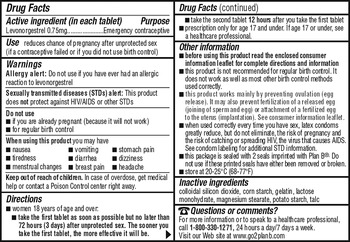
Thus, though it might be surprising that the FDA eventually approved the switch from prescription-only to OTC availability, this fierce conflict did leave a scar.Footnote 9 This trace came in the form of an unprecedented drug label with a hedged claim about Plan B's mechanism: “this product works mainly by preventing ovulation (egg release). It may also prevent fertilization of a released egg (joining of sperm and egg) or attachment of a fertilized egg to the uterus (implantation)” (see Figure 1, my emphasis). Now, if the drug had still required a prescription, only providers would be privy to this label, and the primary issue would involve the (lack of) power of patients. However, with the final approval for OTC sale in 2006, the issue with the “drug fact” shifted from a straightforward lack of power to a more complex problem about the knowledge/power of patients, entangling ethics with epistemology.
The official “Drug Facts” for Plan B once FDA approved for sale over-the-counter in 2006.

Plan B was initially a feminist asset for reproductive rights, but its new market-oriented sponsor, Barr Laboratories, had succumbed to pressure from antiabortionists because of their opposition during the 2003 FDA meeting.Footnote 10 Furthermore, the same description was later added to the FDA's website (FDA 2013), which had significant impacts on health insurance by way of a Supreme Court decision. Leaving those consequences for the next section, we begin with the value judgments obscured in this scientific claim and the epistemic harms of producing the claim.
Zygote-centric Values
At the beginning of the 2003 FDA meeting, representatives from drug sponsor Barr and the President of the American College of Obstetrics and Gynecology (ACOG) asserted that Plan B works by preventing ovulation and possibly fertilization but not implantation (FDA 2003, 30–31, 36–37, 267). One science adviser balked in response: Dr. Joseph Stanford, a “right-to-life” Mormon appointed to the committee by President George W. Bush (Prescott Reference Prescott2011, 118; Stanford Reference Stanford2011a; Reference Stanford2011b). Prior to the meeting, Stanford had co-authored journal articles on the morning-after pill's mechanism and its relation to abortion and informed consent (Larimore and Stanford Reference Larimore and Stanford2000; Kahlenborn, Stanford, and Larimore Reference Kahlenborn, Stanford and Larimore2002). He claimed that his concerns lay with patients who oppose abortion: “I think it is an important issue for women who want to have a clear idea of the best evidence of how this works and for their informed consent for use” (FDA 2003, 267; see also Stanford, Hager, and Crockett Reference Stanford, David Hager and Crockett2004). Because the drug was effective five days after treatment in clinical trials, Stanford contended that Plan B acted after fertilization “at times” or at least “some of the time,” making it a potential abortifacient (FDA 2003, 270–71).
Closer inspection of Stanford's publications reveals the values underlying his judgment about the mechanism, particularly zygote rights.Footnote 11 Antiabortionists like Stanford believe that pregnancy and life begin at fertilization along with human personhood; if so, fertilized eggs (zygotes) have full moral status and a “right to life” (Wilks Reference Wilks2000; Larimore, Stanford, and Kahlenborn Reference Larimore, Stanford and Kahlenborn2004). Accordingly, they hold a variety of zygote-centric beliefs, which influenced their judgments about the mechanism and the scientific evidence for/against it (see ChoGlueck Reference ChoGlueck2021 for more on zygote-centrism). For instance, Stanford notes how the zygote-centrist would describe a drug with this mechanism not merely as “preventing implantation” or having “a postfertilization effect,” but with more moral and teleological valance as functioning “to kill a fertilized egg” (FDA 2003, 289, my emphasis).Footnote 12
These values influenced the standards by which Stanford and others weighed evidence for or against the postfertilization effect. Antiabortionists want to minimize the risks to the lives of zygotes; therefore, Stanford and his colleagues required evidence not of mechanisms “definitely proven to exist or proven to be a common event,” but instead of “rare but important events . . . even if the possibility is judged to be remote” (Kahlenborn, Stanford, and Larimore Reference Kahlenborn, Stanford and Larimore2002, 468, my emphasis). This standard of remote possibilities influenced Stanford's interpretation of the “five-day window,” which he used at the meeting as evidence of a postfertilization effect. Because delayed efficacy might imply that the drug had not completely suppressed ovulation and could still affect zygotes, Stanford asserted to the FDA committee that interference after fertilization was possible “at times,” albeit rare.
Several advisors criticized these value judgments. For instance, FDA chairperson Dr. Linda Giudice immediately challenged Stanford's judgments about the trials because “a five-day window can be interpreted with the sperm being in the reproductive tract for 72 to 96 hours with a very late ovulation and with an effect of the levonorgestrel on a decreased release of the sperm in the cervical mucous or in the crypts of the fallopian tubes” (FDA 2003, 272). Another adviser, Dr. Alastair Wood, considered a novel label about the mechanism distracting and empirically gratuitous: “I would caution, however, against studding the outside of the packet like a Christmas tree with all sorts of issues. I'm particularly concerned about putting things on the outside of the package which are unsupported by data” (341). During the final votes, only five of the twenty-seven advisors expressed their agreement with Stanford's zygote-centric judgments about the mechanism and his suggestion to describe the mechanism “at the point of purchase” with a label on the carton (319, 398–409).
Nonetheless, rather than stating nothing in the “Drug Facts”—which is the norm—Barr Research added an unprecedented label to the outside of the carton that Plan B “may also prevent . . . implantation,” which is the zygote-centric definition of abortion (see Figure 1). Crucially, the process ignored relevant criticisms from advisors who did not share these values. Without response to their alternative interpretations and critical judgments, and with the complicit backing of the FDA, the pharmaceutical company wrote the label under pressure from antiabortionists. The antiabortion values from advisers like Stanford alone supported the scientific judgments that designated the meaning of this claim, the standard of evidence for it, and the impetus to communicate it with patients. Thus, zygote-centric values were decisive in the constitution of this drug label.
The Epistemic Injustice of Deception
What epistemic wrongs resulted from this production of knowledge at the FDA? At the individual level, this process wronged patients by deceiving them about the quality of the knowledge itself, particularly its shaky evidential grounding and its value-ladenness. Once the label was finalized, FDA advisors Dr. Frank Davidoff and Dr. James Trussell argued that antiabortionists had used an unreasonable and unfalsifiable standard based on a “politics of doubt,” aimed at impeding women's access and justifying provider refusals (Davidoff and Trussell Reference Davidoff and Trussell2006, 1775). Without this burdensome standard, a postfertilization effect described in the label looked “speculative, since virtually no evidence supports that [implantation] mechanism and some evidence contradicts it” (1777). Thus, at the core of this knowledge-production is a deception that sows doubt among potential users of the pill.Footnote 13
In a sleight of hand, this framing of “drug fact” cloaked the value-ladenness of the information and misrepresented it as objective science. The issue is not that contextual values influenced science. Rather, the problem is the distortion of the communal norms of the scientific process. Based on Longino's transformative ideal for objective (value-laden) science, it is deceptive to call this claim a scientific “drug fact” before it has withstood proper scrutiny across a diversity of values and the uptake of those criticisms (Longino Reference Longino1990). Thus, for a “drug fact” to be objective,Footnote 14 any controversial value judgments in the process ought to be made transparent, subjected to scrutiny, and then resolved in a transformative manner. Yet the process of making Plan B's label ignored relevant criticisms from non-zygote-centrists, ultimately obscuring the values necessary to the constitution of this “drug fact.” Accordingly, the drug label does not deserve the scientific credibility that comes with FDA authorization.
This deception is a distinctly epistemic sort of wrong because it undermines the autonomy of individual patients to make decisions based on their personal values. Respect for autonomy is a foundational principle of bioethics (Beauchamp and Childress Reference Beauchamp and Childress2013), and patients have a variety of stances on the moral status of zygotes, including indecision. However, assuming that one size fits all, Plan B's “drug fact” is premised on debatable judgments and background assumptions that highly value zygotic life. The “drug fact” indiscriminately imposes that parochial set of values on all potential drug users, irrespective of their own beliefs.
Furthermore, all potential users are harmed by this deception, regardless of their moral stance toward zygotes. For patients who disagree with the values of these antiabortionists, the operative standard of evidence is incongruent with their beliefs. Were they familiar with the cited evidence, potential users would likely disagree with the value judgments and consider the information inconsequential to their own decision. For patients who vacillate about early life ethics or who do not know whether they should assign moral value to zygotes, the label suggests that this piece of information is something they ought to consider when making their decision.Footnote 15
Even for potential users who are antiabortionists and have zygote-centric values, this “drug fact” is largely useless because it pushes them toward excessive caution. All parties admit that the drug works primarily by delaying ovulation, so even zygote-centric patients could use the drug at times with more proper guidance in line with their values. Yet this vague, hedged claim does not provide zygote-centric patients any information about how to reduce the risks to zygotes when using this drug. Instead, the label errs on the side of brevity, without information about how to balance the risks to zygotes with potential benefits to the user (such as possibly reducing risks of maternal mortality and postpartum depression). Rather than enabling epistemic autonomy and agency, the drug label undermines it, encouraging complete disuse out of fear for the remote possibility of inhibiting a zygote from implantation.
Epistemic Oppression through Sexist Knowledge
At the collective level, this process imbued information with values that were sexist and perpetuated women's oppression through such value-ladenness. Recall that the function of sexism is to rationalize the patriarchal order where men dominate women—often a task of normalizing women's inferiority and their “natural duty to provide safe haven and nurture” (Manne Reference Manne2018, 99). These zygote-centric values from antiabortionists reveal a sexist ideology, at least in the context of reproductive health in the US today,Footnote 16 because they legitimize the reduced social power of women and, more specifically, anyone who can get pregnant. Rather than enabling women's ability to exercise their autonomy and their right to not be pregnant, the label instead limits women's agency by narrowing their reproductive rights to the alleged rights of zygotes.
Although the deception of concealing these values in Plan B's label might be unintentional, its effects reinforce systems of domination because the values of patriarchy are so resilient and protected from criticism. As Dotson explains, epistemic oppression is a high order of epistemic exclusion in that the hegemonic resources are inadequate for addressing the exclusion of marginalized groups. This inadequacy for self-criticism renders dominant systems of knowledge resilient and enables them to maintain epistemic oppression (Dotson Reference Dotson2014; see also Medina Reference Medina2013). As Longino notes, “‘Letting the data suggest’ is a recipe for replicating the mainstream values and ideology that feminists and radical scientists reject” (Longino Reference Longino1990, 218). Despite the fact that zygote-centric values are the very premises of the epistemic constitution of this “drug fact,” antiabortionists can appeal to this label as an independent, value-free source of information to justify their actions. Insofar as this mechanistic claim is value-laden, the information itself both contains these sexist values and perpetuates them through its underhanded value-ladenness.
It is not incidental that zygote-centric values have been concealed in this drug label. The modus operandi of sexism is the mundane disenfranchisement of women, slyly accomplished, to normalize women's inferior status.Footnote 17 Epistemic deceit is thus characteristic of patriarchy, linking individual epistemic injustices with collective epistemic oppression. This does not mean that the potential beneficiaries of emergency contraception and their advocates did not recognize and resist the influence of antiabortionists on FDA decision-making.Footnote 18 Yet this value-laden label went under their radar—despite how it would harm the epistemic autonomy of all potential users and reinforce women's oppression through purported knowledge. Regrettably, this label was quickly utilized by antiabortionists to enforce patriarchy's gender norms.
III. Keeping Women “in Their Place” as Mothers
If the relevance of values for science were chiefly about the immediate impact of values on knowledge-production—as the epistemically oriented approach suggests—our story could end here. However, this would overlook the mediate social consequences of the influences of zygote-centric values on science. To link the values in the science with the social value of that science, this section analyzes the broader impacts for society—which the ethical approach would commend in terms of social justice, not necessarily epistemic injustice per se. To demonstrate the power of this purported knowledge about Plan B and its dependence on unfair social norms and structures, this section focuses on the cultural and institutional facets of its impacts in the courts, healthcare facilities, and workplaces. I use this to support my secondary conclusion: there should not be nearly as strong institutional support for healthcare providers to refuse services to patients when their actions are based on value-laden claims.
With its obscured sexist values, this “drug fact” has several harmful consequences for patients’ access to emergency contraceptives. This information enables the coercion of patients’ epistemic autonomy, both proactively and reactively, by imposing on them zygote-centric values, motherhood, and pregnancy itself. Zygote-centrists believe that after fertilization not only is the zygote a person, but also the person carrying the zygote is now a mother—with the potential for good or evil. This section demonstrates the epistemic means of patriarchy's “psychological terrorism and violence” (hooks, Reference hooks2004): how paternalism disciplines women to become “good mothers” who sacrifice their bodies for their children (Bartky Reference Bartky, Diamond and Quinby1988), and misogyny punishes “bad mothers” who do not (Manne Reference Manne2018). I also attend to the different ways zygote-centrists racialize and class “motherhood” (Roberts Reference Roberts1997), illustrating how the misogyny of provider refusals intersects with structural inequalities like health disparities by race and class and barriers to access (Yang Reference Yang2020).
A Warning for “Good Mothers”
According to the antiabortion advisers, part of the reasoning behind labeling Plan B with a statement about its mechanism was to enable patient autonomy. For instance, Dr. Susan Crockett contended that it would undermine women's agency to not describe the mechanism on the outside of the package: “I think if you don't print on the label that this may affect a fertilized egg in an unfavorable way that you're removing my choice and my ability to make the decision about how I am affecting my body and my pregnancy” (FDA 2003, 408, my emphasis). Crockett, an antiabortionist and a Bush appointee, voted with Stanford against making Plan B available OTC, in part because of this lack of informed consent (Stanford, Hager, and Crockett Reference Stanford, David Hager and Crockett2004; Prescott Reference Prescott2011, 118). Yet I have already argued that this logic is dubious.Footnote 19 If not informed consent, what is the actual function of this drug label for patients?
I contend that, rather than promoting epistemic autonomy by enabling informed decision-making, this label does quite the inverse: The drug label is a warning that functions to discipline women's agency toward compliance under patriarchy.Footnote 20 The bold-font description of the mechanism is surrounded by other warnings, instructions, and recommendations that direct patients toward “correct” behaviors (see Figure 1). Similarly, this “drug fact” aims to caution users about a purported ethical risk (the killing of an innocent person) and, ultimately, to encourage them in their alleged responsibility to protect zygotes.
Stanford and his zygote-centric colleagues criticized others for assuming that “all patients will not care about a postfertilization effect” (Kahlenborn, Stanford, and Larimore Reference Kahlenborn, Stanford and Larimore2002, 468); however, their warning label makes an even worse supposition. Rather than taking potential users to be fully autonomous subjects capable of choosing their own values and weighing the risks accordingly, this label engages in paternalism by instructing them what their values ought to be (zygote-centric) and how they ought to act (don't risk taking the drug!).Footnote 21 The label could have supplied patients with enough information to understand the uncertainties of the mechanism and to act according to their values, zygote-centric or otherwise. Instead, it takes each potential user of the morning-after pill to be an epistemically unreliable subject,Footnote 22 who is able—and maybe even likely—to deviate from the norms set by the sexist ideology of zygote-centrism.
For example, antiabortionists at the FDA meeting were less than optimistic about the abilities and integrity of women, especially young women. They considered it the duty of women to be “good mothers” who respect and protect zygotic life and thus who minimize any risks to zygotes when making reproductive decisions. Yet they were anxious that greater access to the morning-after pill would create (literally) perverse incentives for women to embrace their sexuality without heeding their maternal responsibilities. For instance, President Julie Brown of the antiabortion American Life League testified during the public forum to the moral dangers of a pill with the purpose “to destroy the evidence that a sexual encounter has occurred that could result in the conception of a child” (FDA 2003, 214). By separating sex from reproduction, “adolescents who might have given such a result a second thought will not be inclined to take pregnancy into consideration before engaging in risky sex.” The problem begins when people who can get pregnant forget their maternal duty: Think of the children!
Furthermore, antiabortionists were concerned that the potential users—assumed to be cisgender women—would be unable to make “good” decisions because of their female bodies.Footnote 23 Jennifer Taylor from the antiabortion organization Human Life International bemoaned the moral corruption at the root of requests for the morning-after pill, by women with “the inability to control themselves in sexual situations” (FDA 2003, 239). From her zygote-centric perspective, these women were “slaves to their bodies” who are unlikely to consider the risk to zygotes when choosing whether to take the pill or, at best, to take the risk too lightly (293). Exemplified in the testimony from Brown and Taylor, “good women” ought to control themselves and have sex only if they plan to carry the pregnancy to term; however, when access to Plan B is unfettered, such norms are likely violated. These concerns about (young) women's irresponsibility motivated a desire to warn possible users and point them toward what antiabortionists considered the “right” choice: not to use this drug.
Thus the gender norms behind this warning label assume a distrustful view of the potential users of this pill. According to Gaile Pohlhaus, Jr., this attribution of a “truncated” or “circumscribed subjectivity” is a form of othering. It reduces full subjects to “semi-subjects,” who are not fully capable and thus prone to failure, vice, and treachery (Pohlhaus Reference Pohlhaus2014, 105).Footnote 24 In this case, possible users of Plan B are othered according to the sexist gender norms of zygote-centrism: (cisgender) women are “the Reproductive Other” under patriarchy, those with bodies “naturally endowed” to bear children. Ironically, though it is the “duty” of those born with uteruses to be “good mothers” who value and protect zygotic life, the very bodies that provide them this duty also dispose them to shirking their responsibilities.
In turn, the warning label forcefully imposes on users a truncated subjectivity, covertly undermining their epistemic autonomy to follow oppressive norms. Precisely because of the alleged disposition of young women to deviance, zygote-centric beliefs about their reproductive responsibilities are forced on all users without their knowing. The label thus compels potential users to internalize this truncated subjectivity by believing and acting on this drug label. As Stanford himself notes, even before interacting with healthcare professionals, some participants in the drug trials interpreted this warning label as associating their use with the murderous intent “to kill a fertilized egg” (FDA 2003, 289). Therefore, potential users might abstain from using the drug and possibly even accept the inevitability of their pregnancy.Footnote 25 Such disuse would be a (temporary) success for the restrictive gender norms of zygote-centrism, which function to protect zygotes and, more fundamentally, to dominate women's choices about their bodies.
At the collective level, therefore, this label has the oppressive function of paternalism: the proactive control of women through an internalized structure of the self. Here, patriarchy enforces women's subjugation through self-discipline, shaping their subjectivities to be docile and compliant (Bartky Reference Bartky, Diamond and Quinby1988). Obstetrics, gynecology, and public health are full of fetal-centric paternalism (Lyerly et al. Reference Lyerly, Mitchell, Armstrong, Harris, Kukla, Kuppermann and Little2009; Kukla Reference Kukla2010; Waggoner Reference Waggoner2015).Footnote 26 The goal of paternalism is for women to tell themselves, this is the sacrifice I ought to make to be a good mother. Here, the drug label instructs women to organize their own behavior around the risks to zygotes. Ultimately, these warning labels shape potential users to submit themselves and their bodies to their (potential) children, families, and (male) partners. Allegedly benevolent, these paternalistic norms of “good motherhood” function not to improve women's health or well-being but rather to control the Reproductive Other.Footnote 27
Thus, producing this label causes additional epistemic harm at the individual level beyond merely deceiving patients, as it further shapes their subjectivity in a restrictive way as epistemically untrustworthy. The label anticipates noncompliance with zygote-centric responsibilities because of the users that antiabortionists expected: young, uninhibited, unreliable (cisgender) women. This paternalism serves patriarchy as a proactive form of control over women to encourage their “good behavior” of abstaining from the dangerous morning-after pill. Yet these preemptive measures of imposing values through drug labels can only go so far: not everyone reads the fine print, and many women reject zygote-centric values as oppressive. Thus, patriarchy employs additional means of gender enforcement, which relies even more fundamentally on the FDA drug label.
A Tool for Punishing “Bad Mothers”
Although the label's function for patients is to instruct them how to be “good mothers,” its purpose for healthcare providers is more for the complementary norm of “bad mothers.” That is, the drug label warns potential users of the risks to zygotes that they are responsible for minimizing, but it also provides antiabortionists a tool for punishing would-be users as deviants: the authoritative label legitimizes their empirical claims for conscientious-objector status and religious exemptions. This reactive form of control over deviations from gender norms is characteristic of misogyny (Manne Reference Manne2018). Because misogyny targets “bad women,” such punishments disproportionately harm poor women, Indigenous women, and women of color, who are unfairly stereotyped as “welfare queens” and “unworthy mothers” (Roberts Reference Roberts1997; Armstrong Reference Armstrong2003).
By design, this deceptive label was intended to assist antiabortion healthcare professionals to refuse to write and dispense prescriptions for morning-after pills. A few years prior, Dr. Walter Larimore and Stanford began to spread this misinformation to like-minded professionals through journal publications because, after learning about the postfertilization effect themselves, they could no longer prescribe contraceptives “in good conscience” (Larimore and Stanford Reference Larimore and Stanford2000, 133; see also Kahlenborn, Stanford, and Larimore Reference Kahlenborn, Stanford and Larimore2002). Even though Plan B eventually became available OTC, refusals to have still come through pharmacists who limit access through different stocking practices and opt-outs (for example, Wilks Reference Wilks2004; see Shacter, Gee, and Long Reference Shacter, Gee and Long2007; Chiarello Reference Chiarello2013). Today, six states explicitly allow pharmacists to refuse to dispense emergency contraceptives, and an additional five provide protections for refusals more broadly (Guttmacher Institute 2020). Despite its availability to women under eighteen, many pharmacists refuse to provide emergency contraception to adolescents, and they refuse Spanish-speaking women more often than English speakers and do so at rural pharmacies more often than urban ones (Sampson et al. Reference Sampson, Navarro, Khan, Hearst, Raine, Gold, Miller and de Bocanegra2009).
Under the banner of “conscientious objection,” provider refusals are especially common in emergency rooms at Catholic hospitals, which have grown over the past two decades through mergers with non-Catholic hospitals to constitute over 10% of US hospitals (CFFC 2005; Uttley et al. Reference Uttley, Reynertson, Kenny, Melling and HasBrouck2013). Catholic ethical and religious directives limit the use of emergency contraception to prefertilization for preventing pregnancy after sexual assault (USCCB 2009, directive #36). Furthermore, Catholic hospitals are more likely than non-Catholic hospitals to prohibit discussion, prescription, and dispensation of the morning-after pill to rape survivors, despite its being the standard of care (Smugar, Spina, and Merz Reference Smugar, Spina and Merz2000). Accordingly, 82% of Catholic hospitals reported that they did not provide morning-after pills, and only 22% provided referrals (Bucar Reference Bucar1999).
In addition to these religiously based refusals from providers, there have also been significant cases of denial by employers who in the name of “religious freedom” refuse to cover the insurance expenses of emergency contraception.Footnote 28 Antiabortion organizations, especially the US Conference of Catholic Bishops, have lobbied for years to expand “conscience clauses” to include “abortifacient contraceptives” (Griffin Reference Griffin2015; Miller Reference Miller2015, 184–85). In 2010, the Affordable Care Act (“Obamacare”) required health insurers to cover all FDA-approved contraceptives, including Plan B, as “preventative health services.” Since then, there have been over one hundred legal cases challenging this “contraceptive mandate” under the First Amendment and the Religious Freedom Restoration Act of 1993 (Tschann and Soon Reference Tschann and Soon2015).
In these cases, the FDA drug label has been crucial. For instance, when the craft-store chain Hobby Lobby and the Christian bookstore chain Mardel sued the federal government, they cited the FDA's own information that contraceptives like Plan B act abortifaciently (Brief for Hobby Lobby Stores Inc. et al. 2013, 5). The information on that FDA website came directly from the drug facts (FDA 2006; 2013). This description of the mechanism was opposed by many women's health researchers, who submitted an amici curiae brief charging that the label was empirically inadequate since “later studies have led to the conclusion that [levonorgestrel] does not cause changes to the endometrium (uterine lining) that would hamper implantation” (Brief for Physicians for Reproductive Health et al. 2013, 16; see also FIGO and ICEC 2008; Gemzell-Danielsson, Berger, and Lalitkumar Reference Gemzell-Danielsson, Berger and Lalitkumar2013). Nevertheless, the Supreme Court trusted the FDA when ruling in favor of the religious freedom of business owners (and other closely held, for-profit firms) to refuse to cover these alleged abortifacients (Burwell 2014, footnote 7).
Provider refusals are based on the moral claim that they are “conscientious objectors” to cooperating in an immoral act. However, this analogy is dubious: Unlike pacifists who object to military drafts, antiabortion healthcare professionals are not forcibly conscripted into gynecology or pharmacy (Fiala and Arthur Reference Fiala and Arthur2014).Footnote 29
The ethical issue at the individual level again is one of disrespect for autonomy: These acts of refusal and denial of healthcare coerce patients and their choices. This is a case of “forced gestation” that wrongs women and those who can become pregnant by compelling them into a state of physical intimacy with and occupation by an unwanted entity (Little Reference Little1999, 301). As McLeod argues, this is not a “mere inconvenience” for patients but a veritable harm because it interferes with their ability to continue seeking the drug, their moral identity, and their sense of security (McLeod Reference McLeod2010). These refusals either shame women away from using the pill or force them elsewhere. Additionally, provider refusals impose on patients the physical and mental health risks that come with pregnancy because emergency contraception is effective only within seventy-two hours, and its effectiveness decreases during that period.
Yet this threat to bodily integrity comes not only from the sexist values of medical authorities but also from the FDA's drug label that grounds providers’ right to refuse. Thus, this coercion of bodily autonomy is a specifically epistemic form of injustice because these refusals are empirically grounded on the debatable, value-laden “drug fact.” Unlike with Fricker's testimonial injustice, the issue is not deflated/inflated credibility based on stereotypes. Instead, the problem is how undue credence in this mechanistic knowledge and its undeserved credibility are enabling epistemic conditions for undermining patient autonomy. For instance, during Burwell v. Hobby Lobby, the Supreme Court relied on the FDA's epistemic authority, despite the obscured values constituting the information.
Moving to the collective level, these impositions of pregnancy and motherhood constitute epistemic oppression because of their specific patriarchal function: misogynistic punishment of “bad women” (Manne Reference Manne2018). These acts of “conscientious objection” and “religious freedom” are best understood as practices of moral gatekeeping, defined by Elizabeth Chiarello as the “process of social control in which providers uphold cultural and societal values by distributing resources in ways that reward those who comply with normative standards and punish those who do not” (Chiarello Reference Chiarello2013, 325). These refusals are hostile reactions to behavior perceived as “unbecoming of a mother.” They echo the sentiments of Brown and Taylor, who viewed users as sexual deviants who reject children (and motherhood) as the natural, proper outcome of sex (Wynn and Trussell Reference Wynn and Trussell2006a; Reference Wynn and Trussell2006b). According to their misogynistic logic, don't do the crime (sex) if you can't do the time (pregnancy, motherhood). Withholding the medicine from “bad mothers” forces them to conform to these sexual norms, and the FDA's authoritative drug label unwittingly provides empirical legitimacy for such actions.
Teasing out this misogyny in terms of intersectional oppression, we see how different groups of women are harmed differently by these refusals, particularly women of color, poor women, immigrants, Indigenous women, and disabled women (see Yang Reference Yang2020). Typically, women on the margins face pressure to not have children, such as through widespread forced sterilizations supported by eugenic government programs (Patel Reference Patel2017). In contrast, the zygote-centric ideology perceives Plan B to fall somewhere between contraception and abortion, so the threat is less from “women” and more from already “mothers” with maternal responsibilities. As argued above, refusals are reactive misogyny against “bad mothers,” which is racialized and class/ability-based, such that women on the margins are perennially seen as “bad mothers” (Roberts Reference Roberts1997; see also Armstrong Reference Armstrong2003). Therefore, one expects antiabortion providers to refuse marginalized groups at higher rates to “correct” for their “mistakes.” For instance, women of color and immigrants face outright discrimination by healthcare professionals, such as how young Spanish-speakers are refused the morning-after pill at twice the rates of English-speakers (Sampson et al. Reference Sampson, Navarro, Khan, Hearst, Raine, Gold, Miller and de Bocanegra2009).Footnote 30 For Black women specifically, this extra burden of misogynistic, anti-Black refusal is an example of what Moya Bailey calls misogynoir (Bailey Reference Bailey2016).
The expected discrimination against women on the margins is further exacerbated by health disparities: When women of color, especially Black women, are forced to carry pregnancies further, they face higher risks of morbidity and mortality than white women. Part of the cause is structural racism: Black women face two to three times the risk of dying from pregnancy (Tucker et al. Reference Tucker, Berg, Callaghan and Hsia2007); and Black, Indigenous, Latina, and Asian/Pacific Islander women are all more likely than white women to become seriously ill during pregnancy (Creanga et al. Reference Creanga, Bateman, Kuklina and Callaghan2014). In this disproportionate manner, provider refusals undermine not only the autonomy of women of color but also their very lives.
Additionally, the refusals enabled by this drug label also harm poor women and Indigenous women disproportionately because of structural barriers to their access and state control over their healthcare (Yang Reference Yang2020). Particularly in publicly funded facilities, increased protections for providers’ rights by the new HHS division will only increase the instances of these epistemic injustices. After an antiabortionist denies someone a drug, that person must spend extra time to search and travel to find an alternative provider. This search burden is heavier for people of lower socioeconomic status and with disabilities, and it reduces the effectiveness of emergency contraception and thus increases the likelihood of an unwanted pregnancy (with the associated cost of abortion). Furthermore, women on Medicaid are subject to increased scrutiny from their physician to get a prescription and then their pharmacist to fill it, further impeding their access.Footnote 31 Medicaid recipients are disproportionately Black and Latinx/Hispanic (KFF 2018). HHS oversees hospitals under the Indian Health Service, placing Native American women under increased scrutiny by federal authorities.
So far, we have seen how knowledge is shaped by hegemonic power as well as how those in power use such knowledge to enforce social hierarchies of gender, race, class, and so on. The drug label with its undue credibility from the FDA's authority is the empirical grounding for these acts—not despite our current law and order, but rather as regular cases of their normal functioning for the traditional social order. Echoing Dotson, the misogyny and paternalism enabled by this drug label evidence the resilience of patriarchy, its sexist ideology, and intersecting systems of domination (Dotson Reference Dotson2012; Reference Dotson2014). First, sexism influences science through debatable judgments about evidence, producing knowledge-claims laden with obscured values. Then, these epistemic tools enable downstream injustices, such as coercing patients into paternalistic norms and imposing pregnancy and motherhood as punishments for gender nonconformity. If this is how epistemic oppression works through science, I suggest we ought to nip patriarchy in the bud.
IV. Exclude Zygote-Centric Values: Don't Protect Refusals by Providers
I draw two conclusions from this analysis, the first involving illegitimate values in knowledge-production and the second involving unfair organizational structures. I will discuss each in turn, along with several objections. My primary conclusion is that the zygote-centric values and gender norms of antiabortionists are illegitimate in reproductive medicine because they undermine epistemic autonomy and enable epistemic oppression. For this case of sexist science, the problem lies in the interaction between epistemology and injustice. In the context of patriarchy in the US, this purported knowledge laden with sexist values wrongs knowers as knowers, and that same knowledge enables powerful groups to perpetuate systems of oppression epistemically.
My diagnosis of these entangled epistemic-ethical problems exposes previously unnoticed features of sexist science and avoids some philosophical worries about values in science. For one, beyond the critiques by feminist empiricists (for example, Anderson Reference Anderson2004; Lloyd Reference Lloyd2005), I have demonstrated how sexist values adversely impact not only the research process itself but also the broader use of scientific claims, such as how zygote-centric knowledge restricts and undermines the epistemic autonomy of patients. Some philosophers have expressed concerns that working for justice in science might lead to wishful thinking and undermine science's epistemic goals, based on the assumption that ethics and epistemology can work in opposition (Douglas Reference Douglas and Humphreys2015; see also Brown Reference Brown2013). However, my integrated approach rejects the dualistic separation of the epistemic aims of science from its ethical goals (contrast with Kourany Reference Kourany2010), instead exhibiting the more harmonious concord between ethics and epistemology (Hicks Reference Hicks2014). To combat epistemic oppression, extracting sexist values from reproductive medicine would be mutually advantageous for knowledge-production and social justice because of their interdependence.
I anticipate two objections to this primary conclusion that zygote-centric values are illegitimate in US reproductive medicine and regulatory science. First, one might object that my approach has assumed too much about justice from feminist theory. Whereas some contend that Kourany's ethically oriented approach (Kourany Reference Kourany2010) does not go far enough to specify what counts as “socially responsible” values (Brown Reference Brown2013), my analysis might go too far in the other direction: Many of the issues discussed here follow from the ethical quagmire surrounding reproductive rights and abortion. By arguing that zygote-centric conceptions of women and motherhood are unfair, I may have “muddied the waters” and undermined my own ability to make progress in these disputes.Footnote 32
I grant that my analysis is unlikely to convince the most avid antiabortionists. For over half a century, doctors and researchers have debated the mechanism of the morning-after pill because of its ethical and religious significance (ChoGlueck Reference ChoGlueck2019). Today, there remains a small minority of influential scientists and physicians who advise the powerful Catholic Medical Association and maintain that Plan B may have a postfertilization effect (Raviele Reference Raviele2014; Kahlenborn, Peck, and Severs Reference Kahlenborn, Peck and Severs2015; Raviele et al. Reference Raviele, Kahlenborn, Peck, Ruppersberger, Yeung, Tham and Gutowski2015).
Nonetheless, I am skeptical of the potential for resolving Plan B's mechanism without appealing to some conception of justice because of how entangled values are in assessments of facts. Since the 2000s, disagreement about the mechanism of Plan B has decreased, as some zygote-centrists have come to reject its postfertilization potential (see Reznik Reference Reznik2010), such as biologist and Catholic priest Nicanor Austriaco and Catholic nun Patricia Talone (Austriaco Reference Austriaco2007; Talone Reference Talone2010). Crucially, this shift has been ethical and epistemic: partly because of increased concern for the rights of rape survivors (Holbrook Reference Holbrook2010; Talone Reference Talone2010) and because of innovative methods for assessing mechanisms more precisely (Lalitkumar et al. Reference Lalitkumar, Lalitkumar, Meng, Stavreus-Evers, Hambiliki, Bentin-Ley and Gemzell-Danielsson2007; Gemzell-Danielsson, Berger, and Lalitkumar Reference Gemzell-Danielsson, Berger and Lalitkumar2013). Furthermore, I hope to have found some shared ethical grounding, involving the epistemic conditions for patient autonomy and personal liberty from government interference.Footnote 33 Even for advocates of zygote-centrism, if patient autonomy is fundamentally important, it is morally unacceptable to use such deceptive means for achieving antiabortion ends.
Related to patients’ rights is a second objection: Though the label might be abused down the line to reduce women's freedoms, one may object that a complete exclusion of zygote-centric values from reproductive health would violate patients’ fundamental right to know.Footnote 34 Such prohibitions may lead to an undue withholding of important information by medical authorities. Given the uncertainties surrounding the science—and the importance of values in managing uncertainty—it is not clear to experts or laypeople where the truth lies about the mechanism. As Crockett argued, “truth in labeling” is key for patient autonomy, and patients have a variety of values; therefore, more information from more perspectives—even zygote-centric ones—might be better for patients than less (FDA 2003, 408).
Although I share these concerns about paternalism, I do not think that this drug label is informative or liberatory. I have argued that the mechanistic claim that Plan B “may prevent implantation” is deceptive because it has not withstood the scientific scrutiny required of an objective “drug fact.” Accordingly, this claim leaves consumers without the knowledge needed to weigh risks against benefits. Moreover, not all “knowledge” is liberating, especially alleged knowledge couched in uncertainty and based on suppressed sexist gender norms.Footnote 35 For Plan B, the “drug fact” serves the patriarchal functions of paternalism and misogyny, which were essential to its creation. Furthermore, even if we grant that patients have a right to know about the mechanism, it is doubtful that the responsibility for informing users falls on the FDA.Footnote 36
This brings me to my secondary conclusion, which is a corollary to the first and answers the question of whose values are legitimate in science and medicine. If zygote-centric values are illegitimate in reproductive health, then so too are organizations created to protect medical authorities who exercise these values in the name of “religious freedom” and “conscientious objection.” Thus, I contend that healthcare providers should not receive institutional support for refusing services like the morning-after pill to patients based on their value-laden claims. It is these policies and procedures that give zygote-centrism its teeth and enable authorities to impose their sexist values on patients, limit their epistemic autonomy, and dominate their epistemic resources. Moreover, because these rules have more influence in publicly funded facilities, federal protections like the HHS Division for Conscience and Religious Freedom will disproportionately harm poor women of color and Indigenous women.
Instead of privileging the values of providers, healthcare institutions ought to prioritize patients and their values in managing the uncertainty about scientific claims and in organizing the practice of healthcare. The solution is not only centering the patient but also critically reimagining “the patient” to resist hierarchies of gender, race, class, and so on by centering marginalized groups of women and other people who can get pregnant (Roberts Reference Roberts and M1996). Accordingly, creative feminist practices will help resist this epistemic oppression and more positively promote epistemic justice, especially intersectional approaches from the reproductive justice movement (see Ross et al. Reference Ross, Roberts, Derkas, Peoples and Toure2017).
One might object that I have been hasty because this proposal would infringe on the “fundamental and inalienable” rights of healthcare professionals (HHS 2018b).Footnote 37 Regarding the morning-after pill, bioethicists have heavily debated the rights of pharmacists and physicians to refuse and deny drugs based on conscience and religious freedom. They have discussed many potential defenses for providers, such as the conditions required for their moral integrity and freedom and the limited burden on patients of a “simple refusal” (see Cantor and Baum Reference Cantor and Baum2004; Fenton and Lomasky Reference Fenton and Lomasky2005; Card Reference Card2007; McLeod Reference McLeod2010; Del Bo Reference Del Bo2012; Fenton Reference Fenton2013; Fiala and Arthur Reference Fiala and Arthur2014).
In response, I maintain that any professional rights to conscience are not fundamental and absolute “trumps” (contra HHS 2018b) but limited freedoms contingent on their responsibilities to patients. For one, refusals affect patients’ health and well-being more than that of providers. Furthermore, regardless of their intention, refusals can harm patients (McLeod Reference McLeod2010). This situation entails the need for creative compromises, such as obliging objectors to give prompt referrals to more willing providers (Cantor and Baum Reference Cantor and Baum2004; Fenton Reference Fenton2013). Nonetheless, in many cases, I anticipate a “zero-sum game” between two sets of irreconcilable views, where it is in the patient's interest to access this pill, yet the only provider who can do so in the timeframe of effectiveness refuses based on zygote-centric values.Footnote 38 When zygote-centrists refuse negotiations and demand blanket exemptions, what then are the limits to their conscience rights?
I suggest we use the following four guidelines for moral integrity from the Ethics Committee of the American College of Obstetrics and Gynecology (ACOG 2007, reaffirmed 2016). First, refusals ought not impose providers’ beliefs on patients because this would violate patient autonomy. Yet I have argued that refusals based on this “drug fact” undermine the agency of individual patients by imposing zygote-centric values through the information itself. The second criterion is that providers should consider the impact of their patient's well-being and that their primary patient is the woman. In contrast, the zygote-centric view deprioritizes women's health for concerns about the zygote. The third criterion of moral integrity is that a valid refusal must rest on sound, well-evidenced science. Yet I have argued that this “drug fact” is deceptive and undeserving of such credence.Footnote 39 Finally, providers must avoid refusals that are discriminatory and reinforce the oppression of marginalized groups, because refusals disproportionately burden poor women, women of color, and Indigenous women. Because all four criteria fail to hold, I conclude that refusals put providers’ moral integrity in jeopardy. Thus, when compromise fails, as it often has, professionals are morally compelled to provide women the drug.
I maintain that there is a compelling case based on epistemic oppression for excluding zygote-centric values from reproductive medicine and against strengthening institutional protections for value-laden provider refusals. This article has demonstrated how sexist science creates more problems than previously thought: Antiabortion scientific advisers have misused their authority for oppressive purposes and compromised the integrity of the scientific process, even in the face of criticism from women's health advocates. Their zygote-centric values have instantiated gender norms that were later imposed on patients and enforced through knowledge practices in courts and pharmacies. Socially engaged philosophers ought to support policy-makers in making better decisions about which values and whose values are illegitimate in regulatory science.Footnote 40 We ought to excise oppressive values from science to prevent epistemic injustice before it begins.
Acknowledgments
I am especially appreciative to Robyn Bluhm, Laura Cupples, Taeyin ChoGlueck, Kevin Elliott, Teresa Hoard-Jackson, Lisa Lloyd, Manuela Fernández Pinto, and Jutta Schickore for their detailed comments on earlier versions of this article. I developed this analysis from presentations at the Philosophy of Science Association and the Meeting of the Consortium for Socially Relevant Philosophy of/in Science and Engineering (SRPoiSE). I benefited from questions as those meetings as well as the comments, criticisms, and encouragement of Evan Arnet, Matt Brown, Jim Capshew, Justin Garcia, Nora Hangel, Dan Hicks, Bennet Holman, Suzanne Kawamleh, Janet Kourany, Dan Li, Monica Morrison, Erin Nash, Ryan O'Loughlin, and Alison Wylie. I also thank the University of Notre Dame for inspiring this project with their (unjust) suit against the Obamacare contraceptive mandate.
Chris ChoGlueck is Assistant Professor of Ethics at New Mexico Tech in Socorro, N.M.. He has a PhD in history and philosophy of science from Indiana University, Bloomington. His research and teaching focus on the intersection of science and values, spanning philosophy of science, biomedical ethics, and feminism. His main line of research explores how values and gender norms shape drug regulation at the US Food and Drug Administration (FDA), involving reproductive health and the labeling of pharmaceuticals, as well as the consequences for reproductive justice. He is beginning a new project on the medical epistemology of male contraception.