Introduction
A large body of literature has been devoted to integrating personality into general models of psychopathology. Personality traits spanning both normal and abnormal functioning have been mapped onto the widely accepted model of psychopathology containing the higher order factors of internalizing (e.g. mood and anxiety disorders) and externalizing (e.g. substance use disorder, antisocial personality disorder) (Krueger, Reference Krueger1999; Krueger et al. Reference Krueger, McGue and Iacono2001; Vollebergh et al. Reference Vollebergh, Iedema, Bijl, de Graaf, Smit and Ormel2001; Kendler et al. Reference Kendler, Prescott, Myers and Neale2003b ; Watson, Reference Watson2005; Slade & Watson, Reference Slade and Watson2006; Miller et al. Reference Miller, Fogler, Wolf, Kaloupek and Keane2008; Markon, Reference Markon2010; Miller et al. Reference Miller, Wolf, Reardon, Greene, Ofrat and McInerney2012). Most of this work is conducted within the context of the Big Five traits of neuroticism, extraversion, agreeableness, conscientiousness, and openness (Watson et al. Reference Watson, Clark and Harkness1994; Markon et al. Reference Markon, Krueger and Watson2005; Watson et al. Reference Watson, Clark and Chmielewski2008).
Neuroticism/negative emotionality (i.e. the tendency to experience negative emotions) is thought to be a large component of the internalizing disorders (Watson et al. Reference Watson, Gamez and Simms2005; Watson, Reference Watson2009), although there is also evidence that it has modest relations with externalizing disorders (Krueger et al. Reference Krueger, Caspi, Moffitt, Silva and McGee1996; Miller et al. Reference Miller, Vogt, Mozley, Kaloupek and Keane2006; Singh & Waldman, Reference Singh and Waldman2010; Miller et al. Reference Miller, Wolf, Reardon, Greene, Ofrat and McInerney2012). Low levels of extraversion/positive emotionality (i.e. pleasurable engagement in the environment) are thought to characterize internalizing disorders, particularly depression and social anxiety (Naragon-Gainey et al. Reference Naragon-Gainey, Watson and Markon2009; Watson & Naragon-Gainey, Reference Watson and Naragon-Gainey2010). Finally, disinhibition (which can be conceptualized as low agreeableness and low conscientiousness using the Big Five traits; see Markon et al. Reference Markon, Krueger and Watson2005) is uniquely related to externalizing disorders (Krueger et al. Reference Krueger, Hicks, Patrick, Carlson, Iacono and McGue2002; Krueger et al. Reference Krueger, Markon, Patrick, Benning and Kramer2007; Miller et al. Reference Miller, Wolf, Reardon, Greene, Ofrat and McInerney2012).
Given their heritable nature, personality traits have been implicated as risk factors for the onset of psychological disorders, with certain traits predicting certain disorders (Krueger et al. Reference Krueger, Hicks, Patrick, Carlson, Iacono and McGue2002; Kendler et al. Reference Kendler, Prescott, Myers and Neale2003b ; Lahey, Reference Lahey2009). For example, high levels of neuroticism/negative emotionality and low levels of extraversion/positive emotionality are thought to confer risk for depression. Similarly, high levels of disinhibition and to a lesser extent, neuroticism/negative emotionality, would place individuals at risk for the development of externalizing disorders. Constellations of traits have also been used to account for patterns of co-morbidity and symptom expression following traumatic events, particularly within the context of post-traumatic stress disorder (PTSD; Miller, Reference Miller2003; Miller et al. Reference Miller, Greif and Smith2003, Reference Miller, Wolf, Reardon, Greene, Ofrat and McInerney2012; Campbell et al. Reference Campbell, Renshaw and Righter2015).
Beyond direct influences, personality traits are thought to have an effect on the environment, indirectly contributing to onset or elevation of symptoms. Researchers have suggested that certain personality traits increase the risk of experiencing traumatic or stressful events, which in turn increases the likelihood of developing mental disorders (Foley et al. Reference Foley, Neale and Kendler1996; Saudino et al. Reference Saudino, Pedersen, Lichtenstein, McClearn and Plomin1997; Kendler et al. Reference Kendler, Gardner and Prescott2003a ; Lahey, Reference Lahey2009). According to these theories of genotype–environment correlations, individuals seek out certain environments as a function of their personalities (active genotype–environment correlation) or are more likely to be exposed to certain environments as a function of other people's reactions to their personalities (reactive genotype-environment correlation) (Plomin et al. Reference Plomin, DeFries and Loehlin1977).
Although some studies have failed to find a significant association between personality and adverse life events (Lockenhoff et al. Reference Lockenhoff, Terracciano, Patriciu, Eaton and Costa2009; Park et al. Reference Park, Frazier, Tennen, Mills and Tomich2013), a large number of prospective studies have demonstrated that the personality traits of neuroticism and disinhibition are related to negative experiences (Horwood & Fergusson, Reference Horwood and Fergusson1986; Fergusson & Horwood, Reference Fergusson and Horwood1987; Headey & Wearing, Reference Headey and Wearing1989; Poulton & Andrews, Reference Poulton and Andrews1992; Magnus et al. Reference Magnus, Diener, Fujita and Pavot1993; Kendler et al. Reference Kendler, Gardner and Prescott2003a ), including exposure to traumatic events (Breslau et al. Reference Breslau, Davis, Andreski and Peterson1991, Reference Breslau, Davis and Andreski1995) and combat exposure (Helzer et al. Reference Helzer, Robins, Wish and Hesselbrock1979; King et al. Reference King, King, Foy and Gudanowski1996).
Very few studies have examined both the direct and indirect effects of personality on psychopathology longitudinally. Horwood & Fergusson (Reference Horwood and Fergusson1986) found support for a model in which neuroticism predicted depression both directly and via adverse life events. In a more recent longitudinal study, Sadeh et al. (Reference Sadeh, Miller, Wolf and Harkness2015) found that adverse life events mediated the relation between neuroticism, disinhibition, and PTSD. They did not find significant direct effects of personality on symptoms when controlling for indirect pathways.
The current study extends this previous research to examine the direct and indirect pathways from baseline personality to internalizing and externalizing symptoms following deployment to Iraq in a panel of US National Guard soldiers. Information on personality traits was gathered at about 1 month pre-deployment using abbreviated versions of the Personality Psychopathology Five (PSY-5) scales (Harkness et al. Reference Harkness, McNulty and Ben-Porath1995, Reference Harkness, Finn, McNulty and Shields2012). Data on internalizing and externalizing symptoms were also gathered pre-deployment. Combat exposure and symptom measures were gathered about 3 months after deployment. The study design allowed us to prospectively examine the influence of personality traits on both exposure to potentially traumatic events and residualized changes in post-deployment mental health symptoms relative to baseline. As a secondary goal, we examined the relation of pre-deployment symptoms with combat exposure to determine if there are unique effects of both temperament and symptoms on potential exposure to adverse events.
For the purposes of this study, we focus on the PSY-5 scales of Negative Emotionality/Neuroticism (NEGE), Introversion/Low Positive Emotionality (INTR), Aggressiveness (AGGR), and Disconstraint (DISC). We hypothesized that we would find support for a model in which AGGR and DISC predict combat exposure (Helzer et al. Reference Helzer, Robins, Wish and Hesselbrock1979; Breslau et al. Reference Breslau, Davis, Andreski and Peterson1991, Reference Breslau, Davis and Andreski1995; King et al. Reference King, King, Foy and Gudanowski1996). It was unclear if NEGE would also be associated with combat exposure as this prospective relation has not been extensively studied. It was also unclear if baseline internalizing and externalizing symptoms would be related to combat exposure as findings in this area have been inconsistent (Breslau et al. Reference Breslau, Davis and Andreski1995; Sadeh et al. Reference Sadeh, Miller, Wolf and Harkness2015).
We expected combat exposure to predict both internalizing and externalizing symptoms (Prigerson et al. Reference Prigerson, Maciejewski and Rosenheck2002; Dedert et al. Reference Dedert, Green, Calhoun, Yoash-Gantz, Taber, Mumford, Tupler, Morey, Marx, Weiner and Beckham2009; Kehle et al. Reference Kehle, Reddy, Ferrier-Auerbach, Erbes, Arbisi and Polusny2011b ). Finally, we expected to find direct effects of personality traits on both internalizing and externalizing symptoms. Based on the structural studies that have examined the overlap of personality and psychopathology, we expected NEGE and to a lesser extent INTR to predict internalizing symptoms and NEGE, AGGR, and DISC to predict externalizing symptoms.
Method
Participants and procedures
Data were obtained as part of the Readiness and Resilience in National Guard Soldiers (RINGS) project, a longitudinal study of 522 National Guard Brigade Combat Team soldiers deployed to Iraq from March 2006 to July 2007. Details of the RINGS protocol are provided in other publications (Kehle et al. Reference Kehle, Ferrier-Auerbach, Meis, Arbisi, Erbes and Polusny2011a , Reference Kehle, Reddy, Ferrier-Auerbach, Erbes, Arbisi and Polusny b ; Polusny et al. Reference Polusny, Erbes, Murdoch, Arbisi, Thuras and Rath2011). Study procedures were approved by the human subject research review boards of the Army, Minneapolis Veterans Affairs Health Care System, University of Minnesota, and the relevant Army National Guard Commands. The entire sample completed the measures of personality/psychopathology used in these analyses prior to deployment. Of this original sample, 424 completed a mailed survey approximately 3 months following their combat deployment that assessed combat exposure and psychopathology. A subset of post-deployment respondents completed additional personality measures (n = 251). Abbreviated scales from the Minnesota Multiphasic Personality Inventory-2 (MMPI-2; Butcher et al. Reference Butcher, Graham, Ben-Porath, Tellegen, Dahlstrom and Kaemmer2001) were administered pre-deployment and the full MMPI-2 Restructured Form (MMPI-2-RF; Tellegen & Ben-Porath, Reference Tellegen and Ben-Porath2008) was administered to the subset of 251 participants post-deployment. No participants were excluded based on validity scales.
Previous analyses have indicated that there were no significant differences between post-deployment responders and non-responders on demographic variables (including gender and race) and pre-deployment distress (including baseline PTSD symptoms) (Kehle et al. Reference Kehle, Reddy, Ferrier-Auerbach, Erbes, Arbisi and Polusny2011 b; Polusny et al. Reference Polusny, Erbes, Murdoch, Arbisi, Thuras and Rath2011; Erbes et al. Reference Erbes, Polusny, Arbisi and Koffel2012). However, responders tended to be older (t = 4.45, p < 0.001). Analyses for this paper indicated that there were no differences between responders and non-responders on measures of internalizing symptoms and the baseline personality trait of NEGE. Responders tended to be lower on DISC (t = −2.25, p = 0.02) and AGGR (t = −2.08, p = 0.04) and higher on INTR (t = 2.25, p = 0.03). Responders also tended to be lower on some measures of externalizing symptoms. Participants in the cohort were mostly male (88.5%), White-Caucasian (92.9%) and the mean age was 32 years.
Personality measure
MMPI-2 PSY-5
Personality traits were assessed pre-deployment using abbreviated versions of the PSY-5 scales obtained from the MMPI-2 (Harkness et al. Reference Harkness, McNulty and Ben-Porath1995). This study reports data from the INTR, NEGE, DISC, and AGGR scales. Due to time constraints associated with pre-deployment data collection, shortened versions of these scales were used. Items on these shortened scales were selected rationally by the third author (P.A.A.). Internal consistencies of the brief scales were lower but comparable to the reliabilities reported for the complete scales, ranging from 0.57 to 0.82 (Harkness et al. Reference Harkness, McNulty and Ben-Porath1995; Erbes et al. Reference Erbes, Arbisi, Kehle, Ferrier-Auerbach, Barry and Polusny2011; Kehle et al. Reference Kehle, Ferrier-Auerbach, Meis, Arbisi, Erbes and Polusny2011a ).
Combat exposure measure
Deployment Risk and Resilience Inventory (DRRI); Combat Experiences Scale (CES)
The CES from the DRRI (King et al. Reference King, King and Vogt2003) was used to assess combat exposure and was administered post-deployment, referencing the most recent deployment. The CES is a 15-item scale that contains items referring to traditional combat situations and activities that involve exposure to potentially traumatic events, including being wounded, seeing someone wounded or killed, and engaging in assaults and battles. Items are assessed using a 5-point scale ranging from 1 (never) to 5 (daily or almost daily). This scale has shown evidence of reliability, discriminant, and criterion validity among veterans (Vogt et al. Reference Vogt, Proctor, King, King and Vasterling2008). Coefficient alpha was 0.86.
Internalizing measures
PTSD Checklist (PCL)
To obtain a measure of PTSD symptoms, participants completed the PCL (Weathers et al. Reference Weathers, Litz, Herman, Huska and Keane1993) pre- and post-deployment. This instrument assesses the 17 symptoms included in the diagnostic criteria for PTSD in DSM-IV (APA, 2000). Participants are asked to choose a response from a 5-point scale (ranging from not at all to extremely) that best describes how much they have been bothered by each symptom in the past month as it relates to their stressful experiences. Items are summed to provide a total score of PTSD symptom severity. The scale has demonstrated good reliability and convergent validity with self-report and interview measures of PTSD (Weathers et al. Reference Weathers, Litz, Herman, Huska and Keane1993; Blanchard et al. Reference Blanchard, Jones-Alexander, Buckley and Forneris1996). Coefficient alpha ranged from 0.92 to 0.94.
Beck Depression Inventory – II (BDI-II)
Depression scores were obtained pre- and post-deployment from the BDI-II (Beck et al. Reference Beck, Steer and Brown1996), a 21-item measure, with each item rated on a 4-point scale from 0 to 3. Respondents indicate how they have been feeling over the past 2 weeks. This instrument has been shown to have good reliability and construct validity (Beck et al. Reference Beck, Steer and Brown1996; Whisman et al. Reference Whisman, Perez and Ramel2000; Ward, Reference Ward2006; Quilty et al. Reference Quilty, Zhang and Bagby2010). Coefficient alpha ranged from 0.91 to 0.92.
MMPI-2 Restructured Clinical Demoralization (RCd)
The MMPI-2 RCd (Tellegen et al. Reference Tellegen, Ben-Porath, McNulty, Arbisi, Graham and Kaemmer2003) is considered a general subjective unhappiness/discomfort index with items referring to nonspecific internalizing symptoms. As in the PSY-5 scales, 13 items were selected rationally by the third author (P.A.A) and were used to obtain scores on this scale at pre- and post-deployment. Coefficient alpha was 0.85 at both time points.
Externalizing measures
Alcohol use frequency and quantity items
Alcohol use was assessed with items from the Alcohol Use Disorders Identification Test (AUDIT), a screen of risky and harmful drinking behavior developed by the WHO (Saunders et al. Reference Saunders, Aasland, Babor, De la Fuente and Grant1993). Frequency and quantity were indicated by five-point scales. Although the complete AUDIT was not administered at both time points, participants were asked how often they used alcohol (0 = never, 1 = monthly or less, 2 = 2–4 times per month, 3 = 2–3 times per week, 4 = ⩾4 times per week) and how many drinks they typically consumed when drinking (0 = I don't drink or 1–2, 1 = 3 or 4, 2 = 5 or 6, 3 = 7–9, 4 = ⩾10) at both pre- and post- deployment.
MMPI-2-RF Substance Abuse specific problem scale (SUB)
MMPI-2 RF is a restructured version of the MMPI-2 that has scales presenting a broad range of personality and psychopathology symptoms (Tellegen & Ben-Porath, Reference Tellegen and Ben-Porath2008). SUB consists of seven items referring to alcohol and drug use and has shown good psychometric properties in scale development and validation samples (Tellegen & Ben-Porath, Reference Tellegen and Ben-Porath2008). Three items from this scale were administered at pre- and post-deployment. Given the true/false format and skewed distribution of response, the scale did not have sufficient reliability to be included in analyses (coefficient alpha ranged from 0.18 to 0.37), so individual items were used as markers of externalizing.
Disinhibition scale
In addition to alcohol and drug use, it is important to include scales that encompass symptoms from the broader externalizing domain. In previous work, a disinhibition scale was developed to include antisocial behavior, substance use, and impulsive personality traits (Krueger et al. Reference Krueger, Markon, Patrick, Benning and Kramer2007; Patrick et al. Reference Patrick, Kramer, Krueger and Markon2013). Based on this work, an index was developed for the MMPI-2-RF using a regression-based algorithm (Sellbom et al. Reference Sellbom, Ben-Porath, Patrick, Wygant, Gartland and Stafford2012, in press). These indices of disinhibition allowed for identification of candidate items for development of a disinhibition scale using RINGS-available items. This 17-item Disinhibition scale reflects generalized impulse control problems independent of substance use, including unlawful and deceitful behavior, physical aggression, and other antisocial tendencies. Coefficient alpha was 0.76 at pre- and post-deployment.
Statistical analyses
Analyses were conducted using structural equation modeling (SEM) with maximum likelihood estimation in Mplus (version 7; Muthen & Muthen, Reference Muthen and Muthen2012). Covariance coverage ranged from 79% to 99%. Assuming data is missing at random based on the earlier analyses with responders and non-responders, we followed recommendations for missing data that is missing at random or completely at random (Schafer & Graham, Reference Schafer and Graham2002) and missing data was addressed with maximum likelihood estimation.
The SEM analysis involved several steps. First, we developed a measurement model including the latent variables of internalizing (defined by total scores on the BDI-II, PCL, and RCd) and externalizing (defined by frequency and quantity of drinking items, SUB scale items and the Disinhibition scale). Second, a latent variable or structural model was estimated. Pre-deployment symptom levels were controlled by regressing post-deployment internalizing and externalizing onto pre-deployment internalizing and externalizing. Post-deployment internalizing and externalizing were regressed onto combat exposure (see Prigerson et al. Reference Prigerson, Maciejewski and Rosenheck2002; Dedert et al. Reference Dedert, Green, Calhoun, Yoash-Gantz, Taber, Mumford, Tupler, Morey, Marx, Weiner and Beckham2009; Kehle et al. Reference Kehle, Reddy, Ferrier-Auerbach, Erbes, Arbisi and Polusny2011b ). Combat exposure was regressed onto NEGE, DISC, and AGGR (Helzer et al. Reference Helzer, Robins, Wish and Hesselbrock1979; Breslau et al. Reference Breslau, Davis, Andreski and Peterson1991, Reference Breslau, Davis and Andreski1995; King et al. Reference King, King, Foy and Gudanowski1996), as well as pre-deployment internalizing and externalizing (Breslau et al. Reference Breslau, Davis and Andreski1995). Post-deployment internalizing was regressed onto INTR and NEGE, and post-deployment externalizing was regressed onto NEGE, DISC, and AGGR (see Krueger, Reference Krueger1999; Krueger et al. Reference Krueger, Hicks, Patrick, Carlson, Iacono and McGue2002; Watson, Reference Watson2009). We correlated pre-deployment personality and pre-deployment internalizing and externalizing to (1) examine relations between personality and pre-deployment symptom levels, and (2) to ensure that the personality scales represented unique variance independent from baseline symptom levels.
Three different fit indices were used to evaluate these models, including the comparative fit index (CFI), the standardized root-mean-square residual (SRMR), and the root-mean-square error of approximation (RMSEA). In general, fit is considered acceptable if CFI is ⩾0.90 and SRMR and RMSEA are ⩽0.10 (Finch & West, Reference Finch and West1997; Hu & Bentler, Reference Hu and Bentler1998). However, more stringent cut-offs for these indices have been recommended, including values of 0.95 for CFI, 0.08 for SRMR, and 0.06 for RMSEA (Hu & Bentler, Reference Hu and Bentler1999). In these analyses, we consider CFI values of ⩾0.90 to reflect an adequate fit and values of ⩾0.95 to reflect an excellent fit. Similarly, SRMR and RMSEA values of ⩽0.10 are interpreted as representing an adequate fit and values of ⩽0.06 represent an excellent fit.
Results
Descriptive statistics
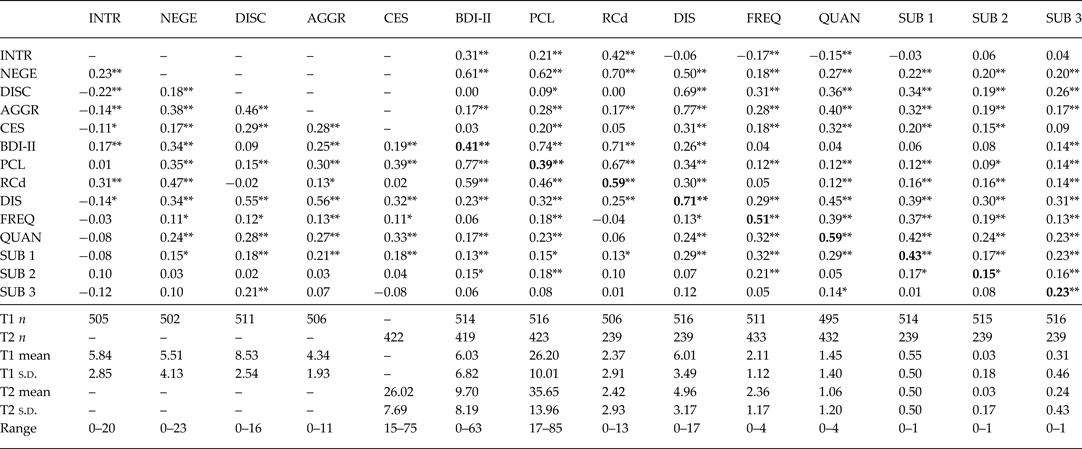
Table 1 presents the means, standard deviations, and correlations for all the variables. Scales measuring internalizing and externalizing symptoms showed evidence of convergent and discriminant validity relative to their respective factors, particularly the scales measuring internalizing (i.e. BDI-II, PCL, and RCd). As hypothesized, NEGE, DISC, and AGGR measured pre-deployment were significantly related to the frequency of combat-related events reported by participants during deployment (r values ranging from 0.17 to 0.29). NEGE and AGGR were significantly related to both internalizing and externalizing measures at pre- and post-deployment. Conversely, INTR showed specificity to internalizing disorders. DISC was specific to externalizing disorders. Finally, combat exposure as measured by the CES showed differential relations with symptoms pre-deployment compared to post-deployment. Pre-deployment symptoms of externalizing and the PCL were significantly related to combat exposure. Post-deployment symptoms of both internalizing and externalizing were significantly related to combat exposure.
Mean scores and correlations for measures of personality, combat exposure, and psychopathology

INTR, PSY-5 Introversion/Low Positive Emotionality; NEGE, PSY-5 Negative Emotionality/Neuroticism; DISC, PSY-5 Disconstraint; AGGR, PSY-5 Aggressiveness; CES, Combat Experiences Scale; BDI-II, Beck Depression Inventory – II; PCL, PTSD Checklist; RCd, Demoralization; DIS, Disinhibition Scale; FREQ, frequency of alcohol use; QUAN, quantity of alcohol use; SUB, Substance Abuse Scale items.
Correlations of pre-deployment personality, combat exposure, and pre-deployment symptoms are above the diagonal. Correlations of pre-deployment personality, combat exposure, and post-deployment symptoms are below the diagonal. Retest correlations are in bold across the diagonal.
*p < 0.05, two-tailed. **p < 0.01, two-tailed.
Structural equation model
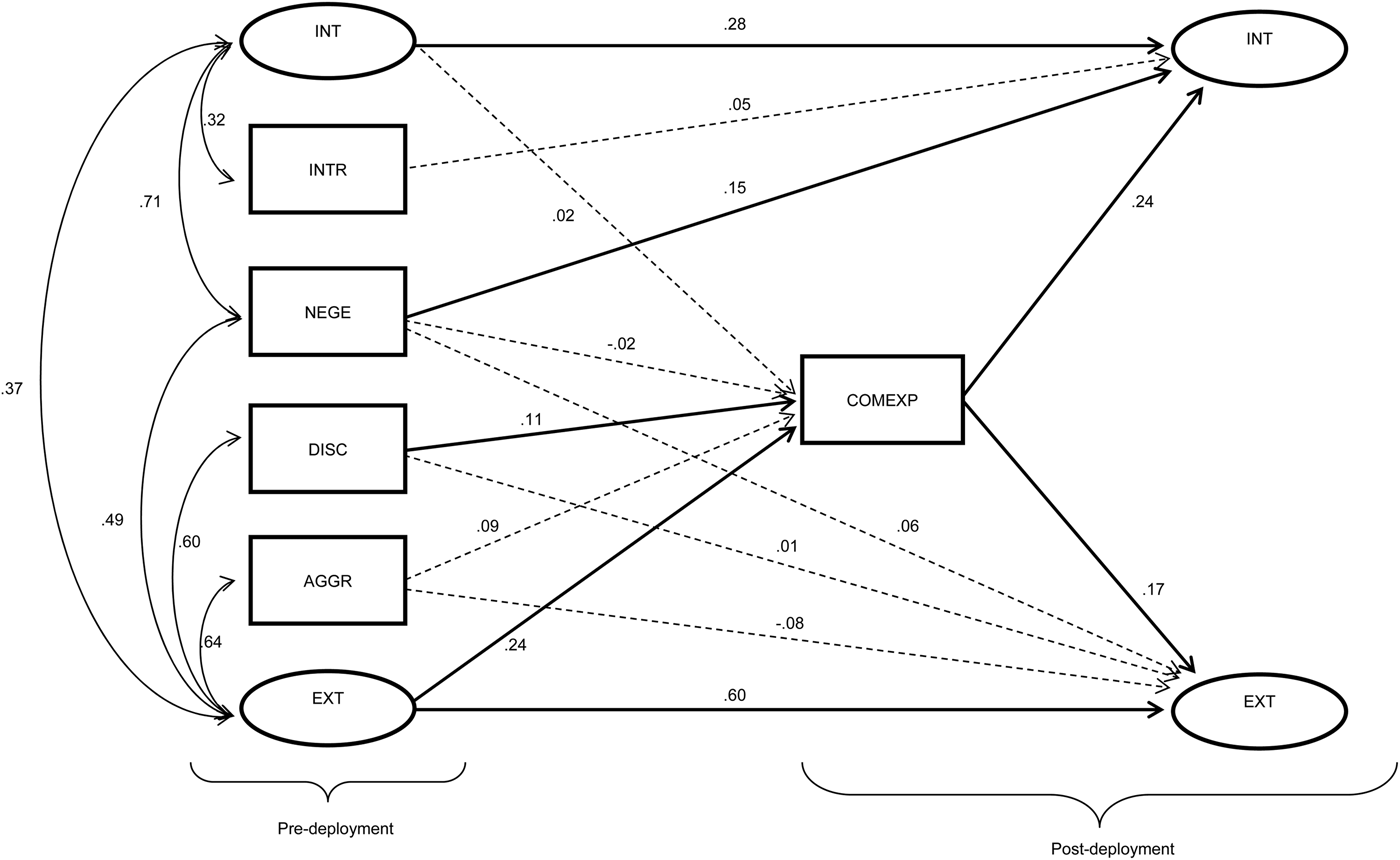
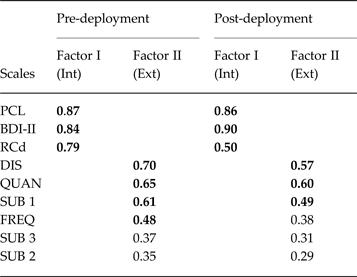
Prior to estimating the structural equation model, we tested whether changes over time in the observed variables were accounted for by mean differences at the level of the latent factors. A formal factorial invariance model with strong invariance constraints (i.e. constrained loadings and intercepts) across pre- and post-deployment time points for the latent internalizing and externalizing factors fit adequately well (CFI = 0.89, SRMR = 0.07, RMSEA = 0.08), indicating that change in the indicators were accounted for by their respective factors. The structural equation model is shown in Fig. 1. Overall, indices suggest an excellent fit (CFI = 0.97, SRMR = 0.02, RMSEA = 0.07). Table 2 presents the factor loadings. All scales loaded >0.40 on the internalizing factor, whereas the Disinhibition scale, quantity of drinking item and a Substance Abuse scale item referencing alcohol use were the strongest markers of externalizing.
Standardized path coefficients in the model generated using structural equation modeling (n = 521). Significant paths and estimates have solid lines, p < 0.05. INT, Internalizing; EXT, Externalizing; INTR, PSY-5 Introversion/Low Positive Emotionality; NEGE, PSY-5 Negative Emotionality/Neuroticism; DISC, PSY-5 Disconstraint; AGGR, PSY-5 Aggressiveness; COMEXP, Deployment Risk and Resilience Inventory Combat Experiences Scale.

Standardized factor loadings for constrained model (n = 518)

Int, Internalizing; Ext, Externalizing; PCL, PTSD Checklist; BDI-II, Beck Depression Inventory – II; RCd, Demoralization; DIS, Disinhibition Scale; QUAN, quantity of alcohol use; SUB, Substance Abuse Scale items; FREQ, frequency of alcohol use.
Factor loadings of ⩾0.40 are highlighted. Unstandardized loadings were constrained to equality but differ across time points owing to standardization.
Fig. 1 shows the standardized parameter estimates for the relationships among the predictors and the latent constructs. As predicted, NEGE and INTR were significantly related to internalizing whereas NEGE, DISC, and AGGR were significantly related to externalizing pre-deployment. DISC significantly predicted combat exposure (regression coefficient 0.11), but NEGE and AGGR did not. Pre-deployment externalizing symptoms significantly predicted combat exposure (regression coefficient of 0.24), but internalizing symptoms did not.
As was hypothesized, combat exposure significantly predicted residualized changes in internalizing and externalizing symptoms, with regression coefficients of 0.24 and 0.17, respectively. We found mixed support for our hypotheses regarding the direct paths from pre-deployment personality to residualized changes in post-deployment symptoms. NEGE significantly predicted internalizing but not externalizing (regression coefficients of 0.15–0.06, respectively). DISC and AGGR did not significantly predict residualized changes in externalizing and INTR did not have a significant path to internalizing as we had hypothesized. The only significant indirect path was from pre-deployment externalizing to post-deployment externalizing via combat exposure (indirect effect = 0.04, p < 0.01)
Discussion
This study utilized a longitudinal prospective design to explore the complex relations between pre-deployment personality, combat experiences, and residualized changes in internalizing and externalizing symptoms following the stressful and potentially traumatic experience of deployment. Several findings are of note. First, both baseline symptoms and personality were unique predictors of combat experiences. The personality trait of DISC (akin to low conscientiousness in the Big Five model) was a significant predictor of the frequency of exposure to combat-related events, which in turn predicted increases in both internalizing and externalizing symptoms post-deployment. Although this indirect path did not reach statistical significance, the model suggests that participants with high levels of this trait are more likely to be exposed to potentially traumatic events which, in turn, increases risk for symptom elevations post-deployment. It is important to note that the relation between genetically determined traits and environment may be the end result of multiple paths. For example, disinhibited participants may be more likely to seek out duties and take an active role in missions that involve combat. It is also possible that these participants would be more likely to place themselves in situations that resulted in combat exposure (e.g. firing weapons at the enemy, being wounded or injured in combat). Finally, these participants may be more likely to be selected for missions that involve combat based on their personalities. A more robust indirect pathway was from pre-deployment externalizing to post-deployment externalizing via combat exposure (indirect effect = 0.04, p < 0.01). A number of mechanisms have been suggested by which premorbid externalizing symptoms contribute to adverse events, including a reduced threshold for anticipating danger, less risk avoidance, and less forethought (King et al. Reference King, King, Foy and Gudanowski1996; Park et al. Reference Park, Frazier, Tennen, Mills and Tomich2013).
A second finding was that the personality trait of NEGE (similar to neuroticism) had a direct relation with internalizing, but did not predict combat exposure. It is well established in the literature that this trait is a common risk factor for psychopathology (Rubin et al. Reference Rubin, Berntsen and Bohni2008). However, contrary to some previous findings, a high level of general distress was not predictive of combat-related events. Pre-deployment internalizing symptoms significantly predicted post-deployment internalizing, suggesting that both premorbid traits and symptoms contribute unique variance to post-deployment internalizing.
Finally, many of our predictions regarding direct paths from pre-deployment personality traits to post-deployment symptoms were not borne out. For example, DISC and AGGR were not significant direct predictors of externalizing post-deployment, although they did show significant correlations pre-deployment. Similarly, NEGE was significantly correlated with both internalizing and externalizing pre-deployment, but only predicted internalizing post-deployment. INTR was related to internalizing pre-deployment, but did not predict this factor post-deployment. These findings are in agreement with recent longitudinal work failing to find direct pathways from personality traits to symptoms when controlling for adverse events (Sadeh et al. Reference Sadeh, Miller, Wolf and Harkness2015). It is likely that controlling for baseline symptom levels limited the amount of unique variance remaining in post-deployment symptoms, allowing only the strongest pathways to emerge. The power of the study to find significant direct paths from personality to symptom elevations may have been further hampered by truncated scales.
It is interesting to note that externalizing showed a higher degree of symptom stability pre- to post-deployment (regression pathway = 0.60) compared to internalizing (0.28), suggesting that these symptoms display more trait-like tendencies than internalizing symptoms. This may also have contributed to our inability to find significant direct paths from pre-deployment personality to residualized changes in post-deployment externalizing. Personality traits may also influence symptom presentation, resulting in stronger correlations when traits and symptoms are measured concurrently rather than sequentially. Further work is needed with models that include personality and symptom measures at both pre-deployment and post-deployment (M. D. Kramer et al. unpublished data).
Overall, these findings have important diagnostic implications, particularly for PTSD. This study shows that exposure to potentially traumatic events has significant paths to internalizing and to a lesser extent, externalizing symptoms. This finding is supported by a large body of literature demonstrating a range of post-trauma reactions that go beyond PTSD to include depression, anxiety disorders, and substance use disorders (Prigerson et al. Reference Prigerson, Maciejewski and Rosenheck2002; Miller, Reference Miller2003; Miller et al. Reference Miller, Greif and Smith2003; Dedert et al. Reference Dedert, Green, Calhoun, Yoash-Gantz, Taber, Mumford, Tupler, Morey, Marx, Weiner and Beckham2009; Kehle et al. Reference Kehle, Reddy, Ferrier-Auerbach, Erbes, Arbisi and Polusny2011b ). The current criteria for PTSD has been expanded to reflect this post-trauma symptom heterogeneity, including disconstrained symptoms of aggression and reckless/self-destructive behavior, as well as additional internalizing symptoms of negative cognitions and mood. The extent to which this expansion blurs the boundaries between PTSD and other disorders needs to be carefully considered, with a focus on identifying unique PTSD symptom clusters that will enhance differential diagnosis. As a related point, externalizing symptoms showed more stability in this study post-deployment compared to internalizing symptoms, suggesting that these symptoms may have limited utility within the current diagnostic construct of PTSD, in which symptoms emerge following a trauma. Taken together, the robust pre- to post-deployment stability of externalizing symptoms and the significant pathways from pre-deployment externalizing symptoms to both combat exposure and subsequent externalizing suggests caution in attributing the emergence of substance use and antisocial behavior problems to trauma per se.
The findings reported in this study are consistent with the work being conducted by Miller and colleagues (Miller, Reference Miller2003; Miller et al. Reference Miller, Greif and Smith2003, Reference Miller, Wolf, Reardon, Greene, Ofrat and McInerney2012; Forbes et al. Reference Forbes, Elhai, Miller and Creamer2010; Campbell et al. Reference Campbell, Renshaw and Righter2015), suggesting that inherent personality traits may influence how symptoms are expressed and which symptoms are elevated following a trauma. This work has led to the suggestion that classification schemes include subtypes of PTSD based on internalizing/externalizing symptoms (Thomas et al. Reference Thomas, Hopwood, Donnellan, Wright, Sanislow, McDevitt-Murphy, Ansell, Grilo, McGlashan, Shea, Markowitz, Skodol, Zanarini and Morey2014). An alternative would be the use of continuous measures of personality traits as predictors of symptom profiles (i.e. levels of internalizing and externalizing symptoms) to enhance reliability and comprehensiveness (Watson et al. Reference Watson, Gamez and Simms2005; Widiger & Samuel, Reference Widiger and Samuel2005; Watson, Reference Watson2009; Markon et al. Reference Markon, Chmielewski and Miller2011). More work is clearly needed to determine if a unique set of symptoms develops or worsens post-trauma to better differentiate PTSD from other disorders, while limiting the inclusion of symptoms that are more indicative of non-specific, general distress in the diagnostic criteria (Erbes et al. Reference Erbes, Polusny, Arbisi and Koffel2012; Koffel et al. Reference Koffel, Polusny, Arbisi and Erbes2012).
This study also has important treatment implications given that pre-deployment symptoms uniquely predicted exposure to potentially traumatic events and post-deployment symptom levels after controlling for baseline temperament. Pre-deployment mental health needs to be considered as a significant factor when predicting post-deployment mental health outcomes. Recent work has shown that a third of post-deployment suicide attempts are predicted by pre-deployment symptoms, including PTSD (Nock et al. Reference Nock, Stein, Heeringa, Ursano, Colpe, Fullerton, Hwang, Naifeh, Sampson, Schoenbaum, Zaslavsky and Kessler2014). Together these findings suggest that targeted early interventions prior to deployment may have a broadband effect on mental well-being during and following deployment.
It will be important for future studies to replicate our model, particularly in civilian populations, using more comprehensive measures of personality traits, traumatic events, and internalizing/externalizing symptoms. In particular, additional work is needed to examine the overlap of personality and adverse events with lower order symptom dimensions. While the current study focused on the role of personality and combat-related trauma exposure in the prediction of change in broad symptom dimensions, additional studies are also necessary to determine whether traumatic events may effect such changes via alterations in basic personality traits (M. D. Kramer et al. unpublished data). In addition, this study did not model the effect of prior deployments and prior combat exposure on baseline personality and symptoms. With redeployments becoming increasingly common, it will be important to obtain a history of trauma exposure so as to accurately model the interactions of environment, traits, and symptoms over time.
Finally, the data in this study was based on self-report obtained from questionnaire measures. Al-though we attempted to select an objective measure of potentially traumatic events (e.g. frequency of combat-related experiences), it is possible that the report of combat experiences was influenced by personality traits. It is, however, noteworthy that NEGE did not predict combat experiences, suggesting that the tendency to experience distress does not lead to an elevated report of combat experiences. It remains possible that other traits (e.g. DISC) could impact self-reports of combat experiences. Ideally, future studies would control for this bias by including objective measures of traumatic events and obtaining trauma histories from multiple sources.
In general, research in the area of personality, life events, and psychopathology tends to be compartmentalized. It is our hope that future studies will begin to integrate these areas of research and use prospective designs to untangle the influences of heritable traits, baseline symptoms, and environmental events on future psychopathology. Greater understanding of these complex relationships will ultimately lead to important gains in the diagnosis, prevention, and treatment of disorders.
Acknowledgements
This work was supported by the Minnesota Medical Foundation (M.A.P., grant number 3662–9227-06), the Department of Defense Congressionally Directed Medical Research Program (M.A.P., grant number W81XWH-07-2-0033), the Department of Veterans Affairs Health Services Research and Development (C.R.E., grant number RRP 08-385), and the University of Minnesota Press (P.A.A.). This material is the result of work supported with resources and the use of facilities at the Minneapolis VA Health Care System, Minneapolis, MN. The views expressed in this article are those of the authors and do not reflect the official policy or position of the Department of Veterans Affairs.
Declaration of Interest
None.